
Saudi Arabia Plastic Furniture Market Size, Share, Trends and Forecast by Type, Distribution Channel, End User, and Region, 2026-2034
Saudi Arabia Plastic Furniture Market Size, Share, Trends & Forecast (2026-2034)
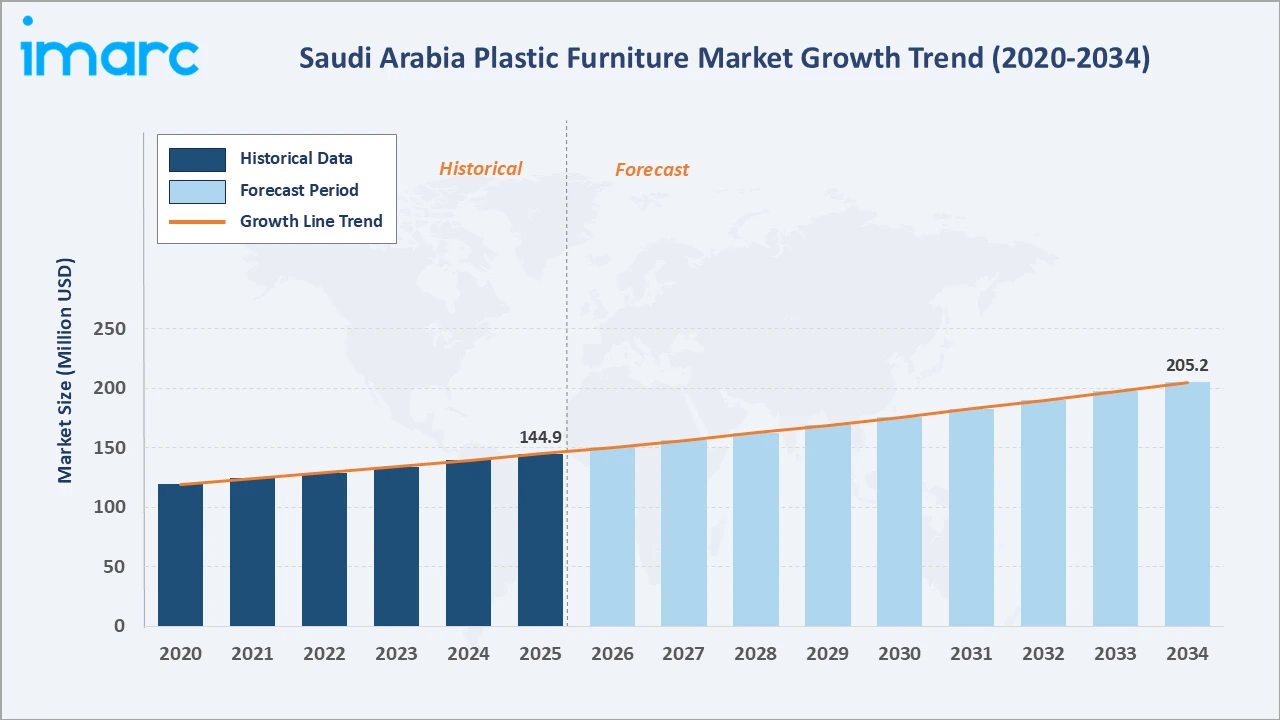
The Saudi Arabia plastic furniture market grew from USD 144.9 Million in 2025 to USD 150.6 Million in 2026 and is projected to reach USD 205.2 Million by 2034, growing at a CAGR of 3.94% during 2026-2034. The residential sector delivered 27,500 units in Riyadh and Jeddah in 2024, taking total housing stock to 1.46 million and 891,000 units, sustaining robust baseline demand for affordable plastic furniture across newly established urban households. Outdoor furniture leads at 30.0% by type, specialty stores command 38.0% of distribution, and the Northern and Central region holds the largest regional share at 42.0% in 2025.
Market Snapshot
| Metric | Value |
|---|---|
| Base Year Market Size (2025) | USD 144.9 Million |
| Market Size (2026) | USD 150.6 Million |
| Forecast Market Size (2034) | USD 205.2 Million |
| CAGR (2026-2034) | 3.94% |
| Base Year | 2025 |
| Historical Period | 2020-2025 |
| Forecast Period | 2026-2034 |
| Dominant Type | Outdoor Furniture (30.0%, 2025) |
| Dominant Distribution Channel | Specialty Stores (38.0%, 2025) |
| Leading Region | Northern and Central Region (42.0%, 2025) |
The Saudi Arabia plastic furniture market grew from USD 119.5 Million in 2020 to USD 144.9 Million in 2025, and further to USD 150.6 Million in 2026, reflecting consistent demand from residential construction and hospitality sector expansion. The market is projected to reach USD 175.8 Million by 2030 before achieving USD 205.2 Million by 2034.
To get more information on this market, Request Sample
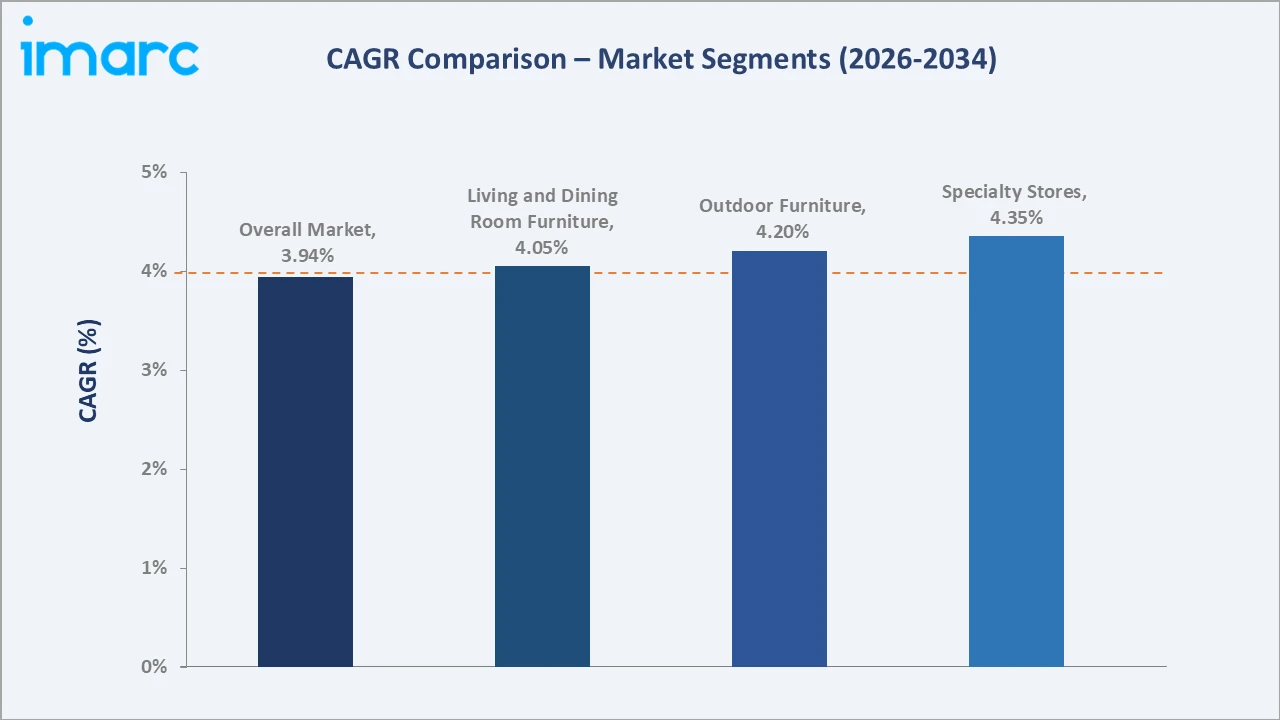
Specialty stores are projected to grow at a CAGR of approximately 4.35% through 2034, driven by growing preference for expert-guided purchasing. Outdoor furniture expands at 4.20% CAGR, supported by Vision 2030 outdoor lifestyle investments. Living and dining room furniture grows at approximately 4.05% CAGR, underpinned by strong urban household formation.
Executive Summary
The Saudi Arabia plastic furniture market is on a steady growth trajectory, underpinned by a rapidly urbanizing population, sustained residential construction activity, and large-scale commercial and hospitality infrastructure development under Saudi Vision 2030. Vision 2030 mega-projects are generating substantial institutional procurement demand for durable plastic furniture across hotels, resorts, and public recreational spaces.
Outdoor furniture captures the leading 30.0% type share in 2025, reflecting strong demand for weather-resistant solutions across residential gardens, hospitality venues, and public spaces. Specialty stores command 38.0% of distribution, retaining market leadership through curated product ranges and expert service. The Northern and Central region leads regionally at 42.0%, driven by Riyadh’s dense urban construction activity and high household purchasing power across the metropolitan area.
Key Market Insights
| Insight | Data |
|---|---|
| Dominant Type | Outdoor Furniture – 30.0% share (2025) |
| Leading Distribution Channel | Specialty Stores – 38.0% share (2025) |
| Leading Region | Northern and Central Region – 42.0% (2025) |
| Key Market Opportunity | Vision 2030 mega-project procurement and growing demand for sustainable, recycled-plastic furniture create significant avenues for sustained market value growth through 2034. |
Key Analytical Observations Supporting the Above Data:
- Outdoor Furniture at 30.0%: Outdoor furniture leads because Saudi Arabia’s expanding recreational spaces, resort developments, and residential outdoor areas generate consistent demand for durable, UV-resistant plastic seating and table sets that perform well in the Kingdom’s high-temperature climate.
- Specialty Stores at 38.0%: Specialty stores maintain channel leadership through curated selections, expert guidance, broader product variety, and after-sales service that appeal to both residential and commercial buyers seeking quality and customization.
- Northern and Central Region at 42.0%: The Northern and Central region’s dominant market position reflects Riyadh’s status as Saudi Arabia’s most populous metropolitan center, where large-scale residential construction, commercial real estate, and hospitality projects generate consistently high plastic furniture demand.
Saudi Arabia Plastic Furniture Market Overview
The Saudi Arabia plastic furniture market encompasses the manufacturing, distribution, and retail of furniture products made from plastic polymers including polypropylene, polyethylene, and ABS. These products serve residential, commercial, hospitality, and institutional end markets across the Kingdom. The ecosystem spans polymer raw material suppliers, furniture manufacturers, domestic and import distributors, specialty and mass-market retailers, and end consumers. Vision 2030 investments in tourism, hospitality, and urban development are reshaping demand patterns and expanding the addressable market across all product segments and regional markets.
Market Dynamics
To evaluate market opportunities, Request Sample
Market Drivers
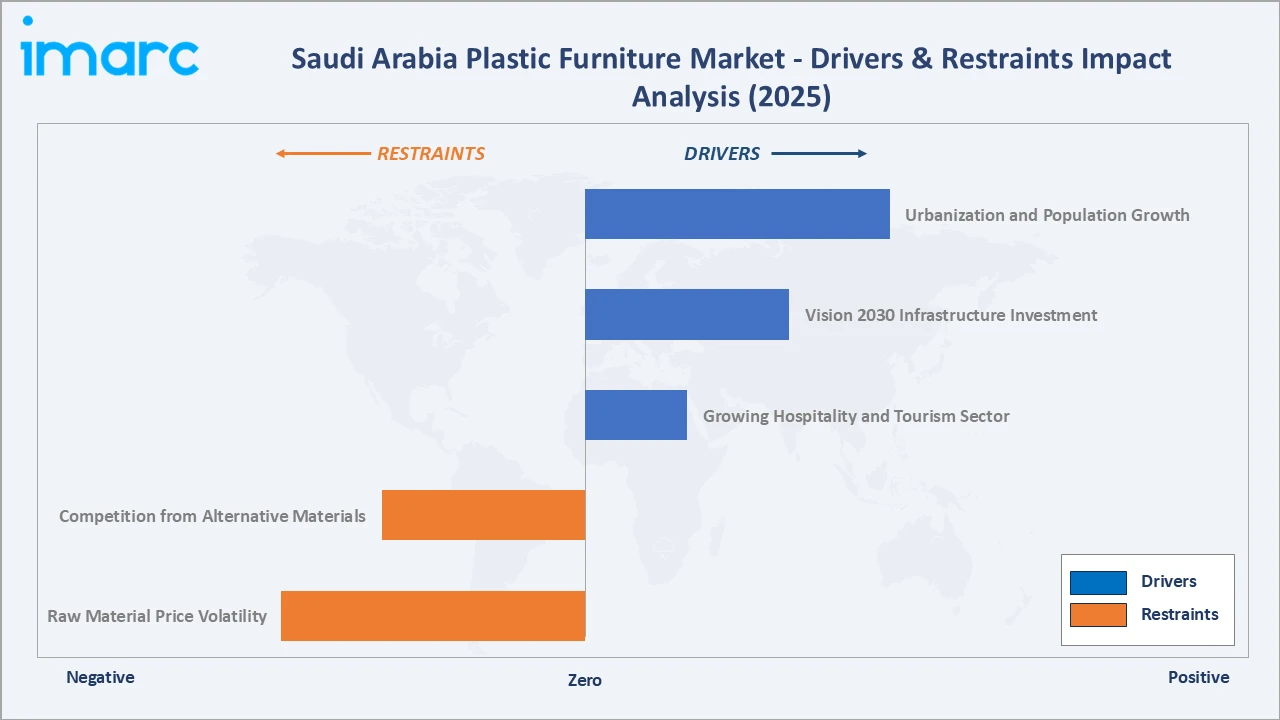
- Urbanization and Population Growth: Saudi Arabia’s urban population surpassed 84% in 2025, with continued migration to Riyadh, Jeddah, and other cities driving new household formation. Rising household numbers create consistent baseline demand for affordable residential furnishing solutions across all plastic furniture categories.
- Vision 2030 Infrastructure Investment: Vision 2030 mega-projects including NEOM, the Red Sea Project, and Qiddiya require substantial procurement of durable outdoor and indoor plastic furniture for hotels, resorts, and public recreational facilities, generating institutional demand that extends through the forecast period.
- Growing Hospitality and Tourism Sector: Saudi Arabia recorded 123 million tourists in 2025, comprising 29.3 million international visitors and 93.3 million domestic travelers. Saudi Arabia’s hospitality sector is expanding to meet Vision 2030 tourism targets, with significant hotel and resort capacity additions planned. Hotels, restaurants, and entertainment venues require large volumes of durable plastic furniture for indoor and outdoor settings throughout the forecast period.
Market Restraints
- Raw Material Price Volatility: Fluctuations in petrochemical feedstock prices, particularly polypropylene and polyethylene resins, affect manufacturer cost structures and compress margins. Rising energy and logistics costs add further pressure on production economics, limiting the ability to maintain stable pricing.
- Competition from Alternative Materials: Wood, rattan, and metal furniture continue to compete for market share, particularly in higher-income residential and premium hospitality segments where material aesthetics and perceived quality influence purchasing decisions over cost considerations.
Market Opportunities
- Sustainable and Recycled Plastic Furniture: Growing environmental awareness is creating demand for plastic furniture made from recycled materials or designed for end-of-life recyclability. This premium segment aligns with Vision 2030 sustainability objectives and offers superior margins for manufacturers that invest in eco-certified product development.
- E-commerce Channel Expansion: The rapid growth of digital retail platforms is opening new distribution pathways for manufacturers and importers, reducing physical retail overhead, improving geographic market reach, and enabling more competitive pricing across underserved regional markets.
Market Challenges
- Quality Perception Among Premium Buyers: Plastic furniture carries a perception disadvantage relative to natural materials in premium segments. Manufacturers must invest in design innovation, premium material formulations, and quality communication to shift preferences toward higher-value plastic product categories.
- Import Competition and Market Fragmentation: Saudi Arabia’s market faces significant import competition from low-cost manufacturers primarily from Asia, which compete aggressively on price and product variety, limiting domestic manufacturer margins and complicating long-term market share growth strategies.
Emerging Market Trends
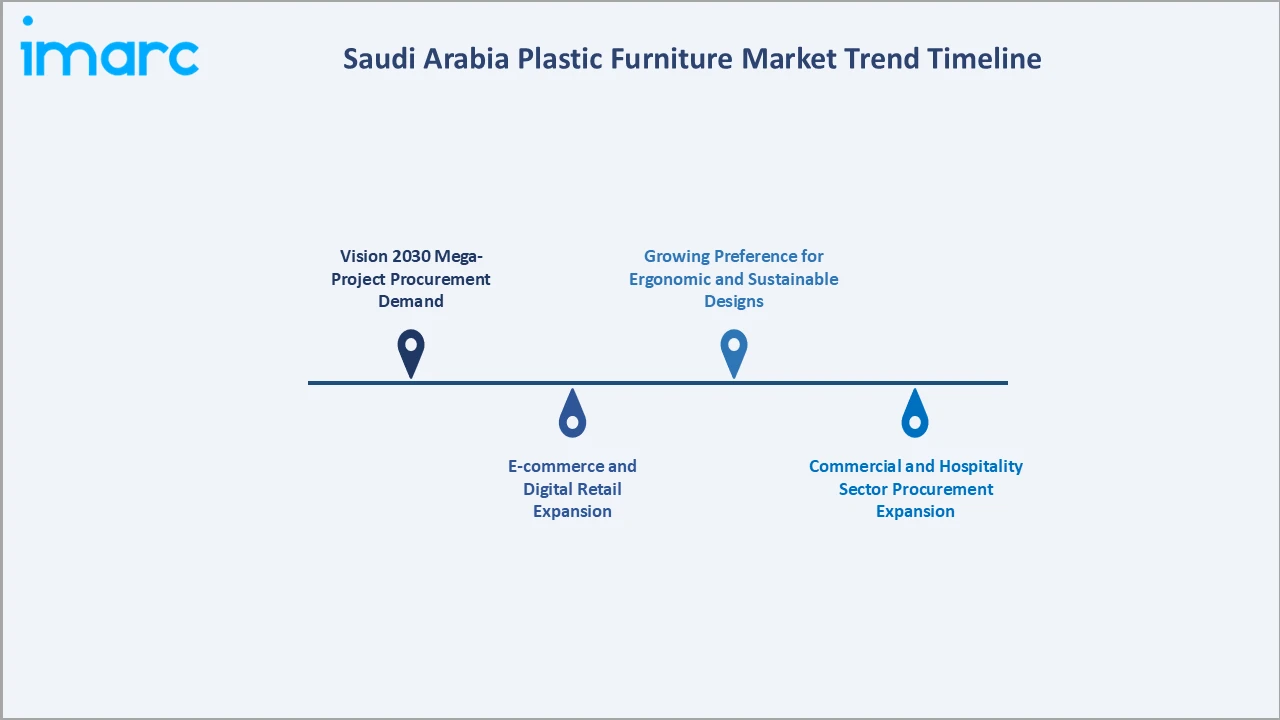
1. Vision 2030 Mega-Project Procurement Demand
Saudi Vision 2030 is generating unprecedented large-scale procurement demand for plastic furniture across its portfolio of tourism destinations, urban development projects, and entertainment facilities. The scale of hotel, resort, and public space construction under Vision 2030 creates sustained volume demand for durable, cost-effective plastic furniture. This trend is expected to intensify through 2030 as major projects reach completion, and operational procurement cycles begin.
2. E-commerce and Digital Retail Expansion
Online furniture retail is growing rapidly as Saudi consumers increasingly adopt digital platforms for home furnishing purchases. Major e-commerce platforms are expanding furniture categories, improving delivery logistics, and offering competitive pricing that appeals to cost-conscious buyers.
3. Growing Preference for Ergonomic and Sustainable Designs
Saudi consumers and commercial buyers are increasingly prioritizing ergonomic design, modern aesthetics, and sustainability credentials in plastic furniture selection. Manufacturers are responding with UV-resistant formulations and eco-friendly material certifications that command premium pricing. This trend is shifting market value toward differentiated, higher-quality products rather than commodity price competition.
4. Commercial and Hospitality Sector Procurement Expansion
In H1 2026, tourism hospitality facilities in Saudi Arabia recorded an overall occupancy rate of 54.8% across hotels, apartments, and other accommodations. The expansion of Saudi Arabia’s hospitality, food service, and entertainment sectors is driving substantial procurement volumes for durable plastic furniture suitable for high-traffic commercial environments. Hotels, restaurant chains, and leisure facilities prioritize cost efficiency, ease of maintenance, and design cohesion in large-volume institutional orders, creating steady demand that supports volume growth through 2034.
Industry Value Chain Analysis
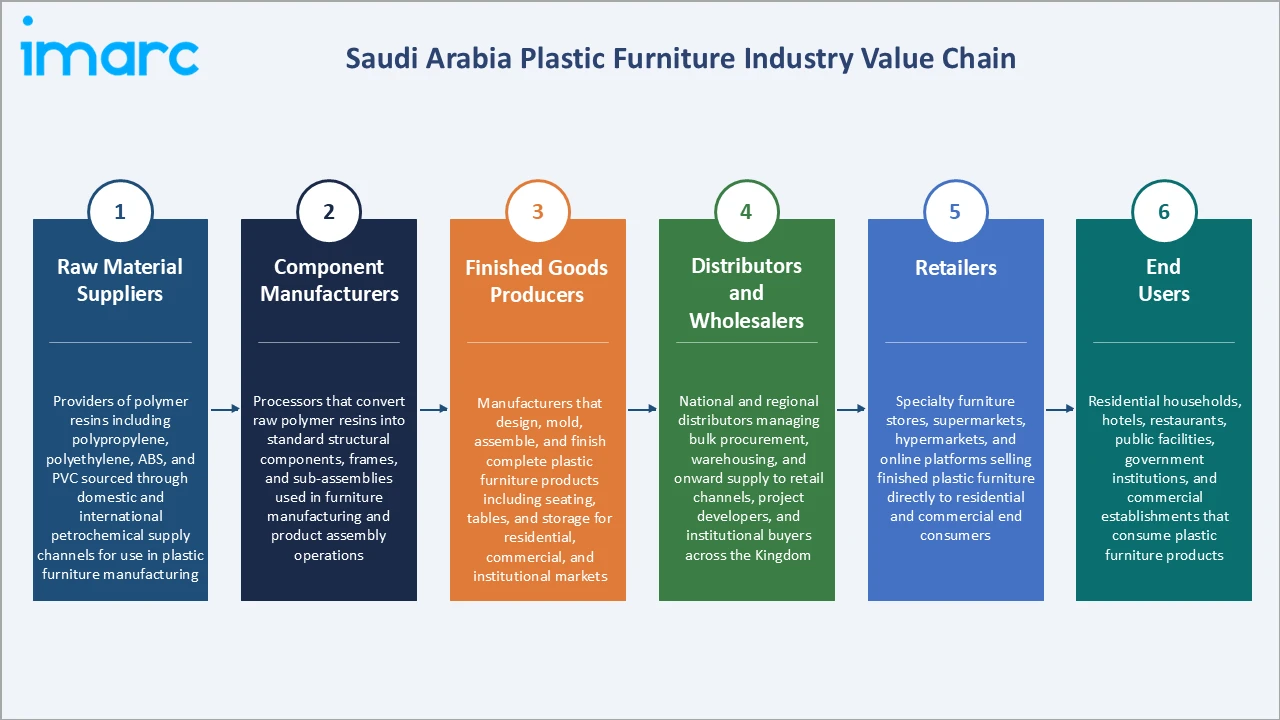
The Saudi Arabia plastic furniture value chain is structured across six integrated stages from petrochemical raw material supply through end-user consumption. Each stage adds value through material processing, component manufacturing, product design, and distribution, with the greatest value addition concentrated at the finished goods manufacturing stage, where design quality, material innovation, and production scale create durable competitive advantages.
| Stage | Description |
|---|---|
| Raw Material Suppliers | Providers of polymer resins including polypropylene, polyethylene, ABS, and PVC sourced through domestic and international petrochemical supply channels for use in plastic furniture manufacturing. |
| Component Manufacturers | Processors that convert raw polymer resins into standard structural components, frames, and sub-assemblies used in furniture manufacturing and product assembly operations. |
| Finished Goods Producers | Manufacturers that design, mold, assemble, and finish complete plastic furniture products including seating, tables, and storage for residential, commercial, and institutional markets. |
| Distributors and Wholesalers | National and regional distributors managing bulk procurement, warehousing, and onward supply to retail channels, project developers, and institutional buyers across the Kingdom. |
| Retailers | Specialty furniture stores, supermarkets, hypermarkets, and online platforms selling finished plastic furniture directly to residential and commercial end consumers. |
| End Users | Residential households, hotels, restaurants, public facilities, government institutions, and commercial establishments that consume plastic furniture products. |
The finished goods manufacturing stage holds the highest strategic value in this chain. Quality formulations, UV-resistant designs, and innovative aesthetics differentiate products and command premium pricing. The retail stage is evolving significantly through rapid e-commerce growth, reducing geographic barriers and broadening market reach for manufacturers and importers across Saudi Arabia.
Technology Landscape in the Saudi Arabia Plastic Furniture Industry
Advanced Polymer Formulations
Modern manufacturers are investing in advanced polymer formulations that enhance UV resistance, color stability, and structural durability. High-density polypropylene and engineered ABS compounds extend product lifecycle and reduce maintenance requirements. These formulations are especially important for outdoor furniture exposed to Saudi Arabia’s high-temperature, high-UV environment.
Injection Molding and Production Automation
High-precision injection molding technology and automated production systems are enabling manufacturers to improve output consistency, reduce material waste, and lower per-unit costs. Computer-controlled mold systems support rapid product design iteration and large-volume manufacturing that meets the procurement requirements of major hospitality and development projects.
Sustainable and Recycled Material Technologies
Growing adoption of recycled PET and recycled polypropylene in furniture production enables manufacturers to reduce raw material costs and address sustainability preferences of environmentally conscious buyers. Recycled plastic furniture is gaining traction in commercial segments where sustainability reporting requirements drive material specification decisions.
Digital Design and Product Customization
Computer-aided design (CAD) tools and 3D prototyping technologies are accelerating product development cycles and enabling greater design customization for commercial clients. Digital visualization tools allow buyers to preview furniture configurations before purchase, reducing return rates and improving the efficiency of commercial project specification and procurement processes.
Market Segmentation Analysis
The report covers the following segments:
| Segment Category | Leading Segment | Market Share | Year |
|---|---|---|---|
| Type | Outdoor Furniture | 30.0% | 2025 |
| Distribution Channel | Specialty Stores | 38.0% | 2025 |
| End User | 🔒 | 🔒 | 2025 |
| Region | Northern and Central Region | 42.0% | 2025 |

By Type
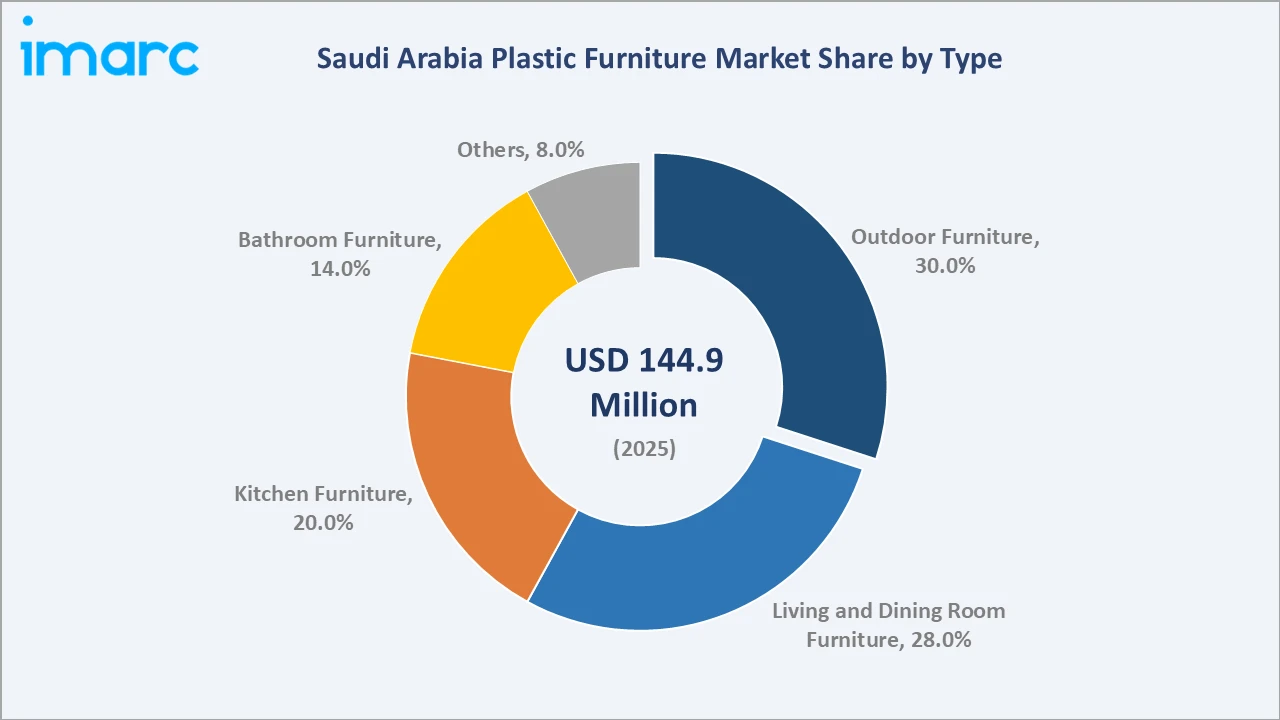
Outdoor furniture leads at 30.0% in 2025, reflecting strong demand for weather-resistant seating, tables, and storage for residential gardens, hospitality venues, and Vision 2030 outdoor recreational facilities. Living and dining room furniture holds a 28.0% share, supported by consistently active urban household demand from Riyadh and Jeddah’s growing residential base.
To access detailed market analysis, Request Sample
Kitchen furniture represents 20.0%, driven by apartment construction activity and compact urban household demand. Bathroom furniture accounts for 14.0%, serving residential renovation and new construction markets. Others, including specialty and niche product categories, account for the remaining 8.0%.
By Distribution Channel
Specialty stores command 38.0% of the market in 2025, retaining distribution leadership through curated product selections, in-store expert guidance, and after-sales service that appeal to design-conscious residential and commercial buyers. Supermarkets and hypermarkets hold a 30.0% share, serving cost-conscious shoppers seeking convenient one-stop furniture purchasing.
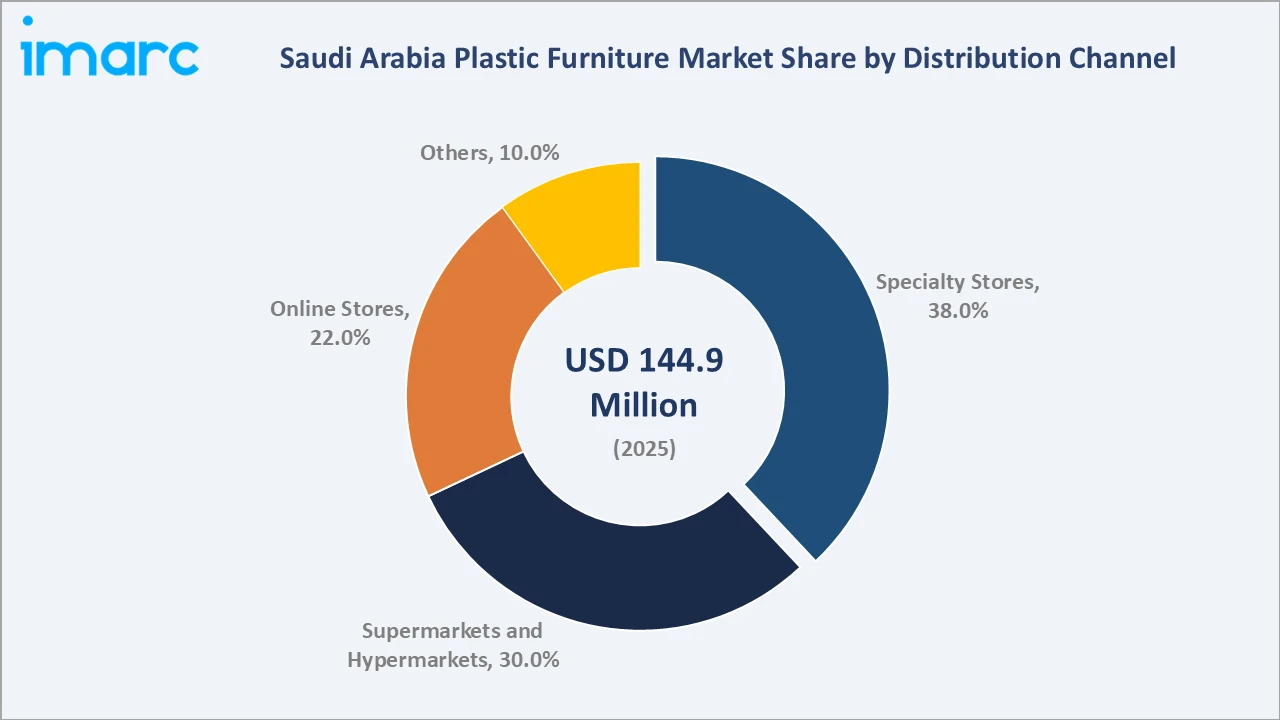
Online stores at 22.0% represent the fastest-growing channel, driven by improving e-commerce platform capabilities, broader product availability, and increasing consumer comfort with digital furniture purchasing. Other channels, including direct project supply and institutional procurement, account for 10.0%.
Regional Market Insights
| Region | Share (2025) | Key Saudi Arabia Plastic Furniture Market Drivers & Characteristics |
|---|---|---|
| Northern and Central Region | 42.0% | Anchored by Riyadh’s dense residential and commercial construction activity, large hospitality and retail development, and high household purchasing power across the broader metropolitan area. |
| Western Region | 28.0% | Driven by Jeddah’s growing residential population, significant Red Sea tourism infrastructure investments, and active retail and commercial hospitality sector development along the western coast. |
| Eastern Region | 20.0% | Supported by industrial and residential demand, growing commercial development, and expanding leisure and hospitality facilities serving the eastern province’s working population. |
| Southern Region | 10.0% | Reflecting an emerging demand base from residential construction growth and improving retail infrastructure serving smaller urban centers in the southern provinces. |
The Northern and Central region leads at 42.0% because Riyadh’s concentrated urban population, rapid residential construction pipeline, and concentration of commercial and hospitality real estate projects generate consistently high plastic furniture demand across all segments. The Western region at 28.0% benefits from Jeddah’s strong retail and tourism economy and Vision 2030’s Red Sea mega-project, which is creating large-scale institutional procurement demand for outdoor and hospitality-grade plastic furniture.
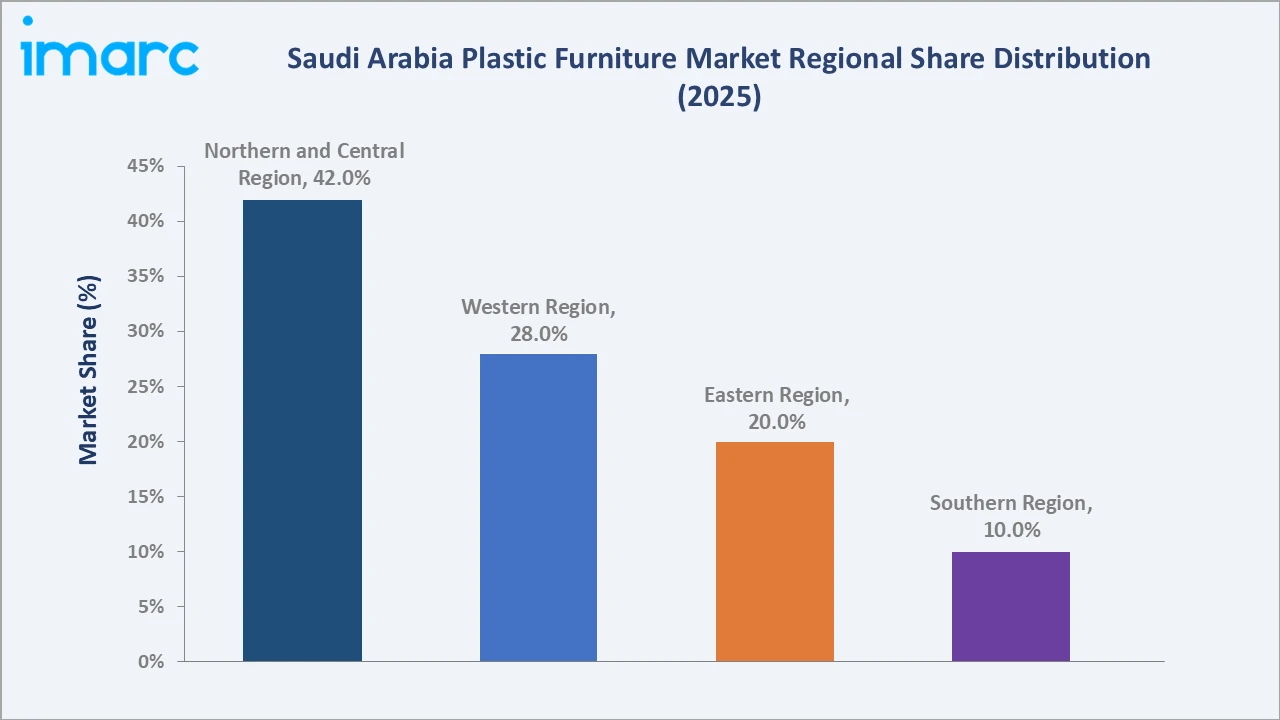
The Eastern region at 20.0% is supported by industrial development and growing residential construction, where household income levels sustain active furniture market participation. The Southern region at 10.0% represents an emerging opportunity as infrastructure development and retail expansion improve market access across underserved southern provinces, gradually growing the addressable consumer base through 2034.
Competitive Landscape
The Saudi Arabia plastic furniture market features a mix of international retail brands, domestic manufacturers, and import-led distributors serving residential and commercial demand. The market is moderately fragmented, with international retail chains leading by brand recognition while domestic manufacturers compete through price competitiveness and local supply chain responsiveness.
| Company | Key Offerings | Market Position | Core Strength |
|---|---|---|---|
| Inter IKEA Systems B.V. | Bar stools & chairs, Bar tables | Market Leader | Inter IKEA Systems B.V. acts as the franchisor for the IKEA brand, heavily shaping the market strategy, sustainability protocols, and product development guidelines for plastic furniture distributed in Saudi Arabia. |
| Danube Home | Plastic Dining Chairs and Tables | Market Leader | Danube Home offers a selection of durable, weather-resistant plastic and polyresin outdoor/indoor seating solutions. |
| Landmark Group | Indoor and Outdoor Plastic Chairs | Established Player | The Landmark Group role is anchored in retail distribution and lifestyle furnishing through mainstream brands like Home Centre. |
| Harwal Group of Companies | Cedarattan Sofa Sets, Chairs, Tables, Stools | Established Player | The Harwal Group plays a major role in the plastic and furniture manufacturing sectors across the Middle East, including Saudi Arabia (KSA), primarily through its key subsidiary Cosmoplast. |
| Al-Abras Plastic Company | Chairs, Bathtubs, Tables | Challenger | Al-Abras Plastic Company plays a localized manufacturing and wholesale-retail role in Saudi Arabia's plastic household and furniture market. |
Competition is intensifying as international retailers continue expanding their physical and digital footprints, while domestic manufacturers seek to differentiate through local customization, faster delivery responsiveness, and institutional project supply capabilities.
Key Company Profiles
Inter IKEA Systems B.V.
Inter IKEA Systems B.V., through the IKEA brand, is a leading furniture retailer in the Kingdom, offering a broad range of affordable, well-designed furniture products, including plastic and composite material indoor and outdoor collections. The company serves residential consumers, commercial buyers, and institutional clients through its physical retail network and growing digital commerce platform. It has established a strong brand presence by consistently providing accessible, design-driven furniture solutions across a wide range of price points and product categories.
- Key Offerings: Bar stools & chairs, Bar tables.
- Strategic Focus: Expanding digital retail infrastructure and improving last-mile delivery while maintaining affordable pricing across all furniture categories. The company emphasizes sustainable product design and packaging reduction as part of broader corporate environmental commitments.
Danube Home
Danube Home is an established furniture and home décor retailer with a broad presence across Saudi Arabia and the wider GCC region, offering competitive product ranges across indoor and outdoor plastic furniture categories. The company serves a diverse customer base of residential consumers and small commercial buyers through an extensive network of large-format retail stores and digital channels. Its consistent pricing strategy and wide product range have established it as a preferred destination for furniture purchasing across Saudi Arabia’s major metropolitan markets.
- Key Offerings: Plastic Dining Chairs and Tables.
- Strategic Focus: Strengthening its multichannel retail presence through store network expansion and digital platform enhancement while maintaining competitive pricing and broadening its furniture product range to serve evolving consumer preferences.
Market Concentration Analysis
The Saudi Arabia plastic furniture market exhibits moderate fragmentation across the broader competitive landscape, with market share distributed among international retail brands, domestic manufacturers, and import distributors operating at varying scales. No single player commands a dominant consolidated share, and competitive dynamics are characterized by coexistence between large international retailers with established brand equity and smaller domestic manufacturers competing on price and local supply responsiveness.
Market concentration is highest in the specialty retail distribution channel, where a small number of large-format retailers account for a significant proportion of consumer-facing furniture sales. The manufacturing segment remains more fragmented, with numerous domestic and regional producers serving both retail and institutional channels. This fragmentation creates ongoing opportunities for consolidation, digital-channel disruption, and product differentiation strategies targeting specific consumer segments or project procurement categories.
Investment & Growth Opportunities
Highest Growth Segments
Outdoor furniture at 30.0% represents the largest and most dynamically growing segment, sustained by Vision 2030 outdoor lifestyle investments and growing residential garden and hospitality venue demand. Online distribution at 22.0% offers the highest channel growth potential as e-commerce penetration in furniture retail accelerates through 2034.
Investment Themes
- Hospitality and Tourism Procurement: Saudi Arabia’s hospitality expansion under Vision 2030, targeting 150 million domestic and international tourists by 2030, creates large-scale sustained demand for outdoor and indoor plastic furniture across hotels, resorts, and entertainment facilities that require periodic replacement and large initial procurement volumes.
- Digital Retail Platform Investment: Growing digital adoption among Saudi consumers presents a significant opportunity for investment in e-commerce furniture platforms, improved logistics infrastructure, and digital visualization tools that reduce purchase friction and increase online furniture conversion rates, particularly for standardized plastic furniture categories.
Future Market Outlook (2026-2034)
The Saudi Arabia plastic furniture market grew from USD 144.9 Million in 2025 to USD 150.6 Million in 2026 and is projected to reach USD 205.2 Million by 2034, exhibiting a CAGR of 3.94% during 2026-2034. The market is expected to reach an intermediate milestone of USD 175.8 Million by 2030, as Vision 2030 tourism and hospitality construction projects reach peak procurement activity and urban residential construction continues across all major regions.
Three structural forces will define the Saudi Arabia plastic furniture market through 2034. First, Vision 2030’s sustained infrastructure investment program will provide a durable institutional demand foundation supporting consistent volume growth across outdoor and commercial furniture segments. Second, Saudi Arabia’s demographic urbanization trajectory will sustain residential demand across all furniture categories, particularly outdoor, living room, and kitchen furniture, as new urban households form in Riyadh, Jeddah, and secondary cities. Third, progressive adoption of digital retail, sustainable product designs, and hospitality-grade procurement programs will gradually shift market value toward higher-margin, differentiated product categories, supporting per-unit revenue growth as overall market volume expands.
Research Methodology
Primary Research
Primary research comprised structured consultations with plastic furniture manufacturing executives, retail procurement managers, distribution network representatives, hospitality sector buyers, and commercial project developers. These discussions validated market sizing estimates, assessed regional demand dynamics, and provided insights into competitive positioning, product development priorities, and procurement trends across the Saudi Arabia plastic furniture market.
Secondary Research
Secondary research drew on published government data, Saudi Vision 2030 program documentation, Ministry of Commerce trade statistics, company product catalogs and investor materials, industry association publications, and regional construction and retail sector reports. Historical market data spanning 2020 through 2025 was cross-validated across primary and secondary sources to ensure consistency and accuracy.
Forecasting Models
Market forecasts were developed using bottom-up and top-down modeling approaches incorporating historical sector growth rates, Vision 2030 investment and construction pipeline projections, residential housing demand models based on urbanization and income growth trends, hospitality sector capacity expansion plans, e-commerce penetration forecasts, and macroeconomic indicators including GDP growth and consumer spending trends specific to Saudi Arabia.
Saudi Arabia Plastic Furniture Market Report Coverage:
| Report Features | Details |
|---|---|
| Base Year of the Analysis | 2025 |
| Historical Period | 2020-2025 |
| Forecast Period | 2026-2034 |
| Units | Million USD |
| Scope of the Report |
Exploration of Historical Trends and Market Outlook, Industry Catalysts and Challenges, Segment-Wise Historical and Future Market Assessment:
|
| Types Covered | Kitchen Furniture, Living and Dining Room Furniture, Bathroom Furniture, Outdoor Furniture, Others |
| Distribution Channels Covered | Supermarkets and Hypermarkets, Specialty Stores, Online Stores, Others |
| End Users Covered | Residential, Commercial |
| Regions Covered | Northern and Central Region, Western Region, Eastern Region, Southern Region |
| Companies Covered | Inter IKEA Systems B.V., Danube Home, Landmark Group, Harwal Group of Companies, Al-Abras Plastic Company, etc. |
| Customization Scope | 10% Free Customization |
| Post-Sale Analyst Support | 10-12 Weeks |
| Delivery Format | PDF and Excel through Email (We can also provide the editable version of the report in PPT/Word format on special request) |
Key Benefits for Stakeholders:
- IMARC’s industry report offers a comprehensive quantitative analysis of various market segments, historical and current market trends, market forecasts, and dynamics of the Saudi Arabia plastic furniture market from 2020-2034.
- The research report provides the latest information on the market drivers, challenges, and opportunities in the Saudi Arabia plastic furniture market.
- Porter's five forces analysis assist stakeholders in assessing the impact of new entrants, competitive rivalry, supplier power, buyer power, and the threat of substitution. It helps stakeholders to analyze the level of competition within the Saudi Arabia plastic furniture industry and its attractiveness.
- Competitive landscape allows stakeholders to understand their competitive environment and provides an insight into the current positions of key players in the market.
Frequently Asked Questions About the Saudi Arabia Plastic Furniture Market Report
The Saudi Arabia plastic furniture market reached USD 150.6 Million in 2026, driven by urbanization, Vision 2030 infrastructure investments, and growing residential and hospitality sector demand across the Kingdom.
The market is projected to grow at a CAGR of 3.94% during 2026-2034, supported by Vision 2030 procurement demand, residential construction, and growing e-commerce furniture retail adoption.
The market is projected to reach approximately USD 175.8 Million by 2030, driven by peak Vision 2030 construction procurement, residential demand, and expanding hospitality and tourism sector growth.
Outdoor furniture leads with a 30.0% share in 2025, driven by demand for UV-resistant weatherproof solutions across residential gardens, public spaces, and Vision 2030 hospitality venues.
Specialty stores lead with a 38.0% share in 2025, retaining channel leadership through curated product ranges, in-store expert guidance, and after-sales service offerings for buyers.
The Northern and Central region leads with a 42.0% share in 2025, driven by Riyadh’s dense urban construction, high purchasing power, and large-scale commercial and hospitality development.
Key players include Inter IKEA Systems B.V., Danube Home, Landmark Group, Harwal Group of Companies, and Al-Abras Plastic Company, among others.
The market is projected to reach USD 205.2 Million by 2034, driven by Vision 2030 sustained investment, residential demand growth, and increasing adoption of sustainable and design-led plastic furniture products.
Need more help?
- Speak to our experienced analysts for insights on the current market scenarios.
- Include additional segments and countries to customize the report as per your requirement.
- Gain an unparalleled competitive advantage in your domain by understanding how to utilize the report and positively impacting your operations and revenue.
- For further assistance, please connect with our analysts.
 Request Customization
 Speak to an Analyst
 Request Brochure
 Inquire Before Buying
Benefits of Customization
- Personalize this research
- Triangulate with your data
- Get data as per your format and definition
- Gain a deeper dive into a specific application, geography, customer, or competitor
- Any level of personalization
Get in Touch With Us
UNITED STATES
Phone: +1-201-971-6302
INDIA
Phone: +91-120-433-0800
UNITED KINGDOM
Phone: +44-753-714-6104
Email: [email protected]
Client Testimonials





















Related Reports

Choose your plan
*Please note that the prices mentioned below are starting prices for each bundle type. Kindly contact our team for further details.*
Single User License
- 1 User License, Access on 2 Devices
- PDF Report + Excel Dataset (Password Protected)
- Lifetime Access
- No Printing Rights
- 10% Free Report Customization
- 10–12 Weeks of Analyst Support
Five User License
- Access for 5 Users, 2 Devices per User
- PDF Report + Excel Dataset (Password Protected)
- Lifetime Access
- Dedicated Account Manager
- 12–14 Weeks of Analyst Support
- No Printing Rights
- 15% Free Report Customization
- 25% Discount on Your Next Purchase
Corporate User License
- Unlimited User Access (Within Your Organization)
- PDF Report + Excel Dataset
- Lifetime Access
- Dedicated Account Manager
- 14–20 Weeks of Analyst Support
- No Printing Rights
- 20% Free Report Customization
- 30% Discount on Your Next Purchase
Essential Insights
What's included:
3 reports
- Lifetime Access
- PDF Reports
- Excel Datasets
- 2 Weeks of Free Analyst Support
- 2 User Licenses
- Access on 2 Devices
- Printing Rights
- Complimentary PowerPoint (PPT) Version
- Complimentary License Upgrade
Professional Access
What's included:
5 reports
- Lifetime Access
- PDF Reports
- Excel Datasets
- 8 Weeks of Free Analyst Support
- 2 User Licenses
- Access on 2 Devices
- Printing Rights
- Complimentary PowerPoint (PPT) Version
- Complimentary License Upgrade
Business Advantage
What's included:
8 reports
- Lifetime Access
- PDF Reports
- Excel Datasets
- 14 Weeks of Free Analyst Support
- 2 User Licenses
- Access on 2 Devices
- Printing Rights
- Complimentary PowerPoint (PPT) Version
- Complimentary License Upgrade
Enterprise Intelligence
What's included:
10 reports
- Lifetime Access
- PDF Reports
- Excel Datasets
- 20 Weeks of Free Analyst Support
- 2 User Licenses
- Access on 2 Devices
- Printing Rights
- Complimentary PowerPoint (PPT) Version
- Complimentary License Upgrade