
Saudi Arabia Semiconductor Manufacturing Equipment Market Size, Share, Trends and Forecast by Equipment Type, Product Type, Dimension, Supply Chain Participant, and Region, 2026-2034
Saudi Arabia Semiconductor Manufacturing Equipment Market Size, Share, Trends & Forecast (2026-2034)
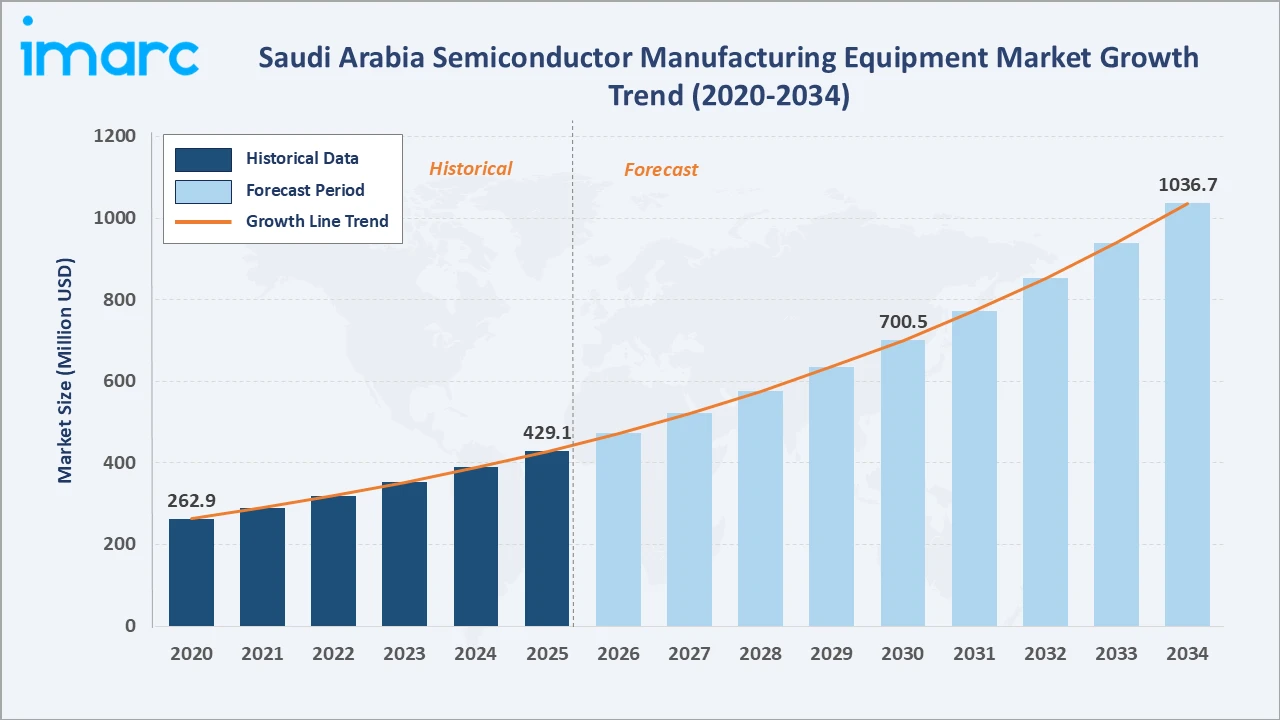
The Saudi Arabia semiconductor manufacturing equipment market was valued at USD 429.1 Million in 2025 and is projected to reach USD 1,036.7 Million by 2034, exhibiting a CAGR of 10.30% during 2026-2034. Vision 2030 industrial localization, rising demand for AI and data center chips, sovereign capital deployment, and the build-out of advanced packaging and test capacity are the primary drivers shaping market growth.
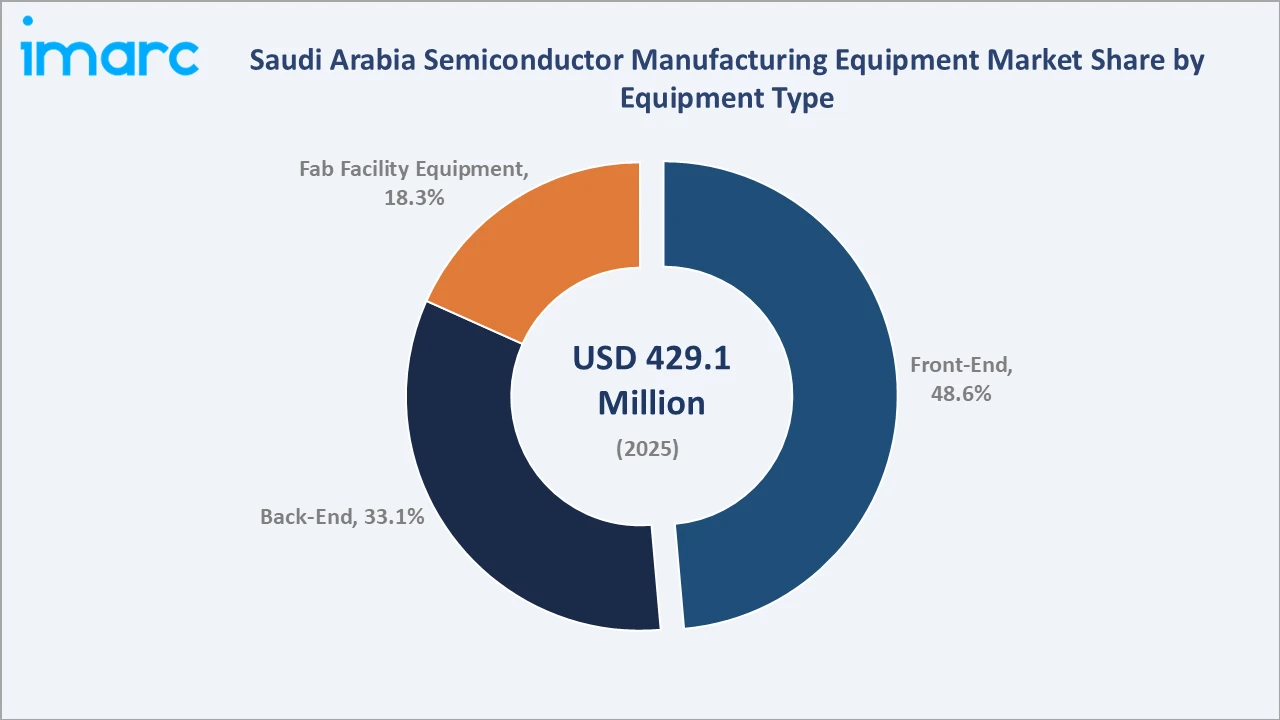
Front-end leads the equipment type segment at 48.6%, 2D dominates the dimension segment at 49.5%, and Northern and Central Region commands 41.2% regional share.
Market Snapshot
|
Metric |
Value |
|
Market Size (2025) |
USD 429.1 Million |
|
Forecast Market Size (2034) |
USD 1,036.7 Million |
|
CAGR (2026-2034) |
10.30% |
|
Base Year |
2025 |
|
Historical Period |
2020-2025 |
|
Forecast Period |
2026-2034 |
|
Largest Region |
Northern and Central Region (41.2%, 2025) |
|
Second Largest Region |
Western Region (25.4%, 2025) |
|
Leading Equipment Type |
Front-End (48.6%, 2025) |
|
Leading Dimension |
2D (49.5%, 2025) |
The market expanded from USD 262.9 Million in 2020 to USD 429.1 Million in 2025, supported by early cleanroom investment, pilot line tooling, and rising test and assembly imports. Anchored at USD 700.5 Million in 2030, the path to USD 1,036.7 Million by 2034 rests on wider back-end capacity and steady public funding.
To get more information on this market, Request Sample
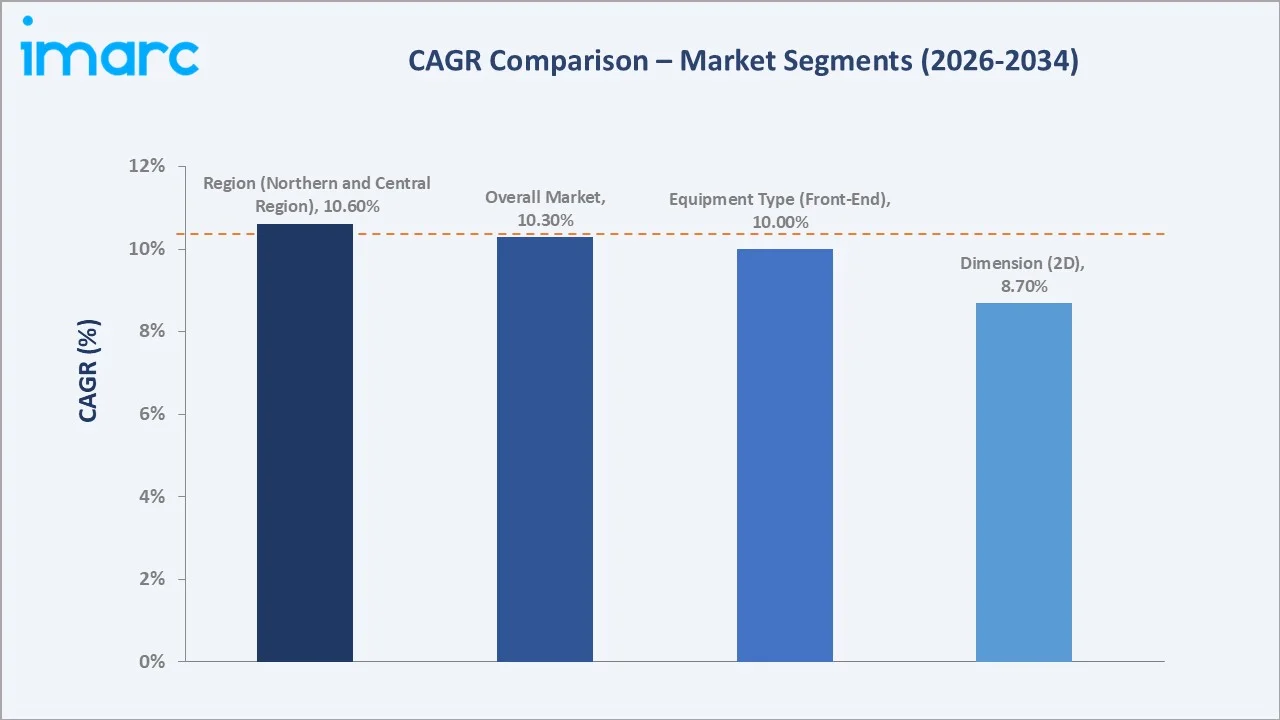
CAGR trajectories across equipment type, dimension, and regional sub-segments show 3D, 2.5D, and back-end outpacing the overall 10.30% market CAGR, largely on advanced packaging intensity and chiplet adoption.
Executive Summary
The Saudi Arabia semiconductor manufacturing equipment market is on a firm growth path, rising from USD 262.9 Million in 2020 to a projected USD 1,036.7 Million by 2034. The Kingdom is pursuing a structured program covering chip design, pilot fabrication, and assembly and test. Low-cost energy, sovereign funding, and Vision 2030 localization targets underpin the shift.
Front-end dominates the equipment type segment at 48.6% in 2025, reflecting lithography, deposition, etch, and metrology spending on early pilot lines. 2D leads the dimension segment at 49.5%, supported by mature-node power and sensor devices. Northern and Central Region holds 41.2% of regional share, anchored by Riyadh's research institutions and policy bodies.
Key Market Insights
|
Insight |
Data |
|
Leading Equipment Type |
Front-End - 48.6% share (2025) |
|
Second Largest Equipment Type |
Back-End - 33.1% share (2025) |
|
Leading Dimension |
2D - 49.5% share (2025) |
|
Second Largest Dimension |
3D - 30.2% share (2025) |
|
Leading Region |
Northern and Central Region - 41.2% share (2025) |
|
Second Largest Region |
Western Region - 25.4% share (2025) |
|
Top Companies |
Applied Materials, Inc., ASML Holding N.V., Lam Research Corporation, Advantest Corporation, Kulicke and Soffa Industries, Inc. |
Key Analytical Observations Expanding On The Data Above:
- Front-end leadership at 48.6% reflects the capital weight of lithography, deposition, etch, and inspection tools required before any wafer reaches assembly. Pilot lines and research fabs buy these systems first, front-loading spending early in an ecosystem build-out.
- Back-end share at 33.1% is the fastest expanding block, driven by assembly, bonding, and final test capacity. The Kingdom's practical entry route into global supply chains runs through packaging rather than leading-edge fabrication.
- 2D dominance at 49.5% aligns with a near-term focus on mature-node power devices, sensors, and edge processors, where planar architectures stay cost effective and process risk remains manageable.
- 3D at 30.2% is growing quickly as through-silicon via stacking and hybrid bonding enter mainstream packaging roadmaps, lifting demand for bonders, thinning tools, and alignment systems.
- Northern and Central Region at 41.2% dominates regional share, anchored by Riyadh, where research universities and policy institutions concentrate design activity and pilot production capability.
Saudi Arabia Semiconductor Manufacturing Equipment Market Overview
Semiconductor manufacturing equipment refers to the capital tools used to fabricate, assemble, and test integrated circuits. The category spans front-end systems, such as lithography, deposition, etch, and metrology; back-end systems covering dicing, bonding, packaging, and test; and fab facility equipment including cleanroom infrastructure, ultra-pure water, and gas delivery.
The Saudi ecosystem links global toolmakers, sub-system suppliers, materials vendors, research institutions, and government programs. Demand reflects oil-linked fiscal capacity, non-oil diversification targets, energy pricing, and the push to localize high-value industrial output under Vision 2030.
Market Dynamics
To evaluate market opportunities, Request Sample
Market Drivers
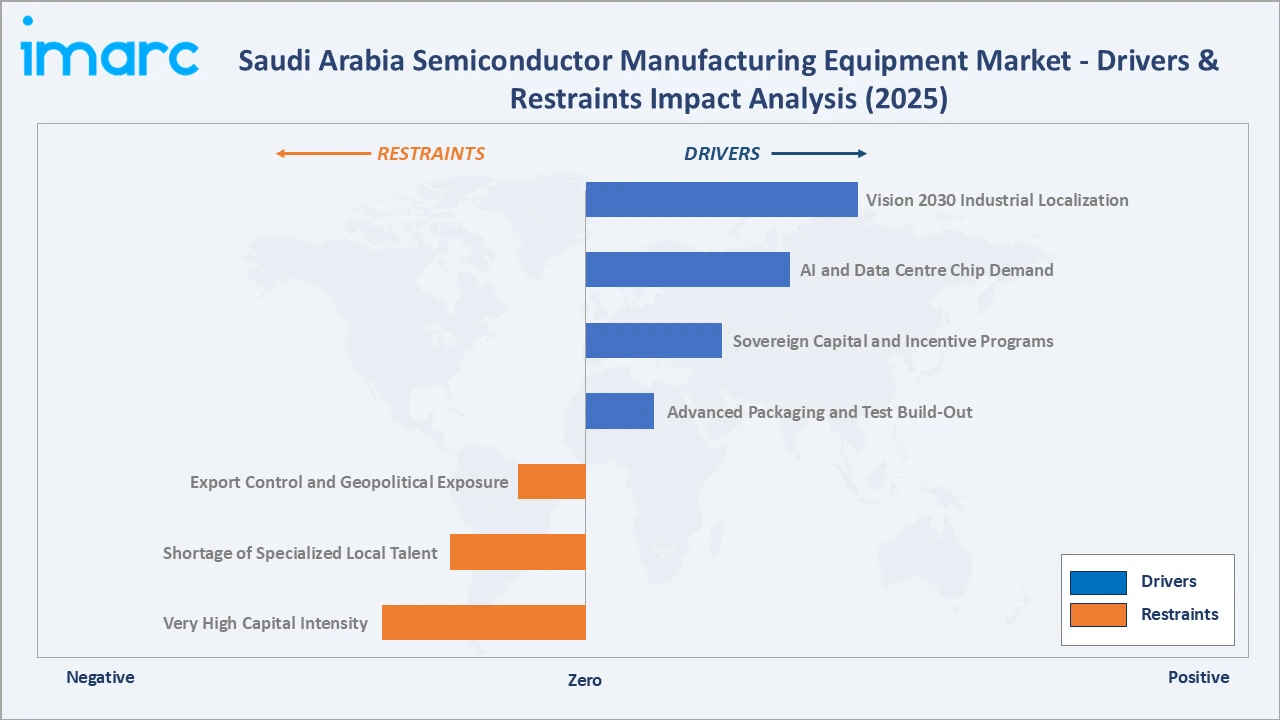
- Vision 2030 Industrial Localization: The diversification agenda places advanced manufacturing at the center of non-oil growth. Semiconductor capability is treated as strategic infrastructure, sustaining procurement budgets for process, assembly, and metrology tools across public programs.
- AI and Data Centre Chip Demand: Rapid data center construction across the Gulf is lifting regional appetite for compute, power management, and networking silicon. In February 2025, Alfanar Global Development revealed a significant USD 1.4 Billion investment aimed at creating four top-tier data centers in Saudi Arabia. This demand strengthens the case for local packaging, test, and eventually mature-node fabrication capacity.
- Sovereign Capital and Incentive Programs: Public investment vehicles, industrial development financing, and targeted incentives lower the effective cost of capital for tool-heavy projects.
- Advanced Packaging and Test Build-Out: Assembly and test offers a lower capital barrier than leading-edge wafer fabrication. Investment in bonders, probers, testers, and inspection systems is therefore rising faster than front-end tooling, reshaping the equipment mix.
Market Restraints
- Very High Capital Intensity: Wafer fabrication facilities rank among the most expensive industrial assets to build and operate. Long payback horizons and continuous reinvestment make procurement decisions slow and dependent on sustained state backing.
- Shortage of Specialized Local Talent: Process engineering, equipment maintenance, and yield management require experience that takes years to build. Reliance on expatriate specialists raises operating costs and slows how quickly new tool sets reach qualified production.
- Export Control and Geopolitical Exposure: Advanced process equipment sits within tightening international control regimes. Licensing requirements and end-use scrutiny introduce delivery uncertainty and can limit access to the newest tool generations.
Market Opportunities
- Energy Advantage for Facility-Intensive Operations: Fabs consume enormous power and ultra-pure water. Competitive energy costs and expanding renewable capacity give the Kingdom a structural case for hosting facility-heavy assembly, test, and mature-node operations.
- Regional Supply Chain Hub Positioning: The Kingdom sits between Asian manufacturing centers and European and African demand markets. Packaging, test, and distribution capability creates an opportunity to serve regional customers with shorter lead times.
Market Challenges
- Competition from Established Chip Nations: Taiwan, South Korea, Japan, the United States, and China command entrenched capacity, supplier networks, and subsidy programs. Attracting tool investment away from those clusters requires sustained, differentiated incentives.
- Supplier Ecosystem Depth: Equipment uptime depends on nearby spare parts inventories, field service engineers, and calibration facilities. Building that layer takes time and initially raises total cost of ownership for local operators.
Emerging Market Trends
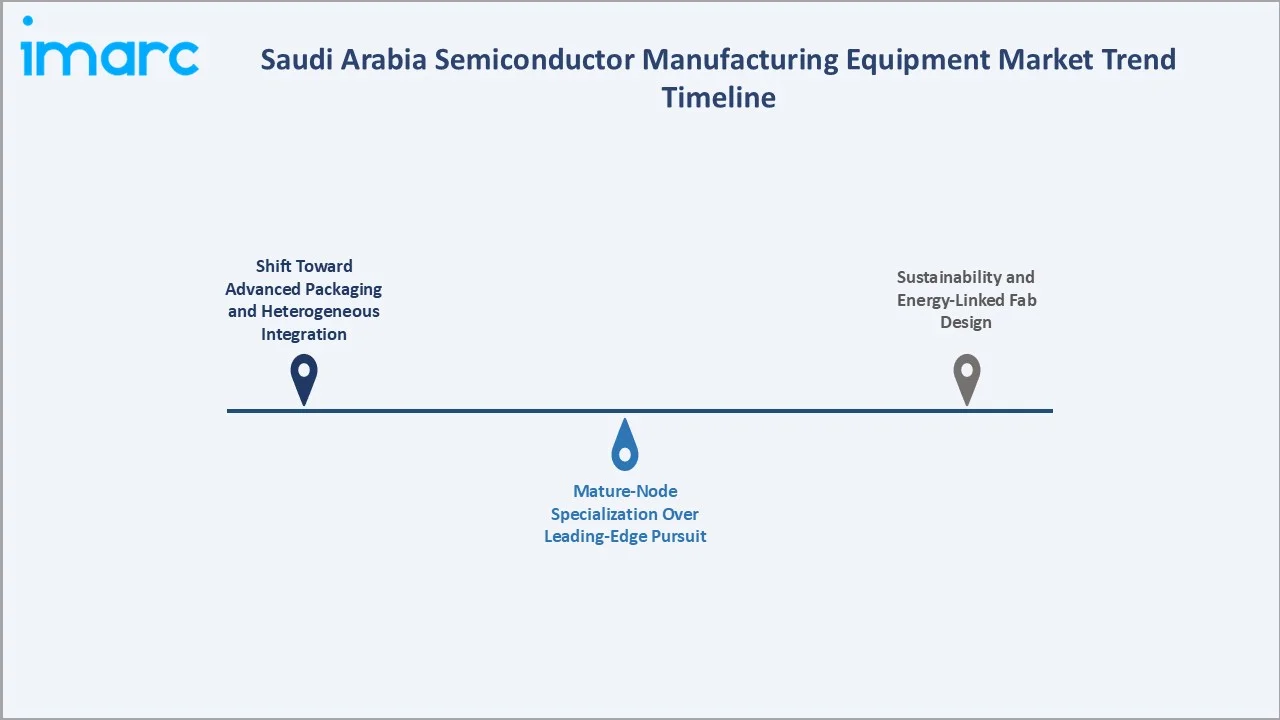
1. Shift Toward Advanced Packaging and Heterogeneous Integration
Chiplet architectures and 2.5D and 3D stacking are moving from niche to mainstream, shifting demand toward thermocompression bonders, wafer thinning systems, and precision alignment tools. Packaging offers the Kingdom a realistic entry point that avoids the capital burden of leading-edge lithography.
2. Mature-Node Specialization Over Leading-Edge Pursuit
Program leadership has signaled a focus on established nodes rather than the cutting edge. Mature-node tools cost less, carry lighter export-control exposure, and serve automotive, industrial, and power applications where regional demand is real.
3. Sustainability and Energy-Linked Fab Design
Water recycling systems, abatement equipment, and energy-efficient facility infrastructure are becoming procurement criteria rather than afterthoughts. Renewable-linked industrial zones give the Kingdom a credible sustainability case for facility-intensive operations.
Industry Value Chain Analysis
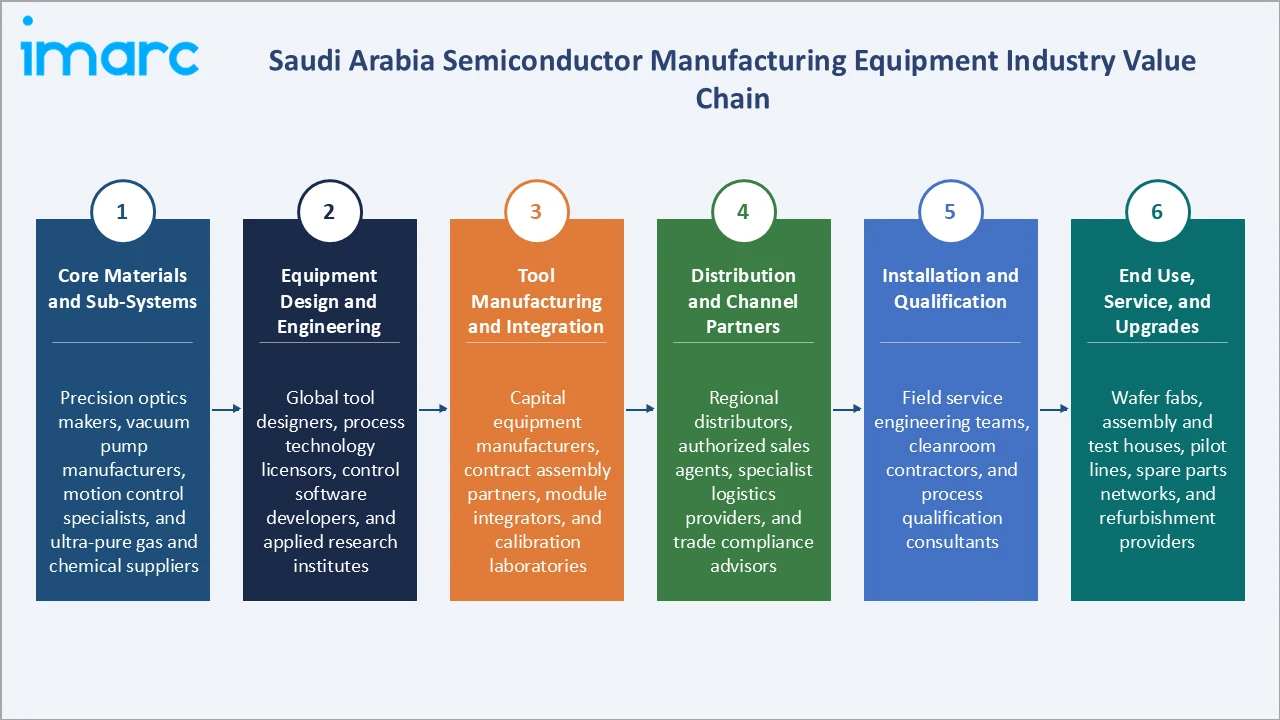
The value chain spans six stages, from core materials and sub-system supply through installation, service, and upgrade cycles. Equipment design and tool integration capture the highest value-add, while service and qualification capability increasingly decide which suppliers win repeat business.
|
Stage |
Key Players / Examples |
|
Core Materials and Sub-Systems |
Precision optics makers, vacuum pump manufacturers, motion control specialists, and ultra-pure gas and chemical suppliers |
|
Equipment Design and Engineering |
Global tool designers, process technology licensors, control software developers, and applied research institutes |
|
Tool Manufacturing and Integration |
Capital equipment manufacturers, contract assembly partners, module integrators, and calibration laboratories |
|
Distribution and Channel Partners |
Regional distributors, authorized sales agents, specialist logistics providers, and trade compliance advisors |
|
Installation and Qualification |
Field service engineering teams, cleanroom contractors, and process qualification consultants |
|
End Use, Service, and Upgrades |
Wafer fabs, assembly and test houses, pilot lines, spare parts networks, and refurbishment providers |
Suppliers combining tool sales with local service depth, training, and process support capture more lifetime value than those relying on third-party channels alone.
Technology Landscape in the Saudi Arabia Semiconductor Manufacturing Equipment Market Industry
Lithography and Patterning Systems
Deep ultraviolet immersion and i-line scanners remain the practical backbone for mature-node work. They handle the geometries relevant to power devices, sensors, and microcontrollers at far lower acquisition and operating cost than extreme ultraviolet platforms.
Deposition, Etch, and Process Control
Atomic layer deposition, chemical vapor deposition, and plasma etch tools define film quality and feature accuracy. Integrated metrology increasingly runs inline, using machine learning (ML) to flag process drift before yield losses accumulate.
Assembly, Bonding, and Test Automation
Wire bonders, thermocompression bonders, die attach systems, probers, and automated test equipment form the back-end core. Automation and adaptive test flows raise throughput while lowering the skilled-labor intensity of packaging.
Market Segmentation Analysis
The report covers the following segments:
|
Segment Category |
Leading Segment |
Market Share |
Year |
|
Equipment Type |
Front-End |
48.6% |
2025 |
|
Product Type |
🔒 |
🔒 |
2025 |
|
Dimension |
2D |
49.5% |
2025 |
|
Supply Chain Participant |
🔒 |
🔒 |
2025 |
|
Region |
Northern and Central Region |
41.2% |
2025 |

By Equipment Type
Front-end holds a 48.6% majority share in 2025, driven by lithography, deposition, etch, cleaning, and metrology purchases tied to pilot lines and research fabs. Continued investment in advanced process technologies and capacity expansion at semiconductor manufacturing facilities further supports sustained demand for front-end equipment.
To access detailed market analysis, Request Sample
Back-end at 33.1% in 2025 covers dicing, bonding, packaging, and test systems. The segment is expanding fastest because assembly and test represent the most accessible entry point into global semiconductor supply chains.
By Dimension
2D leads with 49.5% share in 2025, reflecting continued reliance on planar architectures for power management devices, sensors, and mature-node logic. The format offers proven process stability and lower capital risk, which suits an ecosystem still building operational experience.
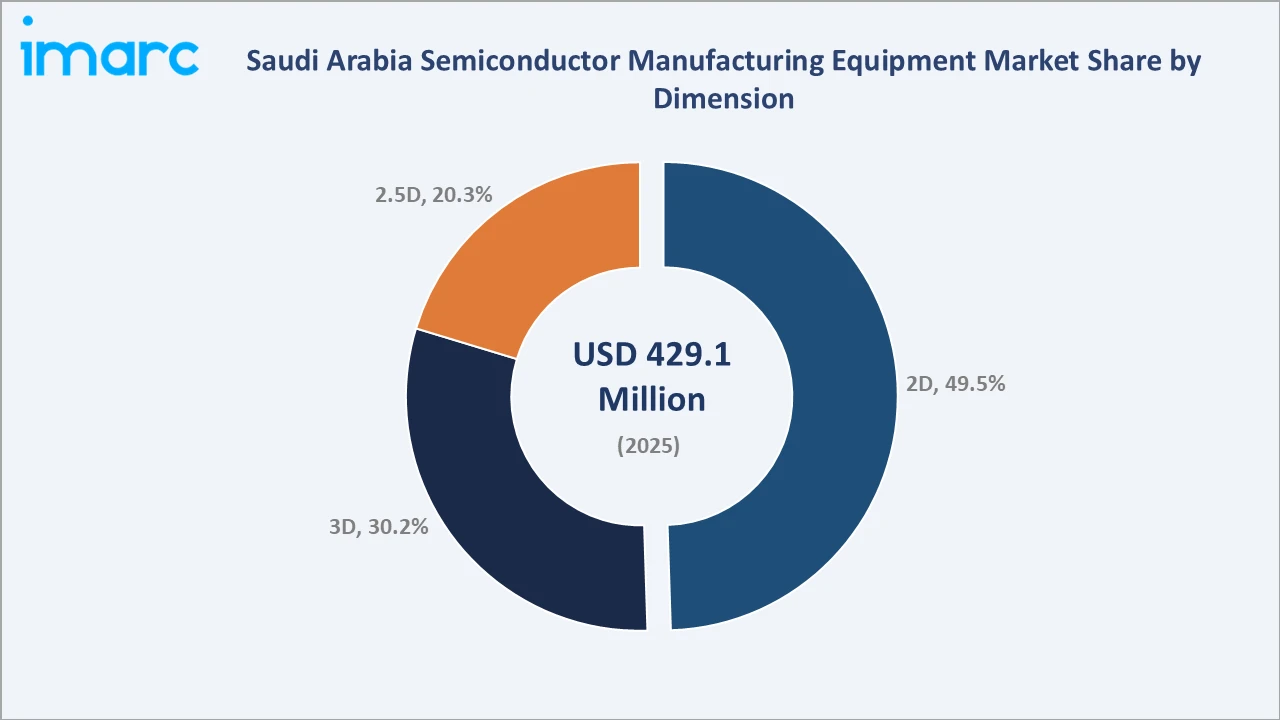
3D at 30.2% is growing quickly through stacked memory, through-silicon via integration, and hybrid bonding adoption.
Regional Market Insights
|
Region |
Share (2025) |
Key Growth Drivers |
|
Northern and Central Region |
41.2% |
Concentration of research institutions, policy bodies, and design activity, supported by strong infrastructure and access to skilled technical talent |
|
Western Region |
25.4% |
Established university research base, port and logistics connectivity, and growing industrial zones attracting advanced manufacturing investment |
|
Eastern Region |
21.8% |
Dense industrial infrastructure, proximity to energy and petrochemical assets, and mature utilities suited to facility-intensive operations |
|
Southern Region |
11.6% |
Emerging industrial development, expanding economic zones, and rising government focus on regional manufacturing diversification |
Northern and Central Region at 41.2% in 2025 leads the regional landscape, anchored by Riyadh. Concentrated research capability, policy institutions, and deep engineering talent pool sustain leadership across design activity and pilot production tooling.
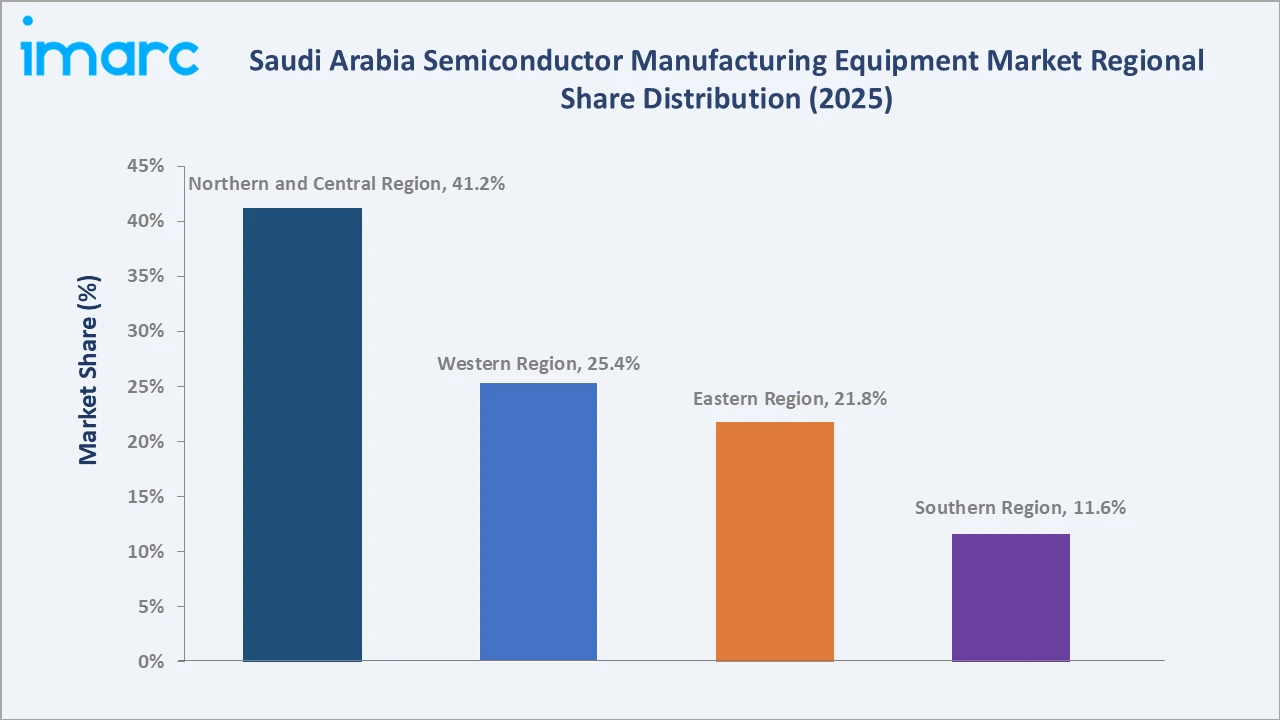
Eastern Region at 21.8% is the fastest growing area. Existing industrial infrastructure, reliable utilities, and proximity to energy assets are accelerating investment in facility-heavy assembly and test operations through 2034.
Competitive Landscape
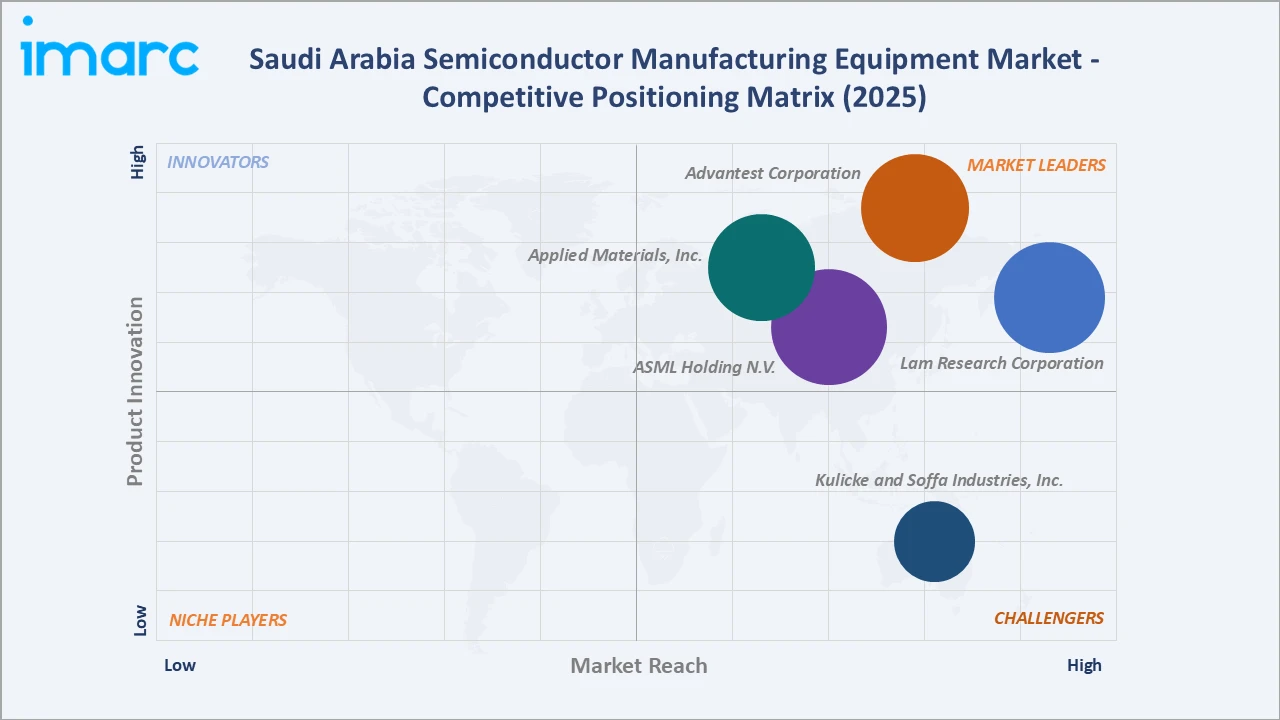
The market is highly consolidated and supplier-led, with a small group of global toolmakers accounting for most installed capability. As an emerging buyer market, competition centers on technology breadth, local service commitment, training support, and export-control navigation.
|
Company Name |
Brand / Key Product |
Position |
Strategic Focus |
|
Applied Materials, Inc. |
Endura PVD |
Leader |
Broad materials engineering portfolio spanning deposition, etch, and process control |
|
ASML Holding N.V. |
TWINSCAN Lithography Systems |
Leader |
Patterning technology leadership with long-cycle customer partnership models |
|
Lam Research Corporation |
Kiyo Etch and Striker Deposition |
Leader |
Deposition and etch specialization aligned to advanced device architectures |
|
Advantest Corporation |
V93000 Platform |
Leader |
Automated test capability supporting back-end and final test operations |
|
Kulicke and Soffa Industries, Inc. |
Asterion Wedge Bonders |
Challenger |
Assembly and packaging equipment aligned to advanced integration demand |
Key players include Applied Materials, Inc., ASML Holding N.V., Lam Research Corporation, Advantest Corporation, and Kulicke and Soffa Industries, Inc., among others.
Key Company Profiles
Applied Materials, Inc.
Applied Materials, Inc. is a United States-based supplier of materials engineering solutions for the semiconductor and display industries. The company provides equipment, services, and software used across wafer fabrication and maintains one of the broadest process tool portfolios in the sector.
- Product Portfolio: Deposition, etch, ion implantation, planarization, metrology and inspection systems, together with wafer packaging equipment and fab-wide service and automation software.
- Recent Developments: The company continues to strengthen its semiconductor equipment portfolio through ongoing process innovation, advanced packaging solutions, and expansion of service capabilities supporting next-generation chip manufacturing.
- Strategic Focus: Extending materials engineering leadership across logic, memory, and packaging applications while deepening service capability in developing manufacturing regions.
ASML Holding N.V.
ASML Holding N.V. is a Netherlands-based supplier of photolithography systems used in semiconductor manufacturing. The company develops patterning platforms for both advanced and mature process nodes and supports a large global installed base.
- Product Portfolio: Deep ultraviolet and extreme ultraviolet lithography platforms, computational lithography software, patterning metrology solutions, and refurbished system offerings for mature-node customers.
- Recent Developments: The company continues to advance patterning capability for finer geometries while expanding installed base management and upgrade services across its customer base.
- Strategic Focus: Sustaining patterning leadership at the leading edge while supporting mature-node demand through services and refurbished system offerings.
Lam Research Corporation
Lam Research Corporation is a United States-based semiconductor equipment company specializing in wafer fabrication processes. The company focuses on deposition, etch, and clean technologies used in memory, logic, and specialty device production.
- Product Portfolio: Kiyo Etch and Striker Deposition; electrochemical deposition tools; single-wafer clean systems.
- Recent Developments: The company continues to extend process capability for three-dimensional device architectures and advanced packaging applications across its deposition and etch lines.
- Strategic Focus: Strengthening deposition and etch leadership while supporting customers moving toward vertically scaled device structures.
Market Concentration Analysis
The Saudi Arabia semiconductor manufacturing equipment market is highly concentrated on the supply side. A small number of global toolmakers account for the large majority of installed process capability, a structure that mirrors the global equipment industry rather than any local dynamic.
Barriers to entry are severe. Accumulated process knowledge, patent portfolios, customer co-development relationships, and heavy research spending protect incumbent positions. New suppliers rarely displace established vendors once a tool set is qualified in production.
Consolidation continues through acquisitions of specialist metrology, bonding, and sub-system firms. For buyers in the Kingdom, procurement leverage is limited, so supplier selection turns on service commitment, training, and partnership terms rather than price.
Investment & Growth Opportunities
Fastest-Growing Segments
3D is expanding the fastest among dimension categories, supported by stacked memory and through-silicon via adoption. Back-end leads growth among equipment types, reflecting the lower capital barrier and faster payback of assembly and test operations.
Emerging Markets
Eastern Region is the fastest growing area, anchored by industrial infrastructure and utility reliability. Southern Region represents the largest untapped opportunity as new economic zones develop and regional diversification policies take effect.
Venture & Investment Trends
Capital is concentrating in fabless design ventures, packaging and test facilities, and equipment service and refurbishment businesses. These models need less upfront capital than wafer fabrication while building the operational base that heavier investment later depends on.
Future Market Outlook (2026-2034)
The market is forecast to expand from USD 429.1 Million in 2025 to USD 1,036.7 Million by 2034 at a CAGR of 10.30%, adding roughly USD 607.6 Million in incremental market value across the forecast period.
Four forces will shape the trajectory: sustained sovereign funding for diversification; the shift of value toward advanced packaging and test; regional AI and data center demand pulling through chip requirements; and the evolving export-control environment.
By 2034, the equipment mix is expected to tilt further toward back-end and 3D-capable systems as packaging capacity scales ahead of any large front-end commitment. Facility equipment demand stays steady as new cleanroom capacity comes online across the Kingdom.
Research Methodology
Primary Research
Primary research included structured interviews with equipment vendors, regional distributors, facility engineering contractors, research institution leads, and industrial policy specialists, validating market sizing, tool mix assumptions, and regional demand patterns.
Secondary Research
Secondary sources included Vision 2030 program documentation, Ministry of Investment and Ministry of Industry publications, industry association statistics, customs and trade data, and annual reports, press releases, and investor presentations from listed equipment suppliers.
Forecasting Models
Forecasts combined top-down and bottom-up approaches, linking announced capacity plans, tool intensity benchmarks per wafer start, facility build schedules, and macroeconomic variables. Scenario analysis addressed funding pace, export-control tightening, and project timeline slippage.
Saudi Arabia Semiconductor Manufacturing Equipment Market Report Coverage:
| Report Features | Details |
|---|---|
| Base Year of the Analysis | 2025 |
| Historical Period | 2020-2025 |
| Forecast Period | 2026-2034 |
| Units | Million USD |
| Scope of the Report | Exploration of Historical and Forecast Trends, Industry Catalysts and Challenges, Segment-Wise Historical and Predictive Market Assessment:
|
| Equipment Types Covered |
|
| Product Types Covered | Memory, Logic Components, Microprocessor, Analog Components, Optoelectronic Components, Discrete Components, Others |
| Dimensions Covered | 2D, 2.5D, 3D |
| Supply Chain Participants Covered | IDM Firms, OSAT Companies, Foundries |
| Regions Covered | Northern and Central Region, Western Region, Eastern Region, Southern Region |
| Companies Covered | Applied Materials Inc., ASML Holding N.V., Lam Research Corporation, Advantest Corporation, Kulicke and Soffa Industries Inc., etc. |
| Customization Scope | 10% Free Customization |
| Post-Sale Analyst Support | 10-12 Weeks |
| Delivery Format | PDF and Excel through Email (We can also provide the editable version of the report in PPT/Word format on special request) |
Key Benefits for Stakeholders:
- IMARC’s industry report offers a comprehensive quantitative analysis of various market segments, historical and current market trends, market forecasts, and dynamics of the Saudi Arabia semiconductor manufacturing equipment market from 2020-2034.
- The research report provides the latest information on the market drivers, challenges, and opportunities in the Saudi Arabia semiconductor manufacturing equipment market.
- Porter's five forces analysis assist stakeholders in assessing the impact of new entrants, competitive rivalry, supplier power, buyer power, and the threat of substitution. It helps stakeholders to analyze the level of competition within the Saudi Arabia semiconductor manufacturing equipment industry and its attractiveness.
- Competitive landscape allows stakeholders to understand their competitive environment and provides an insight into the current positions of key players in the market.
Frequently Asked Questions About the Saudi Arabia Semiconductor Manufacturing Equipment Market Report
The market was valued at USD 429.1 Million in 2025, supported by Vision 2030 localization programs, pilot line investment, and rising regional demand for packaging and test capacity.
The market is projected to grow at a CAGR of 10.30% from 2026-2034, reaching USD 1,036.7 Million, driven by advanced packaging build-out and sustained sovereign investment.
Front-end leads at 48.6% in 2025, reflecting high-value lithography, deposition, etch, and metrology purchases.
2D dominates at 49.5% in 2025, supported by mature-node power and sensor devices. Its widespread adoption across automotive, industrial, and consumer electronics applications continues to sustain equipment demand.
Northern and Central Region commands 41.2% in 2025, anchored by Riyadh's research institutions, design cluster, policy bodies, and concentration of engineering talent.
Leading suppliers include Applied Materials, Inc., ASML Holding N.V., Lam Research Corporation, Advantest Corporation, and Kulicke and Soffa Industries, Inc., among others.
Vision 2030 industrial localization, regional AI and data center chip demand, sovereign capital programs, and the build-out of advanced packaging and test capacity are the principal growth drivers.
High capital intensity, shortage of specialized local talent, export-control exposure, and competition from established chip-making nations remain the most significant constraints on market expansion.
Need more help?
- Speak to our experienced analysts for insights on the current market scenarios.
- Include additional segments and countries to customize the report as per your requirement.
- Gain an unparalleled competitive advantage in your domain by understanding how to utilize the report and positively impacting your operations and revenue.
- For further assistance, please connect with our analysts.
 Request Customization
 Speak to an Analyst
 Request Brochure
 Inquire Before Buying
Benefits of Customization
- Personalize this research
- Triangulate with your data
- Get data as per your format and definition
- Gain a deeper dive into a specific application, geography, customer, or competitor
- Any level of personalization
Get in Touch With Us
UNITED STATES
Phone: +1-201-971-6302
INDIA
Phone: +91-120-433-0800
UNITED KINGDOM
Phone: +44-753-714-6104
Email: [email protected]
Client Testimonials




.webp)




.webp)













Related Reports

Choose your plan
*Please note that the prices mentioned below are starting prices for each bundle type. Kindly contact our team for further details.*
Single User License
- 1 User License, Access on 2 Devices
- PDF Report + Excel Dataset (Password Protected)
- Lifetime Access
- No Printing Rights
- 10% Free Report Customization
- 10–12 Weeks of Analyst Support
Five User License
- Access for 5 Users, 2 Devices per User
- PDF Report + Excel Dataset (Password Protected)
- Lifetime Access
- Dedicated Account Manager
- 12–14 Weeks of Analyst Support
- No Printing Rights
- 15% Free Report Customization
- 25% Discount on Your Next Purchase
Corporate User License
- Unlimited User Access (Within Your Organization)
- PDF Report + Excel Dataset
- Lifetime Access
- Dedicated Account Manager
- 14–20 Weeks of Analyst Support
- No Printing Rights
- 20% Free Report Customization
- 30% Discount on Your Next Purchase
Essential Insights
What's included:
3 reports
- Lifetime Access
- PDF Reports
- Excel Datasets
- 2 Weeks of Free Analyst Support
- 2 User Licenses
- Access on 2 Devices
- Printing Rights
- Complimentary PowerPoint (PPT) Version
- Complimentary License Upgrade
Professional Access
What's included:
5 reports
- Lifetime Access
- PDF Reports
- Excel Datasets
- 8 Weeks of Free Analyst Support
- 2 User Licenses
- Access on 2 Devices
- Printing Rights
- Complimentary PowerPoint (PPT) Version
- Complimentary License Upgrade
Business Advantage
What's included:
8 reports
- Lifetime Access
- PDF Reports
- Excel Datasets
- 14 Weeks of Free Analyst Support
- 2 User Licenses
- Access on 2 Devices
- Printing Rights
- Complimentary PowerPoint (PPT) Version
- Complimentary License Upgrade
Enterprise Intelligence
What's included:
10 reports
- Lifetime Access
- PDF Reports
- Excel Datasets
- 20 Weeks of Free Analyst Support
- 2 User Licenses
- Access on 2 Devices
- Printing Rights
- Complimentary PowerPoint (PPT) Version
- Complimentary License Upgrade