
Saudi Arabia Soda Ash Market Size, Share, Trends and Forecast by Application and Region, 2026-2034
Saudi Arabia Soda Ash Market Size, Share, Trends & Forecast (2026-2034)
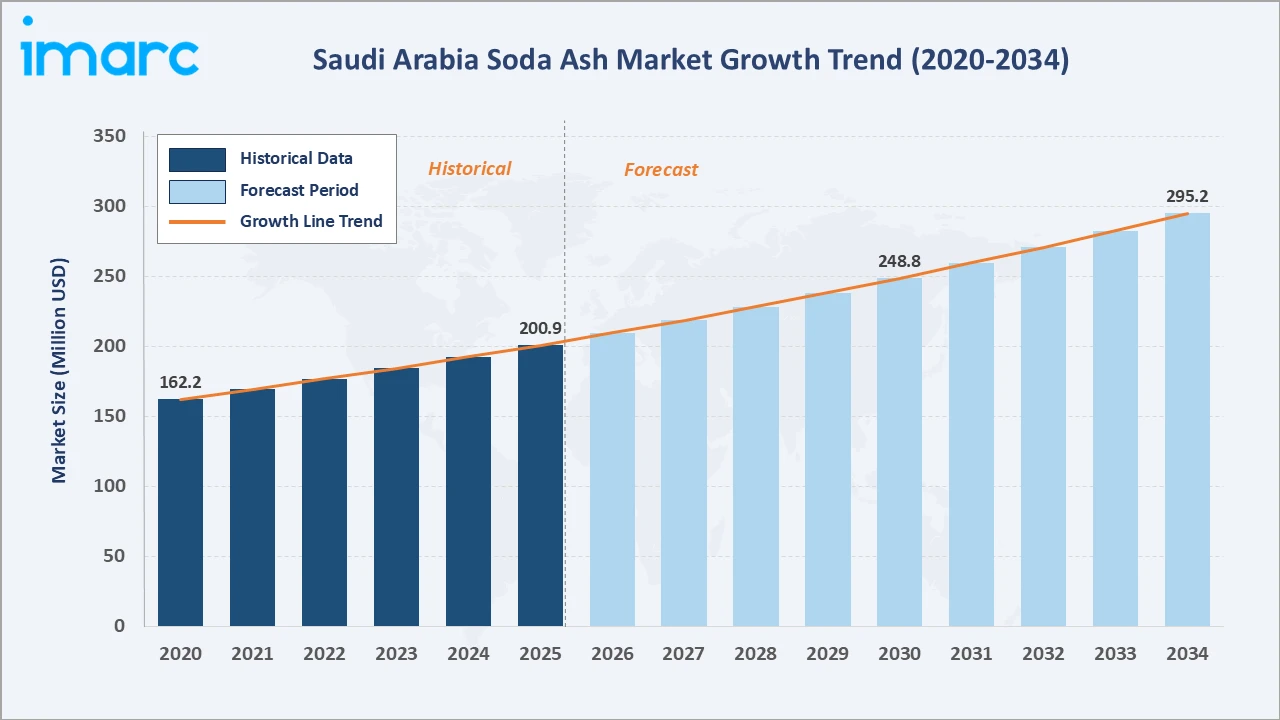
The Saudi Arabia soda ash market size increased from USD 200.9 Million in 2025 to USD 209.6 Million in 2026 and is projected to reach USD 295.2 Million by 2034, growing at a CAGR of 4.37% during 2026-2034. Rising glass manufacturing capacity, expanding chemicals and detergent production, and steady industrial diversification under Vision 2030 are the primary forces lifting demand.
Glass leads application demand at 48.6%, while Northern and Central Region commands 40.8% of regional share in 2025.
Market Snapshot
|
Metric |
Value |
|
Base Year Market Size (2025) |
USD 200.9 Million |
| Market Size (2026) | USD 209.6 Million |
|
Forecast Market Size (2034) |
USD 295.2 Million |
|
CAGR (2026-2034) |
4.37% |
|
Base Year |
2025 |
|
Historical Period |
2020-2025 |
|
Forecast Period |
2026-2034 |
|
Largest Region |
Northern and Central Region (40.8%, 2025) |
|
Second Largest Region |
Eastern Region (27.4%, 2025) |
|
Leading Application |
Glass (48.6%, 2025) |
The Saudi Arabia soda ash market expanded from USD 162.2 Million in 2020 to USD 200.9 Million in 2025 and an estimated USD 209.6 Million in 2026, supported by steady construction activity and rising output from glass and chemical processing units. Anchored at USD 248.8 Million in 2030, the market is set to advance to USD 295.2 Million by 2034 as domestic manufacturing capacity matures and downstream demand broadens across additional end-use industries.
To get more information on this market, Request Sample
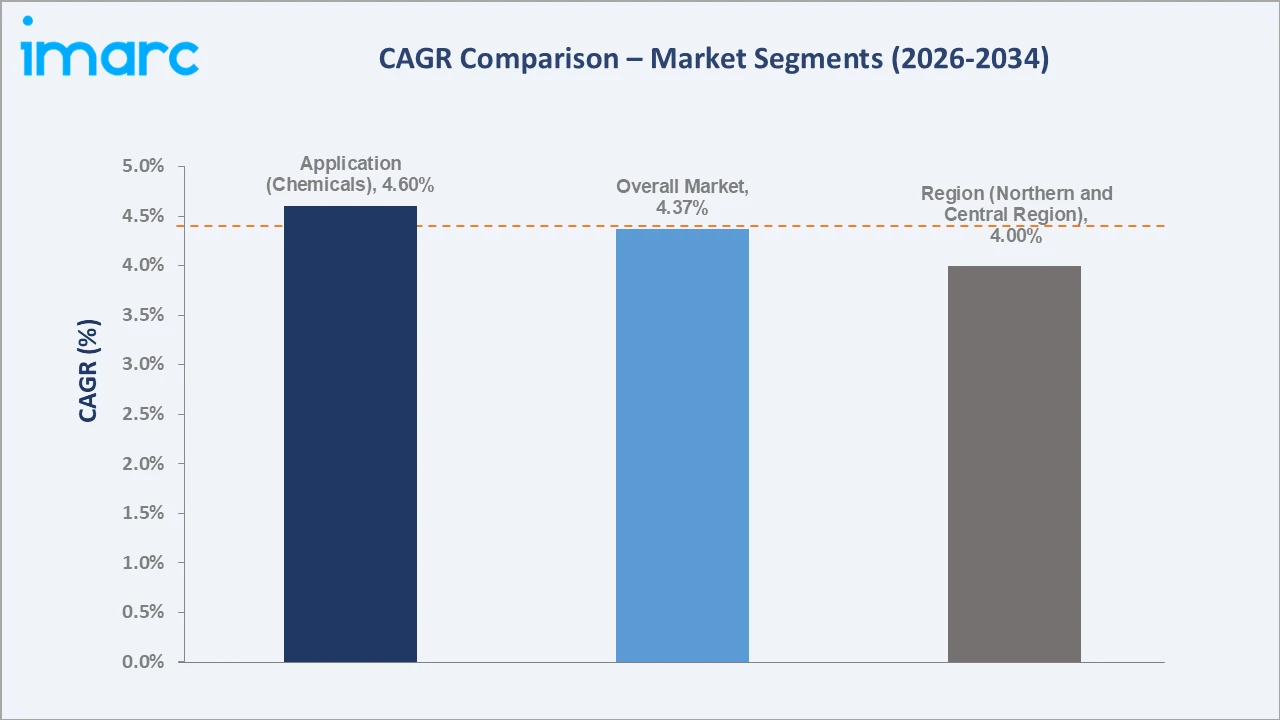
CAGR trajectories across application and regional segments show metallurgy and Southern Region expanding faster than the overall 4.37% market CAGR, driven by diversifying industrial end uses and broadening infrastructure investment outside the established northern core.
Executive Summary
The Saudi Arabia soda ash market is on a stable growth path, expanding from USD 162.2 Million in 2020 to USD 209.6 Million in 2026 and is projected to reach USD 295.2 Million by 2034. Growth is supported by expanding glass manufacturing capacity, increasing detergent and chemical production, and rising demand from industrial processing applications.
Glass dominates the application segment at 48.6%, supported by strong demand from container, flat, and specialty glass manufacturing. Northern and Central Region leads with 40.8% share in 2025, driven by the concentration of industrial manufacturing facilities, construction activity, and glass production capacity.
Key Market Insights
|
Insight |
Data |
|
Leading Application |
Glass - 48.6% share (2025) |
|
Second Largest Application |
Chemicals - 18.4% share (2025) |
|
Leading Region |
Northern and Central Region - 40.8% share (2025) |
|
Second Largest Region |
Eastern Region - 27.4% share (2025) |
|
Top Companies |
InoChem, Solvay, Ciner Group, Sisecam |
Key Analytical Observations Expanding On The Data Above:
- Glass dominance at 48.6% is anchored by sustained demand for float glass, container glass, and architectural glazing across the Kingdom's construction and packaging sectors, which continue to specify soda ash as an essential melting-point reducing agent.
- Chemicals at 18.4% share benefit from soda ash's role as a feedstock for sodium-based compounds used in water treatment, industrial processing, and specialty chemical manufacturing.
- Northern and Central Region at 40.8% reflects the concentration of population, construction activity, and downstream manufacturing around Riyadh and surrounding industrial zones.
Saudi Arabia Soda Ash Market Overview
Soda ash is an inorganic alkali chemical used to lower the melting point of silica in glass production, soften water in soap and detergent formulations, and serve as a processing agent in chemicals, metallurgy, and pulp and paper manufacturing. In Saudi Arabia, the market spans domestic production, import supply chains, and distribution networks connecting raw material suppliers with glass makers, chemical processors, and industrial end users.
The ecosystem includes soda ash manufacturers, raw material and logistics providers, regulatory and industrial authorities overseeing manufacturing standards, and a broad base of downstream industries that rely on the material as a foundational input for everyday and industrial products.
Market Dynamics
To evaluate market opportunities, Request Sample
Market Drivers
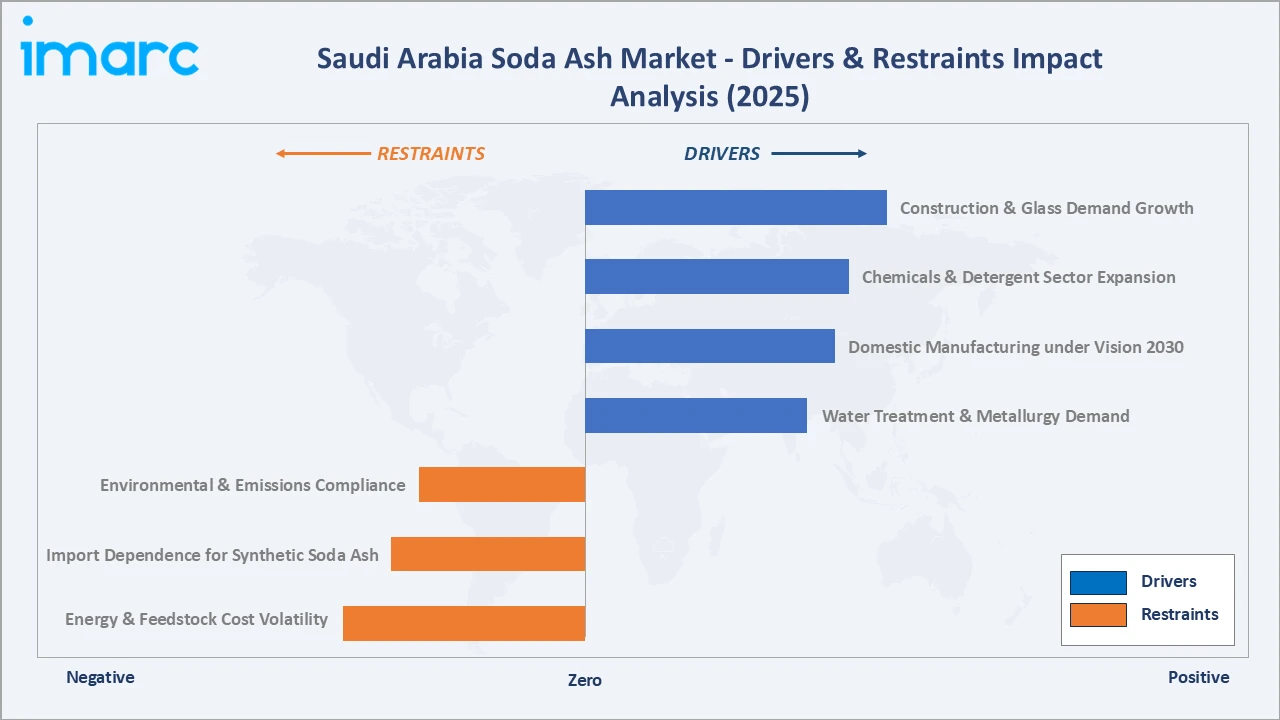
- Construction and Glass Demand Growth: Continued investment in residential, commercial, and giga-project construction sustains demand for float and container glass, the largest end-use category for soda ash in the Kingdom. As per IMARC Group, the Saudi Arabia construction market reached USD 101.4 Billion in 2025.
- Chemicals and Detergent Sector Expansion: Growth in household consumption and industrial water treatment is lifting demand for soda ash-based sodium compounds used in cleaning and processing applications.
- Domestic Manufacturing under Vision 2030: The Kingdom's industrial diversification agenda is encouraging investment in local inorganic chemical production, reducing reliance on imported soda ash over time.
- Water Treatment and Metallurgy Demand: Expanding desalination capacity and non-ferrous metal processing continue to create steady, non-cyclical demand for soda ash as a water-softening and fluxing agent.
Market Restraints
- Energy and Feedstock Cost Volatility: Fluctuating natural gas and feedstock prices create cost uncertainty for soda ash manufacturers, increasing production expenses and limiting pricing flexibility. This volatility can pressure operating margins and constrain investment decisions across the industry.
- Import Dependence for Synthetic Soda Ash: With domestic synthetic production still scaling up, a meaningful share of demand continues to be met through imports, exposing buyers to freight costs and currency fluctuations.
- Environmental and Emissions Compliance: Tightening environmental standards around industrial emissions and water discharge are raising compliance costs for soda ash producers and downstream glass and chemical manufacturers.
Market Opportunities
- Capacity Expansion in Domestic Production: Continued investment in local soda ash manufacturing presents an opportunity to capture import-substitution demand and strengthen supply security for glass and chemical producers.
- Sustainable and Low-Carbon Production Technologies: Adoption of energy-efficient and lower-emission manufacturing processes offers a pathway for producers to align with the Kingdom's broader sustainability goals.
Market Challenges
- Global Oversupply and Price Pressure: Excess soda ash capacity in key exporting regions can weigh on landed prices, pressuring margins for both domestic producers and importers serving the Saudi market.
- Logistics and Freight Cost Exposure: Reliance on seaborne imports for a portion of demand leaves the market exposed to shipping rate fluctuations and port congestion.
Emerging Market Trends
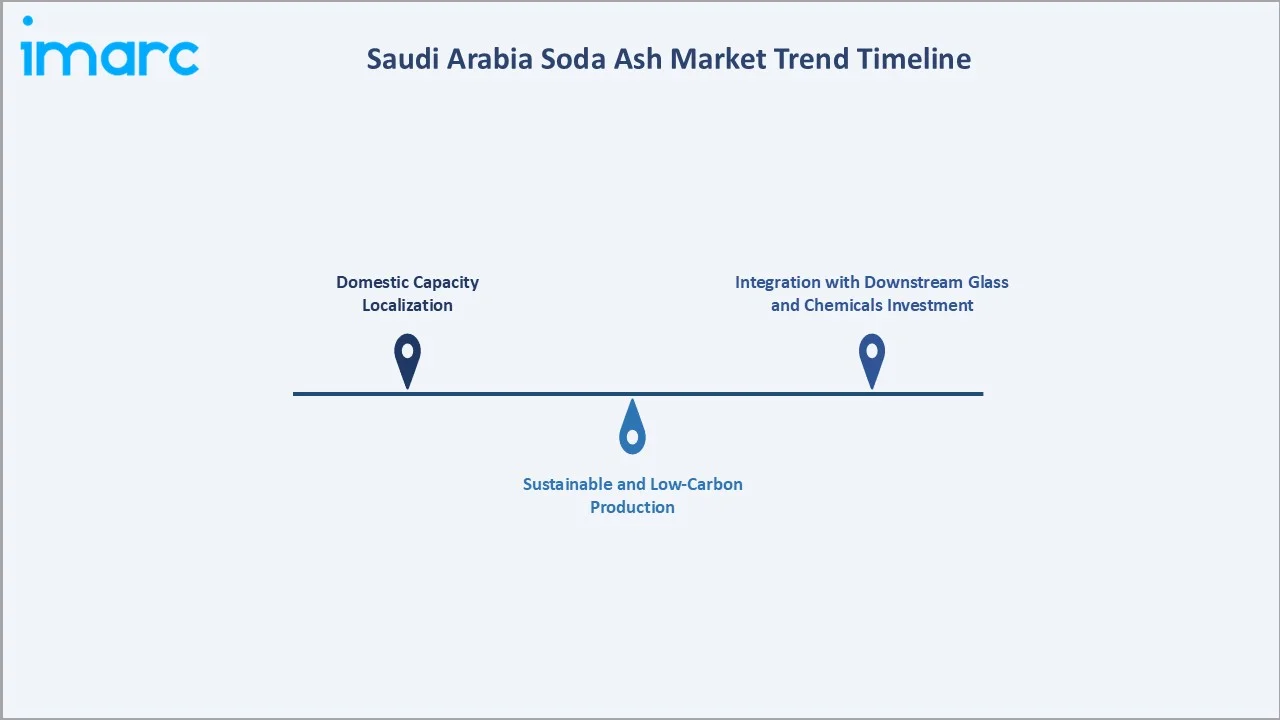
1. Domestic Capacity Localization
Saudi Arabia is gradually shifting from import-dependent supply toward domestic soda ash production as new manufacturing capacity is developed within the country. This transition is expected to strengthen supply security, reduce import reliance, and reshape sourcing patterns for glass and chemical manufacturers over the forecast period.
2. Sustainable and Low-Carbon Production
Global producers are piloting lower-emission manufacturing routes that could eventually inform technology choices in the Kingdom. As sustainability priorities strengthen, manufacturers are expected to focus on improving energy efficiency and reducing the environmental footprint of soda ash production.
3. Integration with Downstream Glass and Chemicals Investment
Expanding float glass and container glass capacity across the Kingdom is tightening the link between soda ash supply and downstream manufacturing investment, encouraging closer coordination between producers and glass makers on long-term offtake.
Industry Value Chain Analysis
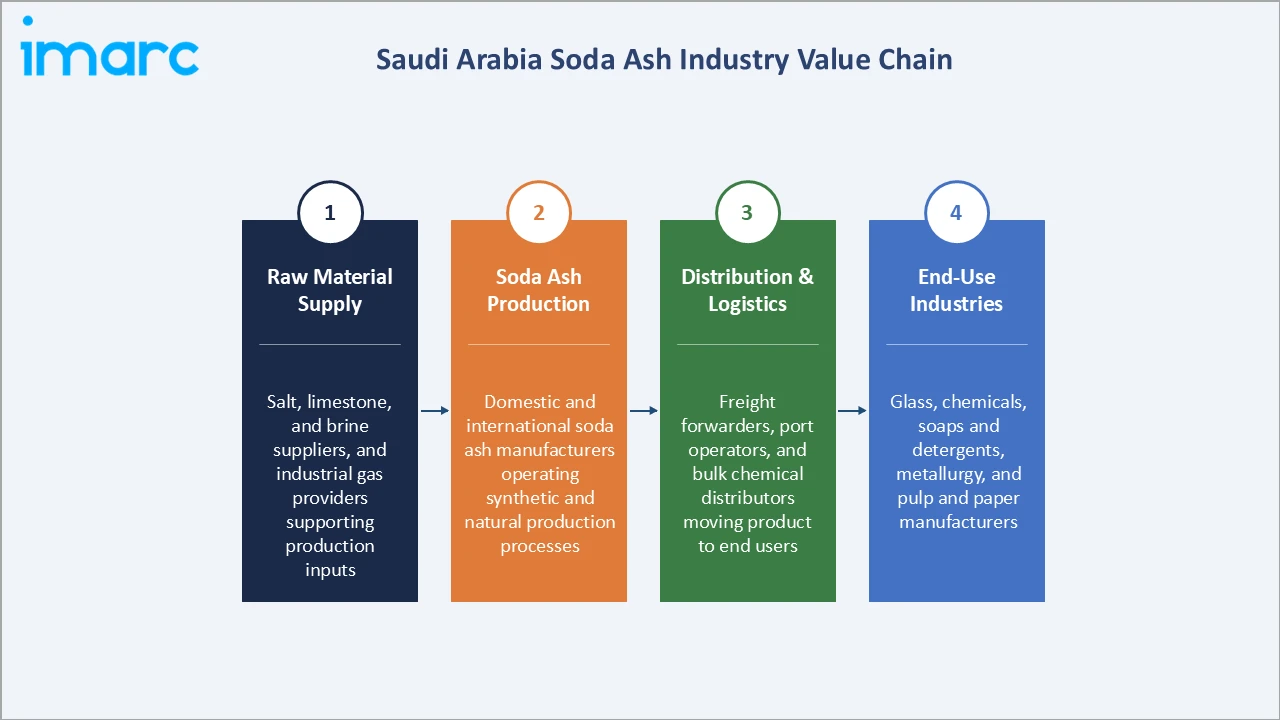
The Saudi Arabia soda ash value chain spans four principal stages, from raw material sourcing through production, distribution, and end-use consumption. Producers and downstream manufacturers increasingly coordinate on long-term supply arrangements to secure feedstock and manage costs.
|
Stage |
Key Players / Examples |
|
Raw Material Supply |
Salt, limestone, and brine suppliers, and industrial gas providers supporting production inputs |
|
Soda Ash Production |
Domestic and international soda ash manufacturers operating synthetic and natural production processes |
|
Distribution & Logistics |
Freight forwarders, port operators, and bulk chemical distributors moving product to end users |
|
End-Use Industries |
Glass, chemicals, soaps and detergents, metallurgy, and pulp and paper manufacturers |
Producers with integrated logistics and closer proximity to end-use industrial zones are better positioned to manage input costs and delivery reliability than suppliers reliant on longer import routes.
Technology Landscape in the Saudi Arabia Soda Ash Industry
Production Technology
Soda ash is manufactured through either the synthetic Solvay process, converting salt and limestone into sodium carbonate, or through natural extraction from trona deposits. Saudi Arabia's domestic capacity relies on synthetic production, supplemented by imported natural soda ash.
Energy Efficiency and Emissions Management
Producers are increasingly investing in heat recovery, process optimization, and lower-carbon energy sources to manage the energy intensity inherent in soda ash manufacturing, particularly as regional energy prices continue to adjust toward market levels.
Automation and Process Control
Modern soda ash and downstream glass facilities are adopting automated process controls and quality monitoring systems to improve yield consistency and reduce production variability across batches.
Sustainable Manufacturing Innovation
Global producers are piloting next-generation production methods aimed at reducing limestone residues, water consumption, and greenhouse gas emissions, offering a technology pathway that Saudi manufacturers may draw on as domestic capacity matures.
Market Segmentation Analysis
The report covers the following segments:
|
Segment Category |
Leading Segment |
Market Share |
Year |
|
Application |
Glass |
48.6% |
2025 |
|
Region |
Northern and Central Region |
40.8% |
2025 |

By Application
Glass leads application demand with a 48.6% share in 2025, reflecting its role in reducing the melting temperature of silica across float glass, container glass, and specialty glass production. The segment benefits from sustained construction activity and packaging demand across the Kingdom.
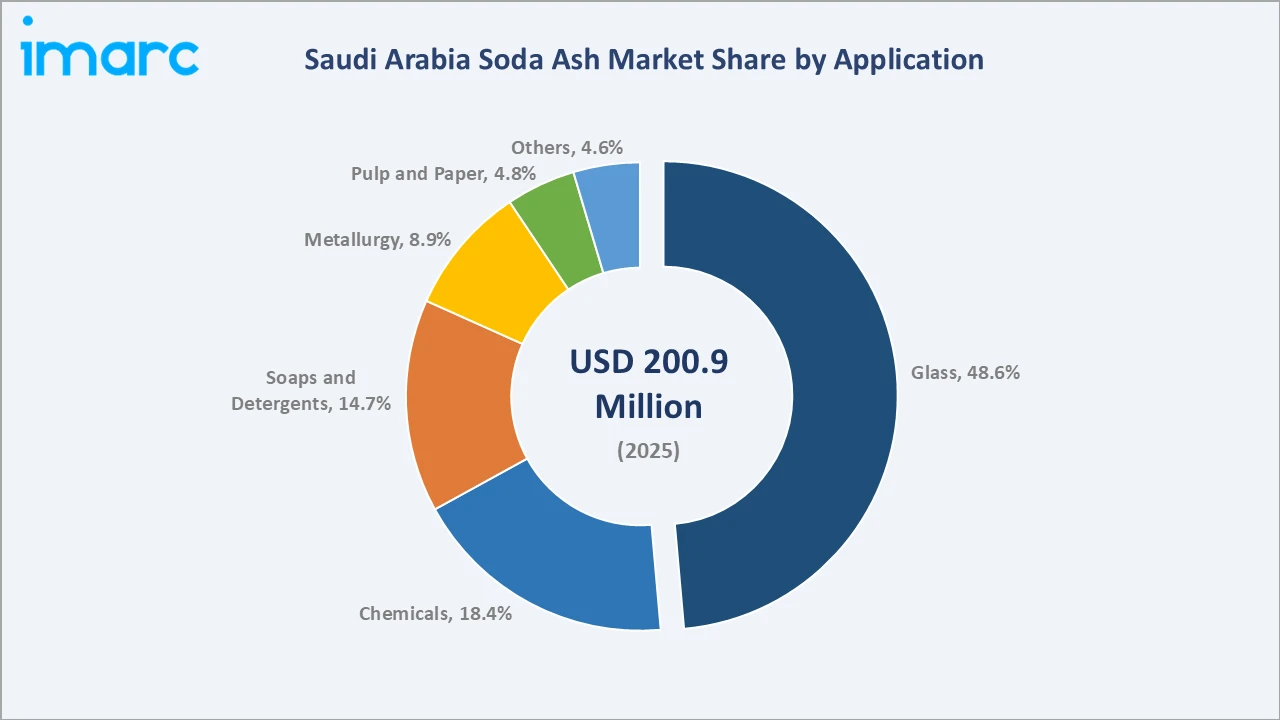
Chemicals account for 18.4% of application demand in 2025, driven by soda ash's use as a feedstock in sodium-based compounds for water treatment and industrial processing.
Regional Market Insights
|
Region |
Share (2025) |
Key Growth Drivers |
|
Northern and Central Region |
40.8% |
Concentration of population, construction activity, and industrial manufacturing capacity |
|
Eastern Region |
27.4% |
Established petrochemical and industrial infrastructure supporting chemicals and metallurgy demand |
|
Western Region |
20.6% |
Port-linked industrial activity and growing construction and packaging demand |
|
Southern Region |
11.2% |
Gradual industrial development and infrastructure investment |
Northern and Central Region leads with 40.8% share in 2025, anchored by Riyadh's concentration of construction activity, population growth, and downstream manufacturing capacity. Continued residential and commercial development across the capital region supports sustained demand for glass and chemical applications of soda ash.
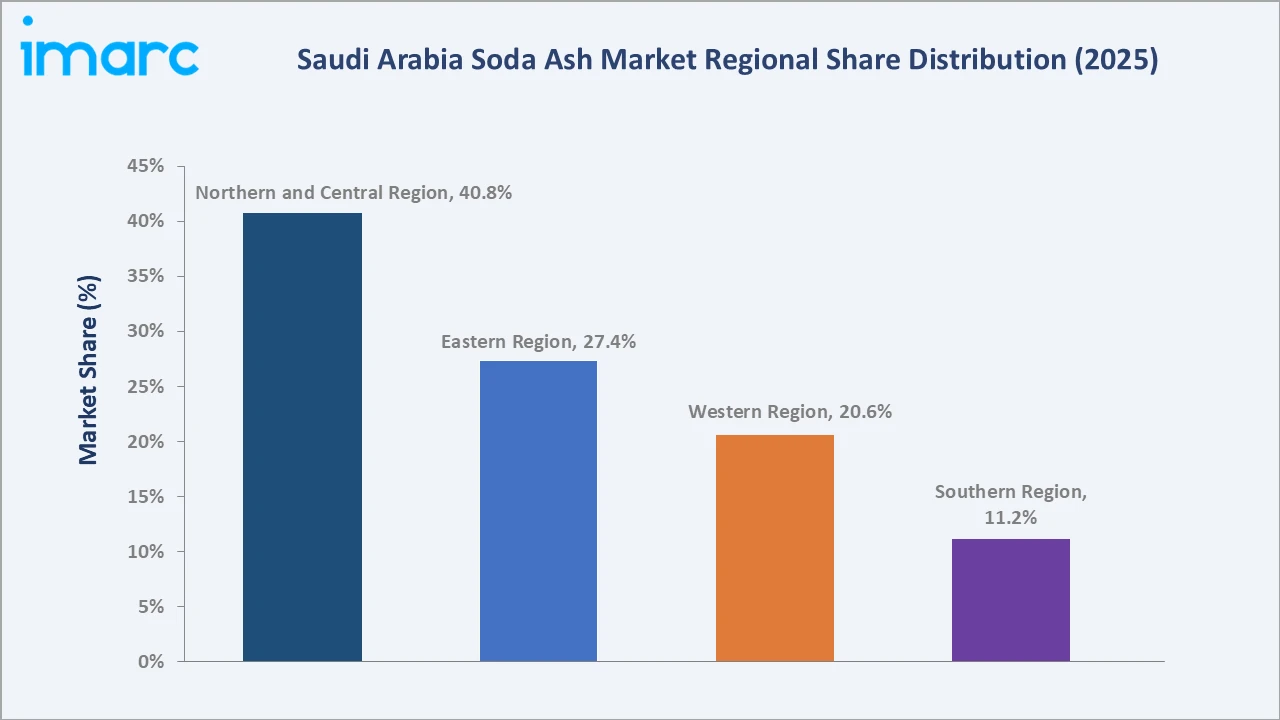
Eastern Region follows at 27.4%, supported by its established petrochemical and industrial base, along with steady demand from glass manufacturing and chemical processing industries.
Competitive Landscape
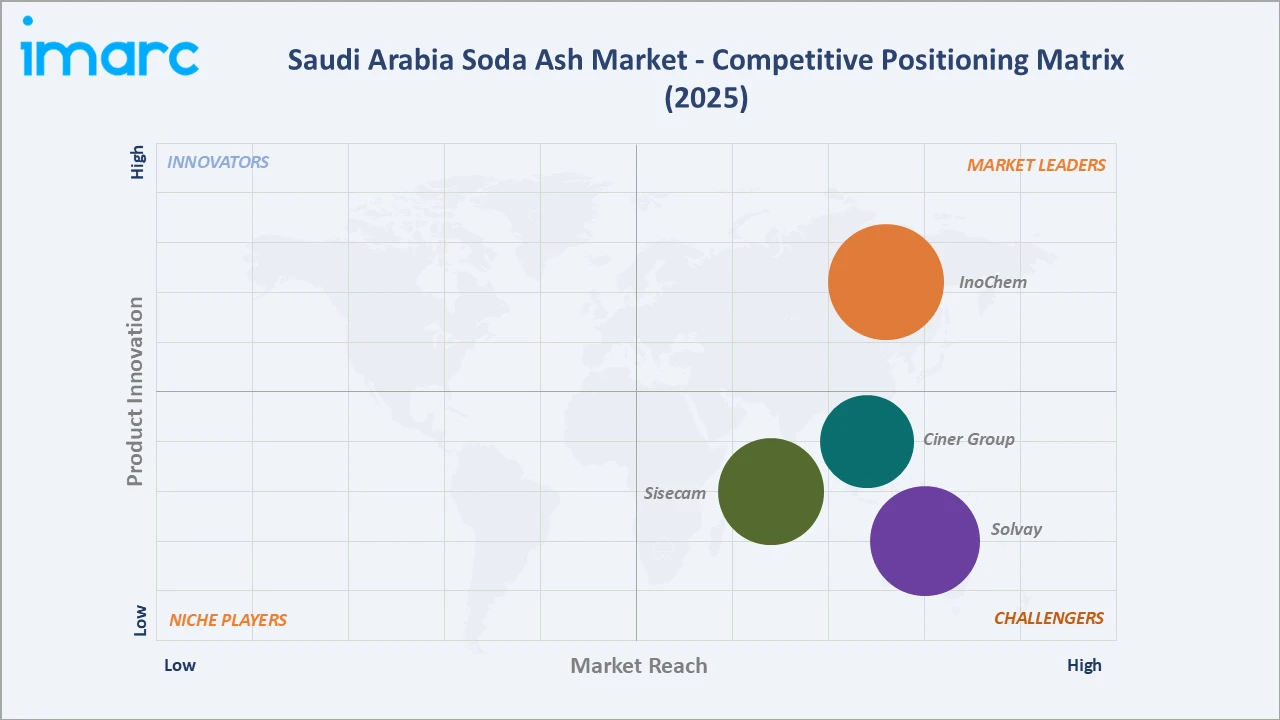
The Saudi Arabia soda ash market is moderately concentrated, with a single domestic manufacturer anchoring local supply alongside established international producers that serve the market through exports. Production scale, logistics proximity, and feedstock access form the primary competitive differentiators among active suppliers.
|
Company Name |
Brand / Key Product |
Position |
Strategic Focus |
|
InoChem |
InoChem |
Leader |
Domestic capacity expansion and import substitution |
|
Solvay |
Solvay |
Challenger |
Sustainable production technology and global supply reach |
|
Ciner Group |
Eti Soda, Kazan Soda |
Challenger |
Natural soda ash scale and global logistics network |
|
Sisecam |
Soda Ash Products |
Challenger |
Integrated glass and soda ash production |
Key players include InoChem, Solvay, Ciner Group, and Sisecam, among others.
Key Company Profiles
InoChem
InoChem is a Saudi Arabia-based chemical company focused on the production and supply of industrial chemicals, serving domestic and regional customers across multiple end-use industries.
- Product Portfolio: Soda ash and calcium chloride in various grades, serving glass, chemicals, and industrial customers.
- Recent Developments: The company has continued to expand production capabilities and strengthen local distribution to support rising industrial demand and enhance supply reliability.
- Strategic Focus: Strengthening the Kingdom's domestic soda ash supply base while reducing reliance on imported material.
Solvay
Solvay is a Belgian-French chemical company with a long-standing global presence in soda ash production, serving industrial customers across multiple continents.
- Product Portfolio: Soda ash and related sodium-based chemical products for industrial applications.
- Recent Developments: Solvay continues to invest in its global soda ash operations and in more sustainable, lower-emission production technology.
- Strategic Focus: Investing in cleaner production methods while maintaining a broad international customer base.
Ciner Group
Ciner Group is a Turkish conglomerate with a significant international presence in natural soda ash production, alongside interests in other industrial sectors.
- Product Portfolio: Natural soda ash produced through its group operations, serving glass, chemicals, and detergent industries worldwide.
- Recent Developments: Ciner Group continues to expand its natural soda ash production scale and global logistics and export capabilities.
- Strategic Focus: Growing its natural soda ash footprint through production scale, integrated logistics, and export reach.
Market Concentration Analysis
The Saudi Arabia soda ash market is moderately concentrated, with established manufacturers, import suppliers, and regional distributors collectively serving industrial demand across the country. Established supplier relationships and long-term procurement contracts further reinforce the competitive position of leading market participants.
Barriers to entry include high capital requirements, feedstock and energy access, and logistics infrastructure needed to compete with established import supply chains, favoring well-capitalized incumbents.
Consolidation within the global soda ash industry is reshaping competitive dynamics through greater production scale and broader distribution capabilities. This trend is expected to influence supply availability, pricing strategies, and sourcing patterns in import-dependent markets, such as Saudi Arabia, over the forecast period.
Investment & Growth Opportunities
Fastest-Growing Segments
Chemicals and metallurgy are expected to grow alongside the broader market, supported by ongoing industrial diversification and water treatment investment across the Kingdom. Growing investment in downstream manufacturing and industrial processing is expected to sustain demand for soda ash across these application segments over the forecast period.
Emerging Markets
Eastern Region's established petrochemical and industrial base positions it as a focal point for continued soda ash demand growth, particularly as chemicals and metallurgy applications expand alongside the region's manufacturing base.
Venture & Investment Trends
Investment is concentrated in domestic production capacity expansion and downstream glass manufacturing, with capital increasingly directed toward projects that support Vision 2030's industrial diversification and import-substitution objectives.
Future Market Outlook (2026-2034)
The Saudi Arabia soda ash market is forecast to expand from USD 200.9 Million in 2025 to USD 209.6 Million in 2026, reaching USD 295.2 Million by 2034 at a CAGR of 4.37%, adding approximately USD 94.3 Million in incremental market value over the forecast period.
Three forces will shape the market through 2034: continued maturation of domestic manufacturing capacity, sustained construction and glass-sector demand under Vision 2030, and gradual adoption of more sustainable production technologies across the industry.
By 2034, the market is expected to reflect a more balanced supply base, with growing domestic production complementing established import channels, and diversified demand extending further into chemicals, metallurgy, and specialty applications alongside glass.
Research Methodology
Primary Research
Primary research included structured discussions with industry participants across glass, chemicals, and soda ash manufacturing, validating demand patterns, application mix, and regional distribution.
Secondary Research
Secondary sources included public company disclosures, industry association publications, and Saudi government economic and industrial development materials, alongside international trade and pricing references.
Forecasting Models
Market forecasts were developed using historical growth patterns combined with application and regional demand indicators, incorporating scenario considerations for domestic capacity additions and construction sector activity.
Saudi Arabia Soda Ash Market Report Coverage:
| Report Features | Details |
|---|---|
| Base Year of the Analysis | 2025 |
| Historical Period | 2020-2025 |
| Forecast Period | 2026-2034 |
| Units | Million USD |
| Scope of the Report |
Exploration of Historical Trends and Market Outlook, Industry Catalysts and Challenges, Segment-Wise Historical and Future Market Assessment:
|
| Applications Covered | Glass, Soaps and detergents, Chemicals, Metallurgy, Pulp and paper, Others |
| Regions Covered | Northern and Central Region, Western Region, Eastern Region, Southern Region |
| Companies Covered | InoChem, Solvay, Ciner Group, Sisecam, etc. |
| Customization Scope | 10% Free Customization |
| Post-Sale Analyst Support | 10-12 Weeks |
| Delivery Format | PDF and Excel through Email (We can also provide the editable version of the report in PPT/Word format on special request) |
Key Benefits for Stakeholders:
- IMARC’s industry report offers a comprehensive quantitative analysis of various market segments, historical and current market trends, market forecasts, and dynamics of the Saudi Arabia soda ash market from 2020-2034.
- The research report provides the latest information on the market drivers, challenges, and opportunities in the Saudi Arabia soda ash market.
- Porter's five forces analysis assist stakeholders in assessing the impact of new entrants, competitive rivalry, supplier power, buyer power, and the threat of substitution. It helps stakeholders to analyze the level of competition within the Saudi Arabia soda ash industry and its attractiveness.
- Competitive landscape allows stakeholders to understand their competitive environment and provides an insight into the current positions of key players in the market.
Frequently Asked Questions About the Saudi Arabia Soda Ash Market Report
The Saudi Arabia soda ash market size is estimated at USD 209.6 Million in 2026, driven by steady glass manufacturing, chemicals production, and continued industrial diversification across the Kingdom.
The market is projected to grow at a CAGR of 4.37% from 2026-2034, reaching USD 295.2 Million, supported by construction activity and domestic manufacturing expansion.
Glass leads at 48.6% share in 2025, driven by construction and packaging demand.
Northern and Central Region commands 40.8% share in 2025, led by Riyadh's concentration of construction activity and downstream manufacturing capacity.
Leading players include InoChem, Solvay, Ciner Group, and Sisecam, among others.
Vision 2030's industrial diversification agenda is encouraging domestic soda ash manufacturing investment, supporting import substitution and broader non-oil economic growth.
Energy and feedstock cost volatility, import dependence for synthetic soda ash, and tightening environmental compliance requirements weigh on market growth.
Producers are adopting energy-efficient processes and exploring lower-carbon production technologies, aligning with global sustainability trends as domestic capacity matures.
Need more help?
- Speak to our experienced analysts for insights on the current market scenarios.
- Include additional segments and countries to customize the report as per your requirement.
- Gain an unparalleled competitive advantage in your domain by understanding how to utilize the report and positively impacting your operations and revenue.
- For further assistance, please connect with our analysts.
 Request Customization
 Speak to an Analyst
 Request Brochure
 Inquire Before Buying
Benefits of Customization
- Personalize this research
- Triangulate with your data
- Get data as per your format and definition
- Gain a deeper dive into a specific application, geography, customer, or competitor
- Any level of personalization
Get in Touch With Us
UNITED STATES
Phone: +1-201-971-6302
INDIA
Phone: +91-120-433-0800
UNITED KINGDOM
Phone: +44-753-714-6104
Email: [email protected]
Client Testimonials




.webp)




.webp)













Related Reports

Choose your plan
*Please note that the prices mentioned below are starting prices for each bundle type. Kindly contact our team for further details.*
Single User License
- 1 User License, Access on 2 Devices
- PDF Report + Excel Dataset (Password Protected)
- Lifetime Access
- No Printing Rights
- 10% Free Report Customization
- 10–12 Weeks of Analyst Support
Five User License
- Access for 5 Users, 2 Devices per User
- PDF Report + Excel Dataset (Password Protected)
- Lifetime Access
- Dedicated Account Manager
- 12–14 Weeks of Analyst Support
- No Printing Rights
- 15% Free Report Customization
- 25% Discount on Your Next Purchase
Corporate User License
- Unlimited User Access (Within Your Organization)
- PDF Report + Excel Dataset
- Lifetime Access
- Dedicated Account Manager
- 14–20 Weeks of Analyst Support
- No Printing Rights
- 20% Free Report Customization
- 30% Discount on Your Next Purchase
Essential Insights
What's included:
3 reports
- Lifetime Access
- PDF Reports
- Excel Datasets
- 2 Weeks of Free Analyst Support
- 2 User Licenses
- Access on 2 Devices
- Printing Rights
- Complimentary PowerPoint (PPT) Version
- Complimentary License Upgrade
Professional Access
What's included:
5 reports
- Lifetime Access
- PDF Reports
- Excel Datasets
- 8 Weeks of Free Analyst Support
- 2 User Licenses
- Access on 2 Devices
- Printing Rights
- Complimentary PowerPoint (PPT) Version
- Complimentary License Upgrade
Business Advantage
What's included:
8 reports
- Lifetime Access
- PDF Reports
- Excel Datasets
- 14 Weeks of Free Analyst Support
- 2 User Licenses
- Access on 2 Devices
- Printing Rights
- Complimentary PowerPoint (PPT) Version
- Complimentary License Upgrade
Enterprise Intelligence
What's included:
10 reports
- Lifetime Access
- PDF Reports
- Excel Datasets
- 20 Weeks of Free Analyst Support
- 2 User Licenses
- Access on 2 Devices
- Printing Rights
- Complimentary PowerPoint (PPT) Version
- Complimentary License Upgrade