
Saudi Arabia Soft Skills Training Market Size, Share, Trends and Forecast by Soft Skill Type, Channel Provider, Sourcing, Delivery Mode, End Use Industry, and Region, 2026-2034
Saudi Arabia Soft Skills Training Market Size, Share, Trends & Forecast (2026-2034)
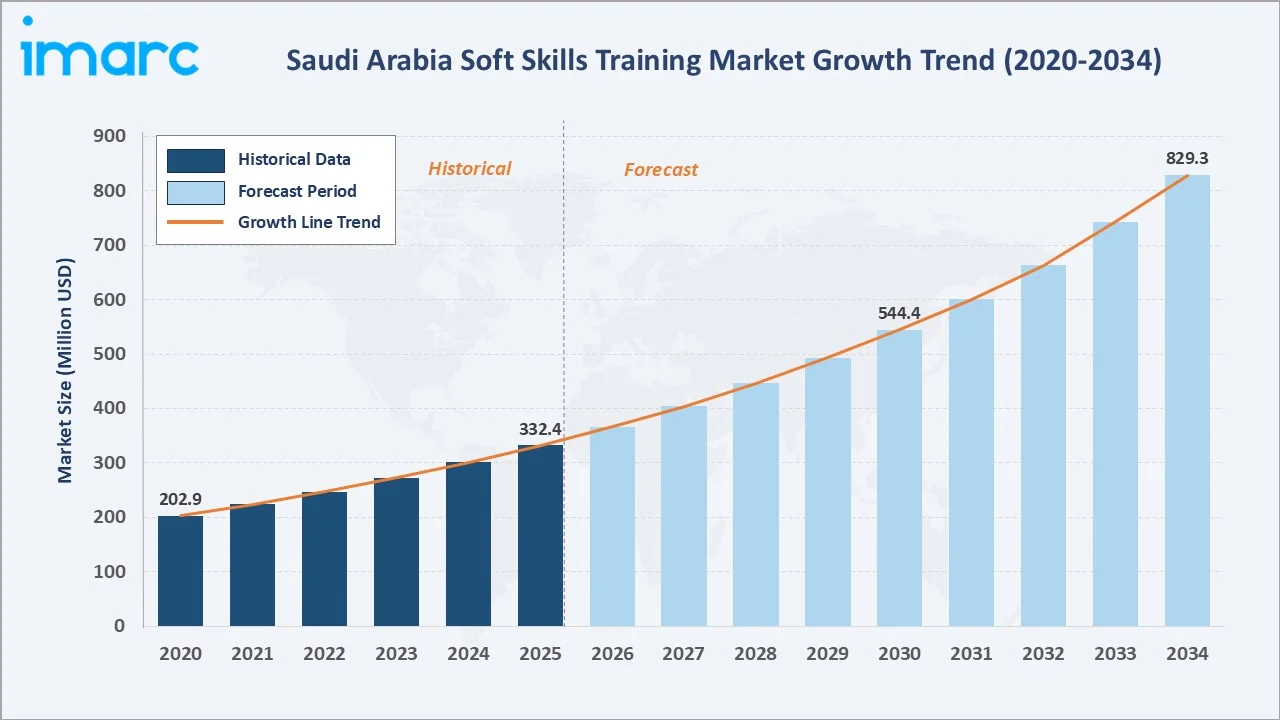
The Saudi Arabia soft skills training market size increased from USD 332.4 Million in 2025 to USD 376.6 Million in 2026 and is projected to reach USD 829.3 Million by 2034, exhibiting a CAGR of 10.37% during 2026-2034. This growth is driven by rising demand for leadership, communication, teamwork, and other interpersonal skills across Saudi Arabia’s evolving workforce.
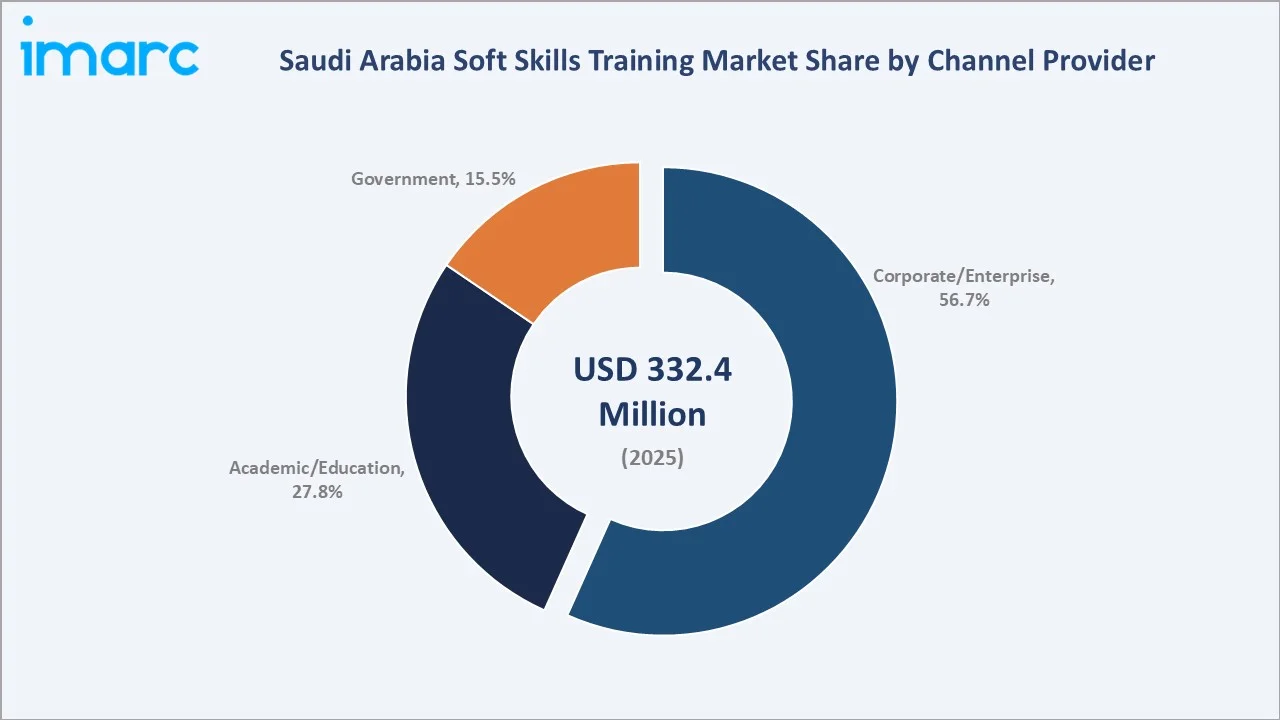
Corporate/enterprise leads the channel provider segment at 56.7%, in-house accounts for 61.4% by sourcing, and Northern and Central Region commands 36.9% of regional share.
Market Snapshot
|
Metric |
Value |
| Base Year Market Size (2025) |
USD 332.4 Million |
| Market Size (2026) | USD 376.6 Million |
|
Forecast Market Size (2034) |
USD 829.3 Million |
|
CAGR (2026-2034) |
10.37% |
|
Base Year |
2025 |
|
Historical Period |
2020-2025 |
|
Forecast Period |
2026-2034 |
|
Largest Region |
Northern and Central Region (36.9%, 2025) |
|
Second Largest Region |
Western Region (30.5%, 2025) |
|
Leading Channel Provider |
Corporate/Enterprise (56.7%, 2025) |
|
Leading Sourcing |
In-house (61.4%, 2025) |
The Saudi Arabia soft skills training market expanded from USD 202.9 Million in 2020 to USD 332.4 Million in 2025 and an estimated USD 376.6 Million in 2026, supported by rising enterprise HR investment, government-mandated Saudization compliance training, and rapid adoption of digital learning platforms across public and private sectors. Anchored at USD 544.4 Million in 2030, the forecast to USD 829.3 Million by 2034 is underpinned by deepening Vision 2030 workforce programs, expanding academic partnerships, and growing demand for bilingual Arabic-English soft skills content.
To get more information on this market, Request Sample
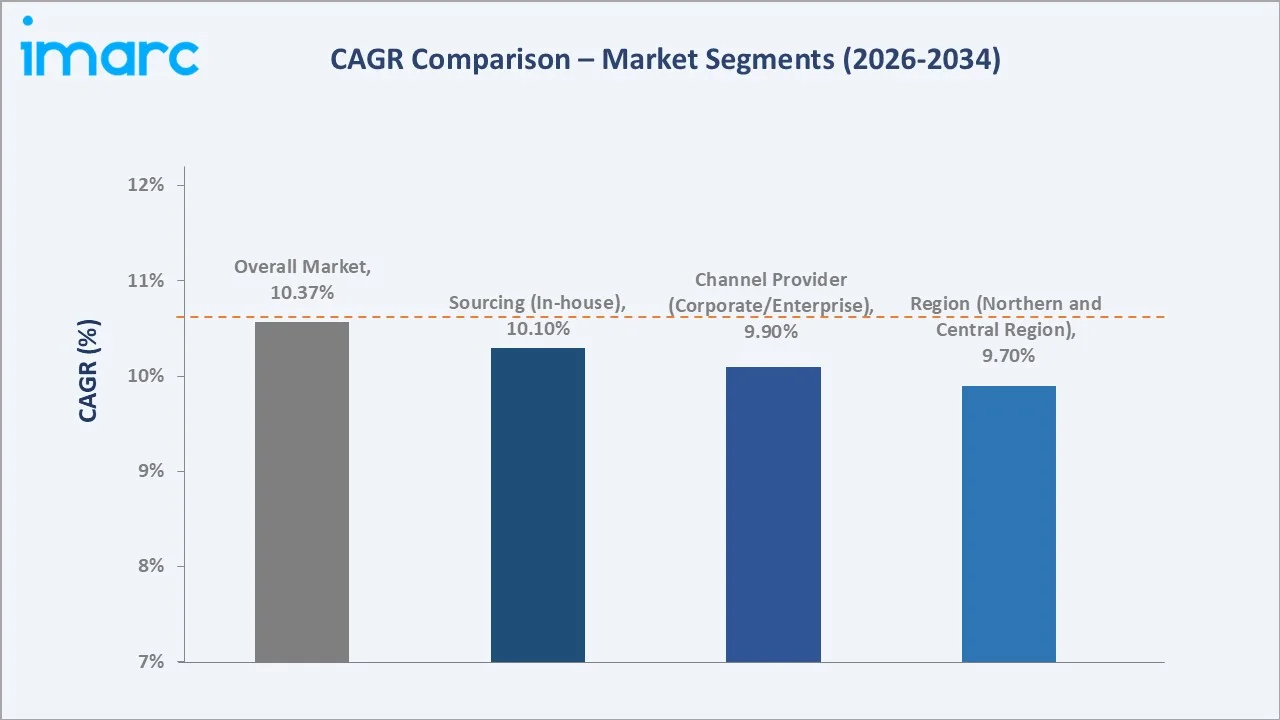
CAGR trajectories across channel provider and sourcing sub-segments, together with regional patterns, show Eastern Region and outsourced expanding faster than the overall 10.37% market CAGR, driven by rising enterprise outsourcing, growing EdTech partnerships, and increasing non-metro participation in structured training programs.
Executive Summary
The Saudi Arabia soft skills training market is on a sustained growth trajectory, rising from USD 202.9 Million in 2020 to an estimated USD 376.6 Million in 2026 and is projected to reach USD 829.3 Million by 2034. The sector has evolved from traditional classroom instruction to a hybrid ecosystem of in-person workshops, live virtual sessions, and self-paced digital modules spanning communication, leadership, critical thinking, and emotional intelligence competencies.
Corporate/enterprise dominates the channel provider segment at 56.7% in 2025, supported by mandatory compliance training, leadership pipelines, and customer-facing staff development programs. In-house commands 61.4% of the sourcing segment, reflecting large enterprises' preference for customized, culturally adapted training content delivered by internal or captive trainers. Northern and Central Region leads with 36.9% share in 2025, anchored by Riyadh's concentration of corporate headquarters, government ministries, and training institutions.
Key Market Insights
|
Insight |
Data |
|
Leading Channel Provider |
Corporate/Enterprise – 56.7% share (2025) |
|
Second Largest Channel Provider |
Academic/Education – 27.8% share (2025) |
|
Leading Sourcing |
In-house – 61.4% share (2025) |
|
Second Largest Sourcing |
Outsourced – 38.6% share (2025) |
|
Leading Region |
Northern and Central Region – 36.9% share (2025) |
|
Second Largest Region |
Western Region – 30.5% share (2025) |
|
Top Companies |
Meirc Training & Consulting, Franklin Covey Co., Dale Carnegie & Associates Global, Inc., Korn Ferry |
Key Analytical Observations Expanding On the Data Above:
- Corporate/enterprise dominance at 56.7% is driven by strong demand for leadership development, communication, teamwork, and managerial effectiveness programs across organizations undergoing workforce transformation.
- Academic/education at 27.8% reflects growing university and vocational institute partnerships with training providers, integrating soft skills curricula to better prepare graduates for the private sector labor market.
- In-house at 61.4% underscores corporate preference for customized, brand-aligned soft skills programs delivered by internal training teams or dedicated corporate academies.
- Outsourced share at 38.6% indicates continued reliance on external training providers for specialized expertise, certified instructors, and scalable soft skills programs that complement internal corporate training capabilities.
- Northern and Central Region at 36.9% is supported by the concentration of major businesses, government institutions, educational organizations, and professional training activities in key urban centers, particularly Riyadh.
Saudi Arabia Soft Skills Training Market Overview
Soft skills training encompasses structured programs designed to develop interpersonal, communication, leadership, emotional intelligence, critical thinking, and adaptability competencies among individuals and teams. In Saudi Arabia, the market serves corporate employees, academic learners, and government personnel, delivering content through classroom instruction, virtual platforms, and on-demand digital modules.
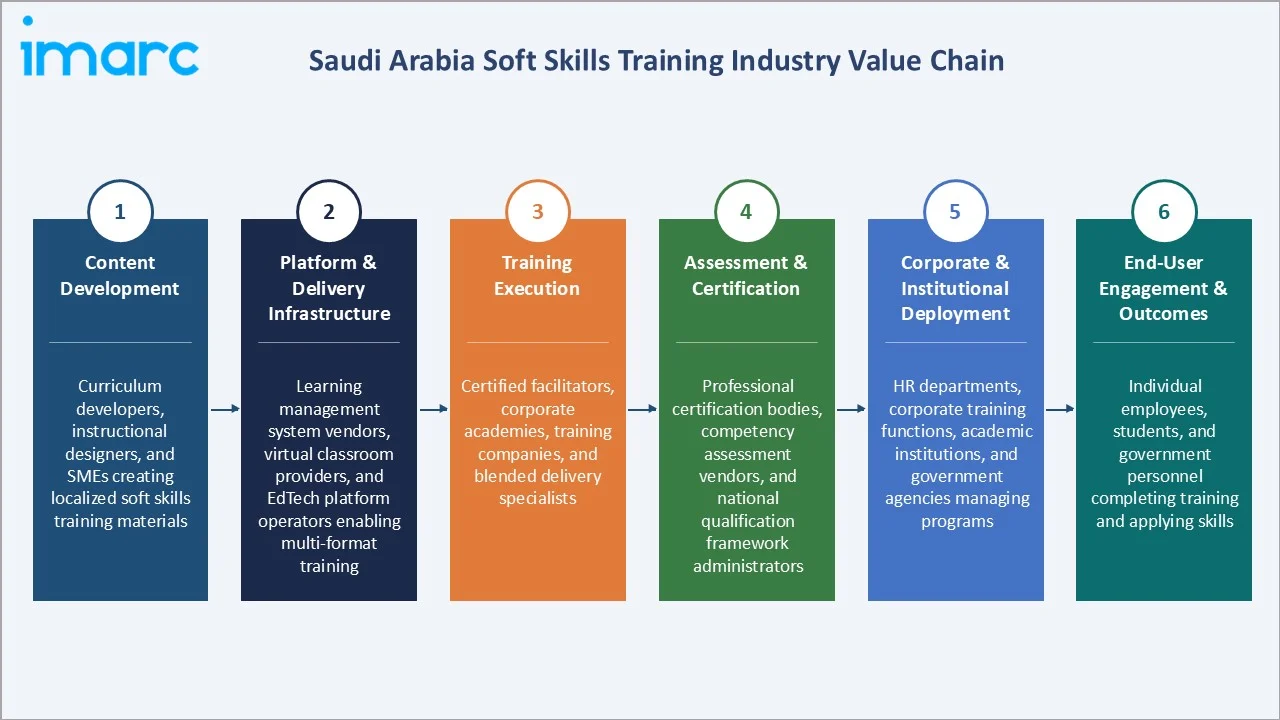
The Saudi ecosystem integrates content developers, training delivery platforms, certified facilitators, assessment bodies, corporate and government clients, and EdTech distributors. Together, these actors support a growing national imperative to close the soft skills gap between Saudi graduates and labor market expectations, directly supporting Vision 2030's Saudization and productivity targets.
Market Dynamics
To evaluate market opportunities, Request Sample
Market Drivers
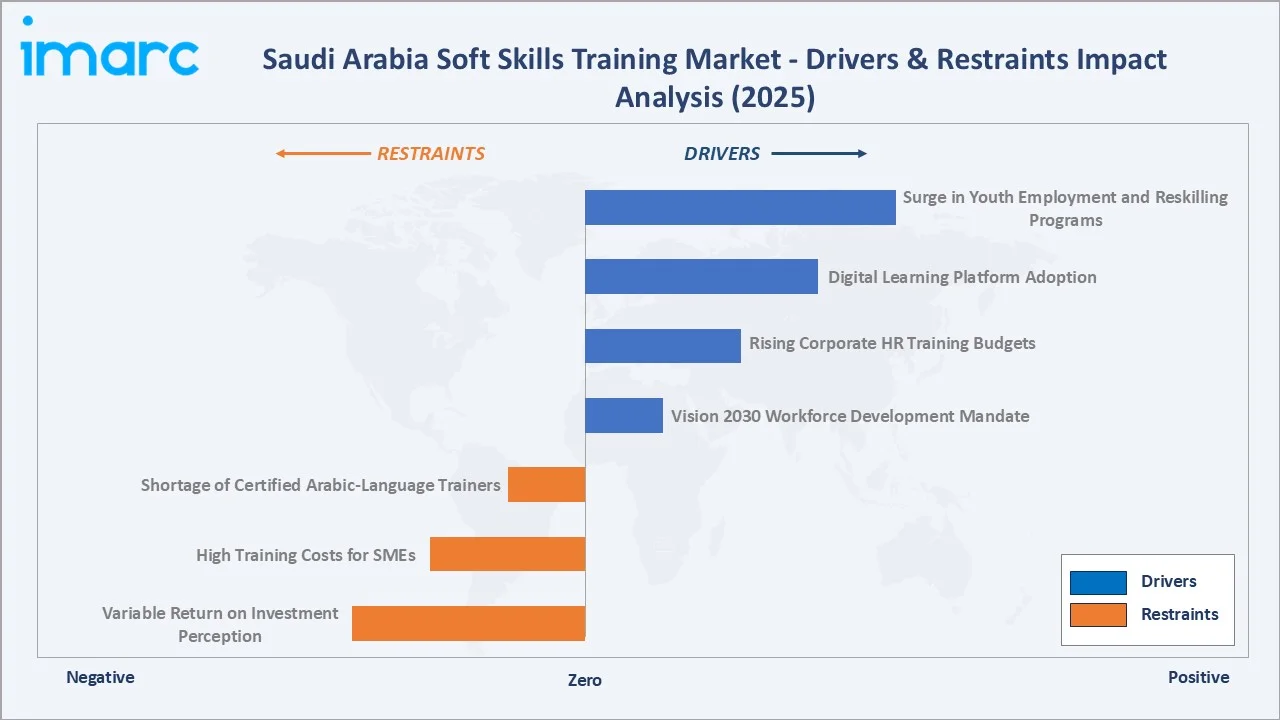
- Vision 2030 Workforce Development Mandate: Saudi Arabia’s Vision 2030 emphasizes workforce capability development and employability, encouraging organizations and educational institutions to strengthen leadership, communication, collaboration, and other interpersonal skills.
- Rising Corporate HR Training Budgets: Large enterprises and multi-national corporations operating in Saudi Arabia are increasing HR training budgets to develop communication, leadership, and customer service skills. The Human Resources Development Fund (HRDF) aided 143,000 Saudi individuals in securing jobs in the private sector during the first quarter of 2025, allocating 1.83 Billion SAR towards training, empowerment, and support programs.
- Digital Learning Platform Adoption: The widespread adoption of learning management systems, virtual instructor-led training, and mobile microlearning platforms is lowering delivery costs and expanding access to soft skills programs across geographically dispersed corporate sites and academic campuses nationwide.
- Surge in Youth Employment and Reskilling Programs: Government initiatives targeting youth employment, graduate employability, and mid-career reskilling are generating a large and consistent pipeline of participants in soft skills programs, sustaining demand across academic and public sector channels.
Market Restraints
- Shortage of Certified Arabic-Language Trainers: The Kingdom faces a structural shortage of locally certified, Arabic-speaking facilitators with expertise in culturally adapted soft skills content, limiting delivery capacity particularly outside major urban centers and constraining program quality in Tier-2 cities.
- High Training Costs for SMEs: Smaller and medium-sized enterprises often face budget constraints that restrict access to premium training programs and certified external providers, moderating demand in the outsourced training segment.
- Variable Return on Investment Perception: Inconsistent measurement frameworks for training return on investment create uncertainty for procurement decision-makers, particularly in the public sector, slowing training budget approvals and renewal cycles.
Market Opportunities
- EdTech and Mobile Learning Expansion: The rapid expansion of the EdTech sector in Saudi Arabia is enabling training providers to offer scalable, bilingual Arabic-English soft skills content through mobile-first platforms, reaching learners in smaller cities and remote corporate sites with consistent quality and lower per-learner costs.
- Emerging Sector Talent Development Needs: Large-scale infrastructure projects, tourism development, and new economic cities under Vision 2030 are generating significant talent acquisition and development needs across hospitality, retail, and project management sectors, creating new and underserved demand pools for soft skills training.
Market Challenges
- Content Localization and Cultural Sensitivity: Culturally sensitive content localization remains a persistent challenge, as many global training frameworks require significant adaptation to align with Saudi workplace norms, communication styles, and gender-segregated learning environments.
- Evolving Learning Format Preferences: Rapid shifts toward hybrid and remote working models are demanding continuous updates to training delivery formats, requiring providers to invest consistently in platform technology and instructor upskilling to maintain relevance and effectiveness.
Emerging Market Trends
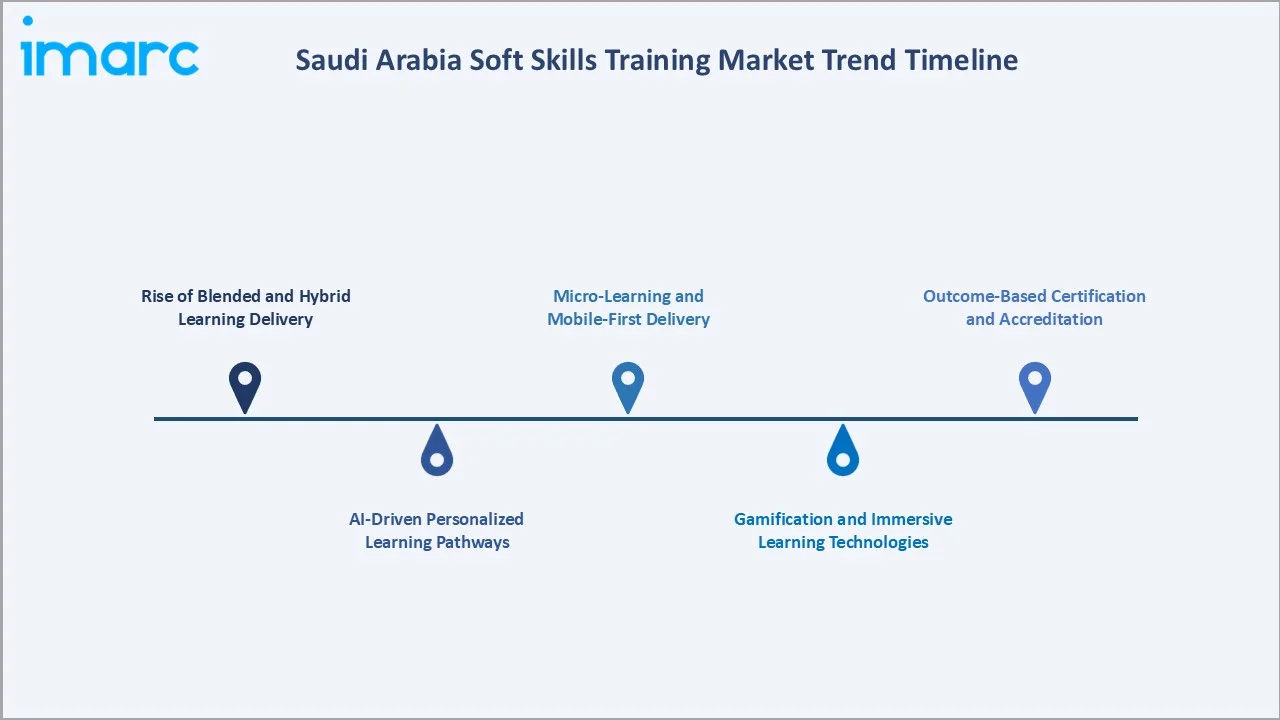
1. Rise of Blended and Hybrid Learning Delivery
Training providers are rapidly integrating in-person workshops with virtual instructor-led sessions and self-paced digital modules to meet diverse learner preferences and organizational scheduling needs. This blended approach is improving completion rates and enabling more flexible deployment across multi-site corporate clients.
2. AI-Driven Personalized Learning Pathways
AI is being deployed within learning management systems to generate adaptive learning paths based on individual competency assessments, prior training history, and role-specific development goals.
3. Gamification and Immersive Learning Technologies
Gamification elements, such as points, leaderboards, and scenario-based simulations, are being embedded in soft skills programs to increase engagement and drive behavioral change. Immersive technologies including virtual reality (VR) are being piloted for high-stakes communication, negotiation, and leadership training scenarios.
4. Micro-Learning and Mobile-First Delivery
Short-form, mobile-optimized learning modules of three to ten minutes are gaining traction among corporate clients seeking to embed continuous development into daily workflows without disrupting business operations. This format is particularly effective for reinforcing communication and professional etiquette skills.
5. Outcome-Based Certification and Accreditation
Employers and government entities are increasingly mandating recognized certifications tied to demonstrated behavioral outcomes rather than completion hours, driving training providers to redesign programs around measurable competency frameworks aligned with national qualification standards.
Industry Value Chain Analysis
The Saudi Arabia soft skills training value chain spans six stages, from content development and platform delivery through end-user engagement and outcome management. Training execution and assessment capture the highest value-add, while content localization and culturally adapted delivery increasingly determine competitive differentiation within this rapidly evolving market.
|
Stage |
Key Players / Examples |
|
Content Development |
Curriculum developers, instructional designers, and subject matter experts creating localized soft skills training materials and digital content modules |
|
Platform & Delivery Infrastructure |
Learning management system vendors, virtual classroom providers, and EdTech platform operators enabling multi-format training deployment |
|
Training Execution |
Certified facilitators, corporate academies, training companies, and blended delivery specialists conducting instructor-led and virtual sessions |
|
Assessment & Certification |
Professional certification bodies, competency assessment vendors, and national qualification framework administrators validating skill attainment |
|
Corporate & Institutional Deployment |
HR departments, corporate training functions, academic institutions, and government agencies procuring and managing training programs |
|
End-User Engagement & Outcomes |
Individual employees, students, and government personnel completing training and applying skills within their respective workplace contexts |
Vertically integrated training providers, particularly those combining proprietary content libraries with direct delivery capabilities and outcome measurement tools, are positioned to capture disproportionate value compared to providers dependent on third-party platforms or external content licensing.
Technology Landscape in the Saudi Arabia Soft Skills Training Industry
Learning Management Systems and Virtual Delivery Platforms
Cloud-based learning management systems and virtual instructor-led training platforms are the primary technology backbone of the soft skills training industry, enabling scalable program delivery, learner progress tracking, and reporting across corporate, academic, and government clients.
AI and Adaptive Learning
AI and machine learning (ML) tools are being integrated into training platforms to deliver personalized learning journeys, automated competency gap analysis, and real-time feedback on learner performance, improving both training efficiency and behavioral change outcomes.
Gamification and Simulation Technologies
Gamified elements and scenario-based simulations are being deployed to enhance learner engagement in communication, negotiation, and leadership programs, with VR piloted for high-fidelity interpersonal skills practice in controlled environments.
Mobile Learning and Microlearning Tools
Mobile-optimized platforms and short-form content authoring tools are enabling employers to embed continuous soft skills development into daily workflows, supporting just-in-time learning and reinforcement across distributed workforce environments.
Market Segmentation Analysis
The report covers the following segments:
|
Segment Category |
Leading Segment |
Market Share |
Year |
|
Soft Skill Type |
🔒 |
🔒 |
2025 |
|
Channel Provider |
Corporate/Enterprise |
56.7% |
2025 |
|
Sourcing |
In-house |
61.4% |
2025 |
|
Delivery Mode |
🔒 |
🔒 |
2025 |
|
End-Use Industry |
🔒 |
🔒 |
2025 |
|
Region |
Northern and Central Region |
36.9% |
2025 |

By Channel Provider
Corporate/enterprise commands a 56.7% majority share in 2025, driven by rising HR investment in leadership development, customer service training, and compliance-related communication programs across Saudi-listed companies and multi-national corporations.
To access detailed market analysis, Request Sample
Academic/education at 27.8% in 2025 reflects growing partnerships between universities, vocational institutes, and training providers to integrate soft skills certification into graduate and continuing education programs.
By Sourcing
In-house leads with 61.4% share in 2025, reflecting the preference of large corporates and government institutions for customized, brand-aligned programs delivered through internal training functions, dedicated corporate academies, or captive trainer networks.
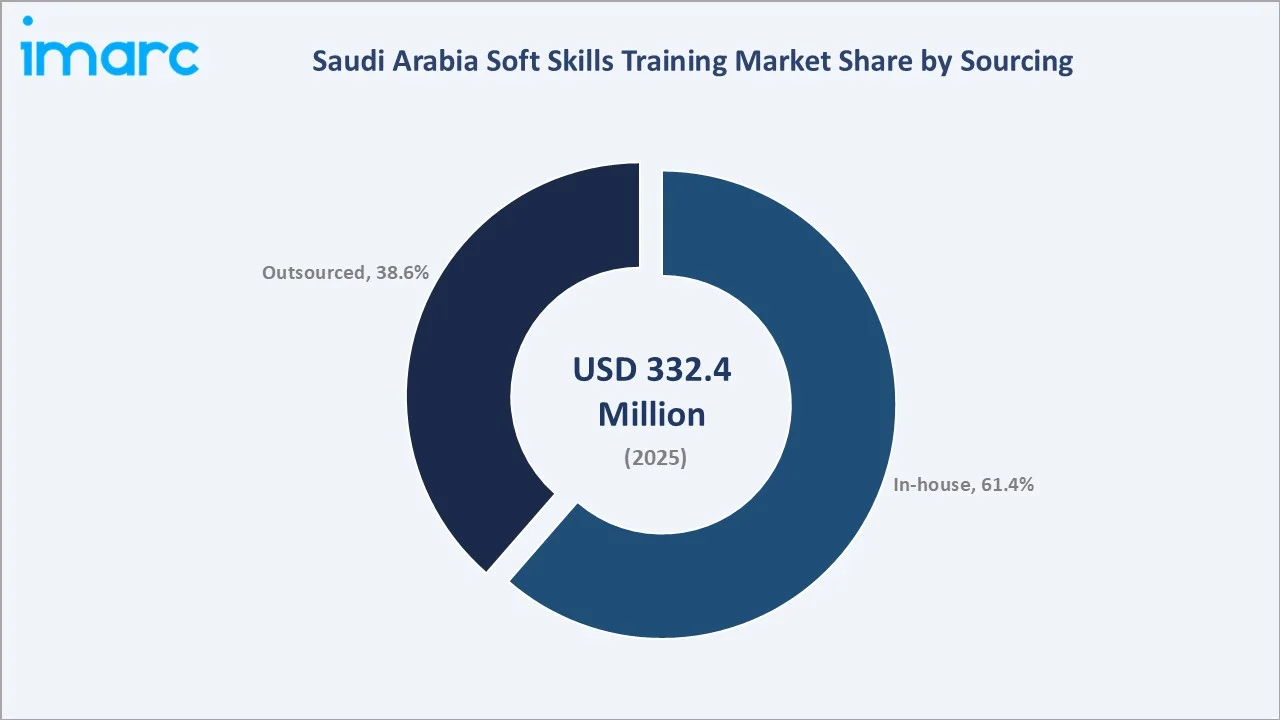
Outsourced at 38.6% in 2025 is gaining traction among mid-sized enterprises and academic institutions seeking access to specialized expertise, accredited content, and technology-enabled delivery without building internal training infrastructure.
Regional Market Insights
|
Region |
Share (2025) |
Key Growth Drivers |
|
Northern and Central Region |
36.9% |
Concentration of corporate headquarters, government ministries, and accredited training centers in Riyadh; high per-capita enterprise training spend and strong regulatory alignment with Vision 2030 |
|
Western Region |
30.5% |
Active commercial environment in Jeddah, growing academic institution partnerships, expanding hospitality and tourism sector training needs, and rising SME investment in staff development |
|
Eastern Region |
21.2% |
Energy sector workforce development programs, rising multinational presence in Dhahran and Dammam, and expanding demand from petrochemical and engineering firms for technical and interpersonal skills training |
|
Southern Region |
11.4% |
Emerging enterprise activity driven by special economic zones, growing government-sponsored training initiatives, and rising participation from regional universities and vocational institutes |
Northern and Central Region at 36.9% in 2025 leads the regional landscape, anchored by Riyadh's position as the Kingdom's administrative and corporate capital. The region's alignment with Vision 2030's core delivery mechanisms and national transformation program headquarters sustains its regional dominance.
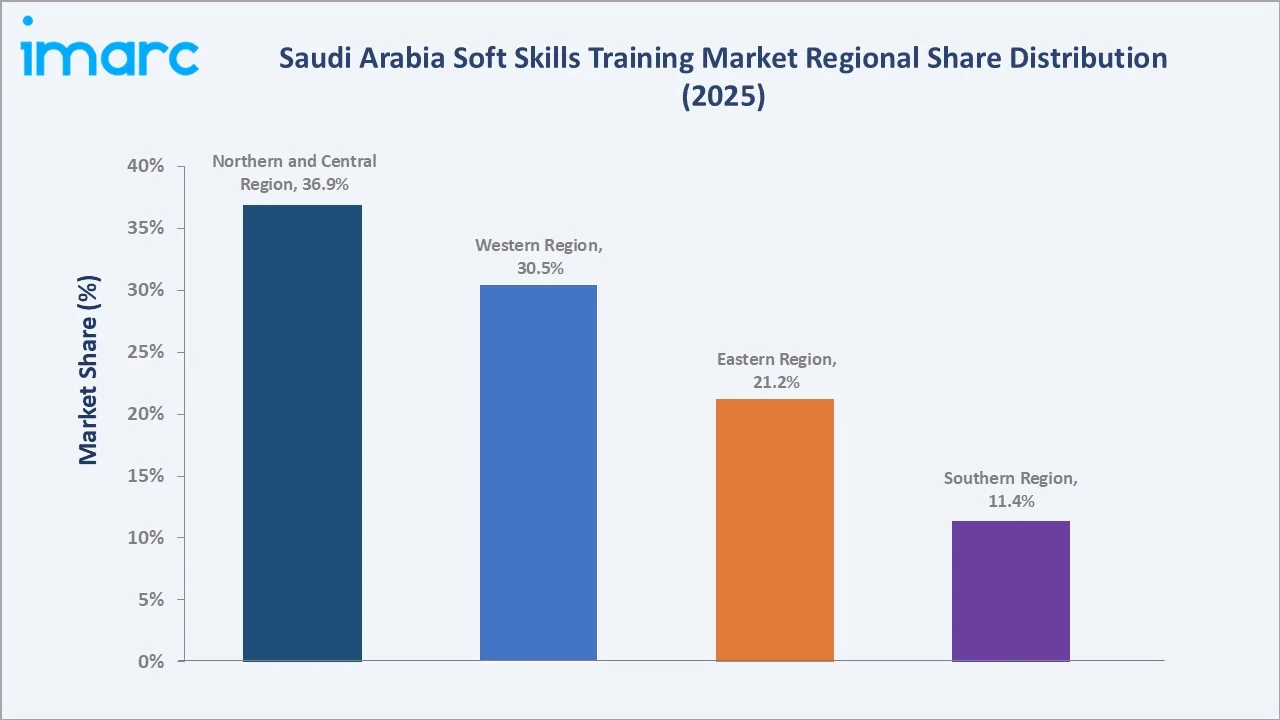
Eastern Region, while currently at 21.2%, is expanding at an above-average rate as energy companies, petrochemical firms, and infrastructure contractors invest in structured interpersonal and leadership training for their Saudi national workforces.
Competitive Landscape
The Saudi Arabia soft skills training market is moderately fragmented, with established international training firms, regional specialists, and government-affiliated academies competing across corporate, academic, and public sector channels. Depth of Arabic-language content, certified facilitator networks, digital delivery capability, and regulatory compliance with HRDF standards form the key competitive differentiators across the industry.
|
Company Name |
Brand / Key Product |
Position |
Strategic Focus |
|
Meirc Training & Consulting |
Meirc |
Leader |
Expanding certified leadership and communication programs through blended delivery and regional center growth |
|
Franklin Covey Co. |
7 Habits of Highly Effective People |
Leader |
Growing digital and in-person program delivery through regional partnerships and enterprise licensing |
|
Dale Carnegie & Associates Global, Inc. |
Dale Carnegie Course |
Leader |
Deepening corporate client relationships through customized in-house programs and facilitator certification |
|
Korn Ferry |
Korn Ferry Leadership & Professional Assessments |
Challenger |
Integrating AI-driven leadership assessment with training delivery for large enterprise and government clients |
Key players include Meirc Training & Consulting, Franklin Covey Co., Dale Carnegie & Associates Global, Inc., and Korn Ferry, among others.
Key Company Profiles
Meirc Training & Consulting
Meirc Training & Consulting is an independent multinational training and consulting firm headquartered in Dubai, UAE, with dedicated operations across Saudi Arabia. The firm offers open-enrollment and customized in-house soft skills and management development programs to corporate and government clients.
- Product Portfolio: Leadership development, communication skills, emotional intelligence, team effectiveness, and professional development certifications tailored for the Gulf region.
- Recent Developments: The company has continued to broaden its training portfolio and strengthen its regional presence, supporting corporate and government clients across the Kingdom with expanded program offerings.
- Strategic Focus: Expanding the certified program portfolio and in-house delivery capability to serve large corporate and government clients across Saudi Arabia and the broader Gulf region.
Franklin Covey Co.
Franklin Covey Co. is a global leadership development and performance improvement company headquartered in Utah. The company delivers leadership and effectiveness programs through directly owned offices and licensee partners in several countries, including dedicated operations across Saudi Arabia.
- Product Portfolio: 7 Habits of Highly Effective People and digital learning subscriptions covering leadership and communication skills.
- Recent Developments: The company has continued to advance its digital and in-person program offerings, supporting enterprise clients across Saudi Arabia with enhanced training solutions and expanded delivery formats.
- Strategic Focus: Growing digital subscription adoption and in-person program delivery across regional markets through licensee networks and certified facilitator programs.
Dale Carnegie & Associates Global, Inc.
Dale Carnegie & Associates Global, Inc. is a global leadership and interpersonal skills training organization, delivering programs in Saudi Arabia through its authorized franchise network and serving corporate clients and individual professionals through structured classroom and virtual formats.
- Product Portfolio: Dale Carnegie Course and customized in-house communication and sales effectiveness programs.
- Recent Developments: The organization has continued to strengthen its franchise network and expand program delivery across the Kingdom, supporting corporate clients with structured soft skills and leadership development solutions.
- Strategic Focus: Deepening franchise-supported program delivery across Saudi Arabia and growing corporate client partnerships through customized in-house training and facilitator certification.
Market Concentration Analysis
The Saudi Arabia soft skills training market is moderately fragmented, with the top training providers accounting for a meaningful but not dominant share of total market revenues. The market structure reflects the presence of established international brands, regional specialists, corporate academies, and a long tail of smaller local providers competing on language, cultural fit, price, and sector expertise.
Barriers to entry are relatively low for smaller providers competing on standard program formats, but high for organizations seeking HRDF accreditation, Arabic-language content depth, and certified bilingual facilitator capacity at scale. These factors favor established regional training firms and international brands with proven localization capabilities and existing government and enterprise relationships.
Consolidation is gradually increasing as larger training organizations acquire niche content specialists and regional providers to broaden their program portfolios and geographic reach. Strategic partnerships between global training brands and local Saudi partners are further reshaping competitive positioning, particularly as HRDF accreditation requirements and Saudization compliance drive enterprise clients toward registered, certified providers.
Investment & Growth Opportunities
Fastest-Growing Segments
Outsourced is expanding fastest among sourcing categories, driven by rising SME demand for affordable, HRDF-registered programs without the overhead of internal training functions.
Emerging Markets
Eastern Region is the fastest growing regional market, supported by sustained energy sector workforce investment, rising multinational presence, and growing HRDF co-funding uptake among Dhahran and Dammam-based enterprises. Southern Region represents significant untapped opportunity as new economic zone development and tourism infrastructure investment generate fresh demand for soft skills training across hospitality, retail, and service sectors.
Venture & Investment Trends
Investment activity is concentrated in EdTech platforms offering Arabic-language soft skills content, AI-powered competency assessment tools, and mobile-first microlearning delivery systems. Capital is also flowing into HRDF-accredited training businesses and content localization specialists capable of scaling bilingual program delivery across the Kingdom's growing enterprise and government client base.
Future Market Outlook (2026-2034)
The Saudi Arabia soft skills training market is projected to grow from USD 332.4 Million in 2025 to USD 376.6 Million in 2026, reaching USD 829.3 Million by 2034 at a CAGR of 10.37%, adding approximately USD 496.9 Million in incremental market value over the forecast period.
Four forces will shape the market through 2034: sustained Vision 2030 workforce development investment and Saudization targets; deeper penetration of AI-driven and mobile-first learning platforms across corporate and academic channels; continued expansion of HRDF-accredited program portfolios by established providers; and growing enterprise demand for outcome-based, certified soft skills programs tied to measurable productivity and leadership performance metrics.
By 2034, the Saudi Arabia soft skills training market is expected to be characterized by integrated digital-physical learning ecosystems, with corporate academies and EdTech partnerships enabling continuous, role-specific competency development. Sustained government investment in national human capital programs and expanding private sector HR budgets are expected to underpin compound growth throughout the forecast period.
Research Methodology
Primary Research
Primary research included structured interviews with corporate training managers, HR directors, government human capital officers, training providers, and EdTech platform executives, validating market sizing, segment mix, and regional demand patterns across Saudi Arabia.
Secondary Research
Secondary sources included Saudi Human Resources Development Fund publications, Ministry of Human Resources and Social Development reports, General Authority for Statistics data, Vision 2030 program documentation, and annual reports, press releases, and investor presentations from listed training providers and EdTech companies.
Forecasting Models
Market forecasts used top-down and bottom-up models combining enterprise training expenditure data, HRDF beneficiary counts, EdTech adoption rates, and macroeconomic indicators. Scenario analysis addressed regulatory developments, Vision 2030 investment pace, and technology adoption trends across corporate, academic, and government training segments.
Saudi Arabia Soft Skills Training Market Report Coverage:
| Report Features | Details |
|---|---|
| Base Year of the Analysis | 2025 |
| Historical Period | 2020-2025 |
| Forecast Period | 2026-2034 |
| Units | Million USD |
| Scope of the Report | Exploration of Historical Trends and Market Outlook, Industry Catalysts and Challenges, Segment-Wise Historical and Future Market Assessment:
|
| Soft Skill Types Covered | Management and Leadership, Administration and Secretarial, Communication and Productivity, Personal Development, Teamwork, Others |
| Channel Providers Covered | Corporate/Enterprise, Academic/Education, Government |
| Sourcings Covered | In-house, Outsourced |
| Delivery Modes Covered | Online, Offline |
| End Use Industries Covered | BFSI, Hospitality, Healthcare, Retail, Media and Entertainment, Others |
| Regions Covered | Northern and Central Region, Western Region, Eastern Region, Southern Region |
| Companies Covered | Meirc Training & Consulting, Franklin Covey Co., Dale Carnegie & Associates Global, Inc., Korn Ferry, etc. |
| Customization Scope | 10% Free Customization |
| Post-Sale Analyst Support | 10-12 Weeks |
| Delivery Format | PDF and Excel through Email (We can also provide the editable version of the report in PPT/Word format on special request) |
Key Benefits for Stakeholders:
- IMARC’s industry report offers a comprehensive quantitative analysis of various market segments, historical and current market trends, market forecasts, and dynamics of the Saudi Arabia soft skills training market from 2020-2034.
- The research report provides the latest information on the market drivers, challenges, and opportunities in the Saudi Arabia soft skills training market.
- Porter's five forces analysis assist stakeholders in assessing the impact of new entrants, competitive rivalry, supplier power, buyer power, and the threat of substitution. It helps stakeholders to analyze the level of competition within the Saudi Arabia soft skills training industry and its attractiveness.
- Competitive landscape allows stakeholders to understand their competitive environment and provides an insight into the current positions of key players in the market.
Frequently Asked Questions About the Saudi Arabia Soft Skills Training Market Report
The Saudi Arabia soft skills training market size is estimated at USD 376.6 Million in 2026, driven by Vision 2030 workforce mandates, rising corporate HR investment, and growing adoption of digital learning platforms.
The market is projected to grow at a CAGR of 10.37% from 2026-2034, reaching USD 829.3 Million, supported by sustained government training investment and expanding enterprise and academic demand.
Corporate/enterprise is the largest channel provider segment at 56.7% share in 2025, driven by structured enterprise HR investment, leadership development mandates, and Saudization compliance programs across large private and listed companies.
In-house is the leading sourcing segment at 61.4% share in 2025, reflecting large enterprises and government institutions' preference for customized, brand-aligned programs delivered through internal training academies.
Northern and Central Region commands 36.9% share in 2025, anchored by Riyadh's concentration of corporate headquarters, government ministries, and HRDF-registered training centers.
Leading players include Meirc Training & Consulting, Franklin Covey Co., Dale Carnegie & Associates Global, Inc., and Korn Ferry, among others.
Vision 2030's Saudization targets, National Human Capital Strategy, and HRDF funding programs are embedding soft skills training as a structural investment priority across government, enterprise, and academic sectors in the Kingdom.
AI-driven learning management systems, mobile microlearning platforms, and virtual instructor-led training are expanding reach, reducing delivery costs, and enabling measurable competency tracking across corporate and academic clients.
Need more help?
- Speak to our experienced analysts for insights on the current market scenarios.
- Include additional segments and countries to customize the report as per your requirement.
- Gain an unparalleled competitive advantage in your domain by understanding how to utilize the report and positively impacting your operations and revenue.
- For further assistance, please connect with our analysts.
 Request Customization
 Speak to an Analyst
 Request Brochure
 Inquire Before Buying
Benefits of Customization
- Personalize this research
- Triangulate with your data
- Get data as per your format and definition
- Gain a deeper dive into a specific application, geography, customer, or competitor
- Any level of personalization
Get in Touch With Us
UNITED STATES
Phone: +1-201-971-6302
INDIA
Phone: +91-120-433-0800
UNITED KINGDOM
Phone: +44-753-714-6104
Email: [email protected]
Client Testimonials




.webp)




.webp)













Related Reports

Choose your plan
*Please note that the prices mentioned below are starting prices for each bundle type. Kindly contact our team for further details.*
Single User License
- 1 User License, Access on 2 Devices
- PDF Report + Excel Dataset (Password Protected)
- Lifetime Access
- No Printing Rights
- 10% Free Report Customization
- 10–12 Weeks of Analyst Support
Five User License
- Access for 5 Users, 2 Devices per User
- PDF Report + Excel Dataset (Password Protected)
- Lifetime Access
- Dedicated Account Manager
- 12–14 Weeks of Analyst Support
- No Printing Rights
- 15% Free Report Customization
- 25% Discount on Your Next Purchase
Corporate User License
- Unlimited User Access (Within Your Organization)
- PDF Report + Excel Dataset
- Lifetime Access
- Dedicated Account Manager
- 14–20 Weeks of Analyst Support
- No Printing Rights
- 20% Free Report Customization
- 30% Discount on Your Next Purchase
Essential Insights
What's included:
3 reports
- Lifetime Access
- PDF Reports
- Excel Datasets
- 2 Weeks of Free Analyst Support
- 2 User Licenses
- Access on 2 Devices
- Printing Rights
- Complimentary PowerPoint (PPT) Version
- Complimentary License Upgrade
Professional Access
What's included:
5 reports
- Lifetime Access
- PDF Reports
- Excel Datasets
- 8 Weeks of Free Analyst Support
- 2 User Licenses
- Access on 2 Devices
- Printing Rights
- Complimentary PowerPoint (PPT) Version
- Complimentary License Upgrade
Business Advantage
What's included:
8 reports
- Lifetime Access
- PDF Reports
- Excel Datasets
- 14 Weeks of Free Analyst Support
- 2 User Licenses
- Access on 2 Devices
- Printing Rights
- Complimentary PowerPoint (PPT) Version
- Complimentary License Upgrade
Enterprise Intelligence
What's included:
10 reports
- Lifetime Access
- PDF Reports
- Excel Datasets
- 20 Weeks of Free Analyst Support
- 2 User Licenses
- Access on 2 Devices
- Printing Rights
- Complimentary PowerPoint (PPT) Version
- Complimentary License Upgrade