
Saudi Arabia Sportswear Market Size, Share, Trends and Forecast by Product, Distribution Channel, End User, and Region, 2026-2034
Saudi Arabia Sportswear Market Size, Share, Trends & Forecast (2026-2034)
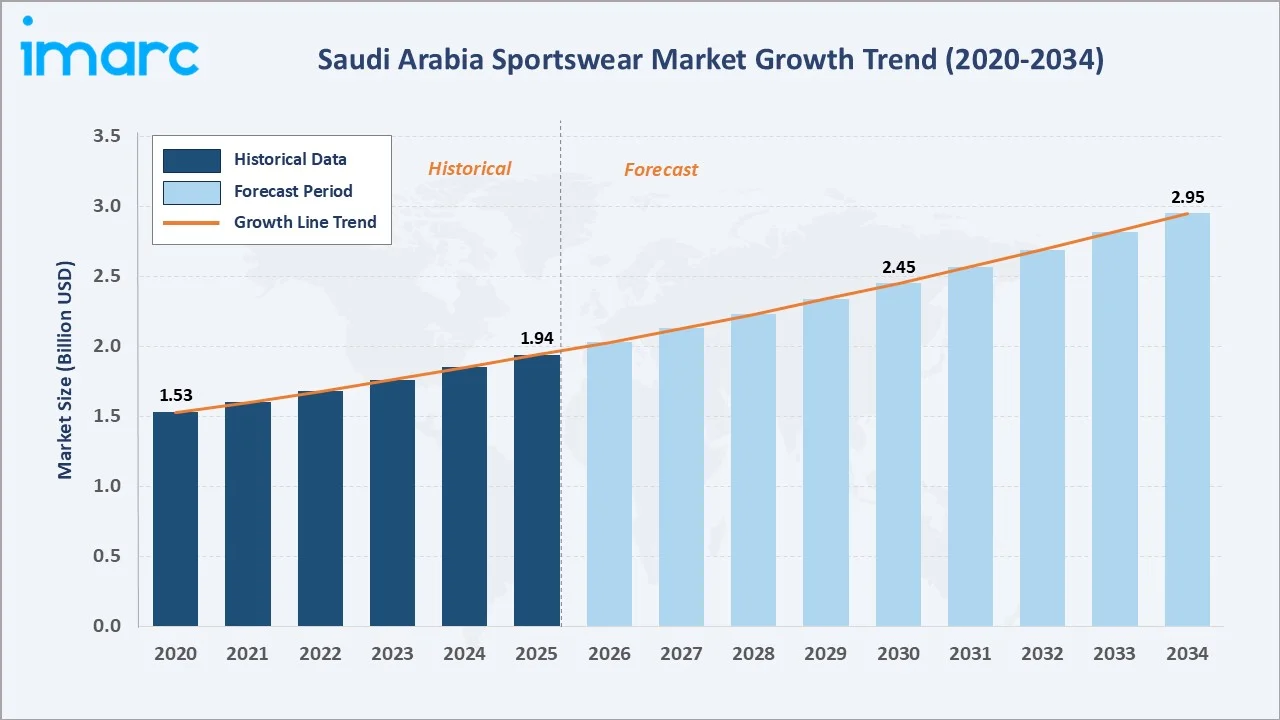
The Saudi Arabia sportswear market was valued at USD 1.94 Billion in 2025 and is projected to reach USD 2.95 Billion by 2034, exhibiting a CAGR of 4.77% during 2026-2034. The market is driven by rising health and fitness awareness, expanding sports participation, and increasing demand for comfortable athleisure wear across Saudi Arabia.
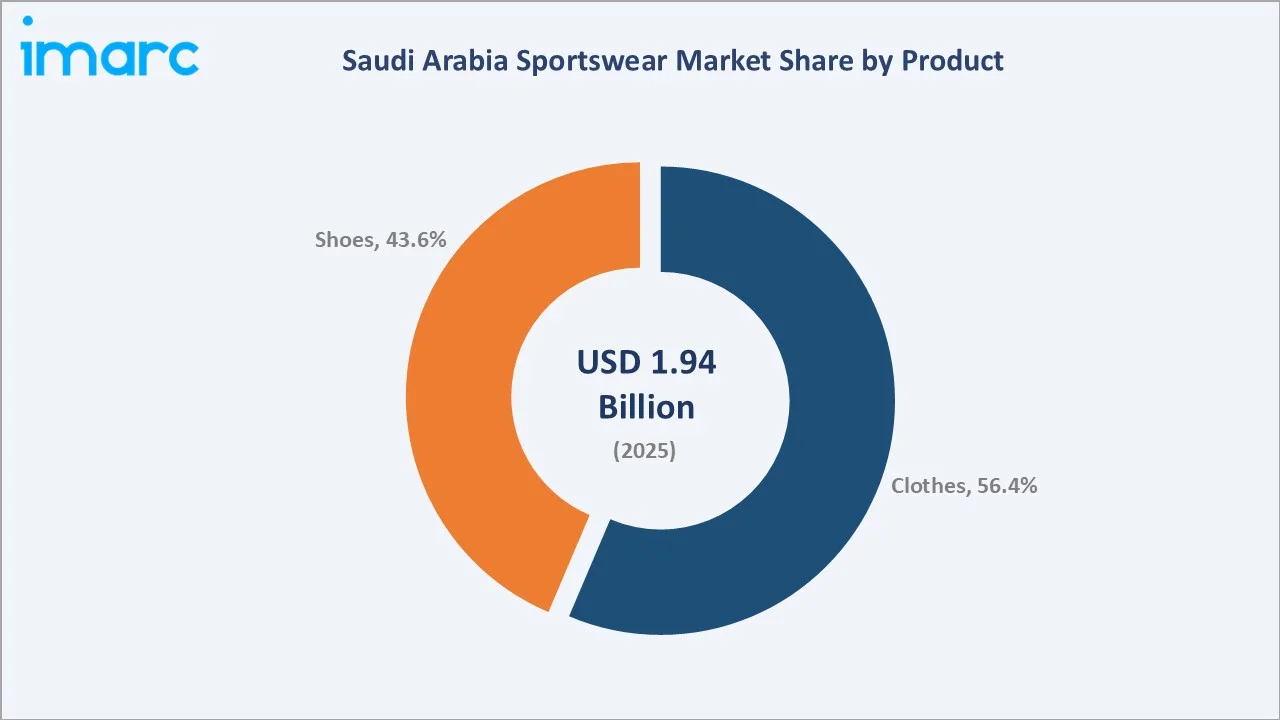
Clothes lead the product segment at 56.4%, retail stores dominate distribution channel at 67.8%, and Northern and Central Region commands a 42.9% regional share.
Market Snapshot
| Metric | Value |
|
Market Size (2025) |
USD 1.94 Billion |
|
Forecast Market Size (2034) |
USD 2.95 Billion |
|
CAGR (2026-2034) |
4.77% |
|
Base Year |
2025 |
|
Historical Period |
2020-2025 |
|
Forecast Period |
2026-2034 |
|
Largest Region |
Northern and Central Region (42.9%, 2025) |
|
Second Largest Region |
Western Region (24.8%, 2025) |
|
Leading Product |
Clothes (56.4%, 2025) |
|
Leading Distribution Channel |
Retail Stores (67.8%, 2025) |
The Saudi Arabia sportswear market expanded from USD 1.53 Billion in 2020 to USD 1.94 Billion in 2025, underpinned by surging fitness consciousness, growing female sports participation following regulatory reforms, and rapid expansion of organized retail across the Kingdom. Anchored at USD 2.45 Billion in 2030, the forecast to USD 2.95 Billion by 2034 reflects sustained momentum from sports tourism, mega-event hosting, and deepening e-commerce penetration in sportswear categories.
To get more information on this market, Request Sample
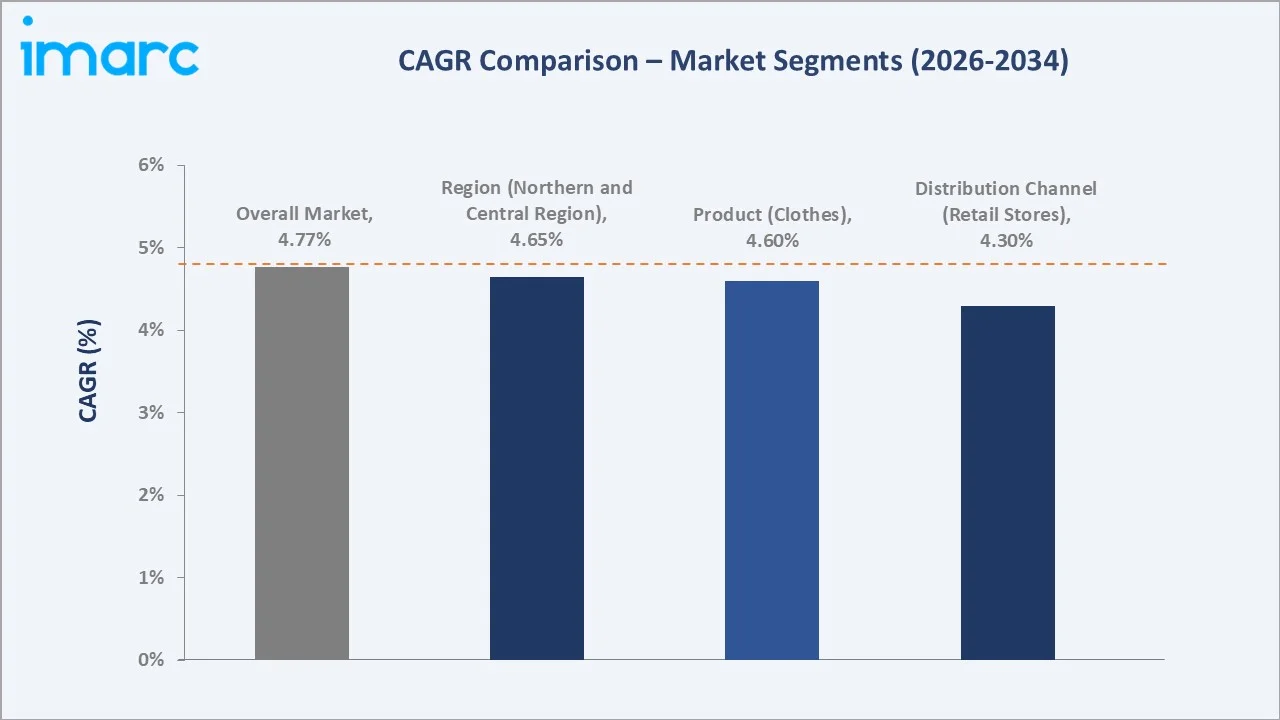
CAGR trajectories across product and distribution channel sub-segments, together with regional patterns, show online stores and Eastern Region expanding faster than the overall 4.77% market CAGR, driven by growing digital commerce adoption, increasing youth participation in sports, and expanding sports retail networks across secondary cities.
Executive Summary
The Saudi Arabia sportswear market is on a steady and sustained growth trajectory, rising from USD 1.53 Billion in 2020 to USD 2.95 Billion by 2034. The industry has evolved from a niche category serving professional athletes to a mainstream consumer segment driven by lifestyle fitness, athleisure trends, and government-led sports promotion. Rising disposable incomes, urbanization, and increasing youth population are encouraging broad consumer adoption of sportswear across performance, training, and casual segments.
Clothes lead the product segment at 56.4% in 2025, anchored by rising athleisure adoption. Retail stores command 67.8% of the distribution channel, underpinned by a growing organized sportswear retail footprint across Riyadh, Jeddah, and Dammam. Northern and Central Region holds 42.9% of regional share, reflecting high population concentration and retail density.
Key Market Insights
|
Insight |
Data |
|
Leading Product |
Clothes - 56.4% share (2025) |
|
Second Largest Product |
Shoes - 43.6% share (2025) |
|
Leading Distribution Channel |
Retail Stores - 67.8% share (2025) |
|
Second Largest Distribution Channel |
Online Stores - 32.2% share (2025) |
|
Leading Region |
Northern and Central Region - 42.9% share (2025) |
|
Second Largest Region |
Western Region - 24.8% share (2025) |
|
Top Companies |
Nike Inc., Adidas AG, Under Armour, Inc., Lululemon Athletica Inc., Decathlon S.A. |
Key Analytical Observations Expanding On the Data Above:
- Clothes at 56.4% lead the product segment, driven by rising adoption of athleisure apparel across both fitness and casual lifestyle segments among Saudi youth and working adults.
- Shoes at 43.6% reflect strong and growing demand for performance footwear, particularly running shoes and gym trainers, linked to surging gym membership and recreational sports participation across urban centers.
- Retail stores at 67.8% remain the dominant distribution channel, supported by a well-developed organized sportswear retail ecosystem across malls and dedicated sports stores in major Saudi cities.
- Online stores at 32.2% represent the fastest-growing channel, with Saudi Arabia recording one of the highest e-commerce adoption rates in the MENA region, accelerating digital sportswear purchasing especially among millennials and Gen Z consumers.
- Northern and Central Region at 42.9% commands the largest regional share, anchored by Riyadh's position as the national capital and a dense concentration of retail infrastructure, corporate offices, and sports facilities.
Saudi Arabia Sportswear Market Overview
Sportswear refers to clothing, footwear, and accessories specifically designed for athletic, fitness, and outdoor recreational activities, combining performance-oriented functionality with contemporary design aesthetics for active lifestyles.
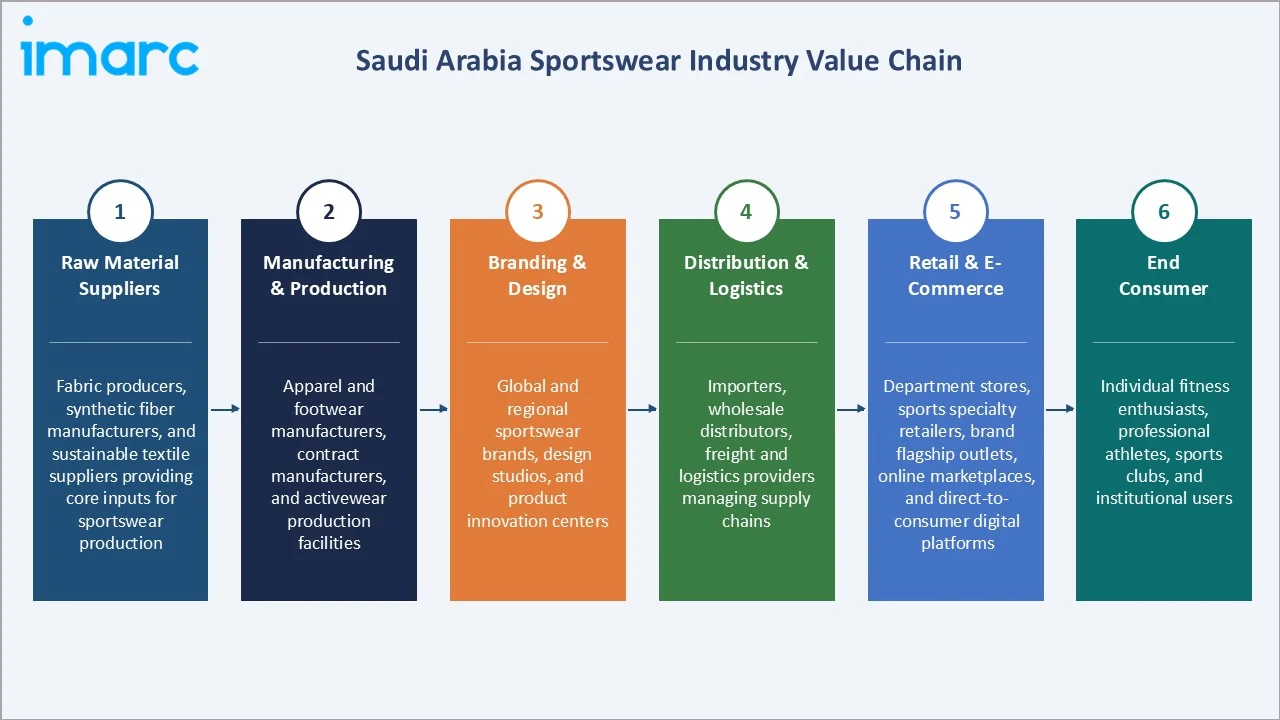
The Saudi Arabia sportswear ecosystem integrates global and regional brand manufacturers, multi-brand retail chains, sports specialty stores, e-commerce platforms, government sports bodies, and end consumers spanning professional athletes, fitness enthusiasts, and casual lifestyle buyers. Together, these stakeholders are shaping an increasingly competitive and fast-growing sportswear environment across the Kingdom.
Market Dynamics
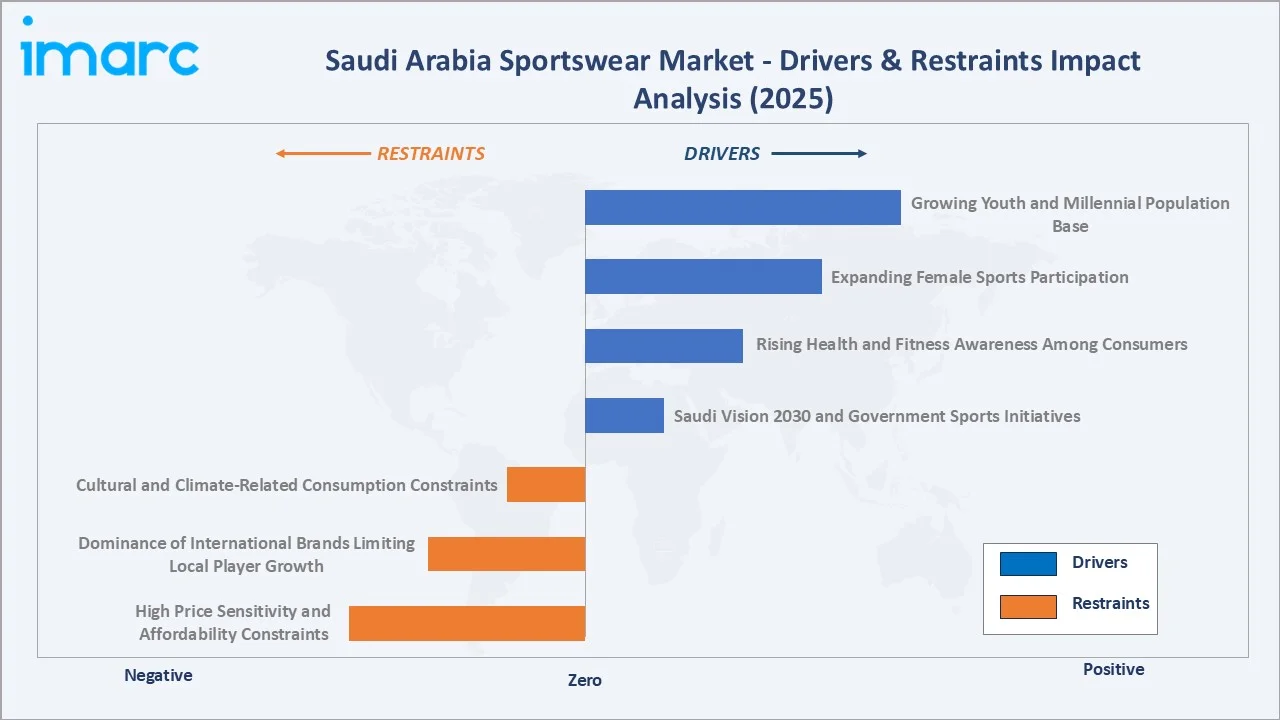
To evaluate market opportunities, Request Sample
Market Drivers
- Saudi Vision 2030 and Government Sports Initiatives: The Saudi government's Vision 2030 program has placed sports development at the core of national economic diversification, driving significant investments in sports infrastructure, event hosting, and active lifestyle programs that are directly expanding sportswear demand across the Kingdom.
- Rising Health and Fitness Awareness Among Consumers: Growing awareness of chronic lifestyle diseases and an increasing preference for active living are encouraging more Saudi consumers to engage in regular gym visits, outdoor sports, and fitness classes, sustaining consistent demand for performance sportswear across all categories.
- Expanding Female Sports Participation: Landmark regulatory reforms permitting women to participate in organized sports and access fitness facilities have opened a significant new consumer segment for sportswear.
- Growing Youth and Millennial Population Base: Saudi Arabia has one of the youngest population profiles in the Gulf Cooperation Council, with 71% of its population under the age of 35 in 2024. This large and brand-conscious youth demographic is a primary driver of sportswear consumption, driven by fashion-forward athleisure preferences and social media influence on active lifestyle trends.
Market Restraints
- High Price Sensitivity and Affordability Constraints: Premium international sportswear brands command high retail prices that remain out of reach for a portion of the Saudi consumer base, particularly in value-oriented segments. This limits volume expansion and pushes price-sensitive buyers toward unbranded or counterfeit alternatives.
- Dominance of International Brands Limiting Local Player Growth: The market is heavily concentrated around a small number of established global brands, creating significant barriers for emerging domestic and regional sportswear manufacturers to build distribution, brand recognition, and consumer trust at scale.
- Cultural and Climate-Related Consumption Constraints: Extreme heat across most of Saudi Arabia for extended periods of the year limits outdoor sports participation during peak summer months, reducing sportswear purchasing frequency in certain product categories and creating seasonal demand volatility.
Market Opportunities
- Rising Sports Tourism and Mega-Event Hosting: Saudi Arabia's growing role as a global host for major international sporting events, including golf, boxing, football, and motorsport, is generating increased demand for branded sportswear among both domestic and visiting consumers, creating significant short-term and long-term sales uplift opportunities.
- Rapid Expansion of E-Commerce and Online Sportswear Retail: The accelerating shift toward digital retail in Saudi Arabia is creating strong growth opportunities for both established sportswear brands and emerging digital-native players to reach younger, tech-savvy consumers through targeted digital marketing and streamlined online purchasing experiences.
Market Challenges
- Counterfeit and Imitation Products Undermining Brand Value: The proliferation of counterfeit sportswear products through informal retail and grey market channels continues to erode brand equity, undercut authorized retailers, and create pricing pressure on legitimate sportswear suppliers operating in the Kingdom.
- Intense Competition from Global and Regional Players: Saudi Arabia's sportswear retail landscape is highly competitive, with major global brands competing aggressively on pricing, product innovation, and retail placement. This compressed competitive environment makes it challenging for newer entrants to achieve sustainable market share without substantial investment in brand building and retail presence.
Emerging Market Trends
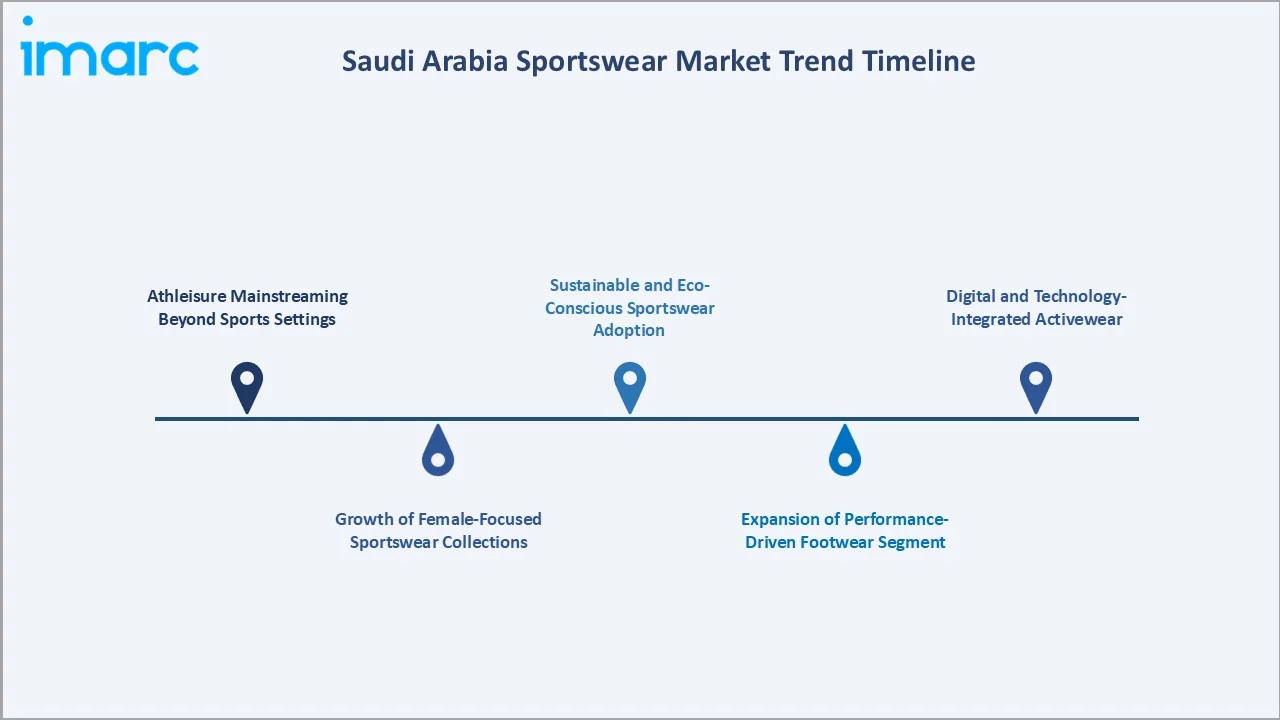
1. Athleisure Mainstreaming Beyond Sports Settings
Sportswear is increasingly being adopted across everyday casual, social, and professional settings in Saudi Arabia, extending beyond traditional gym and sports use cases. The athleisure trend is particularly strong among urban millennials who seek versatile, comfortable, and brand-conscious apparel that transitions seamlessly from fitness activities to social engagements.
2. Growth of Female-Focused Sportswear Collections
Following Saudi Arabia's progressive regulatory reforms on female sports participation, major global and regional sportswear brands have launched dedicated women's sportswear lines tailored to cultural preferences, including modest activewear collections that combine performance functionality with appropriate coverage. This segment is expanding rapidly and represents one of the highest-growth opportunities in the Saudi sportswear market.
3. Expansion of Performance-Driven Footwear Segment
Saudi consumers are showing growing preference for technically advanced running and training shoes driven by rising participation in marathons, gym fitness, and team sports. The Kingdom has seen a significant rise in organized running events, with participation in the Riyadh Marathon growing consistently year on year, directly stimulating performance footwear demand across both premium and mid-tier price bands.
4. Sustainable and Eco-Conscious Sportswear Adoption
Environmental awareness is gradually shaping sportswear purchasing decisions in Saudi Arabia, with consumers showing increasing interest in recycled materials, sustainable manufacturing practices, and eco-certified brands. Global sportswear companies entering the Saudi market are beginning to highlight sustainability credentials as a key differentiator to align with younger consumer values and national sustainability goals tied to Vision 2030.
5. Digital and Technology-Integrated Activewear
The emergence of smart textiles and wearable technology-integrated sportswear is creating a new growth frontier in the market. Biometric tracking features, temperature-regulating fabrics, and compression-enhancement technologies are gaining traction among performance-oriented fitness consumers, encouraging premiumization within the sportswear category and supporting higher average selling prices.
Industry Value Chain Analysis
The Saudi Arabia sportswear value chain spans six stages, from raw material sourcing and manufacturing through branding, distribution, retail, and final consumer engagement. Branding, design, and retail capture the highest value-add within the chain, reflecting the premium nature of globally recognized sportswear and the growing importance of omnichannel retail in the Kingdom.
|
Stage |
Key Players / Examples |
|
Raw Material Suppliers |
Fabric producers, synthetic fiber manufacturers, and sustainable textile suppliers providing core inputs for sportswear production |
|
Manufacturing & Production |
Apparel and footwear manufacturers, contract manufacturers, and specialized activewear production facilities |
|
Branding & Design |
Global and regional sportswear brands, design studios, and product innovation centers developing collections for the Saudi market |
|
Distribution & Logistics |
Importers, wholesale distributors, freight and logistics providers managing supply chain from manufacturing to retail delivery |
|
Retail & E-Commerce |
Department stores, sports specialty retailers, brand flagship outlets, online marketplaces, and direct-to-consumer digital platforms |
|
End Consumer |
Individual fitness enthusiasts, professional athletes, corporate buyers, sports clubs, and institutional end users across the Kingdom |
Vertically integrated global sportswear brands with established Saudi retail footprints and growing e-commerce capabilities are best positioned to capture value across the chain. Local distributors and retail partners with deep market access and consumer relationships remain critical intermediaries, particularly for brands without direct-to-consumer operations in the Kingdom.
Technology Landscape in the Saudi Arabia Sportswear Industry
Performance Fabric and Material Innovation
Advanced synthetic fabrics incorporating moisture-wicking, compression, and UV-protection technologies are becoming standard across mid-to-premium sportswear tiers in Saudi Arabia. Brands are investing in next-generation materials that provide temperature regulation and rapid drying, particularly important in the Kingdom's extreme heat climate, enhancing both performance utility and consumer comfort.
E-Commerce and Digital Retail Technology
Saudi sportswear brands and retailers are deploying AI-powered product recommendation engines, virtual try-on features, and personalized shopping experiences to improve online conversion rates and reduce return rates. Digital retail technology investment is accelerating as brands prioritize growing their online channels alongside physical retail presence across major Saudi cities.
Smart and Wearable-Integrated Sportswear
A growing tier of performance-oriented Saudi consumers is driving demand for smart textiles embedded with biometric sensors, heart rate monitors, and GPS-linked tracking capabilities. International sportswear brands are piloting technology-integrated product lines in Saudi Arabia as part of broader global launches, supported by the Kingdom's high smartphone penetration and tech-forward consumer profile.
Sustainable Manufacturing Technologies
Adoption of recycled polyester, bio-based materials, and low-water dyeing processes is gradually being introduced into sportswear supply chains targeting the Saudi Arabia market. Sustainability-led manufacturing technologies are gaining relevance as global sportswear brands align Saudi product lines with enterprise-wide environmental commitments and respond to growing local consumer awareness of sustainability credentials.
Market Segmentation Analysis
The report covers the following segments:
|
Segment Category |
Leading Segment |
Market Share |
Year |
|
Product |
Clothes |
56.4% |
2025 |
|
Distribution Channel |
Retail Stores |
67.8% |
2025 |
|
End User |
🔒 |
🔒 |
2025 |
|
Region |
Northern and Central Region |
42.9% |
2025 |

By Product
Clothes command a 56.4% majority share in 2025, driven by broad consumer adoption of training apparel, athleisure wear, and performance jerseys across gym, outdoor, and casual lifestyle settings. The segment benefits from strong brand investment in apparel-led marketing, growing female sportswear adoption, and rising consumer preference for branded activewear across all age groups in Saudi Arabia.
To access detailed market analysis, Request Sample
Shoes at 43.6% reflect strong and sustained demand for athletic footwear, driven by rising participation in running, football, gym training, and outdoor sports.
By Distribution Channel
Retail stores lead with 67.8% share in 2025, reflecting the continued dominance of physical retail in the Saudi sportswear purchasing journey. Established sports specialty chains, multi-brand retailers, and brand flagship stores in major malls across Riyadh, Jeddah, and Dammam provide consumers with immersive brand experiences and wide product access.
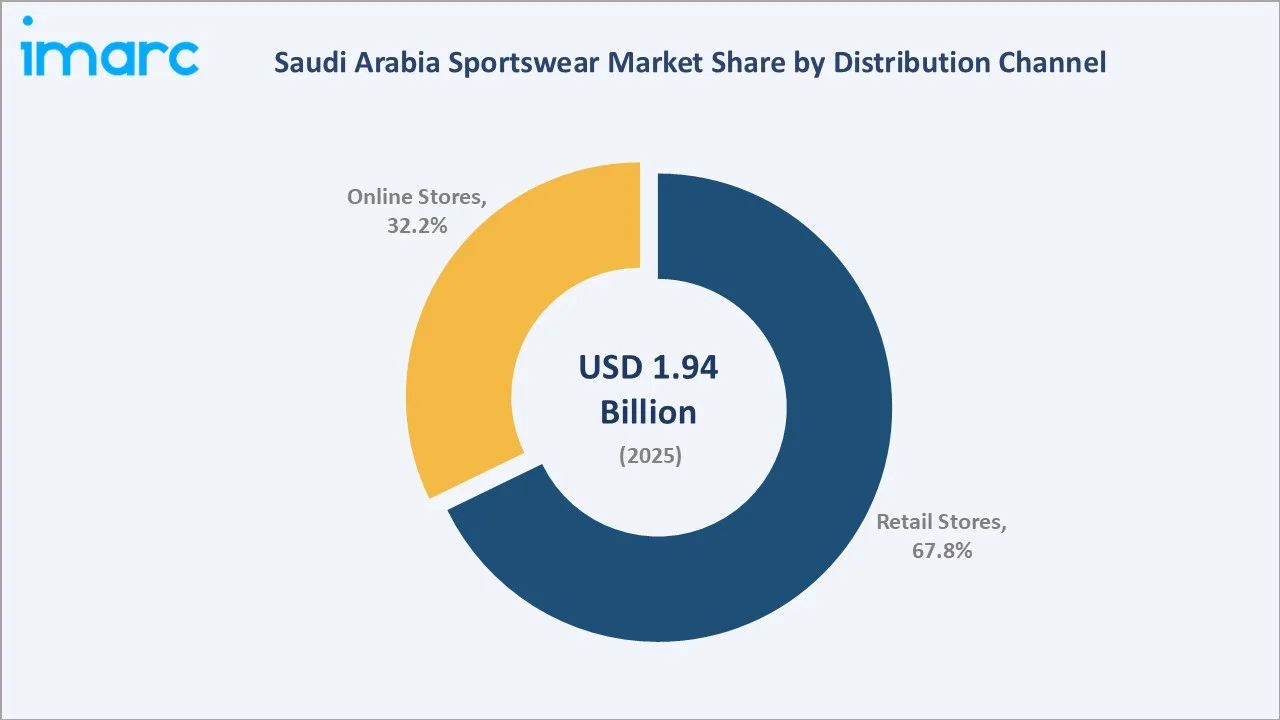
Online stores at 32.2% represent the fastest-growing distribution channel in Saudi Arabia, supported by rising smartphone penetration, growing trust in digital payments, and the convenience of home delivery across the Kingdom.
Regional Market Insights
|
Region |
Share (2025) |
Key Growth Drivers |
|
Northern and Central Region |
42.9% |
High urban population density, national capital Riyadh as retail hub, dense sports infrastructure, and strong government sports investment driving active lifestyle demand |
|
Western Region |
24.8% |
Major commercial and cultural hub anchored by Jeddah, high tourism footfall, growing sports event hosting, and rising expatriate consumer base supporting sportswear demand |
|
Eastern Region |
21.2% |
Strong industrial and corporate workforce driving fitness club memberships, expanding organized retail, and high per-capita income supporting premium sportswear spending |
|
Southern Region |
11.1% |
Expanding youth population, improving retail infrastructure, and growing government investment in sports facilities supporting gradual market development across the region |
Northern and Central Region at 42.9% in 2025 leads the regional landscape, anchored by Riyadh's position as Saudi Arabia's national capital and commercial nerve center. Riyadh's dense population, high retail concentration, and the presence of major sports facilities support sustained regional leadership in sportswear demand.
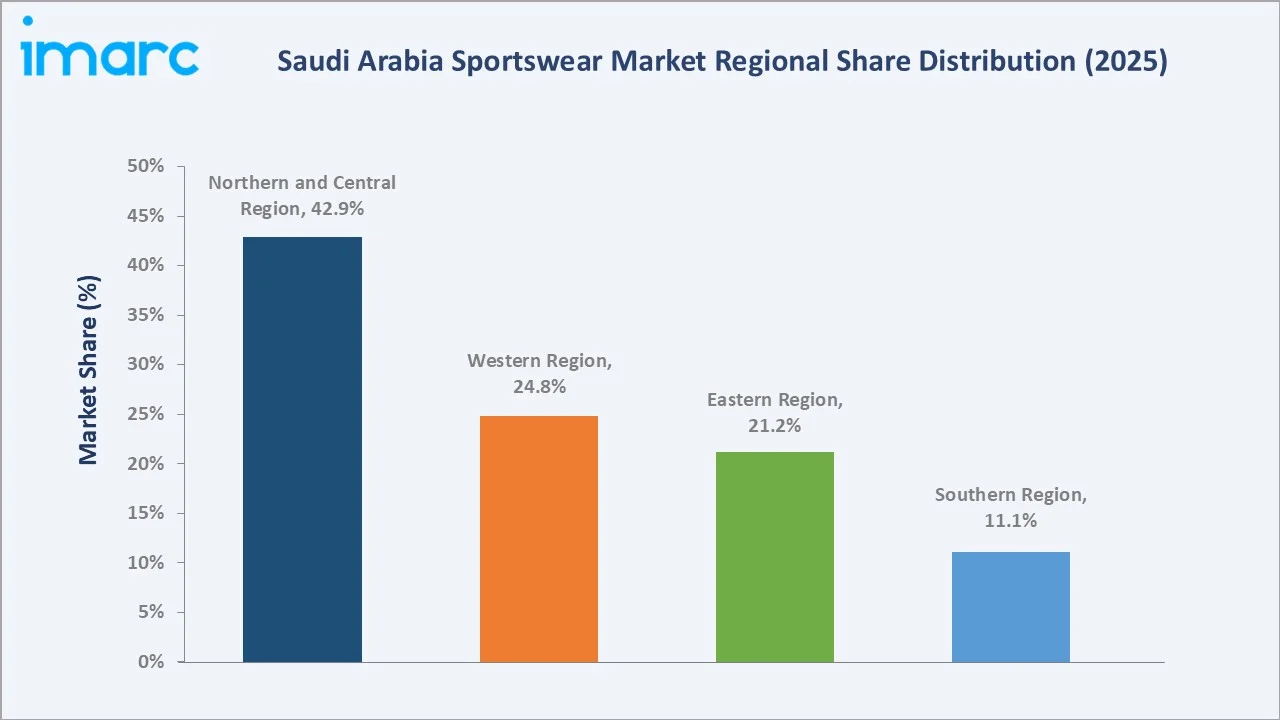
Southern Region, while currently the smallest contributor at 11.1%, is showing steady growth supported by improving sports infrastructure investment and expanding youth sports participation programs funded under Vision 2030's national sports development agenda.
Competitive Landscape
The Saudi Arabia sportswear market is moderately concentrated, with a small number of established global sportswear leaders commanding significant market share while challengers and emerging players compete on niche positioning, value pricing, and targeted demographic strategies. Brand equity, product innovation, retail access, and sports sponsorship investments form the key competitive differentiators across the industry.
|
Company Name |
Brand / Key Product |
Position |
Strategic Focus |
|
Nike Inc. |
Nike, Jordan |
Leader |
Expanding Saudi-specific product lines, sports sponsorships, and direct-to-consumer digital channels to deepen market leadership |
|
Adidas AG |
Adidas |
Leader |
Strengthening omnichannel retail presence and sports partnerships to reinforce leadership across performance and lifestyle sportswear categories |
|
Under Armour, Inc. |
Under Armour |
Challenger |
Expanding performance sportswear product range and digital retail capabilities to capture share from fitness-focused Saudi consumers |
|
Lululemon Athletica Inc. |
Lululemon |
Challenger |
Accelerating retail footprint expansion and growing women's activewear range to capitalize on rising female sports participation in Saudi Arabia |
|
Decathlon S.A. |
Decathlon |
Challenger |
Leveraging value-for-money positioning and broad multi-sport product range to attract price-sensitive and aspiring sports consumers |
Key players include Nike Inc., Adidas AG, Under Armour, Inc., Lululemon Athletica Inc., and Decathlon S.A., among others.
Key Company Profiles
Nike Inc.
Nike Inc. is a global sportswear and footwear company headquartered in Beaverton, Oregon, United States, with a well-established and dominant retail and brand presence across the Saudi Arabia sportswear market.
- Product Portfolio: Comprehensive sportswear portfolio spanning performance running shoes, training apparel, football kits, basketball footwear, and athleisure collections across Nike and Jordan brand lines.
- Recent Developments: The company continues to expand its retail and digital presence in key markets, strengthen sports sponsorship partnerships, and introduce new product lines aligned with evolving consumer preferences.
- Strategic Focus: Expanding brand reach across performance and lifestyle categories, deepening sports sponsorship investments, and scaling direct-to-consumer digital channels to strengthen market leadership.
Adidas AG
Adidas AG is a global sportswear and footwear company headquartered in Herzogenaurach, Germany, operating an extensive retail network and brand presence across Saudi Arabia under the Adidas brand.
- Product Portfolio: Performance and lifestyle sportswear covering running footwear, training apparel, football kits, tennis gear, and athleisure wear across the Adidas brand portfolio.
- Recent Developments: The company continues to invest in omnichannel retail capabilities, develop sports partnerships, and grow its product range across key international markets.
- Strategic Focus: Reinforcing omnichannel retail presence across physical and digital channels, growing sports partnership investments, and targeting lifestyle and performance consumer segments to sustain market leadership.
Under Armour, Inc.
Under Armour, Inc. is a sportswear and footwear company headquartered in Baltimore, Maryland, United States, focused on performance-driven sportswear and growing its presence across international markets including Saudi Arabia.
- Product Portfolio: Performance apparel, footwear, and accessories designed for running, gym training, and team sports, with a core focus on technically advanced materials and compression wear.
- Recent Developments: The company continues to develop its performance product range, invest in digital retail platforms, and pursue strategic partnerships to strengthen brand recognition across target markets.
- Strategic Focus: Expanding performance-focused product offerings and digital retail capabilities and targeting fitness-oriented consumers.
Market Concentration Analysis
The Saudi Arabia sportswear market is moderately concentrated, with the top global sportswear brands accounting for a significant majority of total market revenue. Established players benefit from strong brand loyalty, broad product portfolios, and well-developed retail and distribution networks.
Barriers to entry include substantial brand-building investment requirements, the need to establish and maintain large-scale retail distribution networks, sports sponsorship costs, and the competitive challenge of displacing established global brands entrenched in Saudi consumer preferences. These factors favor large, well-capitalized international players over smaller domestic or regional brands.
The market is experiencing gradual consolidation through brand acquisitions, licensing agreements, and strategic retail partnerships. E-commerce is creating some space for newer entrants by reducing the capital intensity of building physical retail infrastructure, supporting modest expansion of challenger and emerging brand positions in the Saudi sportswear market.
Investment & Growth Opportunities
Fastest-Growing Segments
Online stores are expanding fastest among distribution channels, driven by rising e-commerce adoption and increasing consumer preference for digital sportswear shopping. Within the product category, shoes are gaining share at a faster pace than clothes, supported by growing performance footwear demand linked to running, gym training, and team sports participation across the Kingdom.
Emerging Markets
Southern Region represents a meaningful emerging growth opportunity as sports infrastructure investment and retail expansion accelerates under Vision 2030 national programs. Growing participation in sports and increasing consumer interest in fitness and active lifestyles further support the region’s sportswear demand.
Venture & Investment Trends
Investment activity in the Saudi Arabia sportswear sector is concentrated in e-commerce platforms, digital-first direct-to-consumer sportswear brands, and technology-integrated activewear. Capital is also flowing into women-focused sportswear retailers and modest activewear brands addressing the growing demand for culturally appropriate performance wear among Saudi female consumers.
Future Market Outlook (2026-2034)
The Saudi Arabia sportswear market is forecast to expand from USD 1.94 Billion in 2025 to USD 2.95 Billion by 2034 at a CAGR of 4.77%, adding approximately USD 1.01 Billion in incremental market value over the forecast period.
Four forces will shape the market through 2034: continued government investment in sports infrastructure and active lifestyle programs under Vision 2030; accelerating female sportswear adoption driven by expanded access to sports and fitness; deepening e-commerce penetration and digital brand engagement among younger Saudi consumers; and growing sports tourism and international event hosting creating sustained demand across all sportswear categories.
By 2034, the Saudi Arabia sportswear market is expected to be defined by a more balanced product mix as shoes gain share relative to clothes and deeper brand penetration beyond the main urban centers into secondary cities across all four regions.
Research Methodology
Primary Research
Primary research included structured consultations with sportswear retail executives, brand managers, e-commerce platform representatives, and consumer segments across Saudi Arabia, validating market sizing, segment mix, pricing dynamics, and regional demand patterns.
Secondary Research
Secondary sources included Saudi Sports Authority publications, General Authority for Statistics reports, Ministry of Sport announcements, company annual reports, press releases, and investor presentations from listed sportswear brands, alongside retail trade association data and industry databases covering the Saudi consumer goods sector.
Forecasting Models
Market forecasts employed top-down and bottom-up models incorporating consumer spending data, retail sales trends, sports participation rates, e-commerce adoption curves, and macroeconomic variables including GDP growth and disposable income trends. Scenario analysis addressed policy developments under Vision 2030, evolving demographic trends, and digital channel growth trajectories.
Saudi Arabia Sportswear Market Report Coverage:
| Report Features | Details |
|---|---|
| Base Year of the Analysis | 2025 |
| Historical Period | 2020-2025 |
| Forecast Period | 2026-2034 |
| Units | Billion USD |
| Scope of the Report | Exploration of Historical and Forecast Trends, Industry Catalysts and Challenges, Segment-Wise Historical and Predictive Market Assessment:
|
| Products Covered | Shoes, Clothes |
| Distribution Channels Covered | Online Stores, Retail Stores |
| End Users Covered | Men, Women, Kids |
| Regions Covered | Northern and Central Region, Western Region, Eastern Region, Southern Region |
| Companies Covered | Nike Inc., Adidas AG, Under Armour Inc., Lululemon Athletica Inc., Decathlon S.A., etc. |
| Customization Scope | 10% Free Customization |
| Post-Sale Analyst Support | 10-12 Weeks |
| Delivery Format | PDF and Excel through Email (We can also provide the editable version of the report in PPT/Word format on special request) |
Key Benefits for Stakeholders:
- IMARC’s industry report offers a comprehensive quantitative analysis of various market segments, historical and current market trends, market forecasts, and dynamics of the Saudi Arabia sportswear market from 2020-2034.
- The research report provides the latest information on the market drivers, challenges, and opportunities in the Saudi Arabia sportswear market.
- Porter's five forces analysis assist stakeholders in assessing the impact of new entrants, competitive rivalry, supplier power, buyer power, and the threat of substitution. It helps stakeholders to analyze the level of competition within the Saudi Arabia sportswear industry and its attractiveness.
- Competitive landscape allows stakeholders to understand their competitive environment and provides an insight into the current positions of key players in the market.
Frequently Asked Questions About the Saudi Arabia Sportswear Market Report
The Saudi Arabia sportswear market was valued at USD 1.94 Billion in 2025, driven by Vision 2030 sports initiatives, rising fitness awareness, and growing consumer demand for branded activewear.
The market is projected to grow at a CAGR of 4.77% from 2026-2034, reaching USD 2.95 Billion, supported by e-commerce expansion, female sportswear adoption, and continued government sports investment.
Clothes lead the product segment at 56.4% in 2025, reflecting widespread adoption of athleisure and performance apparel driven by growing fitness participation and rising consumer preference for branded sportswear.
Retail stores lead with 67.8% share in 2025, supported by a well-established organized sportswear retail network across flagship stores and multi-brand sports outlets in major Saudi cities.
Northern and Central Region commands 42.9% share in 2025, led by Riyadh's position as the national capital and its dense concentration of retail infrastructure and sports facilities.
Leading players include Nike Inc., Adidas AG, Under Armour, Inc., Lululemon Athletica Inc., and Decathlon S.A., among others.
Vision 2030 is driving major investment in sports infrastructure, hosting international events, and promoting active lifestyles, directly expanding sportswear demand across all consumer segments in the Kingdom.
Key opportunities include e-commerce sportswear platforms, women-focused activewear brands, technology-integrated performance wear, and retail expansion into tier-2 cities across the Kingdom.
Key challenges include counterfeit product proliferation, intense competition from established global brands, price sensitivity in value segments, and cultural preferences requiring localized product design approaches.
Need more help?
- Speak to our experienced analysts for insights on the current market scenarios.
- Include additional segments and countries to customize the report as per your requirement.
- Gain an unparalleled competitive advantage in your domain by understanding how to utilize the report and positively impacting your operations and revenue.
- For further assistance, please connect with our analysts.
 Request Customization
 Speak to an Analyst
 Request Brochure
 Inquire Before Buying
Benefits of Customization
- Personalize this research
- Triangulate with your data
- Get data as per your format and definition
- Gain a deeper dive into a specific application, geography, customer, or competitor
- Any level of personalization
Get in Touch With Us
UNITED STATES
Phone: +1-201-971-6302
INDIA
Phone: +91-120-433-0800
UNITED KINGDOM
Phone: +44-753-714-6104
Email: [email protected]
Client Testimonials




.webp)




.webp)













Related Reports

Choose your plan
*Please note that the prices mentioned below are starting prices for each bundle type. Kindly contact our team for further details.*
Single User License
- 1 User License, Access on 2 Devices
- PDF Report + Excel Dataset (Password Protected)
- Lifetime Access
- No Printing Rights
- 10% Free Report Customization
- 10–12 Weeks of Analyst Support
Five User License
- Access for 5 Users, 2 Devices per User
- PDF Report + Excel Dataset (Password Protected)
- Lifetime Access
- Dedicated Account Manager
- 12–14 Weeks of Analyst Support
- No Printing Rights
- 15% Free Report Customization
- 25% Discount on Your Next Purchase
Corporate User License
- Unlimited User Access (Within Your Organization)
- PDF Report + Excel Dataset
- Lifetime Access
- Dedicated Account Manager
- 14–20 Weeks of Analyst Support
- No Printing Rights
- 20% Free Report Customization
- 30% Discount on Your Next Purchase
Essential Insights
What's included:
3 reports
- Lifetime Access
- PDF Reports
- Excel Datasets
- 2 Weeks of Free Analyst Support
- 2 User Licenses
- Access on 2 Devices
- Printing Rights
- Complimentary PowerPoint (PPT) Version
- Complimentary License Upgrade
Professional Access
What's included:
5 reports
- Lifetime Access
- PDF Reports
- Excel Datasets
- 8 Weeks of Free Analyst Support
- 2 User Licenses
- Access on 2 Devices
- Printing Rights
- Complimentary PowerPoint (PPT) Version
- Complimentary License Upgrade
Business Advantage
What's included:
8 reports
- Lifetime Access
- PDF Reports
- Excel Datasets
- 14 Weeks of Free Analyst Support
- 2 User Licenses
- Access on 2 Devices
- Printing Rights
- Complimentary PowerPoint (PPT) Version
- Complimentary License Upgrade
Enterprise Intelligence
What's included:
10 reports
- Lifetime Access
- PDF Reports
- Excel Datasets
- 20 Weeks of Free Analyst Support
- 2 User Licenses
- Access on 2 Devices
- Printing Rights
- Complimentary PowerPoint (PPT) Version
- Complimentary License Upgrade