
Saudi Arabia Takaful Market Size, Share, Trends and Forecast by Product Type and Region, 2026-2034
Saudi Arabia Takaful Market Size, Share, Trends & Forecast (2026-2034)
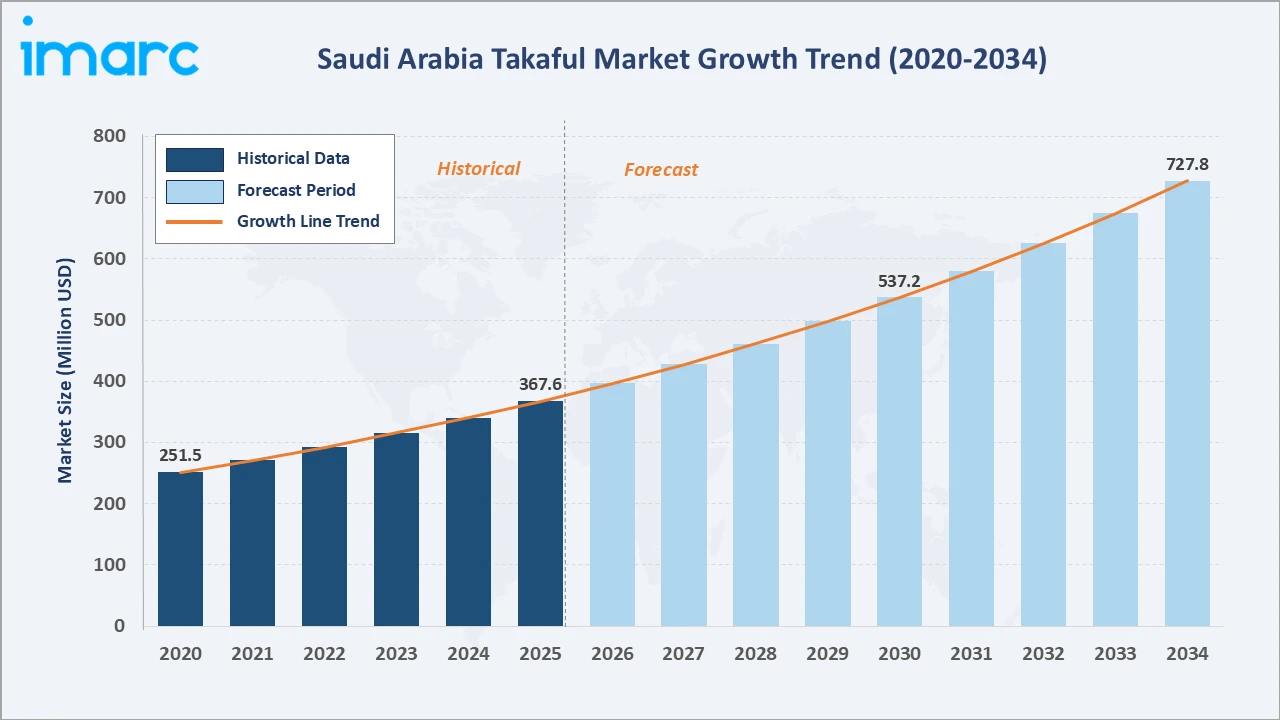
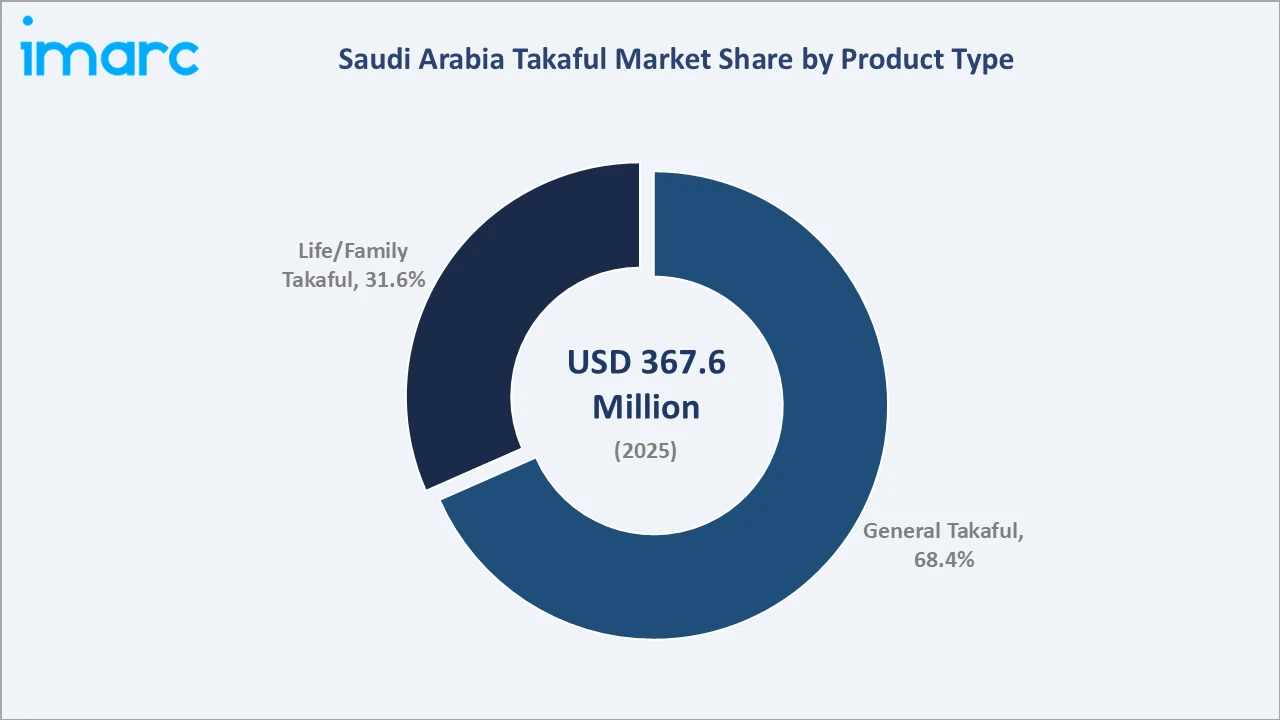
The Saudi Arabia takaful market reached USD 367.6 Million in 2025 and is projected to reach USD 727.8 Million by 2034, exhibiting a CAGR of 7.89% during 2026-2034. Al Rajhi Takaful recorded insurance revenue of SAR 5.322 billion (USD 1.4 billion) for the year ended December 31, 2025. This strong performance reflects rising demand for Shariah-compliant insurance products and supports Saudi Arabia’s takaful market by strengthening customer confidence, expanding insurance penetration, and encouraging further product and distribution development. General takaful leads product type at 68.4%, and the Northern and Central region accounts for the largest regional share at 42.3%.
Market Snapshot
|
Metric |
Value |
|
Market Size (2025) |
USD 367.6 Million |
|
Forecast Market Size (2034) |
USD 727.8 Million |
|
CAGR (2026-2034) |
7.89% |
|
Base Year |
2025 |
|
Historical Period |
2020-2025 |
|
Forecast Period |
2026-2034 |
|
Dominant Product Type |
General Takaful (68.4%, 2025) |
|
Leading Region |
Northern and Central Region (42.3%, 2025) |
The Saudi Arabia takaful market grew from USD 251.5 Million in 2020 to USD 367.6 Million in 2025, driven by mandatory health insurance extensions, Vision 2030's financial inclusion agenda, the post-COVID-19 surge in health and life protection awareness, and transformative impact on pricing discipline. The market is projected to reach USD 537.2 Million by 2030 and USD 727.8 Million by 2034.
To get more information on this market, Request Sample
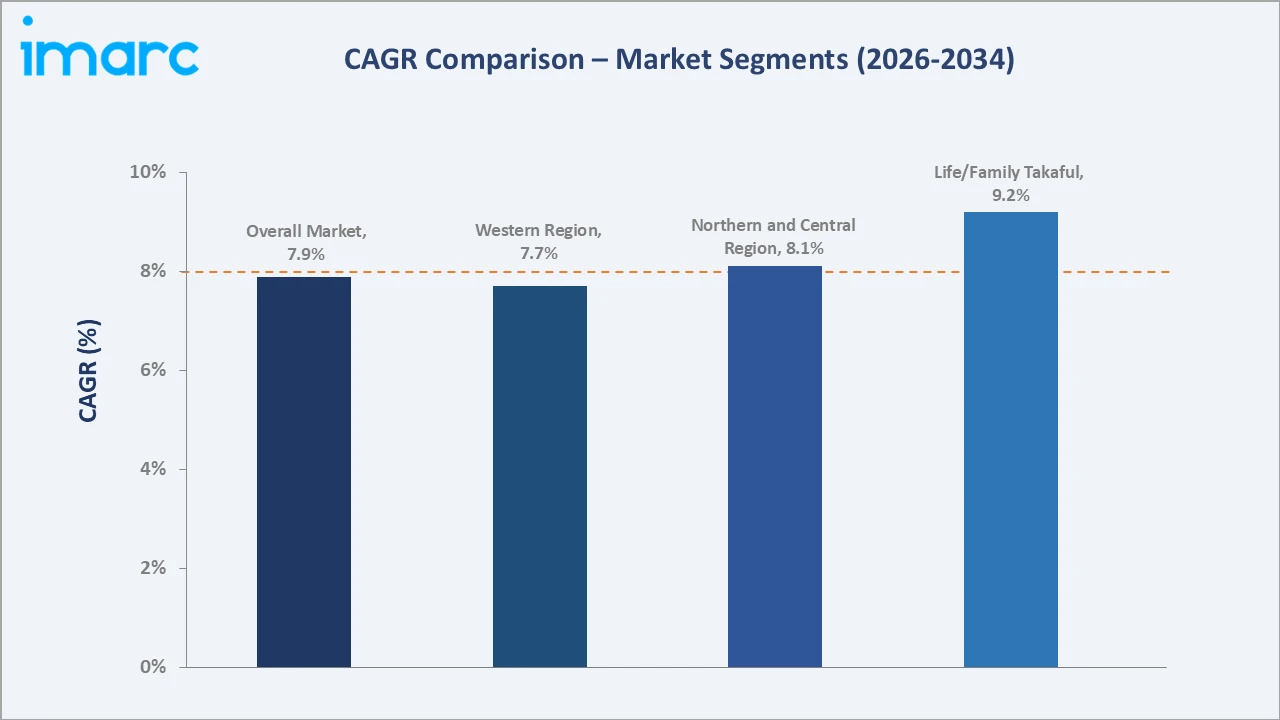
Life/family takaful grows at ~9.2% CAGR through rising financial literacy, Vision 2030's social protection goals, and product expansion. Northern and Central region grows at ~8.1% CAGR through Riyadh's concentration of corporate, government, and high-net-worth individual takaful demand. Western region grows at ~7.7% CAGR through Jeddah and Makkah's commercial insurance density and Hajj/Umrah-driven temporary visitor takaful products.
Executive Summary
The Saudi Arabia takaful market represents one of the most mature and well-developed takaful regulatory environments in the GCC, structured as participant contribution pools managed by a licensed takaful operator in the capacity of a Mudarib (profit-sharing agent) or Wakeel (agent). Saudi Arabia's takaful market penetration relative to its GDP remains well below comparable developed markets, indicating substantial structural growth headroom as Vision 2030's financial sector development targets and insurance market expansion initiatives progressively close the penetration gap. Market value reached USD 367.6 Million in 2025, forecast at USD 727.8 Million by 2034.
General takaful leads at 68.4% (2025) through mandatory medical insurance, mandatory motor takaful, and property and engineering takaful demand from Vision 2030's massive infrastructure construction activity requiring comprehensive property and contractor's all-risks (CAR) takaful coverage. Northern and Central region leads the market at 42.3% (2025).
Key Market Insights
|
Insight |
Data |
|
Dominant Product Type |
General Takaful – 68.4% share (2025) |
|
Leading Region |
Northern and Central Region – 42.3% share (2025) |
|
Market Opportunity |
Family Takaful expansion; mandatory motor reform; SME takaful packages; Hajj/Umrah temporary visitor takaful; digital embedded takaful for gig economy workers |
Key Analytical Observations Supporting the Above Data:
- General Takaful at 68.4% (2025): General takaful in Saudi Arabia is structurally underpinned by two mandatory product categories that guarantee continuous premium flow regardless of consumer discretionary spending decisions: health takaful and motor takaful. Vision 2030's massive infrastructure project portfolio has elevated property and engineering takaful lines of business to record premium volumes, with Saudi Re and international retakaful panels absorbing catastrophe risk capacity at premium levels that improve general takaful profitability compared to health and motor lines.
- Northern and Central Region at 42.3%: The Northern and Central region's takaful market dominance reflects Riyadh's role as Saudi Arabia's administrative capital, concentrating government ministries, state-owned enterprises, and foreign corporate headquarters that collectively represent Saudi Arabia's largest single source of group health takaful, group life takaful, and property takaful contributions.
Saudi Arabia Takaful Market Overview
The Saudi Arabia takaful market operates within the most comprehensive regulatory framework. Under Saudi Arabia's takaful model, policyholders contribute to a participant risk fund (PRF) that pools mutual protection for all policy participants, while the takaful operator manages the fund for a fixed Wakala fee and shares in investment profits on the PRF's invested assets. Saudi Arabia’s economic diversification under Vision 2030, expanding non-oil activity, rising household incomes, and large-scale infrastructure investments are increasing demand for health, motor, property, and commercial takaful products. Population growth, business formation, and compulsory insurance requirements are further supporting market penetration and premium growth.
Market Dynamics
To evaluate market opportunities, Request Sample
Market Drivers
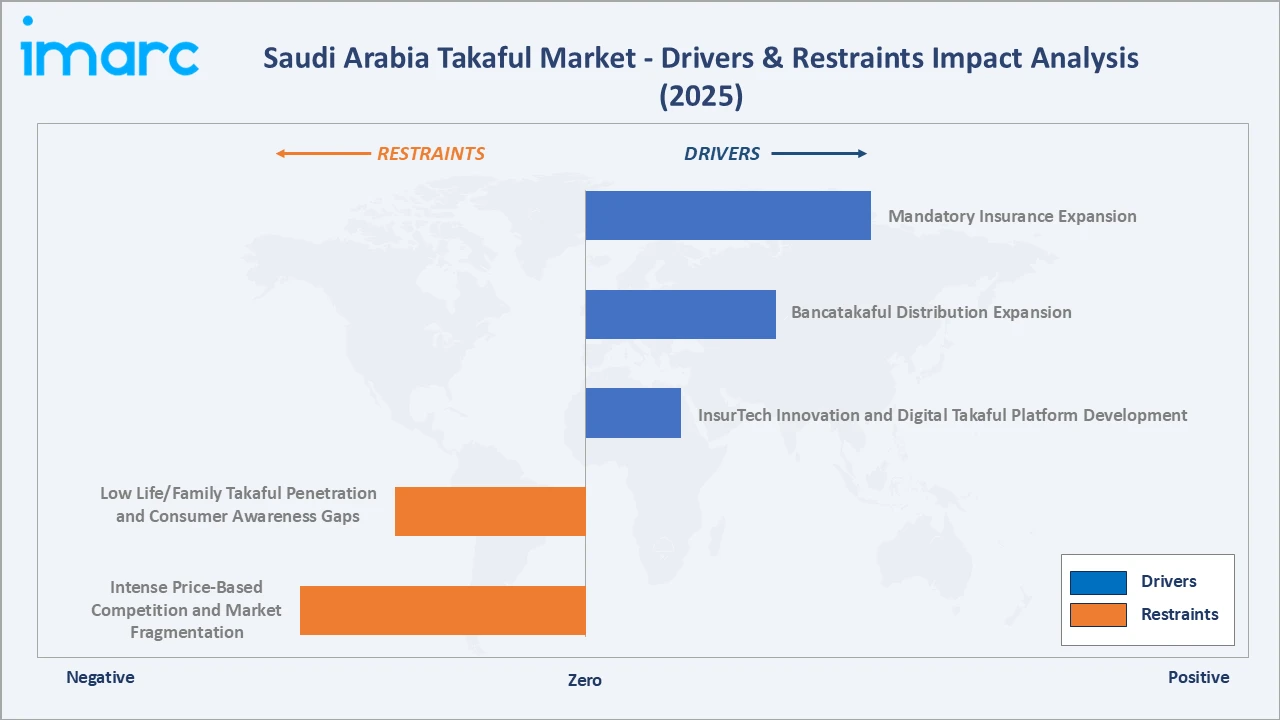
- Mandatory Insurance Expansion: Saudi Arabia's regulatory framework creates structural premium growth through mandatory insurance requirements that expand the takaful contribution base regardless of consumer discretionary spending levels. Saudi Arabia represents the largest insurance market in the Gulf Cooperation Council, generating annual gross written premiums of approximately SAR 55–65 billion and expanding at an estimated rate of 8–12% per year. The proposed extension of mandatory health insurance to all Saudi citizens under the Health Sector Transformation Program could add around 12–15 million insured individuals and generate an additional SAR 15–25 billion in annual health insurance premiums. This will expand the customer base, boost takaful premium volumes, and create growth opportunities for operators offering health and family takaful solutions.
- Bancatakaful Distribution Expansion: Saudi Arabia's leading Islamic banking penetration creates a uniquely favorable bancatakaful distribution infrastructure. The bancatakaful model's structural advantage in Saudi Arabia: bank branch staff serve as takaful representatives under a bancassurance framework, embedding takaful product discussions in mortgage application, personal finance, and investment product consultations that bank customers actively initiate, creating a product introduction context far more receptive than cold-call agent solicitation.
- InsurTech Innovation and Digital Takaful Platform Development: Regulatory sandbox for InsurTech innovation, enabling licensed technology companies to test digital insurance and takaful business models under controlled regulatory conditions with time-limited exemptions from full compliance requirements, has attracted both Saudi-founded InsurTech startups and international digital insurance platform providers to develop Saudi Arabia-specific takaful solutions.
Market Restraints
- Low Life/Family Takaful Penetration and Consumer Awareness Gaps: Saudi Arabia's life/family takaful market remains significantly underpenetrated relative to the Kingdom's income level and population size, with life protection takaful reaching only a small fraction of the population that actuarially informed financial planning would indicate as requiring life protection coverage.
- Intense Price-Based Competition and Market Fragmentation: Saudi Arabia's takaful market exhibits a degree of competitive fragmentation that generates persistent premium rate pressure in high-volume, commoditized lines including motor third-party liability (TPL) and SME group health takaful. Price competition dynamics in mandatory motor TPL have historically compressed motor takaful pricing below actuarially adequate levels for some operators, creating underwriting losses.
Market Opportunities
- SME Takaful and Vision 2030 Entrepreneurship Economy: Saudi Arabia's Vision 2030 target of raising the SME sector's contribution to GDP from 20% to 35% creates an underserved commercial takaful market where business property, liability, professional indemnity, and group health takaful penetration among SMEs is significantly below the large corporate sector average. Dedicated SME takaful package products distributed through digital platforms and Islamic bank SME banking relationships represent a high-growth addressable market.
- Hajj and Umrah Visitor Takaful Market: Saudi Arabia's ambitious tourism and religious visitor target, 150 million total annual visitors by 2030 and the continued expansion of Umrah capacity is expected to broaden the religious tourism base beyond the already surpassed target of 17 million visitors, creates a mass-market opportunity for short-duration travel and visitor takaful products covering medical emergencies, trip cancellation, lost luggage, and personal accident for pilgrims visiting the Kingdom from Muslim-majority countries where takaful consciousness is high.
Market Challenges
- Retakaful Capacity Constraints for Large Commercial Risks: Saudi Arabia's domestic retakaful capacity is primarily provided by Saudi Re and international retakaful panels. For large-capacity Vision 2030 infrastructure construction risks, the availability and pricing of international retakaful capacity creates a critical dependency that can constrain Saudi takaful operators' ability to write the largest commercial lines at competitive rates.
- Actuarial Talent and Shariah Expertise Shortage: Saudi Arabia's takaful sector faces a dual talent shortage at the intersection of technical actuarial expertise and Shariah board advisory capability, which remains undersupplied relative to the market's implementation and reserve adequacy certification requirements, forcing many takaful operators to rely on expensive international actuarial consultancies for statutory reserving work.
Emerging Market Trends
1. Digital Takaful and Embedded Insurance
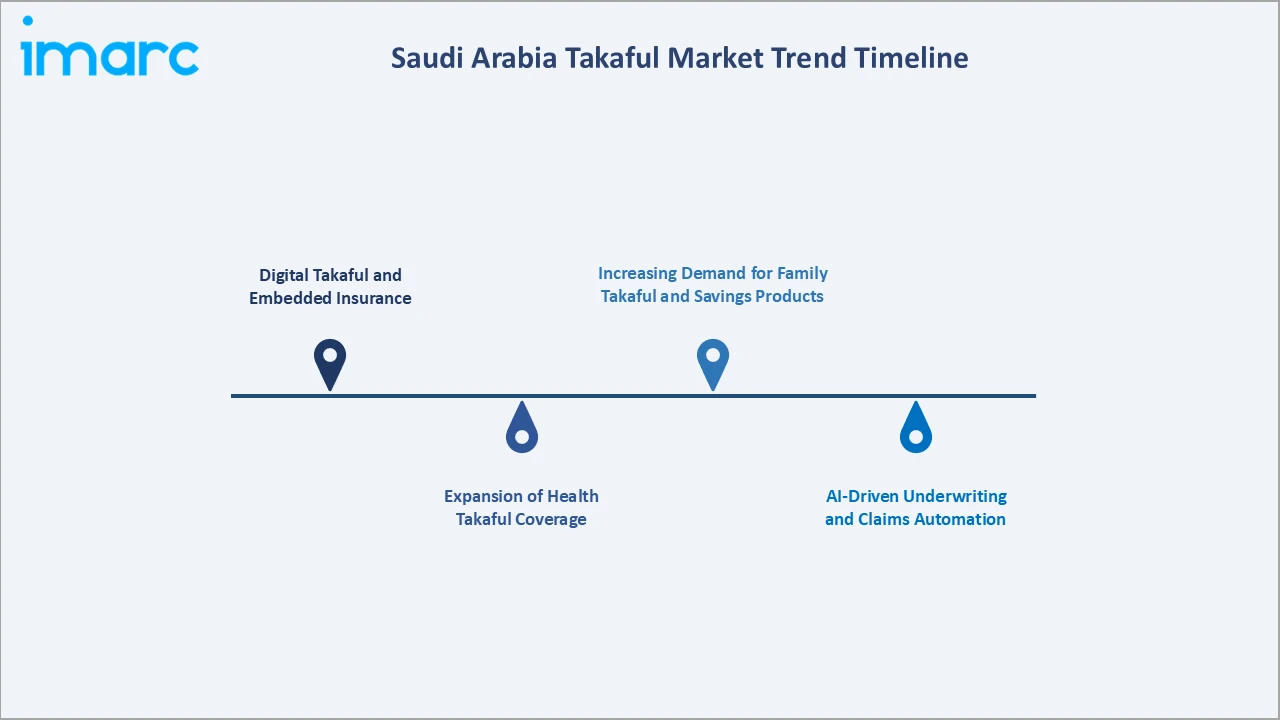
Saudi Arabian takaful operators are accelerating digital transformation through mobile applications, AI-powered underwriting, digital claims processing, and online policy issuance. Partnerships with banks, fintech firms, and e-commerce platforms are enabling embedded takaful products at the point of purchase. In February 2026, Neutrinos and Al Rajhi Takaful jointly received the InsureTek Golden Shield Excellence Award 2026 for Digital Takaful Transformation of the Year at the GAIP–InsureTek Middle East International Conference, held in Riyadh. The recognition highlights Al Rajhi Takaful’s extensive digital transformation across sales, distribution, customer servicing, underwriting, and claims for retail and SME products, covering direct, broker, agent, aggregator, and bancassurance channels across motor, health, life, and general insurance. These innovations improve customer convenience, reduce operational costs, and expand access to younger, digitally connected consumers.
2. Expansion of Health Takaful Coverage
Health takaful is emerging as the fastest-growing segment due to expanding mandatory health insurance requirements and ongoing healthcare reforms under Vision 2030. Broader insurance coverage for citizens, expatriates, and private-sector employees is increasing premium volumes. Insurers are also introducing flexible and value-added health plans with wellness and preventive care benefits.
3. AI-Driven Underwriting and Claims Automation
Takaful providers are increasingly deploying artificial intelligence, data analytics, and automation to enhance underwriting accuracy, detect fraud, and accelerate claims settlement. Digital risk assessment enables more personalized pricing and improved operational efficiency. These technologies also strengthen customer satisfaction by reducing processing times and improving service quality.
4. Increasing Demand for Family Takaful and Savings Products
Growing financial awareness, rising disposable incomes, and long-term financial planning are boosting demand for family takaful products. Consumers are increasingly adopting protection, education, retirement, and savings-linked plans that comply with Islamic principles. Operators are expanding product portfolios to meet evolving household financial security needs.
Industry Value Chain Analysis
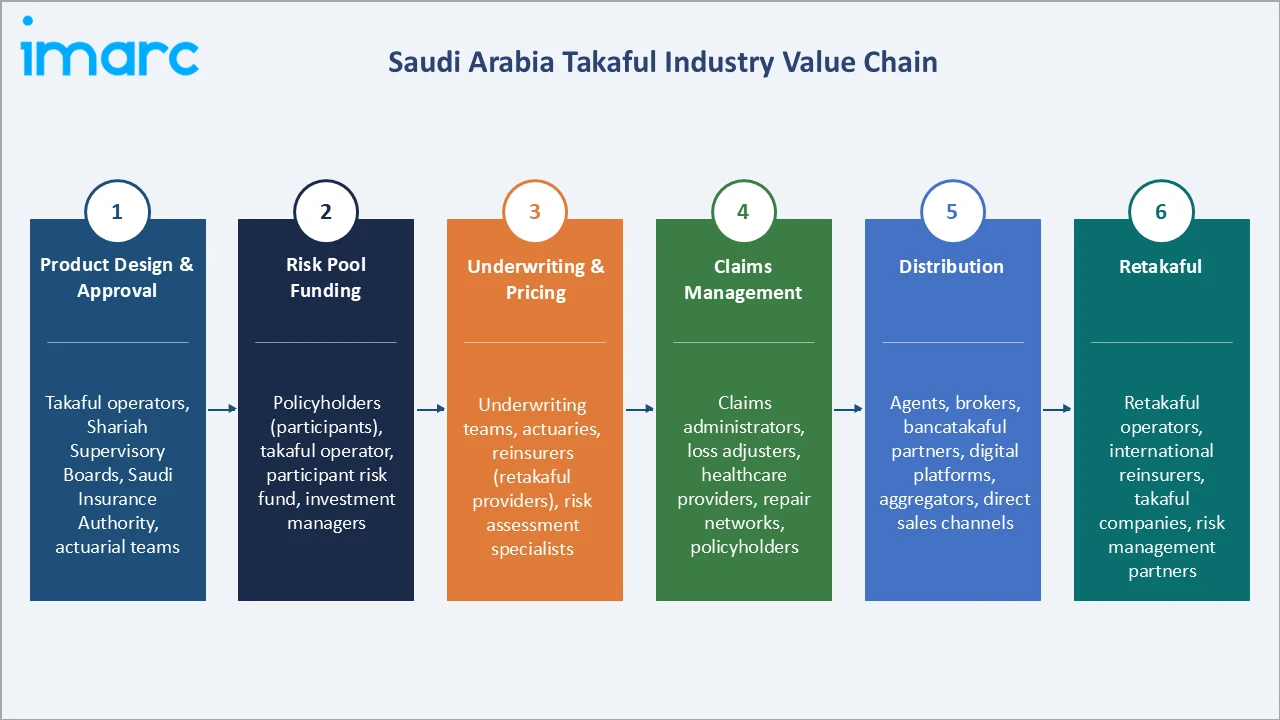
The Saudi Arabia takaful value chain integrates product design & approval, risk pool funding, underwriting & pricing, claims management, distribution, and retakaful.
|
Stage |
Key Participants |
|
Product Design & Approval |
Takaful operators, Shariah Supervisory Boards, Saudi Insurance Authority, actuarial teams. |
|
Risk Pool Funding |
Policyholders (participants), takaful operator, participant risk fund, investment managers. |
|
Underwriting & Pricing |
Underwriting teams, actuaries, reinsurers (retakaful providers), risk assessment specialists. |
|
Claims Management |
Claims administrators, loss adjusters, healthcare providers, repair networks, policyholders. |
|
Distribution |
Agents, brokers, bancatakaful partners, digital platforms, aggregators, direct sales channels. |
|
Retakaful |
Retakaful operators, international reinsurers, takaful companies, risk management partners. |
Underwriting and pricing represent the most value-added stage in the Saudi Arabia takaful value chain, as they determine risk selection, contribution pricing, and overall fund sustainability. Advanced actuarial analysis, AI-driven risk assessment, and Shariah-compliant underwriting practices help optimize profitability while ensuring fair pricing. Effective underwriting also minimizes claims costs, improves customer retention, and enhances the long-term financial performance of takaful operators.
Technology Landscape in the Saudi Arabia Takaful Industry
Digital Underwriting and AI-Powered Claims Management
Saudi Arabia's leading takaful operators are implementing AI and machine learning platforms for health takaful claims fraud detection, motor takaful damage assessment, and actuarial pricing optimization. Motor takaful AI damage assessment platforms enable same-day claim settlement for straightforward damage cases, without requiring physical vehicle inspection by an assessor, dramatically improving policyholder satisfaction while reducing claims administrative costs for operators.
Telematics and IoT-Enabled Motor Takaful
Pay-per-kilometer and usage-based takaful motor products, using OBD (On-Board Diagnostics) device telematics or smartphone GPS-based driving behavior monitoring, are being tested through a sandbox to enable more granular motor risk pricing that rewards low-mileage and safe-driving policyholders with contribution savings versus standard premium models. The Saudi market's high concentration of young male drivers creates strong commercial motivation for behavior-scored telematics products that enable operators to differentiate safe young drivers from risky ones at the individual-policy level, improving adverse selection management while offering competitive pricing to responsible consumers who are currently cross-subsidizing higher-risk peers under standard motor takaful pricing.
Regulatory and Capital-Modelling Solutions
Regulatory technology can automate compliance reporting, solvency monitoring, and capital adequacy assessments. In November 2025, The Cooperative Insurance Company (Tawuniya) secured approval from the Insurance Authority to establish Riyadh Reinsurance Company (Riyadh Re) as a wholly owned subsidiary. Capitalized at SAR 550 million (approximately $146.7 million), Riyadh Re focuses on treaty and facultative reinsurance, supporting primary insurers in managing large and complex risks through structured reinsurance arrangements. These solutions support compliance with Insurance Authority requirements and strengthen long-term financial resilience.
Market Segmentation Analysis
The report covers the following segments:
|
Segment Category |
Leading Segment |
Market Share |
Year |
|
Product Type |
General Takaful |
68.4% |
2025 |
|
Region |
Northern and Central Region |
42.3% |
2025 |

By Product Type
General takaful leads at 68.4% (2025) through mandatory health takaful, mandatory motor takaful, and infrastructure property and engineering takaful. Health takaful drives market growth through mandatory coverage expansion and medical cost inflation that increases per-member-per-month contributions annually.
To access detailed market analysis, Request Sample
Life/family takaful at 31.6%, growing fastest at ~9.2% CAGR, represents the market's highest-growth opportunity through bancatakaful credit life products, endowment savings takaful for wealth accumulation, and group life takaful for corporate employee benefit programs expanding under Vision 2030's labor market formalization.
Regional Market Insights
|
Region |
Share (2025) |
Key Saudi Arabia Takaful Market Drivers & Characteristics |
|
Northern and Central Region |
42.3% |
Largest market supported by Riyadh's concentration of insurers, financial institutions, government entities, and corporate customers. Strong demand for health, motor, and commercial takaful drives premium growth. |
|
Western Region |
26.8% |
Demand is driven by religious tourism, expanding healthcare infrastructure, and growing retail and SME activities in cities such as Jeddah, Makkah, and Madinah. |
|
Eastern Region |
20.1% |
Industrial development, oil and gas operations, and large corporate clients generate significant demand for commercial, engineering, marine, and employee takaful products. |
|
Southern Region |
10.8% |
Gradually expanding market supported by improving healthcare access, rising financial inclusion, infrastructure development, and increasing awareness of Shariah-compliant insurance solutions. |
Northern and Central regions' 42.3% market dominance is led by Riyadh’s strong presence of insurers, banks, government institutions, and major corporate clients and benefits from high demand for health, motor, property, and commercial takaful products. The Western region's 26.8% market is supported by religious tourism, healthcare expansion, retail activity, and infrastructure development in Jeddah, Makkah, and Madinah.
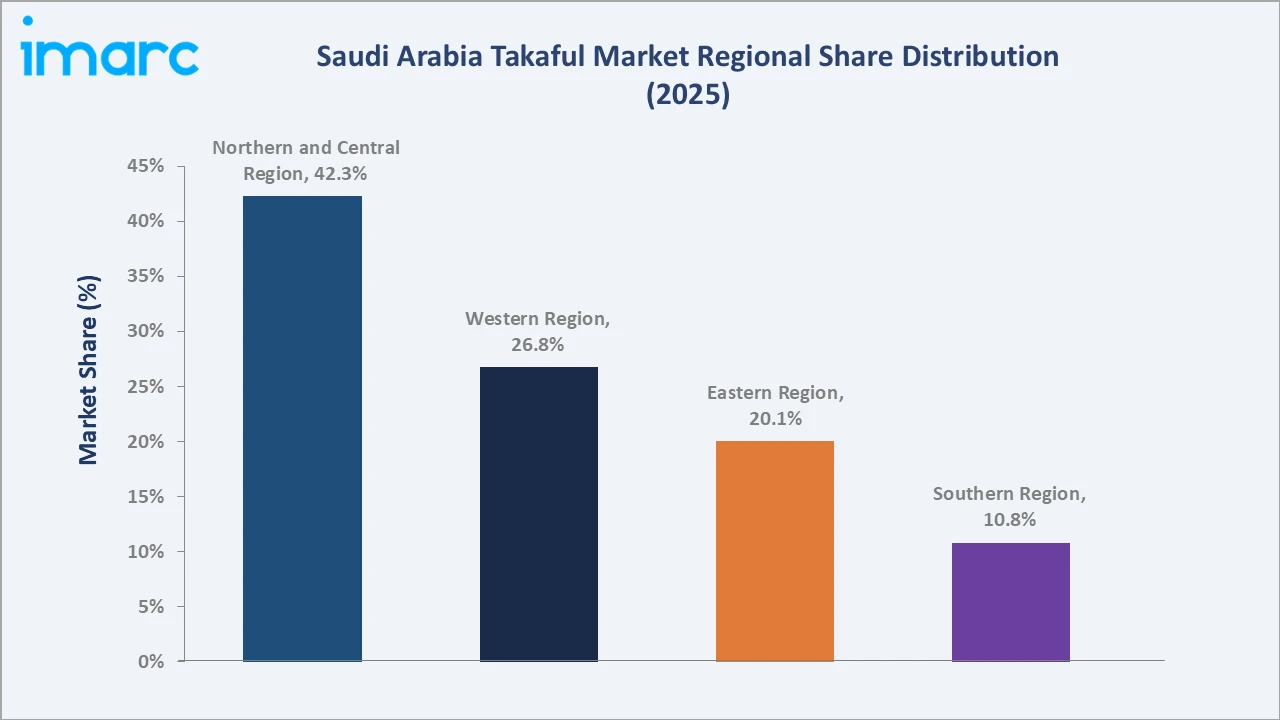
The Eastern region's 20.1% is driven by oil and gas operations, industrial projects, marine activity, and demand for large-scale commercial risk coverage. Southern region, at 10.8% with ~7.3% CAGR, remains comparatively smaller but is gradually expanding due to improving financial inclusion, healthcare access, and insurance awareness.
Competitive Landscape
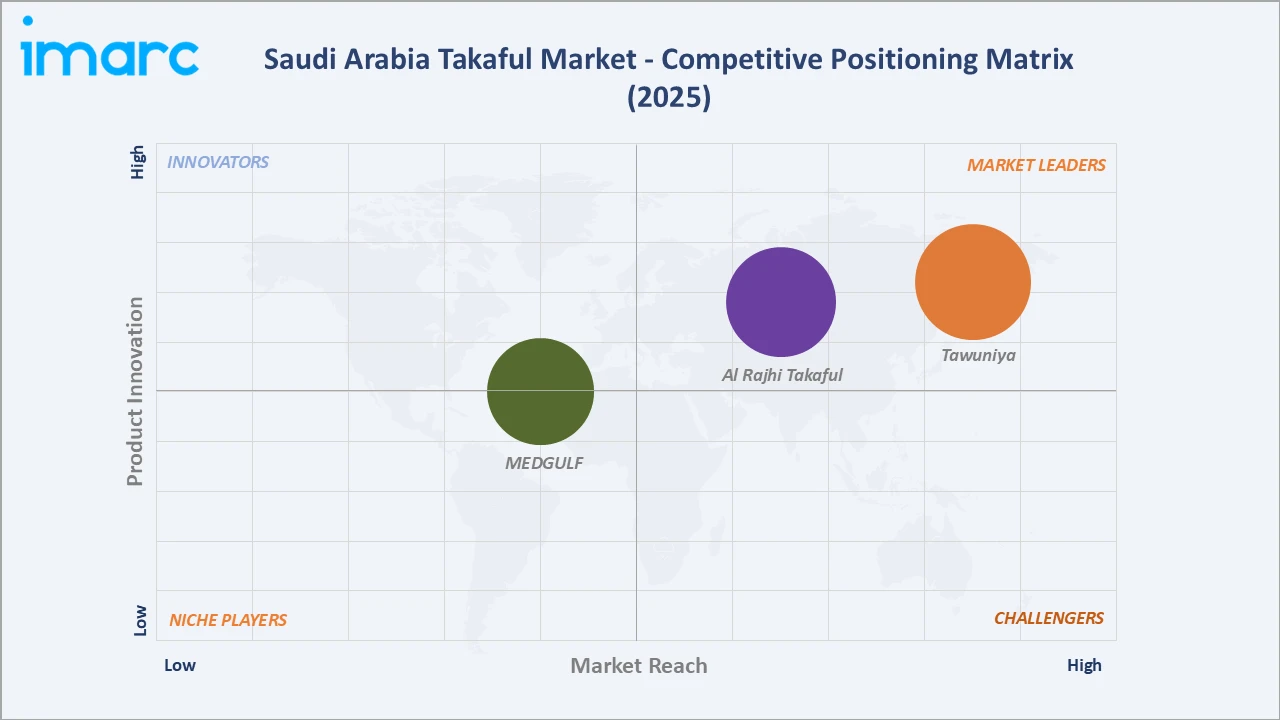
The Saudi Arabia takaful market is moderately consolidated, with leading players competing across health, motor, property, and family takaful segments. Competition is driven by digital transformation, product innovation, customer service, and extensive distribution networks, including bancatakaful and online platforms. Companies are also strengthening their market position through AI-enabled underwriting, automated claims processing, and strategic partnerships. Regulatory reforms, mandatory insurance coverage, and Vision 2030 initiatives continue to encourage innovation and expansion across the market.
|
Company |
Key Offerings |
Market Position |
Core Strength |
|
Tawuniya |
Takaful Life Insurance |
Market Leader |
Tawuniya plays a pioneering role in the Saudi Arabian Takaful sector. Tawuniya provides specialized corporate and Takaful life plans. |
|
Al Rajhi Takaful |
Motor Takaful, Medical Takaful, Travel Takaful |
Market Leader |
Al Rajhi Takaful serves as a pillar of Saudi Arabia's insurance industry, functioning as one of the largest insurers in the Kingdom. |
|
MEDGULF |
Family Takaful, Motor Takaful |
Established Player |
MEDGULF operates as a major regional insurance group. In Saudi Arabia, it functions primarily as a cooperative insurance company rather than a pure Takaful operator. |
Competitive dynamics are increasingly shaped by the bancatakaful distribution advantage, where the bancatakaful-embedded operators have structurally superior family takaful and retail general takaful distribution costs compared to agent-dependent or broker-dependent operators, creating a sustainable competitive moat in the growing retail takaful segments that Vision 2030's financial inclusion agenda is expanding.
Key Company Profiles
Tawuniya
Tawuniya is one of Saudi Arabia’s largest cooperative insurance providers and a leading participant in the Kingdom’s takaful market. The company offers a broad portfolio of Shariah-compliant insurance solutions for individuals, SMEs, and corporate clients. Tawuniya operates through an extensive branch network, digital platforms, and bancassurance partnerships, supported by strong underwriting capabilities and advanced claims management.
- Key Offerings: Takaful Life Insurance.
- Strategic Focus: Focuses on expanding its leadership in Saudi Arabia through digital transformation, AI-enabled underwriting, and automated claims management to enhance customer experience and operational efficiency. The company is strengthening its health, motor, corporate, and family takaful portfolios while broadening distribution through digital platforms, bancatakaful partnerships, and agency networks.
Al Rajhi Takaful
Al Rajhi Takaful is one of the leading providers of Shariah-compliant insurance solutions in Saudi Arabia and operates as a key subsidiary within the Al Rajhi financial ecosystem. The company offers a comprehensive portfolio of takaful products, including health, motor, travel, protection, and solutions for individuals, SMEs, and corporate clients. Leveraging strong brand recognition, an extensive bancatakaful partnership, and advanced digital platforms, Al Rajhi Takaful has established a significant presence in the Kingdom's insurance sector.
- Key Offerings: Motor Takaful, Medical Takaful, Travel Takaful.
- Key Developments: In February 2026, Neutrinos and Al Rajhi Takaful jointly received the InsureTek Golden Shield Excellence Award 2026 for Digital Takaful Transformation of the Year at the GAIP–InsureTek Middle East International Conference, held in Riyadh. The recognition highlights Al Rajhi Takaful’s extensive digital transformation across sales, distribution, customer servicing, underwriting, and claims for retail and SME products, covering direct, broker, agent, aggregator, and bancassurance channels across motor, health, life, and general insurance.
- Strategic Focus: Strengthening its leadership in Shariah-compliant insurance through digital transformation, AI-enabled underwriting, and automated claims processing to enhance customer experience and operational efficiency.
Market Concentration Analysis
The Saudi Arabia takaful market is moderately consolidated, with a few leading insurers accounting for a significant share of premiums. Competition is driven by product innovation, digital transformation, bancatakaful partnerships, and customer service capabilities. Established players benefit from strong brand recognition, extensive distribution networks, and diversified Shariah-compliant insurance portfolios. At the same time, regulatory reforms and Vision 2030 initiatives are encouraging greater market participation and fostering competition through technology adoption and expanding insurance penetration.
Investment & Growth Opportunities
Highest Growth Segments
Life/family takaful (~9.2% CAGR), Northern and Central region (~8.1% CAGR), Hajj/Umrah visitor takaful (emerging high-growth niche), and SME takaful packages (underpenetrated addressable market) represent Saudi Arabia's highest-growth takaful investment vectors through 2034.
Investment Themes
- Family Takaful bancatakaful platform investment: Financial institutions and takaful providers are investing in integrated bancatakaful platforms to distribute family takaful products through digital banking channels. These investments enhance customer accessibility, streamline policy issuance, and support the expansion of long-term protection and savings solutions.
- Parametric and InsurTech Takaful Product Development: Takaful operators are investing in InsurTech capabilities and parametric insurance models to deliver faster, data-driven claims settlement and innovative Shariah-compliant products. The focus is on leveraging AI, automation, and digital platforms to improve operational efficiency and address evolving customer needs.
Future Market Outlook (2026-2034)
The Saudi Arabia takaful market is projected to grow from USD 367.6 Million in 2025 to USD 727.8 Million by 2034, delivering a 7.89% CAGR that reflects the structural alignment between mandatory insurance expansion, Vision 2030's financial sector development targets, and the progressive penetration of bancatakaful distribution into the substantially underpenetrated family takaful segment. The anchor value of USD 537.2 Million in 2030 is driven by three structural forces that compound through the forecast period.
First, Saudi Arabia's mandatory insurance expansion framework provides a guaranteed baseline growth rate for the takaful market that is structurally protected from economic cycle volatility. Second, the life/family takaful segment's ~9.2% CAGR will be sustained by the convergence of three demographic and regulatory forces that create structural demand expansion for voluntary protection and savings takaful products beyond the mandatory credit life category. Third, the impact on Saudi takaful market quality will sustain above-sector-average profitability for technically disciplined operators through the forecast period, creating a virtuous cycle where improved profitability enables R&D investment in product innovation, digital platform development, and InsurTech capability that drives above-market premium growth for leading operators.
Research Methodology
Primary Research
Primary research comprised in-depth interviews with regulatory representatives, insurance officers, senior underwriting and actuarial executives, bancatakaful product managers at Islamic banks, retakaful placement managers, and independent Saudi insurance and takaful market consultants. Discussions validated market size estimates, product type segment dynamics, regional distribution patterns, and competitive positioning analysis.
Secondary Research
Secondary research encompassed annual insurance sector reports, mandatory health insurance expansion documentation, company annual reports, Saudi stock exchange financial results for listed takaful operators, credit life takaful mandate documentation, and regulatory sandbox participant announcements.
Forecasting Models
Forecasting models were developed using historical Saudi Arabia takaful market gross written contribution data, mandatory coverage expansion population modeling, housing program credit life takaful demand projection, bancatakaful distribution penetration rate scenario analysis, profitability improvement sustainability modeling, life/family takaful demographic demand escalation calculation, digital InsurTech channel adoption rate projections, regional market growth differential analysis, and Vision 2030 economic diversification GDP impact scenarios for commercial takaful demand. Both top-down and bottom-up approaches were validated through primary research.
Saudi Arabia Takaful Market Report Coverage:
| Report Features | Details |
|---|---|
| Base Year of the Analysis | 2025 |
| Historical Period | 2020-2025 |
| Forecast Period | 2026-2034 |
| Units | Million USD |
| Scope of the Report |
Exploration of Historical Trends and Market Outlook, Industry Catalysts and Challenges, Segment-Wise Historical and Future Market Assessment:
|
| Product Types Covered | Life/Family Takaful, General Takaful |
| Regions Covered | Northern and Central Region, Western Region, Eastern Region, Southern Region |
| Companies Covered | Tawuniya, Al Rajhi Takaful, MEDGULF, etc. |
| Customization Scope | 10% Free Customization |
| Post-Sale Analyst Support | 10-12 Weeks |
| Delivery Format | PDF and Excel through Email (We can also provide the editable version of the report in PPT/Word format on special request) |
Key Benefits for Stakeholders:
- IMARC’s industry report offers a comprehensive quantitative analysis of various market segments, historical and current market trends, market forecasts, and dynamics of the Saudi Arabia takaful market from 2020-2034.
- The research report provides the latest information on the market drivers, challenges, and opportunities in the Saudi Arabia takaful market.
- Porter's five forces analysis assist stakeholders in assessing the impact of new entrants, competitive rivalry, supplier power, buyer power, and the threat of substitution. It helps stakeholders to analyze the level of competition within the Saudi Arabia takaful industry and its attractiveness.
- Competitive landscape allows stakeholders to understand their competitive environment and provides an insight into the current positions of key players in the market.
Frequently Asked Questions About the Saudi Arabia Takaful Market Report
The Saudi Arabia takaful market reached USD 367.6 Million in 2025, driven by mandatory health takaful expansion under regulations covering Saudi nationals and expatriate workers and digital InsurTech channel growth through a regulatory sandbox.
The market grows at 7.89% CAGR during 2026-2034, reaching USD 727.8 Million by 2034. Growth will be supported by rising insurance penetration, digitalisation, and increasing demand for Shariah-compliant protection solutions.
General takaful leads at 68.4% (2025) through mandatory health takaful, mandatory motor takaful, and Vision 2030 giga-project property and engineering takaful.
Northern and Central region leads at 42.3% (2025) through Riyadh's concentration of government entities, the largest corporate health takaful accounts, and giga-project construction engineering takaful.
Leading companies include Tawuniya, Al Rajhi Takaful, and MEDGULF, among others.
The market is projected to reach approximately USD 537.2 Million by 2030, driven by mandatory health coverage expansion to newly covered worker categories, adding millions of insured lives; life/family takaful bancatakaful product adoption acceleration; and mandatory private sector employee life takaful requirement under evaluation.
Top opportunities include life/family takaful bancatakaful platform development through Islamic banking partnerships targeting the underpenetrated Saudi family protection market, digital InsurTech takaful platform through regulatory sandbox licensing, SME takaful package product development for Vision 2030's registered SME base, and microinsurance takaful for the Southern region and agricultural sector underserved populations.
Need more help?
- Speak to our experienced analysts for insights on the current market scenarios.
- Include additional segments and countries to customize the report as per your requirement.
- Gain an unparalleled competitive advantage in your domain by understanding how to utilize the report and positively impacting your operations and revenue.
- For further assistance, please connect with our analysts.
 Request Customization
 Speak to an Analyst
 Request Brochure
 Inquire Before Buying
Benefits of Customization
- Personalize this research
- Triangulate with your data
- Get data as per your format and definition
- Gain a deeper dive into a specific application, geography, customer, or competitor
- Any level of personalization
Get in Touch With Us
UNITED STATES
Phone: +1-201-971-6302
INDIA
Phone: +91-120-433-0800
UNITED KINGDOM
Phone: +44-753-714-6104
Email: [email protected]
Client Testimonials




.webp)




.webp)













Related Reports

Choose your plan
*Please note that the prices mentioned below are starting prices for each bundle type. Kindly contact our team for further details.*
Single User License
- 1 User License, Access on 2 Devices
- PDF Report + Excel Dataset (Password Protected)
- Lifetime Access
- No Printing Rights
- 10% Free Report Customization
- 10–12 Weeks of Analyst Support
Five User License
- Access for 5 Users, 2 Devices per User
- PDF Report + Excel Dataset (Password Protected)
- Lifetime Access
- Dedicated Account Manager
- 12–14 Weeks of Analyst Support
- No Printing Rights
- 15% Free Report Customization
- 25% Discount on Your Next Purchase
Corporate User License
- Unlimited User Access (Within Your Organization)
- PDF Report + Excel Dataset
- Lifetime Access
- Dedicated Account Manager
- 14–20 Weeks of Analyst Support
- No Printing Rights
- 20% Free Report Customization
- 30% Discount on Your Next Purchase
Essential Insights
What's included:
3 reports
- Lifetime Access
- PDF Reports
- Excel Datasets
- 2 Weeks of Free Analyst Support
- 2 User Licenses
- Access on 2 Devices
- Printing Rights
- Complimentary PowerPoint (PPT) Version
- Complimentary License Upgrade
Professional Access
What's included:
5 reports
- Lifetime Access
- PDF Reports
- Excel Datasets
- 8 Weeks of Free Analyst Support
- 2 User Licenses
- Access on 2 Devices
- Printing Rights
- Complimentary PowerPoint (PPT) Version
- Complimentary License Upgrade
Business Advantage
What's included:
8 reports
- Lifetime Access
- PDF Reports
- Excel Datasets
- 14 Weeks of Free Analyst Support
- 2 User Licenses
- Access on 2 Devices
- Printing Rights
- Complimentary PowerPoint (PPT) Version
- Complimentary License Upgrade
Enterprise Intelligence
What's included:
10 reports
- Lifetime Access
- PDF Reports
- Excel Datasets
- 20 Weeks of Free Analyst Support
- 2 User Licenses
- Access on 2 Devices
- Printing Rights
- Complimentary PowerPoint (PPT) Version
- Complimentary License Upgrade