
Saudi Arabia Toys and Games Market Size, Share, Trends and Forecast by Product Type, Distribution Channel, and Region, 2026-2034
Saudi Arabia Toys and Games Market Size, Share, Trends & Forecast (2026-2034)
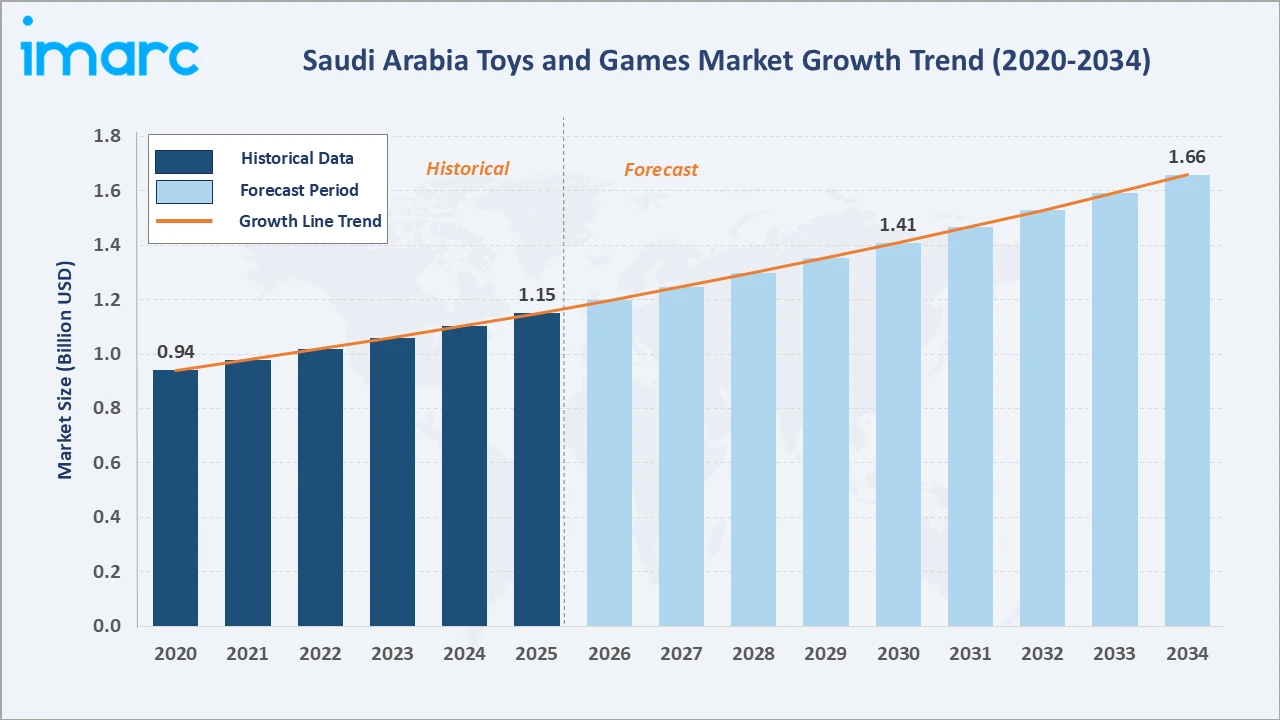
The Saudi Arabia toys and games market size increased from USD 1.15 Billion in 2025 to USD 1.20 Billion in 2026 and is projected to reach USD 1.66 Billion by 2034, growing at a CAGR of 4.15% during 2026-2034. Growth is driven by a large youth population, rising disposable incomes, and expanding e-commerce penetration. Activity toys dominate at 22.8% product type share, while specialty stores hold 37.6% of distribution. The Northern and Central Region leads regionally with a 47.1% share, anchored by Riyadh's population density and retail concentration, supported by Vision 2030's family entertainment and retail expansion initiatives.
Market Snapshot
|
Metric |
Value |
|
Base YearMarket Size (2025) |
USD 1.15 Billion |
| Market Size (2026) | USD 1.20 Billion |
|
Forecast Market Size (2034) |
USD 1.66 Billion |
|
CAGR (2026-2034) |
4.15% |
|
Base Year |
2025 |
|
Historical Period |
2020-2025 |
|
Forecast Period |
2026-2034 |
|
Largest Product Type |
Activity Toys (22.8%, 2025) |
|
Largest Distribution Channel |
Specialty Stores (37.6%, 2025) |
|
Dominant Region |
Northern & Central Region (47.1%, 2025) |
The market expanded from USD 0.94 Billion in 2020 to USD 1.15 Billion in 2025 and an estimated USD 1.20 Billion in 2026, anchored at USD 1.41 Billion in 2030, and forecast to reach USD 1.66 Billion by 2034. Growth is supported by rising birth rates, increasing household spending on child development, and the rapid build-out of family entertainment destinations under Vision 2030.
To get more information on this market, Request Sample
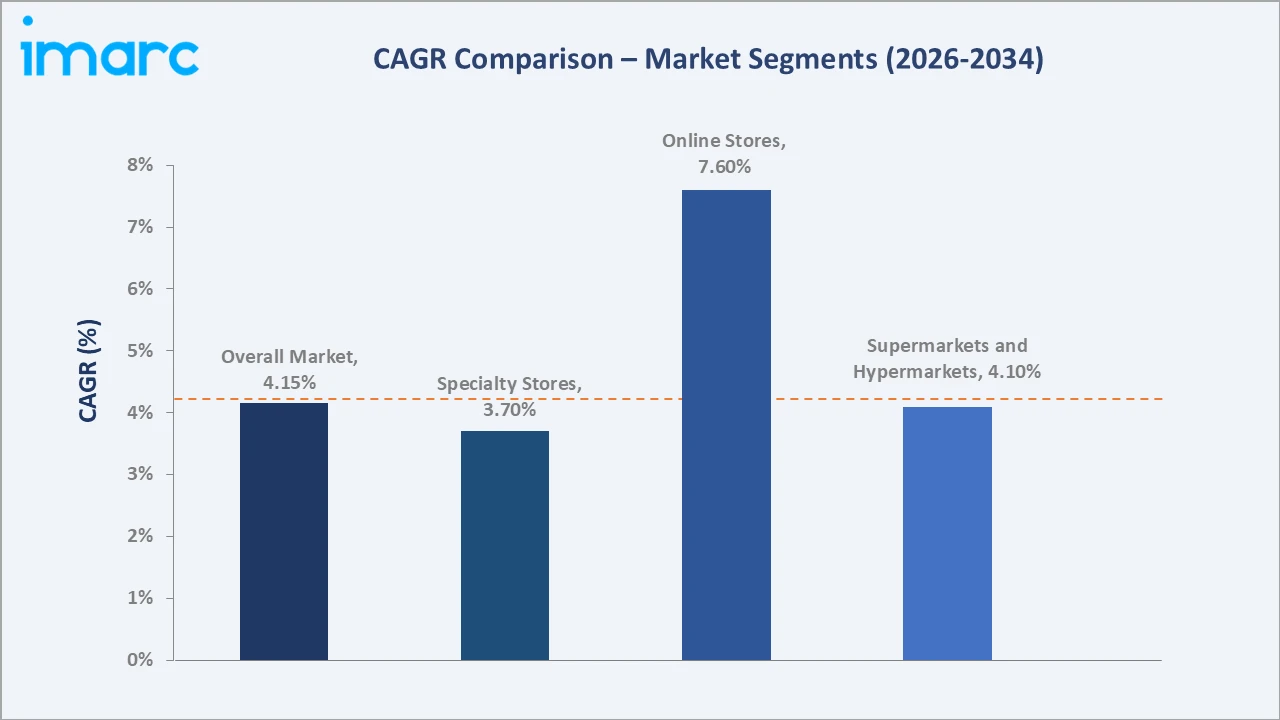
Online stores grow fastest at an estimated 7.6% CAGR (2026-2034), driven by expanding digital retail and social-commerce adoption. Activity toys and games and puzzles maintain steady growth above the category average, reflecting sustained demand for educational and skill-building play, while specialty stores retain leadership through curated assortments and in-store experience.
Executive Summary
The Saudi Arabia toys and games market, which increased from USD 1.15 Billion in 2025 to an estimated USD 1.20 Billion in 2026, driven by one of the region's youngest populations, rising parental spending on developmental play, and the Kingdom's fast-expanding retail and entertainment infrastructure. Vision 2030's family entertainment mega-projects, led by Saudi Entertainment Ventures (SEVEN), are creating new licensed-toy retail and experiential demand. The market is projected to reach USD 1.66 Billion by 2034 at a 4.15% CAGR, reflecting steady expansion supported by e-commerce growth, urbanization, and rising interest in educational and interactive toys.
Activity toys command 22.8% of the 2025 market, reflecting strong parental preference for skill-building and physically engaging play - a category particularly valued in Saudi Arabia's growing focus on child development. Specialty stores retain 37.6% share, anchored by curated assortments, staff expertise, and immediate product availability. The Northern and Central Region dominates at 47.1%, anchored by Riyadh's population concentration and retail density, while the Western Region benefits from Jeddah's commercial port access and religious tourism traffic.
Key Market Insights
|
Insight |
Data |
|
Largest Product Type |
Activity Toys - 22.8% share (2025) |
|
Largest Distribution Channel |
Specialty Stores - 37.6% share (2025) |
|
Fastest-Growing Distribution Channel |
Online Stores - ~7.6% CAGR (2026-2034) |
|
Dominant Region |
Northern & Central Region - 47.1% share (2025) |
|
Top Companies |
Mattel, Inc., Hasbro, Inc., LEGO Group, and Spin Master Corp. |
|
Market Opportunity |
STEM and licensed-character toy expansion |
Key Analytical Observations Supporting The Above Data:
- Activity toys at 22.8% share (2025) driven by developmental-play preference: Saudi parents increasingly prioritize toys that build creativity, problem-solving, and social skills, lifting activity toys and games and puzzles above the category average growth rate.
- Specialty stores at 37.6% anchored by curated in-store experience: Specialty retailers offer curated assortments, in-store demonstrations, and immediate availability that online-only platforms cannot fully replicate for younger age groups.
- Online stores growing fastest at ~7.6% CAGR (2026-2034): Rising smartphone penetration and social-commerce adoption are shifting purchase discovery online, even where fulfillment ultimately occurs offline.
- Northern & Central Region dominant with 47.1% share (2025): The region's concentration of Riyadh's population, higher household incomes, and dense retail infrastructure sustain its outsized contribution to category demand.
- Mattel, Hasbro, and LEGO Group lead brand-level competition: Global brand owners are deepening Saudi engagement through entertainment-destination partnerships, licensed retail, and localized product assortments.
Saudi Arabia Toys and Games Market Overview
Saudi Arabia's toys and games market encompasses activity toys, infant and preschool toys, games and puzzles, plush toys, dolls, ride-ons, and other play categories sold through specialty, online, supermarket, departmental, and general store channels. The market is predominantly import-driven, with negligible large-scale domestic manufacturing as of 2025, relying on global brand owners and regional distributors to supply the Kingdom's specialty and mass retail networks.
The market operates under Saudi Standards, Metrology and Quality Organization (SASO) product-safety regulations governing toy import and sale. Macroeconomic influences include Vision 2030's economic diversification, rising female workforce participation, and government-backed investment in family entertainment destinations, which continue to expand retail shelf space and experiential demand for toys nationwide.
Market Dynamics
To evaluate market opportunities, Request Sample
Market Drivers
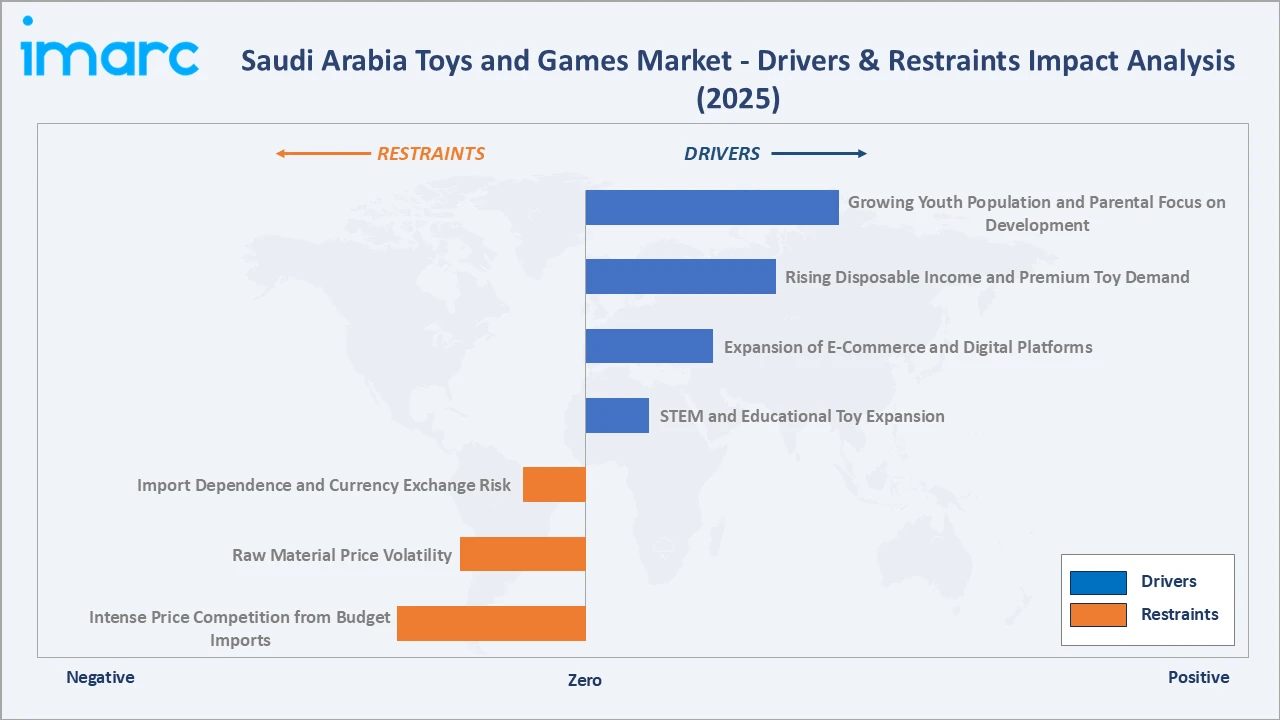
- Growing Youth Population and Parental Focus on Development: Saudi Arabia's large under-14 population base continues to expand, creating structural, recurring demand for age-specific toys and reinforcing category growth well above regional averages.
- Rising Disposable Income and Premium Toy Demand: Higher household incomes are shifting purchases toward premium, branded, and licensed products, lifting average spend per child across activity toys and collectibles.
- Expansion of E-Commerce and Digital Platforms: Online retailers and social platforms are expanding product discovery and access, particularly benefiting families outside major urban centers.
- Vision 2030 Entertainment Infrastructure Investment: Vision 2030 entertainment mega-projects are integrating licensed toy brands into theme parks and family destinations, deepening brand-retail linkages nationwide.
Market Restraints
- Import Dependence and Currency Exchange Risk: Saudi Arabia's near-total import dependence exposes retailers to USD/SAR-linked freight and input cost volatility, occasionally compressing distributor margins.
- Raw Material Price Volatility: Global plastic resin and packaging material price cycles periodically raise landed costs, which can dampen replacement and discretionary purchase demand in price-sensitive segments.
Market Opportunities
- STEM and Educational Toy Expansion: Rising parental awareness of developmental benefits is creating a fast-growing niche for STEM, puzzle, and skill-building toy categories.
- Entertainment-Linked Retail Formats: Vision 2030 entertainment destinations are opening new licensed retail and experiential formats, creating fresh revenue channels beyond traditional stores.
Market Challenges
- Intense Price Competition from Budget Imports: Lower-cost, unbranded imports are expanding in value segments, pressuring margins for mid-tier and premium branded toy distributors.
- Supply Chain Fragility from Import Dependence: Near-total reliance on imported goods creates exposure to shipping lane disruptions and port congestion that can delay seasonal inventory availability.
Emerging Market Trends
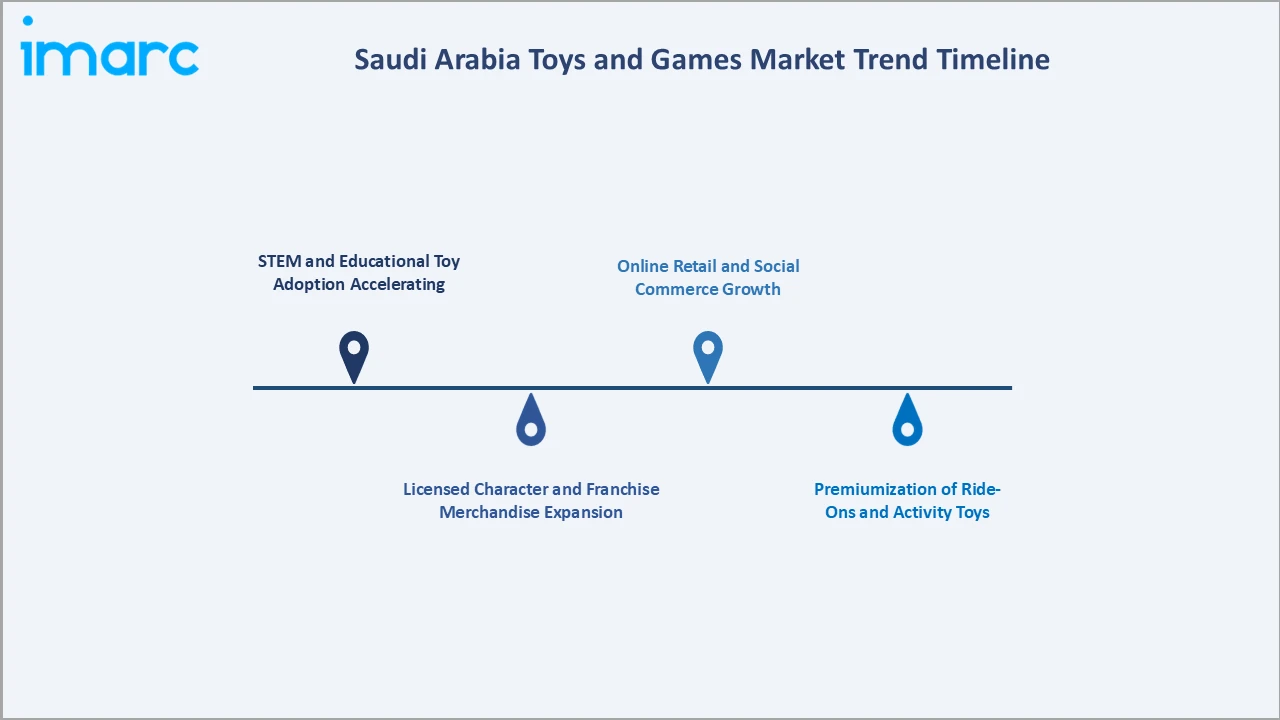
1. STEM and Educational Toy Adoption Accelerating
Parents are increasingly selecting toys that combine entertainment with skill development. Puzzle sets, building kits, and interactive learning toys are gaining shelf space across specialty and online channels alike.
2. Licensed Character and Franchise Merchandise Expansion
Entertainment partnerships between global brand owners and Saudi destination developers are driving demand for franchise-linked toys, from action figures to themed activity sets tied to regional attractions.
3. Online Retail and Social Commerce Growth
Saudi Arabia's e-commerce channel is expanding rapidly as digital platforms offer wider assortments, transparent pricing, and influencer-driven product discovery, particularly among younger parents.
4. Premiumization of Ride-Ons and Activity Toys
Rising household incomes are lifting demand for higher-quality, durable ride-on and activity toys, with consumers increasingly willing to pay a premium for safety-certified, branded products.
Industry Value Chain Analysis
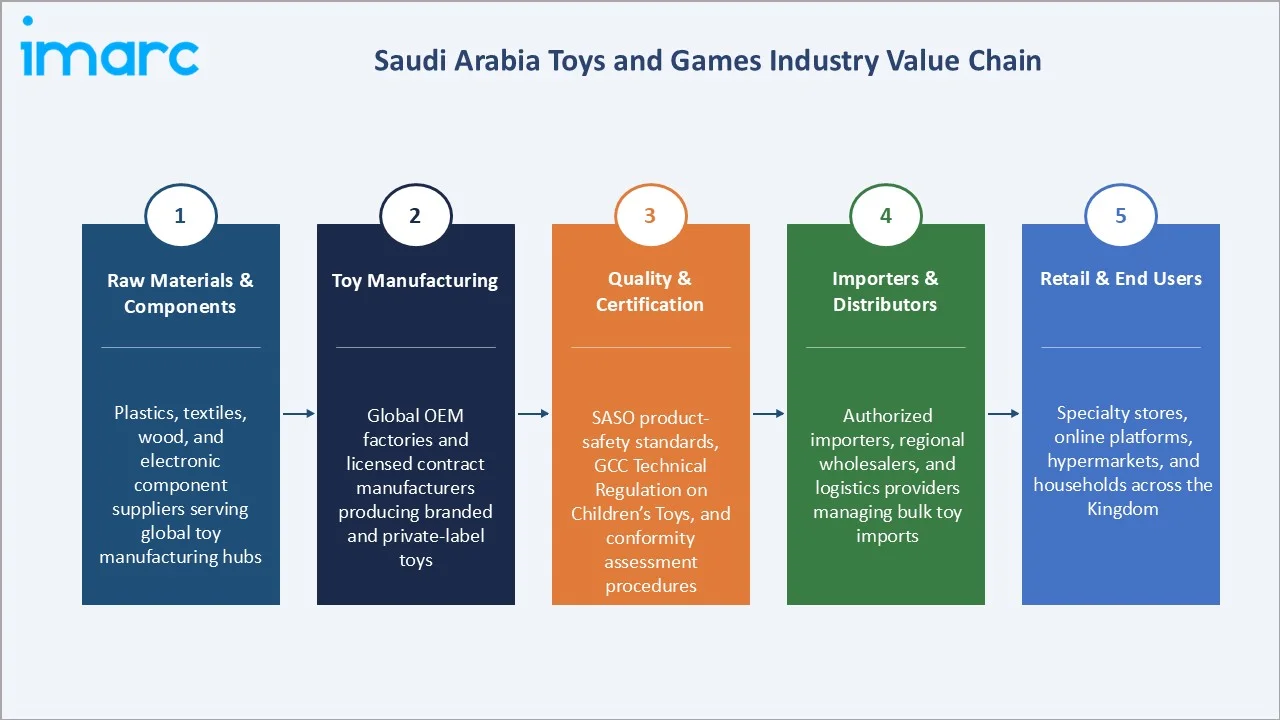
Saudi Arabia's toys and games value chain spans global raw material and component sourcing, contract and licensed manufacturing, SASO regulatory compliance, multi-tier import and distribution networks, and end-consumer retail across specialty, online, and mass-merchandise channels.
|
Stage |
Key Participants |
|
Raw Materials & Components |
Plastics, textiles, wood, and electronic component suppliers serving global toy manufacturing hubs |
|
Toy Manufacturing |
Global OEM factories and licensed contract manufacturers producing branded and private-label toys |
|
Quality & Certification |
SASO product-safety standards, GCC Technical Regulation on Children’s Toys, and conformity assessment procedures |
|
Importers & Distributors |
Authorized importers, regional wholesalers, and logistics providers managing bulk toy imports |
|
Retail & End Users |
Specialty stores, online platforms, hypermarkets, and households across the Kingdom |
Distribution follows a multi-tier model in which global brand owners supply licensed Saudi importers, who in turn distribute to specialty retailers, hypermarkets, and e-commerce platforms. Direct-to-consumer online channels are gradually compressing traditional importer margins.
Technology Landscape in the Saudi Arabia Toys and Games Industry
Smart and Connected Toy Technology
Interactive and app-connected toys incorporating sensors, voice recognition, and companion mobile applications are gradually entering Saudi Arabia's premium toy segment, appealing to tech-engaged parents seeking screen-complementary play experiences.
Materials and Safety Innovation
Manufacturers are increasingly adopting BPA-free plastics, water-based paints, and reinforced safety features to meet SASO compliance requirements and growing parental demand for non-toxic, durable play products.
Digital Retail and Personalization Technology
E-commerce platforms are deploying recommendation engines, augmented-reality product previews, and personalized marketing to improve conversion, particularly for gift-occasion and seasonal toy purchases across Saudi Arabia's growing online shopper base.
Market Segmentation Analysis
The report covers the following segments:
|
Segment Category |
Leading Segment |
Market Share |
Year |
|
Product Type |
Activity Toys |
22.8% |
2025 |
|
Distribution Channel |
Specialty Stores |
37.6% |
2025 |
|
Region |
Northern & Central Region |
47.1% |
2025 |

By Product Type
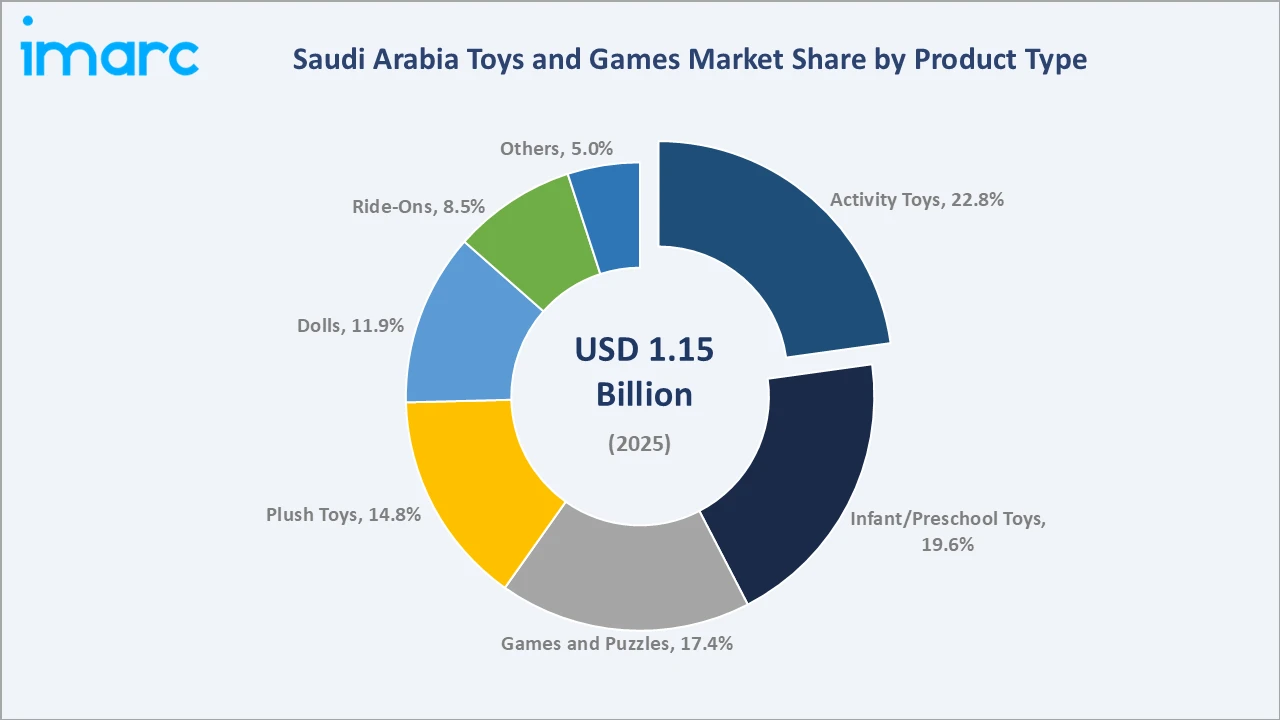
Activity toys lead at 22.8% market share (2025), reflecting strong parental preference for skill-building, physically engaging play. Infant and preschool toys follow at 19.6%, supported by Saudi Arabia's sustained birth rate and early-childhood development focus. Games and puzzles hold 17.4% share, anchored by rising demand for cognitive and educational play formats.
To access detailed market analysis, Request Sample
Plush toys and dolls account for 14.8% and 11.9% shares, respectively, sustained by gifting occasions and character licensing, while ride-ons at 8.5% cater to a premium, higher-spend consumer segment. The others category, at 5.0%, includes novelty and seasonal play items.
By Distribution Channel
Specialty stores lead at 37.6% market share (2025), driven by curated assortments, knowledgeable staff, and immediate product availability that supports impulse and gift purchases. Online stores follow at 24.5%, reflecting rapid e-commerce adoption among Saudi families.
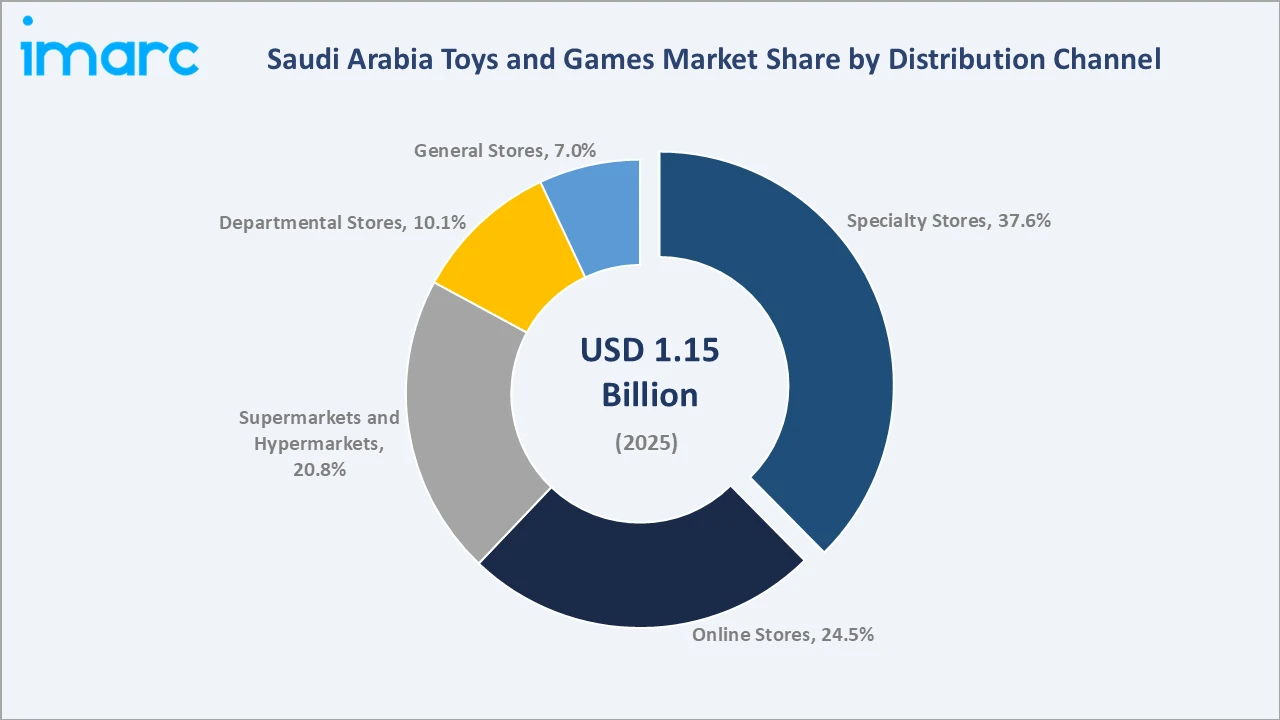
Supermarkets and hypermarkets hold 20.8% share, benefiting from high footfall and convenience-driven impulse purchases, while departmental stores and general stores together account for 17.1%, serving smaller cities and neighborhood retail needs. Online stores are growing fastest at an estimated 7.6% CAGR (2026-2034), the highest among all channels.
Regional Market Insights
|
Region |
Share (2025) |
Key Growth Drivers & Characteristics |
|
Northern & Central Region |
47.1% |
Highest population density centered around Riyadh; strong retail infrastructure and household income levels; concentration of specialty and hypermarket chains driving elevated toy demand |
|
Western Region |
23.8% |
High religious and domestic tourism traffic around Makkah and Madinah; Jeddah's commercial port supporting import logistics; growing hospitality and family entertainment footfall |
|
Eastern Region |
18.4% |
Higher household incomes linked to the oil and petrochemical sector; expanding retail and entertainment infrastructure across Dammam, Khobar, and Dhahran |
|
Southern Region |
10.7% |
Emerging retail infrastructure development; increasing domestic tourism and gradual growth in organized toy retail penetration |
The Northern and Central Region's 47.1% dominance reflects Riyadh's status as Saudi Arabia's economic and population capital, home to the highest household density and the greatest concentration of specialty and hypermarket retail chains. Riyadh's expanding family-entertainment infrastructure under Vision 2030 continues to reinforce the region's outsized market share.
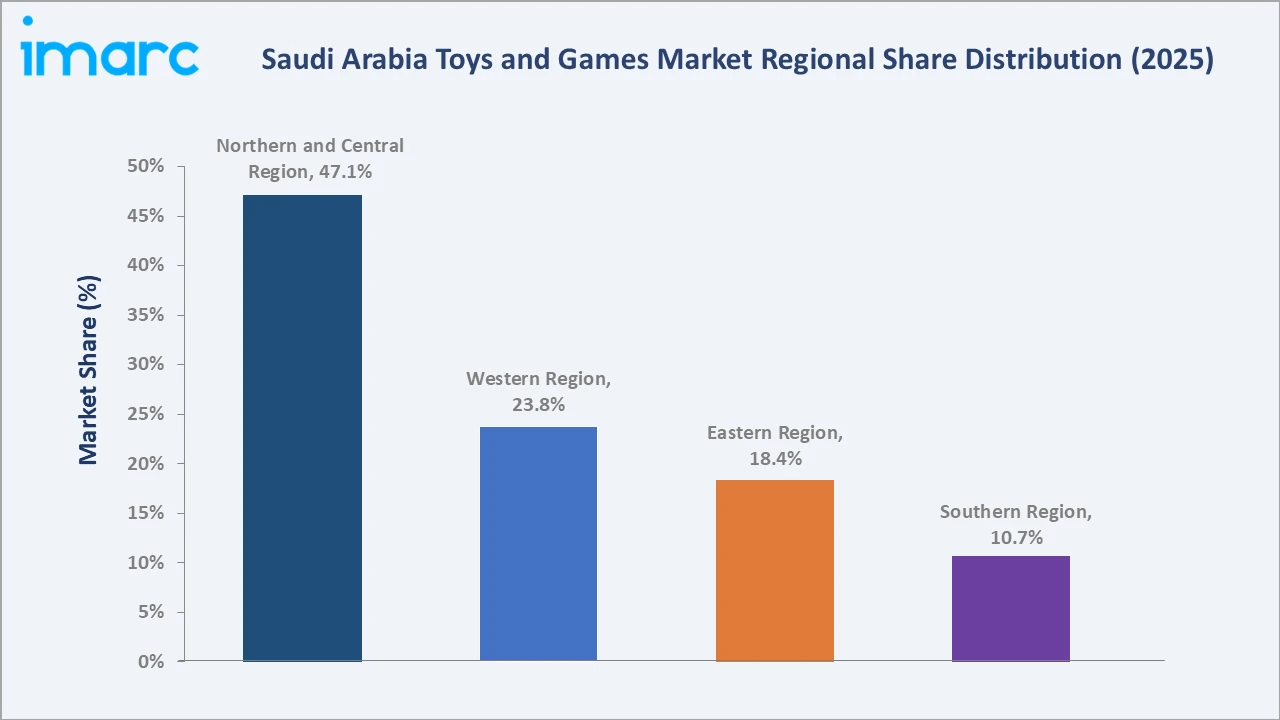
The Western Region's 23.8% share is anchored by Jeddah's role as Saudi Arabia's one of the largest commercial ports and gateway for toy imports, while Makkah and Madinah's year-round pilgrimage traffic sustains above-average retail footfall. The Eastern Region's 18.4% share reflects strong household purchasing power tied to the Kingdom's energy sector.
Competitive Landscape
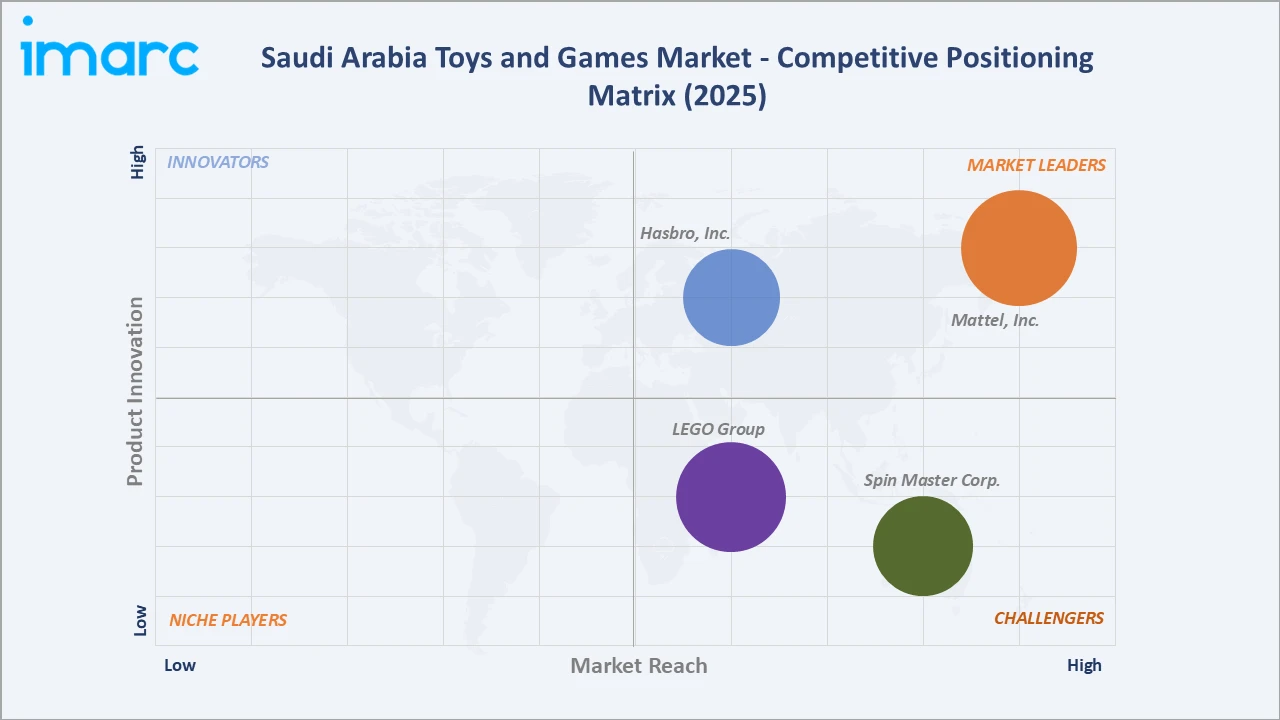
Saudi Arabia's toys and games market is moderately concentrated among global brand owners at the premium and mid-tier level, with growing competition from licensed entertainment partnerships and regional distributors in value segments. Mattel, Hasbro, and LEGO Group collectively command a leading share of branded toy sales (2025).
|
Company Name |
Brand / Product Line |
Market Position |
Core Strength |
|
Mattel, Inc. |
Barbie, Hot Wheels, Fisher-Price, UNO |
Market Leader |
Deep licensing partnerships with Saudi entertainment destinations, including Formula 1 and SEVEN Hot Wheels activations |
|
Hasbro, Inc. |
Monopoly, Play-Doh, The Game of Life, Nerf, Marvel Action Figures |
Market Leader |
First-mover location-based entertainment partnerships with SEVEN across multiple Saudi cities |
|
LEGO Group |
LEGO City, LEGO Technic, LEGO Duplo |
Strong Challenger |
Multi-city flagship retail network operated through Modern Electronics Co. Ltd. (MEC) franchise partnership |
|
Spin Master Corp. |
PAW Patrol, Bakugan, Kinetic Sand, Rubik's Cube |
Strong Challenger |
Broad licensed-character portfolio distributed through regional specialty and hypermarket retailers |
Saudi Arabia's competitive landscape is bifurcated: global brand owners dominate premium and licensed segments through entertainment-destination partnerships and flagship retail, while regional distributors and specialty chains compete on assortment breadth and price across the mid-market and value tiers.
Key Company Profiles
Mattel, Inc.
Mattel is one of Saudi Arabia's leading toy brands by licensed retail presence, commanding strong positioning across activity toys, dolls, and vehicle play segments through its globally recognized Barbie and Hot Wheels franchises.
- Product Portfolio: Barbie, Hot Wheels, Fisher-Price, UNO, and others.
- Strategic Focus: Expanding entertainment-linked licensing and experiential retail presence across Vision 2030 destinations.
Hasbro, Inc.
Hasbro maintains a growing location-based entertainment footprint in Saudi Arabia, anchored by exclusive theme-park-style partnerships that extend its Play-Doh and Transformers brands beyond traditional retail. The company operates via major licensing partnerships with Al Hokair Group (which is opening Playocity indoor theme parks featuring Hasbro brands) and the Saudi Entertainment Ventures (SEVEN).
- Product Portfolio: Play-Doh, Marvel Action Figures, Monopoly, Nerf, and others.
- Strategic Focus: Deepening experiential and location-based entertainment partnerships within Vision 2030 mega-projects.
LEGO Group
LEGO Group has built a multi-city flagship retail network in Saudi Arabia, operating certified stores that combine global product assortments with culturally themed in-store experiences. The company’s official retail stores and distribution in Saudi Arabia are operated by the licensed franchisee, Modern Electronics Co. Ltd. (MEC).
- Product Portfolio: LEGO City, LEGO Technic, LEGO Duplo, and others.
- Strategic Focus: Building brand-immersive flagship retail experiences tied to Saudi cultural landmarks.
Market Concentration Analysis
Saudi Arabia's toys and games market exhibits moderate concentration at the premium and licensed-brand level, with meaningful fragmentation across mid-tier and budget segments. Mattel, Hasbro, and LEGO Group collectively account for an estimated 30-38% of branded toy sales by value (2025), while their combined volume share remains lower given premium pricing versus mass-market competitors.
The market's structural fragmentation below the premium tier reflects Saudi Arabia's diverse consumer base, ranging from price-sensitive families seeking budget imports to higher-income households purchasing exclusive licensed and collectible items. Regional distributors and specialty retail groups hold meaningful share in mid-tier categories.
Consolidation trends remain limited at the distributor level, though global brand owners are increasingly pursuing direct entertainment-destination partnerships that bypass traditional wholesale layers, gradually reshaping the Kingdom's toy distribution landscape.
Investment & Growth Opportunities
Fastest Growing Segments
Online stores (~7.6% CAGR), STEM and educational toy categories, and licensed entertainment-linked merchandise represent Saudi Arabia's highest-growth investment vectors through 2034. Activity toys and games and puzzles continue to grow above the overall market average, reflecting sustained developmental-play demand.
Emerging Market Opportunities
Vision 2030's continued build-out of family entertainment destinations creates a viable pathway for global toy brands to establish co-branded retail and experiential formats. Partnerships combining licensed merchandise with location-based attractions offer differentiated revenue streams beyond traditional store sales.
Investment Themes
- Digital retail platform investment: Saudi Arabia's e-commerce growth creates a compelling opportunity for online toy platforms integrating personalized recommendations, fast delivery, and social-commerce discovery.
- STEM and educational toy portfolio development: Rising parental focus on child development creates first-mover advantage for brands expanding STEM-certified and skill-building product lines.
- Entertainment-linked licensing: Expanding partnerships with Vision 2030 destination developers offer toy brands direct access to high-footfall, family-oriented retail and experiential environments.
Future Market Outlook (2026-2034)
The Saudi Arabia toys and games market is projected to grow from USD 1.15 Billion in 2025 to USD 1.20 Billion in 2026, reaching USD 1.66 Billion by 2034, at a 4.15% CAGR, reflecting steady, structurally supported growth across one of the region's youngest and fastest-urbanizing populations. The market's USD 1.41 Billion size in 2030 will be shaped by continued e-commerce expansion and Vision 2030 entertainment infrastructure investment.
Three structural forces anchor the market's growth trajectory through 2034: sustained population growth supporting recurring toy demand; rising household incomes enabling premiumization across activity toys and licensed merchandise; and continued e-commerce infrastructure investment, which is expected to lift online retail's distribution share meaningfully above its current 24.5% base.
Research Methodology
Primary Research
Primary research comprised structured interviews with industry stakeholders (2025), including regional toy distributors and importers, specialty retail category managers from Riyadh and Jeddah, e-commerce platform merchandising leads, and SASO regulatory officials for toy safety standards.
Secondary Research
Secondary research encompassed Saudi General Authority for Statistics (GASTAT) demographic and household spending data, SASO toy regulation documentation, Vision 2030 entertainment infrastructure investment disclosures, and company annual reports and press releases for major toy brands operating in Saudi Arabia.
Forecasting Models
Market value forecasts were developed using bottom-up demographic and household spending models, segmented by product type, distribution channel, and region, validated against GASTAT population growth projections and Vision 2030 entertainment infrastructure timelines.
Saudi Arabia Toys and Games Market Report Coverage:
| Report Features | Details |
|---|---|
| Base Year of the Analysis | 2025 |
| Historical Period | 2020-2025 |
| Forecast Period | 2026-2034 |
| Units | Billion USD |
| Scope of the Report |
Exploration of Historical Trends and Market Outlook, Industry Catalysts and Challenges, Segment-Wise Historical and Future Market Assessment:
|
| Product Types Covered | Plush Toys, Infant/PreSchool Toys, Activity Toys, Dolls, Games and Puzzles, Ride-Ons, Others |
| Distribution Channels Covered | Specialty Stores, Supermarkets and Hypermarkets, Departmental Stores, Online Stores, General Stores |
| Regions Covered | Northern and Central Region, Western Region, Eastern Region, Southern Region |
| Companies Covered | Mattel, Inc., Hasbro, Inc., LEGO Group, and Spin Master Corp., etc. |
| Customization Scope | 10% Free Customization |
| Post-Sale Analyst Support | 10-12 Weeks |
| Delivery Format | PDF and Excel through Email (We can also provide the editable version of the report in PPT/Word format on special request) |
Key Benefits for Stakeholders:
- IMARC’s industry report offers a comprehensive quantitative analysis of various market segments, historical and current market trends, market forecasts, and dynamics of the Saudi Arabia toys and games market from 2020-2034.
- The research report provides the latest information on the market drivers, challenges, and opportunities in the Saudi Arabia toys and games market.
- Porter's five forces analysis assist stakeholders in assessing the impact of new entrants, competitive rivalry, supplier power, buyer power, and the threat of substitution. It helps stakeholders to analyze the level of competition within the Saudi Arabia toys and games industry and its attractiveness.
- Competitive landscape allows stakeholders to understand their competitive environment and provides an insight into the current positions of key players in the market.
Frequently Asked Questions About the Saudi Arabia Toys and Games Market Report
The Saudi Arabia toys and games market size is estimated at USD 1.20 Billion in 2026, driven by a large youth population, rising disposable incomes, and expanding e-commerce and family entertainment infrastructure.
The market is projected to grow at a CAGR of 4.15% during 2026-2034, reaching USD 1.66 Billion by 2034, supported by Vision 2030 economic diversification and rising household spending on play.
Activity toys lead at 22.8% share (2025), driven by strong parental preference for skill-building, physically engaging play that supports early childhood development.
Specialty stores hold the largest share at 37.6% (2025), anchored by curated assortments, staff expertise, and immediate product availability across major Saudi cities.
Online stores grow fastest at an estimated 7.6% CAGR (2026-2034), driven by expanding e-commerce infrastructure and social-commerce-driven product discovery.
The Northern and Central Region leads with 47.1% market share (2025), anchored by Riyadh's population density, household income levels, and retail infrastructure concentration.
Leading companies include Mattel, Inc., Hasbro, Inc., LEGO Group, and Spin Master Corp., among others.
Vision 2030 is driving family entertainment mega-project investment, licensed retail partnerships, and experiential toy-brand activations, creating new demand channels beyond traditional retail.
The market is projected to reach approximately USD 1.41 Billion by 2030, supported by continued e-commerce expansion and Vision 2030 entertainment infrastructure development.
The market was valued at approximately USD 0.94 Billion in 2020, expanding steadily through the historical period to reach USD 1.15 Billion by 2025.
Need more help?
- Speak to our experienced analysts for insights on the current market scenarios.
- Include additional segments and countries to customize the report as per your requirement.
- Gain an unparalleled competitive advantage in your domain by understanding how to utilize the report and positively impacting your operations and revenue.
- For further assistance, please connect with our analysts.
 Request Customization
 Speak to an Analyst
 Request Brochure
 Inquire Before Buying
Benefits of Customization
- Personalize this research
- Triangulate with your data
- Get data as per your format and definition
- Gain a deeper dive into a specific application, geography, customer, or competitor
- Any level of personalization
Get in Touch With Us
UNITED STATES
Phone: +1-201-971-6302
INDIA
Phone: +91-120-433-0800
UNITED KINGDOM
Phone: +44-753-714-6104
Email: [email protected]
Client Testimonials




.webp)




.webp)













Related Reports

Choose your plan
*Please note that the prices mentioned below are starting prices for each bundle type. Kindly contact our team for further details.*
Single User License
- 1 User License, Access on 2 Devices
- PDF Report + Excel Dataset (Password Protected)
- Lifetime Access
- No Printing Rights
- 10% Free Report Customization
- 10–12 Weeks of Analyst Support
Five User License
- Access for 5 Users, 2 Devices per User
- PDF Report + Excel Dataset (Password Protected)
- Lifetime Access
- Dedicated Account Manager
- 12–14 Weeks of Analyst Support
- No Printing Rights
- 15% Free Report Customization
- 25% Discount on Your Next Purchase
Corporate User License
- Unlimited User Access (Within Your Organization)
- PDF Report + Excel Dataset
- Lifetime Access
- Dedicated Account Manager
- 14–20 Weeks of Analyst Support
- No Printing Rights
- 20% Free Report Customization
- 30% Discount on Your Next Purchase
Essential Insights
What's included:
3 reports
- Lifetime Access
- PDF Reports
- Excel Datasets
- 2 Weeks of Free Analyst Support
- 2 User Licenses
- Access on 2 Devices
- Printing Rights
- Complimentary PowerPoint (PPT) Version
- Complimentary License Upgrade
Professional Access
What's included:
5 reports
- Lifetime Access
- PDF Reports
- Excel Datasets
- 8 Weeks of Free Analyst Support
- 2 User Licenses
- Access on 2 Devices
- Printing Rights
- Complimentary PowerPoint (PPT) Version
- Complimentary License Upgrade
Business Advantage
What's included:
8 reports
- Lifetime Access
- PDF Reports
- Excel Datasets
- 14 Weeks of Free Analyst Support
- 2 User Licenses
- Access on 2 Devices
- Printing Rights
- Complimentary PowerPoint (PPT) Version
- Complimentary License Upgrade
Enterprise Intelligence
What's included:
10 reports
- Lifetime Access
- PDF Reports
- Excel Datasets
- 20 Weeks of Free Analyst Support
- 2 User Licenses
- Access on 2 Devices
- Printing Rights
- Complimentary PowerPoint (PPT) Version
- Complimentary License Upgrade