
Secure File Transfer Market Size, Share, Trends and Forecast by Type, Deployment Model, Enterprises, End Users, and Region, 2026-2034
Secure File Transfer Market Size, Share, Trends & Forecast (2026-2034)
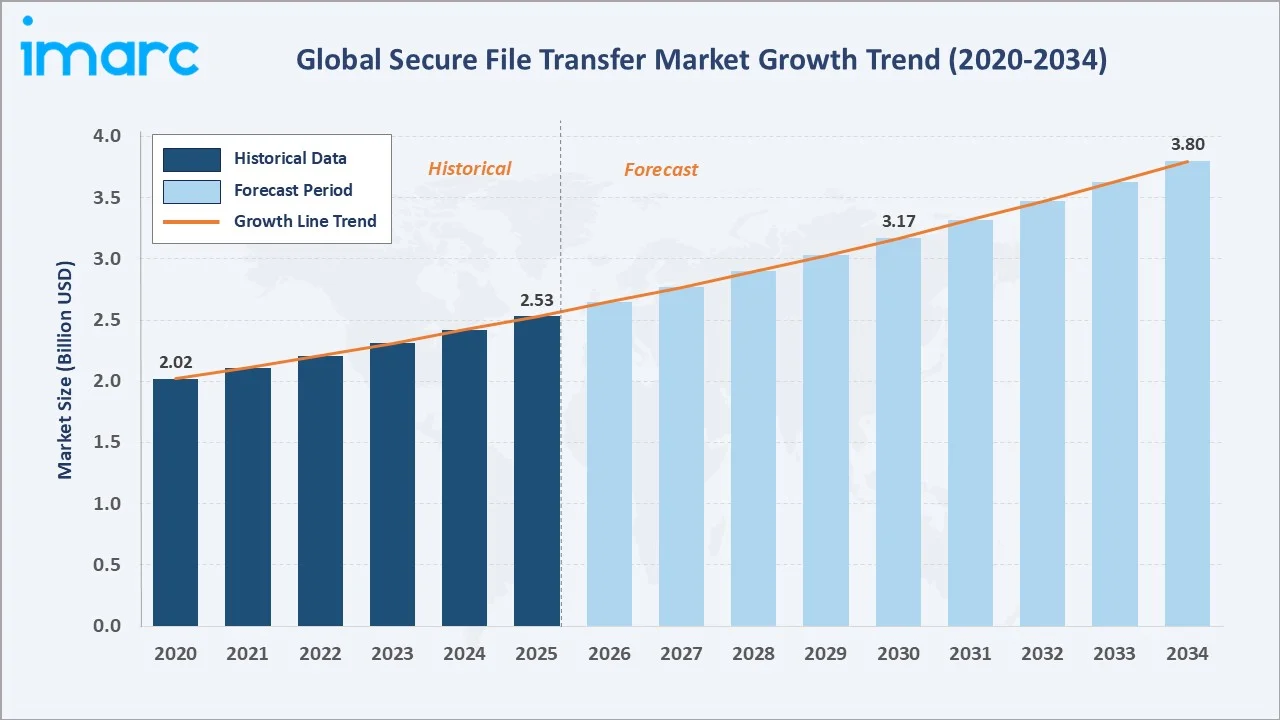
The global secure file transfer market reached USD 2.53 Billion in 2025 and is projected to reach USD 3.80 Billion by 2034, growing at a CAGR of 4.61% during 2026-2034, led by Business-To-Business transfers, cloud-based deployment, and North America. Secure file transfer software enables organizations to move sensitive data safely across networks, applications, and trading-partner ecosystems, replacing unmonitored protocols with encrypted, auditable, and centrally governed managed file transfer (MFT) platforms used across BFSI, healthcare, retail, and government sectors.
Market Snapshot
|
Metric |
Value |
|
Market Size (2025) |
USD 2.53 Billion |
|
Forecast Market Size (2034) |
USD 3.80 Billion |
|
CAGR (2026-2034) |
4.61% |
|
Base Year |
2025 |
|
Historical Period |
2020-2025 |
|
Forecast Period |
2026-2034 |
|
Dominant Type |
Business To Business (50.0%, 2025) |
|
Dominant Deployment Model |
Cloud-based (46.0%, 2025) |
|
Leading Region |
North America (35.0%, 2025) |
The market expanded from an estimated USD 2.02 Billion in 2020 to USD 2.53 Billion in 2025 and is anchored at USD 3.17 Billion in 2030 before reaching USD 3.80 Billion by 2034, reflecting steady, compliance-driven demand. Growth through the historical period was tempered by cautious enterprise IT budgets and gradual migration away from legacy file transfer scripts, while the forecast period benefits from accelerating cloud adoption, tightening cybersecurity regulation, and expanding remote and hybrid work arrangements worldwide.
To get more information on this market, Request Sample
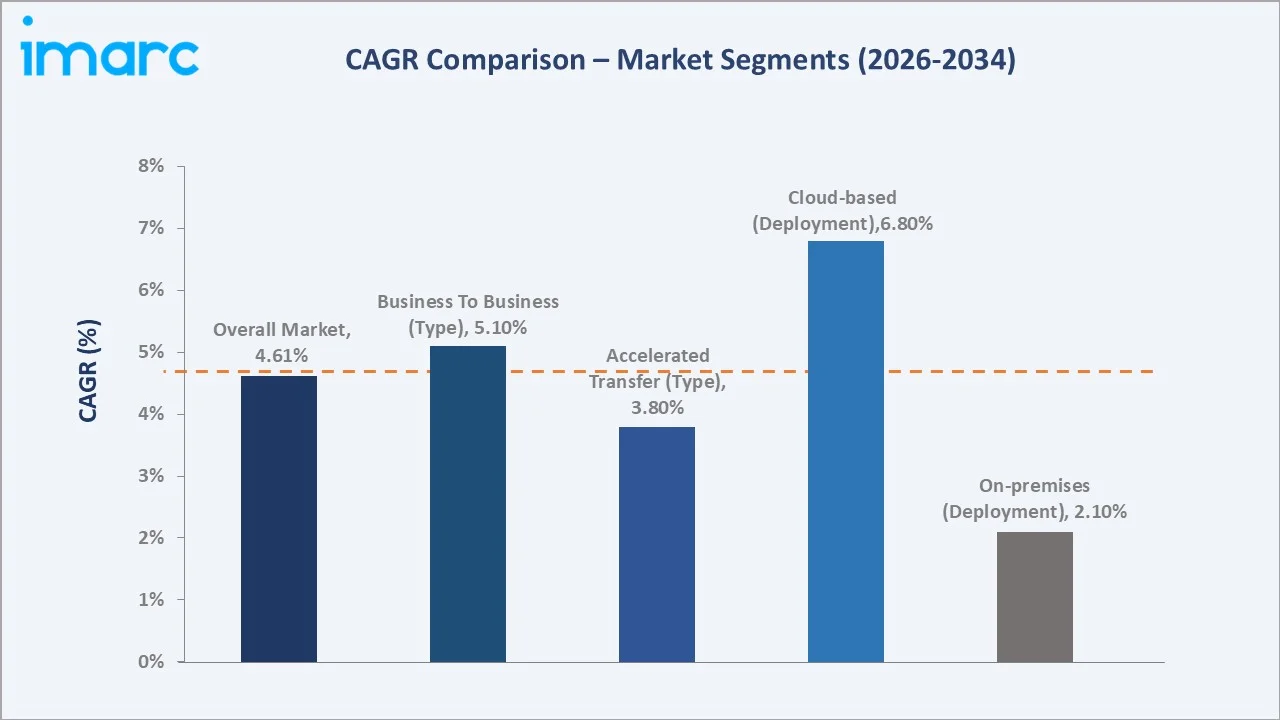
Business To Business transfer and Cloud-based deployment both outpace the overall market CAGR of 4.61%, reflecting faster-growing enterprise-to-enterprise data exchange and accelerating cloud infrastructure adoption through the forecast period.
Executive Summary
The global secure file transfer market reached USD 2.53 Billion in 2025, driven by rising cyberattacks, stricter data-privacy regulation, and the shift to remote and hybrid work models requiring auditable, encrypted file movement across enterprises and trading partners.
Business To Business transfer leads by type at 50.0%, cloud-based deployment leads by model at 46.0%, and North America leads regionally at 35.0%, together anchoring a market forecast to reach USD 3.80 Billion by 2034. Vendor competition is increasingly shaped by automation depth, compliance breadth, and cloud-native delivery, as enterprises replace fragmented legacy scripts and point solutions with unified, centrally governed managed file transfer platforms capable of scaling across global trading-partner networks.
Key Market Insights
|
Insight |
Data |
|
Dominant Type |
Business To Business - 50.0% share (2025) |
|
Dominant Deployment Model |
Cloud-based - 46.0% share (2025) |
|
Leading Region |
North America - 35.0% share (2025) |
|
Market Opportunity |
AI-driven MFT automation, zero-trust file security, and SME cloud adoption |
Key Analytical Observations:
- Business To Business at 50.0%: B2B transfer dominates as enterprises exchange high volumes of confidential files with partners, suppliers, and regulators, requiring auditable, encrypted, and automated workflows at scale.
- Cloud-based at 46.0%: Cloud deployment leads as SaaS delivery lowers upfront cost, eases integration with hybrid IT environments, and speeds onboarding of new trading partners and remote users.
- North America at 35.0%: North America leads through early cybersecurity investment, dense BFSI and healthcare bases, and strict regulatory regimes mandating encrypted, tracked file exchange.
- Market Opportunity: AI-driven anomaly detection, zero-trust file access, and affordable SaaS-delivered platforms create expansion opportunities among small and mid-sized enterprises historically underserved by traditional on-premises MFT solutions.
Secure File Transfer Market Overview
The secure file transfer market covers software that moves data safely between applications, partners, and servers, replacing unsecured protocols such as HTTP and FTP with encrypted, monitored, and auditable managed file transfer (MFT) platforms.
The ecosystem integrates MFT software vendors, cloud infrastructure providers, security and compliance tool makers, and enterprise IT teams across BFSI, healthcare, retail, government, and media, operating under tightening global data-privacy and cybersecurity regulation.
Macro factors shaping the market include rising cyber-insurance requirements, growing enterprise data volumes, expanding cross-border trade documentation needs, and the steady replacement of unsecured FTP and email-based file exchange with governed, auditable transfer infrastructure.
Market Dynamics
To evaluate market opportunities, Request Sample
Market Drivers
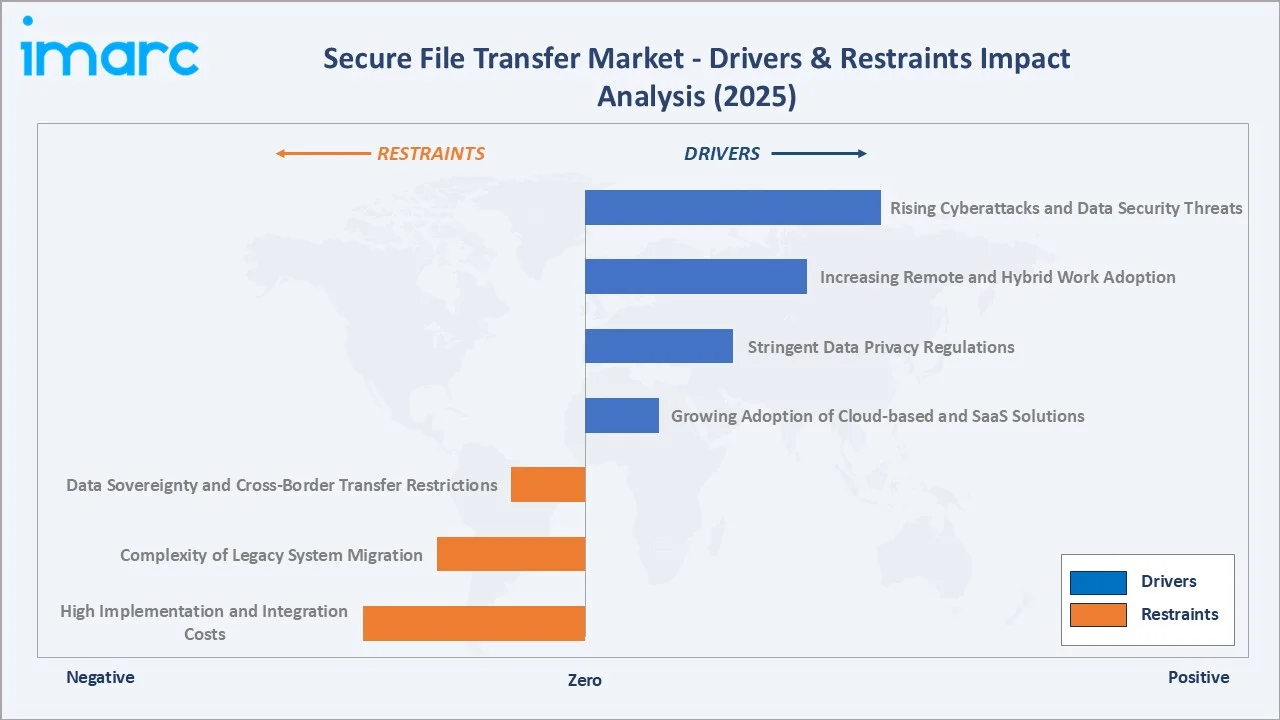
- Rising Cyberattacks and Data Security Threats: Escalating ransomware and data-breach incidents push enterprises toward encrypted, monitored file transfer platforms that replace vulnerable email and FTP-based exchange with auditable, policy-enforced movement of sensitive data. High-profile breaches targeting unsecured file transfer infrastructure have made secure, monitored MFT deployment a board-level cybersecurity priority, further reinforcing enterprise willingness to invest in modern platforms over legacy scripting tools.
- Increasing Remote and Hybrid Work Adoption: Distributed workforces expand the number of endpoints exchanging confidential files, increasing demand for centrally governed transfer solutions that maintain visibility, security, and compliance outside traditional office networks. As employees, contractors, and partners connect from varied locations and devices, organizations require consistent policy enforcement and audit trails regardless of where a file transfer originates or terminates.
- Stringent Data Privacy Regulations: Regulations such as GDPR and sector-specific mandates require demonstrable control over data in transit, pushing BFSI, healthcare, and government bodies to adopt compliant, audit-ready managed file transfer systems. Non-compliance penalties and mandatory breach disclosure requirements are prompting organizations to formalize file transfer governance rather than rely on ad hoc, unmonitored data-sharing practices.
- Growing Adoption of Cloud-based and SaaS Solutions: Enterprises increasingly favor SaaS-delivered file transfer for faster deployment, lower infrastructure overhead, and easier integration with hybrid multi-cloud environments, broadening product uptake among small and mid-sized businesses. Subscription pricing further reduces the capital expenditure barrier that historically limited MFT adoption to only the largest enterprises.
Market Restraints
- High Implementation and Integration Costs: Enterprise-grade secure file transfer platforms require licensing, integration, and staff training investment, which can slow adoption among smaller organizations operating with constrained technology budgets. Customization for legacy protocol support and bespoke workflow automation can further extend implementation timelines and total cost of ownership.
- Complexity of Legacy System Migration: Organizations running legacy FTP scripts and on-premises infrastructure face complex, resource-intensive migrations to modern managed file transfer platforms, delaying upgrade cycles across some industry verticals. Migrating deeply embedded batch-processing workflows without disrupting business-critical data exchange requires careful sequencing and extended parallel-run periods.
- Data Sovereignty and Cross-Border Transfer Restrictions: Varying national data-residency and cross-border transfer rules complicate global deployments, requiring vendors to offer region-specific hosting and compliance configurations that add cost and complexity. Multinational enterprises must reconcile differing regulatory regimes across every jurisdiction in which trading partners and subsidiaries operate.
Market Opportunities
- AI-Driven MFT Automation: Artificial intelligence can automate anomaly detection, policy enforcement, and workflow orchestration within file transfer platforms, creating opportunities for vendors to differentiate through intelligent, self-optimizing MFT offerings. Predictive capabilities that flag unusual transfer volumes or destinations before a breach occurs represent a particularly high-value area for continued vendor investment.
- SME Cloud Adoption: Small and mid-sized enterprises increasingly seek affordable, SaaS-delivered secure file transfer, opening growth opportunities for vendors offering simplified, subscription-based managed file transfer services. Pre-configured compliance templates and simplified onboarding can further accelerate uptake among organizations lacking dedicated IT security teams.
Market Challenges
- Escalating Sophistication of Cyber Threats: Increasingly sophisticated attacks targeting file transfer infrastructure, including recent large-scale MFT-focused breaches, require continuous security investment and challenge vendors to stay ahead of evolving exploit techniques. Zero-day vulnerabilities in widely deployed MFT software can expose thousands of downstream organizations simultaneously, raising the stakes for rapid patch management.
- Talent Shortage in Enterprise Cybersecurity: A shortage of skilled security and compliance professionals makes it harder for organizations to configure, monitor, and maintain secure file transfer environments effectively, slowing full utilization of platform capabilities. This shortage also increases reliance on managed service providers and vendor-delivered support for ongoing operations.
Emerging Market Trends
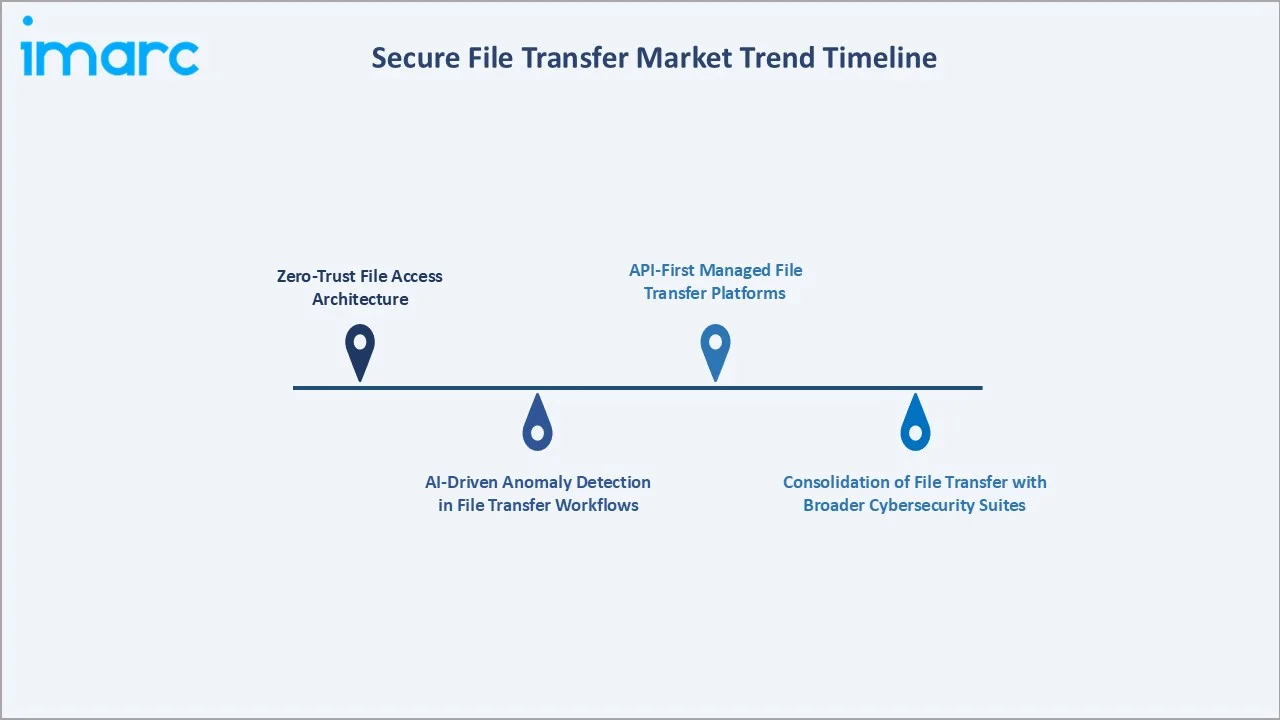
1. Zero-Trust File Access Architecture
Zero-trust principles are extending into file transfer, requiring continuous verification of users and devices before granting access to sensitive files, reducing reliance on perimeter-based security and limiting exposure from compromised credentials. Enterprises are pairing this shift with granular, role-based permissioning so that every transfer request is evaluated individually rather than trusted based on network location alone.
2. AI-Driven Anomaly Detection in File Transfer Workflows
Machine learning models are increasingly embedded in MFT platforms to flag unusual transfer patterns, file sizes, or destinations in real time, helping security teams detect potential breaches faster than manual log review allows. These capabilities also reduce false-positive alert fatigue by learning normal transfer baselines specific to each organization's operating patterns.
3. API-First Managed File Transfer Platforms
Vendors are redesigning MFT platforms around open APIs, enabling tighter integration with enterprise applications, RPA tools, and cloud services, and supporting the shift toward composable, DevOps-friendly IT architectures. This trend allows file transfer to be orchestrated directly within broader business workflows rather than operated as an isolated, standalone system.
4. Consolidation of File Transfer with Broader Cybersecurity Suites
Secure file transfer capabilities are being bundled with antivirus, data-loss prevention, and threat-intelligence tools, as vendors position MFT as a core control point within enterprise-wide cybersecurity strategy rather than standalone infrastructure. This consolidation simplifies vendor management for enterprise buyers while strengthening end-to-end protection across the full data lifecycle.
Industry Value Chain Analysis
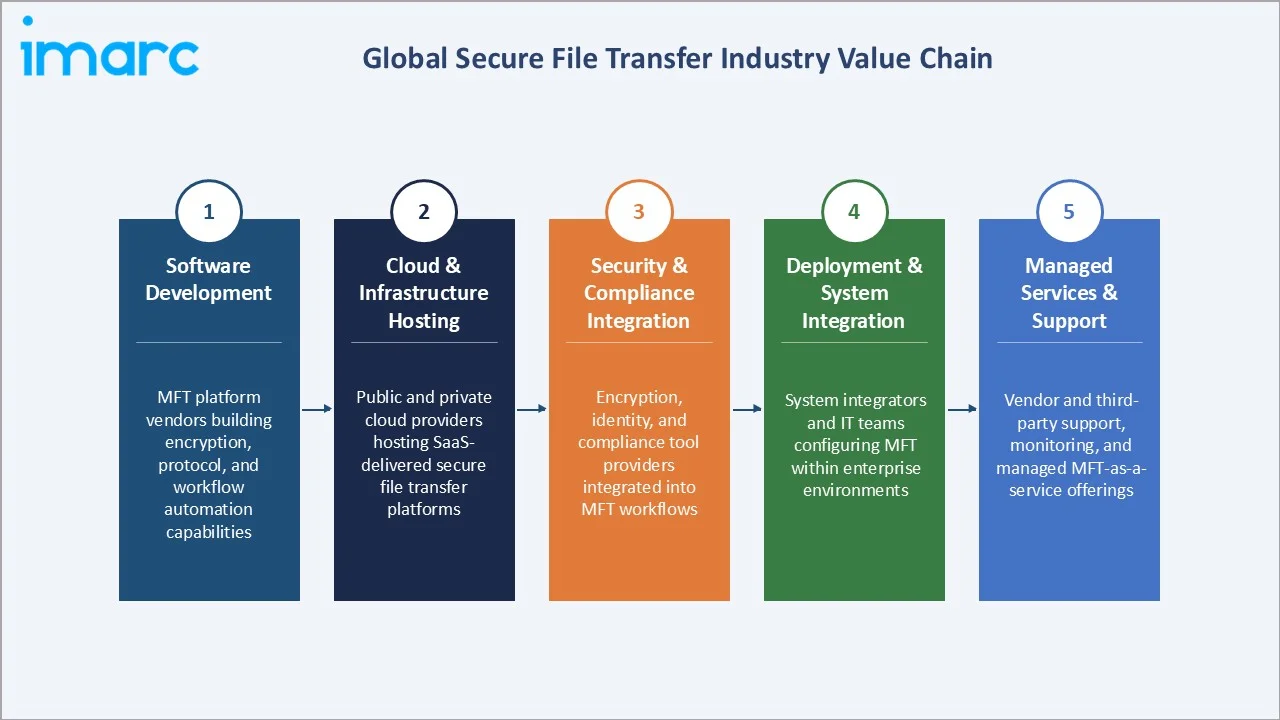
The secure file transfer value chain integrates software development, cloud and infrastructure hosting, security and compliance integration, deployment and system integration, and managed services and support delivered to enterprise customers. Value has progressively shifted toward the cloud-hosting and managed-services stages as more organizations adopt SaaS-delivered MFT rather than self-hosted infrastructure.
|
Stage |
Key Participants |
|
Software Development |
MFT platform vendors building encryption, protocol, and workflow automation capabilities |
|
Cloud & Infrastructure Hosting |
Public and private cloud providers hosting SaaS-delivered secure file transfer platforms |
|
Security & Compliance Integration |
Encryption, identity, and compliance tool providers integrated into MFT workflows |
|
Deployment & System Integration |
System integrators and IT teams configuring MFT within enterprise environments |
|
Managed Services & Support |
Vendor and third-party support, monitoring, and managed MFT-as-a-service offerings |
Vendors that control multiple stages of this value chain, particularly cloud hosting and managed services, are best positioned to capture recurring revenue and deepen customer retention over the forecast period.
Technology Landscape in the Secure File Transfer Industry
Encryption and Secure Transport Protocols
AES-256 encryption combined with SFTP, FTPS, and HTTPS transport protocols remains the technical foundation of secure file transfer, protecting data at rest and in transit across enterprise and trading-partner networks. Continued migration toward TLS 1.3 and post-quantum cryptography research is further strengthening the long-term resilience of these protocols against emerging threats.
AI and Machine Learning-Enabled Automation
AI and machine learning increasingly automate workflow orchestration, anomaly detection, and report generation within MFT platforms, reducing manual administration and improving response time to unusual file activity. Natural-language reporting assistants are also emerging, allowing administrators to generate custom audit and compliance reports without manual query building.
Zero-Trust and Identity-Centric Access Control
Zero-trust access control, multi-factor authentication, and granular permissioning are becoming standard MFT features, ensuring every file request is verified regardless of network location or prior access history. Identity-centric architectures also simplify compliance reporting by tying every file transaction to a verified, individually authenticated user or system credential.
Market Segmentation Analysis
The report covers the following segments:
|
Segment Category |
Leading Segment |
Market Share |
Year |
|
Type |
Business To Business |
50.0% |
2025 |
|
Deployment Model |
Cloud-based |
46.0% |
2025 |
|
Enterprises |
Large Enterprises |
58.0% |
2025 |
|
End Users |
Banking, Financial Services and Insurance (BFSI) |
22% |
2025 |
|
Region |
North America |
35.0% |
2025 |

By Type
To access detailed market analysis, Request Sample
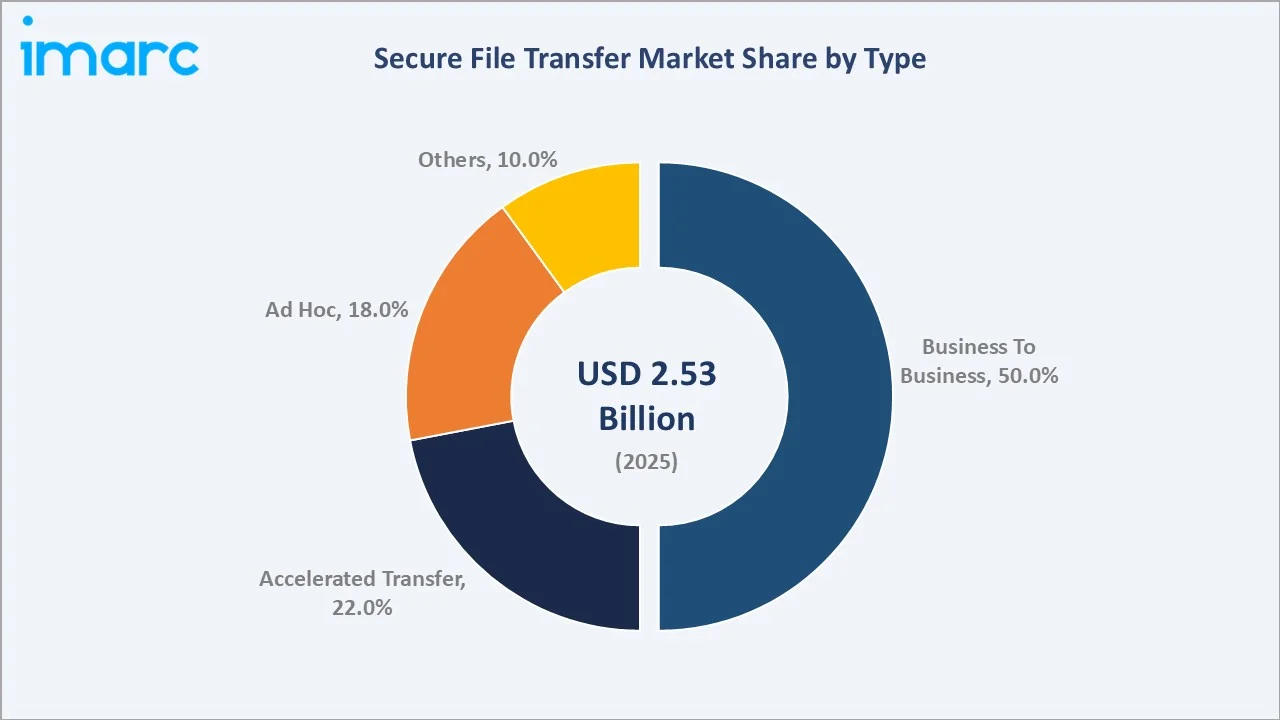
Business To Business leads at 50.0% in 2025, reflecting high-volume, recurring file exchange between enterprises and partners. Accelerated Transfer follows at 22.0%, Ad Hoc at 18.0%, and Others at 10.0%. B2B transfer's scale advantage stems from its role underpinning EDI, supply-chain, and financial settlement data exchange, which requires consistent, automated, and highly reliable connectivity between trading partners.
By Deployment Model
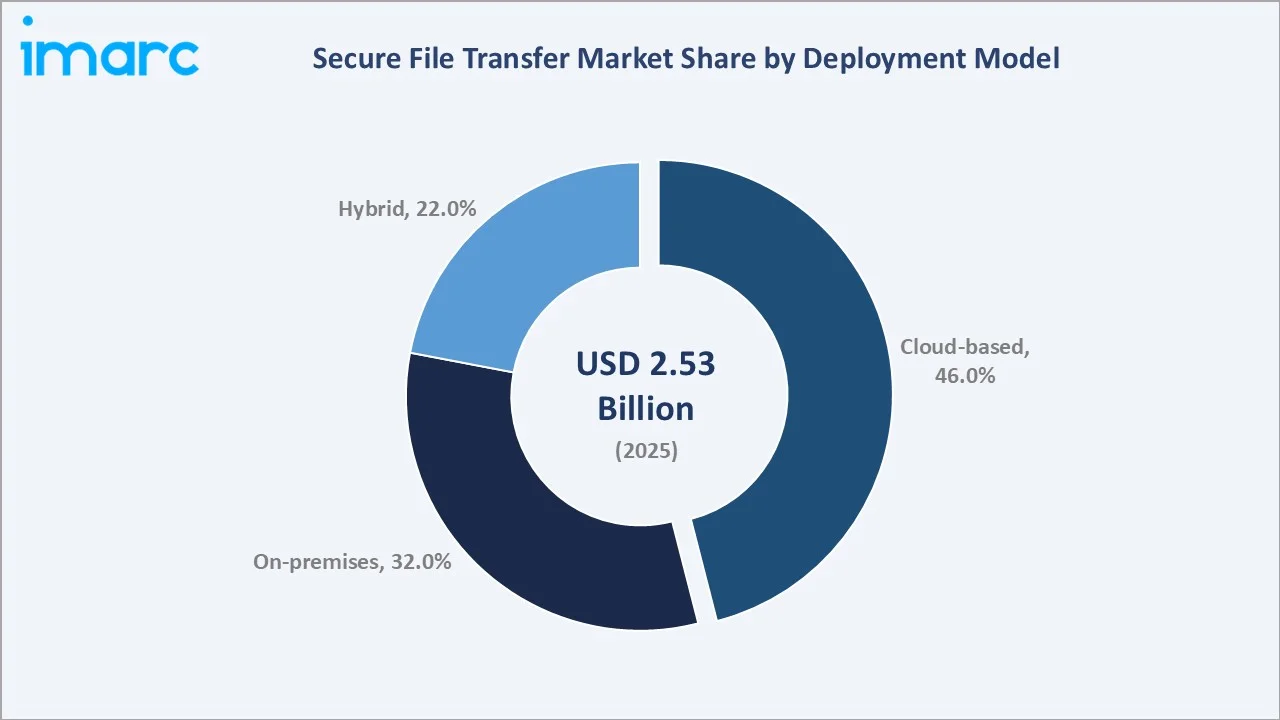
Cloud-based deployment leads at 46.0% in 2025 on faster rollout and lower upfront cost. On-premises follows at 32.0% among regulated industries preferring direct control, while Hybrid stands at 22.0%. Hybrid deployment is gaining traction among enterprises balancing cloud scalability with data-residency requirements for their most sensitive workloads.
Regional Market Insights
|
Region |
Share (2025) |
Key Market Drivers & Characteristics |
|
North America |
35.0% |
Strong cybersecurity investment, a dense base of regulated enterprises, and strict regulatory enforcement of encrypted data exchange |
|
Asia-Pacific |
29.0% |
Rapid digitalization, expanding enterprise cloud adoption, and rising cybersecurity awareness across major economies |
|
Europe |
23.0% |
Strong data-privacy compliance requirements and steady demand from regulated and public sector organizations |
|
Latin America |
7.0% |
Gradual digital transformation and growing enterprise cybersecurity investment across the region |
|
Middle East and Africa |
6.0% |
Emerging demand tied to government digitalization initiatives and expanding financial services infrastructure |
North America leads at 35.0% on mature enterprise IT and regulatory rigor, while Asia-Pacific at 29.0% is the fastest-expanding region, supported by digital transformation across BFSI, government, and manufacturing sectors.
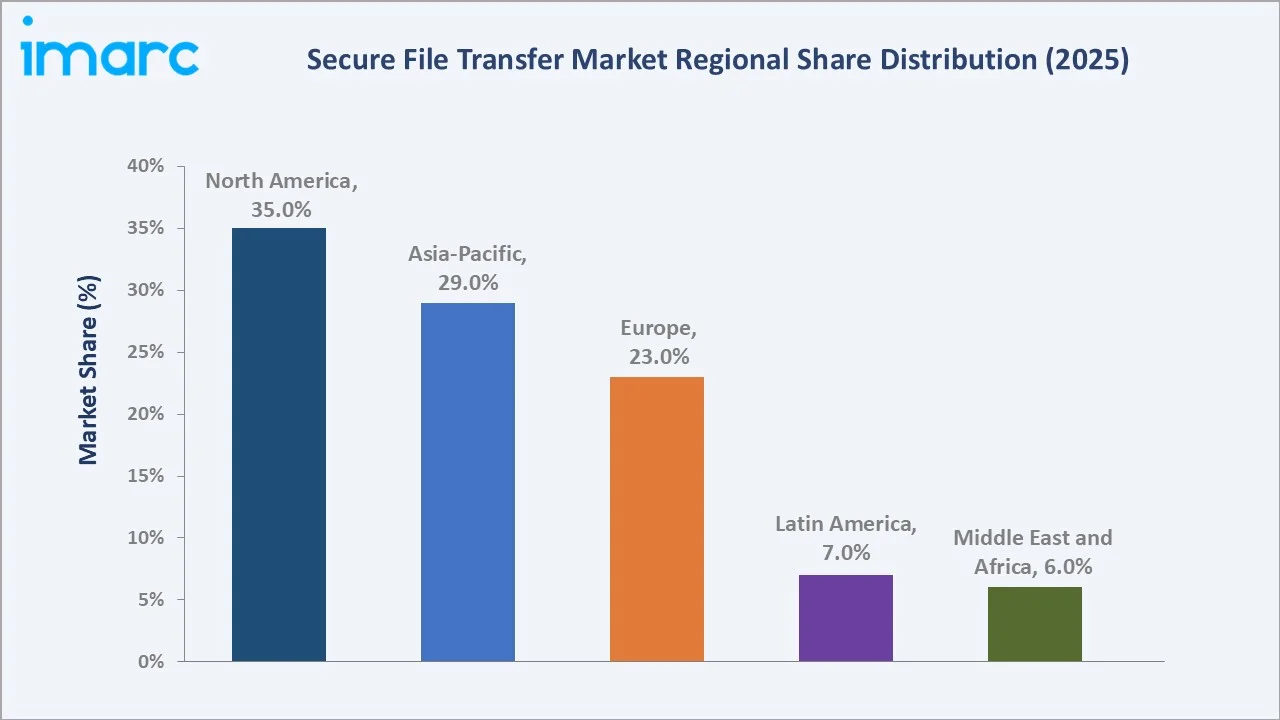
Europe's 23.0% share reflects consistent GDPR-driven compliance demand, while Latin America and the Middle East and Africa, at 7.0% and 6.0% respectively, represent earlier-stage but steadily growing markets as digitalization and cybersecurity investment expand across both regions.
Competitive Landscape
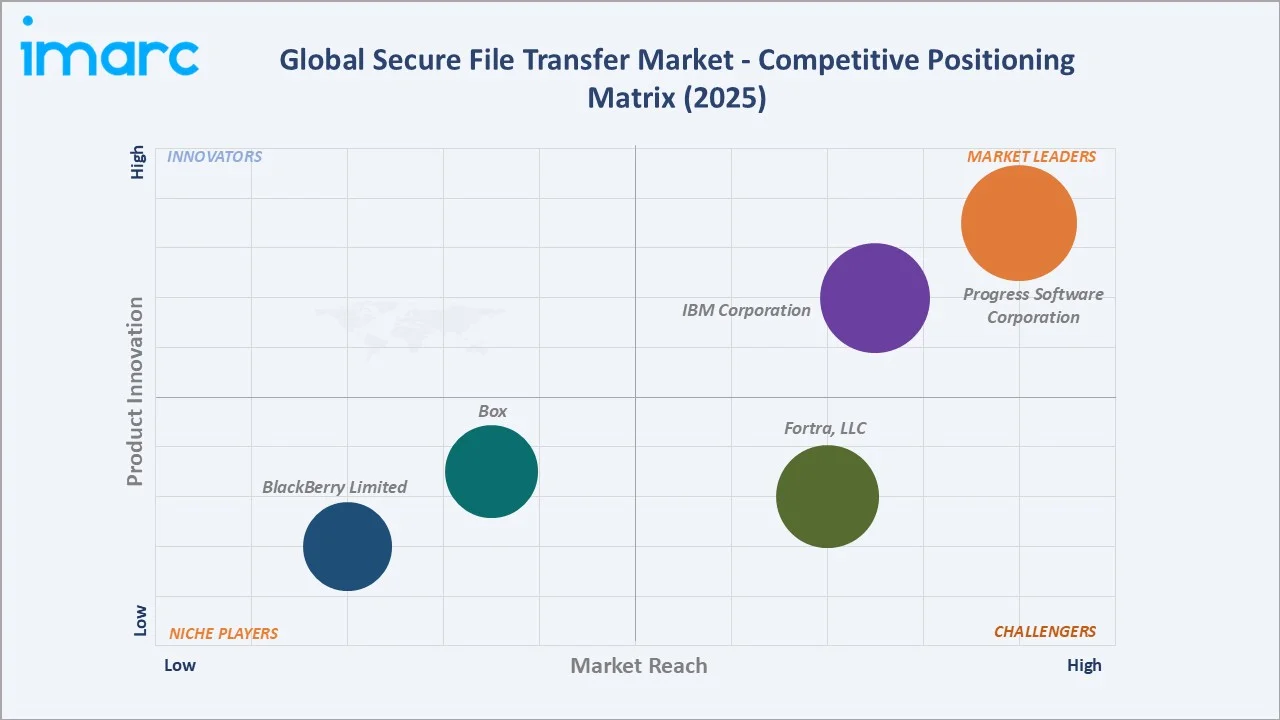
The secure file transfer market is moderately fragmented, spanning large diversified technology vendors, specialist managed file transfer providers, and cloud content platforms competing across BFSI, healthcare, government, and enterprise IT buyers. Competitive differentiation increasingly centers on automation depth, compliance certifications, and the breadth of pre-built connectors to cloud storage, ERP, and CRM systems.
|
Company Name |
Key Products |
Market Position |
Core Strength |
|
IBM Corporation |
IBM Sterling Secure File Transfer |
Market Leader |
Broad enterprise MFT platform with deep BFSI and mainframe integration heritage |
|
Progress Software Corporation |
MOVEit, WS_FTP |
Market Leader |
Widely deployed MFT suite known for compliance features and automation capability |
|
Fortra, LLC |
GoAnywhere MFT |
Strong Challenger |
Security-focused MFT platform popular among mid-market and regulated enterprises |
|
Box |
Secure file sharing |
Niche Player |
Cloud content platform offering secure external file sharing and governance |
|
BlackBerry Limited |
BlackBerry Workspaces |
Niche Player |
Secure enterprise file sharing platform with document rights management |
Key players include IBM Corporation, Progress Software Corporation, Fortra, LLC, Box, BlackBerry Limited, and others.
Key Company Profiles
IBM Corporation
IBM is a US-based technology company with a strong secure file transfer presence through its Sterling platform, serving large BFSI, healthcare, and government customers requiring high-volume, compliant data movement. The platform bundles file gateway, secure proxy, and monitoring components to support mission-critical, high-throughput enterprise data exchange.
- Key Products: IBM Sterling Secure File Transfer.
- Recent Developments: In December 2025, IBM released Sterling File Gateway 6.2.2.0, introducing a redesigned next-generation administrative interface built on IBM's Carbon Design Language for B2B file exchange, aimed at simplifying configuration for large-scale trading-partner networks.
- Strategic Focus: Expanding automation, encryption, and end-to-end visibility features within its managed file transfer platform for large regulated enterprises, while deepening integration with its broader AI and data-governance consulting offerings.
Progress Software Corporation
Progress Software is a US-based enterprise software company whose MOVEit and WS_FTP platforms are widely used for secure, compliant file transfer across financial services, healthcare, and public sector organizations. Its solutions span both self-hosted and cloud-delivered deployment, supporting organizations at varying stages of cloud migration.
- Key Products: MOVEit, WS_FTP.
- Recent Developments: In May 2026, Progress released MOVEit 2026.0, adding OneDrive host support, AWS IAM role-based S3 access, and an updated OpenSSL 3.0 cryptographic foundation to strengthen secure file transfer workflows across hybrid and multi-cloud environments.
- Strategic Focus: Strengthening cloud-hosted managed file transfer offerings and compliance tooling to support PCI, HIPAA, and GDPR-aligned deployments, while extending automation capabilities for regulated audit and reporting workflows.
Market Concentration Analysis
The market is moderately concentrated, with the top four key players collectively holding a meaningful share of enterprise deployments, while cloud content platforms and specialist vendors compete for mid-market and niche use cases. Consolidation among mid-tier vendors and continued bundling of MFT with broader cybersecurity suites are expected to gradually increase concentration over the forecast period.
Investment & Growth Opportunities
Highest Growth Segments
Cloud-based deployment (~6.8% CAGR) and Business To Business transfer (~5.1% CAGR) represent the highest-growth segments, both outpacing the overall 4.61% market CAGR through 2034. This above-market growth reflects accelerating enterprise cloud migration and the expanding scale of automated, high-volume B2B data exchange across global supply chains.
Emerging Investment Opportunities
AI-powered anomaly detection and zero-trust access modules represent the market's highest-value emerging investment opportunities, as enterprises upgrade legacy MFT deployments to meet evolving cybersecurity and compliance requirements. MFT-as-a-service offerings targeting resource-constrained SMEs also represent a fast-growing, underserved opportunity segment for vendors willing to simplify pricing and onboarding.
Investment Themes
- Cloud-Native MFT Platform Development: Vendors investing in cloud-native, API-first architectures can capture share from enterprises migrating away from legacy on-premises file transfer scripts and infrastructure. Multi-tenant SaaS architectures further reduce delivery costs, supporting more competitive pricing for mid-market customers.
- Vertical-Specific Compliance Modules: Purpose-built compliance modules for BFSI, healthcare, and government create differentiated value, as regulated industries prioritize audit-ready, sector-aligned file transfer solutions. Pre-built regulatory templates for frameworks such as HIPAA, PCI DSS, and GDPR can shorten enterprise sales cycles considerably.
Future Market Outlook (2026-2034)
The secure file transfer market is projected to grow from USD 2.53 Billion in 2025 to USD 3.80 Billion by 2034, at a 4.61% CAGR, anchored at USD 3.17 Billion in 2030 as cloud adoption and compliance pressure continue to expand demand.
Cloud-based and hybrid deployment models are expected to gain further share as enterprises modernize legacy FTP infrastructure, while Business To Business transfer remains the dominant use case across global trading-partner networks.
AI-enabled automation, zero-trust access frameworks, and deeper integration with enterprise cybersecurity suites are expected to define competitive differentiation through 2034, as regulatory scrutiny and cyber-risk exposure continue to reinforce sustained investment in governed, auditable file transfer infrastructure.
Research Methodology
Primary Research
Structured interviews with IT security leaders, MFT solution architects, and compliance officers across BFSI, healthcare, and government end users, supplemented by feedback from channel partners and systems integrators on deployment and adoption patterns.
Secondary Research
Company reports, regulatory filings, cybersecurity industry publications, and data-privacy regulation documentation across major regions, cross-referenced with vendor product release notes and industry association data.
Forecasting Models
Bottom-up estimation using enterprise IT spend by industry, deployment-model adoption rates, and regional regulatory-compliance investment trends, validated against historical market sizing and vendor revenue disclosures where available.
Report Coverage:
| Report Features | Details |
|---|---|
| Base Year of the Analysis | 2025 |
| Historical Period | 2020-2025 |
| Forecast Period | 2026-2034 |
| Units | Billion USD |
| Scope of the Report | Exploration of Historical Trends and Market Outlook, Industry Catalysts and Challenges, Segment-Wise Historical and Predictive Market Assessment:
|
| Types Covered | Business To Business, Accelerated Transfer, Ad Hoc, Others |
| Deployment Models Covered | On-premises, Cloud-based, Hybrid, |
| Enterprises Covered | Small and Medium-sized Enterprises, Large Enterprises |
| End Users Covered | Banking, Financial Services and Insurance (BFSI), Healthcare, Legal, Retail, Media, and Entertainment, Manufacturing, Transportation, and Logistics, Educational, Government, Others |
| Region Covered | Asia Pacific, Europe, North America, Latin America, Middle East and Africa |
| Countries Covered | United States, Canada, Germany, France, United Kingdom, Italy, Spain, Russia, China, Japan, India, South Korea, Australia, Indonesia, Brazil, Mexico |
| Companies Covered | IBM Corporation, Progress Software Corporation, Fortra LLC, Box, BlackBerry Limited, etc. |
| Customization Scope | 10% Free Customization |
| Post-Sale Analyst Support | 10-12 Weeks |
| Delivery Format | PDF and Excel through Email (We can also provide the editable version of the report in PPT/Word format on special request) |
Key Benefits for Stakeholders:
- IMARC’s report offers a comprehensive quantitative analysis of various market segments, historical and current market trends, market forecasts, and dynamics of the secure file transfer market from 2020-2034.
- The research study provides the latest information on the market drivers, challenges, and opportunities in the global secure file transfer market.
- The study maps the leading as well as the fastest growing regional markets. It further enables stakeholders to identify the key country-level markets within each region.
- Porter's five forces analysis assist stakeholders in assessing the impact of new entrants, competitive rivalry, supplier power, buyer power, and the threat of substitution. It helps stakeholders to analyze the level of competition within the secure file transfer industry and its attractiveness.
- Competitive landscape allows stakeholders to understand their competitive environment and provides an insight into the current positions of key players in the market.
Frequently Asked Questions About the Secure File Transfer Market Report
The market reached USD 2.53 Billion in 2025, led by Business To Business transfer at 50.0% and cloud-based deployment at 46.0% share, supported by rising cyberattacks and stricter data-privacy regulation.
The market is projected to grow at a 4.61% CAGR during 2026-2034, reaching USD 3.80 Billion by 2034, driven by cloud adoption and expanding compliance requirements.
Business To Business leads at 50.0% share in 2025, followed by Accelerated Transfer at 22.0% and Ad Hoc at 18.0%, reflecting the scale of recurring enterprise-to-enterprise data exchange.
Cloud-based deployment leads at 46.0% share in 2025, ahead of On-premises at 32.0% and Hybrid at 22.0%, as SaaS delivery lowers cost and speeds implementation.
North America leads at 35.0% share in 2025, followed by Asia-Pacific at 29.0% and Europe at 23.0%, reflecting mature enterprise IT and strict regulatory enforcement.
Leading companies include IBM Corporation, Progress Software Corporation, Fortra, LLC, Box, BlackBerry Limited, and others.
The market is projected to reach approximately USD 3.17 Billion by 2030, with cloud-based deployment continuing to gain share over on-premises infrastructure through the mid-forecast period.
Priority opportunities include AI-driven MFT automation, zero-trust access modules, and vertical-specific compliance capabilities for BFSI, healthcare, and government buyers seeking audit-ready platforms.
Need more help?
- Speak to our experienced analysts for insights on the current market scenarios.
- Include additional segments and countries to customize the report as per your requirement.
- Gain an unparalleled competitive advantage in your domain by understanding how to utilize the report and positively impacting your operations and revenue.
- For further assistance, please connect with our analysts.
 Request Customization
 Speak to an Analyst
 Request Brochure
 Inquire Before Buying
Benefits of Customization
- Personalize this research
- Triangulate with your data
- Get data as per your format and definition
- Gain a deeper dive into a specific application, geography, customer, or competitor
- Any level of personalization
Get in Touch With Us
UNITED STATES
Phone: +1-201-971-6302
INDIA
Phone: +91-120-433-0800
UNITED KINGDOM
Phone: +44-753-714-6104
Email: [email protected]
Client Testimonials




.webp)




.webp)













Related Reports

Choose your plan
*Please note that the prices mentioned below are starting prices for each bundle type. Kindly contact our team for further details.*
Single User License
- 1 User License, Access on 2 Devices
- PDF Report + Excel Dataset (Password Protected)
- Lifetime Access
- No Printing Rights
- 10% Free Report Customization
- 10–12 Weeks of Analyst Support
Five User License
- Access for 5 Users, 2 Devices per User
- PDF Report + Excel Dataset (Password Protected)
- Lifetime Access
- Dedicated Account Manager
- 12–14 Weeks of Analyst Support
- No Printing Rights
- 15% Free Report Customization
- 25% Discount on Your Next Purchase
Corporate User License
- Unlimited User Access (Within Your Organization)
- PDF Report + Excel Dataset
- Lifetime Access
- Dedicated Account Manager
- 14–20 Weeks of Analyst Support
- No Printing Rights
- 20% Free Report Customization
- 30% Discount on Your Next Purchase
Essential Insights
What's included:
3 reports
- Lifetime Access
- PDF Reports
- Excel Datasets
- 2 Weeks of Free Analyst Support
- 2 User Licenses
- Access on 2 Devices
- Printing Rights
- Complimentary PowerPoint (PPT) Version
- Complimentary License Upgrade
Professional Access
What's included:
5 reports
- Lifetime Access
- PDF Reports
- Excel Datasets
- 8 Weeks of Free Analyst Support
- 2 User Licenses
- Access on 2 Devices
- Printing Rights
- Complimentary PowerPoint (PPT) Version
- Complimentary License Upgrade
Business Advantage
What's included:
8 reports
- Lifetime Access
- PDF Reports
- Excel Datasets
- 14 Weeks of Free Analyst Support
- 2 User Licenses
- Access on 2 Devices
- Printing Rights
- Complimentary PowerPoint (PPT) Version
- Complimentary License Upgrade
Enterprise Intelligence
What's included:
10 reports
- Lifetime Access
- PDF Reports
- Excel Datasets
- 20 Weeks of Free Analyst Support
- 2 User Licenses
- Access on 2 Devices
- Printing Rights
- Complimentary PowerPoint (PPT) Version
- Complimentary License Upgrade