
Smart Greenhouse Market Size, Share, Trends and Forecast by Type, Offering, End User, and Region, 2026-2034
Smart Greenhouse Market Size and Share:
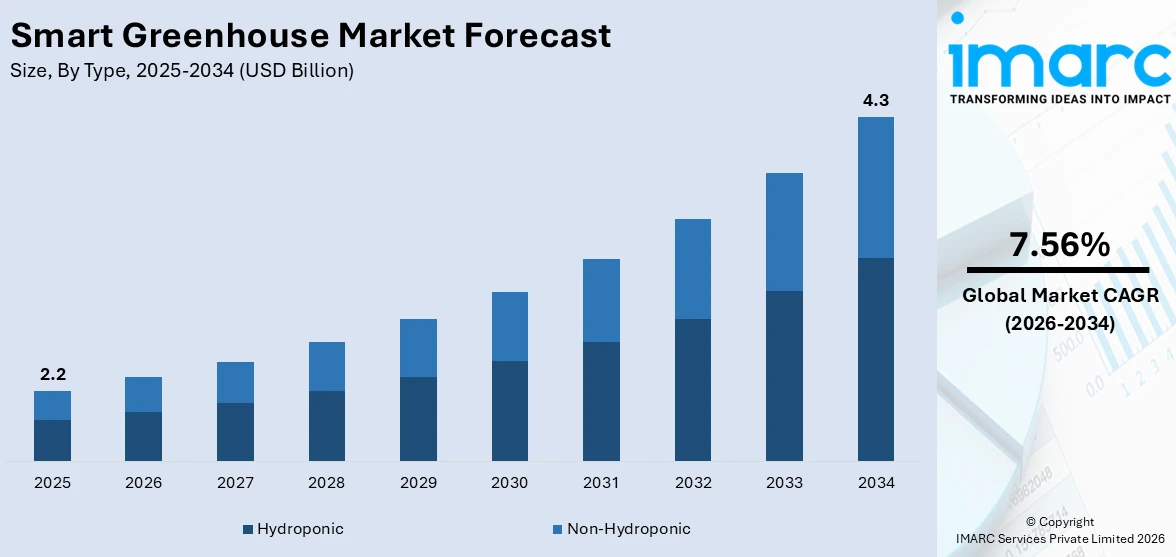
The global smart greenhouse market size was valued at USD 2.2 Billion in 2025. Looking forward, IMARC Group estimates the market to reach USD 4.3 Billion by 2034, exhibiting a CAGR of 7.56% from 2026-2034. Europe currently dominates the market, holding a smart greenhouse market share of over 28.7% in 2025. Temperature, humidity, and soil moisture may be monitored and controlled in real time with the use of IoT and AI-driven automation. By using predictive analytics to increase production and sustainability, automated climate control systems enable farmers transition to data-driven precision farming methods.
|
Report Attribute
|
Key Statistics
|
|---|---|
|
Base Year
|
2025
|
|
Forecast Years
|
2026-2034
|
|
Historical Years
|
2020-2025
|
|
Market Size in 2025
|
USD 2.2 Billion |
|
Market Forecast in 2034
|
USD 4.3 Billion |
| Market Growth Rate (2026-2034) | 7.56% |
The adoption of the Internet of Things (IoT) and AI-driven automation is a major growth driver in the smart greenhouse market, facilitating real-time monitoring and control of essential factors like temperature, humidity, and soil moisture. IoT sensors collect data, which AI algorithms analyze to optimize water usage, nutrient delivery, and lighting conditions, enhancing crop yields while reducing resource wastage. Automated climate control systems further improve efficiency by adjusting conditions based on predictive analytics. This technological integration helps farmers achieve higher productivity, sustainability, and cost savings, driving the demand for smart greenhouse solutions globally as agriculture shifts toward data-driven precision farming practices.
To get more information on this market Request Sample
The U.S. smart greenhouse market, holding an 88.90% share, is driven by advancements in agricultural technology, growing demand for sustainable farming, and the increasing use of automation in controlled-environment agriculture. Government initiatives supporting precision farming and water conservation further accelerate growth. High-tech innovations, including AI-driven climate control, IoT-based monitoring, and hydroponic systems, enhance productivity and resource efficiency. The presence of key industry players and research institutions fosters continuous innovation. Additionally, growing consumer demand for organic and locally sourced produce encourages investments in smart greenhouses. Rising energy costs and climate challenges also push farmers toward technology-driven solutions for optimizing crop yields and reducing operational expenses.
Smart Greenhouse Market Trends:
Automation and Internet of Things (IoT) Integration
Automated systems allow growers to precisely regulate environmental factors such as temperature, humidity, lighting, and soil moisture, ensuring optimal growing conditions for maximum productivity. IoT sensors collect real-time data, enabling predictive maintenance and efficient resource management while reducing labor costs through elimination of manual intervention in routine tasks. The remote monitoring and control capability of greenhouse operations appeals to both commercial and small-scale farmers, increasing overall adoption rates significantly. Smart greenhouses provide data-driven insights to improve crop yield, encouraging widespread adoption of automated solutions. Nature Fresh Farms collaborated with Koidra to test AI-powered automation in their greenhouses, where Koidra's AI-based solutions automate management of climate, lighting, and irrigation systems to help farms operate more efficiently with optimized productivity and resource use, improving operational performance and achieving energy cost savings.
Advancements in Artificial Lighting Technology
Innovations in artificial lighting technology are revolutionizing smart greenhouse operations by enhancing efficiency and crop production capabilities across the industry. LED lighting systems can be precisely controlled to provide optimal light spectrums for different plant growth stages, notably increasing crop yields while consuming less energy. These lights demonstrate superior energy efficiency and have significantly prolonged lifespans compared to traditional lighting alternatives, making them highly cost-effective solutions for greenhouse operators worldwide. Advancements in light automation enable growers to simulate natural sunlight cycles accurately, improving plant health and accelerating growth rates substantially. The OSCONIQ P3737 high-power LED introduced by ams OSRAM achieves 83.2% efficiency in Hyper Red spectrum, designed specifically to lower energy costs in greenhouses while maintaining optimal light output for photosynthesis. This cutting-edge LED technology increases photosynthesis rates and crop yields while offering up to eleven percent energy savings, making adoption of advanced lighting technologies essential for smart greenhouses seeking to maximize productivity.
Rising Demand for Organic Food
Organic farming requires strict adherence to chemical-free cultivation practices, which presents significant challenges to maintain in open fields due to constant exposure to environmental pollutants, pests, and unpredictable weather conditions. Smart greenhouses provide meticulously controlled environments where organic crops can be grown successfully without requiring pesticides or synthetic fertilizers, ensuring complete compliance with stringent organic standards. This advanced technology allows for consistent year-round organic production, effectively helping farmers meet the rapidly increasing consumer demand for organic products. As organic food gains tremendous popularity due to heightened health awareness and environmental concerns among consumers, the utilization of smart greenhouses in organic farming operations is becoming increasingly widespread globally. The total value of the worldwide market for organic food demonstrates substantial growth, reflecting strong consumer preferences for sustainably produced agricultural products that align with environmental conservation goals and personal health objectives.
Smart Greenhouse Industry Segmentation:
IMARC Group provides an analysis of the key trends in each segment of the global smart greenhouse market, along with forecast at the global, regional, and country levels from 2026-2034. The market has been categorized based on type, offering, and end user.
Analysis by Type:
- Hydroponic
- Non-Hydroponic
Hydroponics was the market leader for the majority share, at 59.8%, because it is an extremely efficient method regarding water and nutrient consumption. It offers the chance to control the growing conditions precisely, hence possibly providing a greater crop yield compared to traditional cultivation, and shorter growth cycles, and practically eliminates all resource wastage as there are recirculating nutrient solutions in place. Increasing demand for organic and pesticide-free produce works as a catalyst for hydroponic adoption. Also, the increasing research in automation, IoT-based monitoring, and climate control systems enhance the optimization of hydroponic greenhouse operations. It is compatible with vertical farming and urban agriculture, as it provides possibilities for year-round production in limited areas to enhance food security and profitability.
Analysis by Offering:
- Hardware
- HVAC Systems
- LED Grow Lights
- Irrigation System
- Valves and Pumps
- Sensor and Control System
- Others
- Software
- Services
Hardware accounts for 47.7% of the smart greenhouse market share due to the essential role of advanced equipment in optimizing controlled-environment farming. Essential components like climate control systems, LED grow lights, irrigation systems, sensors, and automated ventilation units play a vital role in ensuring optimal growing conditions in smart greenhouses. The increasing adoption of IoT-enabled sensors and AI-powered automation enhances precision in temperature, humidity, and nutrient management. High initial investments in smart greenhouse infrastructure also contribute to hardware’s dominance. Additionally, technological advancements in energy-efficient lighting and automated irrigation systems drive demand. As growers focus on maximizing yield and resource efficiency, the need for durable, high-performance hardware solutions continues to grow, reinforcing its market leadership in smart greenhouse market outlook.
Analysis by End User:
Access the comprehensive market breakdown Request Sample
- Commercial Growers
- Research and Educational Institutes
- Retail Gardens
- Others
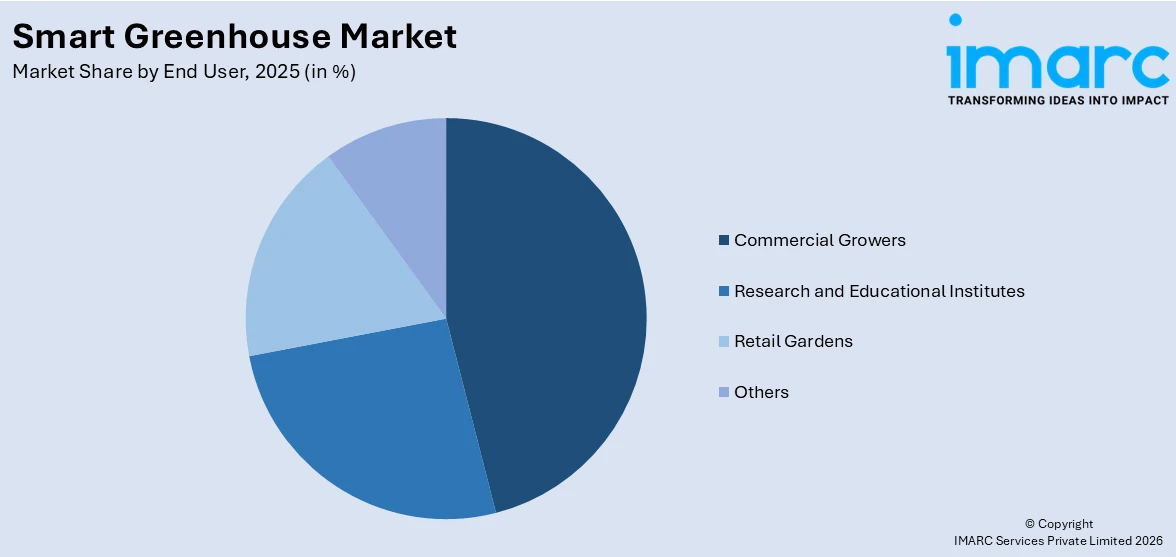
Based on the smart greenhouse market forecast, research, and educational institutes represent the largest market growth segment in the smart greenhouse industry due to their role in advancing agricultural innovation and sustainability. These institutions utilize smart greenhouses for studying climate-resilient crops, optimizing hydroponic and aeroponic systems, and enhancing automation through AI and IoT integration. Government funding and academic grants support infrastructure development, enabling large-scale research initiatives. Additionally, universities collaborate with agritech firms to test and refine precision farming techniques. The increasing focus on food security, resource efficiency, and sustainable agriculture further fuels investment in smart greenhouse research. As a result, institutions drive technological advancements, accelerating market growth while fostering future agricultural solutions through education and experimentation.
Regional Analysis:
To get more information on the regional analysis of this market Request Sample
- North America
- United States
- Canada
- Asia Pacific
- China
- Japan
- India
- South Korea
- Australia
- Indonesia
- Others
- Europe
- Germany
- France
- United Kingdom
- Italy
- Spain
- Russia
- Others
- Latin America
- Brazil
- Mexico
- Others
- Middle East and Africa
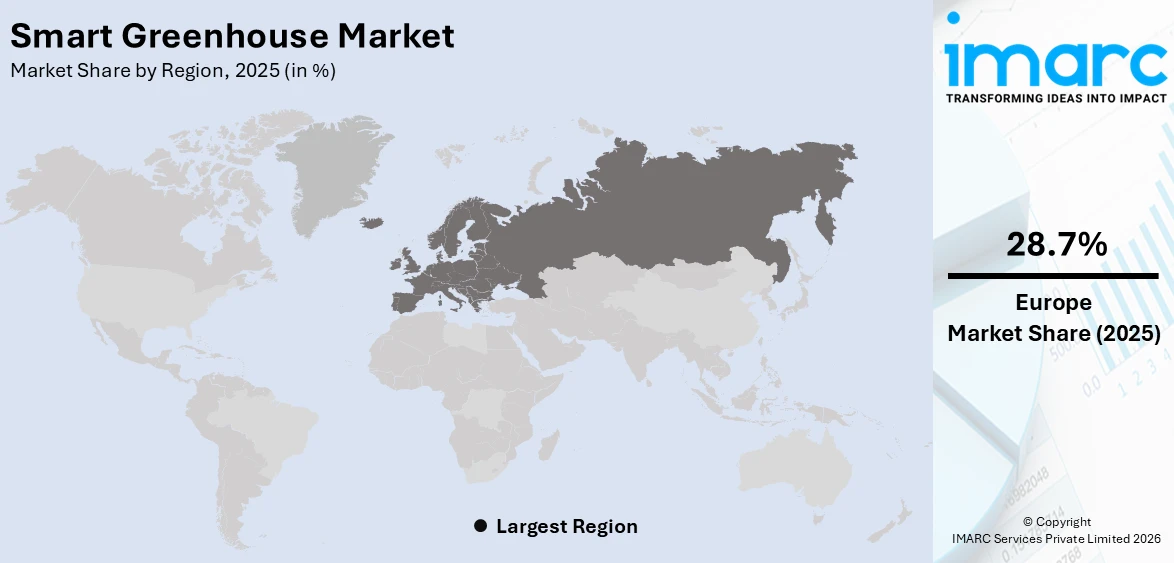
Europe holds the leading position in the smart greenhouse market with a 28.7% share due to its strong emphasis on sustainable agriculture and advanced farming technologies. The region’s stringent environmental regulations encourage the adoption of energy-efficient and resource-saving solutions, such as automated climate control, hydroponics, and LED grow lights. Government initiatives and subsidies support high-tech farming infrastructure, driving the smart greenhouse market growth. Additionally, the increasing demand for organic and locally grown produce fuels investment in controlled-environment agriculture. The presence of leading agritech companies and research institutions fosters continuous innovation. Europe’s focus on reducing agricultural dependency on imports while enhancing food security further strengthens its dominance in the smart greenhouse sector.
Key Regional Takeaways:
United States Smart Greenhouse Market Analysis
The adoption of smart greenhouses has experienced notable expansion due to increasing integration of advanced HVAC systems that enhance environmental control capabilities significantly. These sophisticated systems provide precise regulation of temperature, humidity, and ventilation, ensuring optimal growing conditions throughout all seasons. With growing awareness of maintaining ideal cultivation environments for crops, modern HVAC systems help farmers achieve consistent year-round production without external weather interference. In regions experiencing extreme seasonal variations, HVAC systems in smart greenhouses ensure plants receive stable environments, substantially boosting yields and quality. Advanced monitoring systems integrated with HVAC technology allow remote management capabilities and reduce energy consumption, aligning perfectly with sustainable agricultural practices. As agricultural land availability becomes increasingly limited, HVAC-enhanced greenhouses enable significantly more efficient space utilization, fostering widespread adoption of smart greenhouse solutions across areas where traditional farming methods face substantial operational challenges.
North America Smart Greenhouse Market Analysis
The region experiences rapid expansion due to increasing adoption of advanced agricultural technologies, rising demand for sustainable farming practices, and robust government support for precision agriculture initiatives. North America benefits substantially from strong investments in IoT-based automation, AI-driven climate control systems, and hydroponic cultivation technologies that enhance productivity and resource efficiency dramatically. The United States leads regional market development, driven by cutting-edge technological innovations and growing consumer demand for organic, locally sourced produce. Canada witnesses significant growth, fueled by urban farming initiatives and controlled-environment agriculture adoption. Climate challenges and rising energy costs push growers toward technology-driven solutions for optimizing crop production. Continuous advancements in LED lighting systems, automated irrigation technologies, and sophisticated data analytics platforms further support robust market development across the entire North American region.
Asia Pacific Smart Greenhouse Market Analysis
The expansion of the agricultural sector has been pivotal in driving smart greenhouse adoption throughout the region as governments invest substantially in agricultural innovation. With increasing demand for higher agricultural output, smart greenhouses provide advanced solutions to boost productivity significantly while minimizing resource wastage. Precision farming technologies, coupled with automated irrigation and sophisticated climate control systems, enable farmers to optimize input use including water, fertilizers, and energy efficiently. These systems are specifically tailored to meet growing needs for controlled-environment agriculture, particularly in regions facing climatic challenges or limited arable land availability. High-tech smart greenhouses facilitate consistent year-round cultivation, allowing farmers to meet rising consumer demand for fresh produce reliably. The integration of advanced technological tools within smart greenhouses supports highly efficient farming practices, helping producers achieve consistent yields despite challenging external environmental conditions.
Latin America Smart Greenhouse Market Analysis
The increasing demand for organic food, largely driven by growth in disposable income levels, has been significant in smart greenhouse adoption throughout the region. Advanced greenhouses support organic cultivation by providing controlled environments completely free from chemical interventions and pesticides. Consumers are increasingly seeking high-quality, organic produce consistently, and smart greenhouses enable reliable production to meet this expanding demand effectively. Regional disposable income demonstrates substantial projected growth, creating favorable conditions for agricultural technology investment. With availability of modern equipment, growers can increase productivity based on organic farming principles, ensuring adequate supply of clean and environmentally friendly food products continually. This corresponds directly with rising trends of consumer preferences focusing on healthier lifestyle choices and sustainable food production methods that minimize environmental impact.
Middle East and Africa Smart Greenhouse Market Analysis
Advancements in artificial lighting have become key enablers for smart greenhouse adoption throughout the region by addressing challenging climatic conditions. These systems allow growers to simulate natural sunlight accurately, ensuring optimal plant growth even during adverse weather conditions or extreme temperatures. Significant investments in agricultural innovation leverage AI and technologies like artificial lighting to address both immediate and long-term challenges posed by climate change to regional food systems. The development of energy-efficient lighting solutions enhances cost-effectiveness of greenhouse operations substantially, enabling continuous cultivation regardless of seasonal variations. This technological progress ensures smart greenhouses remain productive year-round, supporting agricultural activities in regions where traditional farming is significantly impacted by unpredictable climate patterns and water scarcity challenges that threaten food security.
Competitive Landscape:
The smart greenhouse market is characterized by intense competition, driven by technological advancements and increasing demand for automated farming solutions. Market players focus on innovations in IoT, AI-powered analytics, and climate control systems to enhance crop yield and efficiency. Companies invest in research and development to introduce energy-efficient solutions, such as LED grow lights and automated irrigation systems. Strategic partnerships and collaborations with agritech firms, research institutions, and government bodies strengthen market presence. Expansion strategies include regional market penetration and customization of solutions based on climate and crop requirements. The rise of vertical farming and hydroponic techniques further intensifies competition, pushing firms to offer scalable and cost-effective smart greenhouse solutions to meet evolving agricultural demands.
The report provides a comprehensive analysis of the competitive landscape in the smart greenhouse market with detailed profiles of all major companies, including:
- Argus Control Systems Limited (Conviron)
- Certhon
- Heliospectra AB
- Netafim (Orbia)
- Sensaphone
Latest News and Developments:
- February 2025: Certhon and DENSO Corporation launched Artemy, an advanced autonomous tomato-harvesting robot that entered commercial operation at The Valley, an eight-hectare commercial greenhouse in the Netherlands. The robot addresses labor shortages and rising costs in Dutch greenhouse horticulture while helping growers maintain competitiveness through automated harvesting capabilities.
- February 2025: South Korea launched its first five-year master plan targeting conversion of 35% of greenhouses into smart farms, boosting education, easing regulations, and creating innovation clusters to drive workforce resilience and technological competitiveness in agriculture. The comprehensive plan runs from 2025 to 2029 and represents a major government commitment to agricultural modernization.
- September 2024, Bicker Elektronik presented a DC UPS solution designed to ensure uninterrupted power for Hoogendoorn’s IIVO smart greenhouse control system. The UPS provides a reliable shutdown and reboot during power failures, using maintenance-free Supercap energy storage for long-lasting, efficient performance.
- August 2024, the USDA announced plans to establish the Greenhouse Gas Technical Assistance Provider and Third-Party Verifier Program Advisory Council. This initiative, part of the Growing Climate Solutions Act (GCSA), aims to enhance emissions monitoring and support climate-friendly agricultural practices. Smart greenhouse stakeholders are invited to contribute through Council membership, aiding climate-focused agricultural innovation.
- August 2024, Skytree unveiled the Stratus Hub, a plug-and-play solution designed for carbon dioxide removal projects. Targeting diverse markets like smart greenhouses, fuels, and chemicals, the Hub supports CO2 storage and utilization initiatives. It complements the decentralized DAC product, Stratus, enhancing carbon sequestration in geological formations.
- May 2024, KUBO launched the first CO2-negative smart greenhouse for vegetable cultivation, cutting fossil energy use significantly. Debuted at GreenTech RAI in Amsterdam, the technology supports food security and CO2 reduction goals. KUBO’s greenhouse minimizes energy, water, and pesticide use, redefining sustainable horticulture.
- April 2024, Costa Rica, with support from CABEI and the Republic of Korea, launched its first intelligent greenhouse. Located at the Los Diamantes Experimental Station, the 2,500 m² facility uses advanced technology for automated crop management, improving productivity and quality.
- July 2024, it was reported that Uzbekistan will construct a 0.6-hectare smart greenhouse with the help of South Korean technology. The facility, equipped with energy-saving technologies and remote management, will support agricultural cultivation and research.
Smart Greenhouse Market Report Scope:
| Report Features | Details |
|---|---|
| Base Year of the Analysis | 2025 |
| Historical Period | 2020-2025 |
| Forecast Period | 2026-2034 |
| Units | Billion USD |
| Scope of the Report |
Exploration of Historical Trends and Market Outlook, Industry Catalysts and Challenges, Segment-Wise Historical and Future Market Assessment:
|
| Types Covered | Hydroponic, Non-Hydroponic |
| Offerings Covered |
|
| End Users Covered | Commercial Growers, Research and Educational Institutes, Retail Gardens, Others |
| Regions Covered | Asia Pacific, Europe, North America, Latin America, Middle East and Africa |
| Countries Covered | United States, Canada, Germany, France, United Kingdom, Italy, Spain, Russia, China, Japan, India, South Korea, Australia, Indonesia, Brazil, Mexico |
| Companies Covered | Argus Control Systems Limited (Conviron), Certhon, Heliospectra AB, Netafim (Orbia), Sensaphone, etc. |
| Customization Scope | 10% Free Customization |
| Post-Sale Analyst Support | 10-12 Weeks |
| Delivery Format | PDF and Excel through Email (We can also provide the editable version of the report in PPT/Word format on special request) |
Key Benefits for Stakeholders:
- IMARC’s report offers a comprehensive quantitative analysis of various market segments, historical and current market trends, market forecasts, and dynamics of the smart greenhouse market from 2020-2034.
- The research study provides the latest information on the market drivers, challenges, and opportunities in the global smart greenhouse market.
- The study maps the leading, as well as the fastest-growing, regional markets. It further enables stakeholders to identify the key country-level markets within each region.
- Porter's Five Forces analysis assists stakeholders in assessing the impact of new entrants, competitive rivalry, supplier power, buyer power, and the threat of substitution. It helps stakeholders to analyze the level of competition within the smart greenhouse industry and its attractiveness.
- Competitive landscape allows stakeholders to understand their competitive environment and provides an insight into the current positions of key players in the market.
Frequently Asked Questions About the Smart Greenhouse Market Report
The smart greenhouse market was valued at USD 2.2 Billion in 2025.
The smart greenhouse market was valued at USD 4.3 Billion in 2034, exhibiting a CAGR of 7.56% during 2026-2034.
The adoption of IoT and AI-driven automation facilitates real-time monitoring and control of temperature, humidity, and soil moisture. Automated climate control systems improve efficiency through predictive analytics, helping farmers achieve higher productivity and sustainability while shifting agriculture toward data-driven precision farming practices.
Europe dominates the smart greenhouse market with 28.7% due to strong government support, advanced agritech adoption, and stringent environmental regulations. The region’s focus on sustainable farming, high demand for organic produce, and investment in automation, hydroponics, and climate control technologies further drive market growth and innovation in controlled-environment agriculture.
Some of the major players in the smart greenhouse market include Argus Control Systems Limited (Conviron), Certhon, Heliospectra AB, Netafim (Orbia), Sensaphone, etc.
Need more help?
- Speak to our experienced analysts for insights on the current market scenarios.
- Include additional segments and countries to customize the report as per your requirement.
- Gain an unparalleled competitive advantage in your domain by understanding how to utilize the report and positively impacting your operations and revenue.
- For further assistance, please connect with our analysts.
 Request Customization
 Speak to an Analyst
 Request Brochure
 Inquire Before Buying
Benefits of Customization
- Personalize this research
- Triangulate with your data
- Get data as per your format and definition
- Gain a deeper dive into a specific application, geography, customer, or competitor
- Any level of personalization
Get in Touch With Us
UNITED STATES
Phone: +1-201-971-6302
INDIA
Phone: +91-120-433-0800
UNITED KINGDOM
Phone: +44-753-714-6104
Email: [email protected]
Client Testimonials




.webp)




.webp)













Related Reports

Choose your plan
*Please note that the prices mentioned below are starting prices for each bundle type. Kindly contact our team for further details.*
Single User License
- 1 User License, Access on 2 Devices
- PDF Report + Excel Dataset (Password Protected)
- Lifetime Access
- No Printing Rights
- 10% Free Report Customization
- 10–12 Weeks of Analyst Support
Five User License
- Access for 5 Users, 2 Devices per User
- PDF Report + Excel Dataset (Password Protected)
- Lifetime Access
- Dedicated Account Manager
- 12–14 Weeks of Analyst Support
- No Printing Rights
- 15% Free Report Customization
- 25% Discount on Your Next Purchase
Corporate User License
- Unlimited User Access (Within Your Organization)
- PDF Report + Excel Dataset
- Lifetime Access
- Dedicated Account Manager
- 14–20 Weeks of Analyst Support
- No Printing Rights
- 20% Free Report Customization
- 30% Discount on Your Next Purchase
Essential Insights
What's included:
3 reports
- Lifetime Access
- PDF Reports
- Excel Datasets
- 2 Weeks of Free Analyst Support
- 2 User Licenses
- Access on 2 Devices
- Printing Rights
- Complimentary PowerPoint (PPT) Version
- Complimentary License Upgrade
Professional Access
What's included:
5 reports
- Lifetime Access
- PDF Reports
- Excel Datasets
- 8 Weeks of Free Analyst Support
- 2 User Licenses
- Access on 2 Devices
- Printing Rights
- Complimentary PowerPoint (PPT) Version
- Complimentary License Upgrade
Business Advantage
What's included:
8 reports
- Lifetime Access
- PDF Reports
- Excel Datasets
- 14 Weeks of Free Analyst Support
- 2 User Licenses
- Access on 2 Devices
- Printing Rights
- Complimentary PowerPoint (PPT) Version
- Complimentary License Upgrade
Enterprise Intelligence
What's included:
10 reports
- Lifetime Access
- PDF Reports
- Excel Datasets
- 20 Weeks of Free Analyst Support
- 2 User Licenses
- Access on 2 Devices
- Printing Rights
- Complimentary PowerPoint (PPT) Version
- Complimentary License Upgrade