
SME Cloud Market Size, Share, Trends and Forecast by Service Model, End User, and Region, 2026-2034
SME Cloud Market Size and Share:
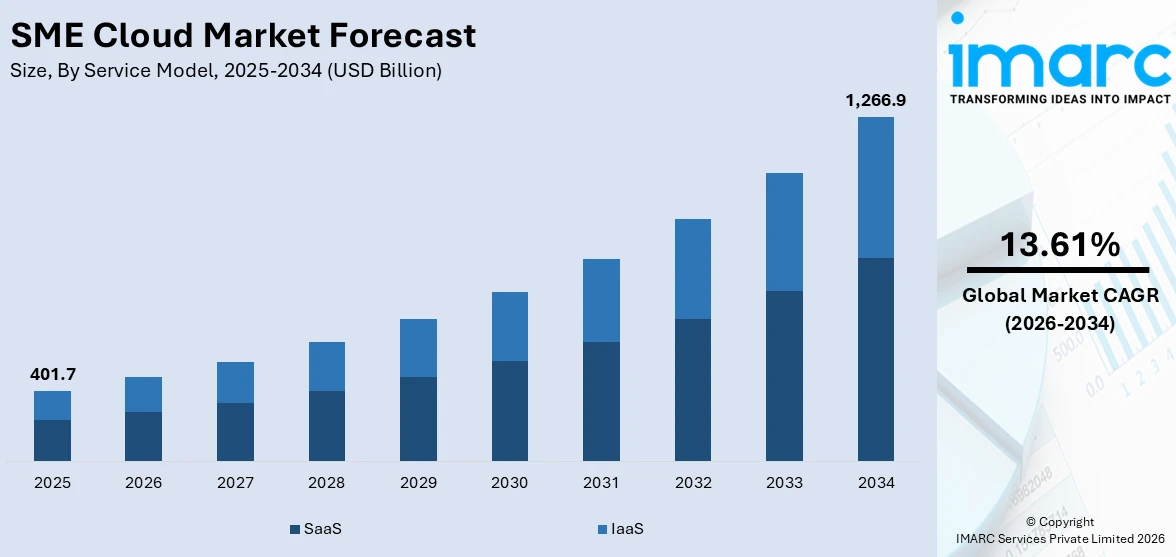
The global SME cloud market size was valued at USD 401.7 Billion in 2025. Looking forward, IMARC Group estimates the market to reach USD 1,266.9 Billion by 2034, exhibiting a CAGR of 13.61% from 2026-2034. North America currently dominates the market, holding a market share of 52%. The market has emerged as a transformative force for small and medium enterprises seeking digital infrastructure solutions. Cloud adoption among SMEs continues accelerating as businesses recognize the operational flexibility and technological accessibility these platforms provide. The market encompasses various service models and deployment strategies tailored to SME requirements, enabling organizations to leverage enterprise-grade capabilities without substantial capital investments. As digital transformation becomes imperative across industries, SMEs increasingly migrate critical operations to cloud environments, fundamentally reshaping how smaller organizations compete and innovate. This evolution reflects broader technological democratization, making sophisticated tools accessible to businesses of all sizes, ultimately strengthening the SME cloud market share.
|
Report Attribute
|
Key Statistics
|
|---|---|
|
Base Year
|
2025
|
|
Forecast Years
|
2026-2034
|
|
Historical Years
|
2020-2025
|
|
Market Size in 2025
|
USD 401.7 Billion |
|
Market Forecast in 2034
|
USD 1,266.9 Billion |
| Market Growth Rate 2026-2034 | 13.61% |
The global shift toward digital-first business models drives unprecedented SME cloud market expansion. Small and medium enterprises worldwide face mounting pressure to modernize operations, enhance customer experiences, and optimize resource allocation. Cloud platforms address these imperatives by delivering scalable infrastructure that adapts to fluctuating business demands. SMEs particularly benefit from eliminating traditional IT overhead, redirecting capital toward core business activities rather than hardware maintenance and software licensing. The subscription-based consumption model aligns technology spending with actual usage, providing financial predictability crucial for smaller organizations managing tight budgets. Additionally, remote work normalization has accelerated cloud adoption, as distributed teams require reliable access to centralized data and applications. Reflecting this ongoing transformation, Netgear’s 2025 acquisition of Bengaluru-based cybersecurity startup Exium underscores growing efforts to enhance secure cloud connectivity for small businesses. Similarly, the surge of SME IPOs in 2025—raising over ₹6,800 crore— demonstrates investor confidence in digitally enabled enterprises that leverage cloud-based infrastructure to scale operations efficiently. Cloud solutions enable seamless collaboration regardless of geographic location, supporting business continuity while expanding talent acquisition possibilities beyond local markets.
To get more information on this market Request Sample
Within the United States, representing 74% of market activity, SME cloud market growth stems from sophisticated digital ecosystems and competitive business environments. American SMEs operate in markets where technological agility directly correlates with competitive positioning, driving aggressive cloud adoption rates. The regulatory landscape, particularly regarding data protection and industry compliance, pushes businesses toward professionally managed cloud environments offering built-in security and compliance frameworks. Access to diverse cloud service providers creates competitive pricing dynamics, making enterprise-grade solutions increasingly affordable for smaller budgets. Furthermore, the entrepreneurial culture prevalent across U.S. business communities emphasizes innovation and rapid scaling, qualities that cloud infrastructure inherently supports. SMEs leverage cloud platforms to test new business models, enter adjacent markets, and respond quickly to consumer preferences, capabilities that would be prohibitively expensive through traditional IT approaches.
SME Cloud Market Trends:
Artificial Intelligence Integration in Cloud Platforms
Artificial intelligence capabilities embedded within cloud services are revolutionizing SME operational efficiency and decision-making processes. Cloud providers increasingly offer AI-powered tools as standard features, enabling smaller businesses to implement sophisticated automation, predictive analytics, and intelligent customer service without specialized expertise. These AI integrations democratize advanced technologies previously accessible only to large enterprises with dedicated data science teams. SMEs utilize cloud-based AI for inventory optimization, demand forecasting, personalized marketing campaigns, and automated administrative tasks. The technology reduces operational costs while improving accuracy and responsiveness across business functions. Machine learning (ML) algorithms continuously refine recommendations and predictions based on accumulated data, providing increasingly valuable insights over time. This trend represents a fundamental shift in competitive dynamics, where technological sophistication becomes accessible regardless of organization size, empowering SMEs to compete on analytics and intelligence rather than solely on resources. Reflecting this shift, for example Alibaba.com found that 63% of global SMEs are now actively using AI tools to support cross-border trade. Along with this in Singapore, Alibaba Cloud partnered with Infocomm Media Development Authority (IMDA) to enable up to 3,000 SMEs and digital solution providers to adopt cloud and AI technologies through training, credits and technical support.
Industry-Specific Cloud Solutions Emergence
Cloud providers are developing specialized solutions targeting specific industry verticals, addressing unique operational requirements and regulatory considerations facing SMEs in different sectors. These industry-specific platforms integrate workflows, compliance tools, and functionality tailored to particular business contexts, reducing implementation complexity and accelerating value realization. Healthcare-focused clouds incorporate HIPAA compliance frameworks, retail platforms integrate inventory and point-of-sale systems, while construction-oriented solutions manage project scheduling and resource allocation. This specialization allows SMEs to adopt cloud infrastructure aligned with established industry practices rather than adapting generic tools to specific needs. The approach reduces training requirements, improves user adoption, and ensures critical industry functions operate seamlessly within cloud environments. As vertical specialization deepens, SME cloud market trends indicate that providers will develop increasingly sophisticated industry expertise, positioning themselves as technology partners rather than infrastructure vendors, fundamentally changing the relationship between SMEs and their cloud providers.
Multi-Cloud and Hybrid Deployment Strategies
SMEs increasingly adopt sophisticated multi-cloud and hybrid deployment approaches, selecting different cloud platforms for specific workloads based on performance, cost, and functionality considerations. Cloud providers and tools are now making it easier to combine on-premises, private and public clouds — for example, recent reports show that 78% of companies use two or more cloud providers and 54% deploy hybrid cloud setups mixing on-premises with public cloud. This strategic flexibility prevents vendor lock-in while optimizing technology investments across diverse requirements. Businesses maintain certain applications on-premises for latency-sensitive operations or regulatory reasons while leveraging public cloud resources for scalable computing needs and collaborative tools. The trend reflects growing technological maturity among SMEs, as organizations develop expertise in cloud architecture and deployment strategies. Multi-cloud approaches also enhance resilience, distributing risk across multiple providers and reducing vulnerability to service disruptions. Cloud management tools simplifying multi-cloud orchestration make these strategies accessible to smaller IT teams without extensive expertise. This evolution signals a maturing market where SMEs exercise greater control over technology infrastructure, making informed decisions based on specific business requirements rather than accepting standardized solutions.
SME Cloud Industry Segmentation:
IMARC Group provides an analysis of the key trends in each segment of the global SME cloud market, along with forecast at the global, regional, and country levels from 2026-2034. The market has been categorized based on service model and end user.
Analysis by Service Model:
- SaaS
- IaaS
Software as a Service dominates the market with 56% representation, reflecting SME preferences for ready-to-use applications requiring minimal technical expertise. SaaS eliminates traditional software deployment complexities, providing immediate access to business applications through web browsers or lightweight clients. This model particularly appeals to resource-constrained SMEs lacking dedicated IT departments, as providers handle maintenance, security updates, and infrastructure management. The subscription pricing structure aligns costs with business growth, allowing organizations to scale usage as needs expand without renegotiating licenses or purchasing additional infrastructure. SaaS applications span critical business functions including customer relationship management, financial management, human resources, and collaboration tools. The model's popularity stems from rapid deployment timelines, typically measured in days rather than months required for traditional software implementations. SMEs access continuous feature enhancements and improvements without additional investment, ensuring technology capabilities evolve alongside business requirements and market conditions.
Analysis by End User:
Access the comprehensive market breakdown Request Sample
- Manufacturing
- Healthcare
- Retail
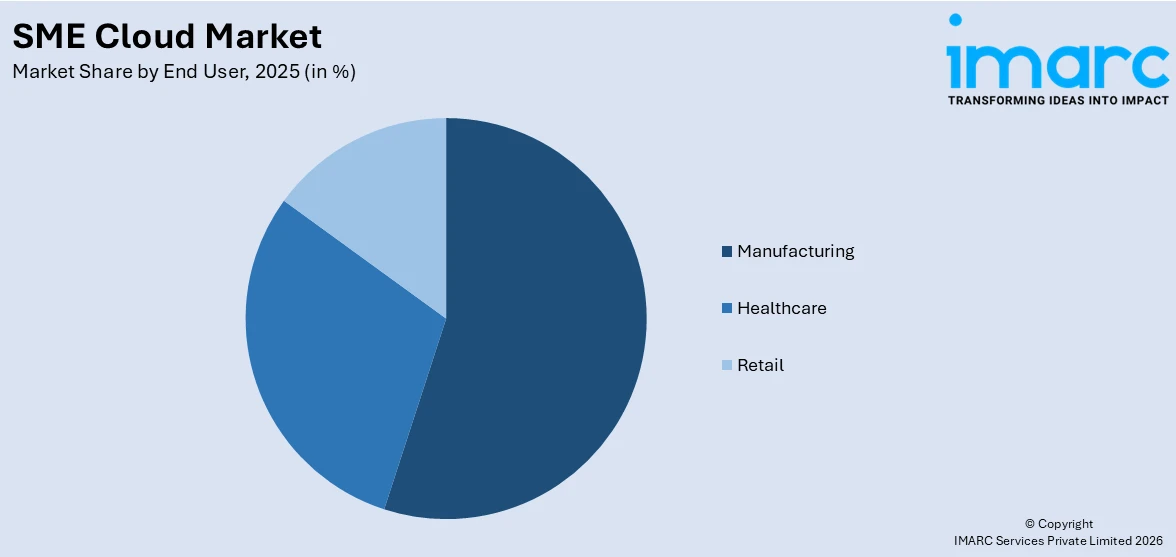
Manufacturing enterprises represent 40% of the market, driven by operational complexity requiring sophisticated planning, production, and supply chain management systems. Cloud platforms enable manufacturers to integrate disparate operations, connecting production equipment, inventory systems, supplier networks, and distribution channels within unified digital environments. Real-time visibility across manufacturing processes improves decision-making, reduces waste, and enhances production efficiency. Cloud-based manufacturing execution systems coordinate production schedules, monitor equipment performance, and optimize resource allocation dynamically based on demand fluctuations. SME manufacturers particularly benefit from cloud solutions providing enterprise resource planning functionality previously accessible only to larger competitors with substantial IT budgets. The technology enables just-in-time manufacturing approaches, reducing inventory carrying costs while maintaining production flexibility. Cloud platforms also facilitate collaboration with suppliers and distributors, creating integrated supply chains responding quickly to market demands and minimizing disruptions through improved visibility and coordination.
Regional Analysis:
To get more information on the regional analysis of this market Request Sample
- North America
- United States
- Canada
- Asia Pacific
- China
- Japan
- India
- South Korea
- Australia
- Indonesia
- Others
- Europe
- Germany
- France
- United Kingdom
- Italy
- Spain
- Russia
- Others
- Latin America
- Brazil
- Mexico
- Others
- Middle East and Africa
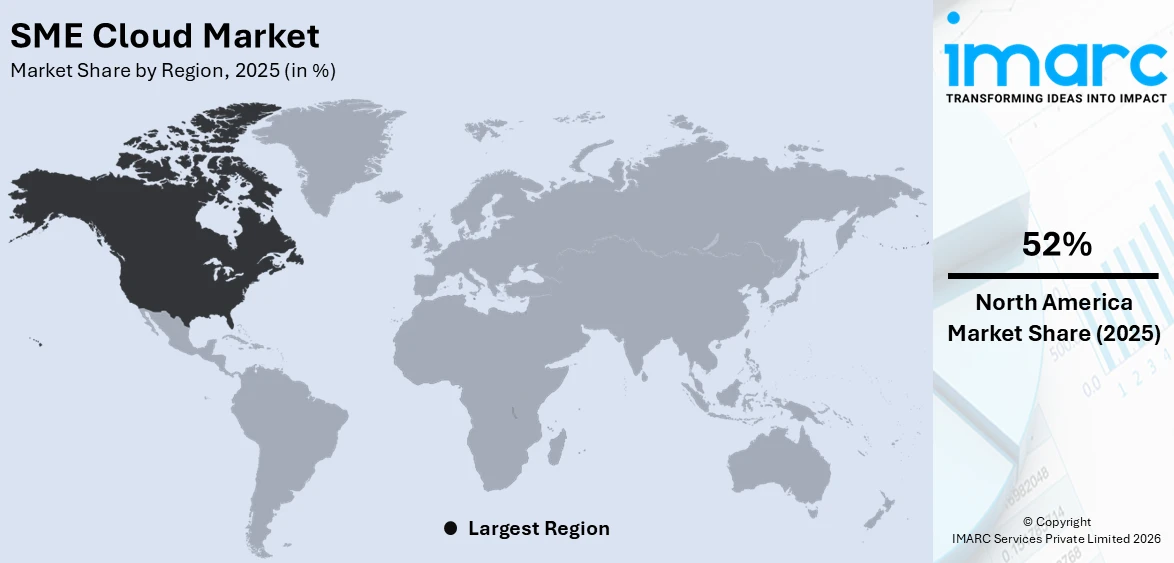
North America commands 52% of the market, reflecting mature digital infrastructure, high internet penetration, and established cloud service provider ecosystems. The region's business culture emphasizes technological innovation and competitive differentiation through digital capabilities, driving aggressive cloud adoption among SMEs. Robust telecommunications networks ensure reliable connectivity supporting cloud-dependent operations, while competitive markets among cloud providers create favorable pricing and service diversity. North American SMEs benefit from extensive support ecosystems including consultants, implementation partners, and training resources facilitating successful cloud transitions. Regulatory frameworks, while complex, provide clear compliance guidelines that cloud providers incorporate into service offerings, simplifying adherence for smaller businesses. The region's entrepreneurial environment, particularly concentrated in technology hubs, creates demand for scalable infrastructure supporting rapid growth and market expansion. Additionally, workforce expectations around remote work and digital collaboration tools drive cloud adoption as businesses attract and retain talent expecting modern technology environments.
Key Regional Takeaways:
United States SME Cloud Market Analysis
The United States leads global adoption, characterized by diverse industry participation and sophisticated implementation strategies. American SMEs leverage cloud infrastructure for competitive differentiation, implementing advanced analytics, customer experience platforms, and operational automation at unprecedented rates. The market benefits from extensive venture capital and growth equity funding supporting cloud-focused startups developing innovative solutions specifically for smaller businesses. Regional variations reflect local industry concentrations, with technology-focused SMEs in coastal regions adopting cutting-edge capabilities while traditional industries in interior markets prioritize operational efficiency and cost optimization. Cybersecurity concerns drive demand for cloud solutions offering robust protection frameworks, as SMEs recognize vulnerability to digital threats without professional security management. The regulatory environment, particularly regarding data privacy and industry-specific compliance, influences cloud adoption patterns as businesses seek providers demonstrating compliance expertise relevant to their specific sectors and operational contexts.
Asia Pacific SME Cloud Market Analysis
Asia Pacific demonstrates explosive growth potential driven by rapidly expanding SME populations and increasing internet accessibility across diverse economies. The region's manufacturing concentration drives demand for cloud-based supply chain management and production optimization systems. Mobile-first approaches characterize regional cloud adoption, as smartphone penetration often exceeds traditional computing access, influencing application design and user interface priorities. Government digitalization initiatives throughout the region create favorable environments for cloud adoption, with public sector support programs subsidizing technology investments and providing implementation guidance. Language diversity necessitates multilingual cloud solutions, creating opportunities for regional providers understanding local business practices and cultural contexts. E-commerce growth throughout Asia Pacific fuels demand for cloud infrastructure supporting online retail operations, payment processing, and digital marketing platforms. Regional cloud providers increasingly compete with global players by offering localized support, data sovereignty compliance, and pricing structures aligned with local economic conditions.
Europe SME Cloud Market Analysis
European markets demonstrate sophisticated cloud adoption balanced with stringent data protection and privacy requirements influencing deployment strategies. Regulatory frameworks, particularly regarding data sovereignty and cross-border data transfers, shape cloud architecture decisions as SMEs navigate complex compliance landscapes. The region's emphasis on sustainability drives demand for cloud providers demonstrating environmental responsibility through renewable energy usage and efficient data center operations. Multilingual requirements across closely integrated economies necessitate cloud solutions supporting diverse languages while maintaining consistent functionality and user experiences. Traditional industries including manufacturing, retail, and professional services increasingly migrate to cloud platforms, modernizing operations while preserving established business processes and customer relationships. Regional variation reflects economic diversity, with northern European markets showing advanced adoption while southern and eastern regions demonstrate rapid growth from lower bases, creating dynamic market evolution across the continent.
Latin America SME Cloud Market Analysis
Latin American markets exhibit accelerating cloud adoption driven by improving telecommunications infrastructure and increasing digital payment adoption. Economic volatility throughout the region makes cloud's subscription pricing particularly attractive, allowing SMEs to access enterprise capabilities without capital expenditure risks. Cross-border e-commerce growth fuels demand for cloud platforms managing international transactions, currency conversions, and regulatory compliance across multiple jurisdictions. Mobile commerce prominence influences cloud solution design, emphasizing smartphone optimization and lightweight applications accommodating varying connectivity quality. Regional cloud providers gain traction by addressing local payment preferences, language requirements, and business practices often overlooked by global platforms. Government digitalization initiatives in larger economies create demonstration effects encouraging broader SME adoption. Currency fluctuations and economic uncertainty drive preference for flexible cloud arrangements allowing rapid scaling adjustments responding to changing business conditions, with minimal commitment periods and usage-based pricing proving particularly popular.
Middle East and Africa SME Cloud Market Analysis
Middle East and Africa represent emerging markets with substantial growth potential as infrastructure development and internet accessibility expand. Regional economic diversification initiatives drive cloud adoption as governments encourage entrepreneurship and technology sector development reducing petroleum dependence. Mobile connectivity often surpasses fixed-line infrastructure, influencing cloud solution design emphasizing mobile access and offline functionality accommodating connectivity interruptions. Islamic finance principles influence cloud financial management solutions, requiring Sharia-compliant features and reporting capabilities. Regional instability and security concerns drive demand for business continuity capabilities and data backup solutions, with cloud platforms offering geographic redundancy and disaster recovery features particularly valued. Language diversity across the region necessitates Arabic language support alongside English and French capabilities. Growing youth populations and improving educational systems create technology-savvy workforces driving bottom-up cloud adoption pressures within organizations, as younger employees expect modern digital tools and collaborative platforms supporting contemporary work styles.
Competitive Landscape:
The competitive environment demonstrates increasing sophistication as global hyperscale providers compete alongside regional specialists and vertical-focused platforms. Market dynamics favor providers offering comprehensive ecosystems integrating multiple service types while maintaining pricing accessibility for budget-conscious SMEs. Strategic partnerships between cloud infrastructure providers and business application developers create integrated solutions reducing implementation complexity and improving user experiences. The landscape increasingly segments between horizontal platforms serving diverse industries and specialized vertical solutions addressing specific sector requirements. Innovation cycles accelerate as providers incorporate emerging technologies including artificial intelligence, machine learning, and advanced analytics into standard offerings. Customer retention strategies emphasize ecosystem lock-in through integrated services rather than contractual obligations, as providers recognize SME preferences for flexibility and minimal commitment requirements. Market consolidation trends emerge as larger platforms acquire specialized providers to expand capabilities and market reach, while simultaneously creating opportunities for agile startups addressing underserved niches. The SME cloud market forecast indicates continued competitive intensity driving innovation and improving value propositions for SME customers.
The report provides a comprehensive analysis of the competitive landscape in the SME cloud market with detailed profiles of all major companies, including:
- Amazon Web Services Inc. (Amazon.com Inc.)
- Cisco Systems Inc.
- Dell Inc. (Dell Technologies Inc.)
- Google LLC (Alphabet Inc.)
- Hewlett Packard Enterprise Development LP
- International Business Machines Corporation
- Microsoft Corporation
- Oracle Corporation
- SAP SE.
Latest News and Developments:
- In August 2025: Bharti Airtel, through its digital arm Xtelify, launched a cloud and AI services platform for businesses and telecom operators. The platform offers IaaS, PaaS, and AI-powered software modules, developed in partnership with Singtel, Globe Telecom, and Airtel Africa, supporting India’s push for domestic cloud capabilities.
- In August 2025: Lucknow-based Takyon Networks Limited listed on the SME platform of the Bombay Stock Exchange (BSE). The ₹20 crore IPO was oversubscribed 20.35×, valuing the firm at ₹78 crore. The company offers networking, data-centre, cloud and managed services, and IT security solutions.
- In September 2025: Virgin Media O2 Business and Daisy Group merged to launch O2 Daisy, a business-to-business telecom and cloud services firm. Targeting SMEs and SOHO clients, it offers connectivity, cybersecurity, 5G private networks, and cloud-based workplace tools to scale enterprise services.
SME Cloud Market Report Scope:
| Report Features | Details |
|---|---|
| Base Year of the Analysis | 2025 |
| Historical Period | 2020-2025 |
| Forecast Period | 2026-2034 |
| Units | Billion USD |
| Scope of the Report |
Exploration of Historical Trends and Market Outlook, Industry Catalysts and Challenges, Segment-Wise Historical and Future Market Assessment:
|
| Service Models Covered | SaaS, IaaS |
| End Users Covered | Manufacturing, Healthcare, Retail |
| Regions Covered | Asia Pacific, Europe, North America, Latin America, Middle East and Africa |
| Countries Covered | United States, Canada, Germany, France, United Kingdom, Italy, Spain, Russia, China, Japan, India, South Korea, Australia, Indonesia, Brazil, Mexico |
| Companies Covered | Amazon Web Services Inc. (Amazon.com Inc.), Cisco Systems Inc., Dell Inc. (Dell Technologies Inc.), Google LLC (Alphabet Inc.), Hewlett Packard Enterprise Development LP, International Business Machines Corporation, Microsoft Corporation, Oracle Corporation, SAP SE., etc. |
| Customization Scope | 10% Free Customization |
| Post-Sale Analyst Support | 10-12 Weeks |
| Delivery Format | PDF and Excel through Email (We can also provide the editable version of the report in PPT/Word format on special request) |
Key Benefits for Stakeholders:
- IMARC’s report offers a comprehensive quantitative analysis of various market segments, historical and current market trends, market forecasts, and dynamics of the SME cloud market from 2020-2034.
- The research study provides the latest information on the market drivers, challenges, and opportunities in the global SME cloud market.
- The study maps the leading, as well as the fastest-growing, regional markets. It further enables stakeholders to identify the key country-level markets within each region.
- Porter's five forces analysis assist stakeholders in assessing the impact of new entrants, competitive rivalry, supplier power, buyer power, and the threat of substitution. It helps stakeholders to analyze the level of competition within the SME cloud industry and its attractiveness.
- Competitive landscape allows stakeholders to understand their competitive environment and provides an insight into the current positions of key players in the market.
Frequently Asked Questions About the SME Cloud Market Report
The SME cloud market was valued at USD 401.7 Billion in 2025.
The SME cloud market is projected to exhibit a CAGR of 13.61% during 2026-2034, reaching a value of USD 1,266.9 Billion by 2034.
Primary drivers include digital transformation imperatives, cost optimization through subscription models eliminating capital expenditure, operational flexibility supporting business growth and contraction, remote work enablement requiring distributed access to business systems, and competitive pressures demanding technological sophistication. Additionally, cybersecurity concerns drive adoption as professional cloud providers offer robust security frameworks exceeding capabilities of in-house SME IT resources. The SME Cloud Market growth reflects these converging factors creating compelling value propositions for smaller organizations seeking enterprise-grade capabilities without traditional infrastructure investments.
North America currently dominates the SME Cloud Market, accounting for a share of 52%. This leadership reflects mature digital infrastructure, established cloud provider ecosystems, high internet penetration, competitive business environments emphasizing technological innovation, robust telecommunications networks, extensive support resources facilitating implementation, and regulatory frameworks encouraging professional data management. The region's entrepreneurial culture and workforce expectations around modern technology tools further drive adoption rates exceeding other global markets, establishing North America's position as the primary SME Cloud Market outlook indicator.
Some of the major players in the SME cloud market include Amazon Web Services Inc. (Amazon.com Inc.), Cisco Systems Inc., Dell Inc. (Dell Technologies Inc.), Google LLC (Alphabet Inc.), Hewlett Packard Enterprise Development LP, International Business Machines Corporation, Microsoft Corporation, Oracle Corporation, SAP SE., etc.
Need more help?
- Speak to our experienced analysts for insights on the current market scenarios.
- Include additional segments and countries to customize the report as per your requirement.
- Gain an unparalleled competitive advantage in your domain by understanding how to utilize the report and positively impacting your operations and revenue.
- For further assistance, please connect with our analysts.
 Request Customization
 Speak to an Analyst
 Request Brochure
 Inquire Before Buying
Benefits of Customization
- Personalize this research
- Triangulate with your data
- Get data as per your format and definition
- Gain a deeper dive into a specific application, geography, customer, or competitor
- Any level of personalization
Get in Touch With Us
UNITED STATES
Phone: +1-201-971-6302
INDIA
Phone: +91-120-433-0800
UNITED KINGDOM
Phone: +44-753-714-6104
Email: [email protected]
Client Testimonials




.webp)




.webp)













Related Reports

Choose your plan
*Please note that the prices mentioned below are starting prices for each bundle type. Kindly contact our team for further details.*
Single User License
- 1 User License, Access on 2 Devices
- PDF Report + Excel Dataset (Password Protected)
- Lifetime Access
- No Printing Rights
- 10% Free Report Customization
- 10–12 Weeks of Analyst Support
Five User License
- Access for 5 Users, 2 Devices per User
- PDF Report + Excel Dataset (Password Protected)
- Lifetime Access
- Dedicated Account Manager
- 12–14 Weeks of Analyst Support
- No Printing Rights
- 15% Free Report Customization
- 25% Discount on Your Next Purchase
Corporate User License
- Unlimited User Access (Within Your Organization)
- PDF Report + Excel Dataset
- Lifetime Access
- Dedicated Account Manager
- 14–20 Weeks of Analyst Support
- No Printing Rights
- 20% Free Report Customization
- 30% Discount on Your Next Purchase
Essential Insights
What's included:
3 reports
- Lifetime Access
- PDF Reports
- Excel Datasets
- 2 Weeks of Free Analyst Support
- 2 User Licenses
- Access on 2 Devices
- Printing Rights
- Complimentary PowerPoint (PPT) Version
- Complimentary License Upgrade
Professional Access
What's included:
5 reports
- Lifetime Access
- PDF Reports
- Excel Datasets
- 8 Weeks of Free Analyst Support
- 2 User Licenses
- Access on 2 Devices
- Printing Rights
- Complimentary PowerPoint (PPT) Version
- Complimentary License Upgrade
Business Advantage
What's included:
8 reports
- Lifetime Access
- PDF Reports
- Excel Datasets
- 14 Weeks of Free Analyst Support
- 2 User Licenses
- Access on 2 Devices
- Printing Rights
- Complimentary PowerPoint (PPT) Version
- Complimentary License Upgrade
Enterprise Intelligence
What's included:
10 reports
- Lifetime Access
- PDF Reports
- Excel Datasets
- 20 Weeks of Free Analyst Support
- 2 User Licenses
- Access on 2 Devices
- Printing Rights
- Complimentary PowerPoint (PPT) Version
- Complimentary License Upgrade