
South Africa Athletic Footwear Market Size, Share, Trends and Forecast by Product Type, Distribution Channel, End User, and Region, 2026-2034
South Africa Athletic Footwear Market Size, Share, Trends & Forecast (2026-2034)
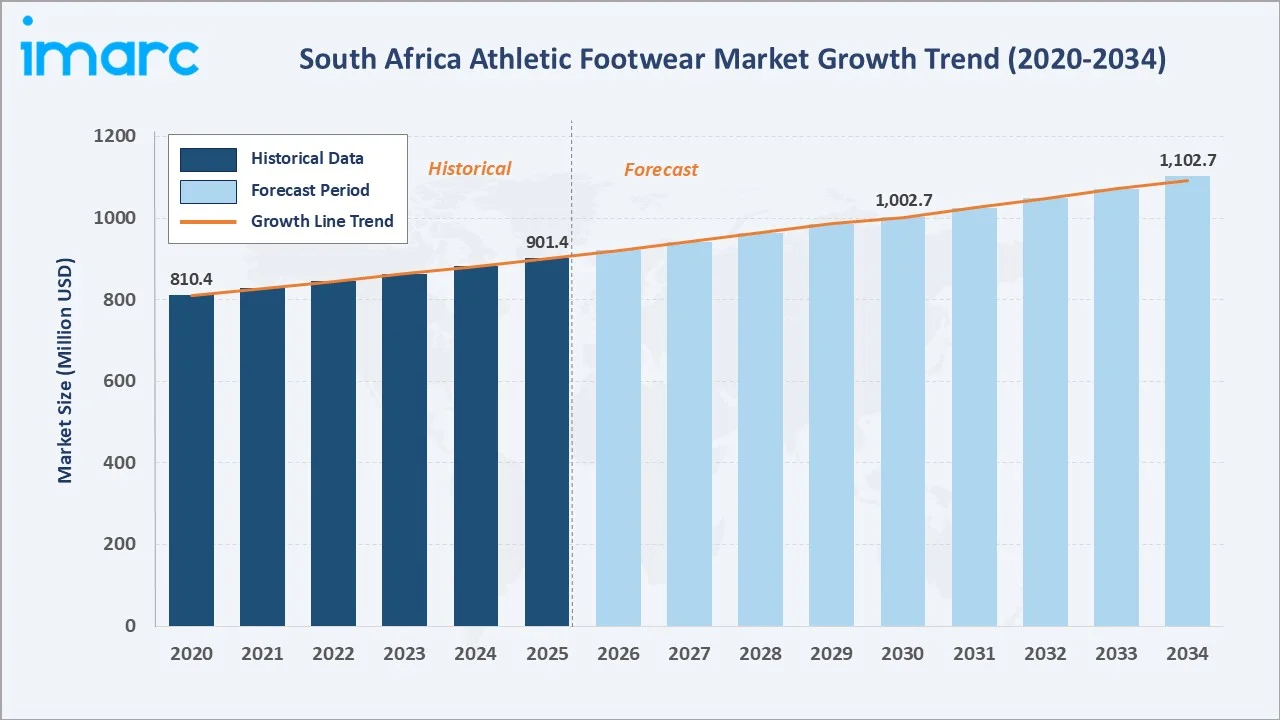
The South Africa athletic footwear market size reached USD 901.4 Million in 2025 and is projected to reach USD 1,102.7 Million by 2034, exhibiting a CAGR of 2.15% during 2026-2034. Rising health consciousness, expanding urban fitness culture, and the growing popularity of sneaker-led streetwear are the primary catalysts behind this steady demand curve. Retail expansion through franchise partnerships, alongside a sustained shift toward locally produced and sustainable footwear, is reshaping South Africa's athletic footwear market dynamics across both formal retail and digital commerce channels through 2034.
Market Snapshot
|
Metric |
Value |
|
Market Size (2025) |
USD 901.4 Million |
|
Forecast Market Size (2034) |
USD 1,102.7 Million |
|
CAGR (2026-2034) |
2.15% |
|
Base Year |
2025 |
|
Historical Period |
2020-2025 |
|
Forecast Period |
2026-2034 |
Gauteng commands the largest regional share at 39.2% in 2025, supported by Johannesburg and Pretoria's dense retail networks and high disposable incomes. Running shoes hold the leading product position with a 36.8% share, reflecting South African consumers' growing participation in road running and gym-based fitness routines. South Africa's parkrun network now exceeds 228 weekly events nationally, a participation base that has grown substantially since 2019 and continues to anchor recurring footwear replacement demand.
To get more information on this market, Request Sample
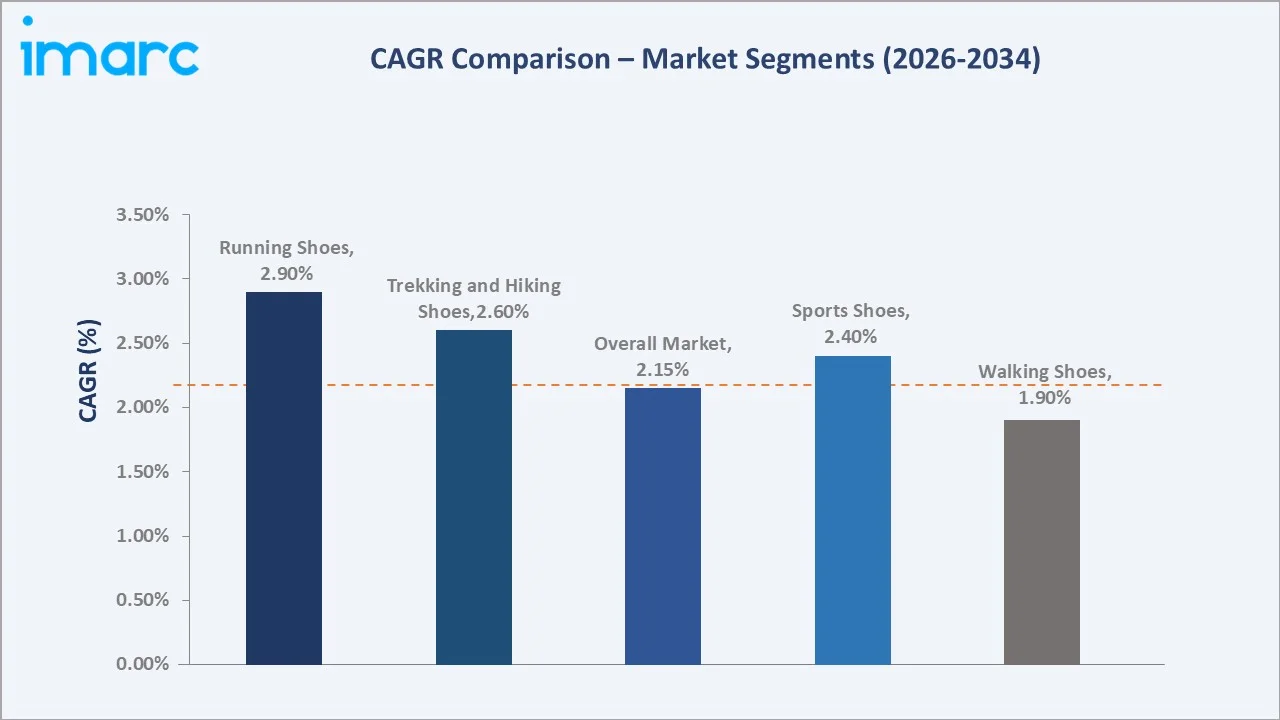
South Africa's athletic footwear market is underpinned by three structural forces: rising health and fitness participation across metropolitan provinces, the cultural convergence of sportswear with streetwear fashion, and the steady formalization of retail through international franchise tie-ups. Each force independently widens the consumer base while reinforcing the other, sustaining a moderate but stable CAGR of 2.15% through 2034.
Executive Summary
The South Africa athletic footwear market is progressing at a measured pace, supported by the convergence of health-driven lifestyle shifts, youth-led sneaker culture, and an expanding retail footprint. Valued at USD 901.4 Million in 2025, the market is forecast to reach USD 1,102.7 Million by 2034, registering a CAGR of 2.15%.
Running shoes dominate the product type segmentation with a 36.8% share in 2025, followed by sports shoes at 24.9% and walking shoes at 16.7%, reflecting a consumer base that values multi-purpose, comfort-oriented footwear for both fitness and daily wear. Among end users, men account for the largest share at 42.3%, while women represent a substantial 35.6%, signaling a near-balanced demand structure that is gradually narrowing as female participation in fitness activities rises.
Gauteng leads regionally with a 39.2% share, trailed by Western Cape at 23.5% and KwaZulu-Natal at 18.9%. International brands, alongside sportswear retail formats, dominate the competitive landscape, leveraging exclusive franchise agreements to expand reach across South Africa's metropolitan and peri-urban markets through 2034. The top five branded players collectively account for an estimated 45-50% of total market revenue, leaving a sizeable mid-market and informal-retail share open to regional and value-tier competitors.
Key Market Insights
|
Insight |
Data |
|
Largest Product Type |
Running Shoes - 36.8% share (2025) |
|
Largest End User |
Men - 42.3% share (2025) |
|
Leading Province |
Gauteng - 39.2% share (2025) |
|
Top Companies |
adidas AG, Nike Inc., PUMA SE, ASICS Corporation, The Foschini Group Limited |
Key Analytical Observations Supporting The Above Data:
- Running shoes hold a 36.8% share in 2025, driven by South Africa's growing parkrun and road-running culture, which has expanded participation across Gauteng and the Western Cape since 2022.
- Sports shoes follow at 24.9%, benefiting from cross-functional use across gym training and casual wear, a pattern accelerated by rising gym membership growth in metropolitan provinces.
- Men represent 42.3% of end-user demand in 2025, reflecting historically higher sports participation rates, though women's 35.6% share is rising on the back of targeted fitness apparel marketing.
- Gauteng's 39.2% regional share stems from Johannesburg and Pretoria's concentration of shopping malls, brand outlets, and disposable income levels well above the national average.
- Western Cape's 23.5% share is reinforced by Cape Town's outdoor and trekking culture, supporting consistent demand for trekking and hiking shoes at a 9.2% national product share.
- Kids' athletic footwear, holding a 22.1% end-user share, is supported by mandatory school sports programs across South Africa's public and private education systems, sustaining predictable replacement-cycle demand.
South Africa Athletic Footwear Market Overview
Athletic footwear encompasses running, sports, walking, aerobic, and trekking and hiking shoes designed for performance, comfort, and everyday lifestyle use. South Africa's market spans formal retail chains, specialty sportswear stores, brand-owned outlets, and a fast-growing online channel, serving fitness enthusiasts, casual wearers, and outdoor recreation participants across all nine provinces. With a population exceeding 63 million in 2025 and an urbanization rate above 63%, the country offers one of the largest addressable athletic footwear consumer bases on the African continent.
Macroeconomic drivers include rising urban health consciousness, growing middle-class disposable income in Gauteng and Western Cape, and globalization of fashion trends that blend performance footwear with streetwear aesthetics. South Africa's position as one of Africa's largest athletic footwear import destinations further reinforces consumer access to international brands and product variety. Average household spending on clothing and footwear in South Africa's urban centers is expected to grow at 6-8% annually, outpacing several other discretionary categories.
Market Dynamics
To evaluate market opportunities, Request Sample
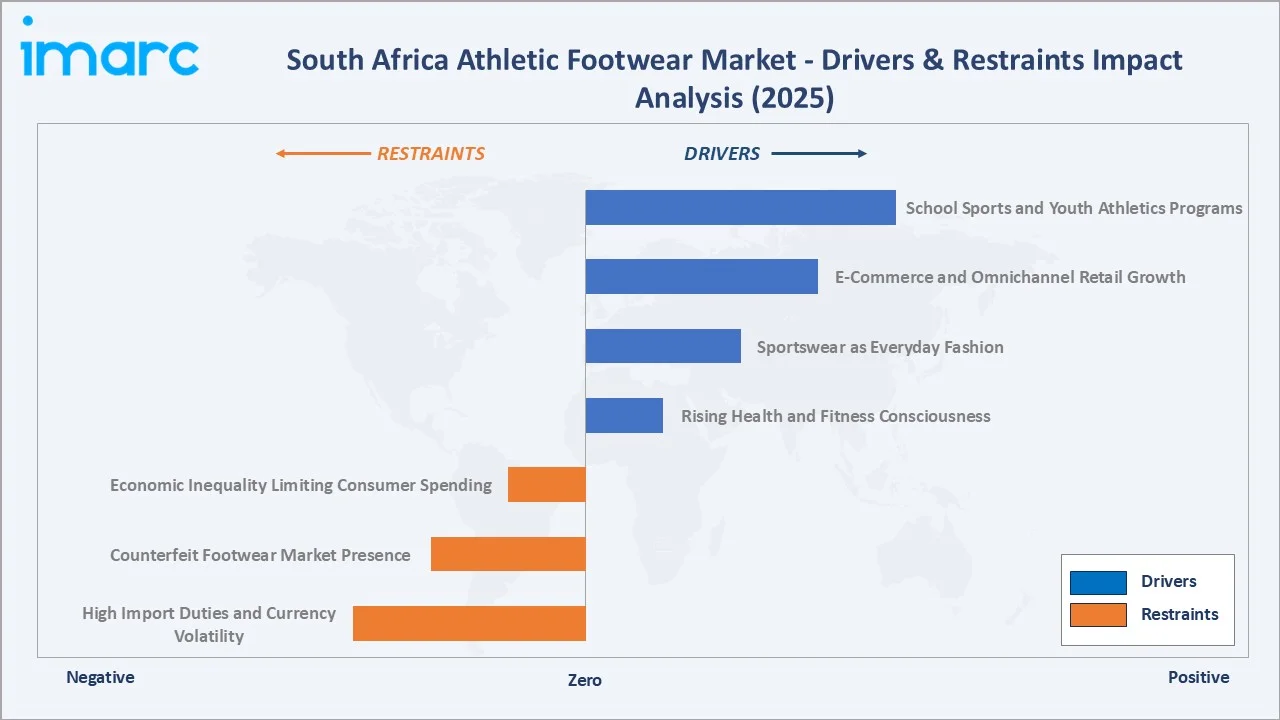
Market Drivers
- Rising Health and Fitness Consciousness: South Africa’s growing health and fitness culture, accelerated by post-pandemic wellness awareness, is driving sustained demand for athletic footwear across running, gym, and group fitness activities. The proliferation of parkrun events across South African cities and towns has created a structural, recurring demand driver for running shoes specifically.
- Sportswear as Everyday Fashion: The global athleisure trend has firmly taken root in South African consumer culture, with athletic footwear increasingly worn as everyday casual fashion rather than exclusively for sport and exercise. This shift has expanded the addressable market for athletic footwear brands beyond traditional sporting-goods consumers to include fashion-conscious buyers.
- E-Commerce and Omnichannel Retail Growth: The expansion of e-commerce platforms and omnichannel retail strategies is improving athletic footwear access across South Africa, particularly benefiting consumers outside the major metropolitan retail centers of Gauteng and Western Cape. Online platforms enable price comparison, broader size and style availability, and direct access to international brand drops.
- School Sports and Youth Athletics Programs: South Africa’s strong school sports culture, encompassing rugby, athletics, netball, and cricket programs across the public and private education systems, sustains structural demand for athletic footwear in the kids and youth end-user segment. Parents’ purchasing decisions for school sports footwear represent a recurring, less discretionary demand category that provides baseline market stability across economic cycles.
Market Restraints
- High Import Duties and Currency Volatility: South Africa’s athletic footwear market relies predominantly on imported products from Asian manufacturing hubs, exposing retail pricing to import duty structures and South African rand exchange rate volatility against the US dollar. Periods of significant rand depreciation increase the landed cost of imported athletic footwear, compressing affordability for price-sensitive consumer segments.
- Counterfeit Footwear Market Presence: South Africa’s informal retail sector, particularly in township markets and informal trading areas, supports a significant counterfeit athletic footwear trade that offers branded-appearing products at a fraction of authentic retail pricing. This counterfeit market diverts price-sensitive aspirational consumers from genuine branded purchases and creates ongoing brand protection and consumer education challenges.
- Economic Inequality Limiting Consumer Spending: South Africa’s structurally high income inequality, among the most pronounced globally, constrains athletic footwear market growth by limiting discretionary spending capacity across a large proportion of the population. Persistent unemployment, particularly among younger demographics, further restricts the addressable consumer base for premium branded athletic footwear.
Market Opportunities
- Township and Secondary Market Retail Expansion: South Africa’s township and secondary city markets remain significantly underserved by formal branded athletic footwear retail relative to their population scale, representing a substantial expansion opportunity for retailers willing to invest in appropriately priced product ranges and accessible store formats that match local purchasing power and demand patterns.
- Local Manufacturing and Import Substitution: Growing government and industry interest in revitalizing South Africa’s domestic footwear manufacturing base, historically concentrated in the Western Cape and KwaZulu-Natal, creates potential for local production partnerships that could reduce import cost exposure while supporting local economic development and employment objectives aligned with national industrial policy.
Market Challenges
- Retail Infrastructure Gaps Beyond Major Metros: Despite South Africa’s relatively developed retail sector by African standards, branded athletic footwear distribution remains heavily concentrated in Gauteng and Western Cape, with significant infrastructure and logistics gaps limiting formal retail access in Eastern Cape, Mpumalanga, and other secondary provinces that constrain market penetration outside established metropolitan centers.
- Load-Shedding and Operational Disruption: South Africa’s ongoing electricity supply challenges, commonly referred to as load-shedding, create operational disruptions for retailers and e-commerce logistics providers, complicating inventory management, point-of-sale operations, and last-mile delivery reliability that collectively add operational cost and complexity for athletic footwear retailers across the value chain.
Emerging Market Trends
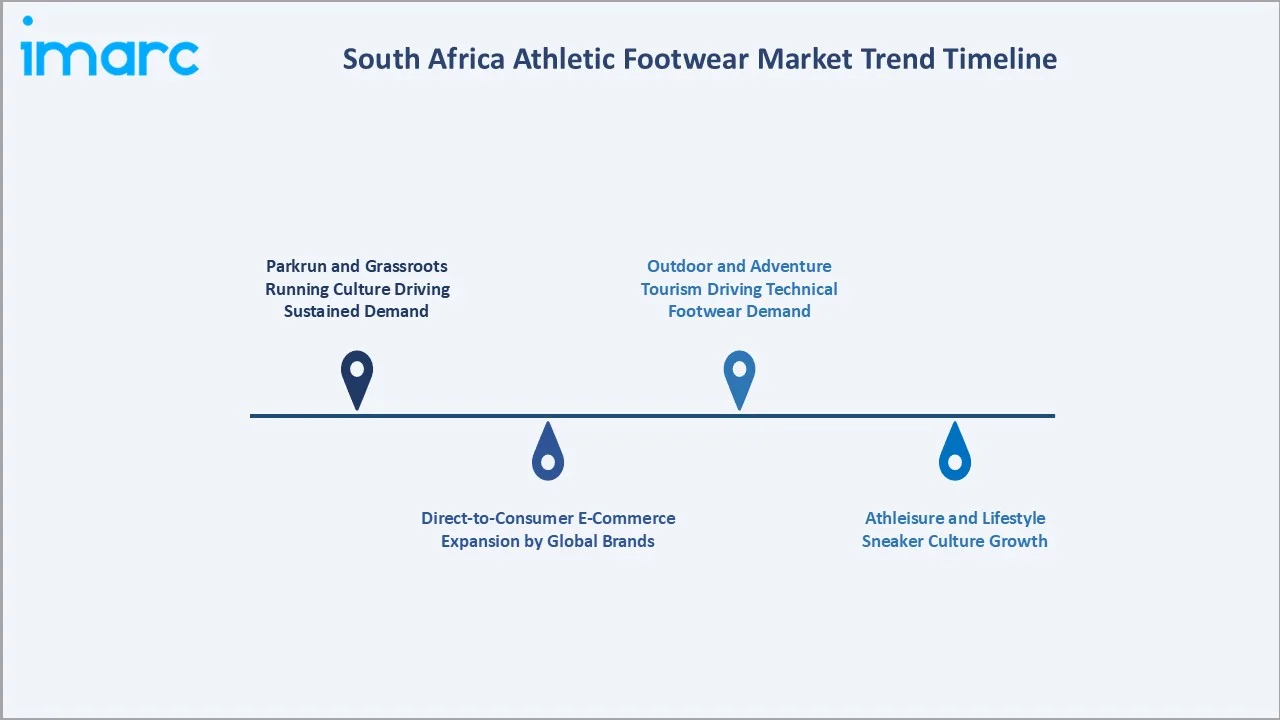
1. Parkrun and Grassroots Running Culture Driving Sustained Demand
South Africa’s parkrun movement, encompassing over 228 weekly free timed 5-kilometer events across the country, has become one of the most powerful grassroots drivers of running shoe demand in the South African athletic footwear market. The weekly recurring nature of parkrun participation normalizes running as an accessible, community-oriented fitness activity across age groups and fitness levels, creating durable replacement-cycle demand for running shoes.
2. Direct-to-Consumer E-Commerce Expansion by Global Brands
Global athletic footwear brands including Nike and Adidas are progressively expanding direct-to-consumer e-commerce capabilities in South Africa, reducing historical dependence on third-party retail distribution and enabling more precise inventory and pricing control. This shift is improving product availability for South African consumers, particularly for limited-edition releases and complete size ranges that were previously constrained by traditional wholesale retail allocation processes.
3. Athleisure and Lifestyle Sneaker Culture Growth
The cultural influence of global sneaker culture and athleisure fashion trends is increasingly visible in South African urban centers, particularly among younger consumers in Gauteng and the Western Cape, where limited-edition releases and collaboration footwear drops generate significant social media engagement and retail demand spikes. This trend is blurring traditional category boundaries between performance athletic footwear and fashion-oriented lifestyle sneakers, encouraging brands to develop crossover product lines.
4. Outdoor and Adventure Tourism Driving Technical Footwear Demand
South Africa’s growing domestic and international adventure tourism sector, encompassing hiking in the Drakensberg and Cederberg mountain ranges, multi-day trail experiences along the Garden Route, and Table Mountain National Park visitation, is driving demand for technical trekking and hiking footwear beyond the country’s traditional athletic footwear consumer base. This trend is supporting the trekking and hiking shoes segment’s growth and encouraging specialty outdoor retailers to expand their footwear assortments.
Industry Value Chain Analysis
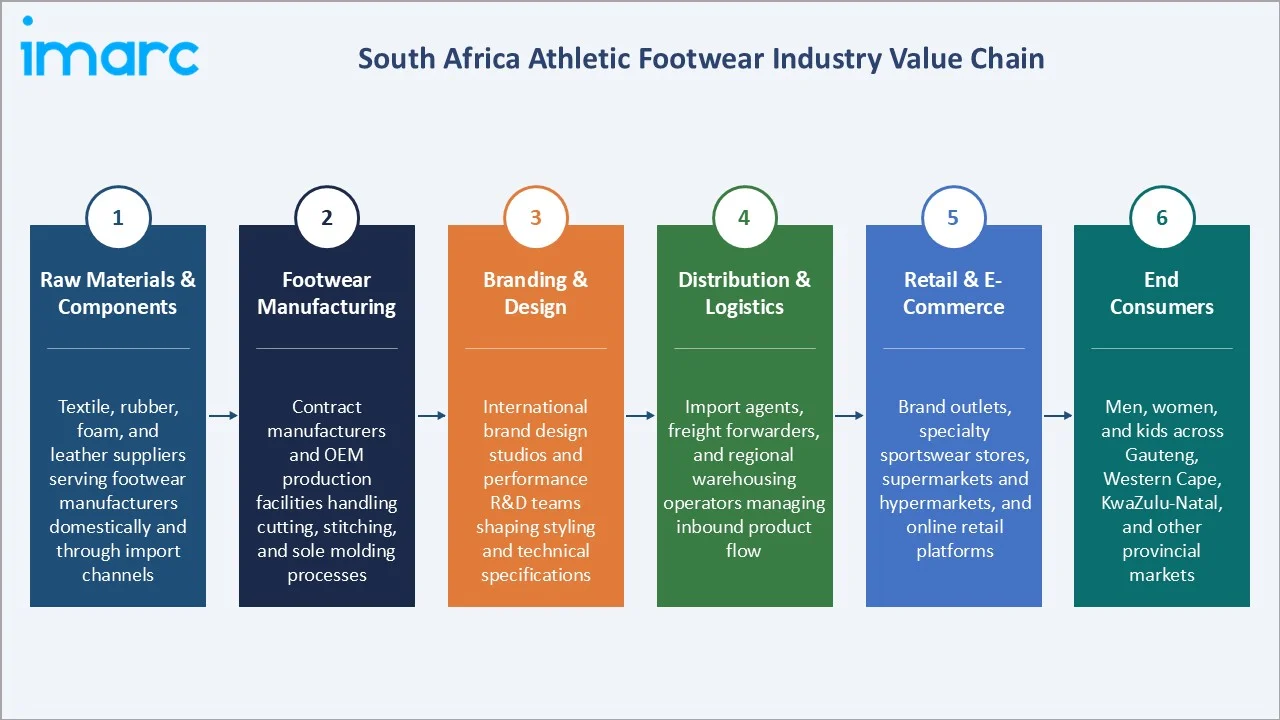
South Africa's athletic footwear value chain spans raw material sourcing through end-consumer retail, with each stage occupied by specialized suppliers, manufacturers, and distribution partners whose efficiency directly shapes product availability, pricing, and brand competitiveness nationwide.
|
Stage |
Key Players / Examples |
|
Raw Materials & Components |
Textile, rubber, foam, and leather suppliers serving footwear manufacturers domestically and through import channels |
|
Footwear Manufacturing |
Contract manufacturers and OEM production facilities handling cutting, stitching, and sole molding processes |
|
Branding & Design |
International brand design studios and performance R&D teams shaping styling and technical specifications |
|
Distribution & Logistics |
Import agents, freight forwarders, and regional warehousing operators managing inbound product flow |
|
Retail & E-Commerce |
Brand outlets, specialty sportswear stores, supermarkets and hypermarkets, and online retail platforms |
|
End Consumers |
Men, women, and kids across Gauteng, Western Cape, KwaZulu-Natal, and other provincial markets |
Technology Landscape in the South Africa Athletic Footwear Industry
Performance Cushioning and Midsole Technology
Advanced cushioning technologies including Nike’s React and ZoomX foam systems, Adidas’s Boost midsole technology, and ASICS’s GEL and FlyteFoam systems represent the core performance differentiation in South Africa’s premium running shoe segment. These proprietary foam and cushioning technologies have progressively migrated into mainstream retail product lines, becoming a key purchasing consideration for South Africa’s growing recreational running population.
Lightweight Mesh and Breathable Upper Construction
Engineered mesh upper construction technologies, including Nike’s Flyknit and Adidas’s Primeknit systems, are increasingly featured in South Africa’s mid-to-premium athletic footwear segment, offering lightweight, breathable, and adaptive fit characteristics suited to the country’s warm climate conditions across most provinces. These knit upper technologies reduce material waste in manufacturing while providing the sock-like fit and ventilation performance that South African consumers increasingly expect in both performance and lifestyle athletic footwear applications.
Sustainable Material Innovation
Athletic footwear brands operating in South Africa are progressively introducing sustainable material technologies including recycled polyester uppers, plant-based foam alternatives, and reduced-waste manufacturing processes in response to growing environmental consciousness among younger South African consumers. Adidas’s Parley Ocean Plastic collaboration and similar sustainability-focused product lines from competing brands are gaining visibility in South Africa’s premium retail channels.
Market Segmentation Analysis
The report covers the following segments:
|
Segment Category |
Leading Segment |
Market Share |
Year |
|
Product Type |
Running Shoes |
36.8% |
2025 |
|
End User |
Men |
42.3% |
2025 |
|
Distribution Channel |
🔒 |
🔒 |
2025 |
|
Province |
Gauteng |
39.2% |
2025 |

By Product Type
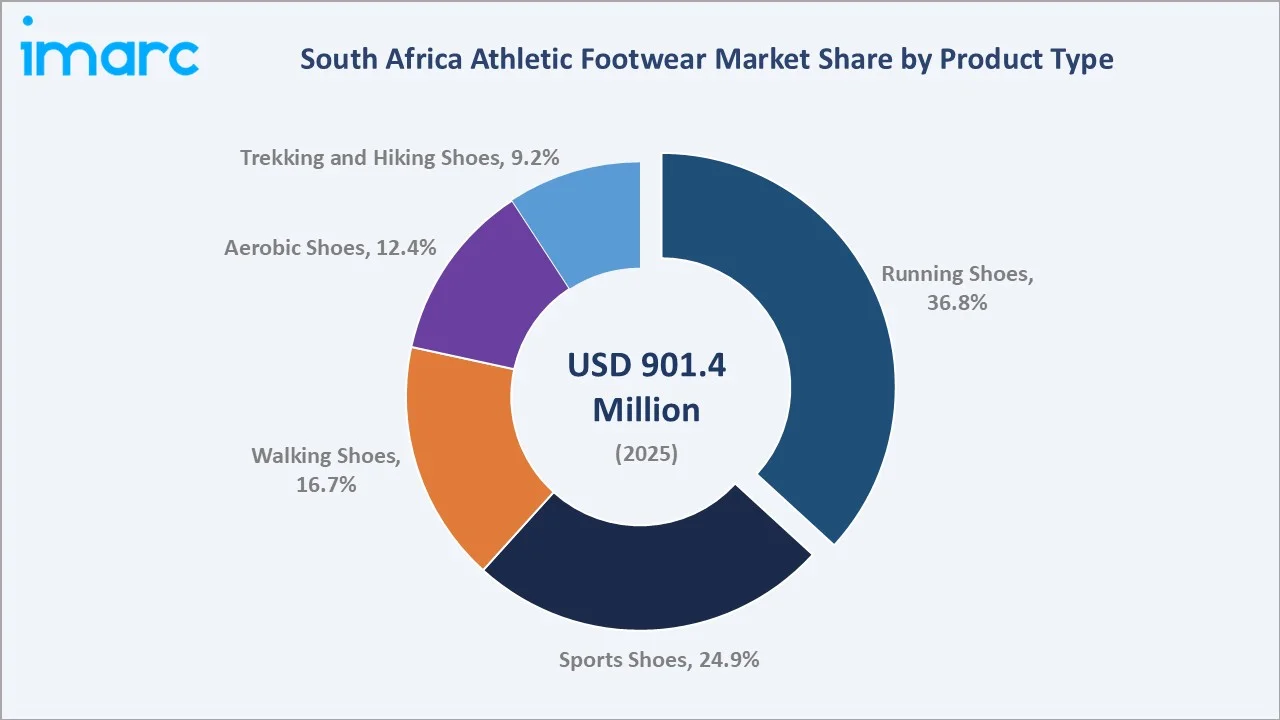
Running shoes lead the product type segment with a 36.8% share in 2025, driven by South Africa's expanding road-running and parkrun community across Gauteng and Western Cape. The segment benefits from frequent replacement cycles and strong brand loyalty among regular runners. Industry estimates suggest dedicated runners replace primary training shoes every 600-800 kilometers, translating into a purchase cycle of roughly six to nine months for active participants.
To access detailed market analysis, Request Sample
Sports shoes follow at 24.9%, supported by cross-functional gym and casual use, while walking shoes hold 16.7% on steady demand from older and health-conscious demographics. Aerobic shoes account for 12.4%, and trekking and hiking shoes represent 9.2%, anchored by the Western Cape's outdoor recreation culture and growing weekend hiking participation since 2023.
By End User
Men constitute the largest end-user segment at 42.3% in 2025, reflecting historically higher organized-sport participation and brand loyalty toward established athletic footwear labels across South Africa's metropolitan centers. Men's segment purchase frequency is estimated at 1.8-2.2 pairs annually among active fitness participants, modestly ahead of the broader population average.
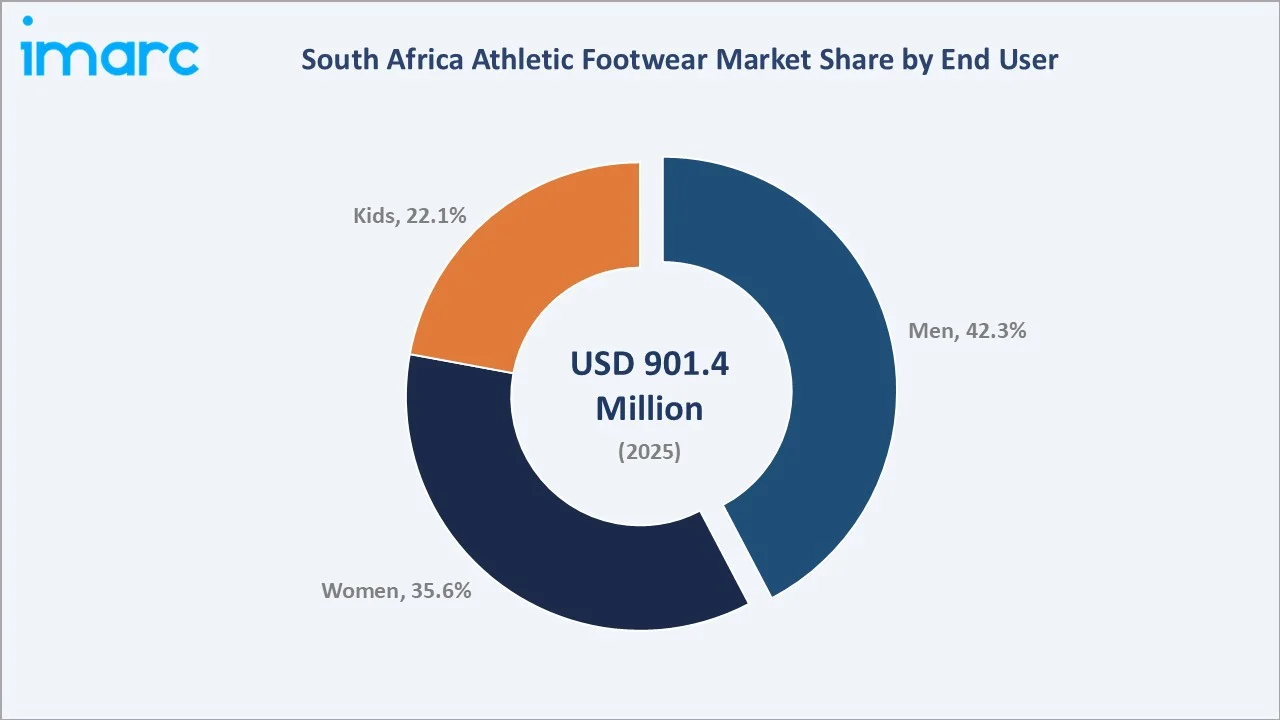
Women represent 35.6% of end-user demand, a share that is gradually expanding as targeted fitness apparel marketing and women-specific running events gain traction nationally. Kids account for 22.1%, sustained by school sports requirements and rising parental spending on children's athletic footwear.
Regional Market Insights
Gauteng's regional leadership at 39.2% in 2025 reflects Johannesburg and Pretoria's concentration of shopping malls, brand outlets, and a disposable income base above the national average, sustaining the province's dominant consumption position through 2034. Gauteng’s mid-year population estimate for 2025 stood at approximately 16.1 million, accounting for around 25.5% of South Africa’s total population, concentrating retail footfall at exceptionally high density.
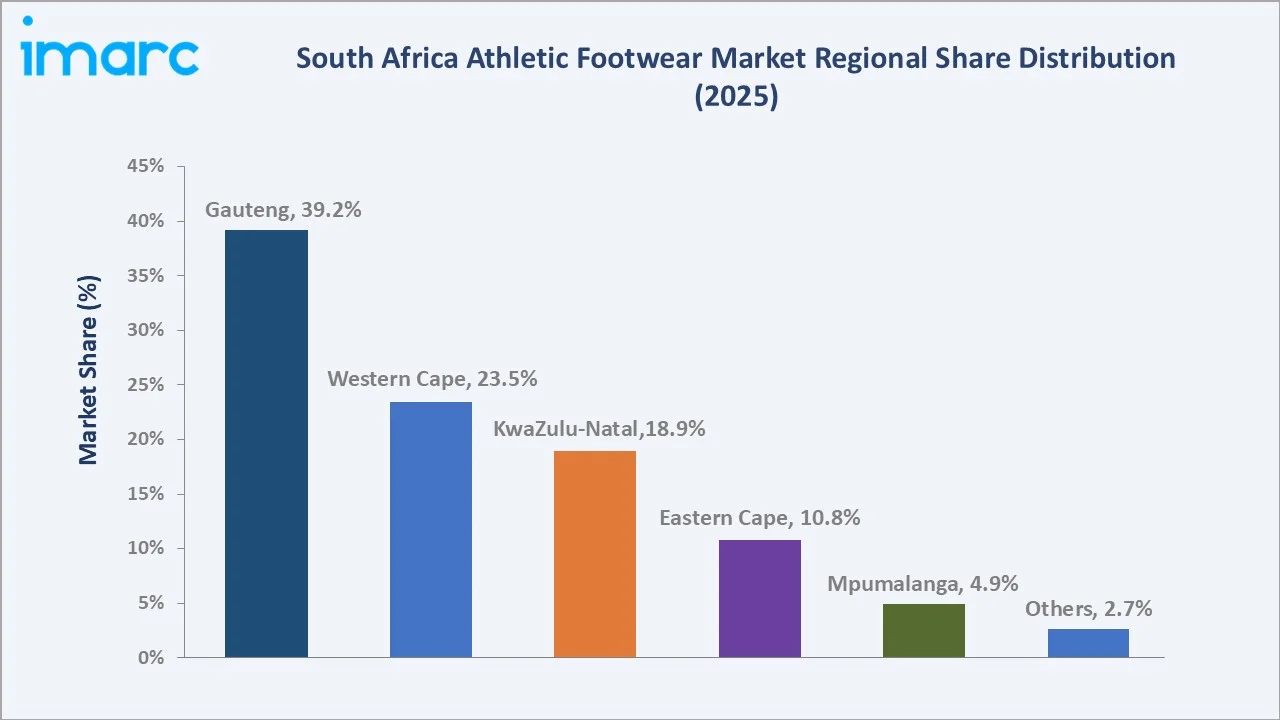
Western Cape's 23.5% share is the second largest, underpinned by Cape Town's outdoor recreation appeal, which sustains above-average demand for trekking and hiking shoes relative to other provinces. KwaZulu-Natal follows at 18.9%, supported by Durban's coastal lifestyle activities and rising e-commerce adoption among younger consumers.
|
Province |
Share (2025) |
Key Growth Drivers |
|
Gauteng |
39.2% |
Dense retail and mall infrastructure, highest disposable income concentration, and strong brand outlet presence |
|
Western Cape |
23.5% |
Strong outdoor and trekking culture in Cape Town, tourism-linked retail demand, and growing specialty sportswear store penetration |
|
KwaZulu-Natal |
18.9% |
Coastal lifestyle activities, expanding online retail adoption, and steady demand from Durban's growing fitness community |
|
Eastern Cape |
10.8% |
Emerging retail formalization, rising youth sneaker culture, and gradual expansion of specialty and brand outlet footprints |
|
Mpumalanga |
4.9% |
Growing urbanization, increasing gym membership uptake, and improving access to branded sportswear through regional retail expansion |
|
Others |
2.7% |
Smaller provincial markets with nascent retail infrastructure and gradually rising fitness and casual footwear adoption |
Competitive Landscape
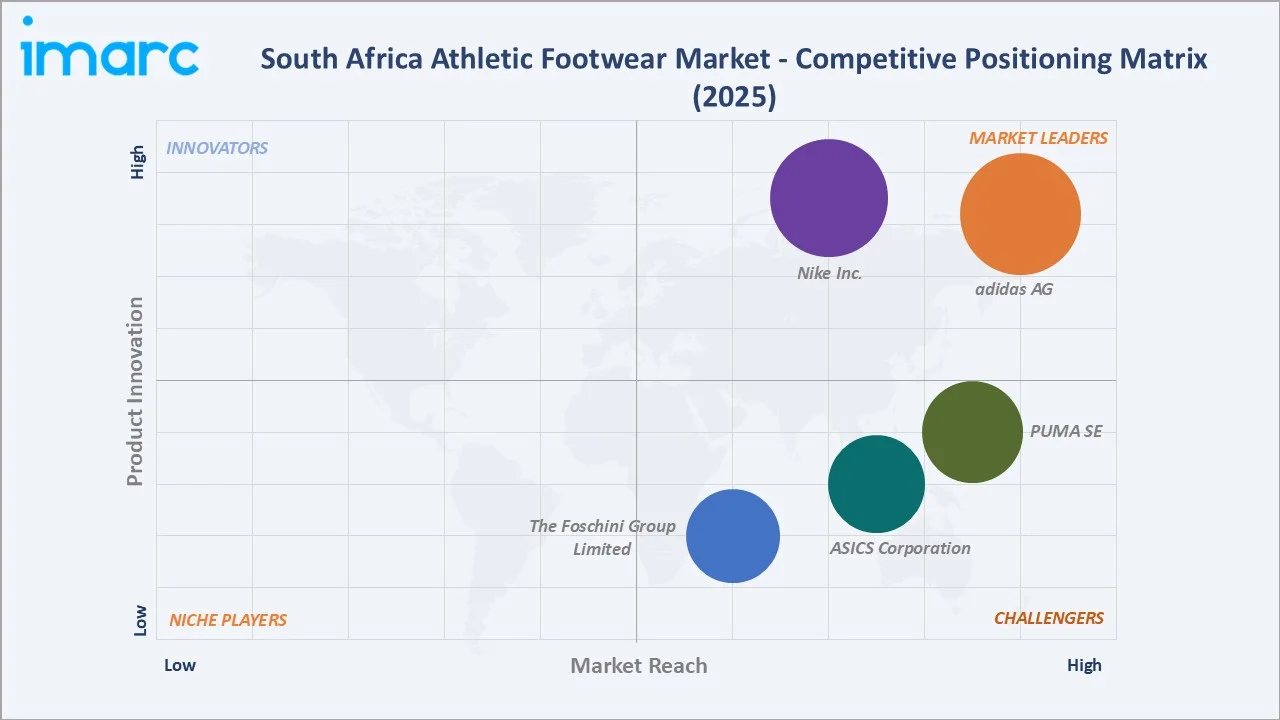
South Africa's athletic footwear market exhibits moderate concentration, with global brands and a leading domestic retail group jointly shaping competitive intensity. International players compete primarily on brand equity and performance innovation, while domestic retail groups compete on distribution depth and franchise partnerships.
|
Company Name |
Brand Name |
Market Position |
Core Strength |
|
adidas AG |
Adidas, Adidas Originals |
Market Leader |
Performance running technology; Originals lifestyle range; Terrex outdoor footwear |
|
Nike Inc. |
Nike, Jordan |
Market Leader |
Running and basketball-led innovation; strong digital and e-commerce distribution |
|
PUMA SE |
Puma |
Strong Challenger |
Football and lifestyle sponsorships; growing sneaker-culture relevance |
|
ASICS Corporation |
ASICS, Onitsuka Tiger |
Strong Challenger |
Running-focused biomechanical cushioning; loyal performance-runner base |
|
The Foschini Group Limited |
Sportscene, Total Sports, Sneaker Factory, JD Sports, among others |
Challenger |
Broadest multi-format retail footprint and franchise distribution depth |
Key Company Profiles
adidas AG
adidas AG is one of the global leaders in performance and lifestyle athletic footwear, maintaining strong brand presence across South Africa's specialty and brand-outlet retail channels.
- Product Portfolio: Ultraboost and Adizero running ranges, Adidas Originals lifestyle sneakers, and Terrex outdoor and trekking footwear.
- Recent Developments: In April 2026, adidas AG reported a strong Q1 2026, with currency-neutral revenues up 14% and net sales reaching EUR 6.6 billion. Operating profit rose 16% to EUR 705 million, supported by double-digit DTC growth across all markets and strong momentum in performance categories.
- Strategic Focus: Expanding direct-to-consumer retail presence and sustainability-linked product lines using recycled materials across emerging African markets.
Nike Inc.
Nike Inc. holds a leading position in South Africa's running and basketball-inspired lifestyle footwear categories through strong digital and retail partner distribution.
- Product Portfolio: Air Max and Pegasus running lines, Air Jordan lifestyle sneakers, and Nike Training cross-functional footwear.
- Recent Developments: In November 2025, Nike Inc. unveiled the Nike Mind recovery footwear range, with South Africa’s Springboks becoming the first rugby team to use the neuroscience-based shoes designed to enhance sensory awareness, mental focus, and post-game recovery.
- Strategic Focus: Strengthening e-commerce penetration and youth-targeted marketing aligned with South Africa's growing sneaker culture.
Market Concentration Analysis
South Africa’s athletic footwear market exhibits moderate-to-high concentration at the premium branded tier, with Nike Inc. and adidas AG collectively estimated to hold the largest market revenue, reflecting their superior retail distribution scale, sponsorship visibility, and brand equity built over decades of presence in the South African market. PUMA SE, ASICS Corporation, and The Foschini Group Limited compete for the remaining branded market share through differentiated positioning in football, performance running, and lifestyle categories, respectively.
Below the branded tier, a fragmented informal and counterfeit market serves price-sensitive consumer segments that the formal branded retail sector does not efficiently reach given South Africa’s significant income inequality. This bifurcated market structure is expected to persist through the forecast period, with formal branded market growth concentrated in metropolitan areas while counterfeit and value alternatives continue serving township and lower-income consumer segments.
Investment & Growth Opportunities
Fastest Growing Segments
Running shoes and sports shoes, holding a combined 61.7% share in 2025, are expected to remain the primary volume drivers through 2034 as fitness participation and casual sneaker adoption continue expanding across metropolitan provinces. Within this combined segment, running shoes alone are estimated to outpace the overall market CAGR by 0.5-0.8 percentage points through the forecast period.
Emerging Market Expansion
Eastern Cape and Mpumalanga, together accounting for 15.7% of 2025 market share, represent incremental growth opportunities as retail infrastructure and brand outlet penetration deepen beyond the established Gauteng and Western Cape hubs. Secondary cities such as Gqeberha, Nelspruit, and Polokwane are each seeing new mall developments that are expected to introduce additional branded sportswear floor space over the coming years.
Venture and Institutional Investment Trends
- International franchise expansion, led by TFG's JD Sports Fashion partnership, is channeling fresh retail investment into South Africa's sportswear distribution network through 2029.
- Sustainability-linked product investment is rising as brands respond to growing consumer demand for locally produced and environmentally responsible footwear lines.
- Shopping Centre developers are allocating an increasing share of new retail gross leasable area to sportswear and lifestyle tenants, reflecting category performance that has outpaced several other apparel segments since 2023.
Future Market Outlook (2026-2034)
South Africa's athletic footwear market is positioned for steady, moderate-paced expansion through 2034. From a base of USD 901.4 Million in 2025, the market is projected to reach USD 1,102.7 Million by 2034, representing incremental value creation of USD 201.3 Million at a CAGR of 2.15%. This trajectory implies the market will have grown by approximately 36% in cumulative value terms across the full 2020-2034 window, from USD 810.4 Million to USD 1,102.7 Million.
Running shoes and sports shoes are expected to retain their combined leadership position, while women's and kids' end-user segments are likely to gain incremental share as targeted marketing and school sports participation sustain broader demographic engagement nationally. By 2034, women's end-user share could approach 38-39% of total demand, narrowing the current gap with the men's segment by roughly two to three percentage points.
Research Methodology
Primary Research
Primary research comprised structured interviews with retail executives, brand distributors, and athletic footwear category specialists across South Africa's major metropolitan provinces, validating market sizing and segment-level demand patterns.
Secondary Research
Secondary research encompassed retailer financial disclosures, South African trade and import data, industry association publications, and international footwear brand reports covering the 2020-2025 historical period.
Forecasting Models
Market size estimations were derived using top-down and bottom-up forecasting, incorporating historical sales trends, retail expansion plans, and provincial demographic data, validated against a base-case CAGR of 2.15% for 2026-2034.
South Africa Athletic Footwear Market Report Coverage:
| Report Features | Details |
|---|---|
| Base Year of the Analysis | 2025 |
| Historical Period | 2020-2025 |
| Forecast Period | 2026-2034 |
| Units | Million USD |
| Scope of the Report |
Exploration of Historical Trends and Market Outlook, Industry Catalysts and Challenges, Segment-Wise Historical and Future Market Assessment:
|
| Product Types Covered | Aerobic Shoes, Running Shoes, Walking Shoes, Trekking and Hiking Shoes, Sports Shoes |
| Distribution Channels Covered | Supermarkets and Hypermarkets, Specialty Stores, Brand Outlets, Online Channels |
| End Users Covered | Men, Women, Kids |
| Regions Covered | Gauteng, KwaZulu-Natal, Western Cape, Mpumalanga, Eastern Cape, Others |
| Companies Covered | adidas AG, Nike Inc., PUMA SE, ASICS Corporation, The Foschini Group Limited, etc. |
| Customization Scope | 10% Free Customization |
| Post-Sale Analyst Support | 10-12 Weeks |
| Delivery Format | PDF and Excel through Email (We can also provide the editable version of the report in PPT/Word format on special request) |
Key Benefits for Stakeholders:
- IMARC’s industry report offers a comprehensive quantitative analysis of various market segments, historical and current market trends, market forecasts, and dynamics of the South Africa athletic footwear market from 2020-2034.
- The research report provides the latest information on the market drivers, challenges, and opportunities in the South Africa athletic footwear market.
- Porter's five forces analysis assist stakeholders in assessing the impact of new entrants, competitive rivalry, supplier power, buyer power, and the threat of substitution. It helps stakeholders to analyze the level of competition within the South Africa athletic footwear industry and its attractiveness.
- Competitive landscape allows stakeholders to understand their competitive environment and provides an insight into the current positions of key players in the market.
Frequently Asked Questions About the South Africa Athletic Footwear Market Report
The South Africa athletic footwear market reached USD 901.4 Million in 2025 and is projected to reach USD 1,102.7 Million by 2034.
The market is expected to grow at a CAGR of 2.15% during 2026-2034, driven by fitness participation and retail expansion.
Running shoes dominate with a 36.8% share in 2025, supported by South Africa's expanding road-running culture.
Men hold the largest end-user share at 42.3% in 2025, followed by women at 35.6% and kids at 22.1%.
Gauteng leads with a 39.2% share in 2025, anchored by Johannesburg and Pretoria's dense retail infrastructure.
Some of the key players include adidas AG, Nike Inc., PUMA SE, ASICS Corporation, and The Foschini Group Limited.
Rising health consciousness, sneaker-led streetwear culture, and expanding franchise retail networks are key growth drivers.
Currency volatility, import dependency, counterfeit penetration, and constrained discretionary spending pose key challenges.
Sustainable, locally manufactured footwear and expansion into underserved provinces like the Eastern Cape present key opportunities.
Need more help?
- Speak to our experienced analysts for insights on the current market scenarios.
- Include additional segments and countries to customize the report as per your requirement.
- Gain an unparalleled competitive advantage in your domain by understanding how to utilize the report and positively impacting your operations and revenue.
- For further assistance, please connect with our analysts.
 Request Customization
 Speak to an Analyst
 Request Brochure
 Inquire Before Buying
Benefits of Customization
- Personalize this research
- Triangulate with your data
- Get data as per your format and definition
- Gain a deeper dive into a specific application, geography, customer, or competitor
- Any level of personalization
Get in Touch With Us
UNITED STATES
Phone: +1-201-971-6302
INDIA
Phone: +91-120-433-0800
UNITED KINGDOM
Phone: +44-753-714-6104
Email: [email protected]
Client Testimonials




.webp)




.webp)













Related Reports

Choose your plan
*Please note that the prices mentioned below are starting prices for each bundle type. Kindly contact our team for further details.*
Single User License
- 1 User License, Access on 2 Devices
- PDF Report + Excel Dataset (Password Protected)
- Lifetime Access
- No Printing Rights
- 10% Free Report Customization
- 10–12 Weeks of Analyst Support
Five User License
- Access for 5 Users, 2 Devices per User
- PDF Report + Excel Dataset (Password Protected)
- Lifetime Access
- Dedicated Account Manager
- 12–14 Weeks of Analyst Support
- No Printing Rights
- 15% Free Report Customization
- 25% Discount on Your Next Purchase
Corporate User License
- Unlimited User Access (Within Your Organization)
- PDF Report + Excel Dataset
- Lifetime Access
- Dedicated Account Manager
- 14–20 Weeks of Analyst Support
- No Printing Rights
- 20% Free Report Customization
- 30% Discount on Your Next Purchase
Essential Insights
What's included:
3 reports
- Lifetime Access
- PDF Reports
- Excel Datasets
- 2 Weeks of Free Analyst Support
- 2 User Licenses
- Access on 2 Devices
- Printing Rights
- Complimentary PowerPoint (PPT) Version
- Complimentary License Upgrade
Professional Access
What's included:
5 reports
- Lifetime Access
- PDF Reports
- Excel Datasets
- 8 Weeks of Free Analyst Support
- 2 User Licenses
- Access on 2 Devices
- Printing Rights
- Complimentary PowerPoint (PPT) Version
- Complimentary License Upgrade
Business Advantage
What's included:
8 reports
- Lifetime Access
- PDF Reports
- Excel Datasets
- 14 Weeks of Free Analyst Support
- 2 User Licenses
- Access on 2 Devices
- Printing Rights
- Complimentary PowerPoint (PPT) Version
- Complimentary License Upgrade
Enterprise Intelligence
What's included:
10 reports
- Lifetime Access
- PDF Reports
- Excel Datasets
- 20 Weeks of Free Analyst Support
- 2 User Licenses
- Access on 2 Devices
- Printing Rights
- Complimentary PowerPoint (PPT) Version
- Complimentary License Upgrade