
South Africa Defoamers Market Size, Share, Trends and Forecast by Medium of Dispersion, Product, Application, and Province, 2026-2034
South Africa Defoamers Market Summary:
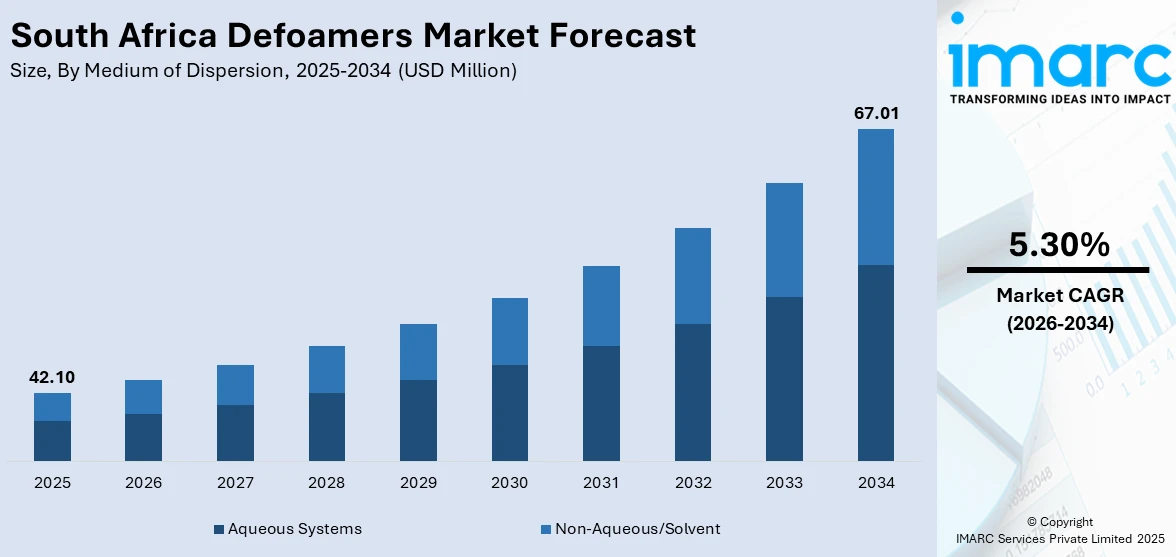
The South Africa defoamers market size was valued at USD 42.10 Million in 2025 and is projected to reach USD 67.01 Million by 2034, growing at a compound annual growth rate of 5.30% from 2026-2034.
The South Africa defoamers market is experiencing steady expansion, driven by robust demand from the pulp and paper industry, water treatment facilities, and the paints and coatings sector. Industrial manufacturing activities, concentrated in Gauteng and KwaZulu-Natal provinces, are generating consistent consumption of foam control agents across diverse applications. The market benefits from growing infrastructure investments, increasing regulatory emphasis on wastewater treatment quality, and the expansion of sustainable packaging production requiring efficient process chemicals.
Key Takeaways and Insights:
- By Medium of Dispersion: Aqueous systems dominate the market with a share of 66% in 2025, due to the extensive utilization in water-based industrial processes, pulp manufacturing operations, and wastewater treatment applications. Compatibility with environmentally conscious formulations is further accelerating the segment expansion.
- By Product: Water-based leads the market with a share of 38% in 2025. This dominance is driven by stringent environmental regulations promoting low-volatile organic compound (VOC) formulations, sustainable manufacturing practices, and the increasing preference for eco-friendly chemical solutions across various industries.
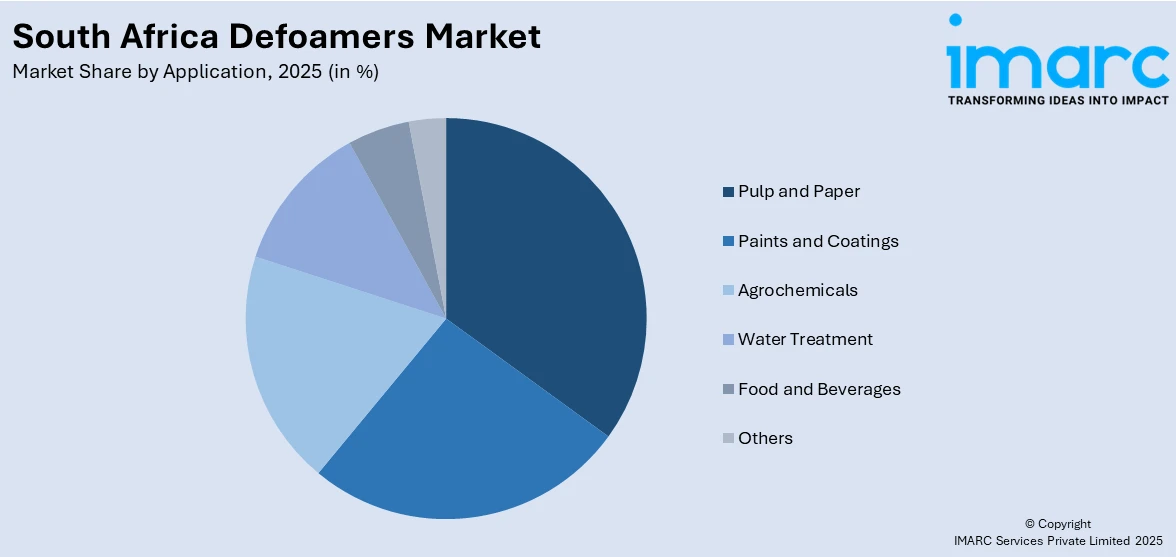
- By Application: Pulp and paper comprise the largest segment with a market share of 25% in 2025, reflecting the critical role of defoamers in maintaining production efficiency, ensuring paper quality, and optimizing manufacturing processes throughout the country's substantial paper industry operations.
- By Province: Gauteng represents the largest province with 30% share in 2025, driven by the concentration of chemical manufacturing facilities, industrial operations, and significant presence of end-use industries in the Johannesburg-Pretoria metropolitan corridor.
- Key Players: Key players drive the South Africa defoamers market by expanding product portfolios, developing sustainable formulations, and strengthening distribution networks. Their investments in eco-friendly technologies, strategic partnerships with local manufacturers, and customized solutions for regional industries boost market penetration and ensure consistent product availability.
To get more information on this market Request Sample
The South Africa defoamers market is witnessing transformative growth, as the industrial sector increasingly prioritizes process optimization and environmental compliance. The thriving pulp and paper sector represents a substantial consumer base for foam control solutions. The pulp and paper industry in South Africa added approximately R50 Billion to the national economy by producing pulp, paper, board, and tissue products in 2024. The industry was a significant factor in the nation's trade balance, contributing approximately R11 Billion in 2024, according to Pamsa. The paints and coatings industry continues to drive the demand for high-performance defoamers in architectural and industrial coating formulations. Manufacturing facilities are increasingly adopting water-based defoamers to meet stringent VOC emission regulations while maintaining production efficiency. The shift towards sustainable chemical solutions, combined with technological advancements in biodegradable defoamer formulations, positions the market favorably for sustained growth during the forecast period.
South Africa Defoamers Market Trends:
Rising Adoption of Eco-Friendly Formulations
The South Africa defoamers market is experiencing a significant shift towards environmentally sustainable products, as manufacturers respond to regulatory pressures and consumer preferences for green chemicals. Water-based and silicone-free defoamers are gaining substantial traction across industrial applications, driven by stringent VOC emission standards and corporate sustainability commitments. Chemical manufacturers are investing in bio-based formulations and biodegradable alternatives that deliver comparable performance while minimizing environmental impact. This trend aligns with broader sustainability initiatives across South African industries seeking to reduce their ecological footprint while maintaining operational efficiency.
Expansion of Water Treatment Infrastructure
Government investments in water and wastewater treatment infrastructure are creating substantial demand for defoaming agents across municipal and industrial applications. As outlined in the 2025 State of the Nation Address (SONA), the government pledged R23 Billion for seven major water projects, which featured the Lesotho Highlands Phase 2 Polihali Dam. This initiative, projected to contribute 490 Million cubic meters of water annually to the Vaal River system, would aid in meeting some of the increasing water needs of the nation. These infrastructure developments require efficient foam control solutions to ensure optimal treatment plant performance and regulatory compliance. The expansion of membrane bioreactor systems and advanced treatment technologies further drives demand for specialized defoamers designed for modern water treatment processes.
Growth of E-Commerce and Digital Distribution Channels
The expansion of e-commerce and digital distribution platforms is emerging as an important driver for the South Africa defoamers market. As per IMARC Group, the South Africa e-commerce market size reached USD 187.60 Billion in 2024. Online procurement channels are improving product accessibility for small and mid-sized industrial users, enabling faster comparison of formulations, performance attributes, and pricing. Chemical suppliers are increasingly leveraging e-commerce platforms to reach a broader customer base across remote and underserved regions. Digital sales channels also support efficient inventory management, shorter delivery timelines, and better demand forecasting. As industrial buyers adopt online purchasing models for specialty chemicals, defoamer manufacturers benefit from improved market penetration, stronger customer engagement, and streamlined distribution networks across South Africa.
Market Outlook 2026-2034:
The South Africa defoamers market outlook remains positive, underpinned by expanding industrial manufacturing activities, increasing water treatment investments, and growing demand for sustainable chemical solutions. The market generated a revenue of USD 42.10 Million in 2025 and is projected to reach a revenue of USD 67.01 Million by 2034, growing at a compound annual growth rate of 5.30% from 2026-2034. The continued expansion of the pulp and paper industry, combined with government infrastructure programs targeting water quality improvements, will drive sustained demand for foam control agents. Technological advancements in eco-friendly defoamer formulations and increasing adoption of water-based products across paints, coatings, and industrial applications are expected to shape market dynamics.
South Africa Defoamers Market Report Segmentation:
|
Segment Category |
Leading Segment |
Market Share |
|
Medium of Dispersion |
Aqueous Systems |
66% |
|
Product |
Water-based |
38% |
|
Application |
Pulp and Paper |
25% |
|
Province |
Gauteng |
30% |
Medium of Dispersion Insights:
- Aqueous Systems
- Non-Aqueous/Solvent
Aqueous systems dominate with a market share of 66% of the total South Africa defoamers market in 2025.
Aqueous systems lead the South Africa defoamers market due to their superior compatibility with water-based industrial processes prevalent across the manufacturing sector. These formulations are extensively utilized in pulp and paper manufacturing, where 1.2 Million Tons of paper products were recycled in 2024, requiring consistent foam control during processing operations. The water treatment sector also relies heavily on aqueous defoamers for efficient treatment plant operations. Their versatility across multiple end-use industries supports stable, large-volume consumption patterns.
The environmental advantages of aqueous systems align with South Africa's regulatory framework emphasizing reduced VOC emissions and sustainable chemical usage. Industrial manufacturers prefer these defoamers for their ease of handling, reduced toxicity profiles, and compatibility with automated dosing systems. The growing adoption of membrane bioreactor technologies in wastewater treatment further drives demand for specialized aqueous defoamer formulations designed for advanced treatment processes. This reinforces long-term preference for aqueous systems over solvent-based alternatives.
Product Insights:
- Water-based
- Oil-based
- Silicone-based
- Others
Water-based leads with a share of 38% of the total South Africa defoamers market in 2025.
Water-based dominates the product segment in the market, due to its eco-friendly characteristics and compliance with increasingly stringent environmental regulations governing industrial emissions. The South Africa paints and coatings market, valued at USD 1.30 Billion in 2024, has embraced water-based formulations to meet VOC reduction requirements while maintaining product performance standards. Manufacturers are prioritizing these defoamers for their non-toxic properties, ease of cleanup, and compatibility with sustainable production processes.
The silicone-free defoamer industry reflects the broader industry shift towards water-based alternatives that South African manufacturers are embracing. Food processing applications, pharmaceutical manufacturing, and textile industries increasingly specify water-based defoamers to ensure product safety and regulatory compliance. The biodegradable nature of these formulations supports circular economy initiatives and aligns with corporate sustainability objectives across diverse industrial sectors. Consistent regulatory oversight continues to reinforce user preference for these formulations.
Application Insights:
Access the comprehensive market breakdown Request Sample
- Pulp and Paper
- Paints and Coatings
- Agrochemicals
- Water Treatment
- Food and Beverages
- Others
Pulp and paper exhibit a clear dominance with a 25% share of the total South Africa defoamers market in 2025.
The pulp and paper industry represents the largest application segment, driven by South Africa's substantial paper manufacturing sector. In order to avoid foam-related quality flaws and preserve production efficiency, defoamers are employed during the pulping, washing, screening, and papermaking processes. The demand for corrugated boxes and recyclable paper goods is rising due to the shift towards sustainable packaging and the expansion of e-commerce, which is increasing the need for defoamer in manufacturing facilities. The production capacity and sustainability initiatives that major industry players continue to invest in have a direct impact on the consumption patterns of foam control chemicals.
As producers concentrate on minimizing downtime, lowering fiber losses, and enhancing machine runnability, rising operational efficiency requirements within pulp and paper mills are further bolstering defoamer demand. Advanced high-speed paper machines and closed-loop water systems enhance foam creation concerns, making regular defoamer usage necessary. Additionally, mills are being encouraged to implement more efficient foam control techniques due to tighter quality standards for paper brightness, surface polish, and printability. The increasing use of recycled fiber in paper production is also contributing to higher foam formation, further supporting sustained defoamer consumption.
Province Insights:
- Gauteng
- KwaZulu-Natal
- Western Cape
- Mpumalanga
- Eastern Cape
- Others
Gauteng represents the leading province with a 30% share of the total South Africa defoamers market in 2025.
Gauteng dominates the defoamers market due to its position as South Africa's industrial and manufacturing heartland. Leading chemical distributors' corporate headquarters, industrial activities, and significant manufacturing facilities are located in the Johannesburg-Pretoria metropolitan area. Key businesses continue to have a sizable operational presence in Gauteng, promoting the local distribution and consumption of defoaming agents for a variety of uses. The province's concentrated manufacturing sector generates strong demand for coatings defoamers. Strong research and development (R&D) capacities in the area also facilitate the quicker implementation of cutting-edge defoamer formulations.
Gauteng’s dominance is further reinforced by its well-developed infrastructure, including logistics networks, warehousing hubs, and access to skilled technical labor, which support efficient production and supply of specialty chemicals like defoamers. Proximity to major end-use industries, such as paints and coatings, construction materials, water treatment, and food processing, ensures steady and diversified demand. Additionally, ongoing urban development and industrial expansion in Gauteng continue to create consistent consumption opportunities, strengthening its role as the primary growth engine for the South Africa defoamers market.

Market Dynamics:
Growth Drivers:
Why is the South Africa Defoamers Market Growing?
Expanding Water and Wastewater Treatment Infrastructure
The South Africa defoamers market is experiencing robust growth, driven by substantial government investments in water and wastewater treatment infrastructure development. Municipal wastewater treatment facilities require defoamers throughout various treatment stages to ensure regulatory compliance and operational efficiency. Infrastructure projects targeting aging facilities and capacity expansion are generating long-term demand growth across the water treatment application segment. In addition, rising urbanization and population growth are increasing wastewater volumes, intensifying the need for effective foam control solutions in treatment plants. As per worldometer, the population of South Africa in 2026 is projected to be 65,453,084 individuals by mid-year. Stricter environmental regulations related to effluent quality and discharge standards are also compelling operators to adopt reliable defoamers to maintain stable treatment processes. The growing adoption of advanced treatment technologies, such as membrane bioreactors and biological nutrient removal systems, further elevates foam formation risks.
Growth of Pulp, Paper, and Sustainable Packaging Industries
The pulp and paper sector represents a primary growth driver for the South Africa defoamers market. The global shift away from single-use plastic packaging toward sustainable fiber-based alternatives is accelerating paper production requirements and corresponding defoamer consumption. The expansion of e-commerce and food delivery services continues to drive the demand for corrugated boxes and recyclable packaging materials. This trend is encouraging paper manufacturers to increase output levels, placing greater emphasis on stable and efficient production processes. Higher machine speeds, increased recycled fiber usage, and tighter quality specifications are contributing to elevated foam generation across pulping and papermaking stages. As a result, defoamers play a critical role in controlling foam-related defects, improving drainage, and maintaining sheet quality. Ongoing investments in mill upgrades and capacity expansions across South Africa are further supporting sustained defoamer demand, reinforcing the sector’s importance as a long-term growth catalyst.
Increasing Demand for Paints, Coatings, and Industrial Applications
The South Africa paints and coatings industry represents a significant demand driver for defoamers across architectural and industrial applications. Construction activities, infrastructure development, and automotive manufacturing are fueling consumption of coating products that require effective foam control during production and application. The thriving automotive sector demands high-performance defoamers for original equipment manufacturer coating processes. As per IMARC Group, the South Africa automotive market size reached USD 14.47 Billion in 2024. Environmental regulations emphasizing low-VOC formulations are driving adoption of water-based paints and coatings that rely on compatible defoamer technologies. Industrial manufacturers are increasingly specifying eco-friendly defoamers to meet sustainability objectives while maintaining coating quality and production efficiency. The growing popularity of green coating resins and sustainable formulations further strengthens demand for advanced foam control solutions across the coatings value chain.
Market Restraints:
What Challenges the South Africa Defoamers Market is Facing?
Raw Material Price Volatility and Supply Chain Disruptions
The South Africa defoamers market faces significant challenges from fluctuating raw material prices and global supply chain uncertainties affecting production costs. The industry's dependence on imported specialty chemicals and petroleum-derived feedstocks exposes manufacturers to international commodity price volatility and currency exchange fluctuations. Supply chain disruptions can delay production schedules and increase operational costs for defoamer manufacturers serving local industries.
Stringent Environmental Regulations and Compliance Requirements
Increasingly stringent environmental regulations governing chemical formulations and industrial emissions pose challenges for traditional defoamer products in the South Africa market. Manufacturers must continuously invest in R&D activities to create compliant formulations while maintaining cost competitiveness and performance standards. The regulatory complexity adds to product development timelines and certification costs.
Infrastructure and Energy Supply Constraints
South Africa's ongoing energy challenges present operational obstacles for both defoamer manufacturers and end-use industries. Power supply instability increases production costs, disrupts manufacturing schedules, and affects the consistent operation of industrial processes requiring foam control solutions across various sectors. Frequent load-shedding also forces plants to rely on costly backup power solutions, further compressing margins and limiting operational efficiency across the defoamers value chain.
Competitive Landscape:
The South Africa defoamers market exhibits a moderately consolidated competitive structure, characterized by the presence of multinational chemical corporations and regional specialty chemical distributors. Leading global players maintain strong market positions through established distribution networks, technical support capabilities, and diverse product portfolios serving multiple industrial applications. Local chemical manufacturers and distributors complement the competitive landscape by providing regionally tailored solutions and responsive customer service. Market participants are increasingly focusing on sustainable product development, with emphasis on bio-based formulations and environmentally compliant alternatives that address evolving regulatory requirements and customer preferences for green chemistry solutions.
South Africa Defoamers Market Report Coverage:
| Report Features | Details |
|---|---|
| Base Year of the Analysis | 2025 |
| Historical Period | 2020-2025 |
| Forecast Period | 2026-2034 |
| Units | Million USD |
| Scope of the Report |
Exploration of Historical Trends and Market Outlook, Industry Catalysts and Challenges, Segment-Wise Historical and Future Market Assessment:
|
| Medium of Dispersions Covered | Aqueous Systems, Non-Aqueous/Solvent |
| Products Covered | Water-based, Oil-based, Silicone-based, Others |
| Applications Covered | Pulp and Paper, Paints and Coatings, Agrochemicals, Water Treatment, Food and Beverages, Others |
| Provinces Covered | Gauteng, KwaZulu-Natal, Western Cape, Mpumalanga, Eastern Cape, Others |
| Customization Scope | 10% Free Customization |
| Post-Sale Analyst Support | 10-12 Weeks |
| Delivery Format | PDF and Excel through Email (We can also provide the editable version of the report in PPT/Word format on special request) |
Frequently Asked Questions About the South Africa Defoamers Market Report
The South Africa defoamers market size was valued at USD 42.10 Million in 2025.
The South Africa defoamers market is expected to grow at a compound annual growth rate of 5.30% from 2026-2034 to reach USD 67.01 Million by 2034.
Aqueous systems dominated the market with a share of 66%, driven by extensive adoption in water-based industrial processes, pulp manufacturing, and wastewater treatment applications across South African industries.
Key factors driving the South Africa defoamers market include expanding water treatment infrastructure investments, growth of the pulp and paper industry driven by sustainable packaging demand, and increasing consumption in the paints and coatings sector.
Major challenges include raw material price volatility and supply chain disruptions, stringent environmental regulations requiring compliant formulations, infrastructure constraints including energy supply instability, and increasing competition from sustainable alternatives.
Need more help?
- Speak to our experienced analysts for insights on the current market scenarios.
- Include additional segments and countries to customize the report as per your requirement.
- Gain an unparalleled competitive advantage in your domain by understanding how to utilize the report and positively impacting your operations and revenue.
- For further assistance, please connect with our analysts.
 Request Customization
 Speak to an Analyst
 Request Brochure
 Inquire Before Buying
Benefits of Customization
- Personalize this research
- Triangulate with your data
- Get data as per your format and definition
- Gain a deeper dive into a specific application, geography, customer, or competitor
- Any level of personalization
Get in Touch With Us
UNITED STATES
Phone: +1-201-971-6302
INDIA
Phone: +91-120-433-0800
UNITED KINGDOM
Phone: +44-753-714-6104
Email: [email protected]
Client Testimonials




.webp)




.webp)













Related Reports

Choose your plan
*Please note that the prices mentioned below are starting prices for each bundle type. Kindly contact our team for further details.*
Single User License
- 1 User License, Access on 2 Devices
- PDF Report + Excel Dataset (Password Protected)
- Lifetime Access
- No Printing Rights
- 10% Free Report Customization
- 10–12 Weeks of Analyst Support
Five User License
- Access for 5 Users, 2 Devices per User
- PDF Report + Excel Dataset (Password Protected)
- Lifetime Access
- Dedicated Account Manager
- 12–14 Weeks of Analyst Support
- No Printing Rights
- 15% Free Report Customization
- 25% Discount on Your Next Purchase
Corporate User License
- Unlimited User Access (Within Your Organization)
- PDF Report + Excel Dataset
- Lifetime Access
- Dedicated Account Manager
- 14–20 Weeks of Analyst Support
- No Printing Rights
- 20% Free Report Customization
- 30% Discount on Your Next Purchase
Essential Insights
What's included:
3 reports
- Lifetime Access
- PDF Reports
- Excel Datasets
- 2 Weeks of Free Analyst Support
- 2 User Licenses
- Access on 2 Devices
- Printing Rights
- Complimentary PowerPoint (PPT) Version
- Complimentary License Upgrade
Professional Access
What's included:
5 reports
- Lifetime Access
- PDF Reports
- Excel Datasets
- 8 Weeks of Free Analyst Support
- 2 User Licenses
- Access on 2 Devices
- Printing Rights
- Complimentary PowerPoint (PPT) Version
- Complimentary License Upgrade
Business Advantage
What's included:
8 reports
- Lifetime Access
- PDF Reports
- Excel Datasets
- 14 Weeks of Free Analyst Support
- 2 User Licenses
- Access on 2 Devices
- Printing Rights
- Complimentary PowerPoint (PPT) Version
- Complimentary License Upgrade
Enterprise Intelligence
What's included:
10 reports
- Lifetime Access
- PDF Reports
- Excel Datasets
- 20 Weeks of Free Analyst Support
- 2 User Licenses
- Access on 2 Devices
- Printing Rights
- Complimentary PowerPoint (PPT) Version
- Complimentary License Upgrade