
South Africa Neuroscience Market Size, Share, Trends and Forecast by Component, Technology, End User, and Region, 2026-2034
South Africa Neuroscience Market Summary:
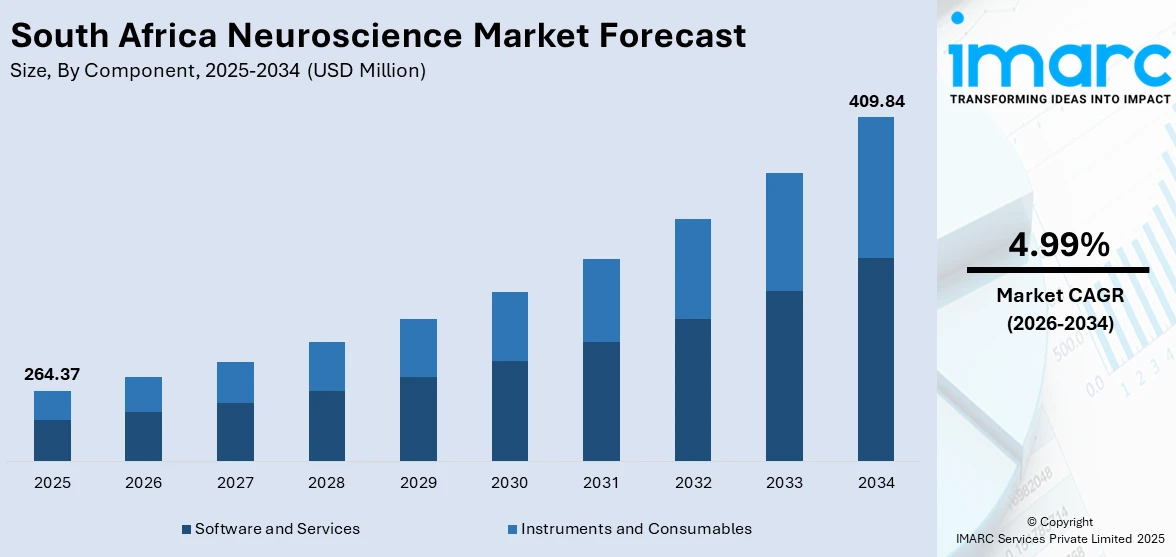
The South Africa neuroscience market size was valued at USD 264.37 Million in 2025 and is projected to reach USD 409.84 Million by 2034, growing at a compound annual growth rate of 4.99% from 2026-2034.
The South Africa neuroscience market is experiencing robust growth driven by increasing investments in brain health research infrastructure and rising awareness of neurological disorders. The expanding healthcare sector, coupled with government initiatives supporting mental health services and academic research programs, is creating favorable conditions for market development. Advancements in neuroimaging technologies, growing adoption of artificial intelligence in neuroscience applications, and strengthening academic-industry collaborations are accelerating innovation and research capabilities, positioning South Africa as a regional hub for neuroscience advancement and contributing to the South Africa neuroscience market share.
Key Takeaways and Insights:
- By Component: Software and services dominate the market with a share of 58% in 2025, driven by increasing demand for advanced data analytics platforms, neuroimaging software solutions, and cloud-based research management tools that enable efficient processing and interpretation of complex neural data across research institutions and healthcare facilities.
- By Technology: Brain imaging leads the market with a share of 25% in 2025, owing to widespread adoption of magnetic resonance imaging and computed tomography technologies for neurological diagnostics, research applications, and treatment planning across hospitals and academic institutions.
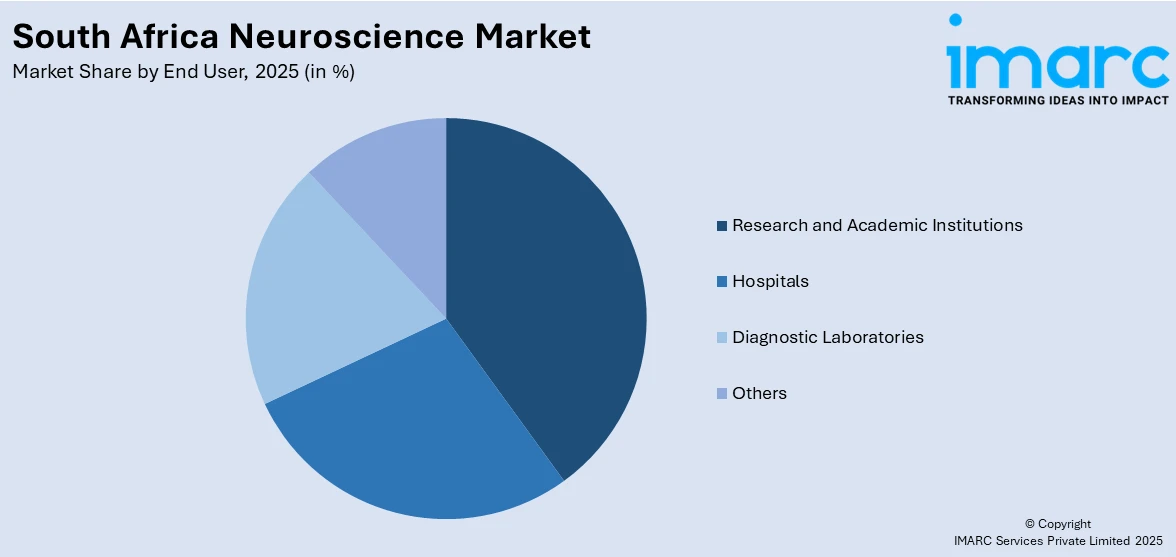
- By End User: Research and academic institutions hold the largest segment with a market share of 37% in 2025, reflecting strong government support for neuroscience research, establishment of dedicated research centers, and increasing international collaborations driving scientific output and innovation.
- By Region: Gauteng represents the largest region with 30% share in 2025, attributed to the concentration of major research universities, teaching hospitals, and healthcare infrastructure in Johannesburg and Pretoria metropolitan areas supporting neuroscience activities.
- Key Players: Key players drive the South Africa neuroscience market by expanding research capabilities, investing in advanced neuroimaging equipment, developing innovative software solutions, and strengthening partnerships with international research institutions to enhance capacity and accelerate scientific discoveries across the region.
To get more information on this market Request Sample
The South Africa neuroscience market is undergoing significant transformation as the nation strengthens its position as a leading center for brain health research in Africa. The establishment of dedicated neuroscience institutes, expansion of neuroimaging facilities, and launch of specialized academic programs are creating a robust ecosystem for scientific advancement. In September 2025, the University of the Witwatersrand launched the Machine Intelligence and Neural Discovery Institute with 34 inaugural fellows from disciplines including computer science, neuroscience, psychology, and philosophy to advance fundamental artificial intelligence and brain research. The growing burden of neurological disorders, estimated to affect nearly one in three South Africans during their lifetime for mental health conditions alone, is driving increased demand for diagnostic tools, treatment technologies, and research solutions. Rising healthcare expenditure, supportive policy frameworks including the National Mental Health Policy Framework 2023-2030, and expanding international research collaborations are further catalyzing the South Africa neuroscience market growth. The integration of artificial intelligence with traditional neuroscience methodologies is opening new frontiers for precision diagnostics and personalized treatment approaches.
South Africa Neuroscience Market Trends:
Integration of Artificial Intelligence in Neuroscience Research
The convergence of artificial intelligence and neuroscience is reshaping research methodologies across South Africa. Academic institutions are increasingly deploying machine learning algorithms for analyzing complex neural datasets, interpreting neuroimaging results, and developing predictive models for neurological conditions. The Wits Machine Intelligence and Neural Discovery Institute exemplifies this trend, bringing together experts from computer science, engineering, and neuroscience to advance the fundamental understanding of intelligence in both biological and artificial systems. This interdisciplinary approach is accelerating discoveries and attracting international collaborations.
Expansion of Academic Neuroimaging Infrastructure
South Africa is witnessing substantial investments in neuroimaging research infrastructure to address historical underrepresentation in global brain data. The Cape Universities Body Imaging Centre houses dedicated research magnetic resonance imaging equipment supporting multiple academic institutions. In September 2024, the University of Cape Town Neuroscience Institute opened applications for its new Master of Neuroscience program, offering students access to state-of-the-art neuroimaging equipment, neuroscience laboratories, and a newly-established brain bank, strengthening regional capacity for advanced brain research.
Rising Focus on Indigenous Population Brain Health Studies
Growing recognition of the need for population-specific neuroscience research is driving specialized studies focused on indigenous South African populations. Researchers are investigating conditions with unique prevalence patterns, including Huntington's Disease-like 2, a rare genetic mutation linked predominantly to African ancestry. South African cognitive neuroscientists are challenging existing global theories developed primarily from Western populations, contributing diverse perspectives on brain-behavior relationships and developing culturally appropriate diagnostic tools and intervention strategies.
Market Outlook 2026-2034:
The South Africa neuroscience market is positioned for sustained growth as healthcare modernization initiatives, academic research expansion, and technological advancements converge to create favorable conditions for industry development. Increasing government prioritization of mental health services, expanding private sector investments in healthcare technology, and strengthening international research partnerships are expected to drive market expansion. The implementation of the National Health Insurance scheme, continued expansion of dedicated neuroscience institutes, and growing adoption of advanced diagnostic technologies are anticipated to accelerate market development throughout the forecast period. The market generated a revenue of USD 264.37 Million in 2025 and is projected to reach a revenue of USD 409.84 Million by 2034, growing at a compound annual growth rate of 4.99% from 2026-2034.
South Africa Neuroscience Market Report Segmentation:
|
Segment Category |
Leading Segment |
Market Share |
|
Component |
Software and Services |
58% |
|
Technology |
Brain Imaging |
25% |
|
End User |
Research and Academic Institutions |
37% |
|
Region |
Gauteng |
30% |
Component Insights:
- Instruments and Consumables
- Software and Services
Software and services dominate with a market share of 58% of the total South Africa neuroscience market in 2025.
The software and services segment leads the South Africa neuroscience market due to increasing demand for sophisticated data analytics platforms, neuroimaging analysis software, and cloud-based research management solutions. Healthcare facilities and research institutions are prioritizing software investments to enhance diagnostic accuracy, streamline workflows, and facilitate collaboration across geographically dispersed teams. The growing volume of neurological data generated from advanced imaging equipment necessitates powerful computational tools for processing, storage, and interpretation, driving sustained demand for specialized software solutions throughout the country.
The services component within this segment encompasses consulting, maintenance, training, and technical support offerings that ensure optimal utilization of neuroscience technologies. Research institutions increasingly rely on specialized service providers for equipment calibration, software updates, and technical troubleshooting to maintain operational efficiency. In 2024, the Centre for Artificial Intelligence Research established multiple research groups across South Africa including Adaptive and Cognitive Systems and Foundations and Applications of Machine Learning, providing advanced computational services and expertise to support neuroscience research initiatives nationwide, further strengthening the services ecosystem.
Technology Insights:
- Brain Imaging
- Neuro-Microscopy
- Electrophysiology
- Neuroproteomic Analysis
- Animal Behaviour Analysis
- Others
Brain imaging leads with a share of 25% of the total South Africa neuroscience market in 2025.
Brain imaging technology maintains market leadership driven by its critical role in neurological diagnostics, research applications, and treatment planning across clinical and academic settings. Magnetic resonance imaging and computed tomography remain the cornerstone technologies for visualizing brain structure and function, supporting diagnosis of stroke, tumors, neurodegenerative diseases, and psychiatric conditions. The establishment of the Cape Universities Body Imaging Centre as Africa's first dedicated research MRI facility marked a significant milestone, and continued investments in imaging infrastructure are expanding access to advanced neuroimaging capabilities.
The integration of artificial intelligence with brain imaging technologies is enhancing diagnostic accuracy and research capabilities across South African institutions. Machine learning algorithms are increasingly deployed to analyze neuroimaging data, identify subtle abnormalities, and support clinical decision-making processes. The Drakenstein Child Health Study exemplifies innovative applications, utilizing multimodal MRI including T1-weighted imaging, resting state functional MRI, and diffusion tensor imaging to investigate brain development in South African children, generating novel insights into neurodevelopmental patterns in underrepresented populations.
End User Insights:
Access the comprehensive market breakdown Request Sample
- Hospitals
- Diagnostic Laboratories
- Research and Academic Institutions
- Others
Research and academic institutions exhibit a clear dominance with a 37% share of the total South Africa neuroscience market in 2025.
Research and academic institutions lead the market driven by substantial government investments in neuroscience research infrastructure, establishment of dedicated research centers, and growing international collaborations. The University of Cape Town Neuroscience Institute, University of the Witwatersrand, and University of Pretoria maintain robust neuroscience research programs generating significant scientific output. These institutions house specialized laboratories, brain banks, and neuroimaging facilities supporting diverse research initiatives spanning clinical neuroscience, cognitive neuroscience, and basic neurobiology.
Academic institutions are increasingly prioritizing interdisciplinary neuroscience training to develop the next generation of researchers and clinicians. Universities across South Africa are expanding specialized programs drawing students from diverse academic backgrounds including biological sciences, engineering, and social sciences. These programs provide foundational training in neuroanatomy, molecular neuroscience, neuroimaging technologies, and machine learning applications, addressing critical workforce development needs and strengthening regional research capacity.
Regional Insights:
- Gauteng
- KwaZulu-Natal
- Western Cape
- Mpumalanga
- Eastern Cape
- Others
Gauteng represents the leading segment with a 30% share of the total South Africa neuroscience market in 2025.
Gauteng continues to hold the top spot in the market due to the concentration of important research universities, teaching hospitals, and healthcare facilities in the Johannesburg and Pretoria metropolitan areas. The province is home to several tertiary hospitals with specialized neurology departments, the University of Pretoria's Neuroscience Research Group, and the University of the Witwatersrand with its recently founded Machine Intelligence and Neural Discovery Institute. A strong ecosystem supporting neuroscience research, training, and service delivery is produced by this concentration of academic and clinical resources.
The majority of South Africa's spending on mental health services comes from the provincial healthcare system; in Gauteng, general healthcare facilities purchase significant amounts of medications for neurological, psychiatric, and drug use illnesses. The province's district hospitals bear a heavy load of care for neurological disorders, and the continued need for specialist treatments and diagnostic services underscores the region's ongoing investment demands and market development prospects.
Market Dynamics:
Growth Drivers:
Why is the South Africa Neuroscience Market Growing?
Rising Burden of Neurological and Mental Health Disorders
The increasing prevalence of neurological and mental health disorders is significantly driving demand for neuroscience research, diagnostics, and treatment technologies across South Africa. Mental health conditions affect a substantial proportion of the population, with studies indicating nearly one in three South Africans experiencing a mental disorder during their lifetime, representing higher prevalence rates compared to many other low and middle-income countries. The growing burden of stroke, epilepsy, neurodegenerative diseases, and trauma-related neurological conditions further compounds demand for advanced diagnostic and therapeutic solutions. The high prevalence of HIV-related neurological complications adds additional complexity to the disease landscape, necessitating specialized research and treatment approaches. These epidemiological patterns are driving healthcare providers, research institutions, and policymakers to prioritize investments in neuroscience infrastructure, workforce development, and service delivery capacity to address population health needs effectively.
Government Healthcare Investments and Policy Support
Government initiatives and supportive policy frameworks are creating favorable conditions for neuroscience market development in South Africa. The National Mental Health Policy Framework and Strategic Plan 2023-2030 outlines comprehensive action areas including service organization aligned with international recommendations, psychotropic medicine availability at all service levels, and mental healthcare system monitoring and evaluation. The proposed National Health Insurance scheme aims to improve equitable access to healthcare services including neurological care across all population segments. International partnerships with organizations including the National Institutes of Health and Wellcome Trust have been transformative for local research groups, providing funding and collaborative opportunities that enhance institutional capabilities.
Expansion of Academic Research Infrastructure and Training Programs
The development of the market in South Africa is being accelerated by the creation and growth of specialized training programs and infrastructure for neuroscience research. Researchers can network, share expertise, and foster a sense of community through the Southern African Neuroscience Society and the Society of Neuroscientists of Africa. By teaching students about neuroanatomy, molecular neuroscience, neuroimaging technology, and computational techniques, new academic programs, such as UCT's Master of Neuroscience, are filling gaps in the workforce. In order to address the severe scarcity of specialists, the African Paediatric Fellowship Program, which was started in Cape Town, is targeting increasing child neurology capacity throughout the region.
Market Restraints:
What Challenges the South Africa Neuroscience Market is Facing?
Limited Funding and Resource Constraints
Insufficient funding allocation for neuroscience research and mental health services remains a significant barrier to market development in South Africa. Mental health accounts for a disproportionately small share of national health budgets despite the substantial disease burden. Resource constraints limit procurement of advanced equipment, restrict research activities, and hinder expansion of service delivery capacity. Many institutions face challenges in maintaining existing infrastructure, upgrading outdated equipment, and accessing research licenses that unlock advanced capabilities available in well-resourced international centers.
Shortage of Skilled Neuroscience Professionals
The scarcity of trained neuroscience researchers, neurologists, and specialized technicians constrains market growth and service delivery capacity. Sub-Saharan Africa has the lowest ratio of child neurology specialists compared to other WHO regions, creating significant workforce gaps. Limited radiologist availability puts pressure on existing staff resources and causes setbacks to training schedules. The isolation of emerging local experts from international networks further hinders professional development and knowledge exchange, though organizations like IBRO and TReND in Africa are working to address these challenges through training programs and capacity building initiatives.
Infrastructure and Equipment Accessibility Gaps
Uneven distribution of neuroscience infrastructure and equipment creates accessibility challenges across South Africa. Advanced neuroimaging equipment remains concentrated in major metropolitan areas, limiting access for populations in rural and semi-urban regions. High installation costs, specialized facility requirements, and power infrastructure demands create barriers to expanding imaging capabilities. Many existing high-field scanners approach end-of-life cycles without adequate replacement plans, and most facilities lack research licenses that unlock advanced imaging sequences readily available in academic centers in other regions.
Competitive Landscape:
International producers of medical devices, suppliers of diagnostic equipment, and developers of specialist software coexist with domestic research organizations and healthcare service providers in the competitive South African neuroscience market. To improve their competitive positions, major market players concentrate on expanding their service networks, forming technology alliances, and developing new products. To improve customer relations and increase equipment usage, businesses are investing in localized support services, training initiatives, and maintenance skills. Knowledge transfer, research partnerships, and workforce development programs that benefit the larger market ecosystem are made possible by strategic partnerships between foreign technology companies and regional academic institutions.
South Africa Neuroscience Market Report Coverage:
| Report Features | Details |
|---|---|
| Base Year of the Analysis | 2025 |
| Historical Period | 2020-2025 |
| Forecast Period | 2026-2034 |
| Units | Million USD |
| Scope of the Report |
Exploration of Historical Trends and Market Outlook, Industry Catalysts and Challenges, Segment-Wise Historical and Future Market Assessment:
|
| Components Covered | Instruments and Consumables, Software and Services |
| Technologies Covered | Brain Imaging, Neuro-Microscopy, Electrophysiology, Neuroproteomic Analysis, Animal Behaviour Analysis, Others |
| End Users Covered | Hospitals, Diagnostic Laboratories, Research and Academic Institutions, Others |
| Regions Covered | Gauteng, KwaZulu-Natal, Western Cape, Mpumalanga, Eastern Cape, Others |
| Customization Scope | 10% Free Customization |
| Post-Sale Analyst Support | 10-12 Weeks |
| Delivery Format | PDF and Excel through Email (We can also provide the editable version of the report in PPT/Word format on special request) |
Frequently Asked Questions About the South Africa Neuroscience Market Report
The South Africa neuroscience market size was valued at USD 264.37 Million in 2025.
The South Africa neuroscience market is expected to grow at a compound annual growth rate of 4.99% from 2026-2034 to reach USD 409.84 Million by 2034.
Software and services dominated the market with a share of 58%, driven by increasing demand for data analytics platforms, neuroimaging analysis software, and cloud-based research management solutions across healthcare facilities and research institutions.
Key factors driving the South Africa neuroscience market include rising burden of neurological disorders, government healthcare investments and policy support, expansion of academic research infrastructure, and growing adoption of artificial intelligence in neuroscience applications.
Major challenges include limited funding and resource constraints, shortage of skilled neuroscience professionals, infrastructure and equipment accessibility gaps in rural areas, and dependency on imported technologies and equipment for advanced research applications.
Need more help?
- Speak to our experienced analysts for insights on the current market scenarios.
- Include additional segments and countries to customize the report as per your requirement.
- Gain an unparalleled competitive advantage in your domain by understanding how to utilize the report and positively impacting your operations and revenue.
- For further assistance, please connect with our analysts.
 Request Customization
 Speak to an Analyst
 Request Brochure
 Inquire Before Buying
Benefits of Customization
- Personalize this research
- Triangulate with your data
- Get data as per your format and definition
- Gain a deeper dive into a specific application, geography, customer, or competitor
- Any level of personalization
Get in Touch With Us
UNITED STATES
Phone: +1-201-971-6302
INDIA
Phone: +91-120-433-0800
UNITED KINGDOM
Phone: +44-753-714-6104
Email: [email protected]
Client Testimonials




.webp)




.webp)













Related Reports

Choose your plan
*Please note that the prices mentioned below are starting prices for each bundle type. Kindly contact our team for further details.*
Single User License
- 1 User License, Access on 2 Devices
- PDF Report + Excel Dataset (Password Protected)
- Lifetime Access
- No Printing Rights
- 10% Free Report Customization
- 10–12 Weeks of Analyst Support
Five User License
- Access for 5 Users, 2 Devices per User
- PDF Report + Excel Dataset (Password Protected)
- Lifetime Access
- Dedicated Account Manager
- 12–14 Weeks of Analyst Support
- No Printing Rights
- 15% Free Report Customization
- 25% Discount on Your Next Purchase
Corporate User License
- Unlimited User Access (Within Your Organization)
- PDF Report + Excel Dataset
- Lifetime Access
- Dedicated Account Manager
- 14–20 Weeks of Analyst Support
- No Printing Rights
- 20% Free Report Customization
- 30% Discount on Your Next Purchase
Essential Insights
What's included:
3 reports
- Lifetime Access
- PDF Reports
- Excel Datasets
- 2 Weeks of Free Analyst Support
- 2 User Licenses
- Access on 2 Devices
- Printing Rights
- Complimentary PowerPoint (PPT) Version
- Complimentary License Upgrade
Professional Access
What's included:
5 reports
- Lifetime Access
- PDF Reports
- Excel Datasets
- 8 Weeks of Free Analyst Support
- 2 User Licenses
- Access on 2 Devices
- Printing Rights
- Complimentary PowerPoint (PPT) Version
- Complimentary License Upgrade
Business Advantage
What's included:
8 reports
- Lifetime Access
- PDF Reports
- Excel Datasets
- 14 Weeks of Free Analyst Support
- 2 User Licenses
- Access on 2 Devices
- Printing Rights
- Complimentary PowerPoint (PPT) Version
- Complimentary License Upgrade
Enterprise Intelligence
What's included:
10 reports
- Lifetime Access
- PDF Reports
- Excel Datasets
- 20 Weeks of Free Analyst Support
- 2 User Licenses
- Access on 2 Devices
- Printing Rights
- Complimentary PowerPoint (PPT) Version
- Complimentary License Upgrade