
South Africa Watch Market Size, Share, Trends and Forecast by Type, Price Range, Distribution Channel, End User, and Province, 2026-2034
South Africa Watch Market Summary:
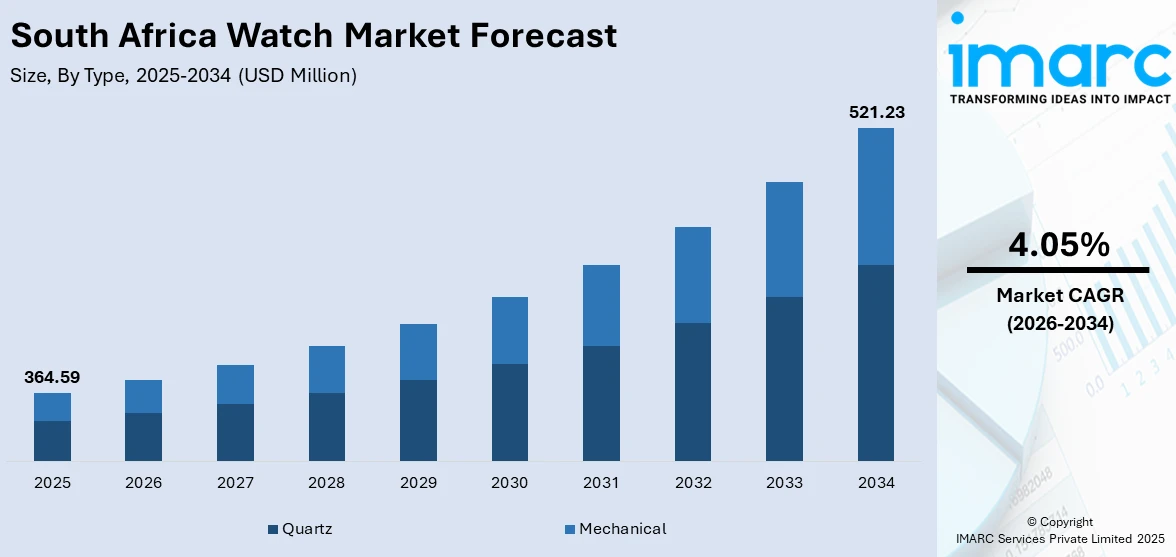
The South Africa watch market size was valued at USD 364.59 Million in 2025 and is projected to reach USD 521.23 Million by 2034, growing at a compound annual growth rate of 4.05% from 2026-2034.
The South African watch market is consistently growing due to the public's shifting preferences for stylish timepieces and their ever-increasing awareness of trend. The growing middle class, growing urbanization, and growing demand for personal accessories are all factors driving demand. Accordingly, the market is positioned as a significant watch market in the African region due to its extensive product selection that appeals to various lifestyle categories and its well-established retail infrastructure.
Key Takeaways and Insights:
- By Type: Quartz dominates the market with a share of 59.92% in 2025, because of its outstanding accuracy, low cost, and low maintenance needs. Growing consumer demand for dependable timepieces drives market growth.
- By Price Range: Mid-range leads the market with a share of 34.95% in 2025. This domination is fueled by striking a balance between price and quality, attracting aspirational customers looking for fashionable timepieces without high price tags.
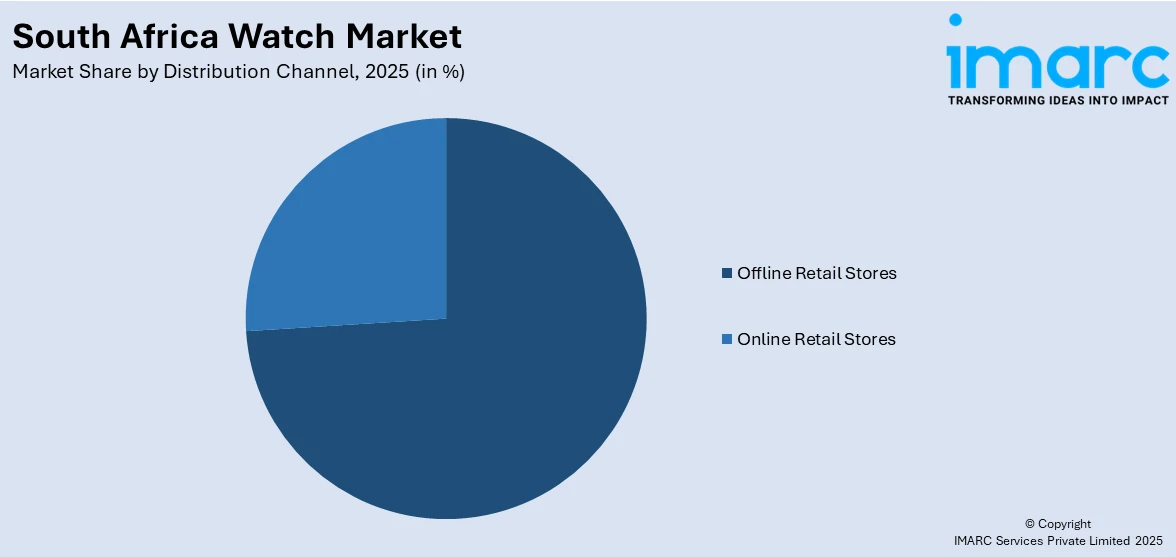
- By Distribution Channel: Offline retail stores represent the largest segment with a market share of 74.96% in 2025, reflecting strong consumer preference for in-store experiences that allow physical inspection and personalized service when purchasing watches.
- By End User: Men hold the biggest market share of 54.98% in 2025, owing to continued male preference for watches as essential accessories that complement professional attire and personal style statements.
- Key Players: By broadening product offerings, enhancing technological features and design aesthetics, and fortifying national distribution networks, major companies propel the South African watch market. They increase awareness, speed up acceptance, and guarantee consistent product availability across a range of customer categories through their marketing, brand positioning, and retail outlet agreements.
To get more information on this market Request Sample
The South Africa watch market is advancing as consumers increasingly embrace stylish timepieces and functional accessories that reflect personal identity and fashion preferences. With approximately 66.92% of South Africa's population residing in urban areas and a median age of 28.9 years, the country presents a young, urbanizing consumer base receptive to contemporary timepiece designs. Growing urbanization and increased disposable income are driving up demand for high-end timepieces across a range of price points. The market benefits from a strong retail environment, with upmarket malls in Johannesburg, Cape Town, and Durban offering a wide range of watch collections to suit a variety of consumer preferences. By delivering individualized services, holding product demos, and offering post-purchase support to create long-lasting relationships, retailers hope to enhance consumer experiences. Both younger consumers looking for stylish accessories and older people appreciating traditional artistry are drawn to the combination of classic watch types and contemporary aesthetics. Additionally, the increasing influence of international fashion trends and celebrity endorsements continuously influences customer tastes and improves brand recognition across the country.
South Africa Watch Market Trends:
Growing Preference for Fashion-Forward Timepieces
Watches are increasingly seen by South African consumers as essential fashion accessories rather than only timepieces. The demand for stylish looks that complement contemporary wardrobes and highlight individual personalities is being fueled by this shift. Retailers are expanding their offerings to include stylish designs with integrated bands, a variety of dial options, and flexible color schemes. Younger generations in particular value timepieces that smoothly transition from informal to formal settings, spurring design innovation across a range of price points.
Expansion of Premium Shopping Experiences
With improved in-store experiences that put an emphasis on client interaction and individualized care, South Africa's watch retail scene is changing. Major retail districts are seeing the establishment of dedicated watch boutiques and concept stores that offer specific selections and expert guidance. Customers may physically inspect products, compare styles, and get expert advice on choices in these upscale retail settings. The focus on experiential retail is boosting brand loyalty and motivating discriminating customers to make additional purchases.
Rising Interest in Hybrid and Connected Timepieces
Customers in South Africa are becoming more interested in watches that combine classic style with contemporary functionality. Tech-savvy consumers who value both appearance and functionality are increasingly drawn to hybrid watches that combine traditional designs with connection features. This trend is a reflection of broader worldwide trends toward multipurpose items that facilitate digital connectivity and health tracking while preserving stylish looks. In response, companies are launching models that combine wearable technology with traditional watchmaking.
Market Outlook 2026-2034:
The South Africa watch market is poised for sustained growth as evolving consumer lifestyles and increasing fashion consciousness continue to drive demand for quality timepieces. The market generated a revenue of USD 364.59 Million in 2025 and is projected to reach a revenue of USD 521.23 Million by 2034, growing at a compound annual growth rate of 4.05% from 2026-2034. Market development is anticipated to be accelerated by the growth of retail infrastructure in large cities and the increasing impact of global fashion trends. Growing urbanization and rising middle-class customers' disposable incomes will increase their ability to buy mid-range and high-end timepieces. Additionally, while complementing digital channels improve accessibility and convenience, offline retail supremacy will be maintained by consumers' continued preference for in-store shopping experiences where they can physically inspect products and obtain tailored recommendations.
South Africa Watch Market Report Segmentation:
| Segment Category | Leading Segment | Market Share |
|---|---|---|
| Type | Quartz | 59.92% |
| Price Range | Mid-Range | 34.95% |
| Distribution Channel | Offline Retail Stores | 74.96% |
| End User | Men | 54.98% |
Type Insights:
- Quartz
- Mechanical
Quartz dominates with a market share of 59.92% of the total South Africa watch market in 2025.
Quartz watches maintain their dominant position in South Africa due to their exceptional accuracy, reliability, and affordability compared to mechanical alternatives. The battery-powered quartz movement offers consumers a hassle-free timekeeping experience with minimal maintenance requirements, making it the preferred choice for everyday use. These timepieces have become synonymous with accessible quality, appealing to consumers who prioritize precision without the complexity associated with mechanical movements. The widespread availability of quartz watches across retail channels ensures that consumers can easily find options matching their style preferences and budget constraints.
The appeal of quartz watches extends across all demographic segments in South Africa, from budget-conscious students to professional workers seeking reliable accessories. Manufacturers continue to innovate by integrating contemporary designs, diverse color options, and enhanced features while maintaining competitive price points. South African consumers particularly appreciate the combination of precision engineering and stylish aesthetics that quartz watches deliver at accessible price ranges. The segment benefits from continuous technological improvements that enhance battery longevity, water resistance, and overall durability, further strengthening consumer confidence in quartz timepieces as dependable everyday companions.
Price Range Insights:
- Low-Range
- Mid-Range
- Luxury
Mid-range leads with a share of 34.95% of the total South Africa watch market in 2025.
Mid-range watches occupy the sweet spot in South Africa's market by offering consumers a balance between quality craftsmanship and reasonable pricing. This segment appeals to aspirational buyers who desire stylish timepieces with reputable brand associations without committing to luxury price tags. Mid-range products cater to the growing middle class seeking sophisticated accessories that complement their professional and personal lifestyles. These timepieces represent attainable quality, enabling consumers to experience superior materials and design aesthetics while remaining within practical budget parameters that align with everyday purchasing decisions.
The mid-range segment benefits from diverse product offerings that span contemporary fashion watches to classic designs with enhanced features. Consumers in this category typically seek watches that deliver durability, aesthetic appeal, and functional reliability for everyday wear. Retailers actively promote mid-range collections through attractive financing options and seasonal promotions to capture this value-conscious yet quality-seeking consumer segment. The availability of installment payment plans and store credit facilities further democratizes access to quality timepieces, enabling consumers to upgrade their accessories without significant immediate financial burden while building brand loyalty.
Distribution Channel Insights:
Access the comprehensive market breakdown Request Sample
- Online Retail Stores
- Offline Retail Stores
Offline retail stores exhibit a clear dominance with 74.96% share of the total South Africa watch market in 2025.
Offline retail stores maintain their dominant position in South Africa's watch market by providing consumers with tangible shopping experiences that digital channels cannot replicate. Customers value the ability to physically examine watch designs, assess build quality, and try on different styles before making purchasing decisions. Premium shopping destinations in Johannesburg, Cape Town, and Durban serve as key hubs where established watch retailers and boutiques showcase extensive collections to both local and international shoppers seeking quality timepieces. The tactile nature of watch shopping, combined with the emotional significance of timepiece purchases, reinforces consumer preference for physical retail environments.
The in-store experience extends beyond product selection to include personalized consultations, expert advice, and comprehensive after-sales services that build lasting customer relationships. Retailers invest in training knowledgeable staff who can guide consumers through various collections and help them find watches matching their preferences and budgets. The emphasis on customer service excellence, warranty support, and authentication guarantees provides reassurance that online platforms struggle to match. Physical stores also enable immediate product availability, allowing consumers to complete purchases and wear their new timepieces without delivery waiting periods.
End User Insights:
- Men
- Women
- Unisex
Men represent the leading segment with 54.98% share of the total South Africa watch market in 2025.
Men continue to dominate watch consumption in South Africa, viewing timepieces as essential accessories that complement professional attire and reflect personal achievement. The male demographic shows strong preference for watches that convey status, sophistication, and attention to detail in both business and casual settings. Watches serve as one of the few socially acceptable forms of jewelry for men, making them important tools for self-expression and professional image projection. The cultural significance of watches as markers of success drives consistent demand among career-oriented South African men across various professional fields.
Diverse product offers, from sporty chronographs to sophisticated dress watches that fit various events and tastes, are advantageous to the men's watch market. Men in South Africa especially value timepieces that blend robustness with fashionable styles appropriate for the nation's diverse environment and way of life. A growing number of younger consumers are joining the market in search of reasonably priced, stylish watches that follow current trends. Fresh viewpoints on watch design are brought about by this generational shift, with younger consumers preferring adaptable styles that work well in both work and play settings.

Province Insights:
- Gauteng
- KwaZulu-Natal
- Western Cape
- Mpumalanga
- Eastern Cape
- Others
Gauteng province represents the primary watch market hub in South Africa, home to Johannesburg and Pretoria metropolitan areas with significant consumer purchasing power. Premium shopping destinations including Sandton City, Melrose Arch, and Hyde Park Corner attract affluent local and international shoppers seeking luxury timepieces. The province's concentration of corporate headquarters and financial institutions creates strong demand for professional accessories among business executives.
KwaZulu-Natal has experienced remarkable growth in its watch market, with Durban emerging as a significant retail destination. The province benefits from a diverse consumer base and increasing tourism that drives accessory purchases. Growing wealth among the local population, particularly within entrepreneurial communities, fuels demand for both mid-range and luxury timepieces across established shopping centers and specialty retailers.
Western Cape serves as a prominent watch market anchored by Cape Town's V&A Waterfront, which attracts substantial tourist traffic alongside local consumers. The province's fashion-conscious population demonstrates strong appreciation for stylish timepieces that complement Mediterranean-influenced lifestyles. Seasonal fluctuations coincide with tourist arrivals, creating peak demand periods that retailers actively capitalize upon through targeted marketing initiatives.
Mpumalanga province represents an emerging watch market with growing retail infrastructure serving expanding urban populations. The region's economic activities in mining and agriculture create consumer segments with increasing disposable incomes for accessory purchases. Retail development in provincial towns continues to improve product accessibility, bringing established watch brands closer to previously underserved consumer markets.
Eastern Cape contributes to South Africa's watch market through urban centers including Port Elizabeth and East London, which host established retail destinations. The province's diverse economic base supports consumer demand across various price segments, with growing middle-class populations seeking quality timepieces. Retailers focus on offering value-oriented collections that appeal to budget-conscious yet style-aware consumers in this regional market.
Market Dynamics:
Growth Drivers:
Why is the South Africa Watch Market Growing?
Rising Urbanization and Middle-Class Expansion
The current urbanization trend in South Africa is contributing to the growth of the watch industry, as people continue to move to cities in search of employment and better living standards. Cities provide better visibility of fashion trends, shopping facilities, and social settings where individual accessories such as watches are critical fashion statements. The growing middle class is an important driving factor, with more people gaining access to disposable incomes that are sufficient for purchasing quality watches beyond the basic need for time-telling functionality. The changing middle class demographics present a demand for products that fall within the mid-range and affordable luxury categories, where consumers seek products that provide a balance of quality, looks, and affordability. Urban professionals are increasingly recognizing watches as accessories that complement business attire and convey professionalism in the corporate world. The retail infrastructure is also centralized in cities, ensuring that consumers have easy access to a variety of watch models from reputable brands. Shopping malls and dedicated watch stores continue to expand their product lines, presenting competitive scenarios that are beneficial to consumers through improved services and marketing events.
Evolving Fashion Consciousness and Personal Expression
Growing fashion consciousness among South African customers is significantly accelerating the expansion of the watch business as people begin to view watches as significant personal accessories rather than just useful objects. Modern consumers choose timepieces that reflect their lifestyle choices, career standing, and personal style in order to meticulously curate their looks. All age groups are affected by this increased awareness, but younger populations are especially affected by social media, international fashion trends, and celebrity sponsorships that highlight timepieces as fashionable accessories. The need for a variety of watch styles, from strong statement pieces to minimalist contemporary designs, is created by the incorporation of foreign fashion influences into local society. As they look for watches for formal, informal, and professional situations, consumers are creating watch collections to fit various events, which encourages repeat purchases. In response, retailers constantly update their stocks with fashionable new items that reflect changing aesthetic tastes. Beyond strictly functional concerns, market demand is sustained by the emotional bond that consumers have with their timepieces, seeing them as extensions of their selves.
Strengthening Retail Infrastructure and Consumer Access
The continued development of retail infrastructure across South Africa, which improves product accessibility for a range of client categories, has significantly contributed to the growth of the watch market. Major cities are home to upscale shopping destinations with authorized dealers, specialty watch shops, and multi-brand stores with wide product selections. This retail boom extends beyond typical urban centers as developers construct modern retail establishments in rural towns and growing suburban areas. Thanks to enhanced infrastructure, customers who were previously neglected by niche merchants may now purchase high-quality timepieces without traveling to major cities. The professionalization of watch retail through better showroom environment, trained staff, and enhanced after-sales services increases consumer trust in purchasing decisions. By focusing on individualized consultations and product demonstrations, retailers engage in developing captivating shopping experiences that set physical storefronts apart from online competitors. Access to high-quality timepieces across a range of economic levels is further democratized by the availability of flexible payment options, such as credit facilities and installment plans.
Market Restraints:
What Challenges the South Africa Watch Market is Facing?
Economic Pressures and Currency Volatility
Consumer purchasing power is impacted by economic issues including inflation and currency changes, which makes imported watches comparatively more expensive for South African consumers. The mid-range and premium categories, where price sensitivity affects purchase decisions, are especially affected by these pressures. During uncertain economic times, consumers may put off purchases or choose less expensive alternatives, which would limit the market's potential for total growth. In order to maintain competitive pricing, retailers must absorb currency-related cost increases, which puts pressure on their margins.
Competition from Smartwatches and Digital Devices
Traditional watch categories face competition from the rise of smartwatches and fitness trackers, especially from younger consumers who value multipurpose gadgets. Tech-savvy consumers who may otherwise buy traditional timepieces are drawn to digital alternatives that offer health monitoring, connectivity functions, and app integration. In the low-cost and mid-range segments, where smartwatches provide attractive value propositions that blend functionality with modern design, the competition is getting fiercer. To stay relevant, traditional watchmakers need to constantly innovate.
Counterfeit Products and Grey Market Concerns
The presence of counterfeit watches and unauthorized grey market products undermines legitimate market growth by eroding consumer confidence and brand value. Counterfeit goods deceive uninformed buyers while reducing demand for authentic products from authorized retailers. Grey market channels offering unauthorized imports at discounted prices disrupt established distribution networks and create pricing inconsistencies. Addressing these challenges requires coordinated efforts between brands, retailers, and regulatory authorities to protect consumers and market integrity.
Competitive Landscape:
The South African watch market features a variety of competitors, including global luxury brands and providers of affordable fashion watches. Established companies sustain their market presence through comprehensive after-sales support systems, specialized boutiques, and sanctioned retail partnerships. To attract cost-sensitive shoppers while preserving brand reputation, producers are participating in more intense competition over pricing. Market participants set themselves apart via product innovation, design appeal, advertising efforts, and distribution methods. Retailers strive to attract discerning customers by providing enhanced shopping experiences, expert staff advice, and adaptable payment solutions. The expanding market for pre-owned luxury watches creates fresh competitive dynamics as authorized resellers offer consumers access to premium watches at more affordable prices. By strategically positioning themselves at different pricing tiers, participants can address a range of customer needs and cultivate brand loyalty in multiple market segments.
South Africa Watch Market Report Coverage:
| Report Features | Details |
|---|---|
| Base Year of the Analysis | 2025 |
| Historical Period | 2020-2025 |
| Forecast Period | 2026-2034 |
| Units | Million USD |
| Scope of the Report |
Exploration of Historical Trends and Market Outlook, Industry Catalysts and Challenges, Segment-Wise Historical and Future Market Assessment:
|
| Types Covered | Quartz, Mechanical |
| Price Ranges Covered | Low-Range, Mid-Range, Luxury |
| Distribution Channels Covered | Online Retail Stores, Offline Retail Stores |
| End Users Covered | Men, Women, Unisex |
| Provinces Covered | Gauteng, KwaZulu-Natal, Western Cape, Mpumalanga, Eastern Cape, Others |
| Customization Scope | 10% Free Customization |
| Post-Sale Analyst Support | 10-12 Weeks |
| Delivery Format | PDF and Excel through Email (We can also provide the editable version of the report in PPT/Word format on special request) |
Frequently Asked Questions About the South Africa Watch Market Report
The South Africa watch market size was valued at USD 364.59 Million in 2025.
The South Africa watch market is expected to grow at a compound annual growth rate of 4.05% from 2026-2034 to reach USD 521.23 Million by 2034.
Quartz dominated the market with a share of 59.92%, owing to its exceptional accuracy, affordability, and minimal maintenance requirements that appeal to consumers across all demographic segments.
Key factors driving the South Africa watch market include rising urbanization, expanding middle-class demographics, growing fashion consciousness, strengthening retail infrastructure, and increasing disposable incomes enabling accessory purchases.
Significant obstacles include price sensitivity among consumers during uncertain economic times, competition from smartwatches and digital devices, currency volatility and economic pressures affecting import costs, counterfeit goods undermining brand value, and grey market issues interfering with authorized distribution.
Need more help?
- Speak to our experienced analysts for insights on the current market scenarios.
- Include additional segments and countries to customize the report as per your requirement.
- Gain an unparalleled competitive advantage in your domain by understanding how to utilize the report and positively impacting your operations and revenue.
- For further assistance, please connect with our analysts.
 Request Customization
 Speak to an Analyst
 Request Brochure
 Inquire Before Buying
Benefits of Customization
- Personalize this research
- Triangulate with your data
- Get data as per your format and definition
- Gain a deeper dive into a specific application, geography, customer, or competitor
- Any level of personalization
Get in Touch With Us
UNITED STATES
Phone: +1-201-971-6302
INDIA
Phone: +91-120-433-0800
UNITED KINGDOM
Phone: +44-753-714-6104
Email: [email protected]
Client Testimonials




.webp)




.webp)













Related Reports

Choose your plan
*Please note that the prices mentioned below are starting prices for each bundle type. Kindly contact our team for further details.*
Single User License
- 1 User License, Access on 2 Devices
- PDF Report + Excel Dataset (Password Protected)
- Lifetime Access
- No Printing Rights
- 10% Free Report Customization
- 10–12 Weeks of Analyst Support
Five User License
- Access for 5 Users, 2 Devices per User
- PDF Report + Excel Dataset (Password Protected)
- Lifetime Access
- Dedicated Account Manager
- 12–14 Weeks of Analyst Support
- No Printing Rights
- 15% Free Report Customization
- 25% Discount on Your Next Purchase
Corporate User License
- Unlimited User Access (Within Your Organization)
- PDF Report + Excel Dataset
- Lifetime Access
- Dedicated Account Manager
- 14–20 Weeks of Analyst Support
- No Printing Rights
- 20% Free Report Customization
- 30% Discount on Your Next Purchase
Essential Insights
What's included:
3 reports
- Lifetime Access
- PDF Reports
- Excel Datasets
- 2 Weeks of Free Analyst Support
- 2 User Licenses
- Access on 2 Devices
- Printing Rights
- Complimentary PowerPoint (PPT) Version
- Complimentary License Upgrade
Professional Access
What's included:
5 reports
- Lifetime Access
- PDF Reports
- Excel Datasets
- 8 Weeks of Free Analyst Support
- 2 User Licenses
- Access on 2 Devices
- Printing Rights
- Complimentary PowerPoint (PPT) Version
- Complimentary License Upgrade
Business Advantage
What's included:
8 reports
- Lifetime Access
- PDF Reports
- Excel Datasets
- 14 Weeks of Free Analyst Support
- 2 User Licenses
- Access on 2 Devices
- Printing Rights
- Complimentary PowerPoint (PPT) Version
- Complimentary License Upgrade
Enterprise Intelligence
What's included:
10 reports
- Lifetime Access
- PDF Reports
- Excel Datasets
- 20 Weeks of Free Analyst Support
- 2 User Licenses
- Access on 2 Devices
- Printing Rights
- Complimentary PowerPoint (PPT) Version
- Complimentary License Upgrade