
South East Asia Cryptocurrency Market Size, Share, Trends and Forecast by Component, Type, Process, Application, and Country, 2026-2034
South East Asia Cryptocurrency Market Summary:
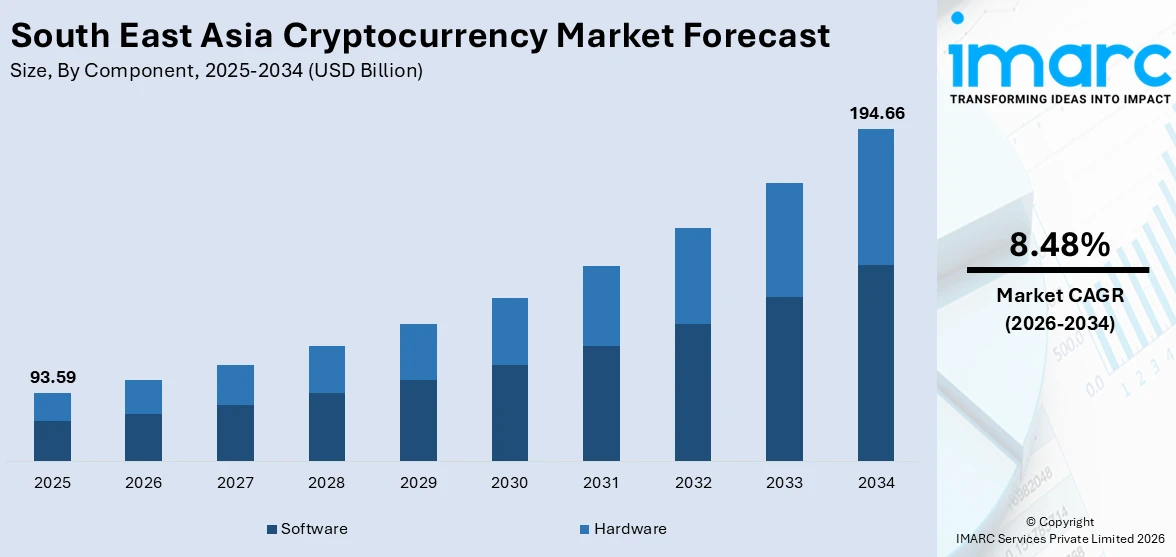
The South East Asia cryptocurrency market size was valued at USD 93.59 Billion in 2025 and is projected to reach USD 194.66 Billion by 2034, growing at a compound annual growth rate of 8.48% from 2026-2034.
The South East Asia cryptocurrency market is expanding rapidly as rising digital literacy, youthful demographics, and increasing smartphone penetration accelerate digital asset adoption across the region. Supportive regulatory frameworks in key economies, growing institutional participation, and the integration of blockchain technology into mainstream financial services are strengthening market fundamentals. Expanding cross-border payment solutions, rising demand for decentralized finance platforms, and the proliferation of cryptocurrency exchanges are collectively reshaping the financial landscape.
Key Takeaways and Insights:
- By Component: Software dominates the market with a share of 62% in 2025, owing to the rapid proliferation of cryptocurrency exchange platforms, digital wallet applications, and blockchain-based trading tools that enable seamless participation in digital asset ecosystems across the region.
- By Type: Bitcoin leads the market with a share of 50% in 2025, driven by its established reputation as the most recognized and widely traded digital currency, attracting both retail and institutional investors seeking reliable store-of-value opportunities.
- By Process: Transaction holds the market with a share of 69% in 2025, reflecting the growing utilization of cryptocurrencies for cross-border payments, peer-to-peer transfers, and everyday digital transactions facilitated by expanding exchange infrastructure.
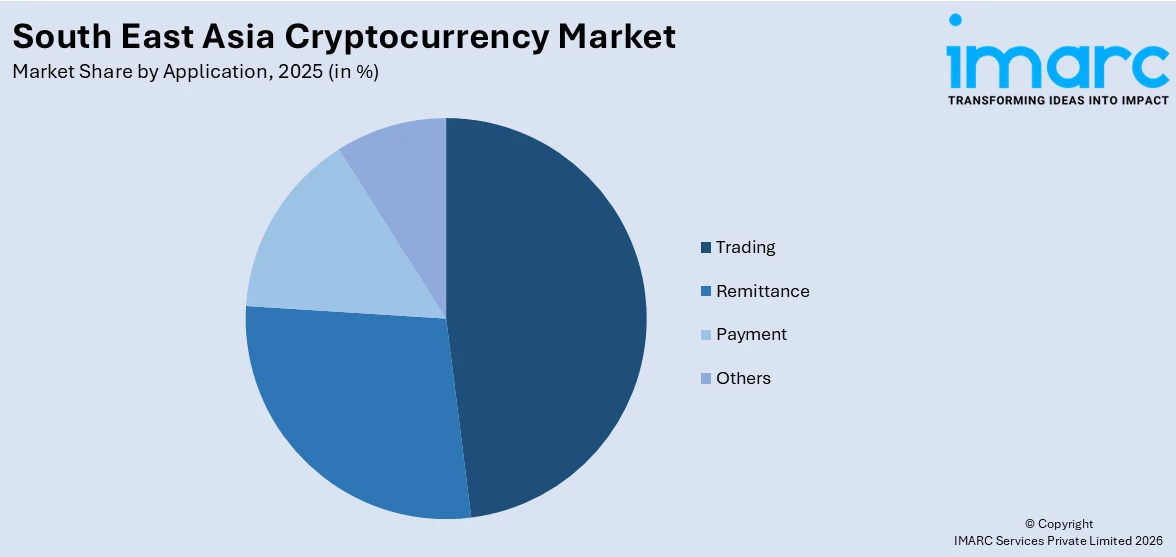
- By Application: Trading represents the largest segment with a market share of 48% in 2025, underscoring the strong speculative interest and active participation of retail and professional investors in cryptocurrency trading across South East Asian exchanges.
- Key Players: Key players drive the South East Asia cryptocurrency market by expanding platform capabilities, enhancing security protocols, investing in regulatory compliance, and forming strategic partnerships to strengthen market share and advance digital asset adoption across the region.
To get more information on this market Request Sample
The South East Asia cryptocurrency market is witnessing robust expansion, as regional economies embrace digital transformation and blockchain innovation. Governments across the region are progressively establishing regulatory frameworks that balance innovation with consumer protection, fostering a favorable environment for cryptocurrency adoption. The region benefits from one of the highest cryptocurrency adoption rates globally, with countries, such as Vietnam, Thailand, the Philippines, and Indonesia, leading grassroots digital asset participation. As per February 2026, Vietnam held the second position with 21.2%, indicating 21 Million individuals owning cryptocurrency. The proliferation of cryptocurrency exchange platforms, mobile wallet applications, and decentralized finance solutions has democratized access to digital assets, enabling millions of previously unbanked individuals to participate in the financial ecosystem. Furthermore, the expanding role of stablecoins in facilitating cross-border commerce, coupled with increasing venture capital investment in regional blockchain startups, is reinforcing the South East Asia cryptocurrency market growth trajectory.
South East Asia Cryptocurrency Market Trends:
Growing Integration of Cryptocurrency with Mainstream Financial Services
Cryptocurrency is increasingly being integrated into everyday financial services across South East Asia, as major technology platforms and payment providers incorporate digital asset functionalities into their existing ecosystems. Super-apps and ride-hailing platforms are enabling users to transact using digital currencies, blurring the lines between traditional finance and decentralized assets. In March 2024, Singapore-based super-app Grab began accepting cryptocurrency top-ups to its e-wallet through a partnership with payments firm Triple-A, allowing users to pay using Bitcoin, Ether, and stablecoins for everyday services. This trend is accelerating financial inclusion and broadening the practical utility of digital currencies across the region.
Expansion of Institutional-Grade Cryptocurrency Derivatives
Institutional participation in the South East Asia cryptocurrency market is deepening as regulated exchanges introduce sophisticated derivative products tailored to professional investors. The demand for transparent, exchange-cleared cryptocurrency instruments is driving established financial infrastructure providers to bridge traditional finance with digital assets. In November 2025, Singapore Exchange Derivatives launched Bitcoin and Ethereum perpetual futures, recording nearly 2,000 lots on day one with approximately USD 35 Million in notional trading volume. This shift towards regulated derivative offerings is enhancing market depth and attracting institutional capital that previously remained on the sidelines of digital asset markets.
Rising Adoption of Stablecoins for Cross-Border Commerce
Stablecoins are emerging as a critical infrastructure layer for cross-border payments and commerce in South East Asia, offering faster settlement and lower transaction costs compared to traditional banking channels. Regional stablecoin initiatives are gaining traction as payment providers develop tokenized settlement systems that connect diverse digital wallets across multiple countries. In November 2025, Grab partnered with stablecoin issuer StraitsX to develop a web3 wallet and stablecoin payments network for clearing and settlement across markets where Grab operates, serving its 41 Million monthly transacting users. This trend is positioning stablecoins as foundational tools for digital commerce expansion across the region.
Market Outlook 2026-2034:
The South East Asia cryptocurrency market is poised for sustained growth over the forecast period, driven by accelerating digital adoption, evolving regulatory clarity, and expanding institutional engagement across the region. Progressive regulatory frameworks in Singapore, Indonesia, Thailand, and the Philippines are creating a more predictable business environment that encourages both domestic and international investment in digital asset infrastructure. The market generated a revenue of USD 93.59 Billion in 2025 and is projected to reach a revenue of USD 194.66 Billion by 2034, growing at a compound annual growth rate of 8.48% from 2026-2034. The ongoing expansion of decentralized finance platforms, increasing integration of blockchain technology across financial services, and the proliferation of mobile-first cryptocurrency applications are expected to further broaden market participation and strengthen the regional ecosystem.
South East Asia Cryptocurrency Market Report Segmentation:
| Segment Category | Leading Segment | Market Share |
|---|---|---|
|
Component |
Software |
62% |
|
Type |
Bitcoin |
50% |
|
Process |
Transaction |
69% |
|
Application |
Trading |
48% |
Component Insights:
- Hardware
- Software
Software dominates with a market share of 62% of the total South East Asia cryptocurrency market in 2025.
The software segment commands the largest share of the South East Asia cryptocurrency market, driven by the growing need for decentralized finance protocols, blockchain analytics tools, digital wallet software, and cryptocurrency exchange platforms. Millions of consumers across the area can easily access cryptocurrency markets, owing to the growth of mobile-first trading apps, which have dramatically reduced entry hurdles for retail investors. Singapore alone granted 13 crypto licenses in 2024, reflecting a maturing regulatory environment that encourages the development and deployment of compliant software solutions.
The incorporation of cutting-edge security measures, real-time market analytics, and multi-currency support that meet the various demands of South East Asian investors solidifies the increasing sophistication of bitcoin software platforms. In order to improve trading algorithms, fraud detection, and user experience improvement, software providers are progressively integrating artificial intelligence (AI) and machine learning (ML) capabilities. This has positioned the software industry as the main driver of the expansion of the digital asset ecosystem throughout the area.
Type Insights:
- Bitcoin
- Ethereum
- Bitcoin Cash
- Ripple
- Litecoin
- Dashcoin
- Others
Bitcoin leads with a share of 50% of the total South East Asia cryptocurrency market in 2025.
Bitcoin maintains its dominant position in the South East Asia cryptocurrency market, serving as the most widely recognized and actively traded digital currency across the region. Retail and professional investors continue to be drawn to it, due to its proven track record as a store of value and growing institutional recognition. Furthermore, Bitcoin is the favored entrance point for new market players, owing to its high liquidity levels and wide exchange availability. Its function as a benchmark asset affects investor sentiment and pricing patterns within the larger regional cryptocurrency ecosystem.
Growing merchant adoption and increased regulatory clarity surrounding Bitcoin-specific investment products promote Bitcoin's continued dominance in the area. Bitcoin-denominated products, such as exchange-traded funds and futures contracts that give institutional-grade exposure to the digital asset, are being increasingly offered by asset management companies and exchange platforms. Bitcoin's position as the primary cryptocurrency driving market participation in South East Asia is being strengthened by its increasing integration into digital wallet ecosystems and cross-border payment networks.
Process Insights:
- Mining
- Transaction
Transaction comprises the largest segment with a 69% share of the total South East Asia cryptocurrency market in 2025.
The transaction segment holds the largest share of the South East Asia cryptocurrency market, driven by the accelerating utilization of digital currencies for cross-border remittances, peer-to-peer transfers, and everyday commercial payments across the region. Cryptocurrency transactions are becoming increasingly accessible in urban and semi-urban locations because of the widespread use of smartphones and the quick rise of digital-first consumers. Additionally, people and small businesses are using financial services more frequently due to cheaper transaction costs when compared to traditional channels. Transaction-led market expansion is being reinforced by the growing acceptance of cryptocurrency payments by retail, travel, and online service providers.
The expansion of transaction volumes is further fueled by the growing integration of stablecoin-based settlement systems and digital wallet platforms that facilitate real-time cryptocurrency payments across multiple South East Asian economies. Payment service providers are developing interoperable networks that enable seamless cryptocurrency transactions between diverse national markets, reducing friction in cross-border commerce. The rising adoption of cryptocurrency for both micro-transactions and large-value institutional transfers is reinforcing the transaction segment's dominance within the regional market framework.
Application Insights:
Access the comprehensive market breakdown Request Sample
- Trading
- Remittance
- Payment
- Others
Trading represents the leading segment with a 48% share of the total South East Asia cryptocurrency market in 2025.
The trading segment commands the largest application share in the South East Asia cryptocurrency market, reflecting the strong speculative interest and active market participation of both retail and institutional investors across the region. The rapid growth of cryptocurrency exchanges, coupled with the availability of diverse trading instruments, including spot, margin, and derivatives products, has created a vibrant trading ecosystem. The government of Vietnam mandated the swift initiation of trading platforms for digital assets, gold, and real estate by February 28, 2026, to improve transparency and guarantee the secure and orderly functioning of these markets.
The trading landscape is further strengthened by the entry of global exchange platforms into South East Asia markets and the expansion of domestic trading venues that offer localized services. Cryptocurrency trading platforms are enhancing user experiences through mobile-optimized interfaces, educational content, and social trading features that attract the region's young and digitally engaged population. The growing availability of regulated derivative products and the increasing participation of professional trading firms are elevating market liquidity and sophistication across South East Asia cryptocurrency exchanges.
Country Insights:
- Indonesia
- Thailand
- Singapore
- Philippines
- Vietnam
- Malaysia
- Others
Indonesia is among the most dynamic cryptocurrency markets in South East Asia, supported by expanding user participation and rising mainstream awareness. Regulatory restructuring has strengthened market oversight, enhanced governance standards, and improved overall investor confidence, contributing to a more credible digital asset ecosystem.
Thailand has emerged as a notable cryptocurrency hub, driven by strong retail engagement and increasing institutional participation. Ongoing regulatory refinement has enabled the introduction of regulated crypto-linked investment products, reflecting a balanced approach that supports innovation while maintaining effective risk control.
Singapore continues to serve as the region’s primary institutional gateway for cryptocurrencies, supported by a clear, stable, and innovation-oriented regulatory environment. The city-state has established itself as a trusted center for regulated digital asset trading, payments, and merchant adoption, particularly among enterprises and financial institutions.
The Philippines remains a strong cryptocurrency adoption market, influenced by its remittance-oriented economy and demand for alternative financial services. Digital assets are increasingly used to improve cross-border transfer efficiency and expand financial access, especially among underserved and unbanked populations.
Vietnam stands out as one of the most active cryptocurrency markets in the region, with widespread participation across retail and trading communities. Government-led initiatives to formalize the sector indicate a proactive approach towards developing a structured and transparent regulatory framework for digital assets.
Malaysia is steadily advancing its cryptocurrency regulatory landscape by integrating digital assets within its broader capital markets framework. The market benefits from high digital literacy, a young population, and close ties to major regional financial hubs, supporting the long-term growth of regulated cryptocurrency activity.
Market Dynamics:
Growth Drivers:
Why is the South East Asia Cryptocurrency Market Growing?
Expanding Financial Inclusion through Digital Asset Adoption
South East Asia's large unbanked and underbanked populations present a significant opportunity for cryptocurrency adoption, as digital assets offer accessible financial services without requiring traditional bank accounts. The region's high smartphone penetration and growing internet connectivity enable individuals in remote and rural areas to participate in financial ecosystems through mobile cryptocurrency wallets and exchange platforms. In Vietnam, the percentage of the population using the Internet was recorded at 84.15% in 2024, as per the World Bank collection of development indicators. This democratization of financial access is particularly impactful in countries, such as Indonesia, where digital financial services are rapidly expanding to serve previously underserved communities. Cryptocurrency platforms function as gateways to broader financial services, including savings, lending, and investment opportunities. The integration of digital wallets with cryptocurrency exchanges is streamlining the transition from fiat to digital currencies, enabling seamless participation in the growing digital economy and strengthening financial resilience across vulnerable populations.
Progressive Regulatory Frameworks Encouraging Market Development
Governments across South East Asia are establishing regulatory frameworks that balance innovation with consumer protection, creating favorable conditions for cryptocurrency market development. Indonesia completed the transition of crypto oversight to the Financial Services Authority in January 2025, issuing 19 digital financial asset trader licenses by March 2025 and establishing comprehensive compliance requirements, including minimum capital thresholds and anti-money laundering protocols. These measures are strengthening operational transparency and reinforcing accountability across cryptocurrency trading platforms and service providers. They are also encouraging market participants to adopt standardized governance practices that align with international financial compliance norms. These progressive approaches are reducing regulatory uncertainty, attracting international investment, and fostering a stable environment that encourages both domestic innovation and foreign market entry into the regional cryptocurrency ecosystem.
Rising Institutional Participation and Infrastructure Investment
Institutional investors are increasingly entering the South East Asia cryptocurrency market, driven by improving regulatory clarity and the availability of institutional-grade digital asset products. The growing participation of professional traders, asset managers, and traditional financial institutions is deepening market liquidity and sophistication across the region. Custodial service providers, regulated exchanges, and digital asset infrastructure firms are expanding their presence to support institutional participation through secure trading environments, compliance-focused frameworks, and advanced risk management tools. Financial institutions are also exploring diversified investment strategies that include cryptocurrency exposure within broader alternative asset portfolios. The introduction of structured investment vehicles, including crypto-linked funds and derivatives products, is enabling institutional investors to participate in the market with greater confidence and transparency. This gradual institutionalization is contributing to improved price discovery, stronger governance standards, and a more resilient cryptocurrency ecosystem across South East Asia.
Market Restraints:
What Challenges the South East Asia Cryptocurrency Market is Facing?
Prevalence of Cryptocurrency-Related Fraud and Scam Operations
The proliferation of cryptocurrency-related fraud, including investment scams and phishing operations, poses a significant challenge to market credibility and consumer confidence in the region. Organized cybercrime operations, particularly those involving forced labor compounds in Cambodia, Myanmar, and Laos, have exploited cryptocurrency infrastructure for money laundering and fraudulent investment schemes, generating substantial negative public perception that undermines legitimate market development efforts.
Market Volatility and Consumer Awareness Limitations
Cryptocurrency price volatility continues to deter risk-averse consumers and institutional investors from entering the South East Asia market, particularly in economies where financial literacy regarding digital assets remains limited. The speculative nature of many cryptocurrency investments, combined with inadequate investor education and protection mechanisms in certain markets, creates barriers to mainstream adoption and increases the risk of consumer financial losses.
Taxation Ambiguity and Compliance Complexity
Unclear or evolving taxation policies related to cryptocurrency trading, mining, and digital asset gains present another challenge for market participants. Inconsistent tax treatment across jurisdictions can create uncertainty for investors and businesses attempting to comply with local regulations. The absence of standardized reporting frameworks and guidance may discourage participation from both retail users and institutional investors who require clear compliance structures before allocating capital to the cryptocurrency market.
Competitive Landscape:
The South East Asia cryptocurrency market features an increasingly competitive landscape as global exchange platforms, regional digital asset companies, and traditional financial institutions vie for market dominance. Companies are focusing on expanding platform capabilities, enhancing security infrastructure, obtaining regulatory licenses, and developing localized services to attract diverse user segments. Competition is intensified by investments in blockchain technology, mobile-first trading applications, and strategic partnerships that accelerate user acquisition and market penetration. The entry of established financial infrastructure providers into cryptocurrency derivatives and stablecoin settlement is further elevating competitive dynamics, compelling market participants to continuously refine their strategies and strengthen their positions within the region's rapidly evolving digital asset ecosystem.
Recent Developments:
- In April 2025, KuCoin expanded into South East Asia by launching a platform in Thailand through ERX Company Ltd, the nation's first Securities and Exchange Commission-regulated digital token exchange. The rebranded KuCoin Thailand platform merged top-notch industry-leading trading expertise and security protocols with localized operations, providing users in the country with professional and dependable digital asset services.
South East Asia Cryptocurrency Market Report Coverage:
| Report Features | Details |
|---|---|
| Base Year of the Analysis | 2025 |
| Historical Period | 2020-2025 |
| Forecast Period | 2026-2034 |
| Units | Billion USD |
| Scope of the Report | Exploration of Historical Trends and Market Outlook, Industry Catalysts and Challenges, Segment-Wise Historical and Future Market Assessment:
|
| Components Covered | Hardware, Software |
| Types Covered | Bitcoin, Ethereum, Bitcoin Cash, Ripple, Litecoin, Dashcoin, Others |
| Processes Covered | Mining, Transaction |
| Applications Covered | Trading, Remittance, Payment, Others |
| Countries Covered | Indonesia, Thailand, Singapore, Philippines, Vietnam, Malaysia, Others |
| Customization Scope | 10% Free Customization |
| Post-Sale Analyst Support | 10-12 Weeks |
| Delivery Format | PDF and Excel through Email (We can also provide the editable version of the report in PPT/Word format on special request) |
Frequently Asked Questions About the South East Asia Cryptocurrency Market Report
The South East Asia cryptocurrency market size was valued at USD 93.59 Billion in 2025.
The South East Asia cryptocurrency market is expected to grow at a compound annual growth rate of 8.48% from 2026-2034 to reach USD 194.66 Billion by 2034.
Software dominated the market with a share of 62%, driven by the rapid proliferation of cryptocurrency exchange platforms, digital wallet applications, and blockchain-based trading tools enabling seamless digital asset participation across the region.
Key factors driving the South East Asia cryptocurrency market include expanding financial inclusion initiatives, progressive regulatory frameworks, rising institutional participation, growing remittance-based adoption, and increasing integration of blockchain technology into mainstream financial services.
Major challenges include fragmented regulatory landscapes across regional economies, prevalence of cryptocurrency-related fraud and scam operations, market volatility, limited consumer awareness, cybersecurity threats, and inconsistent compliance frameworks across national jurisdictions.
Need more help?
- Speak to our experienced analysts for insights on the current market scenarios.
- Include additional segments and countries to customize the report as per your requirement.
- Gain an unparalleled competitive advantage in your domain by understanding how to utilize the report and positively impacting your operations and revenue.
- For further assistance, please connect with our analysts.
 Request Customization
 Speak to an Analyst
 Request Brochure
 Inquire Before Buying
Benefits of Customization
- Personalize this research
- Triangulate with your data
- Get data as per your format and definition
- Gain a deeper dive into a specific application, geography, customer, or competitor
- Any level of personalization
Get in Touch With Us
UNITED STATES
Phone: +1-201-971-6302
INDIA
Phone: +91-120-433-0800
UNITED KINGDOM
Phone: +44-753-714-6104
Email: [email protected]
Client Testimonials




.webp)




.webp)













Related Reports

Choose your plan
*Please note that the prices mentioned below are starting prices for each bundle type. Kindly contact our team for further details.*
Single User License
- 1 User License, Access on 2 Devices
- PDF Report + Excel Dataset (Password Protected)
- Lifetime Access
- No Printing Rights
- 10% Free Report Customization
- 10–12 Weeks of Analyst Support
Five User License
- Access for 5 Users, 2 Devices per User
- PDF Report + Excel Dataset (Password Protected)
- Lifetime Access
- Dedicated Account Manager
- 12–14 Weeks of Analyst Support
- No Printing Rights
- 15% Free Report Customization
- 25% Discount on Your Next Purchase
Corporate User License
- Unlimited User Access (Within Your Organization)
- PDF Report + Excel Dataset
- Lifetime Access
- Dedicated Account Manager
- 14–20 Weeks of Analyst Support
- No Printing Rights
- 20% Free Report Customization
- 30% Discount on Your Next Purchase
Essential Insights
What's included:
3 reports
- Lifetime Access
- PDF Reports
- Excel Datasets
- 2 Weeks of Free Analyst Support
- 2 User Licenses
- Access on 2 Devices
- Printing Rights
- Complimentary PowerPoint (PPT) Version
- Complimentary License Upgrade
Professional Access
What's included:
5 reports
- Lifetime Access
- PDF Reports
- Excel Datasets
- 8 Weeks of Free Analyst Support
- 2 User Licenses
- Access on 2 Devices
- Printing Rights
- Complimentary PowerPoint (PPT) Version
- Complimentary License Upgrade
Business Advantage
What's included:
8 reports
- Lifetime Access
- PDF Reports
- Excel Datasets
- 14 Weeks of Free Analyst Support
- 2 User Licenses
- Access on 2 Devices
- Printing Rights
- Complimentary PowerPoint (PPT) Version
- Complimentary License Upgrade
Enterprise Intelligence
What's included:
10 reports
- Lifetime Access
- PDF Reports
- Excel Datasets
- 20 Weeks of Free Analyst Support
- 2 User Licenses
- Access on 2 Devices
- Printing Rights
- Complimentary PowerPoint (PPT) Version
- Complimentary License Upgrade