
South East Asia Luxury Travel Market Size, Share, Trends and Forecast by Type of Tour, Age Group, Type of Traveller, and Country, 2026-2034
South East Asia Luxury Travel Market Summary:
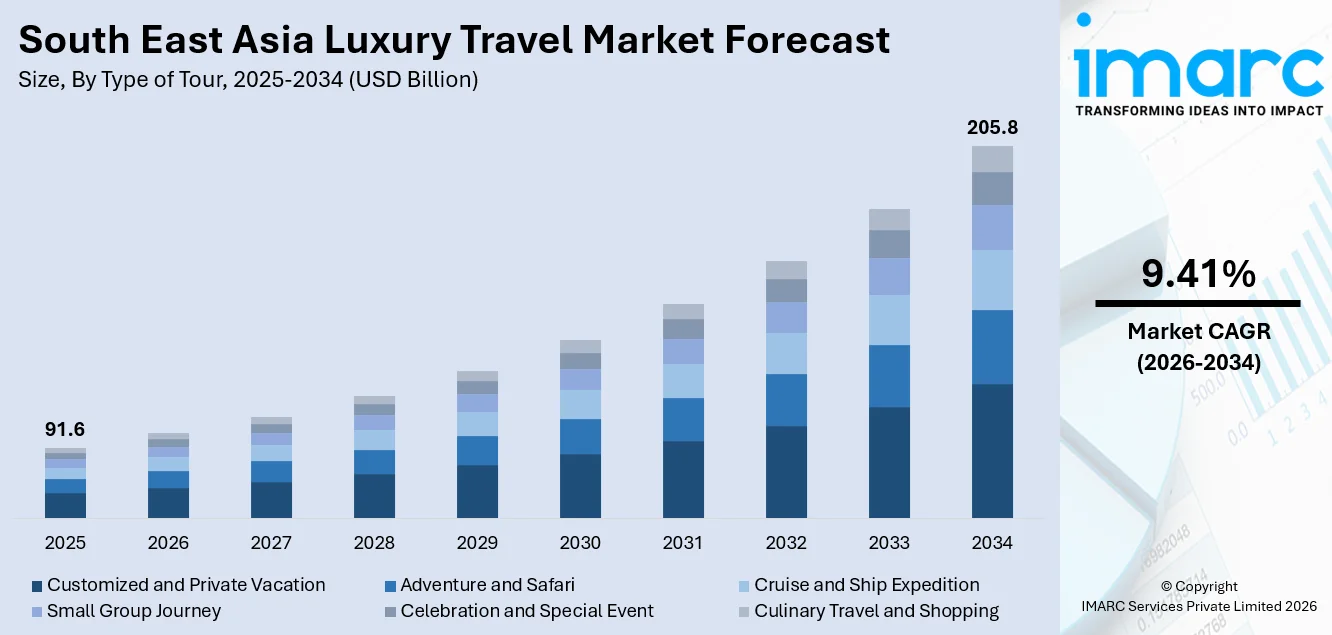
The South East Asia luxury travel market size was valued at USD 91.6 Billion in 2025 and is projected to reach USD 205.8 Billion by 2034, growing at a compound annual growth rate of 9.41% from 2026-2034.
Due to the region's growing affluent population, rising demand for carefully planned experiential travel, and top-notch hospitality infrastructure, the luxury travel market in South East Asia is expanding rapidly. Travel preferences are still changing due to the growing desire for custom lodgings, wellness-focused getaways, and culturally intensive itineraries. The market share of luxury travel in South East Asia is being further reinforced by improved air connectivity, lenient visa regulations, and changing customer demands for individualized luxury experiences.
Key Takeaways and Insights:
- By Type of Tour: Customized and private vacation dominates the market with a share of 25% in 2025, driven by rising traveler preference for tailor-made itineraries, private villa accommodations, and unique cultural interactions that provide highly customized and significant luxury experiences around the area.
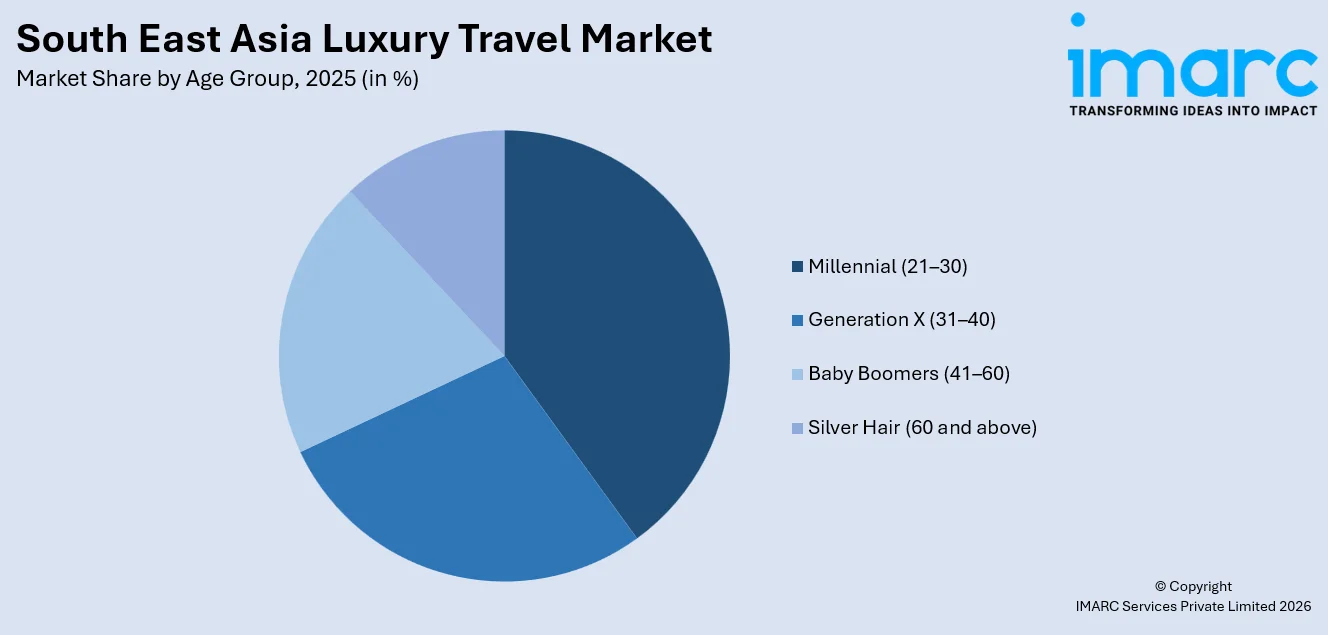
- By Age Group: Millennial (21–30) leads the market with a share of 32% in 2025, owing to their strong desire for authentic, experience-driven travel, growing digital connectivity, social media influence, and increasing disposable incomes that enable frequent exploration of premium destinations.
- By Type of Traveller: Aspiring luxury represents the largest segment with a market share of 40% in 2025, reflecting the expanding upper-middle-class population seeking premium travel experiences that combine comfort, exclusivity, and cultural immersion at accessible price points throughout South East Asia.
- Key Players: By growing resort portfolios, improving individualized service offerings, investing in wellness-integrated experiences, and fortifying distribution networks, major players propel the luxury tourism market in South East Asia. Their emphasis on sustainable hospitality, experiential innovation, and strategic alliances speeds up adoption and guarantees constant high-quality service delivery across a range of traveler demographics.
To get more information on this market Request Sample
As governments, hospitality organizations, and tourism players embrace premium service innovation and infrastructure modernization, the luxury travel market in South East Asia is growing gradually. Rising foreign visitor numbers in the area, which support the ongoing desire for upscale travel experiences, are a significant driver of this development. Visitor numbers have recovered strongly from the pandemic in all of the region's countries, with top travel destinations solidifying their positions with top-notch hospitality services and culturally immersive experiences. The region's attraction to wealthy tourists is being further enhanced by the growth of ultra-luxury hotel properties, spa retreats, and custom tour services. Longer and more expensive visits are being encouraged by supportive government policies, such as prolonged visa-free stays and digital nomad visa schemes. Additionally, younger, adventure-seeking tourists are being drawn to upscale locations by the increasing influence of social media and digital platforms in determining travel preferences. As an internationally competitive luxury travel center, South East Asia continues to attract discriminating travelers looking for unique and customized adventures across different landscapes and heritage-rich destinations because to its growing air connections, increased hospitality standards, and cultural diversity.
South East Asia Luxury Travel Market Trends:
Rise of Wellness-Integrated Luxury Hospitality
South East Asia is witnessing a transformative shift as wellness becomes a core element of luxury hospitality offerings. Travelers increasingly seek destinations that combine premium accommodations with holistic health experiences, including spa therapies, yoga retreats, and personalized wellness programs. For instance, in January 2025, Anantara Riverside Bangkok Resort unveiled a 677 square-metre Anantara Wellness complex featuring nine treatment suites, on-site traditional Chinese medicine consulting rooms, and membership packages incorporating biometric progress tracking. This integration of medical wellness with luxury travel is redefining guest expectations and elevating the South East Asia luxury travel market growth.
Expansion of Ultra-Luxury Hotel Infrastructure
The region is experiencing an unprecedented wave of ultra-luxury hotel openings as global hospitality brands deepen their footprint across key South East Asian destinations. New properties are setting elevated benchmarks through innovative design, culturally immersive experiences, and world-class amenities. For example, in October 2025, Hilton announced the signing of 17 new properties across six South East Asian countries, adding nearly 4,000 luxury and lifestyle rooms in markets including Thailand, Vietnam, Malaysia, Indonesia, Singapore, and the Philippines. This sustained investment in premium hospitality infrastructure is enhancing the region’s competitive positioning.
Growing Millennial and Gen Z Influence on Luxury Travel Preferences
Younger demographics are reshaping the South East Asia luxury travel landscape by prioritizing authenticity, cultural immersion, and digitally curated experiences over traditional opulence. Social media platforms significantly influence destination selection and travel planning among this cohort. According to C9 Hotelworks data from February 2025, approximately 58% of international visitor arrivals in Phuket in 2024 were aged between 18 and 44, underscoring the demographic shift toward younger luxury travelers. This trend is driving operators to develop more experiential, flexible, and technology-enabled premium offerings tailored to evolving millennial preferences.
Market Outlook 2026-2034:
The South East Asia luxury travel market is positioned for sustained growth, underpinned by expanding affluent consumer bases, deepening hospitality investments, and evolving traveler expectations for premium experiential journeys. The market generated a revenue of USD 91.6 Billion in 2025 and is projected to reach a revenue of USD 205.8 Billion by 2034, growing at a compound annual growth rate of 9.41% from 2026-2034. Increasing international tourist arrivals, supported by liberalized visa regimes and enhanced air connectivity, are expected to drive higher revenue streams across luxury accommodations, bespoke tour packages, and wellness-integrated travel offerings. The continued entry of global luxury hotel brands into emerging destinations, coupled with rising demand for customized and culturally immersive itineraries, will further strengthen the region’s competitive appeal and foster a more mature, diversified luxury travel ecosystem across South East Asia.
South East Asia Luxury Travel Market Report Segmentation:
|
Segment Category |
Leading Segment |
Market Share |
|
Type of Tour |
Customized and Private Vacation |
25% |
|
Age Group |
Millennial (21–30) |
32% |
|
Type of Traveller |
Aspiring Luxury |
40% |
Type of Tour Insights:
- Customized and Private Vacation
- Adventure and Safari
- Cruise and Ship Expedition
- Small Group Journey
- Celebration and Special Event
- Culinary Travel and Shopping
Customized and private vacation dominates with a market share of 25% of the total South East Asia luxury travel market in 2025.
The increased desire from tourists for bespoke itineraries that provide exclusivity, privacy, and highly customized cultural experiences has kept the customized and private holiday category at the top of the South East Asia luxury travel market. Rich tourists are becoming more and more interested in personalized dining experiences, carefully planned excursions, and exclusive villa stays. Demand in this market is being further bolstered by the growth of upscale destination management firms that specialize in highly customized travel packages to places like Bali, Phuket, and Hoi An. Travelers can create customized itineraries around the region with the help of premium operators who are creating multi-destination trips that smoothly integrate cultural heritage exploration, wellness retreats, and culinary discoveries.
The growth of high-end hospitality services catered to private tourists is increasing demand for personalized luxury vacations. Prominent ultra-luxury companies are making investments in remote resorts and private urban havens that value seclusion, personalized service, and culturally immersed programs for discriminating visitors. Travelers looking for unique and private South East Asian experiences are the target market for the proliferation of private island retreats, heritage villa conversions, and boutique wellness estates in both established and growing locations. As specialized luxury concierge platforms and customized travel advisory services become more widely available, seamless customization is made possible, enabling wealthy tourists to plan every element of their trip, from lodging to private guided tours and exclusive cultural access.
Age Group Insights:
Access the comprehensive market breakdown Request Sample
- Millennial (21–30)
- Generation X (31–40)
- Baby Boomers (41–60)
- Silver Hair (60 and above)
Millennial (21–30) leads the market with a share of 32% of the total South East Asia luxury travel market in 2025.
Due to their preference for genuine, experience-driven travel over conventional luxury indicators, millennials make up the most dynamic demographic segment in the South East Asia luxury travel sector. This generation places a high value on adventurous travel, wellness, and cultural immersion. They typically look for locations that provide exceptional comfort and memorable moments fit for social media. Peer recommendations, visually appealing platforms that highlight off-the-beaten-path premium destinations, and digital content makers all have a significant impact on their travel choices. Because of this demographic shift, hospitality providers are rethinking what they offer, focusing on sustainable luxury concepts, local community involvement, and authentic experiences that appeal to millennial values and travel aspirations throughout the region.
The way luxury operators create and promote their products in South East Asia is changing as a result of millennials' increasing purchasing power, digital literacy, and desire for flexible, customized travel arrangements. Curated health retreats, immersive culinary adventures, and eco-conscious luxury experiences are increasingly being created by tour operators and hotel firms with this demographic in mind. Millennials are traveling for longer periods of time due to the growth of remote work and digital nomad lifestyles, which has increased demand for long-term luxury lodging, co-living spaces, and destination-blended work-leisure experiences across the region. In order to draw in and keep millennial visitors who are looking for deep relationships in addition to first-rate comfort, luxury hotels are now including technologically advanced amenities, smooth online booking systems, and community-focused programming.
Type of Traveller Insights:
- Absolute Luxury
- Aspiring Luxury
- Accessible Luxury
The aspiring luxury segment exhibits a clear dominance with a 40% share of the total South East Asia luxury travel market in 2025.
Due to the rapidly growing upper-middle-class population in the region, aspirant luxury travelers make up the largest traveler segment in the South East Asia luxury travel market. They are looking for high-end travel experiences that strike a compromise between exclusivity and affordability. This market is made up of tourists who want luxurious comfort and well chosen experiences but are still cost-conscious. They frequently look for boutique hotels, carefully planned group tours, and high-end activities at reasonable prices. Their increasing involvement is increasing the addressable market for luxury operators and promoting the creation of tiered hospitality products intended to close the gap between standard tourism and ultra-luxury travel, opening up premium experiences to a wider range of more discriminating customers throughout the region.
The growing affluence in economies like Indonesia, the Philippines, and Vietnam, where rising disposable incomes allow a wider consumer base to purchase premium travel products, is driving a considerable expansion of the aspiring luxury segment. In response, hospitality companies are creating tiered luxury goods, such as high-end economy cruises, carefully chosen cultural events, and boutique resort packages that offer superior comfort at affordable prices. The region's segment growth is being further accelerated by the availability of digital booking platforms catered to aspirational tourists, loyalty programs, and flexible payment alternatives. First-time luxury travelers are being encouraged to discover South East Asia's varied portfolio of premium destinations by social media exposure to luxury travel lifestyles and the democratization of premium hospitality through marketing campaigns and seasonal offers.
Country Insights:
- Indonesia
- Thailand
- Singapore
- Philippines
- Vietnam
- Malaysia
- Others
Indonesia's luxury travel market is booming because to Bali's long-standing appeal as a top resort and wellness destination as well as new luxury options in places like Lombok and Komodo. Bali continues to be the main attraction for wealthy tourists, and the nation continues to draw an increasing number of foreign visitors. Indonesia's position as a top luxury tourism destination in the area is being strengthened by the expansion of ultra-luxury resort developments, private island getaways, and culturally immersive experiences.
With its top-notch hospitality infrastructure and steadily growing portfolio of ultra-luxury properties, Thailand continues to be the top luxury travel destination in South East Asia. The country's premium appeal is being enhanced by the entry of prominent businesses into the capital and resort areas, as well as the growth of wellness tourism offers. Government programs, such as extending visa-free stays for many nations, continue to draw wealthy tourists and support Thailand's luxury tourism industry.
Singapore is the leading destination for luxury tourism in South East Asia, offering world-class hospitality, aircraft connectivity, and sophisticated urban experiences. The city-state's hotel industry continues to grow due to the high demand for upscale vacation experiences. Singapore is a key entry point for wealthy tourists visiting the larger South East Asian luxury travel circuit because of its concentration of five-star hotels, Michelin-starred restaurants, upscale shopping areas, and high-profile events.
By utilizing its pristine island landscapes, private resort experiences, and expanding wellness tourism services, the Philippines is becoming a unique luxury travel destination. Exquisite private island homes are a prime example of the nation's remarkable potential in the upscale market. The demand for luxury travel both domestically and abroad is being driven by a fast growing base of wealthy households, which is also drawing more foreign hospitality investment to the nation's island attractions.
Vietnam's luxury tourism market is the fastest-growing in South East Asia, with steady annual growth in foreign tourists. Strong investor confidence in the nation's premium tourist potential is demonstrated by the growing pipeline of luxury hotels. Premium resort developments are drawn to locations like Da Nang, Phu Quoc, and Hoi An, and demand for customized luxury experiences is being driven by Vietnam's rich cultural legacy and culinary customs.
Malaysia's luxury travel market is gaining momentum, supported by the arrival of prestigious international hotel brands and expanding premium hospitality offerings across Langkawi, Penang, and Sabah. The country continues to attract a growing number of international tourists, with the Visit Malaysia 2026 campaign expected to further accelerate arrivals. Malaysia's competitive pricing, cultural diversity, and strategic geographic positioning make it an increasingly attractive destination for aspiring luxury travelers.
Market Dynamics:
Growth Drivers:
Why is the South East Asia Luxury Travel Market Growing?
Surging International Tourist Arrivals and Post-Pandemic Recovery
South East Asia's luxury travel market is benefiting significantly from the region's strong post-pandemic tourism recovery, with international arrivals reaching levels approaching or exceeding pre-pandemic benchmarks across key destinations. The resumption of international air routes, expansion of low-cost and premium carrier networks, and increasing traveler confidence have collectively driven a surge in visitor numbers across major luxury travel hubs. This recovery is particularly pronounced in the luxury segment, where demand for premium accommodations, exclusive tour packages, and curated cultural experiences has outpaced overall tourism growth. High-spending travelers from established source markets such as China, South Korea, India, and Western economies are returning in greater numbers, while emerging source markets are adding new demand layers. The sustained momentum in visitor arrivals is underpinning revenue growth across luxury hotels, premium cruise lines, and bespoke travel operators, reinforcing the region's position as a globally competitive luxury travel destination and creating favorable conditions for continued market expansion throughout the forecast period.
Expanding Affluent Consumer Base Across the Region
The rapid expansion of the affluent and upper-middle-class population across South East Asia is creating a larger addressable market for luxury travel services. Rising disposable incomes, urbanization, and sustained economic development in countries such as Indonesia, Vietnam, and the Philippines are enabling a growing number of consumers to access premium travel experiences for the first time. Several South East Asian markets are witnessing among the steepest climbs in affluent households globally, signaling a significant shift in the luxury consumer landscape toward the region. This expanding wealth base is driving demand across all luxury travel segments, from aspirational boutique experiences to ultra-luxury private island retreats. Domestic luxury travel within the region is also growing, as newly affluent consumers explore premium destinations within their own countries and neighboring markets before venturing further afield. The democratization of luxury through tiered product offerings and accessible premium hospitality concepts is enabling broader participation in the premium travel market and sustaining long-term segment growth.
Supportive Government Policies and Visa Liberalization
Government-led tourism promotion initiatives and visa liberalization measures across South East Asia are creating a more accessible and attractive environment for international luxury travelers. Countries are actively competing to attract high-spending visitors through streamlined entry requirements, extended visa-free stay provisions, digital nomad visa programs, and targeted marketing campaigns directed at affluent demographics. Multiple nations have significantly expanded their visa-free arrangements, extended permissible stay durations for key source markets, and introduced specialized long-stay visa categories designed to attract remote workers, retirees, and high-net-worth individuals. Electronic visa systems and digital arrival processes are being modernized to ensure seamless and efficient entry experiences for premium travelers. These coordinated policy efforts across the region are lengthening average visitor stays, increasing per-visitor expenditure, and strengthening South East Asia's collective appeal as a multi-destination luxury travel corridor where affluent travelers can seamlessly explore diverse cultural, wellness, and experiential offerings across several countries within a single journey.
Market Restraints:
What Challenges the South East Asia Luxury Travel Market is Facing?
Infrastructure Gaps in Emerging Luxury Destinations
Despite significant progress in established destinations, many emerging luxury tourism corridors across South East Asia continue to face inadequate transportation networks, limited connectivity, and underdeveloped utility infrastructure. Remote island destinations and secondary cities often lack the road quality, airport capacity, and reliable utilities required to support premium hospitality operations consistently. These infrastructure limitations can deter luxury hospitality investment, constrain guest experience quality, and restrict the scalability of new luxury tourism developments in otherwise promising destinations.
Overtourism and Environmental Sustainability Pressures
Popular luxury destinations such as Bali, Phuket, and Boracay face mounting overtourism pressures that threaten the pristine environments and exclusive experiences that define luxury travel. Environmental degradation, including coral reef damage, water pollution, and waste management challenges, undermines the natural appeal of these destinations. Balancing the influx of mass tourism with the preservation of exclusivity and environmental integrity required by luxury travelers remains a significant challenge, prompting some destinations to implement visitor caps and sustainability regulations that may affect market growth.
Geopolitical Uncertainties and Economic Volatility
The South East Asia luxury travel market remains susceptible to geopolitical tensions, trade disruptions, and macroeconomic volatility that can rapidly impact international travel flows and consumer confidence. Currency fluctuations, inflationary pressures, and shifting trade policies in key source markets such as China and Western economies can reduce outbound luxury travel demand. Additionally, regional political instability in certain South East Asian markets creates uncertainty for both hospitality investors and affluent travelers, potentially constraining long-term growth in the premium travel segment.
Competitive Landscape:
The South East Asia luxury travel market is characterized by intensifying competition as global and regional hospitality operators expand their premium portfolios across established and emerging destinations. Market participants are differentiating through experiential innovation, wellness-integrated offerings, culturally immersive programming, and sustainable luxury concepts. Competition is further driven by investments in ultra-luxury resort developments, branded residences, and boutique hospitality concepts tailored to evolving traveler preferences. Strategic partnerships between international hotel chains and local operators are fostering innovation, accelerating premium property launches, and improving distribution reach, enabling market players to strengthen positioning and capture a larger share of the region’s growing luxury travel demand.
South East Asia Luxury Travel Market Report Coverage:
| Report Features | Details |
|---|---|
| Base Year of the Analysis | 2025 |
| Historical Period | 2020-2025 |
| Forecast Period | 2026-2034 |
| Units | Billion USD |
| Scope of the Report | Exploration of Historical Trends and Market Outlook, Industry Catalysts and Challenges, Segment-Wise Historical and Future Market Assessment:
|
| Types of Tour Covered | Customized and Private Vacation, Adventure and Safari, Cruise and Ship Expedition, Small Group Journey, Celebration and Special Event, Culinary Travel and Shopping |
| Age Groups Covered | Millennial (21-30), Generation X (31-40), Baby Boomers (41-60), Silver Hair (60 and above) |
| Types of Traveller Covered | Absolute Luxury, Aspiring Luxury, Accessible Luxury |
| Countries Covered | Indonesia, Thailand, Singapore, Philippines, Vietnam, Malaysia, Others |
| Customization Scope | 10% Free Customization |
| Post-Sale Analyst Support | 10-12 Weeks |
| Delivery Format | PDF and Excel through Email (We can also provide the editable version of the report in PPT/Word format on special request) |
Frequently Asked Questions About the South East Asia Luxury Travel Market Report
The South East Asia luxury travel market size was valued at USD 91.6 Billion in 2025.
The South East Asia luxury travel market is expected to grow at a compound annual growth rate of 9.41% from 2026-2034 to reach USD 205.8 Billion by 2034.
Customized and private vacation dominated the market with a share of 25%, driven by growing demand for tailor-made itineraries, private villa accommodations, and exclusive cultural encounters that deliver deeply personalized luxury experiences across South East Asian destinations.
Key factors driving the South East Asia luxury travel market include surging international tourist arrivals, expanding affluent consumer bases, supportive government visa policies, growing wellness tourism demand, expanding ultra-luxury hotel infrastructure, and rising millennial preference for experiential travel.
Major challenges include infrastructure gaps in emerging destinations, overtourism and environmental sustainability pressures, geopolitical uncertainties, economic volatility in key source markets, and balancing mass tourism growth with luxury exclusivity preservation.
Need more help?
- Speak to our experienced analysts for insights on the current market scenarios.
- Include additional segments and countries to customize the report as per your requirement.
- Gain an unparalleled competitive advantage in your domain by understanding how to utilize the report and positively impacting your operations and revenue.
- For further assistance, please connect with our analysts.
 Request Customization
 Speak to an Analyst
 Request Brochure
 Inquire Before Buying
Benefits of Customization
- Personalize this research
- Triangulate with your data
- Get data as per your format and definition
- Gain a deeper dive into a specific application, geography, customer, or competitor
- Any level of personalization
Get in Touch With Us
UNITED STATES
Phone: +1-201-971-6302
INDIA
Phone: +91-120-433-0800
UNITED KINGDOM
Phone: +44-753-714-6104
Email: [email protected]
Client Testimonials




.webp)




.webp)













Related Reports

Choose your plan
*Please note that the prices mentioned below are starting prices for each bundle type. Kindly contact our team for further details.*
Single User License
- 1 User License, Access on 2 Devices
- PDF Report + Excel Dataset (Password Protected)
- Lifetime Access
- No Printing Rights
- 10% Free Report Customization
- 10–12 Weeks of Analyst Support
Five User License
- Access for 5 Users, 2 Devices per User
- PDF Report + Excel Dataset (Password Protected)
- Lifetime Access
- Dedicated Account Manager
- 12–14 Weeks of Analyst Support
- No Printing Rights
- 15% Free Report Customization
- 25% Discount on Your Next Purchase
Corporate User License
- Unlimited User Access (Within Your Organization)
- PDF Report + Excel Dataset
- Lifetime Access
- Dedicated Account Manager
- 14–20 Weeks of Analyst Support
- No Printing Rights
- 20% Free Report Customization
- 30% Discount on Your Next Purchase
Essential Insights
What's included:
3 reports
- Lifetime Access
- PDF Reports
- Excel Datasets
- 2 Weeks of Free Analyst Support
- 2 User Licenses
- Access on 2 Devices
- Printing Rights
- Complimentary PowerPoint (PPT) Version
- Complimentary License Upgrade
Professional Access
What's included:
5 reports
- Lifetime Access
- PDF Reports
- Excel Datasets
- 8 Weeks of Free Analyst Support
- 2 User Licenses
- Access on 2 Devices
- Printing Rights
- Complimentary PowerPoint (PPT) Version
- Complimentary License Upgrade
Business Advantage
What's included:
8 reports
- Lifetime Access
- PDF Reports
- Excel Datasets
- 14 Weeks of Free Analyst Support
- 2 User Licenses
- Access on 2 Devices
- Printing Rights
- Complimentary PowerPoint (PPT) Version
- Complimentary License Upgrade
Enterprise Intelligence
What's included:
10 reports
- Lifetime Access
- PDF Reports
- Excel Datasets
- 20 Weeks of Free Analyst Support
- 2 User Licenses
- Access on 2 Devices
- Printing Rights
- Complimentary PowerPoint (PPT) Version
- Complimentary License Upgrade