
South Korea Aquafeed Market Size, Share, Trends and Forecast by Species, Ingredients, Additives, Product Form, and Region, 2026-2034
South Korea Aquafeed Market Summary:
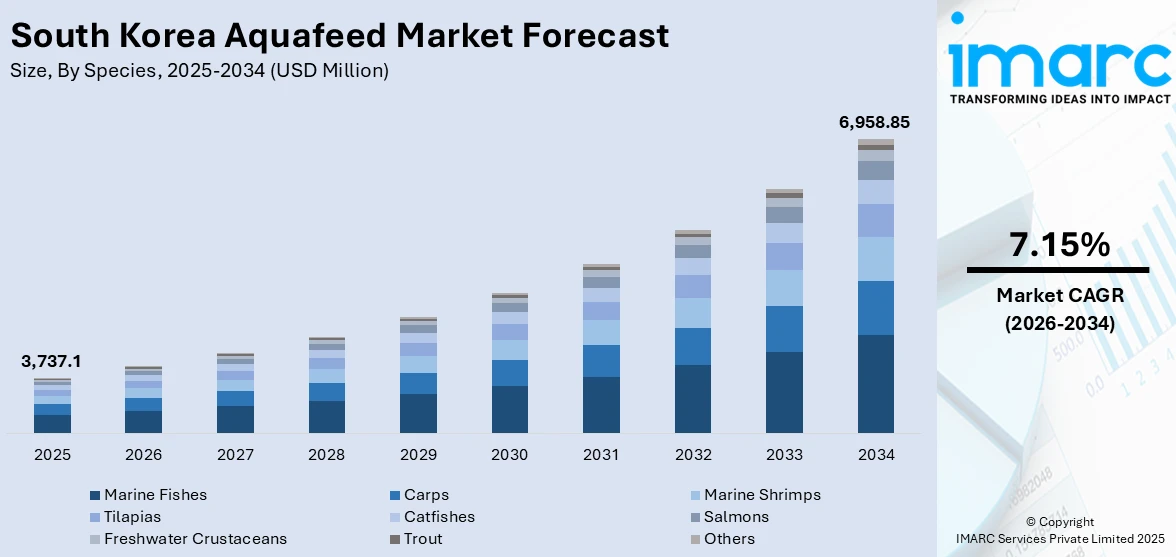
The South Korea aquafeed market size was valued at USD 3,737.10 Million in 2025 and is projected to reach USD 6,958.85 Million by 2034, growing at a compound annual growth rate of 7.15% during 2026-2034.
The South Korea aquafeed market is experiencing robust expansion driven by the country’s thriving aquaculture sector, growing seafood consumption, and increasing emphasis on sustainable farming practices. Rising investments in smart aquaculture technologies, including recirculating aquaculture systems and automated feed management, are reshaping production capabilities. Government-led modernization programs, advancements in functional feed formulations, and expanding marine finfish cultivation are further reinforcing demand. Additionally, the shift toward nutritionally optimized and eco-friendly feed solutions is creating new growth opportunities, strengthening the South Korea aquafeed market share.
Key Takeaways and Insights:
- By Species: Marine fishes hold the largest market share at 34.7% in 2025, reflecting strong demand for premium marine finfish aquaculture feed in South Korea’s expanding coastal and offshore farming operations.
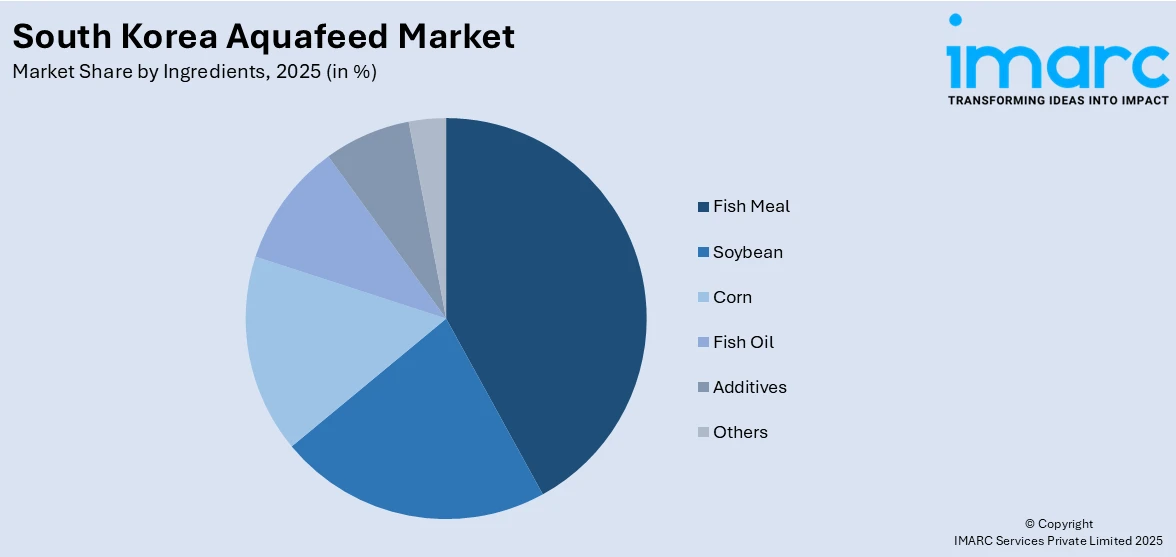
- By Ingredients: Fish meal dominates the market with a 41.5% share in 2025, serving as the primary protein source in aquafeed formulations due to its high digestibility and essential amino acid profile for marine species.
- By Additives: Vitamins and minerals account for the largest share at 48.2% in 2025, driven by their critical role in enhancing immune function, disease resistance, and growth performance across farmed aquatic species.
- By Product Form: Pellets led the market with a 52.6% share in 2025, preferred for their nutrient stability, ease of automated distribution, and superior water compatibility across diverse aquaculture operations.
- By Region: Seoul Capital Area accounts for the highest revenue share at 37.8% in 2025, supported by its concentration of aquafeed manufacturing facilities, corporate headquarters, and proximity to major seafood distribution networks.
- Key Players: The South Korea aquafeed market features a competitive landscape with domestic and international companies expanding product portfolios, investing in sustainable formulations, and leveraging advanced feed technologies to strengthen market presence.
To get more information on this market Request Sample
The South Korea aquafeed market is progressing steadily as the country’s aquaculture industry embraces modernization, sustainability, and advanced nutritional science to meet evolving seafood demands. A major catalyst reinforcing this progress is the government’s commitment to transforming aquaculture through smart technology adoption and infrastructure development. For instance, in 2024, South Korea’s Ministry of Oceans and Fisheries expanded fisheries policy funds to a historical high of KRW 4.1 Trillion, supporting smart aquaculture cluster development, automated feed systems, and eco-friendly farming transitions. Increasing domestic cultivation of high-value marine species such as olive flounder, salmon, and rockfish is directly boosting demand for species-specific, high-performance aquafeed. The growing adoption of functional feed additives, alternative protein ingredients, and precision feeding technologies is further strengthening the market’s trajectory. Moreover, continued collaboration between government agencies, research institutions, and private enterprises is positioning South Korea as a key aquafeed market in the Asia Pacific region.
South Korea Aquafeed Market Trends:
Rising Adoption of Smart Aquaculture and Recirculating Aquaculture Systems
South Korea is witnessing a significant shift toward technology-driven aquaculture, with land-based farming systems gaining momentum. For instance, in December 2024, GS Engineering & Construction inaugurated the Busan Smart Aquaculture Cluster, the country’s first land-based salmon farm utilizing recirculating aquaculture system (RAS) technology with a capacity of 500 metric tons annually. The growing deployment of smart monitoring systems, automated feed delivery, and water quality management solutions is enhancing production efficiency and supporting South Korea aquafeed market growth.
Growing Emphasis on Sustainable and Certified Aquafeed Practices
Sustainability is increasingly shaping South Korea’s aquafeed landscape as stakeholders prioritize eco-friendly production methods and responsible sourcing. For instance, in June 2025, the Aquaculture Stewardship Council (ASC) signed a Memorandum of Understanding with South Korea’s National Institute of Fisheries Science (NIFS) to develop innovative aquaculture technologies and ecosystem-based certification standards. Moreover, the rising demand for traceable, sustainably sourced feed ingredients is encouraging manufacturers to adopt certified supply chains and environmentally conscious formulations.
Expansion of Functional Feed Additives and Alternative Protein Integration
The South Korean aquafeed industry is steadily shifting toward advanced formulations that emphasize functional additives and alternative protein sources to improve feed efficiency and sustainability. Producers are adopting insect meal, algae-derived proteins, and single-cell proteins to lower reliance on fishmeal and fish oil. These alternatives help stabilize raw material sourcing, support consistent feed quality, and strengthen supply chain resilience. The transition also aligns with broader efforts to improve farm productivity while addressing cost pressures and environmental expectations in aquaculture.
Market Outlook 2026-2034:
The South Korea aquafeed market is positioned for sustained expansion over the forecast period, supported by accelerating aquaculture modernization, rising seafood consumption, and increasing government investment in sustainable farming infrastructure. According to an industry report, South Korea’s per capita fish and seafood consumption rose from USD 223.97 in 2020 to USD 283.67 in 2024, growing at a 6.08% CAGR and far exceeding Northeast Asia’s USD 101.47 average. In line with this, expanding domestic production of high-value marine species, ongoing investments in recirculating aquaculture systems and smart farming clusters, and advancements in functional feed formulations are expected to drive higher demand for premium aquafeed solutions. Additionally, strengthening emphasis on traceability, sustainability certifications, and alternative protein integration is creating new growth avenues, positioning South Korea as a prominent aquafeed market within the broader Asia Pacific region. The market generated a revenue of USD 3,737.10 Million in 2025 and is projected to reach a revenue of USD 6,958.85 Million by 2034, growing at a compound annual growth rate of 7.15% during 2026-2034.
South Korea Aquafeed Market Report Segmentation:
|
Segment Category |
Leading Segment |
Market Share |
|
Species |
Marine Fishes |
34.7% |
|
Ingredients |
Fish Meal |
41.5% |
|
Additives |
Vitamins and Minerals |
48.2% |
|
Product Form |
Pellets |
52.6% |
|
Region |
Seoul Capital Area |
37.8% |
Species Insights:
- Carps
- Marine Shrimps
- Tilapias
- Catfishes
- Marine Fishes
- Salmons
- Freshwater Crustaceans
- Trout
- Others
Marine fishes lead the market with a revenue share of 34.7% of the total South Korea aquafeed market in 2025.
Marine finfish aquaculture represents the cornerstone of South Korea’s aquafeed demand, driven by intensive cultivation of high-value species including olive flounder, black rockfish, red seabream, and yellowtail. The country’s extensive coastal farming infrastructure and well-established marine hatchery systems support large-scale production requiring specialized, nutrient-dense feed formulations. As such, Olive flounder alone constitutes approximately 65% of South Korea’s total farmed fish output, underscoring the species’ outsized influence on marine aquafeed consumption. The rising emphasis on product quality and consistent supply to domestic seafood markets is reinforcing demand for premium marine fish feed solutions.
Government-led initiatives to expand offshore aquaculture and develop new farming sites in the East Sea are further strengthening demand for marine fish aquafeed. The government initiatives prioritize expanding marine aquaculture capacity and advancing land-based smart farming for high-value species. These strategic investments in production infrastructure, species diversification, and sustainable farming technologies are creating sustained growth opportunities for marine fish feed manufacturers across the country.
Ingredients Insights:
Access the comprehensive market breakdown Request Sample
- Soybean
- Corn
- Fish Meal
- Fish Oil
- Additives
- Others
Fish meal dominates the market with a share of 41.5% of the South Korea aquafeed market in 2025.
Fish meal remains the most critical protein ingredient in South Korea’s aquafeed industry, valued for its superior amino acid composition, high digestibility, and proven growth-promoting properties across marine and freshwater species. The ingredient’s essential role in formulating feeds for carnivorous marine species such as olive flounder and rockfish sustains its dominant position. Furthermore, the price volatility is prompting South Korean aquafeed manufacturers to explore ingredient diversification strategies while maintaining fishmeal’s core nutritional benefits.
The sustained reliance on fish meal in South Korea is supported by the country’s significant marine finfish aquaculture sector, which demands high-protein feed formulations to achieve optimal growth rates and feed conversion ratios. Domestic feed manufacturers are increasingly investing in research to optimize fishmeal inclusion levels by blending complementary protein sources such as soybean meal and fermented ingredients without compromising feed performance. The growing focus on sustainable sourcing practices, including procurement from certified fisheries, is also shaping the fish meal supply chain. These evolving strategies are ensuring fish meal’s continued relevance while addressing cost and sustainability pressures in the market.
Additives Insights:
- Vitamins and Minerals
- Antioxidants
- Feed Enzymes
- Others
Vitamins and minerals account for the highest revenue share of 48.2% in the South Korea aquafeed market in 2025.
Vitamins and minerals constitute the most essential additive category in South Korea’s aquafeed formulations, playing a fundamental role in supporting immune function, bone development, metabolic processes, and overall health of farmed aquatic species. The intensive nature of South Korean aquaculture, particularly in land-based and high-density marine cage systems, necessitates precise vitamin and mineral supplementation to prevent nutritional deficiencies and optimize growth performance.
The growing adoption of recirculating aquaculture systems and controlled-environment farming operations in South Korea is further amplifying the need for comprehensive vitamin and mineral supplementation in feed formulations. These advanced farming systems limit natural nutrient intake from the environment, making manufactured feed the primary source of essential micronutrients. Feed manufacturers are responding by developing advanced premix solutions that deliver optimized vitamin and mineral profiles tailored to species-specific requirements and life-stage nutritional demands. The increasing focus on disease prevention through nutritional interventions rather than antibiotic use is also strengthening the position of vitamins and minerals as critical aquafeed components.
Product Form Insights:
- Pellets
- Extruded
- Powdered
- Liquid
Pellets hold the largest share at 52.6% of the South Korea aquafeed market in 2025.
Pelleted aquafeed represents the most widely utilized product form in South Korea’s aquaculture industry, valued for its nutrient stability, uniform composition, and compatibility with automated feeding systems. The country’s progressive transition from traditional moist pellet feeds, composed primarily of raw fish mixed with compound feed, toward fully formulated dry pellets is a significant trend reshaping feed production. The shift is driven by the recognition that dry pellets offer superior water stability, reduced pollution loads, and lower disease transmission risks compared to conventional moist feed preparations. South Korea’s aquaculture sector produced over 3.3 Million Tons of output in 2024, sustaining strong demand for efficient pelleted feed solutions.
The expanding deployment of automated feeding infrastructure across South Korea’s marine and land-based aquaculture facilities is further reinforcing pellet dominance. Automated feed delivery systems, which are increasingly integrated into smart aquaculture clusters and RAS facilities, require uniform pellet sizes and consistent nutritional compositions for optimal dispensing and fish intake. Feed manufacturers are investing in advanced extrusion and pelleting technologies that enhance digestibility, control sinking rates, and improve palatability for target species. These technological advancements, combined with regulatory encouragement to reduce raw fish usage in favor of formulated feeds, are positioning pellets as the cornerstone product form in South Korea’s evolving aquafeed market.
Regional Insights:
- Seoul Capital Area
- Yeongnam (Southeastern Region)
- Honam (Southwestern Region)
- Hoseo (Central Region)
- Others
Seoul Capital Area is the largest segment, accounting for 37.8% of the South Korea aquafeed market in 2025.
The Seoul Capital Area serves as the primary commercial and logistical hub for South Korea’s aquafeed industry, concentrating major feed manufacturing operations, corporate headquarters, research and development facilities, and distribution networks. The region’s advanced transportation infrastructure enables efficient supply chain management, connecting feed producers with aquaculture operations across the country. For example, in January 2026, the city of Busan announced a KRW 10 Billion investment to establish Korea’s first aquaculture big data center, integrating artificial intelligence and big data analytics to transform fish farming into a digitally driven smart industry, further reinforcing technology-led growth in the market.
The Seoul Capital Area’s dominance is further reinforced by its concentration of academic institutions, government agencies, and industry associations that drive aquafeed research and policy development. Major aquafeed companies maintain their national and regional coordination centers in this area, leveraging proximity to key decision-makers, regulatory bodies, and financial markets. The region’s role as a gateway for international trade and technology partnerships also supports the introduction of innovative feed ingredients and advanced formulation technologies. These strategic advantages position the Seoul Capital Area as the commanding force in South Korea’s aquafeed market landscape.
Market Dynamics:
Growth Drivers:
Why is the South Korea Aquafeed Market Growing?
Government Investments in Aquaculture Modernization and Infrastructure Development
South Korea’s government is spearheading significant investments to modernize its aquaculture sector, creating a strong foundation for sustained aquafeed demand growth. The Ministry of Oceans and Fisheries has prioritized smart aquaculture transformation through targeted funding programs, regulatory reforms, and infrastructure development. For instance, in April 2025, Jeonnam Province planned to invest KRW 57.2 Billion to advance eco-friendly aquaculture through infrastructure upgrades, smart farming clusters, disaster prevention, disease control, and development of climate-resilient, high-value species to ensure sustainable seafood production. These government-backed initiatives are expanding the scale and sophistication of domestic fish farming operations, directly increasing demand for high-quality, formulated aquafeed products. The establishment of Smart Aquaculture Clusters in regions such as Busan and Gangneung-Yangyang, designed to produce high-value species like Atlantic salmon, further demonstrates the alignment between public investment and aquafeed market expansion.
Expanding Domestic Aquaculture Production and Rising Seafood Consumption
South Korea’s growing aquaculture output and steady domestic seafood demand are fundamental drivers of aquafeed market expansion. The country’s aquaculture sector reached a substantial production volume, supported by increasing cultivation of marine finfish, shellfish, and seaweed. The government’s Third Basic Plan for Fisheries Development sets an ambitious target to boost total seafood production to 4 million tonnes by 2030, which will require substantial increases in commercial feed supply. Similarly, rising health consciousness among South Korean consumers is sustaining demand for protein-rich seafood, including salmon, olive flounder, and rockfish, all of which require premium aquafeed formulations. The expansion of land-based and offshore aquaculture facilities, combined with diversification into new high-value species, is creating broader and more specialized feed requirements. The growing emphasis on reducing reliance on imported seafood through domestic production enhancement is further reinforcing the structural demand for aquafeed across the country.
Increasing Emphasis on Sustainability Certifications and Traceability Standards
The growing adoption of sustainability certifications and traceability frameworks in South Korea’s aquaculture sector is creating new quality benchmarks that directly influence aquafeed demand. Furthermore, the achievement of landmark certifications, such as South Korea’s Raon Bada earning the world’s first ASC certification for olive flounder, demonstrates the rising standards applied to farming operations and their associated feed inputs. Certified operations increasingly require aquafeed produced with traceable, responsibly sourced ingredients and eco-friendly manufacturing processes. This trend is encouraging feed manufacturers to invest in certified supply chains, alternative proteins, and transparent ingredient sourcing practices, thereby strengthening overall market quality and driving premium aquafeed adoption across the sector.
Market Restraints:
What Challenges the South Korea Aquafeed Market is Facing?
Rising Raw Material Costs and Fishmeal Price Volatility
The aquafeed industry in South Korea faces significant cost pressures due to the volatility of key raw material prices, particularly fishmeal and fish oil. Global fishmeal prices have surged considerably since early 2024, driven by reduced anchoveta harvests and tightening supply from major producing regions. This price escalation increases production costs for feed manufacturers and compresses margins, particularly for small and medium-sized producers. The heavy reliance on imported fishmeal and other protein ingredients exposes the South Korean market to international supply disruptions and currency fluctuations, creating persistent cost management challenges.
Environmental Challenges from Intensive Aquaculture Operations
Intensive aquaculture practices in South Korea’s coastal waters have led to environmental concerns including nutrient overloads, harmful algal blooms, and water quality deterioration. Excess nutrients from uneaten feed and fish waste contribute to eutrophication in farming zones, particularly in southeastern coastal regions where finfish cage density is high. These environmental pressures not only threaten the health of farmed and wild aquatic species but also invite stricter regulatory oversight and operational constraints, potentially limiting the expansion of conventional aquaculture operations and associated aquafeed consumption.
Dependence on Imported Ingredients and Supply Chain Vulnerabilities
South Korea’s aquafeed industry relies heavily on imported raw materials, including fishmeal, soybean meal, corn, and specialty additives, making it vulnerable to global supply chain disruptions. Geopolitical tensions, trade policy changes, and logistical challenges can cause delays and cost increases in sourcing critical feed ingredients. The limited domestic production capacity for key raw materials constrains the industry’s ability to buffer against international market fluctuations. Additionally, climate change impacts on global fisheries and crop production further threaten the stability and affordability of essential aquafeed ingredient supply chains.
Competitive Landscape:
The South Korean aquafeed market presents a competitive environment which shows moderate consolidation because domestic producers and international feed companies fight for market share. The main companies in the market focus on three areas to create unique products which include increasing their production capacity, creating specialized feed for different species, and developing sustainable methods of ingredient acquisition. The strategic alliances which feed manufacturers establish with research institutions and government agencies create new pathways for developing functional additives, alternative protein sources, and precision feeding systems. The companies use new technologies in smart manufacturing and quality control systems and digital supply chain management to improve their operational efficiency while they progress to meet the changing needs of the modernizing aquaculture industry in South Korea.
Recent Developments:
- In December 2025, Peru, FAO, and South Korea launched SANISMART, an AI-powered big data platform to anticipate health risks in shrimp aquaculture. The initiative creates biosecurity enhancements together with tracing improvements and it provides decision-making support through its digital monitoring system which operates with national biosecurity frameworks and responsible antimicrobial usage.
- In May 2025, the first land-based salmon farm in South Korea started its operations in Busan through the implementation of Norwegian RAS technology, which enables the facility to produce 500 tons of salmon annually with its first harvest scheduled for 2026. The project supports smart aquaculture and sustainability measures while decreasing the need for imported products, which will enable the facility to expand its production capacity to 5000 tons in coming years.
South Korea Aquafeed Market Report Coverage:
|
Report Features |
Details |
|
Base Year of the Analysis |
2025 |
|
Historical Period |
2020-2025 |
|
Forecast Period |
2026-2034 |
|
Units |
Million USD |
|
Scope of the Report |
Exploration of Historical Trends and Market Outlook, Industry Catalysts and Challenges, Segment-Wise Historical and Future Market Assessment:
|
|
Species Covered |
Carps, Marine Shrimps, Tilapias, Catfishes, Marine Fishes, Salmons, Freshwater Crustaceans, Trout, Others |
|
Ingredients Covered |
Soybean, Corn, Fish Meal, Fish Oil, Additives, Others |
|
Additives Covered |
Vitamins and Minerals, Antioxidants, Feed Enzymes, Others |
|
Product Form Covered |
Pellets, Extruded, Powdered, Liquid |
|
Regions Covered |
Seoul Capital Area, Yeongnam (Southeastern Region), Honam (Southwestern Region), Hoseo (Central Region), Others |
|
Customization Scope |
10% Free Customization |
|
Post-Sale Analyst Support |
10-12 Weeks |
|
Delivery Format |
PDF and Excel through Email (We can also provide the editable version of the report in PPT/Word format on special request) |
Frequently Asked Questions About the South Korea Aquafeed Market Report
The South Korea aquafeed market size was valued at USD 3,737.10 Million in 2025.
The market is expected to grow at a compound annual growth rate of 7.15% during 2026-2034 to reach USD 6,958.85 Million by 2034.
Marine fishes, holding the largest revenue share of 34.7%, lead the South Korea aquafeed market, driven by intensive cultivation of high-value species such as olive flounder and rockfish that require specialized, nutrient-dense feed formulations.
Key factors driving the South Korea aquafeed market include government investments in aquaculture modernization, expanding domestic seafood production, rising consumer health awareness, growing sustainability certification adoption, and advancements in smart aquaculture technologies.
Major challenges include rising raw material and fishmeal costs, environmental pressures from intensive aquaculture, dependence on imported feed ingredients, and supply chain vulnerabilities linked to global trade disruptions and climate change impacts.
Need more help?
- Speak to our experienced analysts for insights on the current market scenarios.
- Include additional segments and countries to customize the report as per your requirement.
- Gain an unparalleled competitive advantage in your domain by understanding how to utilize the report and positively impacting your operations and revenue.
- For further assistance, please connect with our analysts.
 Request Customization
 Speak to an Analyst
 Request Brochure
 Inquire Before Buying
Benefits of Customization
- Personalize this research
- Triangulate with your data
- Get data as per your format and definition
- Gain a deeper dive into a specific application, geography, customer, or competitor
- Any level of personalization
Get in Touch With Us
UNITED STATES
Phone: +1-201-971-6302
INDIA
Phone: +91-120-433-0800
UNITED KINGDOM
Phone: +44-753-714-6104
Email: [email protected]
Client Testimonials




.webp)




.webp)













Related Reports

Choose your plan
*Please note that the prices mentioned below are starting prices for each bundle type. Kindly contact our team for further details.*
Single User License
- 1 User License, Access on 2 Devices
- PDF Report + Excel Dataset (Password Protected)
- Lifetime Access
- No Printing Rights
- 10% Free Report Customization
- 10–12 Weeks of Analyst Support
Five User License
- Access for 5 Users, 2 Devices per User
- PDF Report + Excel Dataset (Password Protected)
- Lifetime Access
- Dedicated Account Manager
- 12–14 Weeks of Analyst Support
- No Printing Rights
- 15% Free Report Customization
- 25% Discount on Your Next Purchase
Corporate User License
- Unlimited User Access (Within Your Organization)
- PDF Report + Excel Dataset
- Lifetime Access
- Dedicated Account Manager
- 14–20 Weeks of Analyst Support
- No Printing Rights
- 20% Free Report Customization
- 30% Discount on Your Next Purchase
Essential Insights
What's included:
3 reports
- Lifetime Access
- PDF Reports
- Excel Datasets
- 2 Weeks of Free Analyst Support
- 2 User Licenses
- Access on 2 Devices
- Printing Rights
- Complimentary PowerPoint (PPT) Version
- Complimentary License Upgrade
Professional Access
What's included:
5 reports
- Lifetime Access
- PDF Reports
- Excel Datasets
- 8 Weeks of Free Analyst Support
- 2 User Licenses
- Access on 2 Devices
- Printing Rights
- Complimentary PowerPoint (PPT) Version
- Complimentary License Upgrade
Business Advantage
What's included:
8 reports
- Lifetime Access
- PDF Reports
- Excel Datasets
- 14 Weeks of Free Analyst Support
- 2 User Licenses
- Access on 2 Devices
- Printing Rights
- Complimentary PowerPoint (PPT) Version
- Complimentary License Upgrade
Enterprise Intelligence
What's included:
10 reports
- Lifetime Access
- PDF Reports
- Excel Datasets
- 20 Weeks of Free Analyst Support
- 2 User Licenses
- Access on 2 Devices
- Printing Rights
- Complimentary PowerPoint (PPT) Version
- Complimentary License Upgrade