
South Korea Asset Tokenization Market Size, Share, Trends and Forecast by Asset Type, End User Vertical, and Region, 2026-2034
South Korea Asset Tokenization Market Summary:
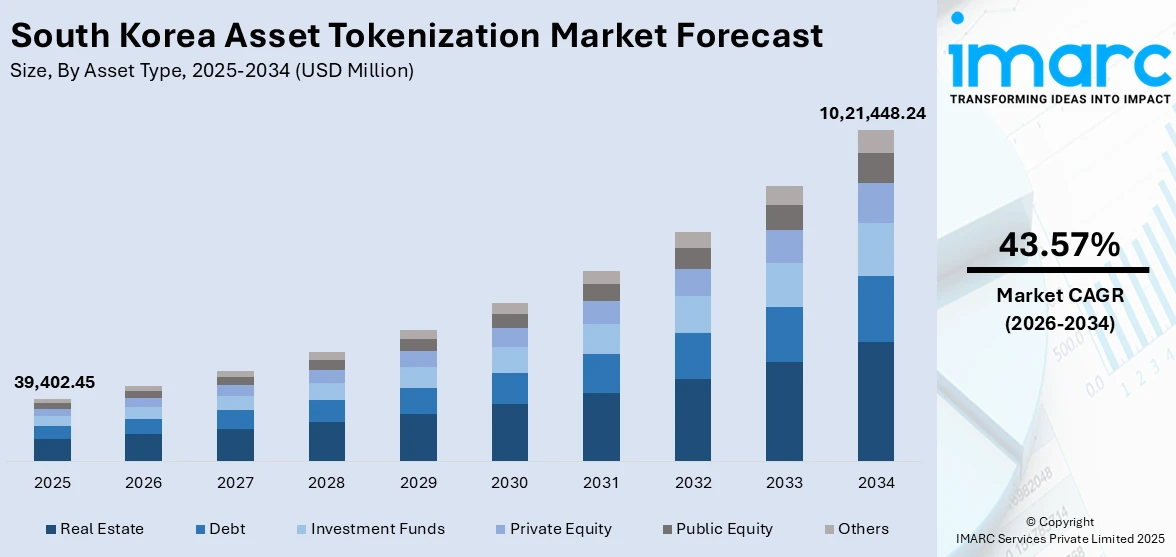
The South Korea asset tokenization market size was valued at USD 39,402.45 Million in 2025 and is projected to reach USD 10,21,448.24 Million by 2034, growing at a compound annual growth rate of 43.57% from 2026-2034.
The South Korea asset tokenization market is experiencing rapid expansion, as regulatory reforms, institutional adoption, and blockchain innovation converge to reshape capital markets. Increasing demand for fractional ownership, enhanced liquidity in traditionally illiquid assets, and a supportive policy landscape are accelerating market growth. Advancements in distributed ledger technology, rising investor interest, and a maturing digital asset ecosystem are positioning South Korea as a leading hub for tokenized securities and real-world asset investment.
Key Takeaways and Insights:
- By Asset Type: Real estate dominates the market with a share of 46.7% in 2025, driven by rising demand for fractional ownership of high-value commercial properties, regulatory sandbox approvals for tokenized real estate platforms, and growing investor preference for asset-backed digital securities offering stable returns.
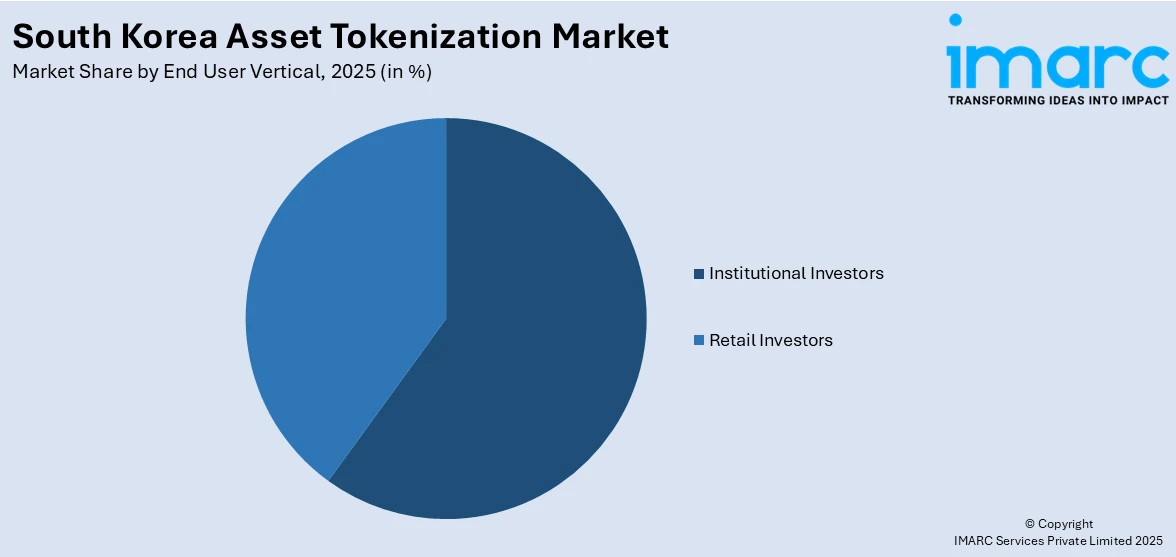
- By End User Vertical: Institutional investors lead the market with a share of 62.4% in 2025, reflecting the strategic pivot of major securities firms and financial groups towards blockchain-based capital markets, security token offerings, and the development of proprietary tokenization infrastructure and trading platforms.
- By Region: Seoul Capital Area represents the largest region with 58.9% share in 2025, owing to the concentration of leading financial institutions, fintech startups, blockchain technology companies, and regulatory bodies that collectively form the core ecosystem driving tokenization innovation and adoption across South Korea.
- Key Players: Key players drive the South Korea asset tokenization market by developing proprietary blockchain platforms, forming strategic consortia for security token infrastructure, investing in digital asset data capabilities, and forging global partnerships to expand tokenized securities offerings across diverse asset classes and investor segments.
To get more information on this market Request Sample
The South Korea asset tokenization market is advancing rapidly, as the country establishes itself as a global frontrunner in regulated digital securities infrastructure. Legislative reforms, particularly the landmark amendments to the Capital Markets Act and Electronic Securities Act passed by the National Assembly in December 2024, have provided the first comprehensive legal framework for issuing, managing, and trading tokenized securities using distributed ledger technology. Institutional momentum is intensifying as major financial groups redirect their strategies towards blockchain-based capital markets, with leading securities firms developing proprietary platforms for security token issuance and distribution. The broadening scope of tokenizable asset classes, rising demand for fractional ownership, and growing participation from both domestic and international investors are further strengthening the market share.
South Korea Asset Tokenization Market Trends:
Landmark Regulatory Framework Enabling Institutional Participation
South Korea is witnessing a transformative shift in its digital asset regulatory environment, with authorities formally integrating tokenized securities into the existing financial system. This transition is being driven by efforts to balance innovation with investor protection, as regulators establish clearer legal definitions and compliance requirements for security tokens. Financial institutions, fintech firms, and blockchain platforms are increasingly collaborating to develop regulated issuance, trading, and custody infrastructure. The integration of tokenized securities is expected to enhance market transparency, improve liquidity, and expand access to alternative investment products.
Convergence of Traditional Finance and Blockchain Infrastructure
Leading financial institutions are integrating blockchain technology into their core operations to support tokenized securities. This integration enables institutions to streamline issuance, settlement, and post-trade processes by reducing reliance on intermediaries and manual reconciliation. Blockchain-based infrastructure also improves transaction transparency, data immutability, and auditability, strengthening investor confidence. Banks and securities firms are leveraging smart contracts to automate corporate actions, compliance checks, and reporting requirements. In parallel, investments in digital custody and cybersecurity frameworks are increasing to safeguard tokenized assets.
Diversification of Tokenizable Asset Classes Beyond Real Estate
Asset tokenization in South Korea is rapidly expanding beyond real estate into diverse categories, including debt instruments, intellectual property, cultural assets, and maritime assets. Korean firms are exploring tokenization for investment funds, infrastructure projects, data centers, and airline mileage points. In September 2025, the Seoul Exchange partnered with Story Protocol to tokenize Korean cultural intellectual property (K-pop, webtoons, patents) through blockchain, generating compliant digital securities. The platform leveraged Story’s Layer-1 blockchain and the $IP token to streamline licensing and royalty distribution using smart contracts for transparent monetization of IP.
Market Outlook 2026-2034:
The South Korea asset tokenization market is poised for substantial expansion over the forecast period, supported by regulatory maturity, institutional readiness, and an evolving digital asset ecosystem. The market generated a revenue of USD 39,402.45 Million in 2025 and is projected to reach a revenue of USD 10,21,448.24 Million by 2034, growing at a compound annual growth rate of 43.57% from 2026-2034. Increasing institutional investments in blockchain infrastructure, the expansion of tokenizable asset classes, and the growing integration of artificial intelligence (AI) for compliance and valuation are expected to drive higher revenue streams. The convergence of traditional and digital finance, coupled with South Korea’s advanced technological infrastructure and active investor base, will foster a more competitive and mature tokenized capital market landscape.
South Korea Asset Tokenization Market Report Segmentation:
|
Segment Category |
Leading Segment |
Market Share |
|
Asset Type |
Real Estate |
46.7% |
|
End User Vertical |
Institutional Investors |
62.4% |
|
Region |
Seoul Capital Area |
58.9% |
Asset Type Insights:
- Real Estate
- Debt
- Investment Funds
- Private Equity
- Public Equity
- Others
Real estate dominates with a market share of 46.7% of the total South Korea asset tokenization market in 2025.
Real estate commands the largest share of the South Korea asset tokenization market, driven by strong investor demand for fractional ownership of high-value commercial properties. As per IMARC Group, the South Korea real estate market size was valued at USD 12.35 Trillion in 2024. By enabling investors to access premium assets with lesser initial commitments and take advantage of possible capital appreciation and rental income, tokenization reduces entry barriers. By making secondary trading on digital platforms possible, it also increases liquidity in an asset class that has historically had less liquidity. Tokenization is being used more by developers and asset managers to increase capital raising speed, diversify financing sources, and reach a larger investor base inside regulated frameworks.
As digital investment models become more widely accepted, residential and mixed-use properties are also becoming more popular in tokenized formats, in addition to commercial assets. Clear ownership rights and transaction histories provided by blockchain-based records increase transparency and boost investor trust. Trust in real estate tokenization is being further reinforced by institutional involvement and clear regulations. Real estate tokenization is anticipated to be a key factor in changing the property investment environment in South Korea as digital platforms develop and investor familiarity rises.
End User Vertical Insights:
Access the comprehensive market breakdown Request Sample
- Institutional Investors
- Retail Investors
Institutional investors lead the market with a share of 62.4% of the total South Korea asset tokenization market in 2025.
Institutional investors represent the dominant end user segment in the South Korea asset tokenization market, reflecting the strategic realignment of major financial groups towards blockchain-based capital markets. Tokenization is being actively used by banks, securities firms, and asset managers to access alternative asset classes, improve liquidity management, and diversify their portfolios. Institutions can obtain real-time visibility into holdings and establish more effective settlement procedures with tokenized assets.
Additionally, by increasing demand for reliable trading platforms, custody solutions, and compliance infrastructure, institutional engagement is speeding up ecosystem development. Their participation promotes best practices and uniformity in the secondary and issuance markets. Growing institutional confidence is encouraging more corporate issuers and technology providers to participate. The long-term scalability of the South Korea asset tokenization ecosystem is being supported by this reinforcing cycle, which is also enhancing market depth and liquidity.
Regional Insights:
- Seoul Capital Area
- Yeongnam (Southeastern Region)
- Honam (Southwestern Region)
- Hoseo (Central Region)
- Others
Seoul Capital Area represents the largest region with a 58.9% share of the total South Korea asset tokenization market in 2025.
The Seoul Capital Area commands the dominant position in the South Korea asset tokenization market, serving as the primary hub for financial innovation and blockchain development. The region hosts the headquarters of all major securities firms, asset management companies, and fintech startups driving tokenization adoption. Korea Blockchain Week 2025 (KBW2025), the top Web3 conference in Asia, confirmed its comeback to Seoul in September 2025. Industry executives and numerous delegates would gather to explore the newest developments in blockchain, AI, and regulatory measures, reflecting the city’s central role in the digital asset ecosystem.
The Seoul Capital Area's leadership position is further reinforced by the concentration of regulatory organizations, such as the Korea Securities Depository and the Financial Services Commission. Prominent tokenization platforms concentrate their activities on high-end commercial real estate in the Gangnam and Seocho neighborhoods of Seoul. An unmatched environment for tokenized securities innovation and market development is created by the region's sophisticated digital infrastructure, fast connectivity, and close proximity to institutional decision-makers.
Market Dynamics:
Growth Drivers:
Why is the South Korea Asset Tokenization Market Growing?
Comprehensive Regulatory Framework Establishing Legal Clarity
For tokenized securities, South Korea has created a very sophisticated legal framework that offers the structure and clarity required to encourage institutional involvement and sustained market expansion. By acknowledging security tokens as digital versions of traditional securities issued and recorded using blockchain-based infrastructure, authorities have formally included them in the established financial system. Market players face less legal uncertainty due to precise definitions, uniform issuance standards, and clearly defined monitoring obligations. The creation of specific trading platforms for tokenized assets has also been made possible by regulatory bodies, guaranteeing conformity with accepted market procedures and investor protection guidelines. Financial institutions and tech companies can test novel tokenization methods in regulated environments while being compliant because of frameworks that encourage innovation. In parallel, enhanced rules around transparency, custody, and risk management strengthen trust and market integrity.
Aggressive Institutional Investment in Blockchain Infrastructure
The infrastructure needed for tokenized securities markets is receiving significant funding and strategic attention from major financial firms in South Korea. A complete ecosystem that facilitates the issuance, custody, settlement, and secondary trading of tokenized assets is being fostered by the convergence of blockchain technology and traditional finance. Blockchain platform developers are working with asset managers and securities companies to create automated settlement methods and on-chain fund structures. Leading tech firms are concurrently developing cloud-based platforms, smart contract frameworks, and essential blockchain infrastructure to facilitate safe and expandable tokenization. By establishing specialized digital asset units to oversee security token sales and on-chain services, financial institutions are also restructuring their internal processes. These coordinated efforts across finance and technology are strengthening interoperability with existing market systems and accelerating commercialization.
Growing Demand for Fractional Ownership and Enhanced Liquidity
The fundamental value proposition of asset tokenization, which is enabling fractional ownership and improving liquidity for traditionally illiquid assets, is driving strong investor interest across South Korea. Tokenization allows investors to acquire fractional stakes in high-value assets, such as commercial real estate, artwork, and debt instruments that were previously accessible mainly to institutional or high-net-worth participants. The country’s active retail crypto market highlights strong grassroots demand for blockchain-based investment products and more flexible trading access. In parallel, plans by the Korea Exchange to move towards a 24-hour trading regime by December 2027 are reinforcing this momentum by signaling a shift towards more continuous, globally competitive capital markets. Together, fractional ownership models and extended trading access strengthen liquidity expectations, enhance market accessibility, and position tokenized assets as a natural extension of South Korea’s evolving digital investment landscape.
Market Restraints:
What Challenges the South Korea Asset Tokenization Market is Facing?
Valuation Complexity and Risk Management for Illiquid Asset Classes
Regulators remain cautious about tokenized assets backed by illiquid and hard-to-value underlying assets, requiring enhanced disclosure, clear risk warnings, and stricter sales practices before market availability. The prohibition on tokenizing assets related to uncertain businesses reflects concerns about valuation accuracy and investor protection. Developing robust pricing mechanisms and standardized valuation frameworks for diverse tokenized asset classes remains a significant challenge that could limit the pace and scope of market expansion.
Cybersecurity and Digital Asset Safeguards
The digital nature of tokenized assets exposes market participants to cybersecurity risks, such as hacking, data breaches, and wallet compromises. Ensuring secure custody, transaction integrity, and protection against cyber threats requires continuous investment in advanced security infrastructure. Any high-profile security incident could undermine investor trust and slow adoption. Maintaining robust safeguards while scaling platforms remains an ongoing challenge for the asset tokenization ecosystem.
Investor Education and Market Understanding Gaps
Many investors still lack a clear understanding of how tokenized assets function, including ownership rights, return structures, and associated risks. Misconceptions about liquidity, valuation, and technological dependencies can limit adoption. Without sufficient education and transparent communication, potential participants may remain cautious. Bridging this knowledge gap is essential for building confidence and supporting broader participation across both institutional and sophisticated retail investor segments.
Competitive Landscape:
The South Korea asset tokenization market features an increasingly competitive landscape as traditional financial institutions, blockchain technology firms, and fintech startups converge to establish leadership positions. Major securities firms are forming strategic consortia to develop shared infrastructure and industry standards while simultaneously building proprietary platforms for security token issuance and distribution. Competition is intensifying as financial groups invest in digital asset capabilities, acquire crypto exchanges, and forge international partnerships to expand their tokenization offerings. Technology companies are playing critical enabling roles by providing blockchain infrastructure, smart contract development, and data analytics platforms.
South Korea Asset Tokenization Market Report Coverage:
|
Report Features |
Details |
|
Base Year of the Analysis |
2025 |
|
Historical Period |
2020-2025 |
|
Forecast Period |
2026-2034 |
|
Units |
USD Million |
|
Scope of the Report |
Exploration of Historical Trends and Market Outlook, Industry Catalysts and Challenges, Segment-Wise Historical and Future Market Assessment:
|
|
Asset Types Covered |
Real Estate, Debt, Investment Funds, Private Equity, Public Equity, Others |
|
End User Verticals Covered |
Institutional Investors, Retail Investors |
|
Regions Covered |
Seoul Capital Area, Yeongnam (Southeastern Region), Honam (Southwestern Region), Hoseo (Central Region), Others |
|
Customization Scope |
10% Free Customization |
|
Post-Sale Analyst Support |
10-12 Weeks |
|
Delivery Format |
PDF and Excel through Email (We can also provide the editable version of the report in PPT/Word format on special request) |
Frequently Asked Questions About the South Korea Asset Tokenization Market Report
The South Korea asset tokenization market size was valued at USD 39,402.45 Million in 2025.
The South Korea asset tokenization market is expected to grow at a compound annual growth rate of 43.57% from 2026-2034 to reach USD 10,21,448.24 Million by 2034.
Real estate dominated the market with a share of 46.7%, driven by strong demand for fractional ownership of commercial properties, regulatory sandbox approvals for tokenized real estate platforms, and investor preference for asset-backed digital securities with predictable returns.
Key factors driving the South Korea asset tokenization market include comprehensive regulatory reforms establishing legal clarity for tokenized securities, aggressive institutional investment in blockchain infrastructure, growing demand for fractional ownership and enhanced liquidity, and the expanding scope of tokenizable asset classes.
Major challenges include extended implementation timelines delaying full-scale market operations, regulatory frameworks that prioritize large financial institutions over fintech innovators, valuation complexity for illiquid asset classes, and evolving compliance requirements for diverse tokenized securities.
Need more help?
- Speak to our experienced analysts for insights on the current market scenarios.
- Include additional segments and countries to customize the report as per your requirement.
- Gain an unparalleled competitive advantage in your domain by understanding how to utilize the report and positively impacting your operations and revenue.
- For further assistance, please connect with our analysts.
 Request Customization
 Speak to an Analyst
 Request Brochure
 Inquire Before Buying
Benefits of Customization
- Personalize this research
- Triangulate with your data
- Get data as per your format and definition
- Gain a deeper dive into a specific application, geography, customer, or competitor
- Any level of personalization
Get in Touch With Us
UNITED STATES
Phone: +1-201-971-6302
INDIA
Phone: +91-120-433-0800
UNITED KINGDOM
Phone: +44-753-714-6104
Email: [email protected]
Client Testimonials




.webp)




.webp)













Related Reports

Choose your plan
*Please note that the prices mentioned below are starting prices for each bundle type. Kindly contact our team for further details.*
Single User License
- 1 User License, Access on 2 Devices
- PDF Report + Excel Dataset (Password Protected)
- Lifetime Access
- No Printing Rights
- 10% Free Report Customization
- 10–12 Weeks of Analyst Support
Five User License
- Access for 5 Users, 2 Devices per User
- PDF Report + Excel Dataset (Password Protected)
- Lifetime Access
- Dedicated Account Manager
- 12–14 Weeks of Analyst Support
- No Printing Rights
- 15% Free Report Customization
- 25% Discount on Your Next Purchase
Corporate User License
- Unlimited User Access (Within Your Organization)
- PDF Report + Excel Dataset
- Lifetime Access
- Dedicated Account Manager
- 14–20 Weeks of Analyst Support
- No Printing Rights
- 20% Free Report Customization
- 30% Discount on Your Next Purchase
Essential Insights
What's included:
3 reports
- Lifetime Access
- PDF Reports
- Excel Datasets
- 2 Weeks of Free Analyst Support
- 2 User Licenses
- Access on 2 Devices
- Printing Rights
- Complimentary PowerPoint (PPT) Version
- Complimentary License Upgrade
Professional Access
What's included:
5 reports
- Lifetime Access
- PDF Reports
- Excel Datasets
- 8 Weeks of Free Analyst Support
- 2 User Licenses
- Access on 2 Devices
- Printing Rights
- Complimentary PowerPoint (PPT) Version
- Complimentary License Upgrade
Business Advantage
What's included:
8 reports
- Lifetime Access
- PDF Reports
- Excel Datasets
- 14 Weeks of Free Analyst Support
- 2 User Licenses
- Access on 2 Devices
- Printing Rights
- Complimentary PowerPoint (PPT) Version
- Complimentary License Upgrade
Enterprise Intelligence
What's included:
10 reports
- Lifetime Access
- PDF Reports
- Excel Datasets
- 20 Weeks of Free Analyst Support
- 2 User Licenses
- Access on 2 Devices
- Printing Rights
- Complimentary PowerPoint (PPT) Version
- Complimentary License Upgrade