
South Korea Baby Diapers Market Size, Share, Trends and Forecast by Product Type, Sales Channel, and Region, 2026-2034
South Korea Baby Diapers Market Summary:
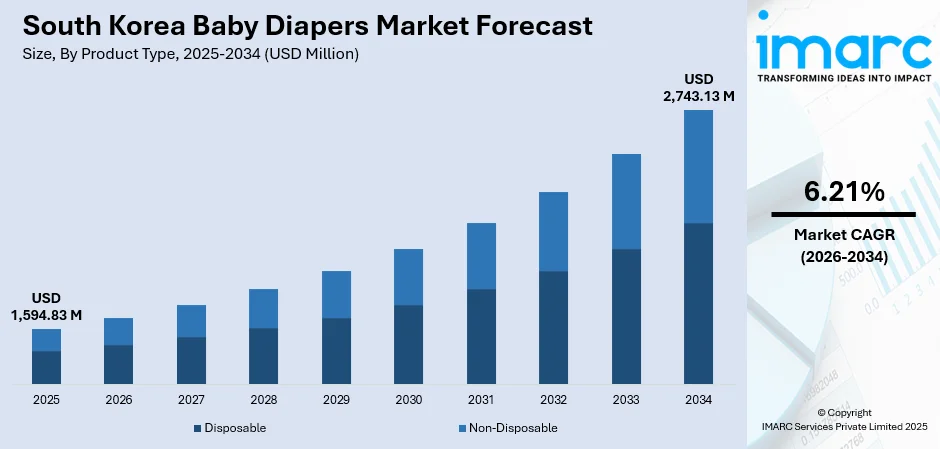
The South Korea baby diapers market size was valued at USD 1,594.83 Million in 2025 and is projected to reach USD 2,743.13 Million by 2034, growing at a compound annual growth rate of 6.21% from 2026-2034.
The market is driven by increasing government financial incentives for childbearing, rising consumer preference for premium and technologically advanced diaper products, and the rapid expansion of e-commerce platforms offering convenient purchasing options. Additionally, growing awareness of infant hygiene, the shift toward eco-friendly and skin-sensitive diaper materials, and the influence of dual-income households seeking convenience-oriented baby care solutions are further propelling market expansion, contributing to the South Korea baby diapers market share.
Key Takeaways and Insights:
- By Product Type: Disposable dominates the market with 88.9% market share in 2025, driven by superior absorption capacity, convenience for busy parents, and continuous product innovations in skin-friendly and breathable materials across premium and mid-range categories.
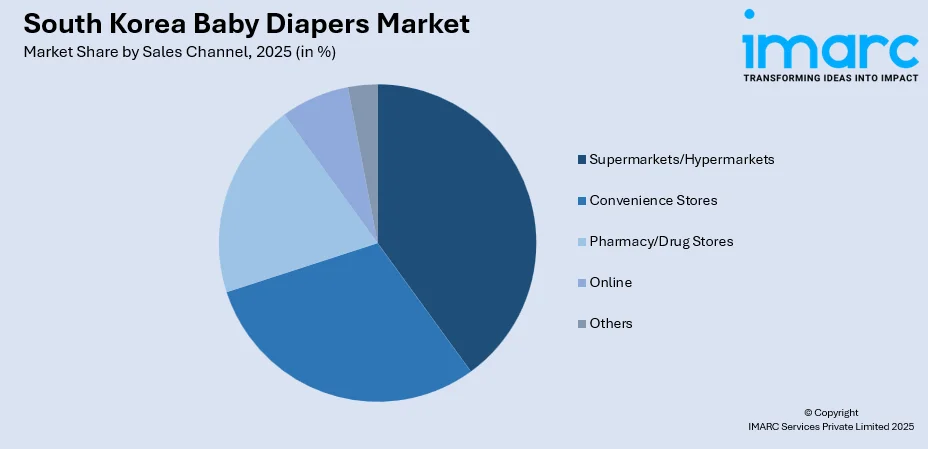
- By Sales Channel: Supermarkets/hypermarkets segment leads the market with a share of 34.6% in 2025, owing to extensive product assortment, bulk purchase discounts, competitive pricing strategies, and the one-stop shopping convenience that appeals to cost-conscious Korean consumers.
- By Region: Seoul Capital Area represents the largest segment in the market with 42.3% share in 2025, driven by the highest population density in the country, elevated disposable income levels, concentration of retail infrastructure, and proximity to major distribution networks.
- Key Players: The South Korea baby diapers market exhibits a consolidated competitive landscape, with established multinational personal care corporations competing alongside domestic manufacturers through continuous product innovation, brand differentiation, and premium positioning strategies.
To get more information on this market Request Sample
The South Korea baby diapers market is experiencing steady growth driven by a convergence of demographic policies, technological innovation, and evolving consumer preferences. The South Korean government's aggressive pro-natalist measures, including cash subsidies of 29.6 Million Korean won per child born in 2024 distributed over eight years, are reinforcing the market's demand base. The country's technologically advanced consumer landscape is fueling premiumization, with parents increasingly seeking diapers equipped with enhanced features such as wetness indicators, superior absorbency cores, and temperature-regulating materials. Furthermore, the rapid growth of e-commerce platforms is transforming the distribution landscape, with online channels gaining substantial traction as mobile-first shopping habits become deeply ingrained among Korean consumers. The rising emphasis on infant skin health and eco-friendly materials is additionally shaping product development strategies, encouraging manufacturers to introduce biodegradable, plant-based, and chemical-free diaper variants that cater to the growing segment of environmentally and health-conscious parents.
South Korea Baby Diapers Market Trends:
Rising Adoption of Smart Diaper Technology and IoT-Enabled Baby Care
The South Korean baby diapers market is witnessing accelerating integration of smart technologies into diaper products. Manufacturers are incorporating Internet of Things-enabled sensors that monitor moisture levels, infant activity patterns, and sleep quality through connected mobile applications. For instance, in April 2025, Asahi Kasei unveiled a battery-free smart diaper at CES 2025 that generates power from urine to detect leaks. Targeting aging societies, the innovation helps caregivers change diapers promptly, reducing infection risks among elderly and incontinence patients. This convergence of baby care and technology reflects the broader trend of digitalization within the Korean consumer market, appealing to tech-savvy millennial and Generation Z parents who prioritize data-driven parenting solutions.
Growing Demand for Eco-Friendly and Sustainable Diaper Products
Environmental sustainability is increasingly shaping consumer purchasing behavior in the South Korean baby diapers market. Parents are demonstrating growing preference for diapers manufactured from biodegradable materials, plant-based fibers, and chemical-free compositions. In May 2024, Kimberly-Clark collaborated with Amcor to roll out redesigned packaging for its Huggies Eco Protect diapers, featuring flexible packaging that incorporates 30% post-consumer recycled content. This initiative reflects the industry's broader commitment to reducing environmental impact while maintaining product performance. The South Korean government's regulatory emphasis on sustainability and waste reduction is further accelerating the adoption of eco-conscious diaper alternatives across the market.
Premiumization and Climate-Adaptive Product Innovation
The South Korean market is experiencing a pronounced shift toward premium diaper products designed to address specific climate and comfort requirements. Manufacturers are developing season-specific diaper lines that incorporate advanced temperature management technologies. As such, in April 2024, P&G Korea launched two summer-specific diaper variants featuring its proprietary Cool Care System, which reduces diaper temperature by one degree Celsius while maintaining dryness for up to 12 hours. This trend toward climate-adaptive innovation underscores the market's emphasis on functional differentiation and highlights the willingness of Korean parents to invest in premium products for enhanced infant comfort.
Market Outlook 2026-2034:
The South Korea baby diapers market is projected to witness sustained growth throughout the forecast period, supported by the government's continued investment in pro-natalist policies and financial incentives for childbearing families. Since 2024, the government expanded special housing loans for newborn households and introduced a priority supply scheme, allocating 30,000 public and private apartments each year to families with children under two. In tandem, the ongoing premiumization trend is anticipated to further elevate per-unit revenue, as consumers increasingly transition toward technologically advanced, eco-friendly, and dermatologically tested diaper products. The e-commerce distribution channel is projected to register the fastest growth rate, fueled by the country's advanced digital infrastructure, same-day delivery capabilities, and growing consumer preference for subscription-based purchasing models. Furthermore, the accelerating demand for biodegradable and sustainable diaper alternatives is expected to create new revenue opportunities for manufacturers investing in green product development. The market generated a revenue of USD 1,594.83 Million in 2025 and is projected to reach a revenue of USD 2,743.13 Million by 2034, growing at a compound annual growth rate of 6.21% from 2026-2034.
South Korea Baby Diapers Market Report Segmentation:
|
Segment Category |
Leading Segment |
Market Share |
|
Product Type |
Disposable |
88.9% |
|
Sales Channel |
Supermarkets/Hypermarkets |
34.6% |
|
Region |
Seoul Capital Area |
42.3% |
Product Type Insights:
- Disposable
- Non-Disposable
Disposable segment leads with 88.9% revenue share of the total South Korea baby diapers market in 2025.
The disposable baby diapers segment commands the overwhelming majority of the South Korea baby diapers market, primarily attributed to the unmatched convenience, superior absorption capabilities, and widespread availability that these products offer to modern Korean families. For example, in October 2025, Foshan AiKa launched UIKI, a Korea-designed brand for disposable baby diapers. Backed by strong research and development (R&D), certified quality, advanced production lines, and bulk sourcing, the company targets global expansion with competitive pricing and reliable supply. The fast-paced lifestyle prevalent in South Korea, where dual-income households represent a significant proportion of families, necessitates hassle-free baby care solutions that disposable diapers effectively deliver.
The segment continues to benefit from relentless product innovation focused on skin health, breathability, and lightweight construction that enhances infant comfort during extended wear periods. Leading manufacturers are investing substantially in research and development to create ultra-thin absorbent cores, hypoallergenic liners, and moisture-wicking materials that address growing parental concerns about diaper rash and skin irritation. The strong distribution network spanning supermarkets, pharmacies, convenience stores, and e-commerce platforms ensures widespread accessibility of disposable diaper products across urban and suburban markets, reinforcing the segment's dominant market position throughout the forecast period.
Sales Channel Insights:
Access the comprehensive market breakdown Request Sample
- Supermarkets/Hypermarkets
- Convenience Stores
- Pharmacy/Drug Stores
- Online
- Others
Supermarkets/hypermarkets segment holds the largest share, accounting for 34.6% of the total South Korea baby diapers market in 2025.
Supermarkets and hypermarkets serve as the leading distribution channel for baby diapers in South Korea, leveraging their extensive product assortments, competitive pricing strategies, and bulk purchasing options that appeal to budget-conscious families. These retail formats provide parents with the ability to physically assess product quality, compare multiple brands side-by-side, and take advantage of promotional discounts and loyalty programs. The well-established retail infrastructure in South Korea, anchored by major chains operating across urban and suburban locations, ensures consistent product availability and supports impulse purchasing behavior among consumers who prefer one-stop shopping destinations for their comprehensive baby care needs.
The channel's continued dominance is reinforced by strategic partnerships between diaper manufacturers and major retail chains that facilitate prominent shelf placement, exclusive product launches, and targeted promotional campaigns. South Korea's e-commerce market exceeded USD 100 Billion in total online sales in 2024, yet physical retail formats maintain their relevance through experiential shopping environments and immediate product availability that online channels cannot entirely replicate. Supermarkets and hypermarkets are increasingly integrating omnichannel capabilities, including online ordering with in-store pickup and same-day delivery services, further strengthening their competitive positioning against the growing digital retail landscape.
Regional Insights:
- Seoul Capital Area
- Yeongnam (Southeastern Region)
- Honam (Southwestern Region)
- Hoseo (Central Region)
- Others
Seoul Capital Area dominates, representing the largest share of 42.3% of the total South Korea baby diapers market in 2025.
The Seoul Capital Area, encompassing Seoul, Incheon, and the surrounding Gyeonggi Province, commands the largest share of the South Korea baby diapers market owing to its status as the country's most densely populated and economically dynamic region. Home to approximately half of the nation's total population, the region generates the highest concentration of baby care product demand, supported by elevated disposable income levels and sophisticated retail and e-commerce infrastructure. The region's birthrate, although the lowest nationally at 0.58 in 2024, is offset by its massive population base, which ensures sustained product demand.
The Seoul Capital Area benefits from the presence of comprehensive distribution networks, including flagship outlets of major retail chains, an extensive network of convenience stores and pharmacies, and the headquarters of leading e-commerce platforms such as Coupang, which recorded USD 30.3 Billion in total sales in 2024. The region's tech-savvy consumer demographic drives the adoption of premium and innovative diaper products, with parents demonstrating strong willingness to pay for advanced features such as smart sensors, eco-friendly materials, and climate-adaptive technologies. The concentration of healthcare facilities, maternity centers, and childcare infrastructure further supports the region's dominant market position.
Market Dynamics:
Growth Drivers:
Why is the South Korea Baby Diapers Market Growing?
Expansion of Government Pro-Natalist Financial Incentives
The South Korean government's aggressive expansion of financial incentives aimed at boosting the national birth rate represents a significant growth driver for the baby diapers market. The government has implemented comprehensive childbearing support packages that substantially reduce the economic burden on families, thereby encouraging parenthood and sustaining the consumer base for baby care products. As such, Korea provides pregnancy support under national health insurance, including a 1 million won benefit from 2022, rising child stipends in 2024 up to 1 million won monthly, and a 3 million won First Meet Voucher for newborns. These financial incentives directly increase household purchasing power for essential baby products, including diapers, reinforcing sustained market demand.
Rising Premiumization and Technological Innovation in Diaper Products
Rising demand for premium, technology-driven baby diapers is supporting strong revenue growth in South Korea. Parents with high spending capacity and strong brand awareness are prioritizing products that promise better comfort, skin safety, and reliable performance. Diapers with advanced absorption layers, breathable materials, and dermatologically tested components are gaining preference over standard options. This shift reflects greater awareness of infant health and long-term skin care. Manufacturers are responding by investing in material innovation, improved fit, and functional upgrades that address leakage, softness, and irritation concerns. Product differentiation through quality and performance has become central to competition, reinforcing the premium segment’s role in shaping market growth.
Rapid Expansion of E-Commerce and Digital Distribution Channels
The explosive growth of South Korea's e-commerce ecosystem is fundamentally reshaping the distribution landscape for baby diapers, creating new channels of access and convenience for consumers. South Korea's total online retail sales are expanding, with mobile shopping accounting for approximately 75% of all e-commerce transactions, underscoring the market's digital-first consumer orientation. Various platforms have established maternity and baby products as a leading category, with Huggies diapers consistently ranking among the top five best-selling products across all categories on the platform. The availability of subscription-based purchasing models, same-day and next-day delivery through services such as Coupang's Rocket Delivery, and AI-driven personalized product recommendations are collectively driving higher purchase frequency and consumer retention in the baby diapers category.
Market Restraints:
What Challenges the South Korea Baby Diapers Market is Facing?
Persistently Low and Declining National Birth Rate
South Korea’s persistently low birth rate remains the most significant constraint on baby diaper market growth. Even with slight recent improvement, fertility levels remain extremely low. Despite extensive government efforts to encourage childbirth, deep-rooted socioeconomic pressures, including expensive housing, high education costs, and demanding work environments, continue to discourage family formation. These structural challenges restrict the size of the infant population, ultimately limiting long-term demand growth for baby diaper products across the domestic market.
Intense Competitive Pressure and Market Consolidation
The South Korean baby diapers market faces significant competitive challenges arising from the concentrated presence of established multinational corporations, alongside domestic players. The intense rivalry among these well-resourced manufacturers drives aggressive pricing strategies, heavy promotional spending, and constant product innovation cycles that compress profit margins. Strong brand loyalty among Korean consumers, particularly toward established brands, creates substantial barriers for new entrants and limits the ability of smaller players to gain meaningful market share.
Growing Environmental Concerns Regarding Disposable Diaper Waste
Increasing environmental consciousness among South Korean consumers and strengthening regulatory frameworks around waste management pose challenges to the dominant disposable diaper segment. Disposable diapers contribute significantly to landfill waste due to their synthetic components and non-biodegradable materials, prompting growing consumer scrutiny and regulatory pressure. The development of commercially viable biodegradable alternatives remains technologically challenging and cost-intensive, creating tension between consumer demand for eco-friendly products and the economic realities of sustainable production at scale within the South Korean market.
Competitive Landscape:
The South Korea baby diaper market functions as a consolidated market which multinational personal care companies control through their strong brand presence and their wide distribution systems. Leading players use their ongoing research and development investment to create new products which feature better absorption materials and skin health benefits and products which adapt to different climate conditions. The South Korean market now uses premiumization, sustainability and digital marketing capabilities as the main methods for businesses to create their unique competitive advantage. The company uses its strategic alliances with major retail chains and e-commerce platforms together with its strong advertising campaigns and subscription model to maintain market share and build customer loyalty.
Recent Developments:
- In September 2025, South Korean media reported a growing trend among affluent parents who choose oversized luxury tote bags from Dior Goyard and Hermès as diaper bags. The phenomenon shows how Korean people consume luxury products because their culture needs to show status while they want personal fulfillment despite their limited ability to use the item.
- In January 2024, Yuhan-Kimberly launched the Huggies AI Fitting Room on its MomQ online mall. The artificial intelligence system examines baby pictures together with height and weight measurements to determine the best diaper sizes which will minimize leaks and skin irritation and fitting problems while enhancing customer satisfaction and product development.
South Korea Baby Diapers Market Report Coverage:
|
Report Features |
Details |
|
Base Year of the Analysis |
2025 |
|
Historical Period |
2020-2025 |
|
Forecast Period |
2026-2034 |
|
Units |
USD Million |
|
Scope of the Report |
Exploration of Historical Trends and Market Outlook, Industry Catalysts and Challenges, Segment-Wise Historical and Future Market Assessment:
|
|
Product Types Covered |
Disposable, Non-Disposable |
|
Sales Channels Covered |
Supermarkets/Hypermarkets, Convenience Stores, Pharmacy/Drug Stores, Online, Others |
|
Regions Covered |
Seoul Capital Area, Yeongnam (Southeastern Region), Honam (Southwestern Region), Hoseo (Central Region), Others |
|
Customization Scope |
10% Free Customization |
|
Post-Sale Analyst Support |
10-12 Weeks |
|
Delivery Format |
PDF and Excel through Email (We can also provide the editable version of the report in PPT/Word format on special request) |
Frequently Asked Questions About the South Korea Baby Diapers Market Report
The South Korea baby diapers market size was valued at USD 1,594.83 Million in 2025.
The market is expected to grow at a compound annual growth rate of 6.21% from 2026-2034 to reach USD 2,743.13 Million by 2034.
Disposable held the largest market share of 88.9% in 2025, driven by unmatched convenience, superior absorption capabilities, and continuous innovation in skin-friendly and breathable materials catering to modern Korean families.
Key factors driving the market include the expansion of government pro-natalist financial incentives, rising consumer preference for premium and technologically advanced products, and the rapid growth of e-commerce distribution channels.
Major challenges include the persistently low national birth rate constraining the consumer base, intense competitive pressure among established multinational brands, and growing environmental concerns regarding disposable diaper waste.
Need more help?
- Speak to our experienced analysts for insights on the current market scenarios.
- Include additional segments and countries to customize the report as per your requirement.
- Gain an unparalleled competitive advantage in your domain by understanding how to utilize the report and positively impacting your operations and revenue.
- For further assistance, please connect with our analysts.
 Request Customization
 Speak to an Analyst
 Request Brochure
 Inquire Before Buying
Benefits of Customization
- Personalize this research
- Triangulate with your data
- Get data as per your format and definition
- Gain a deeper dive into a specific application, geography, customer, or competitor
- Any level of personalization
Get in Touch With Us
UNITED STATES
Phone: +1-201-971-6302
INDIA
Phone: +91-120-433-0800
UNITED KINGDOM
Phone: +44-753-714-6104
Email: [email protected]
Client Testimonials




.webp)




.webp)













Related Reports

Choose your plan
*Please note that the prices mentioned below are starting prices for each bundle type. Kindly contact our team for further details.*
Single User License
- 1 User License, Access on 2 Devices
- PDF Report + Excel Dataset (Password Protected)
- Lifetime Access
- No Printing Rights
- 10% Free Report Customization
- 10–12 Weeks of Analyst Support
Five User License
- Access for 5 Users, 2 Devices per User
- PDF Report + Excel Dataset (Password Protected)
- Lifetime Access
- Dedicated Account Manager
- 12–14 Weeks of Analyst Support
- No Printing Rights
- 15% Free Report Customization
- 25% Discount on Your Next Purchase
Corporate User License
- Unlimited User Access (Within Your Organization)
- PDF Report + Excel Dataset
- Lifetime Access
- Dedicated Account Manager
- 14–20 Weeks of Analyst Support
- No Printing Rights
- 20% Free Report Customization
- 30% Discount on Your Next Purchase
Essential Insights
What's included:
3 reports
- Lifetime Access
- PDF Reports
- Excel Datasets
- 2 Weeks of Free Analyst Support
- 2 User Licenses
- Access on 2 Devices
- Printing Rights
- Complimentary PowerPoint (PPT) Version
- Complimentary License Upgrade
Professional Access
What's included:
5 reports
- Lifetime Access
- PDF Reports
- Excel Datasets
- 8 Weeks of Free Analyst Support
- 2 User Licenses
- Access on 2 Devices
- Printing Rights
- Complimentary PowerPoint (PPT) Version
- Complimentary License Upgrade
Business Advantage
What's included:
8 reports
- Lifetime Access
- PDF Reports
- Excel Datasets
- 14 Weeks of Free Analyst Support
- 2 User Licenses
- Access on 2 Devices
- Printing Rights
- Complimentary PowerPoint (PPT) Version
- Complimentary License Upgrade
Enterprise Intelligence
What's included:
10 reports
- Lifetime Access
- PDF Reports
- Excel Datasets
- 20 Weeks of Free Analyst Support
- 2 User Licenses
- Access on 2 Devices
- Printing Rights
- Complimentary PowerPoint (PPT) Version
- Complimentary License Upgrade