
South Korea Defense Market Size, Share, Trends and Forecast by Type, Armed Forces, and Region, 2026-2034
South Korea Defense Market Summary:
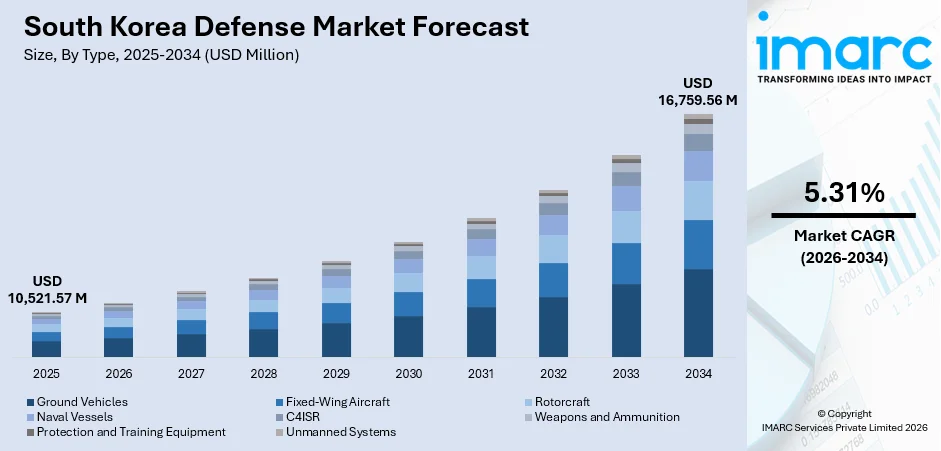
The South Korea defense market size was valued at USD 10,521.57 Million in 2025 and is projected to reach USD 16,759.56 Million by 2034, growing at a compound annual growth rate of 5.31% from 2026-2034.
The South Korea defense market is experiencing robust growth, underpinned by escalating geopolitical tensions on the Korean Peninsula, substantial increases in national defense budgets, and an accelerating push toward military modernization through advanced technologies. Surging global demand for domestically produced weapons platforms, expanding defense export partnerships, and strategic investments in autonomous systems and artificial intelligence are further strengthening the South Korea defense market share.
Key Takeaways and Insights:
- By Type: Ground vehicles reign the market with a 29.6% share in 2025, driven by steady demand for armored vehicles, self-propelled howitzers, and main battle tanks, supported by domestic modernization programs and rapidly growing international export orders.
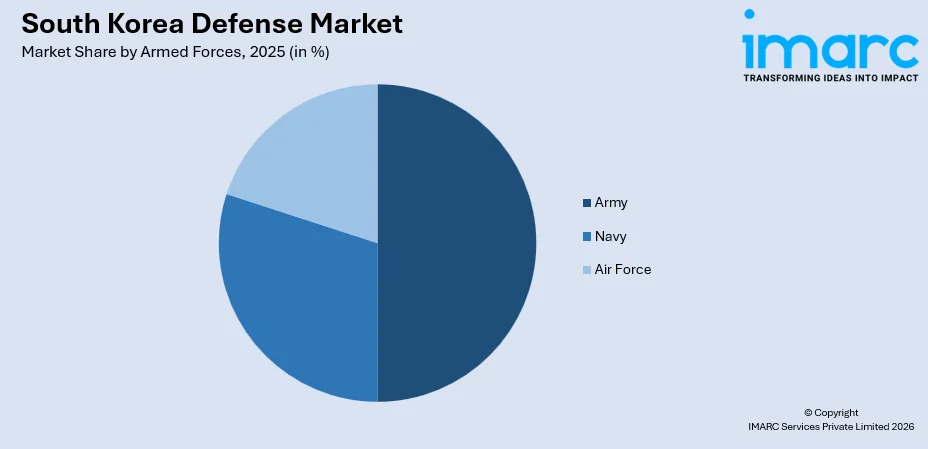
- By Armed Forces: Army leads the market with a share of 46.3% in 2025. This dominance is driven by the army’s critical frontline defense role against North Korean threats, ongoing ground force modernization programs, and substantial procurement investments in next-generation combat vehicles and artillery systems.
- By Region: Seoul Capital Area comprises the largest region with 41.9% share in 2025, driven by the concentration of defense ministry headquarters, major procurement agencies, leading defense manufacturers, and proximity to the Korean Demilitarized Zone necessitating heightened military readiness.
- Key Players: Key players drive the South Korea defense market by developing advanced indigenous weapons platforms, expanding international export partnerships, investing in next-generation unmanned systems and artificial intelligence capabilities, and scaling production to meet surging global demand for cost-effective defense solutions.
To get more information on this market Request Sample
The South Korea defense market is undergoing a transformative expansion as the nation consolidates its position among the world’s leading defense producers and exporters. The government’s sustained commitment to military modernization, anchored by the Defense Innovation 4.0 initiative and reinforced through consecutive annual budget increases, is driving comprehensive upgrades across ground, naval, air, and cyber defense domains. South Korea’s defense industry has achieved remarkable international recognition, with the country ranking among the top ten global arms exporters between 2020 and 2024, capturing a 2.2% share of global arms exports, as reported by the Stockholm International Peace Research Institute (SIPRI). Domestically produced platforms including main battle tanks, self-propelled howitzers, fighter aircraft, and guided missile systems are securing major procurement contracts from NATO-aligned nations and partners across the Middle East and Asia-Pacific. Strategic investments in unmanned systems, manned-unmanned teaming technologies, and defense artificial intelligence are positioning the industry for sustained long-term competitiveness and continued demand generation.
South Korea Defense Market Trends:
Surging Global Demand for Indigenous Weapons Platforms
South Korea’s defense industry is experiencing unprecedented international demand for its domestically developed weapons systems, driven by their cost-effectiveness, rapid delivery timelines, and proven interoperability with NATO-standard equipment. European nations seeking to replenish materiel transferred to Ukraine and modernize their arsenals are increasingly turning to South Korean suppliers. As such, in 2024, the combined sales of 31 listed South Korean defense companies reached KRW 43.1 Trillion, representing a 16% increase from the previous year, with export revenues accounting for the majority of growth across leading manufacturers.
Acceleration of Unmanned Systems and AI Integration
South Korea is rapidly integrating artificial intelligence and autonomous platforms into its military doctrine to offset demographic-driven manpower constraints and enhance operational capabilities. The Defense Innovation 4.0 initiative emphasizes manned-unmanned teaming, intelligent command and control systems, and AI-powered surveillance along the Demilitarized Zone. For instance, in September 2025, the Ministry of National Defense announced an initiative to cultivate 500,000 troops proficient in drone operations, designating the Army’s 36th Infantry Division as the military’s first dedicated drone training ground, supporting the South Korea defense market growth.
Expansion of International Defense Industrial Partnerships
South Korea is deepening defense industrial cooperation through technology transfers, joint production agreements, and strategic partnerships with allied nations across Europe, the Middle East, and the Indo-Pacific region. These collaborations encompass co-development of advanced platforms, establishment of overseas production lines, and comprehensive maintenance support agreements. For example, in November 2024, the European Union and South Korea signed a Security and Defence Partnership covering collaboration in 15 areas including defense industrial cooperation, marking the first such comprehensive security framework between Seoul and Brussels.
Market Outlook 2026-2034:
The South Korea defense market is positioned for sustained growth as heightened regional security threats, accelerating military modernization, and expanding global export demand converge to drive robust investment across all defense segments. In accordance with this, the government’s decision to raise the 2026 defense budget by 8.2% to KRW 66.3 Trillion, representing the largest annual increase since 2008, underscores the deepening fiscal commitment to force enhancement and technological superiority. Continued expansion of the three-axis deterrence system against North Korean threats, growing procurement of next-generation fighter aircraft and naval vessels, and rising investments in unmanned systems and defense artificial intelligence are expected to generate sustained demand across the defense value chain throughout the forecast period. The market generated a revenue of USD 10,521.57 Million in 2025 and is projected to reach a revenue of USD 16,759.56 Million by 2034, growing at a compound annual growth rate of 5.31% from 2026-2034.
South Korea Defense Market Report Segmentation:
|
Segment Category |
Leading Segment |
Market Share |
|
Type |
Ground Vehicles |
29.6% |
|
Armed Forces |
Army |
46.3% |
|
Region |
Seoul Capital Area |
41.9% |
Type Insights:
- Fixed-Wing Aircraft
- Rotorcraft
- Ground Vehicles
- Naval Vessels
- C4ISR
- Weapons and Ammunition
- Protection and Training Equipment
- Unmanned Systems
Ground vehicles dominate with a market share of 29.6% of the total South Korea defense market in 2025.
The ground vehicles segment commands the largest share of the South Korea defense market, driven by sustained domestic procurement of armored fighting vehicles, main battle tanks, and self-propelled artillery systems essential for maintaining frontline defense readiness against North Korean threats. The segment benefits from decades of indigenous development expertise that has produced globally competitive platforms recognized for their advanced firepower, mobility, and protection capabilities. South Korea’s ground vehicle manufacturing base has evolved into a major export engine, with platforms securing multi-billion-dollar contracts across Europe and the Middle East. For instance, in 2025, Poland signed a USD 6.5 Billion contract for 180 upgraded K2PL main battle tanks to be partially produced domestically.
Ongoing modernization programs are further strengthening the ground vehicles segment through the introduction of next-generation platforms incorporating autonomous capabilities, enhanced survivability systems, and digital battlefield networking. Manufacturers are investing heavily in developing unmanned ground vehicles, automated turret systems, and AI-integrated fire control solutions that align with the military’s Defense Innovation 4.0 strategy. The K-NIFV next-generation infantry fighting vehicle program, designed to replace aging K200A1 and K21 platforms, demonstrates the sector’s commitment to technological advancement. In October 2024, the K-NIFV development initiative commenced with an estimated budget of approximately USD 25 Million and a scheduled completion date of March 2028.
Armed Forces Insights:
Access the comprehensive market breakdown Request Sample
- Army
- Navy
- Air Force
Army leads with a share of 46.3% of the total South Korea defense market in 2025.
The army segment holds the largest share of the South Korea defense market, reflecting the service branch's critical role in maintaining territorial defense along the heavily fortified Korean Demilitarized Zone and its extensive force modernization requirements. The army receives the most substantial allocation of defense procurement budgets, which funds the development of new armored vehicle fleets and the improvement of existing artillery systems, tactical missile systems and command and control networks. The segment's dominance is further reinforced by the army's large active-duty force structure and its priority in receiving advanced domestically developed weapons platforms.
The army is changing its operational methods because it needs to build a force structure which emphasizes technology through the implementation of manned-unmanned teaming systems, autonomous reconnaissance systems and AI-enabled battlefield management solutions because conscription rates have decreased. The Army TIGER program which focuses on fourth industrial revolution technologies is developing new combat systems which will provide increased firepower while requiring fewer soldiers to operate them. The army's modernization plan will include unmanned ground vehicles, autonomous surveillance systems and drone-enabled soldier operations as essential components.
Regional Insights:
- Seoul Capital Area
- Yeongnam (Southeastern Region)
- Honam (Southwestern Region)
- Hoseo (Central Region)
- Others
The Seoul Capital Area exhibits a clear dominance with a 41.9% share of the total South Korea defense market in 2025.
The Seoul Capital Area commands the largest share of the South Korea defense market, driven by the concentration of critical defense institutions including the Ministry of National Defense, the Defense Acquisition Program Administration, and the headquarters of major defense contractors. The region’s strategic proximity to the Korean Demilitarized Zone necessitates heightened military readiness and substantial forward-deployed force concentrations.
Beyond institutional concentration, the Seoul Capital Area also benefits from advanced research and development capabilities that support defense modernization. Major universities, technology parks, and aerospace clusters in the region contribute to innovation in missiles, surveillance systems, cyber defense, and unmanned platforms. As such, in January 2026, South Korea and NATO expanded defense cooperation through the ITPP, prioritizing cyber defense and emerging technologies. Centered in Seoul’s strategic defense hub, Korea’s growing role includes major participation in Locked Shields and NATO research partnerships. Government procurement programs and defense exhibitions hosted in and around Seoul further strengthen industry linkages and investment flows. This ecosystem enables faster coordination between policymakers, armed forces, and contractors, reinforcing the region’s central role in shaping South Korea’s defense production and strategic planning.
Market Dynamics:
Growth Drivers:
Why is the South Korea Defense Market Growing?
Escalating Regional Security Threats and North Korean Provocations
The persistent and evolving security threats emanating from North Korea’s nuclear weapons program, ballistic missile development, and increasing military cooperation with Russia represent the foremost growth driver for the South Korea defense market. Pyongyang’s continued advancement of intercontinental ballistic missiles, tactical nuclear warheads, and conventional artillery capabilities creates an urgent imperative for Seoul to maintain and enhance its deterrence posture. The government’s three-axis deterrence system, encompassing preemptive strike capabilities, integrated missile defense, and retaliatory precision fires, demands sustained procurement investment across multiple defense domains. In December 2025, the Ministry of National Defense confirmed that spending on the three-axis deterrence system will rise 21.3% to nearly USD 6 Billion in the 2026 fiscal year. The deepening military cooperation between North Korea and Russia, including the reported deployment of North Korean troops to support Russian operations, has further heightened security concerns and accelerated defense spending priorities.
Record-Breaking Defense Export Demand and Global Market Expansion
South Korea’s defense industry is experiencing transformative growth fueled by surging international demand for its cost-effective, rapidly deliverable, and NATO-interoperable weapons platforms. European nations seeking to rebuild depleted arsenals following materiel transfers to Ukraine have turned to South Korean manufacturers, generating unprecedented export revenues and expanding the country’s global defense footprint. The government’s strategic ambition to become the world’s fourth-largest arms exporter by 2027 is supported by comprehensive industrial policies, diplomatic engagement, and technology transfer frameworks that enhance competitiveness. South Korea’s defense industry Big 4 are projected to surpass 40 trillion won in sales in 2025, driven by surging overseas export. The diversification of export destinations across Europe, the Middle East, and Southeast Asia is creating sustainable revenue streams that reinforce domestic research and development investment.
Military Modernization Through Advanced Technology Integration
South Korea’s comprehensive military modernization strategy, centered on the Defense Innovation 4.0 initiative, is generating sustained demand for advanced defense systems incorporating artificial intelligence, autonomous platforms, and digital battlefield capabilities. The initiative emphasizes a technology-centric force transformation designed to maintain combat effectiveness despite declining military manpower resulting from the nation’s demographic challenges. Investments span intelligent command and control systems, manned-unmanned teaming capabilities, advanced sensor networks, and next-generation precision strike platforms. The Seoul International Aerospace and Defence Exhibition 2025 attracted a record 600 companies from 35 countries, showcasing South Korea’s growing leadership in defense technology innovation. The government’s commitment to tripling artificial intelligence spending with an allocation of KRW 10.1 Trillion demonstrates the strategic priority placed on emerging technology integration across military and civilian domains.
Market Restraints:
What Challenges the South Korea Defense Market is Facing?
Demographic Decline Constraining Military Manpower Availability
South Korea’s persistently low birth rate is driving a deepening military personnel shortage that poses serious risks to long-term readiness and operational sustainability. A shrinking pool of eligible recruits is reducing active-duty manpower and constraining force structure across all service branches. This demographic pressure is accelerating reliance on advanced technologies, automation, and unmanned systems to offset labor gaps. However, these substitutions require substantial investment and cannot fully replace manpower-intensive roles, creating strategic challenges for maintaining deterrence, training capacity, and sustained operational effectiveness.
Technology Transfer Risks in Export-Driven Industrial Strategy
South Korea’s aggressive export strategy, which increasingly incorporates technology transfers and licensed local production agreements to secure international contracts, carries inherent risks of creating future competitors who may eventually develop indigenous capabilities based on transferred knowledge. The requirement to share proprietary technologies, manufacturing processes, and critical component designs with partner nations can erode long-term competitive advantages. Balancing short-term export revenue gains against the strategic risk of enabling recipient countries to develop independent defense production capabilities remains a significant challenge for policymakers and industry leaders.
Geopolitical Uncertainties Affecting Alliance Dynamics and Policy Continuity
Shifting geopolitical alignments and evolving alliance expectations, particularly regarding the United States security commitment to the Korean Peninsula, introduce uncertainty into long-term defense planning and procurement strategies. Changes in the bilateral cost-sharing framework, potential redeployment of forward-stationed forces, and evolving regional security architectures can disrupt established defense cooperation models. Additionally, the transition of presidential administrations every five years in South Korea has historically introduced discontinuities in defense reform priorities, potentially delaying multi-year procurement programs and complicating strategic force development planning.
Competitive Landscape:
The South Korea defense market features a concentrated competitive landscape dominated by major domestic conglomerates that have achieved global recognition through advanced indigenous platform development and aggressive export expansion. Companies are competing through technological differentiation, offering next-generation weapons systems with enhanced automation, extended operational range, and modular upgrade paths. Strategic acquisitions of international production facilities, joint venture formations with allied defense firms, and comprehensive package deals combining military equipment with civilian infrastructure projects are reshaping competitive dynamics and strengthening global market positioning.
Recent Developments:
- In February 2026, Hanwha Aerospace and Korea Aerospace Industries signed an MoU at the World Defense Show in Riyadh to jointly develop air-launched weapons, including a long-range air-to-air missile for KF-21 and FA-50 aircraft. The partnership also targets integrated export packages and joint international marketing.
- In February 2026, At WDS 2026 in Riyadh, 39 South Korean defense firms showcased major weapon systems to target Saudi Arabia’s growing market under Vision 2030 localization goals. Large and SME companies presented integrated capabilities, including K9 howitzers, submarines, air defense networks, and the KF-21 fighter, boosting export momentum.
South Korea Defense Market Report Coverage:
|
Report Features |
Details |
|
Base Year of the Analysis |
2025 |
|
Historical Period |
2020-2025 |
|
Forecast Period |
2026-2034 |
|
Units |
Million USD |
|
Scope of the Report |
Exploration of Historical Trends and Market Outlook, Industry Catalysts and Challenges, Segment-Wise Historical and Future Market Assessment:
|
|
Types Covered |
Fixed-Wing Aircraft, Rotorcraft, Ground Vehicles, Naval Vessels, C4ISR, Weapons and Ammunition, Protection and Training Equipment, Unmanned Systems |
|
Armed Forces Covered |
Army, Navy, Air Force |
|
Regions Covered |
Seoul Capital Area, Yeongnam (Southeastern Region), Honam (Southwestern Region), Hoseo (Central Region), Others |
|
Customization Scope |
10% Free Customization |
|
Post-Sale Analyst Support |
10-12 Weeks |
|
Delivery Format |
PDF and Excel through Email (We can also provide the editable version of the report in PPT/Word format on special request) |
Frequently Asked Questions About the South Korea Defense Market Report
The South Korea defense market size was valued at USD 10,521.57 Million in 2025.
The South Korea defense market is expected to grow at a compound annual growth rate of 5.31% from 2026-2034 to reach USD 16,759.56 Million by 2034.
Ground vehicles dominated the market with a share of 29.6%, driven by sustained domestic procurement of armored platforms, self-propelled artillery systems, and main battle tanks alongside rapidly expanding international export contracts.
Key factors driving the South Korea defense market include escalating North Korean security threats, record-breaking defense export demand, accelerating military modernization through AI and autonomous technologies, and sustained government budget increases.
Major challenges include demographic decline constraining military manpower availability, technology transfer risks in export agreements, geopolitical uncertainties affecting alliance dynamics, and skilled workforce retention difficulties across defense industries.
Need more help?
- Speak to our experienced analysts for insights on the current market scenarios.
- Include additional segments and countries to customize the report as per your requirement.
- Gain an unparalleled competitive advantage in your domain by understanding how to utilize the report and positively impacting your operations and revenue.
- For further assistance, please connect with our analysts.
 Request Customization
 Speak to an Analyst
 Request Brochure
 Inquire Before Buying
Benefits of Customization
- Personalize this research
- Triangulate with your data
- Get data as per your format and definition
- Gain a deeper dive into a specific application, geography, customer, or competitor
- Any level of personalization
Get in Touch With Us
UNITED STATES
Phone: +1-201-971-6302
INDIA
Phone: +91-120-433-0800
UNITED KINGDOM
Phone: +44-753-714-6104
Email: [email protected]
Client Testimonials




.webp)




.webp)













Related Reports

Choose your plan
*Please note that the prices mentioned below are starting prices for each bundle type. Kindly contact our team for further details.*
Single User License
- 1 User License, Access on 2 Devices
- PDF Report + Excel Dataset (Password Protected)
- Lifetime Access
- No Printing Rights
- 10% Free Report Customization
- 10–12 Weeks of Analyst Support
Five User License
- Access for 5 Users, 2 Devices per User
- PDF Report + Excel Dataset (Password Protected)
- Lifetime Access
- Dedicated Account Manager
- 12–14 Weeks of Analyst Support
- No Printing Rights
- 15% Free Report Customization
- 25% Discount on Your Next Purchase
Corporate User License
- Unlimited User Access (Within Your Organization)
- PDF Report + Excel Dataset
- Lifetime Access
- Dedicated Account Manager
- 14–20 Weeks of Analyst Support
- No Printing Rights
- 20% Free Report Customization
- 30% Discount on Your Next Purchase
Essential Insights
What's included:
3 reports
- Lifetime Access
- PDF Reports
- Excel Datasets
- 2 Weeks of Free Analyst Support
- 2 User Licenses
- Access on 2 Devices
- Printing Rights
- Complimentary PowerPoint (PPT) Version
- Complimentary License Upgrade
Professional Access
What's included:
5 reports
- Lifetime Access
- PDF Reports
- Excel Datasets
- 8 Weeks of Free Analyst Support
- 2 User Licenses
- Access on 2 Devices
- Printing Rights
- Complimentary PowerPoint (PPT) Version
- Complimentary License Upgrade
Business Advantage
What's included:
8 reports
- Lifetime Access
- PDF Reports
- Excel Datasets
- 14 Weeks of Free Analyst Support
- 2 User Licenses
- Access on 2 Devices
- Printing Rights
- Complimentary PowerPoint (PPT) Version
- Complimentary License Upgrade
Enterprise Intelligence
What's included:
10 reports
- Lifetime Access
- PDF Reports
- Excel Datasets
- 20 Weeks of Free Analyst Support
- 2 User Licenses
- Access on 2 Devices
- Printing Rights
- Complimentary PowerPoint (PPT) Version
- Complimentary License Upgrade