
South Korea Hydrogen Fuel Cell Vehicles Market Size, Share, Trends and Forecast by Technology, Vehicle Type, and Region, 2026-2034
South Korea Hydrogen Fuel Cell Vehicles Market Summary:
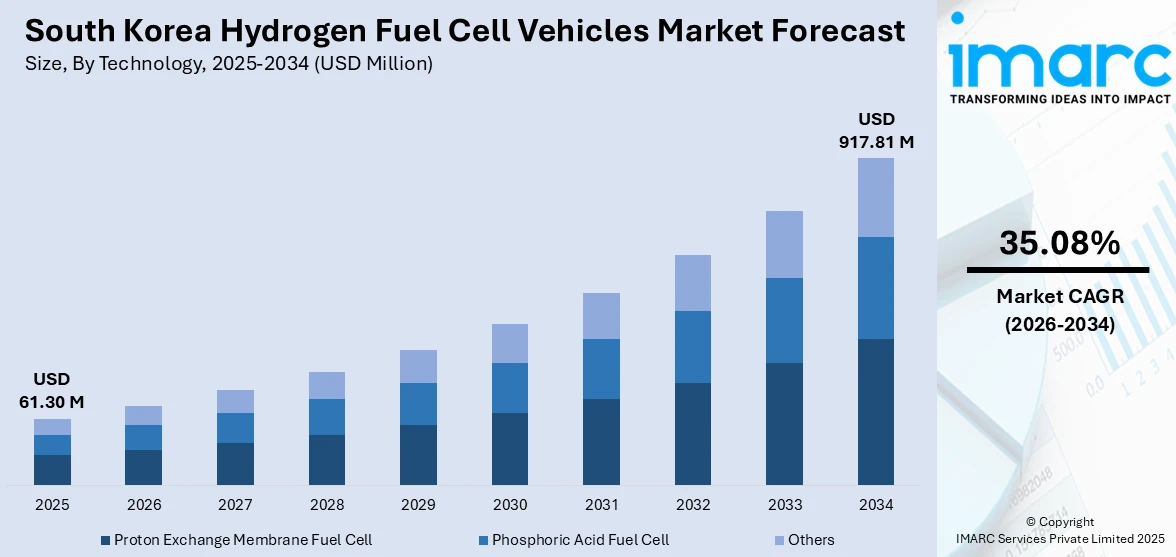
The South Korea hydrogen fuel cell vehicles market size was valued at USD 61.30 Million in 2025 and is projected to reach USD 917.81 Million by 2034, growing at a compound annual growth rate of 35.08% from 2026-2034.
The South Korea hydrogen fuel cell vehicles market is experiencing strong momentum, driven by the government’s ambitious Hydrogen Economy Roadmap targeting large-scale fuel cell vehicle deployment and extensive refueling infrastructure expansion. Increasing investments in next-generation fuel cell technologies, accelerating commercial fleet electrification, and rising environmental awareness are strengthening adoption. Generous purchase subsidies, carbon neutrality commitments, and domestic manufacturing scale-up are further reinforcing the South Korea hydrogen fuel cell vehicles market share.
Key Takeaways and Insights:
- By Technology: Proton exchange membrane fuel cell dominates the market with a share of 72.4% in 2025, owing to its high power density, rapid startup capability, and low operating temperature that make it exceptionally suitable for automotive applications requiring efficient and responsive energy conversion.
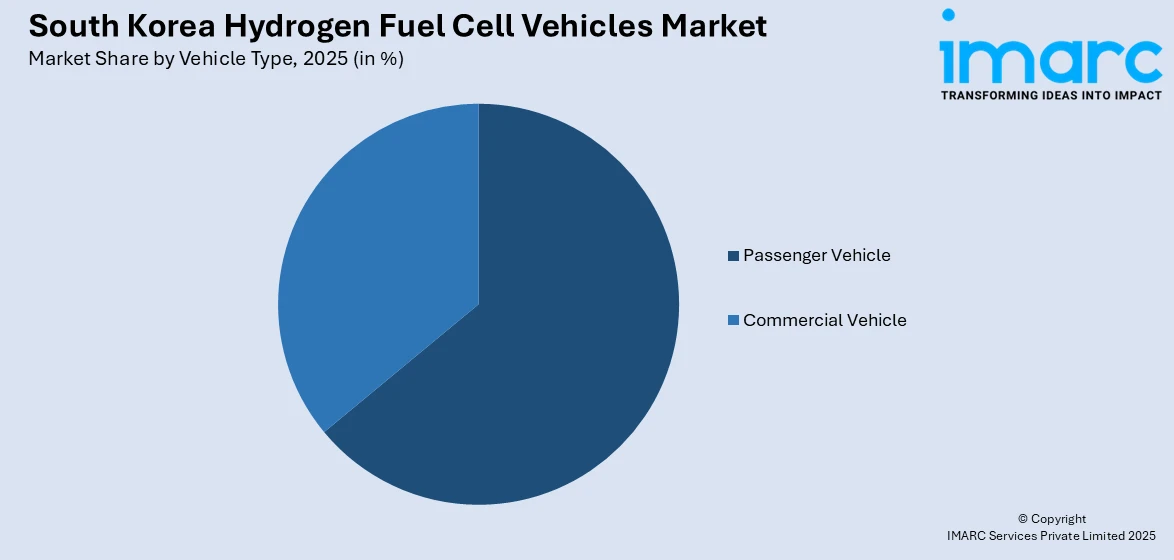
- By Vehicle Type: Passenger vehicle leads the market with a share of 64.1% in 2025. This dominance is driven by strong consumer uptake supported by generous government purchase subsidies, expanding hydrogen refueling accessibility, and growing environmental awareness among urban commuters seeking zero-emission mobility solutions.
- By Region: Seoul Capital Area comprises the largest region with 56.8% share in 2025, driven by the concentration of hydrogen refueling infrastructure, higher consumer purchasing power, dense population centers, and proximity to government-backed hydrogen mobility demonstration projects.
- Key Players: The market is concentrated, led by Hyundai and supported by government-backed refueling and procurement programs. Competition is shifting toward fleet and commercial use, while global players and Chinese entrants pressure costs, stack performance, and supply-chain localization.
To get more information on this market Request Sample
The South Korea hydrogen fuel cell vehicles market is advancing rapidly as the nation consolidates its position as a global hydrogen mobility leader. The government’s comprehensive policy framework, anchored by the Hydrogen Economy Roadmap and reinforced through the Hydrogen Economy Promotion and Safety Management Act, establishes a structured pathway for large-scale fuel cell vehicle deployment. Ambitious targets envision placing 300,000 fuel cell electric vehicles on the road and installing over 660 hydrogen refueling stations by 2030, supported by substantial purchase subsidies and infrastructure investment. In 2024, the Ministry of Environment distributed over 1,000 hydrogen buses nationwide, representing a 277% increase compared to the previous year, signaling a decisive shift toward commercial vehicle electrification through hydrogen technology. Domestic manufacturers are scaling production capabilities while advancing third-generation fuel cell systems that deliver enhanced power output, improved durability, and greater cost competitiveness. Rising consumer environmental awareness and favorable fiscal incentives continue to broaden demand across both passenger and commercial segments.
South Korea Hydrogen Fuel Cell Vehicles Market Trends:
Rapid Expansion of Commercial Hydrogen Fleet Electrification
South Korea is witnessing accelerating adoption of hydrogen fuel cell technology in commercial transportation fleets, particularly buses and heavy-duty trucks. The government’s focused subsidy restructuring has prioritized commercial vehicles as key demand catalysts for hydrogen mobility infrastructure. Accordingly, in 2025, the Ministry of Environment confirmed a budget of KRW 721.8 Billion for hydrogen vehicle distribution, supporting the procurement of 2,000 hydrogen buses and 11,000 hydrogen passenger cars. This commercial fleet transformation is reshaping the hydrogen mobility ecosystem through sustained public procurement initiatives.
Advancement of Next-Generation Fuel Cell Stack Technology
Continuous innovation in proton exchange membrane fuel cell stack design is enhancing vehicle performance, range, and consumer appeal across South Korea’s hydrogen mobility ecosystem. Manufacturers are developing third-generation fuel cell systems that achieve higher power output while reducing physical dimensions and production costs. For example, Hyundai’s All-New Nexo hydrogen SUV debuted in June 2025 with up to 720km range and five-minute refueling, reinforcing its hydrogen mobility strategy. Powertrain upgrades, quieter cabin design, and advanced driving tech strengthen its leadership in fuel cell vehicles, supporting the South Korea hydrogen fuel cell vehicles market growth.
Diversification of Hydrogen Refueling Infrastructure Models
South Korea is pioneering diversified hydrogen refueling models, including liquid hydrogen stations and pipeline-fed facilities, to address infrastructure accessibility gaps. The government is transitioning toward commercial grade refueling systems capable of servicing heavy-duty vehicles alongside passenger cars. For instance, in April 2025, South Korea opened its largest hydrogen commercial vehicle refueling station in Ulsan Myeongchon, operating at 95 MPa pressure with capacity to dispense 300 kg per hour and simultaneously refuel three hydrogen buses through a 10.5 km underground hydrogen pipeline network.
Market Outlook 2026-2034:
The South Korea hydrogen fuel cell vehicles market is poised for substantial expansion as government policy commitments, infrastructure investments, and technological breakthroughs converge to create favorable conditions for widespread adoption. Accordingly, the government’s allocation of KRW 196.3 Billion for hydrogen charging station construction in 2025, targeting over 64 new installations to achieve a cumulative count exceeding 450 stations, highlights the sustained fiscal commitment to infrastructure development. In addition, ongoing expansion of liquid hydrogen refueling facilities, advancement of hydrogen-powered urban transit networks including tram corridors in cities like Daejeon and Ulsan and deepening international cooperation in clean hydrogen supply chains are broadening the application landscape and demand pipeline for fuel cell vehicles across the nation. The market generated a revenue of USD 61.30 Million in 2025 and is projected to reach a revenue of USD 917.81 Million by 2034, growing at a compound annual growth rate of 35.08% from 2026-2034.
South Korea Hydrogen Fuel Cell Vehicles Market Report Segmentation:
|
Segment Category |
Leading Segment |
Market Share |
|
Technology |
Proton Exchange Membrane Fuel Cell |
72.4% |
|
Vehicle Type |
Passenger Vehicle |
64.1% |
|
Region |
Seoul Capital Area |
56.8% |
Technology Insights:
- Proton Exchange Membrane Fuel Cell
- Phosphoric Acid Fuel Cell
- Others
Proton exchange membrane fuel cell dominates with a market share of 72.4% of the total South Korea hydrogen fuel cell vehicles market in 2025.
Proton exchange membrane fuel cell technology commands the largest share of the South Korea hydrogen fuel cell vehicles market owing to its superior suitability for automotive applications that demand rapid startup, high power density, and efficient operation at relatively low temperatures. PEM fuel cells convert hydrogen and oxygen into electricity through electrochemical reactions without combustion, delivering zero tailpipe emissions while providing driving performance comparable to conventional vehicles. The technology’s compact form factor and responsive power delivery make it the preferred choice for both passenger and commercial hydrogen vehicles. In Q3 2025, Hyundai Motor reported fuel cell vehicle sales of 3,723 units in South Korea, representing a 200% year-over-year increase.
The ongoing development of PEM fuel cell stack design leads to market growth since this technology solves essential obstacles which include cost, durability and power output. The manufacturers use their accumulated fuel cell development knowledge from multiple decades to achieve two goals which are reduced production expenses and increased system reliability and energy efficiency. The domestic supply chains gain strength through the local production of essential components which include membrane electrode assemblies and catalyst materials, thereby increasing their ability to compete with imported products.
Vehicle Type Insights:
Access the comprehensive market breakdown Request Sample
- Passenger Vehicle
- Commercial Vehicle
Passenger vehicle leads with a share of 64.1% of the total South Korea hydrogen fuel cell vehicles market in 2025.
The passenger vehicle segment holds the largest share of the South Korea hydrogen fuel cell vehicles market, supported by robust government purchase subsidies and a well-established consumer ecosystem centered around hydrogen-powered personal mobility. The segment benefits from strong brand recognition of domestically produced fuel cell SUVs, which offer compelling driving ranges, rapid refueling convenience, and premium features that appeal to environmentally conscious consumers. Favorable fiscal policies, including combined national and local government subsidies that can reduce vehicle purchase costs by more than 40%, have been instrumental in sustaining consumer demand.
The introduction of redesigned fuel cell passenger models with significantly enhanced range and advanced safety technologies is reinvigorating consumer interest and expanding the addressable market. Third-generation fuel cell systems deliver improved power output in more compact configurations which enable manufacturers to produce vehicles that offer increased interior space and extended driving range together with decreased ownership expenses. The growing hydrogen refueling station network which extends throughout urban areas and between cities helps to mitigate range anxiety problems while promoting first-time hydrogen vehicle users to adopt the technology.
Regional Insights:
- Seoul Capital Area
- Yeongnam (Southeastern Region)
- Honam (Southwestern Region)
- Hoseo (Central Region)
- Others
The Seoul Capital Area exhibits a clear dominance with a 56.8% share of the total South Korea hydrogen fuel cell vehicles market in 2025.
The Seoul Capital Area commands the largest share of the South Korea hydrogen fuel cell vehicles market, driven by the highest concentration of hydrogen refueling infrastructure, superior consumer purchasing power, and dense urban population centers generating substantial demand for zero-emission mobility. The metropolitan region serves as the focal point for government-backed hydrogen mobility demonstration projects and hosts key technology innovation hubs accelerating fuel cell vehicle development. As of August 2024, approximately 40 hydrogen-fueled buses were operating on intercity routes within the Seoul metropolitan area, reflecting the region’s pioneering role in commercial hydrogen transit deployment.
Beyond passenger vehicles, the Seoul Capital Area is also emerging as a testbed for hydrogen adoption across logistics, municipal fleets, and public transportation. Local governments are prioritizing hydrogen-powered buses, trucks, and service vehicles to meet air-quality targets and carbon reduction goals. Collaboration between automakers, energy companies, and research institutions in the region supports pilot projects, infrastructure rollout, and cost optimization. This ecosystem approach accelerates commercialization, shortens adoption timelines, and reinforces the Seoul Capital Area’s leadership in shaping South Korea’s hydrogen mobility market.
Market Dynamics:
Growth Drivers:
Why is the South Korea Hydrogen Fuel Cell Vehicles Market Growing?
Comprehensive Government Policy and Fiscal Support Framework
The South Korean government’s multi-layered policy architecture represents the primary growth catalyst for the hydrogen fuel cell vehicles market, combining ambitious deployment targets, generous purchase subsidies, and dedicated infrastructure funding to create a comprehensive ecosystem for hydrogen mobility adoption. The Hydrogen Economy Roadmap envisions placing fuel cell electric vehicles on the road and constructing hydrogen refueling stations, with long-term targets extending to 6.2 million vehicles and 1,200 stations by 2040. Furthermore, national and local government purchase subsidies can reduce individual vehicle acquisition costs, significantly lowering the entry barrier for consumers. The Hydrogen Economy Promotion and Safety Management Act provide the overarching legal framework, while the Clean Hydrogen Portfolio Standard, launched in May 2024 with a total bidding volume of 6,500 GWh annually, is establishing a dedicated clean hydrogen power market that strengthens the broader hydrogen supply chain supporting vehicle deployment.
Accelerating Domestic Manufacturing and Technology Scale-Up
South Korea’s hydrogen fuel cell vehicles market is benefiting from significant domestic manufacturing investments that are expanding production capacities, advancing fuel cell technologies, and strengthening supply chain resilience. Major automotive manufacturers are committing substantial capital toward purpose-built hydrogen fuel cell production infrastructure, reflecting a long-term strategic commitment to hydrogen mobility leadership. The localization of critical components, including fuel cell stacks, membrane electrode assemblies, and hydrogen storage systems, is driving cost reductions and improving production efficiency across the value chain. As such, in October 2025, Hyundai Motor held a groundbreaking ceremony for a KRW 930 Billion hydrogen fuel cell production facility in Ulsan, designed to mass-produce 30,000 fuel cell units annually alongside polymer electrolyte membrane electrolyzers, with scheduled completion by 2027. This facility will serve diverse mobility applications including passenger vehicles, commercial trucks, buses, construction equipment, and marine vessels.
Expanding Hydrogen Refueling Infrastructure Network
The systematic expansion of hydrogen refueling infrastructure across South Korea is directly enabling fuel cell vehicle adoption by addressing range anxiety and improving daily usability for both passenger and commercial vehicle operators. The government’s infrastructure strategy encompasses diverse station formats, including compressed gaseous hydrogen, liquid hydrogen, and pipeline-fed facilities, designed to serve varying vehicle types and geographic requirements. Urban, suburban, and highway corridor station placements are progressively extending the practical operating range of fuel cell vehicles nationwide. South Korea ranked as the global leader outside China in hydrogen refueling station expansion for the third consecutive year, underscoring its commitment to building comprehensive refueling infrastructure.
Market Restraints:
What Challenges the South Korea Hydrogen Fuel Cell Vehicles Market is Facing?
High Vehicle Acquisition and Total Ownership Costs
The upfront purchase price of hydrogen fuel cell vehicles remains substantially higher than both conventional internal combustion engine vehicles and battery electric alternatives, creating a significant barrier to mass-market adoption. Even with generous national and local government subsidies, the net cost of fuel cell passenger vehicles exceeds comparably equipped conventional models. Additionally, hydrogen fuel costs at the pump remain elevated compared to electricity and gasoline on a per-kilometer basis, further affecting the total cost of ownership and deterring price-sensitive consumers from transitioning to hydrogen-powered mobility.
Insufficient Geographic Coverage of Refueling Infrastructure
Despite ongoing expansion efforts, the geographic distribution of hydrogen refueling stations remains heavily concentrated in major metropolitan areas, leaving significant accessibility gaps in rural, semi-urban, and remote regions across the country. This uneven infrastructure distribution creates practical limitations for fuel cell vehicle owners traveling outside established corridors and constrains adoption in underserved areas. The pace of station construction relative to growing vehicle registrations has widened the ratio of vehicles per station, increasing wait times and diminishing the overall refueling convenience for existing hydrogen vehicle users.
Competition from Rapidly Advancing Battery Electric Vehicle Technology
The accelerating maturation of battery electric vehicle technology, characterized by declining battery costs, expanding driving ranges, and proliferating fast-charging infrastructure, presents an intensifying competitive challenge to hydrogen fuel cell vehicle adoption in the passenger segment. Battery electric vehicles benefit from significantly higher energy conversion efficiency compared to hydrogen fuel cell systems, which require multiple energy transformation steps from production to end use. The growing availability of affordable battery electric models across diverse vehicle categories is diverting potential consumers away from hydrogen alternatives.
Competitive Landscape:
The South Korea hydrogen fuel cell vehicles market is characterized by concentrated domestic manufacturing leadership, with key players investing heavily in next-generation fuel cell stack development, production capacity expansion, and commercial vehicle diversification. Companies are competing through technological differentiation, focusing on enhancing power output, extending durability, and reducing unit costs to achieve price competitiveness with alternative propulsion systems. Strategic collaborations between automotive manufacturers, hydrogen infrastructure providers, and government agencies are fostering ecosystem-wide innovation. Partnerships with global hydrogen technology firms and energy companies are expanding supply chain capabilities, while localized production strategies are strengthening competitive positioning.
Recent Developments:
- In September 2025, South Korea launched a pilot in Ulsan integrating a 1MW hydrogen fuel cell with a 0.5MW solar system using real-time controls. Led by Korea East-West Power with Hyundai, the project demonstrates fast-response hydrogen systems for grid stabilization, virtual power plants, and renewable integration.
- In February 2025, South Korea raised hydrogen fuel subsidies for fuel cell buses to 5,000 won per kilogram in February 2025, cutting operating fuel costs by about 22%. The move aims to improve the cost competitiveness of hydrogen buses versus battery-electric alternatives and accelerate adoption in public transport fleets.
South Korea Hydrogen Fuel Cell Vehicles Market Report Coverage:
|
Report Features |
Details |
|
Base Year of the Analysis |
2025 |
|
Historical Period |
2020-2025 |
|
Forecast Period |
2026-2034 |
|
Units |
Million USD |
|
Scope of the Report |
Exploration of Historical Trends and Market Outlook, Industry Catalysts and Challenges, Segment-Wise Historical and Future Market Assessment:
|
|
Technologies Covered |
Proton Exchange Membrane Fuel Cell, Phosphoric Acid Fuel Cell, Others |
|
Vehicle Types Covered |
Passenger Vehicle, Commercial Vehicle |
|
Regions Covered |
Seoul Capital Area, Yeongnam (Southeastern Region), Honam (Southwestern Region), Hoseo (Central Region), Others |
|
Customization Scope |
10% Free Customization |
|
Post-Sale Analyst Support |
10-12 Weeks |
|
Delivery Format |
PDF and Excel through Email (We can also provide the editable version of the report in PPT/Word format on special request) |
Frequently Asked Questions About the South Korea Hydrogen Fuel Cell Vehicles Market Report
The South Korea hydrogen fuel cell vehicles market size was valued at USD 61.30 Million in 2025.
The South Korea hydrogen fuel cell vehicles market is expected to grow at a compound annual growth rate of 35.08% from 2026-2034 to reach USD 917.81 Million by 2034.
Proton exchange membrane fuel cell dominated the market with a share of 72.4%, driven by its high power density, rapid startup capability, low operating temperature, and proven reliability in automotive fuel cell systems across both passenger and commercial vehicle platforms.
Key factors driving the South Korea hydrogen fuel cell vehicles market include comprehensive government subsidies and deployment targets, accelerating domestic fuel cell manufacturing investments, expanding hydrogen refueling infrastructure, advancing fuel cell stack technologies, and growing commercial fleet electrification initiatives.
Major challenges include high vehicle acquisition and ownership costs relative to alternatives, insufficient geographic coverage of hydrogen refueling stations beyond metropolitan areas, intensifying competition from battery electric vehicle technologies, and limited consumer awareness about hydrogen mobility benefits.
Need more help?
- Speak to our experienced analysts for insights on the current market scenarios.
- Include additional segments and countries to customize the report as per your requirement.
- Gain an unparalleled competitive advantage in your domain by understanding how to utilize the report and positively impacting your operations and revenue.
- For further assistance, please connect with our analysts.
 Request Customization
 Speak to an Analyst
 Request Brochure
 Inquire Before Buying
Benefits of Customization
- Personalize this research
- Triangulate with your data
- Get data as per your format and definition
- Gain a deeper dive into a specific application, geography, customer, or competitor
- Any level of personalization
Get in Touch With Us
UNITED STATES
Phone: +1-201-971-6302
INDIA
Phone: +91-120-433-0800
UNITED KINGDOM
Phone: +44-753-714-6104
Email: [email protected]
Client Testimonials




.webp)




.webp)













Related Reports

Choose your plan
*Please note that the prices mentioned below are starting prices for each bundle type. Kindly contact our team for further details.*
Single User License
- 1 User License, Access on 2 Devices
- PDF Report + Excel Dataset (Password Protected)
- Lifetime Access
- No Printing Rights
- 10% Free Report Customization
- 10–12 Weeks of Analyst Support
Five User License
- Access for 5 Users, 2 Devices per User
- PDF Report + Excel Dataset (Password Protected)
- Lifetime Access
- Dedicated Account Manager
- 12–14 Weeks of Analyst Support
- No Printing Rights
- 15% Free Report Customization
- 25% Discount on Your Next Purchase
Corporate User License
- Unlimited User Access (Within Your Organization)
- PDF Report + Excel Dataset
- Lifetime Access
- Dedicated Account Manager
- 14–20 Weeks of Analyst Support
- No Printing Rights
- 20% Free Report Customization
- 30% Discount on Your Next Purchase
Essential Insights
What's included:
3 reports
- Lifetime Access
- PDF Reports
- Excel Datasets
- 2 Weeks of Free Analyst Support
- 2 User Licenses
- Access on 2 Devices
- Printing Rights
- Complimentary PowerPoint (PPT) Version
- Complimentary License Upgrade
Professional Access
What's included:
5 reports
- Lifetime Access
- PDF Reports
- Excel Datasets
- 8 Weeks of Free Analyst Support
- 2 User Licenses
- Access on 2 Devices
- Printing Rights
- Complimentary PowerPoint (PPT) Version
- Complimentary License Upgrade
Business Advantage
What's included:
8 reports
- Lifetime Access
- PDF Reports
- Excel Datasets
- 14 Weeks of Free Analyst Support
- 2 User Licenses
- Access on 2 Devices
- Printing Rights
- Complimentary PowerPoint (PPT) Version
- Complimentary License Upgrade
Enterprise Intelligence
What's included:
10 reports
- Lifetime Access
- PDF Reports
- Excel Datasets
- 20 Weeks of Free Analyst Support
- 2 User Licenses
- Access on 2 Devices
- Printing Rights
- Complimentary PowerPoint (PPT) Version
- Complimentary License Upgrade