
South Korea Hyperlocal Delivery Market Size, Share, Trends and Forecast by Type, Nature, and Region, 2026-2034
South Korea Hyperlocal Delivery Market Summary:
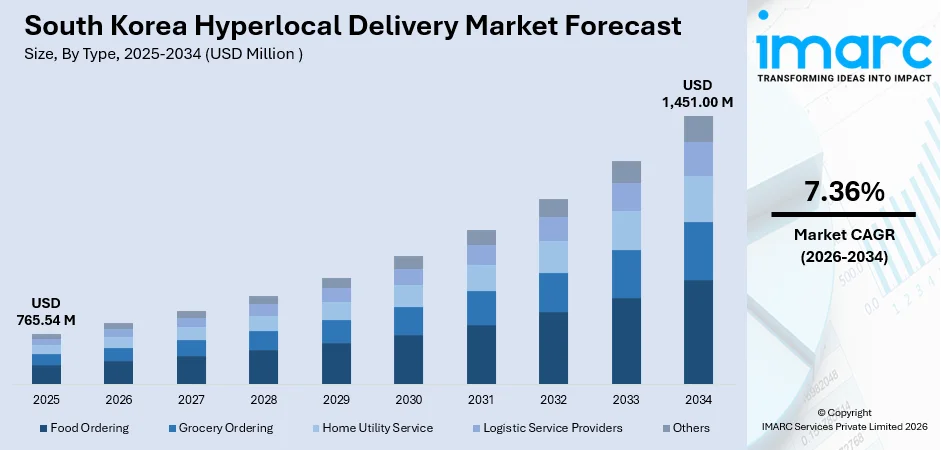
The South Korea hyperlocal delivery market size was valued at USD 765.54 Million in 2025 and is projected to reach USD 1,451.00 Million by 2034, growing at a compound annual growth rate of 7.36% from 2026-2034.
The South Korea hyperlocal delivery market is experiencing robust expansion driven by the nation's advanced digital infrastructure, evolving consumer lifestyles, and intensifying platform competition. Rising demand for ultra-fast delivery across food, grocery, and daily essentials categories is reshaping last-mile logistics. Proliferating single-person households, widespread smartphone adoption, and innovative quick commerce models are accelerating on-demand service utilization, strengthening the South Korea hyperlocal delivery market share.
Key Takeaways and Insights:
- By Type: Food ordering dominates the market with a share of 48.6% in 2025, owing to South Korea's deeply embedded delivery culture, competitive platform ecosystems, and consumer preference for convenient meal solutions that cater to busy urban lifestyles and growing single-person households.
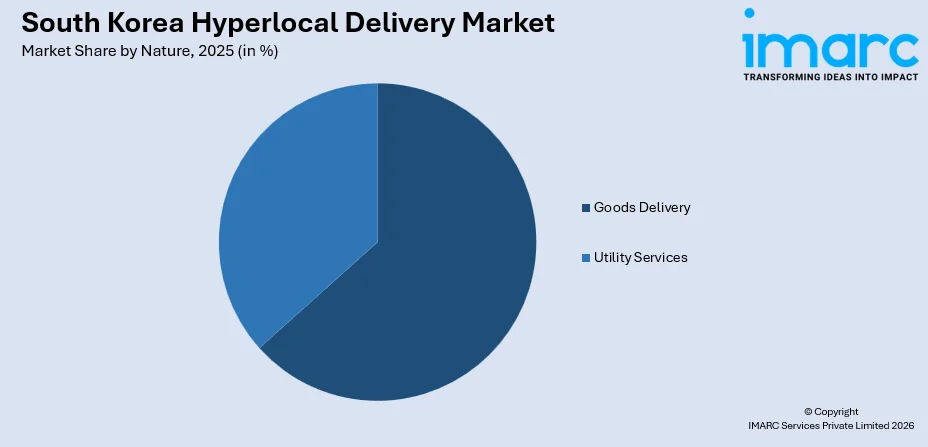
- By Nature: Goods delivery leads the market with a share of 69.2% in 2025, driven by the expansion of quick commerce services delivering groceries, daily essentials, and consumer products within ultra-short timeframes through integrated platform logistics networks.
- By Region: Seoul Capital Area comprises the largest region with 57.4% share in 2025, reflecting the high concentration of residents, dense urban infrastructure, advanced logistics networks, and the highest penetration of delivery platform services across the nation.
- Key Players: Leading operators in the market are intensifying competition through membership-based loyalty programs, autonomous delivery technologies, strategic retail partnerships, and rapid expansion of quick commerce fulfillment networks to capture growing consumer demand for instant, convenient delivery services.
To get more information on this market Request Sample
The South Korea hyperlocal delivery market is advancing as digital ecosystems, shifting demographics, and evolving consumer expectations converge to create a highly dynamic on-demand services landscape. A key factor shaping this growth is the rapid expansion of quick commerce, which enables delivery of goods within minutes of ordering. For instance, South Korea's quick commerce market surged from KRW 350 Billion in 2020 to a projected KRW 5 Trillion in 2025, representing a remarkable acceleration in sub-one-hour delivery adoption. Platform innovation, expanding micro-fulfillment infrastructure, and growing preference for hyperlocal convenience are contributing to a more favorable environment for sustained market development. Additionally, rising integration between major delivery apps and traditional offline retailers is broadening service reach beyond food into groceries, personal care, and household goods, creating a comprehensive on-demand consumption ecosystem.
South Korea Hyperlocal Delivery Market Trends:
Intensifying platform competition reshaping delivery ecosystems
South Korea's hyperlocal delivery landscape is undergoing significant transformation as major platforms engage in aggressive competition for market dominance. For instance, Coupang Eats' market share by credit card transaction value doubled to 35.3% in 2024, while incumbent leader Baemin's share declined from over 70% to 57.6%, driven largely by Coupang's free delivery strategy for its paid membership subscribers. This competitive intensity is fueling innovation in pricing models, service speed, and customer retention strategies, supporting South Korea hyperlocal delivery market growth.
Autonomous robot delivery gaining commercial traction
Autonomous delivery robots are transitioning from pilot programs to commercial-scale operations across South Korean cities, following the government's legalization of outdoor robot delivery on sidewalks. For example, in September 2024, Neubility partnered with food delivery app Yogiyo to launch a large-scale robot delivery service in Songdo, Incheon, deploying robots capable of completing deliveries within 30 minutes across a 1.2-kilometer radius. These advancements in last-mile automation are reducing operational costs while addressing labor shortages in the delivery sector.
Quick commerce expansion beyond food into retail and daily essentials
Major delivery platforms are rapidly expanding beyond food ordering into quick commerce services that include groceries, household essentials, and consumer products. This shift is building hyperlocal retail ecosystems where consumers can purchase a wide range of items through a single digital interface. With faster fulfillment models and improved last-mile logistics, these platforms are reshaping shopping behavior by offering greater convenience, instant access, and broader product availability across urban centers.
Market Outlook 2026-2034:
South Korea's hyperlocal delivery market is poised for sustained advancement, supported by deepening platform integration, expanding quick commerce infrastructure, and evolving consumer demand for instant fulfillment. In tandem, rising single-person households, which reached 8.05 Million in 2024 accounting for 36.1% of all households, are creating structural demand for small-basket, on-demand delivery services. Continued investments in autonomous delivery technologies, AI-powered logistics optimization, and micro-fulfillment networks are expected to enhance operational efficiency and expand service coverage beyond metropolitan centers into secondary cities and suburban corridors across the nation. The market generated a revenue of USD 765.54 Million in 2025 and is projected to reach a revenue of USD 1,451.00 Million by 2034, growing at a compound annual growth rate of 7.36% from 2026-2034.
South Korea Hyperlocal Delivery Market Report Segmentation:
|
Segment Category |
Leading Segment |
Market Share |
|
Type |
Food Ordering |
48.6% |
|
Nature |
Goods Delivery |
69.2% |
|
Region |
Seoul Capital Area |
57.4% |
Type Insights:
- Food Ordering
- Grocery Ordering
- Home Utility Service
- Logistic Service Providers
- Others
Food ordering dominates the market with a share of 48.6% of the total South Korea hyperlocal delivery market in 2025.
South Korea's food ordering segment maintains its leadership position within the hyperlocal delivery market, underpinned by a deeply entrenched delivery culture and fierce competition among platform operators. The nation's online food delivery market reached approximately KRW 29.28 Trillion in total transaction value in 2024, reflecting a 12.1% increase from the last year according to Statistics Korea. Platform operators are continuously enhancing user experiences through personalized recommendations, subscription-based loyalty programs, and ultra-fast delivery guarantees that reinforce habitual ordering behavior among consumers across all age demographics.
The competitive dynamics between major food delivery platforms are accelerating innovation and driving market expansion. Coupang Eats' active user base surged to 7,981,015 users, up from 7,751,810. This membership-driven growth model is compelling rival platforms to develop comparable value propositions, collectively expanding the addressable consumer base and increasing order frequency across the food ordering segment.
Nature Insights:
Access the comprehensive market breakdown Request Sample
- Goods Delivery
- Utility Services
Goods delivery leads with a share of 69.2% of the total South Korea hyperlocal delivery market in 2025.
The goods delivery segment commands the largest share of South Korea's hyperlocal delivery market, encompassing food, grocery, and consumer product deliveries that collectively address the broadest range of daily consumption needs. South Korea's internet penetration stood at 97.4% as of January 2025, with 50.4 million individuals using the internet, creating an exceptionally connected consumer base that readily adopts digital ordering and delivery services. This world-leading digital infrastructure enables seamless mobile commerce experiences that support high-frequency goods ordering across diverse product categories.
Structural demographic shifts are reinforcing demand for goods delivery services. Single-person households exhibit higher reliance on delivery services for daily necessities including prepared meals, groceries, and personal care items, generating consistent order volumes that sustain growth in the goods delivery segment across urban and suburban areas.
Regional Insights:
- Seoul Capital Area
- Yeongnam (Southeastern Region)
- Honam (Southwestern Region)
- Hoseo (Central Region)
- Others
Seoul Capital Area holds the largest share at 57.4% of the total South Korea hyperlocal delivery market in 2025.
The Seoul Capital Area dominates South Korea's hyperlocal delivery market, benefiting from the highest population density, most advanced logistics infrastructure, and greatest concentration of platform operations in the nation. Seoul is home to more than 9.6 million residents and spans 605.2 square kilometres, accounting for around 18.6% of the nation’s total population, which is creating ideal conditions for efficient hyperlocal fulfillment. Major platforms have established their densest networks of micro-fulfillment centers, delivery rider pools, and partner restaurant networks within the capital area.
The region stands at the center of platform competition, where major delivery and quick commerce players test new features, pricing models, and fulfillment strategies. High smartphone penetration, dense population clusters, and strong purchasing power create ideal conditions for rapid service adoption. Companies frequently pilot advanced logistics systems and subscription programs here before national rollout. Intense rivalry encourages faster innovation cycles, improved customer experience, and broader service integration, positioning the Seoul Capital Area as the driving force behind the nationwide expansion of hyperlocal delivery ecosystems.
Market Dynamics:
Growth Drivers:
Why is the South Korea Hyperlocal Delivery Market Growing?
Surging single-person households driving on-demand delivery adoption
South Korea's rapidly expanding single-person household segment is creating sustained structural demand for hyperlocal delivery services. The rise in number of single-person households, driven by an aging population, delayed marriages, and shifting social values among younger demographics, is impelling the market. These households demonstrate significantly higher reliance on delivery platforms for daily meals, groceries, and essential goods compared to multi-person households. Recognizing this demographic shift, major platform operators are tailoring their services to address the specific needs of solo consumers. Accordingly, in June 2025, Woowa Brothers announced that Baemin would exempt commissions on restaurant orders under 10,000 won as part of a three-year plan to subsidize KRW 300 Billion for partner stores, directly targeting the small-order patterns characteristic of single-person households. This strategic alignment between platform incentives and demographic trends is expanding order frequency and broadening the consumer base for hyperlocal delivery services.
World-leading digital infrastructure enabling seamless mobile commerce
South Korea's unparalleled digital ecosystem provides a foundational advantage for hyperlocal delivery market expansion. Mobile devices account for three-quarters of online purchases, and digital wallet adoption is growing at a rapid pace, enabling frictionless one-click checkouts that reduce the decision-to-delivery cycle. This advanced connectivity is complemented by government policies that actively support technology-driven logistics innovation. The South Korean government aims to commercialize robotic delivery by 2026 and drone delivery by 2027, following the November 2023 amendment to the Intelligent Robot Development and Supply Act that legalized autonomous robots on sidewalks. Cash grants covering 75% of qualified spending and seven-year import-duty holidays for automation equipment further reinforce investment in smart logistics infrastructure.
Expanding quick commerce and platform ecosystem integration
The rapid evolution of quick commerce is reshaping South Korea’s hyperlocal delivery market by expanding ultra-fast fulfillment beyond restaurant meals into groceries, household essentials, and wellness products. Leading platform operators are investing heavily in dark stores, last-mile logistics, and AI-driven routing to strengthen competitive positioning. Integrated strategies that combine food delivery with retail commerce are creating all-in-one service ecosystems. This shift is increasing order frequency, improving convenience, and driving deeper consumer reliance on hyperlocal delivery platforms across major urban centers.
Market Restraints:
What Challenges the South Korea Hyperlocal Delivery Market is Facing?
Escalating regulatory pressure on platform commission structures
South Korea's major delivery platforms face intensifying regulatory scrutiny regarding commission fees charged to partner restaurants and small businesses. The Fair Trade Commission has prioritized building a fair market environment by regulating influential platforms as a major policy initiative for 2025. Both Baemin and Coupang Eats have faced sanctions for allegedly forcing partner restaurants to match food prices across competing apps, while ongoing government pressure to reform commission structures could constrain platform revenue models and affect service sustainability.
High operational costs straining last-mile delivery economics
Sustained investment requirements for last-mile logistics infrastructure, rider compensation, and rapid fulfillment networks create significant cost pressures for hyperlocal delivery operators. Maintaining sub-one-hour delivery promises requires dense networks of micro-fulfillment centers, substantial rider fleets, and advanced route optimization technologies. These operational demands limit profitability, signaling that revenue expansion alone cannot offset sub-scale fulfillment costs without sustained efficiency improvements.
Intense price competition compressing platform margins
The ongoing competitive war among major delivery platforms is creating margin pressure through aggressive promotional spending, free delivery subsidies, and membership discount programs. The elimination of delivery fees for paid subscribers, combined with escalating marketing expenditures to attract and retain users, requires substantial capital investment that may prove unsustainable for smaller operators. This price-driven competition risks industry consolidation and could limit innovation in service quality and product diversification.
Competitive Landscape:
The South Korea hyperlocal delivery market is characterized by intense competition among a concentrated group of technology-driven platform operators. Leading companies are pursuing aggressive strategies centered on membership ecosystem integration, quick commerce diversification, and autonomous delivery innovation to differentiate their service offerings. Competition extends beyond traditional food delivery into grocery, daily essentials, and retail categories, compelling operators to build comprehensive logistics networks. Strategic alliances between delivery platforms and offline retailers are reshaping competitive dynamics, while regulatory developments around commission transparency and fair competition practices are influencing operational strategies across the industry.
Recent Developments:
- In April 2025, JD Logistics entered South Korea’s domestic supply chain market, launching self-operated centers in Icheon and Incheon. Offering 3PL and integrated logistics services, the facilities use automation and AI systems to enable 12-hour delivery in Seoul. The company also supports cross-border trade through JD Worldwide.
- In April 2025, Naver and Kurly announced a strategic alliance under which Market Kurly's fresh grocery products would officially launch on Naver's AI-powered shopping platform, Naver Plus Store. The partnership strengthens Naver's fresh food category while providing Kurly access to Naver's vast user base of over 45 million monthly active users.
South Korea Hyperlocal Delivery Market Report Coverage:
|
Report Features |
Details |
|
Base Year of the Analysis |
2025 |
|
Historical Period |
2020-2025 |
|
Forecast Period |
2026-2034 |
|
Units |
Million USD |
|
Scope of the Report |
Exploration of Historical Trends and Market Outlook, Industry Catalysts and Challenges, Segment-Wise Historical and Future Market Assessment:
|
|
Types Covered |
Food Ordering, Grocery Ordering, Home Utility Service, Logistic Service Providers, Others |
|
Natures Covered |
Goods Delivery, Utility Services |
|
Regions Covered |
Seoul Capital Area, Yeongnam (Southeastern Region), Honam (Southwestern Region), Hoseo (Central Region), Others |
|
Customization Scope |
10% Free Customization |
|
Post-Sale Analyst Support |
10-12 Weeks |
|
Delivery Format |
PDF and Excel through Email (We can also provide the editable version of the report in PPT/Word format on special request) |
Frequently Asked Questions About the South Korea Hyperlocal Delivery Market Report
The South Korea hyperlocal delivery market size was valued at USD 765.54 Million in 2025.
The South Korea hyperlocal delivery market is expected to grow at a compound annual growth rate of 7.36% from 2026-2034 to reach USD 1,451.00 Million by 2034.
Food ordering dominated the market with a share of 48.6%, driven by South Korea's deeply embedded delivery culture, competitive platform ecosystems, and rising consumer preference for convenient meal solutions.
Key factors driving the South Korea hyperlocal delivery market include surging single-person households, world-leading digital infrastructure and smartphone penetration, expanding quick commerce ecosystems, and intensifying platform competition.
Major challenges include escalating regulatory pressure on platform commission structures, high operational costs for last-mile delivery infrastructure, intense price competition compressing margins, and sustainability concerns around delivery subsidies.
Need more help?
- Speak to our experienced analysts for insights on the current market scenarios.
- Include additional segments and countries to customize the report as per your requirement.
- Gain an unparalleled competitive advantage in your domain by understanding how to utilize the report and positively impacting your operations and revenue.
- For further assistance, please connect with our analysts.
 Request Customization
 Speak to an Analyst
 Request Brochure
 Inquire Before Buying
Benefits of Customization
- Personalize this research
- Triangulate with your data
- Get data as per your format and definition
- Gain a deeper dive into a specific application, geography, customer, or competitor
- Any level of personalization
Get in Touch With Us
UNITED STATES
Phone: +1-201-971-6302
INDIA
Phone: +91-120-433-0800
UNITED KINGDOM
Phone: +44-753-714-6104
Email: [email protected]
Client Testimonials




.webp)




.webp)













Related Reports

Choose your plan
*Please note that the prices mentioned below are starting prices for each bundle type. Kindly contact our team for further details.*
Single User License
- 1 User License, Access on 2 Devices
- PDF Report + Excel Dataset (Password Protected)
- Lifetime Access
- No Printing Rights
- 10% Free Report Customization
- 10–12 Weeks of Analyst Support
Five User License
- Access for 5 Users, 2 Devices per User
- PDF Report + Excel Dataset (Password Protected)
- Lifetime Access
- Dedicated Account Manager
- 12–14 Weeks of Analyst Support
- No Printing Rights
- 15% Free Report Customization
- 25% Discount on Your Next Purchase
Corporate User License
- Unlimited User Access (Within Your Organization)
- PDF Report + Excel Dataset
- Lifetime Access
- Dedicated Account Manager
- 14–20 Weeks of Analyst Support
- No Printing Rights
- 20% Free Report Customization
- 30% Discount on Your Next Purchase
Essential Insights
What's included:
3 reports
- Lifetime Access
- PDF Reports
- Excel Datasets
- 2 Weeks of Free Analyst Support
- 2 User Licenses
- Access on 2 Devices
- Printing Rights
- Complimentary PowerPoint (PPT) Version
- Complimentary License Upgrade
Professional Access
What's included:
5 reports
- Lifetime Access
- PDF Reports
- Excel Datasets
- 8 Weeks of Free Analyst Support
- 2 User Licenses
- Access on 2 Devices
- Printing Rights
- Complimentary PowerPoint (PPT) Version
- Complimentary License Upgrade
Business Advantage
What's included:
8 reports
- Lifetime Access
- PDF Reports
- Excel Datasets
- 14 Weeks of Free Analyst Support
- 2 User Licenses
- Access on 2 Devices
- Printing Rights
- Complimentary PowerPoint (PPT) Version
- Complimentary License Upgrade
Enterprise Intelligence
What's included:
10 reports
- Lifetime Access
- PDF Reports
- Excel Datasets
- 20 Weeks of Free Analyst Support
- 2 User Licenses
- Access on 2 Devices
- Printing Rights
- Complimentary PowerPoint (PPT) Version
- Complimentary License Upgrade