
Southeast Asia E-Commerce Market Size, Share, Trends and Forecast by Type, Transaction, and Country 2026-2034
Southeast Asia E-Commerce Market Summary:
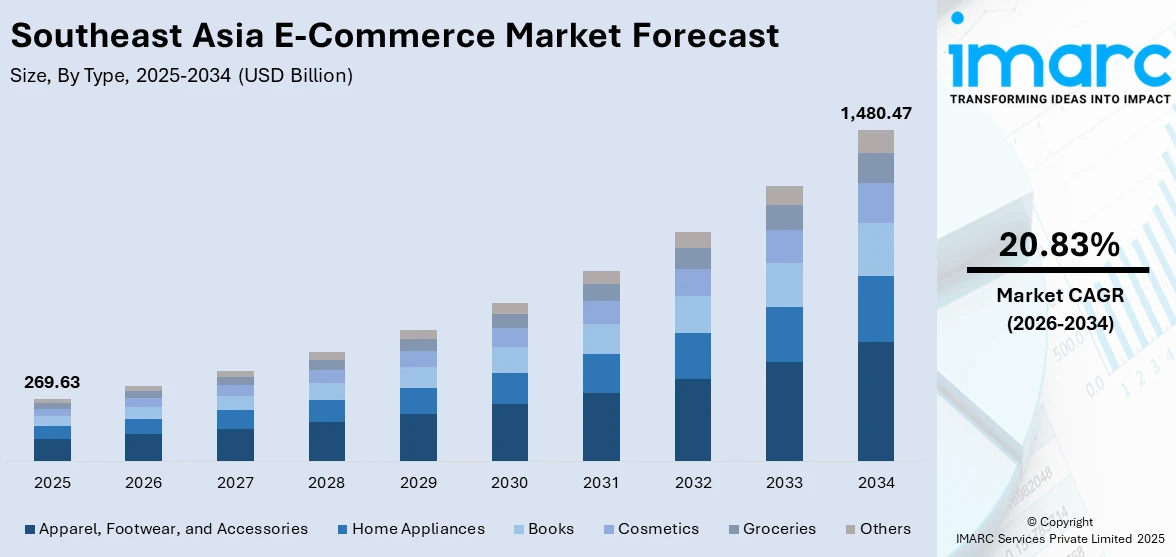
The Southeast Asia e-commerce market size was valued at USD 269.63 Billion in 2025 and is projected to reach USD 1,480.47 Billion by 2034, growing at a compound annual growth rate of 20.83% from 2026-2034.
The e-commerce market in Southeast Asia is undergoing significant growth fueled by the region's swiftly expanding digital user population, increasing mobile internet access, and the spread of cutting-edge digital payment options. The merging of social commerce platforms, improved logistics frameworks, and rising smartphone usage is fundamentally transforming retail dynamics throughout the region, generating unmatched opportunities for market players aiming to leverage the digital commerce revolution.
Key Takeaways and Insights:
- By Type: Apparel, footwear, and accessories dominate the market with a share of 26% in 2025. This is due to the growing impact of social commerce platforms and live-streaming buying experiences, which have revolutionized fashion retail throughout the region.
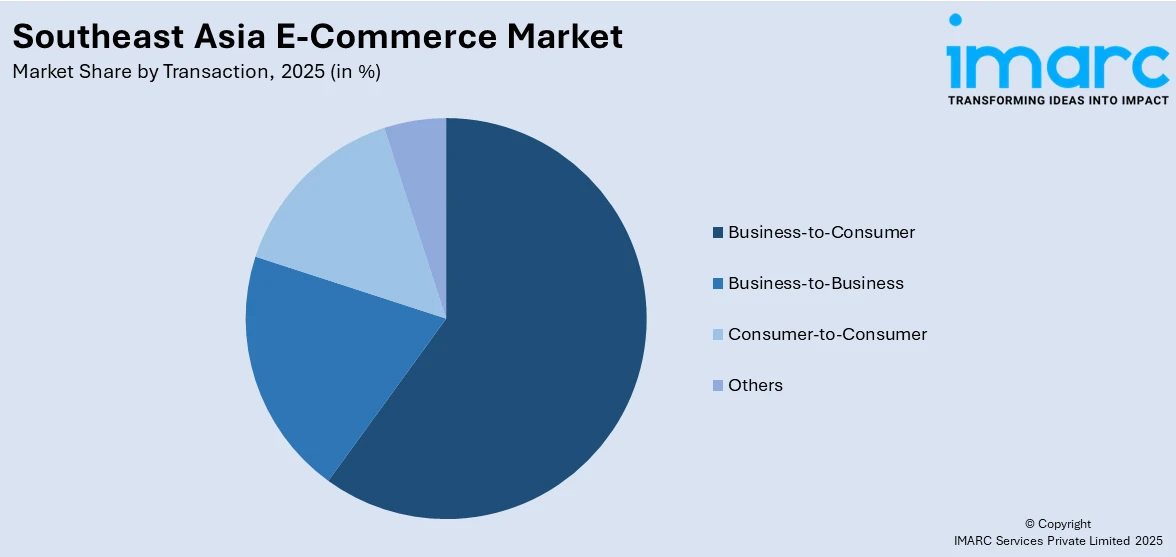
- By Transaction: Business-to-consumer leads the market with a share of 60% in 2025, owing to the rising number of digital users, improved mobile shopping experiences, and the growth of marketplace platforms with a wide range of product options.
- By Country: Indonesia represents the largest segment with a market share of 28% in 2025. This leadership is driven by the nation's substantial population, expanding middle class, and rapid growth in internet and smartphone usage.
- Key Players: The Southeast Asia e-commerce market is characterized by fierce competition, with both established regional platforms and emerging social commerce operators vying for customers in a variety of product categories and distribution methods.
To get more information on this market Request Sample
The e-commerce sector in Southeast Asia is propelled by swift digital assimilation, the growing internet availability, and a youthful, mobile-oriented demographic that is increasingly dependent on online platforms for daily shopping. Rising smartphone adoption and social media engagement foster discovery-driven shopping and live commerce, while major investments in logistics and fulfillment infrastructure are enhancing service dependability. An essential element in this growth is the digital enablement of small and medium-sized enterprises (SMEs), aided by government programs and imaginative corporate platforms. In 2025, Huawei introduced its inaugural HUAWEI eKit e-commerce platform in Thailand, collaborating with AIOT to offer customized digital solutions and network products for SMEs, including installation services and round-the-clock support. These localized, industry-specific solutions, along with competitive pricing and cross-border trading, enhance user adoption and maintain high transaction volumes, further reinforcing Southeast Asia as a vibrant center for digital commerce and tech integration.
Southeast Asia E-Commerce Market Trends:
Expansion of Digital Payment Ecosystems
Rapid expansion of digital payment infrastructure is strengthening e-commerce participation by reducing reliance on cash and lowering transaction friction. Improved regulatory oversight and security standards are increasing confidence in electronic payments, encouraging broader user adoption. Seamless payment integration within online platforms shortens checkout time and limits drop-offs. This trend is reinforced by cross-border payment initiatives, as seen in 2025 when Vietnam and Laos introduced LamoPay to support cashless transactions for tourists and small businesses and improve bilateral digital trade flows. Wider financial inclusion through such platforms expands the user base, supports higher purchase frequency, and sustains long-term growth in online retail activity.
Logistics and Fulfillment Network Improvements
Continued investment in logistics infrastructure is reinforcing the operational reliability of e-commerce across Southeast Asia. Platform-led warehousing, last-mile delivery networks, and cross-border coordination are improving delivery speed, tracking visibility, and service consistency. Distributed inventory models and urban fulfillment hubs reduce transit time and inventory risk, while route optimization lowers per-unit logistics costs. This momentum is reflected in 2025 when SF International launched an Asia-Pacific bulky-goods logistics service covering Thailand, Malaysia, Singapore, and Indonesia, offering integrated transport, storage, delivery, and installation support. As logistics capability strengthens, user confidence in online purchasing increases, enabling platforms to scale efficiently across varied regional markets.
Policy Support and Regulatory Maturity
Strengthening of regulatory frameworks across Southeast Asia is improving institutional confidence in digital commerce. Governing bodies in the region are focusing on user protection, data security, and platform accountability, reducing operational and legal uncertainty for market participants. This direction was evident in 2025 when Vietnam introduced a draft e-commerce law alongside a new cyberspace decree that expanded platform liability, tightened seller verification requirements, and enhanced mechanisms to address intellectual property violations and online fraud. Such regulatory clarity supports fair competition and investor confidence. As compliance standards become more predictable, platforms and merchants are better positioned to commit long-term capital, contributing to the e-commerce market in Southeast Asia.
Market Outlook 2026-2034:
The Southeast Asia e-commerce market demonstrates strong growth potential throughout the forecast period, driven by ongoing digital adoption and changing user purchasing behavior across the region. Rising smartphone penetration, improving internet access, and increased confidence in online payment systems continue to support higher transaction volumes and platform engagement. The market generated a revenue of USD 269.63 Billion in 2025 and is projected to reach a revenue of USD 1,480.47 Billion by 2034, growing at a compound annual growth rate of 20.83% from 2026-2034.
Southeast Asia E-Commerce Market Report Segmentation:
|
Segment Category |
Leading Segment |
Market Share |
|
Type |
Apparel, Footwear and Accessories |
26% |
|
Transaction |
Business-to-Consumer |
60% |
|
Country |
Indonesia |
28% |
Type Insights:
- Home Appliances
- Apparel, Footwear, and Accessories
- Books
- Cosmetics
- Groceries
- Others
Apparel, footwear, and accessories dominate with a market share of 26% of the total Southeast Asia e-commerce market in 2025.
Apparel, footwear, and accessories represent the largest segment owing to strong user demand driven by a young, fashion-aware population and rising urbanization. Frequent product refresh cycles, affordable pricing, and wide brand availability encourage repeat purchases. Social media influence, celebrity endorsements, and live commerce formats are further increasing interest, especially among mobile-first users. Easy comparison of styles, sizes, and prices online also supports higher conversion rates than many other product categories.
This dominance is bolstered by advancements in logistics, adaptable return policies, and cash-on-delivery (COD) choices that diminish purchase reluctance. Local and global brands are progressively utilizing e-commerce platforms to introduce exclusive collections, discounts, and flash sales, enhancing traffic levels. Sales throughout the year are sustained by seasonal demand linked to festivals, climate changes, and lifestyle trends. The relatively light weight of clothing and accessories also reduces shipping expenses, enhancing online fulfillment efficiency across dispersed regional markets.
Transaction Insights:
Access the comprehensive market breakdown Request Sample
- Business-to-Consumer
- Business-to-Business
- Consumer-to-Consumer
- Others
Business-to-consumer leads with a market share of 60% of the total Southeast Asia e-commerce market in 2025.
Business-to-consumer dominate the market attributed to strong demand for convenience, product variety, and competitive pricing among individual shoppers. People increasingly rely on online platforms for apparel, electronics, personal care, and household goods, supported by frequent discounts and fast delivery options. Large marketplaces offer integrated services covering payments, returns, and client support, making direct purchases from businesses more reliable. Rising digital literacy and mobile commerce adoption further reinforce user preference for structured B2C shopping environments.
The dominance of B2C is further fueled by the benefits of well-established platforms and sellers supported by brands. Companies gain advantages from being able to invest in marketing, logistical partnerships, and data-driven demand forecasting, which guarantees reliable service quality and client contentment. Confidence in approved vendors, recognized storefronts, and platform-supported guarantees diminishes perceived risk and encourages increased purchase rates. Simultaneously, digital initiatives aimed at enterprises are progressing, evident in 2025 when Vietnam inaugurated the An Lac Business Hub in Ho Chi Minh City to digitally link local businesses with international partners. Subscription models, loyalty initiatives, and extensive sales events continue to support elevated transaction volumes among various user groups.
Country Insights:
- Indonesia
- Thailand
- Singapore
- Philippines
- Vietnam
- Malaysia
- Others
Indonesia exhibits a clear dominance with a 28% share of the total Southeast Asia e-commerce market in 2025.
Indonesia holds the biggest market share due to its large population base, expanding middle class, and rapid growth in internet and smartphone usage. A young, mobile-first demographic actively engages with online shopping platforms for everyday needs and discretionary purchases. High social media usage supports discovery-led buying, while aggressive promotional campaigns by major platforms drive frequent transactions. Urban centers like Jakarta act as demand hubs, setting consumption trends that influence nationwide online retail activity.
This position is further supported by strong participation from local sellers, competitive marketplace ecosystems, and the growing digital payment adoption. E-wallet penetration and buy-now-pay-later (BNPL) options are lowering entry barriers for first-time buyers. Public programs supporting digital commerce and MSME onboarding further expand the seller base. This direction was evident in 2024 when Lazada partnered with Indonesia-based AHA Commerce to support local brands through end-to-end services covering store operations, logistics, marketing, and client management. Alongside sustained investment in last-mile delivery and fulfillment infrastructure, these initiatives improve service reach and enable efficient platform expansion across urban and semi-urban markets.

Market Dynamics:
Growth Drivers:
Why is the Southeast Asia E-Commerce Market Growing?
Mobile-First Digital Infrastructure
Mobile-first digital access continues to support the growth of e-commerce market across Southeast Asia, with smartphones functioning as the primary gateway for online transactions. Wider mobile network coverage and affordable data plans are extending participation across income levels and geographic areas. Platforms increasingly integrate browsing, payments, client support, and order tracking into unified mobile interfaces, reducing friction for new users. This trend is supported by rising device penetration, as reflected in Malaysia, where mobile phone usage reached 99.5% in 2024, with growth recorded in both urban and rural areas. High mobile reliance enables frequent, short purchasing sessions, increasing engagement intensity and transaction volumes throughout the day.
Sustainability-Driven Digital Trade Enablement
The growing regulatory and market pressure for environmental compliance is reshaping digital commerce across Southeast Asia. Businesses increasingly face requirements to disclose emissions data, verify responsible sourcing, and demonstrate supply chain accountability to participate in global trade. Digital platforms that integrate sustainability reporting tools reduce administrative burden and improve transparency for sellers. This shift was reflected in 2025 when Vietnam launched EcoHub, a green B2B e-commerce platform designed to support ESG-aligned trade through emissions disclosure and transparent production standards. By aligning digital trade infrastructure with sustainability objectives, such platforms improve export readiness and market access, reinforcing their strategic value and driving long-term structural growth in the e-commerce market.
Integration of Social Media and Commerce Platforms
The increasing integration between social media and e-commerce platforms is bolstering the market growth across Southeast Asia by embedding shopping within daily digital engagement. High usage of video and creator-led content supports discovery-driven purchasing and strengthens client trust. These integrations shorten the path from product awareness to transaction while improving conversion efficiency for sellers. This trend was reinforced in 2024 when Shopee partnered with YouTube in Indonesia, enabling creators to tag products directly in videos and redirect viewers to Shopee for purchases, strengthening competitive positioning. As content, payments, and fulfillment become interconnected, social commerce continues to drive higher engagement, repeat transactions, and sustained expansion in mobile-centric regional markets.
Market Restraints:
What Challenges the Southeast Asia E-Commerce Market is Facing?
Digital Infrastructure Disparities Across Geographic Regions
Uneven digital infrastructure development across Southeast Asian markets continues to limit accessibility and slow overall market growth. Many rural and remote regions face weak internet coverage, inconsistent network availability, and lower bandwidth capacity, making reliable online access difficult. These conditions restrict consumer participation, reduce trust in online platforms, and hinder the growth of e-commerce, digital payments, and app-based services across underserved areas.
Regulatory Fragmentation and Cross-Border Complexity
The diverse regulatory environments across Southeast Asian nations create significant operational complexity for e-commerce platforms aiming to achieve regional scale. Differences in data localization rules, individual protection laws, tax structures, and platform licensing obligations require market-specific compliance approaches. These variations increase administrative effort, raise legal and operational costs, and slow expansion timelines, particularly for smaller platforms with limited regulatory and compliance resources.
Persistent Cash-on-Delivery Preferences Elevating Return Rates
COD payment preferences remain common across several market segments, contributing to higher order return rates that weaken profitability for e-commerce operators. COD orders typically show return levels well above prepaid transactions, creating uncertainty in demand planning. These returns disrupt inventory management, raise reverse logistics expenses, and place additional strain on fulfillment operations, particularly in price-sensitive and trust-constrained customer segments.
Competitive Landscape:
The Southeast Asia e-commerce market exhibits intense competitive dynamics characterized by the presence of established regional marketplace platforms alongside rapidly expanding social commerce operators. The competitive landscape is increasingly shaped by platform ecosystem strategies that integrate e-commerce with financial services, logistics capabilities, and entertainment content. Market participants are pursuing differentiated positioning across price segments, product categories, and user experience dimensions. Competition is intensifying around live commerce capabilities, seller services, and fulfillment infrastructure as platforms seek sustainable competitive advantages. The market is witnessing strategic partnerships between e-commerce platforms and content providers to capture emerging shopping behaviors.
Recent Developments:
- August 2025: Vietnam and Singapore launched the Vietnamsgp.arobid.com green e-commerce platform, connecting 20,000 businesses from both countries. This platform aimed to promote sustainable digital trade using AI, big data, and 3D virtual exhibitions, facilitating eco-friendly and transparent commerce.
- August 2025: Shopee Philippines launched the 2025 Tatak Pinoy MSME Training Roadshow to help Filipino MSMEs grow through e-commerce. This nationwide initiative, in collaboration with local governments, aimed to train and empower MSMEs with digital tools and strategies to succeed online.
Southeast Asia E-Commerce Market Report Coverage:
| Report Features | Details |
|---|---|
| Base Year of the Analysis | 2025 |
| Historical Period | 2020-2025 |
| Forecast Period | 2026-2034 |
| Units | Billion USD |
| Scope of the Report | Exploration of Historical Trends and Market Outlook, Industry Catalysts and Challenges, Segment-Wise Historical and Future Market Assessment:
|
| Types Covered | Home Appliances, Apparel, Footwear and Accessories, Books, Cosmetics, Groceries, Others |
| Transactions Covered | Business-to-Consumer, Business-to-Business, Consumer-to-Consumer, Others |
| Countries Covered | Indonesia, Thailand, Singapore, Philippines, Vietnam, Malaysia, Others |
| Customization Scope | 10% Free Customization |
| Post-Sale Analyst Support | 10-12 Weeks |
| Delivery Format | PDF and Excel through Email (We can also provide the editable version of the report in PPT/Word format on special request) |
Frequently Asked Questions About the Southeast Asia E-Commerce Market Report
The Southeast Asia e-commerce market size was valued at USD 269.63 Billion in 2025.
The Southeast Asia e-commerce market is expected to grow at a compound annual growth rate of 20.83% from 2026-2034 to reach USD 1,480.47 Billion by 2034.
Apparel, footwear, and accessories dominate the market with a share of 26% in 2025, driven by high purchase frequency, trend sensitivity among young individuals, strong social media influence, and frequent online promotions that encourage repeat buying across Southeast Asian e-commerce platforms.
Key factors driving the Southeast Asia e-commerce market include rapid expansion of digital payment infrastructure, improved regulatory oversight, and rising trust in cashless transactions. Seamless platform integration reduces checkout friction and drop-offs. In 2025, Vietnam and Laos introduced LamoPay to support cross-border digital payments, strengthening financial inclusion and sustaining higher online purchase activity.
Major challenges include digital infrastructure disparities between urban and rural areas, regulatory fragmentation across different national jurisdictions, persistent cash-on-delivery preferences contributing to elevated return rates, and competitive intensity pressuring profit margins.
Need more help?
- Speak to our experienced analysts for insights on the current market scenarios.
- Include additional segments and countries to customize the report as per your requirement.
- Gain an unparalleled competitive advantage in your domain by understanding how to utilize the report and positively impacting your operations and revenue.
- For further assistance, please connect with our analysts.
 Request Customization
 Speak to an Analyst
 Request Brochure
 Inquire Before Buying
Benefits of Customization
- Personalize this research
- Triangulate with your data
- Get data as per your format and definition
- Gain a deeper dive into a specific application, geography, customer, or competitor
- Any level of personalization
Get in Touch With Us
UNITED STATES
Phone: +1-201-971-6302
INDIA
Phone: +91-120-433-0800
UNITED KINGDOM
Phone: +44-753-714-6104
Email: [email protected]
Client Testimonials




.webp)




.webp)













Related Reports

Choose your plan
*Please note that the prices mentioned below are starting prices for each bundle type. Kindly contact our team for further details.*
Single User License
- 1 User License, Access on 2 Devices
- PDF Report + Excel Dataset (Password Protected)
- Lifetime Access
- No Printing Rights
- 10% Free Report Customization
- 10–12 Weeks of Analyst Support
Five User License
- Access for 5 Users, 2 Devices per User
- PDF Report + Excel Dataset (Password Protected)
- Lifetime Access
- Dedicated Account Manager
- 12–14 Weeks of Analyst Support
- No Printing Rights
- 15% Free Report Customization
- 25% Discount on Your Next Purchase
Corporate User License
- Unlimited User Access (Within Your Organization)
- PDF Report + Excel Dataset
- Lifetime Access
- Dedicated Account Manager
- 14–20 Weeks of Analyst Support
- No Printing Rights
- 20% Free Report Customization
- 30% Discount on Your Next Purchase
Essential Insights
What's included:
3 reports
- Lifetime Access
- PDF Reports
- Excel Datasets
- 2 Weeks of Free Analyst Support
- 2 User Licenses
- Access on 2 Devices
- Printing Rights
- Complimentary PowerPoint (PPT) Version
- Complimentary License Upgrade
Professional Access
What's included:
5 reports
- Lifetime Access
- PDF Reports
- Excel Datasets
- 8 Weeks of Free Analyst Support
- 2 User Licenses
- Access on 2 Devices
- Printing Rights
- Complimentary PowerPoint (PPT) Version
- Complimentary License Upgrade
Business Advantage
What's included:
8 reports
- Lifetime Access
- PDF Reports
- Excel Datasets
- 14 Weeks of Free Analyst Support
- 2 User Licenses
- Access on 2 Devices
- Printing Rights
- Complimentary PowerPoint (PPT) Version
- Complimentary License Upgrade
Enterprise Intelligence
What's included:
10 reports
- Lifetime Access
- PDF Reports
- Excel Datasets
- 20 Weeks of Free Analyst Support
- 2 User Licenses
- Access on 2 Devices
- Printing Rights
- Complimentary PowerPoint (PPT) Version
- Complimentary License Upgrade