
Southeast Asia Fast Food Market Size, Share, Trends and Forecast by Product Type, End User, and Country, 2026-2034
Southeast Asia Fast Food Market Summary:
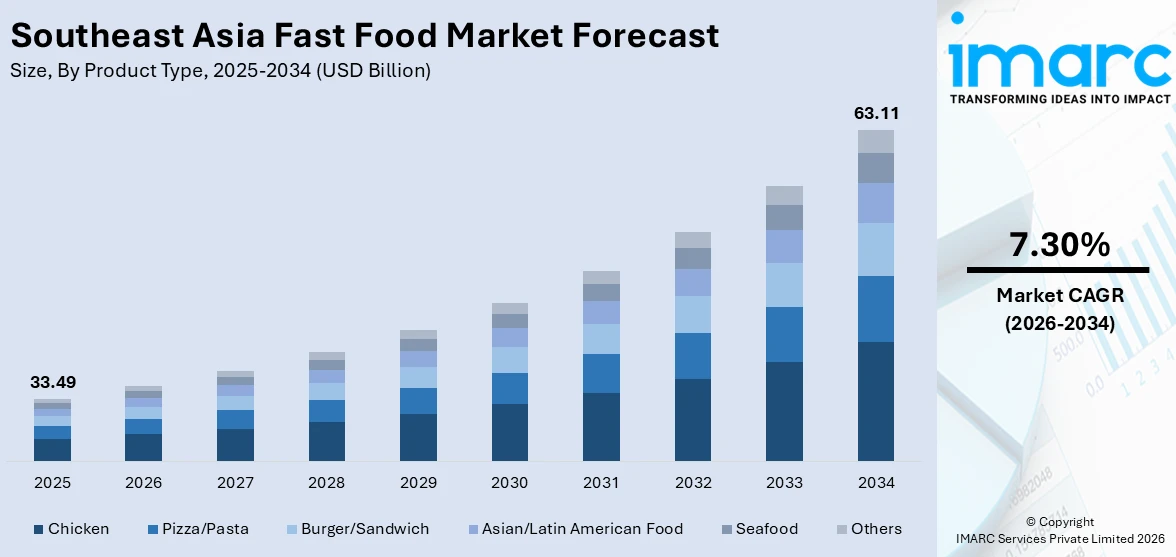
The Southeast Asia fast food market size was valued at USD 33.49 Billion in 2025 and is projected to reach USD 63.11 Billion by 2034, growing at a compound annual growth rate of 7.30% from 2026-2034.
The Southeast Asia fast food market is expanding rapidly, as accelerating urbanization, rising disposable incomes, and shifting consumer lifestyles drive sustained demand for convenient and affordable dining options. The proliferation of international and homegrown quick-service restaurant (QSR) chains, coupled with the widespread adoption of digital food ordering and delivery platforms, is broadening market accessibility across urban and suburban areas. Menu localization strategies, growing youth demographics, and the integration of halal-certified offerings to serve the region’s large Muslim population are further reinforcing consumer engagement and strengthening the market share.
Key Takeaways and Insights:
- By Product Type: Chicken dominates the market with a share of 32% in 2025, owing to its broad cultural acceptance, affordability, and the strong presence of both global fried chicken chains and popular regional brands across Southeast Asian countries.
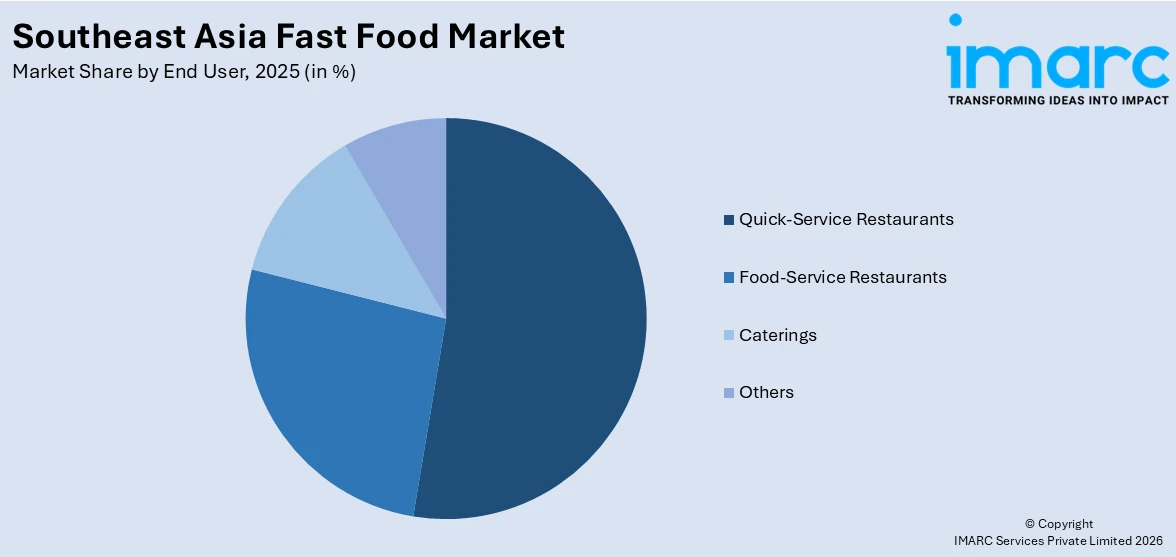
- By End User: Quick-service restaurants lead the market with a share of 50% in 2025. This dominance is driven by scalable franchise models, standardized operations, aggressive digital integration through mobile ordering apps, and strategic partnerships with food delivery platforms.
- Key Players: Key players drive the Southeast Asia fast food market by expanding store networks, investing in digital ordering ecosystems, localizing menus to regional palates, and forging strategic delivery partnerships to strengthen brand reach and consumer loyalty across diverse markets.
To get more information on this market Request Sample
The Southeast Asia fast food market is experiencing robust expansion, as the region undergoes significant economic and demographic transformation. Rapid urbanization continues to reshape consumption patterns, with over 50% of the Southeast Asia population residing in urban areas, as of December 2023, creating a vast consumer base seeking quick, accessible meal options. The growing middle class, rising workforce participation, and increasingly time-constrained lifestyles are fueling demand for affordable and convenient dining solutions across the region. International fast food chains alongside homegrown brands are aggressively expanding their footprint, leveraging franchise models and localized product strategies to capture diverse consumer segments. The integration of digital food delivery platforms is further accelerating market penetration and transforming how consumers access fast food services throughout the region.
Southeast Asia Fast Food Market Trends:
Expansion of Digital Food Ordering and Delivery Ecosystems
The rapid proliferation of mobile food ordering and delivery platforms is fundamentally reshaping fast food accessibility across Southeast Asia. Consumers increasingly rely on integrated superapp ecosystems for meal ordering, driven by urban density, smartphone penetration, and the convenience of contactless transactions. According to industry reports, Indonesia ranked as one of the five nations with the highest number of smartphone users worldwide, as of July 2025. It stood in fourth place following China, India, and the United States, with 187.7 Million users. Major platforms are leveraging real-time data analytics and predictive ordering systems to optimize operations and reduce food waste. This shift is also enabling fast food brands to expand their digital-only and cloud kitchen formats, strengthening reach while lowering fixed operating costs.
Rising Demand for Halal-Certified Fast Food Products
The growing Muslim consumer base across Southeast Asia is accelerating demand for halal-certified fast food offerings. Countries, such as Indonesia and Malaysia, are leading the adoption of standardized halal certification frameworks, prompting both global and regional fast food operators to align their supply chains with halal compliance requirements. This trend is broadening consumer trust and expanding market reach into previously underserved demographics. Indonesia mandated halal certification for food, beverages, and services starting October 2024.
Menu Localization and Fusion Innovation Strategies
Fast food operators across Southeast Asia are increasingly adapting their menus to reflect local culinary preferences and cultural tastes. Brands are introducing region-specific offerings, such as rice-based meals, spiced variants, and locally inspired desserts, to resonate with diverse consumer segments. This localization strategy enhances brand relevance, fosters consumer loyalty, and differentiates operators in an intensely competitive landscape. Additionally, collaborations with local suppliers and chefs are helping operators maintain authenticity while ensuring quality and supply chain efficiency.
Market Outlook 2026-2034:
The Southeast Asia fast food market is positioned for sustained growth over the forecast period, underpinned by accelerating urbanization, rising disposable incomes, and the deepening integration of digital ordering and delivery ecosystems. The expanding middle class, growing youth demographic, and increasing workforce participation across the region are driving consistent demand for convenient, affordable, and diverse fast food options. The market generated a revenue of USD 33.49 Billion in 2025 and is projected to reach a revenue of USD 63.11 Billion by 2034, growing at a compound annual growth rate of 7.30% from 2026-2034. The continued proliferation of international and homegrown fast food chains, adoption of franchise-driven expansion models, and increasing consumer preference for halal-certified and locally adapted menus are expected to further strengthen market momentum across key Southeast Asian economies.
Southeast Asia Fast Food Market Report Segmentation:
| Segment Category | Leading Segment | Market Share |
|---|---|---|
| Product Type | Chicken | 32% |
| End User | Quick-Service Restaurants | 50% |
Product Type Insights:
- Pizza/Pasta
- Burger/Sandwich
- Chicken
- Asian/Latin American Food
- Seafood
- Others
Chicken dominates with a market share of 32% of the total Southeast Asia fast food market in 2025.
Chicken holds the largest share of the Southeast Asia fast food market, driven by its strong regional cultural resonance, affordability in comparison to other protein sources, and adaptability to a wide range of flavor profiles, ranging from traditional fried preparations to spicy and locally inspired variations. Due to the large number of local operators and international fried chicken chains, a strong competitive environment has been created that consistently improves customer interaction.
The chicken segment also benefits from strong alignment with the halal food requirements prevalent across major Southeast Asian markets, particularly in Indonesia and Malaysia, where chicken serves as the primary protein in halal-certified fast food menus. To meet changing consumer preferences and draw in health-conscious consumers, operators are investing in product innovation, such as plant-based chicken substitutes and Korean-style fried chicken variations. The segment's market leading position throughout the area is further strengthened by its scalability through franchise models and compatibility with delivery and takeaway forms.
End User Insights:
Access the comprehensive market breakdown Request Sample
- Food-Service Restaurants
- Quick-Service Restaurants
- Caterings
- Others
Quick-service restaurants lead with a share of 50% of the total Southeast Asia fast food market in 2025.
Quick-service restaurants represent the backbone of the Southeast Asia fast food market, motivated by their consistent operational effectiveness, reasonable pricing, and capacity to quickly serve large numbers of customers. International and regional brands, which have built vast retail networks throughout metropolitan areas, profit from the segment's rapid franchise-led expansion. Quick-service restaurants continue to draw a wide range of patrons due to their convenience, reliable quality, and familiarity, which strengthens their position as the industry leader.
The accessibility and operational reach of quick-service restaurants across the region have been greatly improved by the integration of digital ordering platforms, mobile applications, and strategic collaborations with food delivery aggregators. By allowing well-known QSR brands to test new areas with substantially less capital investment, cloud kitchen models are further speeding up market penetration. The segment's dominant market position throughout Southeast Asia is supported by increasing young population, rise in dual-income households, and the growing customer preference for convenience-driven dining options.
Country Insights:
- Indonesia
- Thailand
- Singapore
- Philippines
- Vietnam
- Malaysia
- Others
Indonesia represents the most dynamic fast food market within Southeast Asia, driven by its vast population base, rapid urbanization, and rising middle-class disposable incomes. The country’s fast food landscape is anchored by strong international brand presence alongside thriving local operators. Additionally, the rapid expansion of digital ordering, delivery platforms, and mall-based food courts is accelerating fast food consumption across both metropolitan and tier-two cities.
Thailand constitutes a significant contributor to the Southeast Asia fast food sector, supported by a well-developed tourism industry and an increasingly urbanized consumer base. In large cities and transit hubs, there is a rising need for quick and convenient dining options due to the high volume of tourists. Fast food is becoming more common for daily meals as a result of changing lifestyles and an increase in the number of working professionals.
Singapore operates as a mature and innovation-driven fast food market, characterized by a dense metropolitan setting that supports delivery-centric business models and premium product positioning, high levels of digital usage, and sophisticated customer expectations. In order to maintain consumer loyalty in a fiercely competitive market, Singaporean fast food companies continue to set themselves apart through menu innovation, sustainability programs, and technology-enabled customization.
The Philippines anchors a rapidly expanding fast food ecosystem, distinguished by the dominance of homegrown chains that have cultivated deep cultural relevance and brand loyalty. The country’s vibrant QSR landscape is characterized by aggressive store expansion strategies and strong consumer engagement with locally developed menu offerings tailored to Filipino culinary preferences.
Vietnam represents one of the fastest-growing fast food markets in the region, propelled by accelerating urbanization, a young demographic profile, and the rapid expansion of digital food delivery platforms. Growing exposure to global food trends and increasing demand for affordable, Western-style dining options are further strengthening fast food adoption across major Vietnamese cities.
Malaysia represents a strategically important market within the region, underpinned by strong halal food infrastructure, a well-established franchise ecosystem, and deep consumer familiarity with both global and regional fast food brands. The country’s QSR sector benefits from high brand loyalty and government-supported halal certification frameworks.

Market Dynamics:
Growth Drivers:
Why is the Southeast Asia Fast Food Market Growing?
Accelerating Urbanization and Shifting Consumer Lifestyles
Rapid urbanization across Southeast Asia is fundamentally transforming consumer dining patterns. As cities expand and working populations grow, consumers are increasingly gravitating towards quick, accessible, and affordable meal solutions that align with their time-constrained lifestyles. In February 2025, the number of employed individuals continued to improve in Malaysia, rising by 0.3% (+49.7 Thousand individuals) to reach 16.73 Million individuals. A structural trend away from conventional home-cooked meals and towards fast food consumption is being driven by the rise in dual-income households, lengthier commutes, and demanding work schedules. The addressable market for fast food operators is growing as a result of the continuous development of residential complexes, commercial districts, and transportation infrastructure in developing urban centers in Indonesia, Vietnam, and the Philippines. This is because new food courts and retail establishments offer additional quick-service dining distribution channels.
Proliferation of Digital Food Delivery Platforms
The explosive growth of digital food delivery platforms is significantly accelerating fast food market penetration across Southeast Asia by eliminating geographical barriers and enabling consumers to access a wide array of fast food options from their homes and workplaces. This shift is transforming consumption patterns, with convenience, speed, and variety becoming primary decision drivers for urban consumers. Fast food brands are increasingly optimizing menus, packaging, and pricing specifically for delivery-led demand to maintain food quality and profitability. Data-driven insights from delivery platforms are also helping operators refine demand forecasting, manage peak-hour volumes, and tailor promotions more effectively. Additionally, the rise of cloud kitchens and delivery-only outlets is reducing real estate costs, allowing brands to expand rapidly into new neighborhoods and secondary cities while maintaining operational efficiency and scalability.
Expansion of International and Regional Fast Food Chains
The aggressive expansion strategies pursued by both international and regional fast food operators are significantly broadening market coverage and strengthening consumer accessibility across Southeast Asia. Global chains are leveraging established franchise models and localized product strategies to penetrate tier-two and tier-three cities, while regional brands are capitalizing on cultural familiarity and competitive pricing to capture market share. Jollibee opened 51 new stores across Southeast Asia in 2024, including its 200th store in Vietnam, underscoring the scale and ambition of regional operators in expanding their footprint. This sustained expansion is supported by favorable franchising environments, growing consumer aspirations, and improving supply chain infrastructure across the region. The entry of Korean and Japanese fast food concepts, alongside the strengthening of homegrown brands in markets, such as Thailand and Indonesia, is diversifying the competitive landscape and introducing new product categories that appeal to evolving consumer preferences.
Market Restraints:
What Challenges the Southeast Asia Fast Food Market is Facing?
Rising Raw Material and Operational Costs
Escalating costs of key raw materials, including poultry, cooking oils, and wheat-based ingredients, are placing significant pressure on fast food operators across Southeast Asia. The region’s substantial dependence on imported food commodities exposes the industry to global price fluctuations, supply chain disruptions, and currency volatility. Increasing labor costs in urban centers, rising energy expenses, and compliance-related expenditures further compress profit margins, compelling operators to balance pricing competitiveness with cost recovery strategies.
Growing Health Consciousness Among Urban Consumers
Rising health awareness among the urban population across Southeast Asia is posing challenges to traditional fast food consumption patterns. Consumers are increasingly scrutinizing nutritional content, caloric intake, and ingredient sourcing, leading to a gradual shift toward healthier dining alternatives. Government-led public health initiatives promoting reduced consumption of processed and high-calorie foods are influencing consumer behavior, requiring fast food operators to invest significantly in menu reformulation and healthier product innovation to maintain market relevance.
Intense Market Competition and Margin Pressures
The Southeast Asia fast food landscape is characterized by intense competition among a multitude of international chains, regional operators, local street food vendors, and emerging cloud kitchen platforms. This crowded competitive environment creates significant pricing pressures, escalates customer acquisition costs, and compresses operating margins. Operators must continuously invest in brand differentiation, promotional activities, and digital infrastructure to retain consumer attention and sustain market positioning amidst an increasingly fragmented and dynamic competitive landscape.
Competitive Landscape:
The Southeast Asia fast food market is highly competitive, featuring a dynamic mix of established multinational corporations and rapidly scaling regional operators. Companies are intensifying their focus on franchise-led expansion, digital transformation, and menu localization to strengthen their competitive positioning across diverse national markets. Strategic partnerships with food delivery platforms, investment in cloud kitchen infrastructure, and the deployment of mobile ordering technologies are emerging as critical differentiators. Operators are also prioritizing halal certification compliance, sustainability initiatives, and loyalty program development to deepen consumer engagement and build long-term brand equity in an increasingly competitive environment.
Southeast Asia Fast Food Market Report Coverage:
| Report Features | Details |
|---|---|
| Base Year of the Analysis | 2025 |
| Historical Period | 2020-2025 |
| Forecast Period | 2026-2034 |
| Units | Billion USD |
| Scope of the Report | Exploration of Historical Trends and Market Outlook, Industry Catalysts and Challenges, Segment-Wise Historical and Future Market Assessment:
|
| Product Types Covered | Pizza/Pasta, Burger/Sandwich, Chicken, Asian/Latin American Food, Seafood, Others |
| End Users Covered | Food-Service Restaurants, Quick-Service Restaurants, Caterings, Others |
| Countries Covered | Indonesia, Thailand, Singapore, Philippines, Vietnam, Malaysia, Others |
| Customization Scope | 10% Free Customization |
| Post-Sale Analyst Support | 10-12 Weeks |
| Delivery Format | PDF and Excel through Email (We can also provide the editable version of the report in PPT/Word format on special request) |
Frequently Asked Questions About the Southeast Asia Fast Food Market Report
The Southeast Asia fast food market size was valued at USD 33.49 Billion in 2025.
The Southeast Asia fast food market is expected to grow at a compound annual growth rate of 7.30% from 2026-2034 to reach USD 63.11 Billion by 2034.
Chicken dominated the market with a share of 32%, driven by its broad cultural acceptance, affordability, versatility across diverse regional flavor profiles, and strong presence of global and local fried chicken operators.
Key factors driving the Southeast Asia fast food market include rapid urbanization, rising disposable incomes, proliferation of digital food delivery platforms, expansion of international and regional fast food chains, and growing demand for halal-certified offerings.
Major challenges include rising raw material and operational costs, growing health consciousness among urban consumers, intense market competition, supply chain vulnerabilities linked to imported commodities, and increasing regulatory compliance requirements across diverse national markets.
Need more help?
- Speak to our experienced analysts for insights on the current market scenarios.
- Include additional segments and countries to customize the report as per your requirement.
- Gain an unparalleled competitive advantage in your domain by understanding how to utilize the report and positively impacting your operations and revenue.
- For further assistance, please connect with our analysts.
 Request Customization
 Speak to an Analyst
 Request Brochure
 Inquire Before Buying
Benefits of Customization
- Personalize this research
- Triangulate with your data
- Get data as per your format and definition
- Gain a deeper dive into a specific application, geography, customer, or competitor
- Any level of personalization
Get in Touch With Us
UNITED STATES
Phone: +1-201-971-6302
INDIA
Phone: +91-120-433-0800
UNITED KINGDOM
Phone: +44-753-714-6104
Email: [email protected]
Client Testimonials




.webp)




.webp)













Related Reports

Choose your plan
*Please note that the prices mentioned below are starting prices for each bundle type. Kindly contact our team for further details.*
Single User License
- 1 User License, Access on 2 Devices
- PDF Report + Excel Dataset (Password Protected)
- Lifetime Access
- No Printing Rights
- 10% Free Report Customization
- 10–12 Weeks of Analyst Support
Five User License
- Access for 5 Users, 2 Devices per User
- PDF Report + Excel Dataset (Password Protected)
- Lifetime Access
- Dedicated Account Manager
- 12–14 Weeks of Analyst Support
- No Printing Rights
- 15% Free Report Customization
- 25% Discount on Your Next Purchase
Corporate User License
- Unlimited User Access (Within Your Organization)
- PDF Report + Excel Dataset
- Lifetime Access
- Dedicated Account Manager
- 14–20 Weeks of Analyst Support
- No Printing Rights
- 20% Free Report Customization
- 30% Discount on Your Next Purchase
Essential Insights
What's included:
3 reports
- Lifetime Access
- PDF Reports
- Excel Datasets
- 2 Weeks of Free Analyst Support
- 2 User Licenses
- Access on 2 Devices
- Printing Rights
- Complimentary PowerPoint (PPT) Version
- Complimentary License Upgrade
Professional Access
What's included:
5 reports
- Lifetime Access
- PDF Reports
- Excel Datasets
- 8 Weeks of Free Analyst Support
- 2 User Licenses
- Access on 2 Devices
- Printing Rights
- Complimentary PowerPoint (PPT) Version
- Complimentary License Upgrade
Business Advantage
What's included:
8 reports
- Lifetime Access
- PDF Reports
- Excel Datasets
- 14 Weeks of Free Analyst Support
- 2 User Licenses
- Access on 2 Devices
- Printing Rights
- Complimentary PowerPoint (PPT) Version
- Complimentary License Upgrade
Enterprise Intelligence
What's included:
10 reports
- Lifetime Access
- PDF Reports
- Excel Datasets
- 20 Weeks of Free Analyst Support
- 2 User Licenses
- Access on 2 Devices
- Printing Rights
- Complimentary PowerPoint (PPT) Version
- Complimentary License Upgrade