
Sports Mouthguard Market Size, Share, Trends and Forecast by Product, Distribution Channel, and Region, 2026-2034
Sports Mouthguard Market Size, Share, Trends & Forecast (2026-2034)
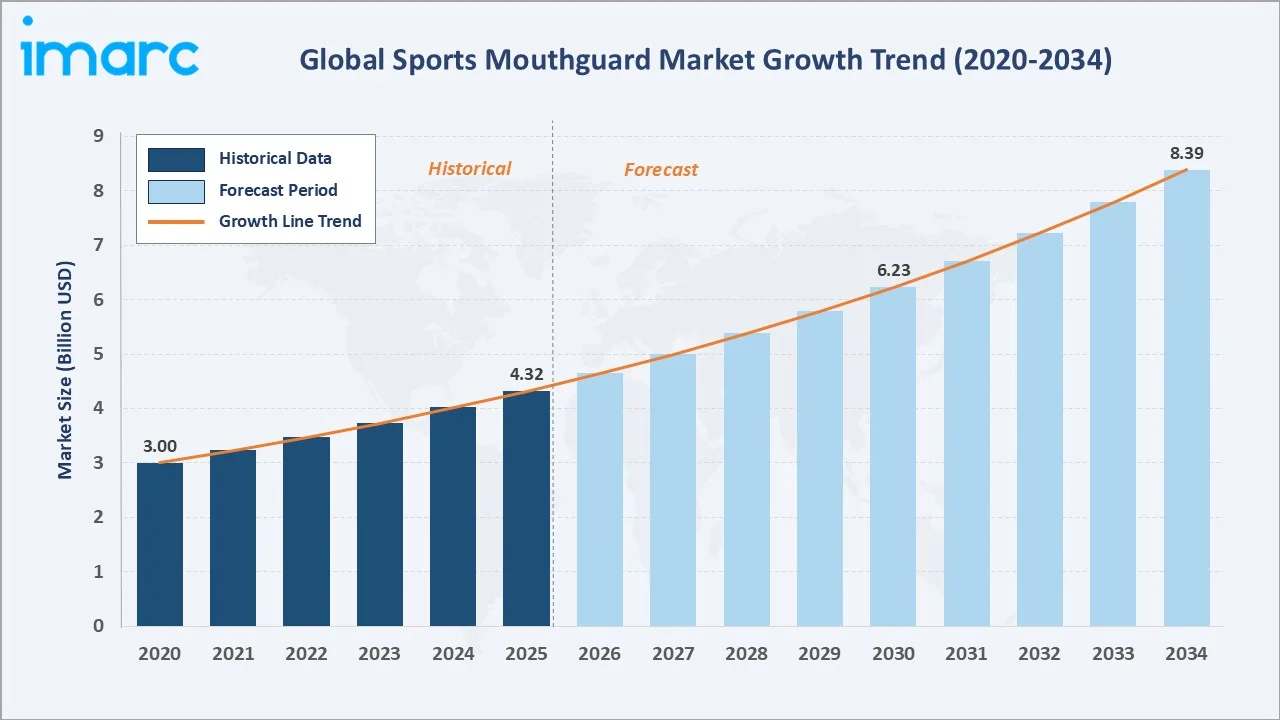
The sports mouthguard market was valued at USD 4.32 Billion in 2025 and is projected to reach USD 8.39 Billion by 2034, exhibiting a CAGR of 7.57% during 2026-2034. Rising participation in contact and combat sports, surging awareness of oral injury prevention, and wider retail availability across sports shops, specialty stores, and online channels are the primary drivers shaping market growth.
Boil and bite mouth guard leads the product segment at 46.8%, sports shops dominate distribution channel at 35.7%, and North America commands 37.5% regional share in 2025.
Market Snapshot
|
Metric |
Value |
|
Market Size (2025) |
USD 4.32 Billion |
|
Forecast Market Size (2034) |
USD 8.39 Billion |
|
CAGR (2026-2034) |
7.57% |
|
Base Year |
2025 |
|
Historical Period |
2020-2025 |
|
Forecast Period |
2026-2034 |
|
Largest Region |
North America (37.5%, 2025) |
|
Second Largest Region |
Europe (26.4%, 2025) |
|
Leading Product |
Boil and Bite Mouth Guard (46.8%, 2025) |
|
Leading Distribution Channel |
Sports Shops (35.7%, 2025) |
The sports mouthguard market expanded from USD 3.00 Billion in 2020 to USD 4.32 Billion in 2025, driven by widening youth and amateur sports participation, growing dental-injury awareness among parents and coaches, and steady retail expansion across sports and specialty stores. Anchored at USD 6.23 Billion in 2030, the forecast to USD 8.39 Billion by 2034 is supported by accelerating custom-fit mouthguard adoption, expanding online retail penetration, and broader enforcement of protective-gear rules across contact sports.
To get more information on this market, Request Sample
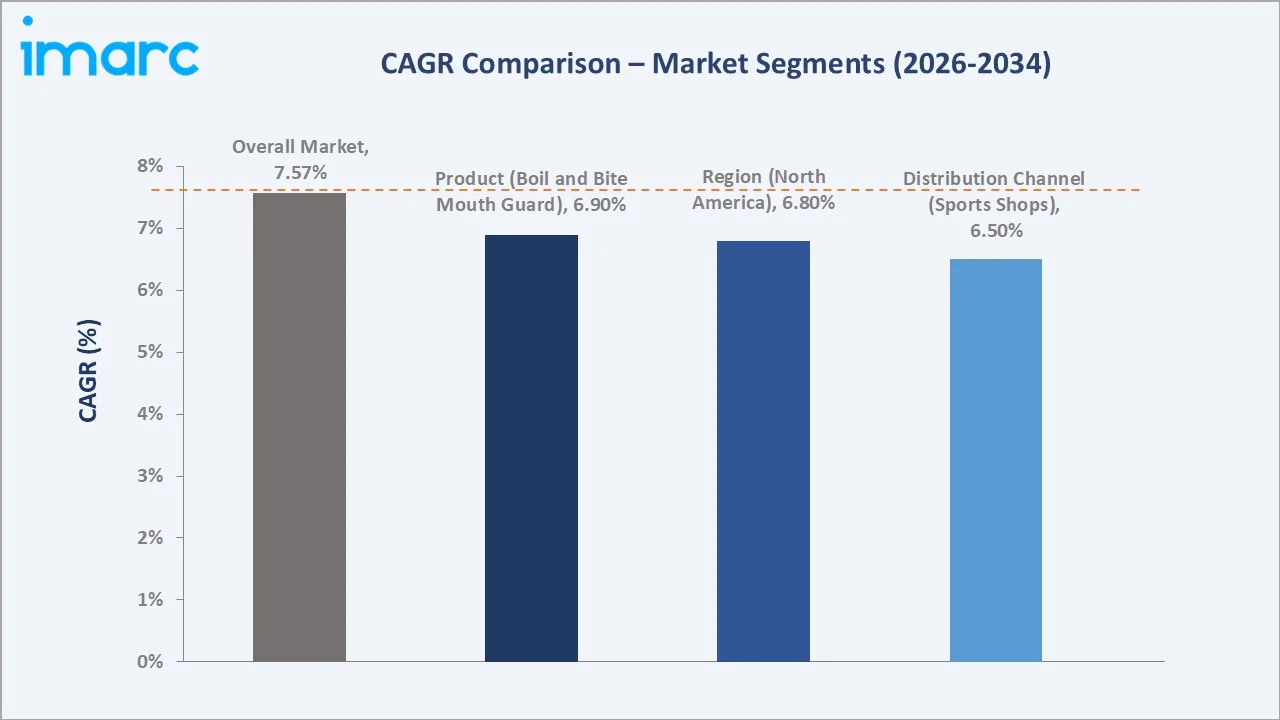
CAGR trajectories across product and distribution channel sub-segments show custom-made mouth guard and online stores expanding faster than the overall 7.57% market CAGR, driven by rising demand for precision-fit protection and the growing convenience of digital retail channels.
Executive Summary
The sports mouthguard market is on a steady growth trajectory from USD 3.00 Billion in 2020 to USD 8.39 Billion by 2034. The category has moved from a niche protective accessory used mainly in boxing and American football toward a broad-based sports safety essential worn across hockey, basketball, martial arts, rugby, and youth recreational leagues. Rising disposable incomes, growing organized sports infrastructure, and increasing parental focus on injury prevention are encouraging wider adoption across age groups.
Boil and bite mouth guard dominates the product segment at 46.8% in 2025, supported by affordability, wide retail availability, and ease of at-home fitting, while sports shops lead distribution channel at 35.7%, reflecting the continued importance of specialized, trust-based purchase environments. North America commands 37.5% of the regional share, led by deep-rooted contact-sports culture, high household spending on youth sports, and strong retail infrastructure across the region.
Key Market Insights
|
Insight |
Data |
|
Leading Product |
Boil and Bite Mouth Guard - 46.8% share (2025) |
|
Second Largest Product |
Custom-made Mouth Guard - 31.4% share (2025) |
|
Leading Distribution Channel |
Sports Shops - 35.7% share (2025) |
|
Second Largest Distribution Channel |
Specialty Stores - 24.6% share (2025) |
|
Leading Region |
North America - 37.5% share (2025) |
|
Second Largest Region |
Europe - 26.4% share (2025) |
|
Top Companies |
United Sports Brands, Under Armour, Inc., OPRO, SAFEJAWZ, Erkodent Erich Kopp GmbH |
Key Analytical Observations Expanding On The Data Above:
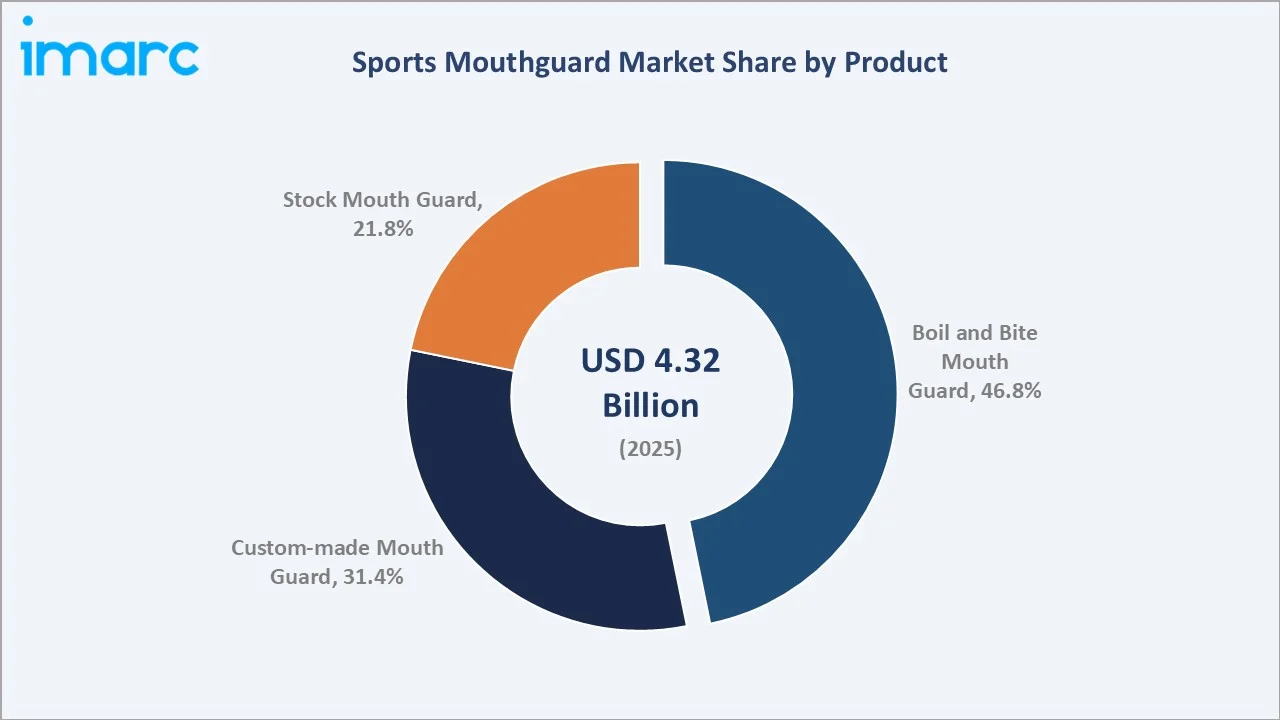
- Boil and bite mouth guard dominance at 46.8% is supported by low price points, straightforward at-home heat-and-fit preparation, and broad availability across sports shops, specialty stores, and supermarkets, making it the default entry format for recreational and youth athletes.
- Custom-made mouth guard share at 31.4% continues to expand among competitive and collegiate athletes who prioritize precision fit, superior comfort, and enhanced shock absorption.
- Sports shops leadership at 35.7% reflects the category's reliance on knowledgeable in-store staff, sizing assistance, and bundled purchases alongside other protective gear such as helmets and pads.
- Specialty stores at 24.6% share are benefiting from demand for premium and professionally recommended mouthguards, supported by wider product assortments, expert guidance, and growing consumer preference for high-performance protective sports equipment.
- North America at 37.5% dominates regional share, anchored by widespread youth football, hockey, and lacrosse participation, mandatory mouthguard rules in several school and league systems, and dense sporting-goods retail infrastructure.
Sports Mouthguard Market Overview
A sports mouthguard is a protective device worn over the teeth and gums to cushion impact and reduce the risk of dental trauma, jaw injury, and concussion during athletic activity. The market spans boil and bite, custom-made, and stock formats, sold through sports shops, specialty stores, online stores, supermarkets and hypermarkets, and other retail formats.
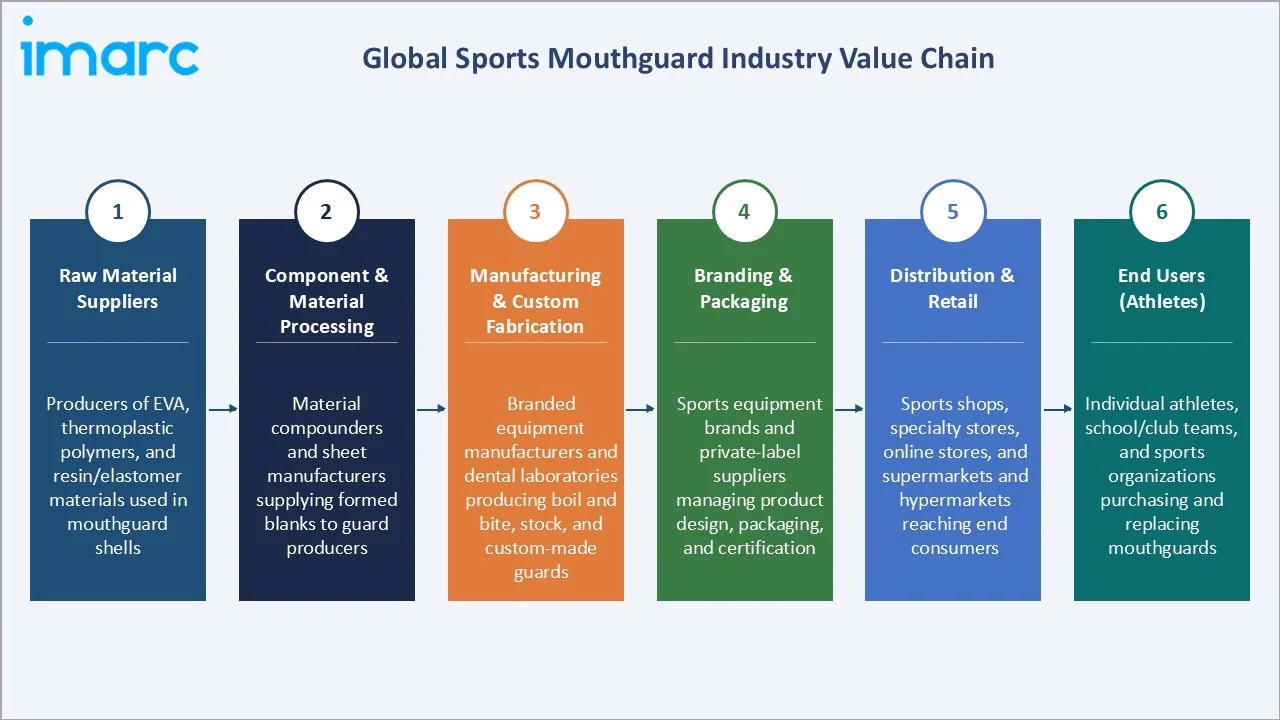
The industry ecosystem integrates raw material suppliers, manufacturers and brand owners, dental laboratories and custom fabricators, distribution and retail channels, sports organizations and institutions, and end-use athletes. Macroeconomic factors, such as household discretionary spending, school and league sports budgets, and healthcare cost sensitivity around preventable dental injuries, continue to shape purchasing behavior across both developed and emerging sporting markets.
Market Dynamics
To evaluate market opportunities, Request Sample
Market Drivers
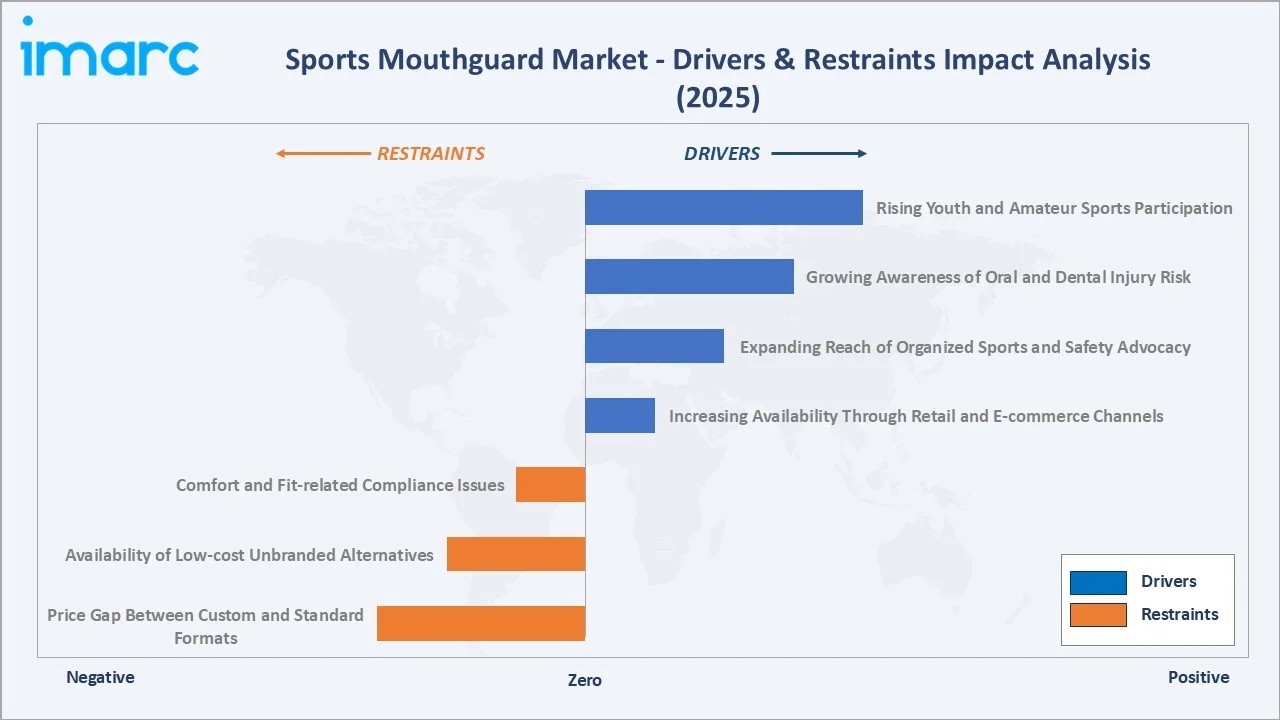
- Rising Youth and Amateur Sports Participation: Growing enrollment in school, club, and recreational league sports is expanding the base of athletes required or encouraged to wear protective mouthguards during practice and competition.
- Growing Awareness of Oral and Dental Injury Risk: Increasing parental and coaching focus on preventable dental trauma is normalizing mouthguard use even in sports where it is not strictly mandated by governing bodies.
- Expanding Reach of Organized Sports and Safety Advocacy: Wider promotion of athlete safety by sports associations, schools, and healthcare organizations is encouraging greater adoption of mouthguards across both contact and non-contact sports, strengthening long-term demand for protective equipment.
- Increasing Availability Through Retail and E-commerce Channels: As per IMARC Group, the global e-commerce market size was valued at USD 33.80 Trillion in 2025. Wider product availability across sporting goods retailers, pharmacies, supermarkets, and online platforms is making mouthguards more accessible to recreational and competitive athletes, supporting higher adoption rates.
Market Restraints
- Price Gap Between Custom and Standard Formats: Professionally fitted custom mouthguards remain significantly more expensive than stock and boil-and-bite alternatives, limiting adoption among recreational athletes, schools, and other price-sensitive consumers.
- Availability of Low-cost Unbranded Alternatives: Generic, unbranded mouthguards sold through discount and general merchandise channels compete on price, pressuring margins for established branded manufacturers.
- Comfort and Fit-related Compliance Issues: Bulkiness, breathing discomfort, and poor initial fit among entry-level products continue to discourage consistent wear, particularly among younger athletes.
Market Opportunities
- Digital Scanning and 3D-printed Custom Guards: Wider dental-clinic adoption of intraoral scanning is shortening custom mouthguard turnaround times and creating new premium product tiers.
- Expansion into Non-Contact and Recreational Sports: Manufacturers have an opportunity to expand adoption beyond traditional contact sports by promoting mouthguards for recreational activities, fitness programs, and emerging sports where awareness of dental injury prevention continues to increase.
Market Challenges
- Inconsistent Enforcement Across Amateur Leagues: Mouthguard rules vary widely across recreational and school-level competitions, leaving adoption gaps outside professional and collegiate tiers.
- Counterfeit and Non-certified Products: Uncertified imports sold through informal retail and online channels can undermine consumer trust in protective performance claims.
Emerging Market Trends
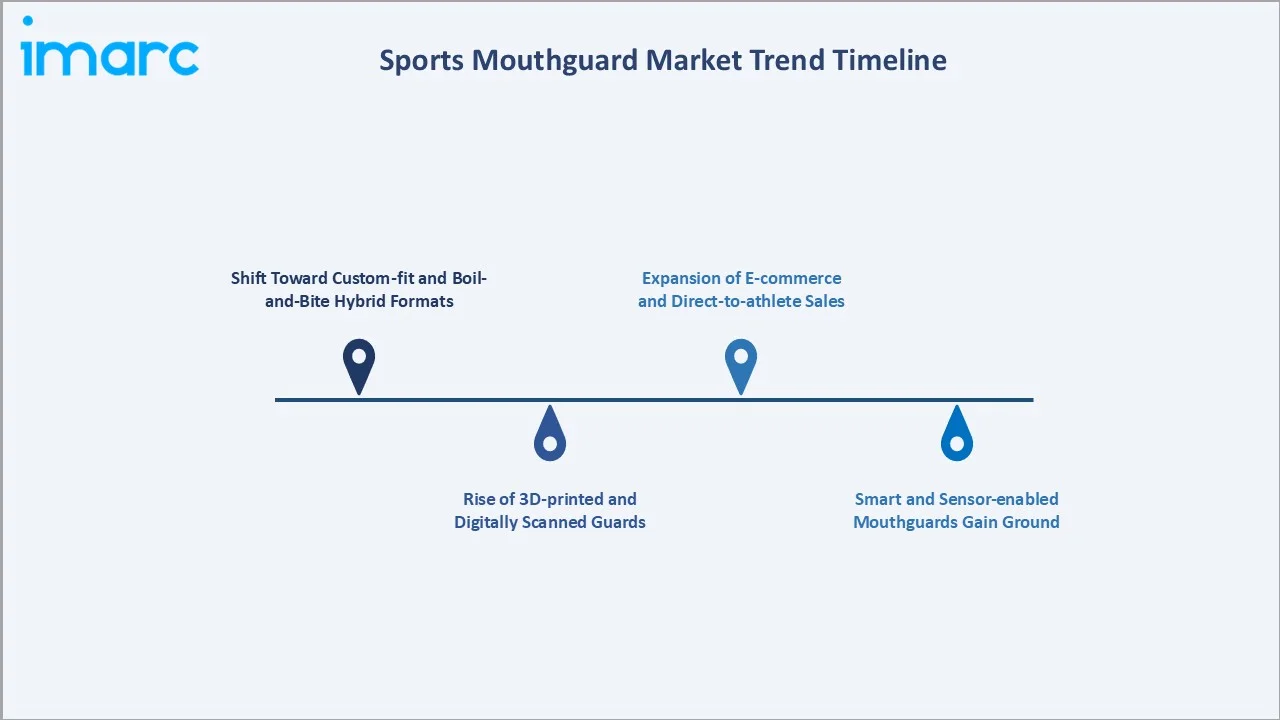
1. Shift Toward Custom-fit and Boil-and-Bite Hybrid Formats
Manufacturers are blending boil-and-bite convenience with semi-custom shell designs that improve fit without requiring a dental visit. This hybrid approach is helping brands capture upgrade demand from entry-level users seeking better comfort at moderate price points.
2. Rise of 3D-printed and Digitally Scanned Guards
Growing dental-clinic adoption of intraoral scanning is reshaping custom mouthguard production, cutting turnaround time in leading markets. Digital workflows are also improving fit accuracy and reducing material waste compared with traditional impression-tray methods.
3. Expansion of E-commerce and Direct-to-athlete Sales
Brands are increasingly selling impression kits and semi-custom guards directly online, bypassing traditional retail and dental-clinic touchpoints. This shift is broadening access in regions with limited specialty sporting-goods infrastructure and supporting faster international expansion.
4. Smart and Sensor-enabled Mouthguards Gain Ground
Early-stage adoption of sensor-embedded mouthguards capable of tracking impact force and potential concussion risk is emerging among collegiate and semi-professional programs, pointing to a longer-term convergence between protective equipment and athlete health monitoring.
Industry Value Chain Analysis
The sports mouthguard value chain spans six stages, from raw material sourcing through end-user purchase and replacement. Manufacturing and custom fabrication, together with branding and distribution, capture the highest value-add, while material innovation and digital fitting technology increasingly determine competitive positioning across the category.
|
Stage |
Key Players / Examples |
|
Raw Material Suppliers |
Producers of ethylene-vinyl acetate (EVA), thermoplastic polymers, and other resin and elastomer materials used in mouthguard shells |
|
Component & Material Processing |
Material compounders and sheet manufacturers supplying formed and laminated blanks to guard producers |
|
Manufacturing & Custom Fabrication |
Branded equipment manufacturers and dental laboratories producing boil and bite, stock, and custom-made guards |
|
Branding & Packaging |
Sports equipment brands and private-label suppliers managing product design, packaging, and certification |
|
Distribution & Retail |
Sports shops, specialty stores, online stores, and supermarkets and hypermarkets reaching end consumers |
|
End Users (Athletes) |
Individual athletes, school and club teams, and sports organizations purchasing and replacing mouthguards |
Vertically integrated players that combine proprietary material formulations with direct-to-athlete distribution are positioned to capture greater value than manufacturers reliant solely on third-party retail partners.
Technology Landscape in the Sports Mouthguard Industry
Material Innovation
Manufacturers are increasingly formulating multi-layer EVA and thermoplastic blends that balance shock absorption with breathability and reduced bulk. Lighter, more flexible materials are helping address long-standing comfort complaints that limit consistent mouthguard use among younger athletes.
Digital Scanning and Custom Fabrication
Intraoral scanning and computer-aided design are replacing traditional impression-tray methods in premium custom-made segments, improving fit accuracy while shortening production cycles for dental laboratories and specialty fabricators.
Smart Connectivity
Early-stage sensor integration is enabling select mouthguards to capture impact-force data for athlete safety monitoring, an emerging capability that is drawing interest from collegiate athletics programs and sports science researchers.
Automation in Manufacturing
Automated thermoforming and injection-molding lines are improving production consistency and unit economics for boil and bite and stock mouthguard formats, supporting the scale needed to serve mass retail channels.
Market Segmentation Analysis
The report covers the following segments:
|
Segment Category |
Leading Segment |
Market Share |
Year |
|
Product |
Boil and Bite Mouth Guard |
46.8% |
2025 |
|
Distribution Channel |
Sports Shops |
35.7% |
2025 |
|
Region |
North America |
37.5% |
2025 |

By Product
Boil and bite mouth guard commands a 46.8% majority share in 2025, driven by affordability, ease of at-home fitting, and broad availability across nearly every retail format. The segment benefits from low unit costs and strong repeat purchase behavior among youth and recreational athletes who replace guards frequently as they grow.
To access detailed market analysis, Request Sample
Custom-made mouth guard at 31.4% in 2025 serves competitive, collegiate, and semi-professional athletes who prioritize superior fit and comfort, typically sourced through dental professionals or specialty sports-dentistry providers.
By Distribution Channel
Sports shops lead the segment with 35.7% share in 2025, reflecting the category's continued reliance on knowledgeable in-store staff, sizing guidance, and bundled purchases alongside other protective gear. The channel remains the default destination for team and league equipment procurement.
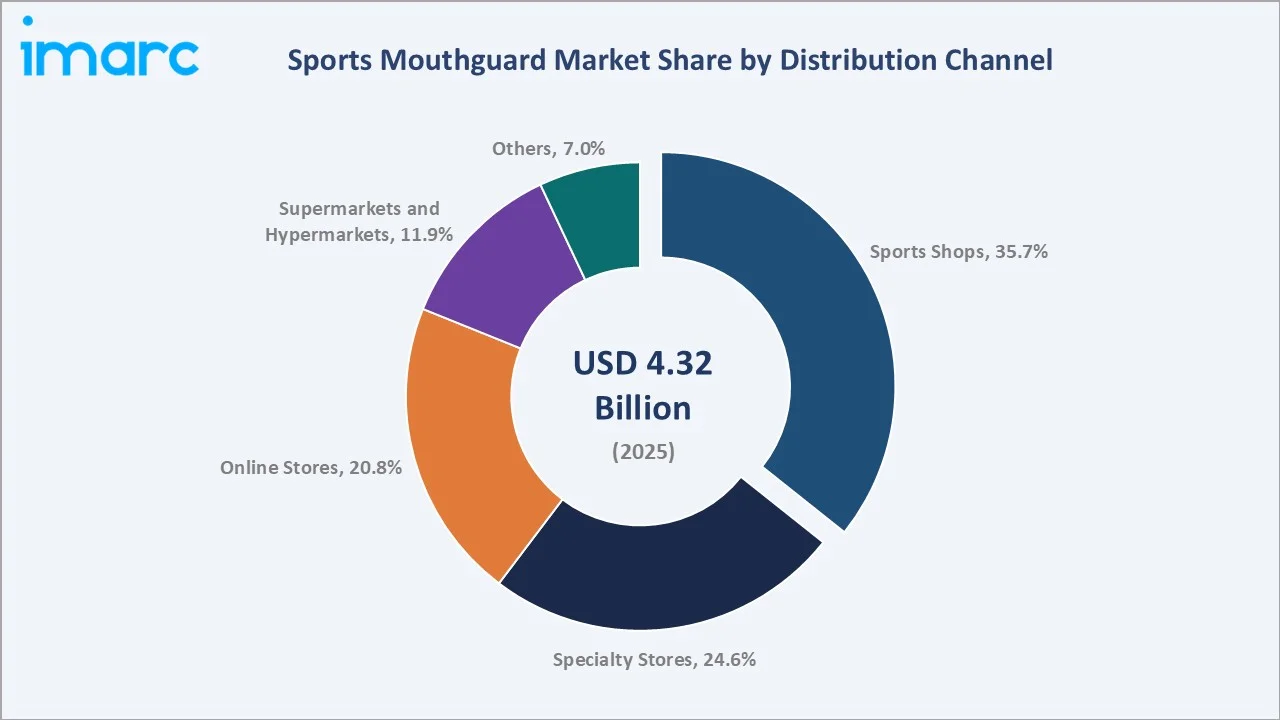
Specialty stores follow at 24.6%, supported by their focus on premium protective equipment, access to specialized product ranges, and personalized fitting guidance for athletes seeking enhanced comfort and performance.
Regional Market Insights
|
Region |
Share (2025) |
Key Growth Drivers |
|
North America |
37.5% |
Deep-rooted contact-sports culture, mandatory protective-gear rules in several school and league systems, and dense sporting-goods retail infrastructure |
|
Europe |
26.4% |
Strong participation in rugby, football, and combat sports, established sports-dentistry networks, and high consumer awareness of injury prevention |
|
Asia-Pacific |
24.1% |
Rising disposable incomes, expanding organized sports infrastructure, and fast-growing e-commerce penetration across major economies |
|
Latin America |
6.5% |
Growing youth participation in football and combat sports and gradual expansion of modern retail and specialty sporting-goods formats |
|
Middle East and Africa |
5.5% |
Increasing investment in sports infrastructure, rising participation in school and club-level athletics, and expanding organized retail |
North America at 37.5% in 2025 leads the regional landscape, supported by widespread youth football, hockey, and lacrosse participation, along with mandatory mouthguard requirements across several school and amateur league systems. Dense specialty and sporting-goods retail infrastructure and high household spending on youth sports further reinforce regional leadership.
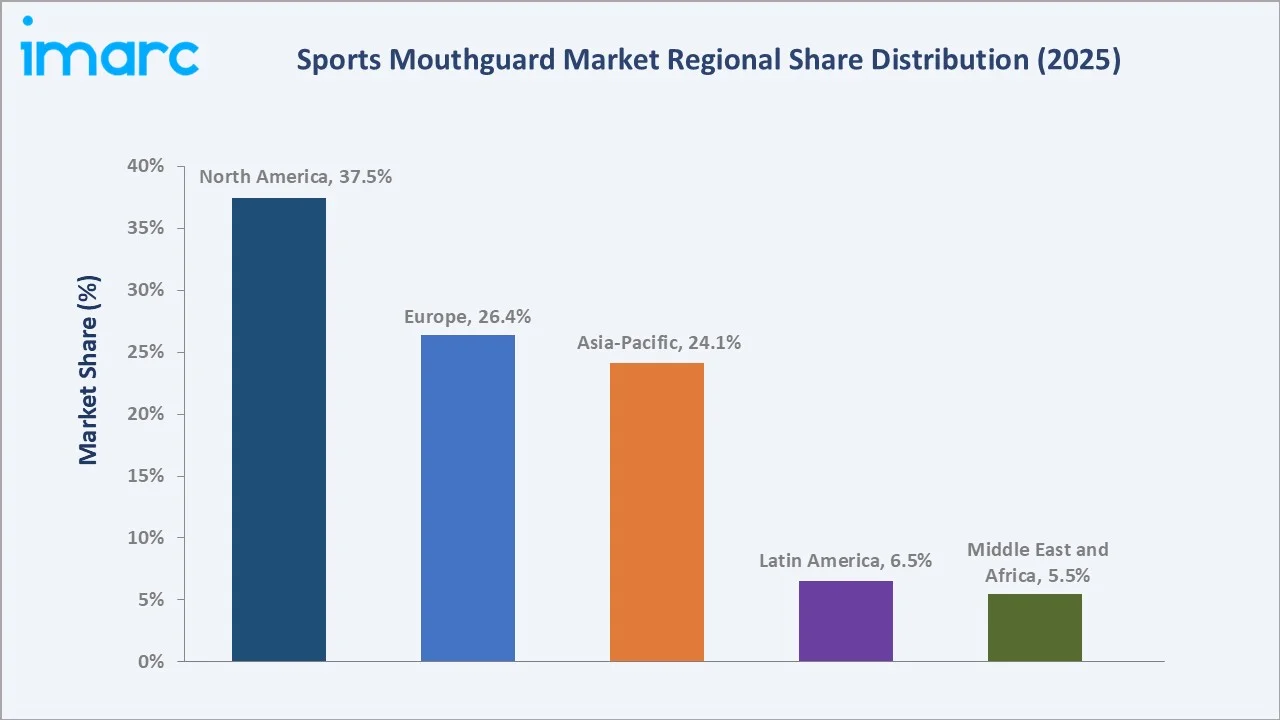
Asia-Pacific at 24.1% is the fastest growing region. Expanding organized sports infrastructure, rising participation in school and club athletics, and rapid growth in online retail penetration are accelerating regional expansion through 2034, positioning the region as an increasingly important growth engine for the sports mouthguard market.
Competitive Landscape
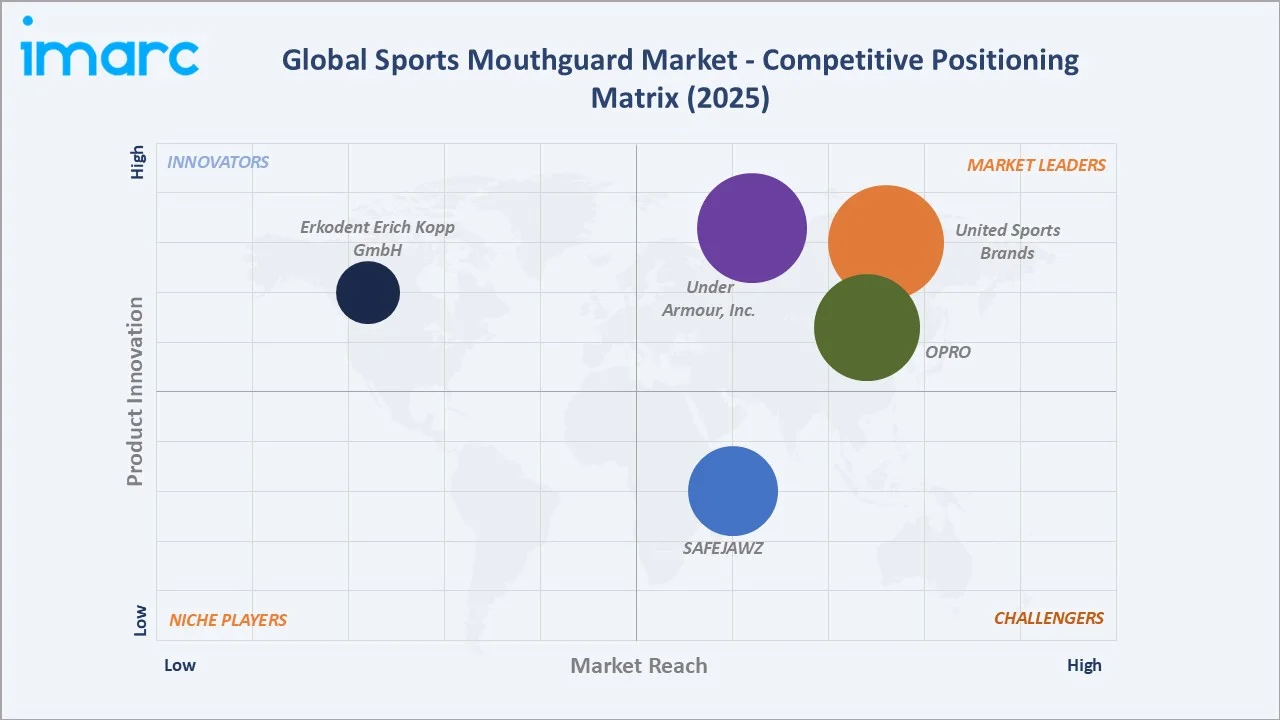
The sports mouthguard market is moderately fragmented, with established protective-equipment brands competing alongside specialized dental-technology manufacturers and direct-to-athlete challenger brands. Brand trust, retail distribution reach, and material and fit innovation form the key competitive differentiators across the category.
|
Company Name |
Brand / Key Product |
Position |
Strategic Focus |
|
United Sports Brands |
Shock Doctor |
Leader |
Protective sports equipment portfolio with broad retail distribution |
|
Under Armour, Inc. |
Under Armour Mouthguard |
Leader |
Performance apparel and accessories brand extending into protective gear |
|
OPRO |
OPRO |
Leader |
Sports-dentistry heritage brand with professional-athlete partnerships |
|
SAFEJAWZ |
SAFEJAWZ |
Challenger |
Customizable, design-led mouthguards for combat and contact sports |
|
Erkodent Erich Kopp GmbH |
PLAYSAFE |
Innovator |
Dental thermoforming materials and equipment supplying custom-fabrication labs |
Key players include United Sports Brands, Under Armour, Inc., OPRO, SAFEJAWZ, and Erkodent Erich Kopp GmbH, among others.
Key Company Profiles
United Sports Brands
United Sports Brands is a United States-based sporting goods company. It develops and markets protective sports equipment and performance gear for athletes across a wide range of competitive and recreational sports.
- Product Portfolio: Boil and bite and strapped mouthguards sold across youth, amateur, and competitive sport categories, alongside broader protective and performance accessories.
- Recent Developments: The company continues to expand its protective sports equipment portfolio while strengthening distribution across sporting goods retailers and online sales channels.
- Strategic Focus: Strengthening category leadership through broad retail reach and continued investment in product comfort and fit.
Under Armour, Inc.
Under Armour, Inc. is a global performance apparel, footwear, and accessories company that also markets protective mouthguards for athletes across contact and team sports.
- Product Portfolio: Under Armour mouthguard, alongside the company's broader athletic accessories lineup.
- Recent Developments: The company continues to expand its protective accessories range and retail presence across sporting-goods and e-commerce channels.
- Strategic Focus: Extending brand equity from apparel and footwear into protective performance accessories.
OPRO
OPRO is a United Kingdom-based company known for its heritage in sports-dentistry research and its mouthguard partnerships with professional athletes and sporting organizations.
- Product Portfolio: Self-fit and custom-fit mouthguards spanning entry-level to elite competitive tiers.
- Recent Developments: The company continues to expand its professional-sport partnerships and international distribution footprint.
- Strategic Focus: Building on sports-science credibility and athlete endorsements to support premium positioning.
Market Concentration Analysis
The sports mouthguard market is moderately fragmented, with the leading players accounting for a meaningful but non-dominant share of global revenue. Established protective-equipment brands compete alongside specialty dental-technology suppliers and a growing number of digitally native challenger brands targeting custom and semi-custom formats.
Barriers to entry include the need for established retail relationships across sports shops and specialty stores, brand trust around safety and certification, and, for custom-made formats, access to dental-fabrication or digital-scanning capabilities. These factors favor incumbents with diversified distribution and long-standing brand recognition.
Consolidation activity remains limited relative to more mature sporting-goods categories, though larger diversified sports-equipment holding companies continue to acquire complementary protective-gear brands to broaden their retail assortment and cross-selling opportunities.
Investment & Growth Opportunities
Fastest-Growing Segments
Custom-made mouth guard is the fastest-growing product segment as competitive and collegiate athletes increasingly upgrade from entry-level formats. Online stores represent the fastest-growing distribution channel, supported by expanding impression-kit and semi-custom ordering models that reduce dependence on physical retail visits.
Emerging Markets
Asia-Pacific is the fastest growing region, anchored by rising disposable incomes, expanding organized sports infrastructure, and fast-growing e-commerce penetration. The region represents meaningful untapped opportunity for brands able to localize sizing, pricing, and distribution strategies.
Venture & Investment Trends
Investment interest is concentrated around digital scanning and custom-fabrication technology, direct-to-athlete e-commerce platforms, and material science innovation aimed at improving comfort and impact absorption. Capital is also flowing toward brand consolidation within diversified sporting-goods portfolios.
Future Market Outlook (2026-2034)
The sports mouthguard market is forecast to expand from USD 4.32 Billion in 2025 to USD 8.39 Billion by 2034 at a CAGR of 7.57%, adding roughly USD 4.07 Billion in incremental market value over the forecast period.
Three forces will shape the market through 2034: continued mainstreaming of custom-fit and digitally fabricated mouthguards, sustained growth in online and direct-to-athlete distribution, and expanding youth and amateur sports participation across emerging economies.
By 2034, the sports mouthguard market is expected to be defined by a broader mix of custom and semi-custom formats, deeper integration of digital scanning technology within the fabrication process, and a more balanced regional footprint as Asia-Pacific narrows the gap with North America and Europe.
Research Methodology
Primary Research
Primary research included structured conversations with sporting-goods retailers, dental laboratory operators, and protective-equipment brand representatives, validating market sizing, segment shares, and regional demand patterns.
Secondary Research
Secondary sources included publicly available sports-participation statistics from national federations, dental-health data from recognized professional associations, company websites, and publicly disclosed corporate information from leading protective-equipment manufacturers.
Forecasting Models
Market forecasts used top-down and bottom-up estimation combining historical shipment trends, sports-participation growth, retail channel evolution, and macroeconomic variables. Scenario analysis addressed variation in custom-format adoption rates and regional retail infrastructure development.
Report Coverage:
| Report Features | Details |
|---|---|
| Base Year of the Analysis | 2025 |
| Historical Period | 2020-2025 |
| Forecast Period | 2026-2034 |
| Units | Billion USD |
| Scope of the Report | Exploration of Historical Trends and Market Outlook, Industry Catalysts and Challenges, Segment-Wise Historical and Predictive Market Assessment:
|
| Products Covered | Stock Mouth Guard, Boil and Bite Mouth Guard, Custom-made Mouth Guard |
| Distribution Channels Covered | Supermarkets and Hypermarkets, Specialty Stores, Sports Shops, Online Stores, Others |
| Regions Covered | Asia Pacific, Europe, North America, Latin America, Middle East and Africa |
| Countries Covered | United States, Canada, Germany, France, United Kingdom, Italy, Spain, Russia, China, Japan, India, South Korea, Australia, Indonesia, Brazil, Mexico |
| Companies Covered | United Sports Brands, Under Armour, Inc., OPRO, SAFEJAWZ, Erkodent Erich Kopp GmbH, etc. |
| Customization Scope | 10% Free Customization |
| Post-Sale Analyst Support | 10-12 Weeks |
| Delivery Format | PDF and Excel through Email (We can also provide the editable version of the report in PPT/Word format on special request) |
Frequently Asked Questions About the Sports Mouthguard Market Report
The sports mouthguard market was valued at USD 4.32 Billion in 2025, supported by rising sports participation and growing awareness of dental injury prevention.
The market is projected to grow at a CAGR of 7.57% from 2026-2034, reaching USD 8.39 Billion, driven by custom-fit adoption and expanding online retail.
Boil and bite mouth guard leads at 46.8% in 2025, supported by its affordability, easy at-home fitting process, and wide availability across retail channels.
Sports shops dominate at 35.7% in 2025, driven by their specialized product assortment, expert fitting assistance, and strong presence among amateur and professional athletes.
North America commands 37.5% share in 2025, led by strong contact-sports participation and mandatory protective-gear rules in several leagues.
Asia-Pacific, with 24.1% share in 2025, is the fastest-growing region, supported by rising incomes and expanding organized sports infrastructure.
Leading players include United Sports Brands, Under Armour, Inc., OPRO, SAFEJAWZ, and Erkodent Erich Kopp GmbH, among others.
Digital intraoral scanning, 3D-printed fabrication, and early-stage sensor-enabled impact monitoring are reshaping product design and production.
Need more help?
- Speak to our experienced analysts for insights on the current market scenarios.
- Include additional segments and countries to customize the report as per your requirement.
- Gain an unparalleled competitive advantage in your domain by understanding how to utilize the report and positively impacting your operations and revenue.
- For further assistance, please connect with our analysts.
 Request Customization
 Speak to an Analyst
 Request Brochure
 Inquire Before Buying
Benefits of Customization
- Personalize this research
- Triangulate with your data
- Get data as per your format and definition
- Gain a deeper dive into a specific application, geography, customer, or competitor
- Any level of personalization
Get in Touch With Us
UNITED STATES
Phone: +1-201-971-6302
INDIA
Phone: +91-120-433-0800
UNITED KINGDOM
Phone: +44-753-714-6104
Email: sales@imarcgroup.com
Client Testimonials




.webp)




.webp)













Related Reports

Choose your plan
*Please note that the prices mentioned below are starting prices for each bundle type. Kindly contact our team for further details.*
Single User License
- 1 User License, Access on 2 Devices
- PDF Report + Excel Dataset (Password Protected)
- Lifetime Access
- No Printing Rights
- 10% Free Report Customization
- 10–12 Weeks of Analyst Support
Five User License
- Access for 5 Users, 2 Devices per User
- PDF Report + Excel Dataset (Password Protected)
- Lifetime Access
- Dedicated Account Manager
- 12–14 Weeks of Analyst Support
- No Printing Rights
- 15% Free Report Customization
- 25% Discount on Your Next Purchase
Corporate User License
- Unlimited User Access (Within Your Organization)
- PDF Report + Excel Dataset
- Lifetime Access
- Dedicated Account Manager
- 14–20 Weeks of Analyst Support
- No Printing Rights
- 20% Free Report Customization
- 30% Discount on Your Next Purchase
Essential Insights
What's included:
3 reports
- Lifetime Access
- PDF Reports
- Excel Datasets
- 2 Weeks of Free Analyst Support
- 2 User Licenses
- Access on 2 Devices
- Printing Rights
- Complimentary PowerPoint (PPT) Version
- Complimentary License Upgrade
Professional Access
What's included:
5 reports
- Lifetime Access
- PDF Reports
- Excel Datasets
- 8 Weeks of Free Analyst Support
- 2 User Licenses
- Access on 2 Devices
- Printing Rights
- Complimentary PowerPoint (PPT) Version
- Complimentary License Upgrade
Business Advantage
What's included:
8 reports
- Lifetime Access
- PDF Reports
- Excel Datasets
- 14 Weeks of Free Analyst Support
- 2 User Licenses
- Access on 2 Devices
- Printing Rights
- Complimentary PowerPoint (PPT) Version
- Complimentary License Upgrade
Enterprise Intelligence
What's included:
10 reports
- Lifetime Access
- PDF Reports
- Excel Datasets
- 20 Weeks of Free Analyst Support
- 2 User Licenses
- Access on 2 Devices
- Printing Rights
- Complimentary PowerPoint (PPT) Version
- Complimentary License Upgrade