
Thailand Gaming Market Size, Share, Trends and Forecast by Device Type, Platform, Revenue Type, Type, Age Group, and Region, 2026-2034
Thailand Gaming Market Size, Share, Trends & Forecast (2026-2034)
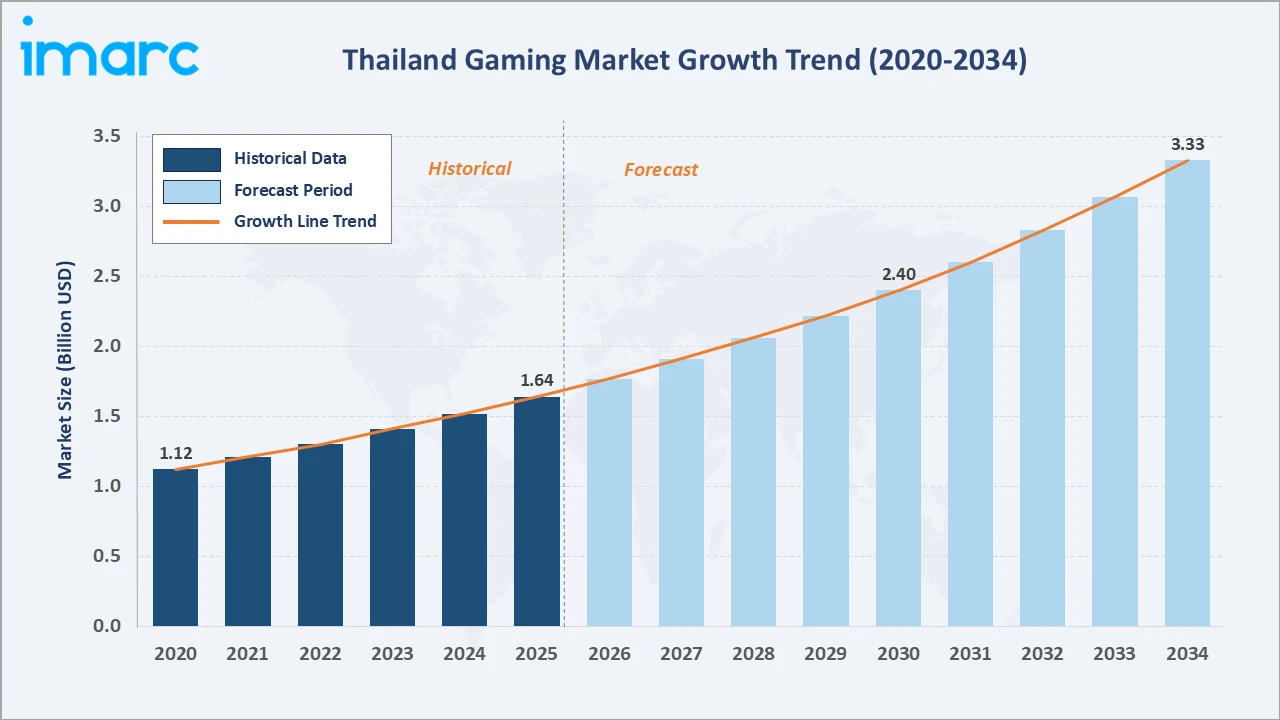
The Thailand gaming market was valued at USD 1.64 Billion in 2025 and is projected to reach USD 3.33 Billion by 2034, growing at a CAGR of 7.95% during 2026-2034. Rising smartphone penetration, affordable mobile data, and expanding digital-payment adoption remain the primary drivers of market growth.
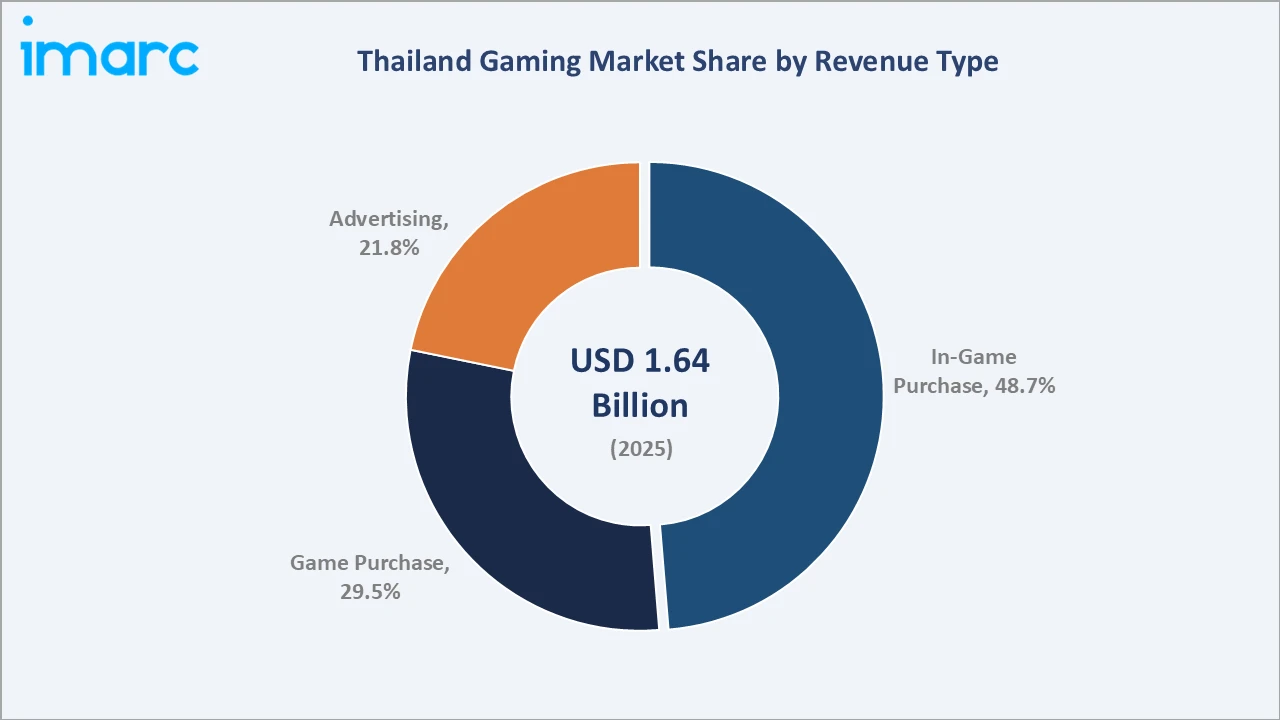
In-game purchase leads the revenue type segment at 48.7%, adults command the age group segment at 76.3%, and Bangkok holds 34.8% of the regional share.
Market Snapshot
|
Metric |
Value |
|
Market Size (2025) |
USD 1.64 Billion |
|
Forecast Market Size (2034) |
USD 3.33 Billion |
|
CAGR (2026-2034) |
7.95% |
|
Base Year |
2025 |
|
Historical Period |
2020-2025 |
|
Forecast Period |
2026-2034 |
|
Largest Region |
Bangkok (34.8%, 2025) |
|
Second Largest Region |
Eastern (18.6%, 2025) |
|
Leading Revenue Type |
In-Game Purchase (48.7%, 2025) |
|
Leading Age Group |
Adults (76.3%, 2025) |
The Thailand gaming market expanded from USD 1.12 Billion in 2020 to USD 1.64 Billion in 2025, driven by rising mobile-first engagement, growing esports viewership, and deepening digital-payment penetration across urban and provincial markets. Tracking the Thailand gaming market size 2026 onward, the market is anchored at USD 2.40 Billion in 2030, with the forecast to USD 3.33 Billion by 2034 supported by accelerating in-game monetization, expanding advertising inventory, and sustained smartphone upgrade cycles.
To get more information on this market, Request Sample
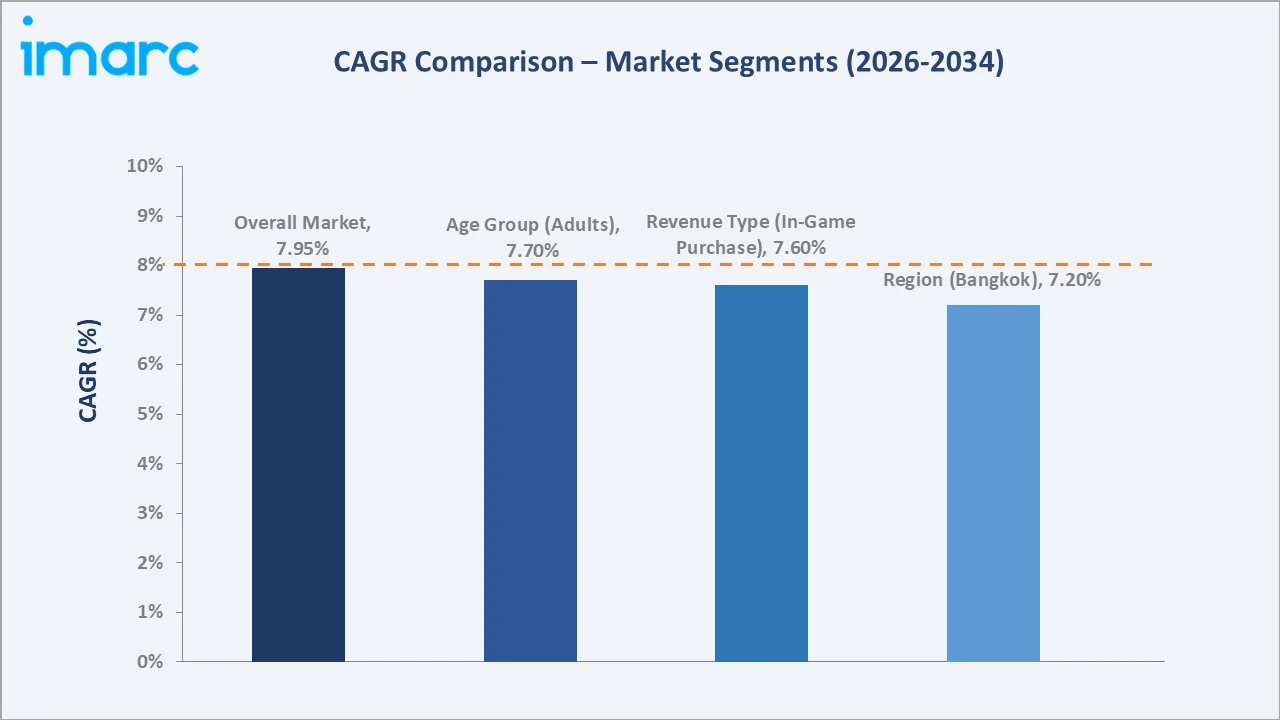
CAGR trajectories across revenue type, age group, and regional sub-segments show advertising and Northeastern expanding faster than the overall 7.95% market CAGR, driven by younger audiences, rising advertising inventory demand, and accelerating provincial digital adoption.
Executive Summary
The Thailand gaming market is on a steady growth trajectory from USD 1.12 Billion in 2020 to USD 3.33 Billion by 2034. The industry has moved from PC-cafe and console-led play toward mobile-first, live-service participation across battle royale, multiplayer online battle arena, and gacha-style titles. Affordable smartphones, expanding network coverage, and seamless digital wallets are encouraging players to engage more deeply with in-game economies.
In-game purchase leads the revenue type segment at 48.7% in 2025, supported by cosmetic items, battle passes, and gacha mechanics across top-grossing titles. Adults command 76.3% of the age group segment, reflecting a maturing player base with sustained spending power. Bangkok commands 34.8% of the regional share, led by high smartphone penetration, dense esports fan communities, and a large concentration of digital-first consumers in the country.
Key Market Insights
|
Insight |
Data |
|
Leading Revenue Type |
In-Game Purchase - 48.7% share (2025) |
|
Second Largest Revenue Type |
Game Purchase - 29.5% share (2025) |
|
Leading Age Group |
Adults - 76.3% share (2025) |
|
Second Largest Age Group |
Children - 23.7% share (2025) |
|
Leading Region |
Bangkok - 34.8% share (2025) |
|
Second Largest Region |
Eastern - 18.6% share (2025) |
|
Top Companies |
Sea Limited, Tencent Holdings Limited, Electronic Arts Inc., KONAMI Group Corporation, Asphere Innovations Public Company Limited |
Key Analytical Observations Supporting the Above Data:
- In-game purchase dominance at 48.7% is anchored by cosmetic skins, seasonal battle passes, and gacha mechanics embedded in the country's top-grossing battle royale and MOBA titles.
- Game purchase at 29.5% is sustained by console and PC title sales alongside one-time unlocks purchased through official app-store billing systems.
- Adults share at 76.3% reflects a maturing, higher-spending player base with established preferences for live-service titles and season-based content.
- Children at 23.7% remain concentrated in casual, family-friendly, and educational game formats accessed primarily through shared household devices.
- Bangkok at 34.8% leads regional share, anchored by dense urban connectivity, strong esports fan culture, and a high concentration of digital-first consumers.
Thailand Gaming Market Overview
Gaming refers to the development, publishing, and consumption of interactive digital entertainment across mobile, personal computer, and console platforms, spanning battle royale, multiplayer online battle arena, role-playing, and casual formats. The Thailand gaming market encompasses free-to-play and premium titles, in-game virtual economies, and advertising-supported experiences accessed through app stores, web portals, and digital distribution platforms.
The domestic ecosystem integrates global and regional publishers, engine and cloud-technology providers, mobile-payment and wallet operators, telecom infrastructure providers, esports organizers, streaming platforms, and localization specialists. Thailand gaming market statistics 2026 show a mobile-first, digitally native audience whose spending power continues to stand out across the broader Southeast Asian region.
Market Dynamics
To evaluate market opportunities, Request Sample
Market Drivers
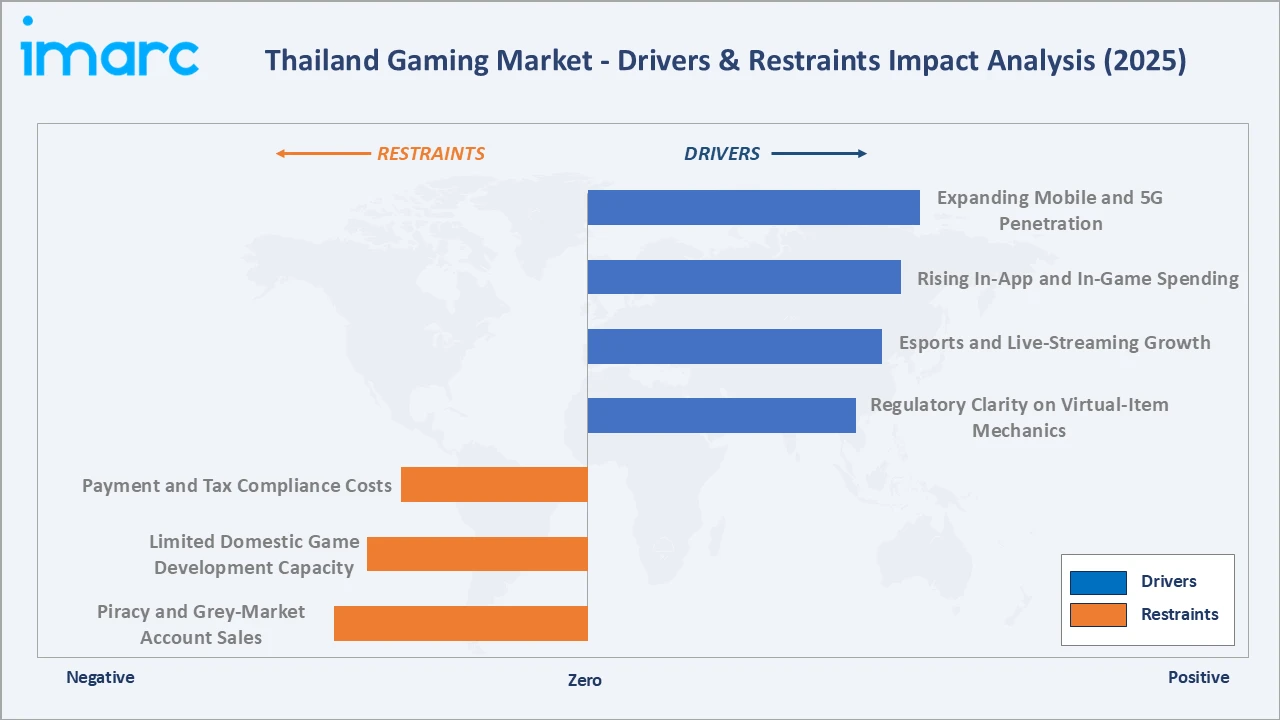
- Expanding Mobile and 5G Penetration: Rapid rollout of affordable smartphones and expanding 5G network coverage continue to bring new players into mobile-first titles across both urban and provincial markets.
- Rising In-App and In-Game Spending: Strong digital-payment infrastructure and a high willingness to spend on virtual goods position Thailand among Southeast Asia's top-spending gaming markets on a per-player basis. In 2023, Thailand had around 30.8 Million users of digital payments.
- Esports and Live-Streaming Growth: Government recognition of esports as a professional sport, alongside growing tournament viewership, is strengthening community engagement and sponsorship inflows.
- Regulatory Clarity on Virtual-Item Mechanics: Greater clarity around digital transactions, virtual goods, and consumer-protection requirements is helping game developers and publishers structure monetization models with greater transparency and compliance.
Market Restraints
- Piracy and Grey-Market Account Sales: Unauthorized account trading and pirated PC titles continue to divert revenue away from licensed publishers and official distribution channels.
- Limited Domestic Game Development Capacity: A relatively small base of local studios constrains the supply of Thailand-developed titles, leaving the market reliant on international publishers for most top-grossing content.
- Payment and Tax Compliance Costs: Evolving digital-payment regulations and tax obligations on in-game transactions add administrative complexity for both domestic and international operators.
Market Opportunities
- Cloud Gaming and Cross-Platform Expansion: Growing broadband and 5G infrastructure creates room for cloud-streamed titles that reduce hardware barriers for premium PC and console experiences.
- Local Content and Folklore-Inspired Titles: Rising interest in Thailand-developed games drawing on local folklore and culture offers publishers a path to deeper player loyalty and export potential.
Market Challenges
- Fragmented Regulatory Oversight: Overlapping responsibilities across digital-economy, culture, and consumer-protection authorities create inconsistent enforcement of content and monetization rules.
- Talent and Studio Capacity Constraints: A limited pool of experienced local developers and technical artists slows the pace of domestic game production relative to regional peers.
Emerging Market Trends
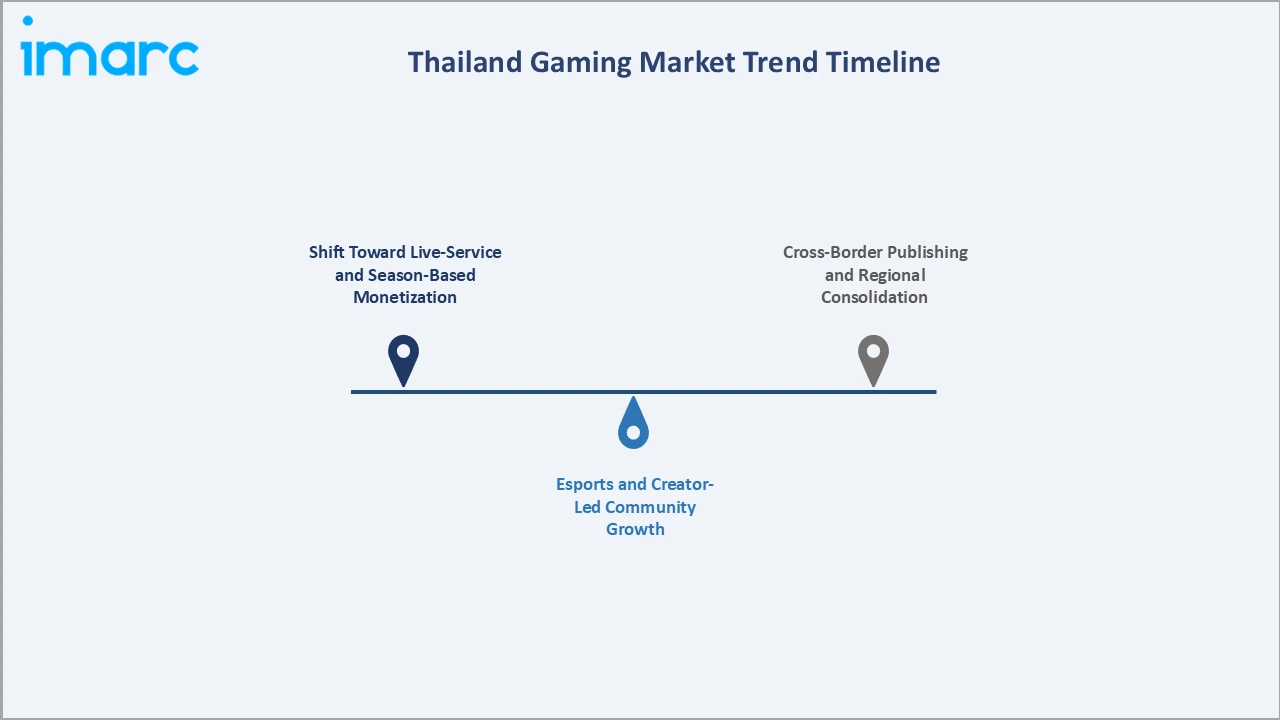
1. Shift Toward Live-Service and Season-Based Monetization
Publishers are increasingly favoring ongoing battle-pass and season-based content over one-time purchases, extending player lifecycles and creating more predictable recurring revenue streams. Among the defining Thailand gaming market trends 2026, this shift is reshaping how in-game purchase and advertising revenue are balanced across top titles.
2. Esports and Creator-Led Community Growth
National esports leagues and creator-driven content on livestreaming platforms are deepening community engagement around flagship titles, translating viewership into sustained in-game spending and merchandise demand.
3. Cross-Border Publishing and Regional Consolidation
Regional publishers are increasingly bundling Thailand alongside other Southeast Asian markets in unified content and marketing calendars, allowing faster simultaneous launches and shared localization investment across the region.
Industry Value Chain Analysis
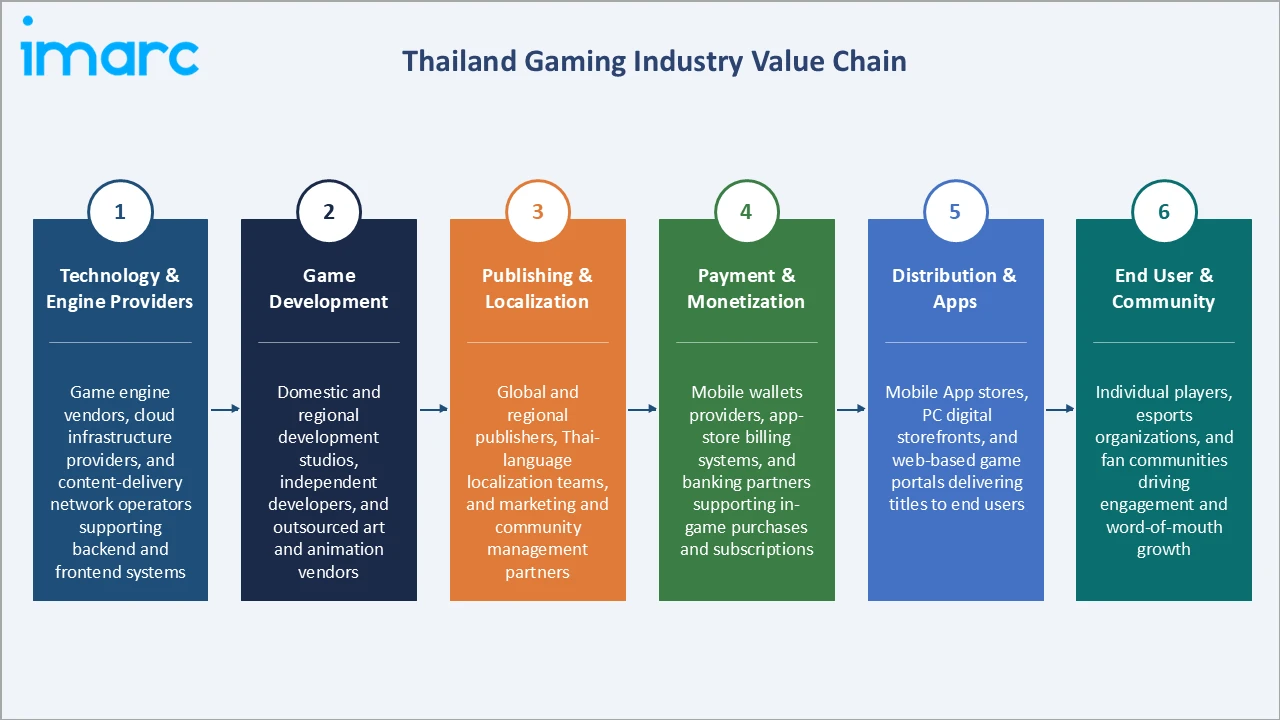
The Thailand gaming value chain spans six stages, from technology and engine provision through end-user community engagement. Publishing, localization, and payment integration capture the highest value-add, while distribution and community management increasingly determine long-term player retention in this mobile-first market.
|
Stage |
Key Players / Examples |
|
Technology & Engine Providers |
Game engine vendors, cloud infrastructure providers, and content-delivery network operators supporting backend and frontend systems |
|
Game Development |
Domestic and regional development studios, independent developers, and outsourced art and animation vendors |
|
Publishing & Localization |
Global and regional publishers, Thai-language localization teams, and marketing and community management partners |
|
Payment & Monetization |
Mobile wallet providers, app-store billing systems, and banking partners supporting in-game purchases and subscriptions |
|
Distribution & Apps |
Mobile app stores, PC digital storefronts, and web-based game portals delivering titles to end users |
|
End User & Community |
Individual players, streamers, esports organizations, and fan communities driving engagement and word-of-mouth growth |
Vertically integrated publishers with proprietary engines, direct payment relationships, and owned community platforms are positioned to capture greater value than partners reliant on third-party distribution alone.
Technology Landscape in the Thailand Gaming Industry
Game Engines and Cloud Streaming
Developers increasingly rely on cross-platform engines and cloud-rendering infrastructure to deliver high-fidelity titles across mobile, PC, and emerging cloud-streaming formats, reducing hardware barriers for players with lower-end devices.
AI, Analytics, and Personalization
AI and machine learning (ML) models support player segmentation, matchmaking, anti-cheat detection, and personalized in-game offers, helping publishers tailor content and monetization to individual player behavior.
Mobile-First Platforms and Embedded Payments
Native mobile apps tightly integrated with digital wallets, one-click billing, and biometric login dominate the Thai player experience, supporting fast onboarding and frictionless in-game purchases across smartphones and tablets.
Esports Broadcast and Streaming Technology
Low-latency streaming infrastructure and multi-platform broadcast tools are enabling publishers and esports organizers to reach larger domestic and regional audiences during tournaments and community events.
Market Segmentation Analysis
The report covers the following segments:
|
Device Type |
🔒 |
🔒 |
2025 |
|
Platform |
🔒 |
🔒 |
2025 |
|
Revenue Type |
In-Game Purchase |
48.7% |
2025 |
|
Type |
🔒 |
🔒 |
2025 |
|
Age Group |
Adults |
76.3% |
2025 |
|
Region |
Bangkok |
34.8% |
2025 |

By Revenue Type
In-game purchase leads the revenue type segment with a 48.7% share in 2025, driven by cosmetic skins, battle passes, and gacha-style mechanics embedded in the country's top-grossing battle royale and MOBA titles. The format benefits from low marginal cost per transaction and strong repeat-purchase behavior among active players.
To access detailed market analysis, Request Sample
Game purchase holds 29.5% share in 2025, spanning premium console and PC titles alongside one-time mobile unlocks.
By Age Group
Adults command 76.3% of the age group segment in 2025, reflecting a maturing, higher-spending player base with strong preferences for live-service titles, esports viewership, and season-based content.
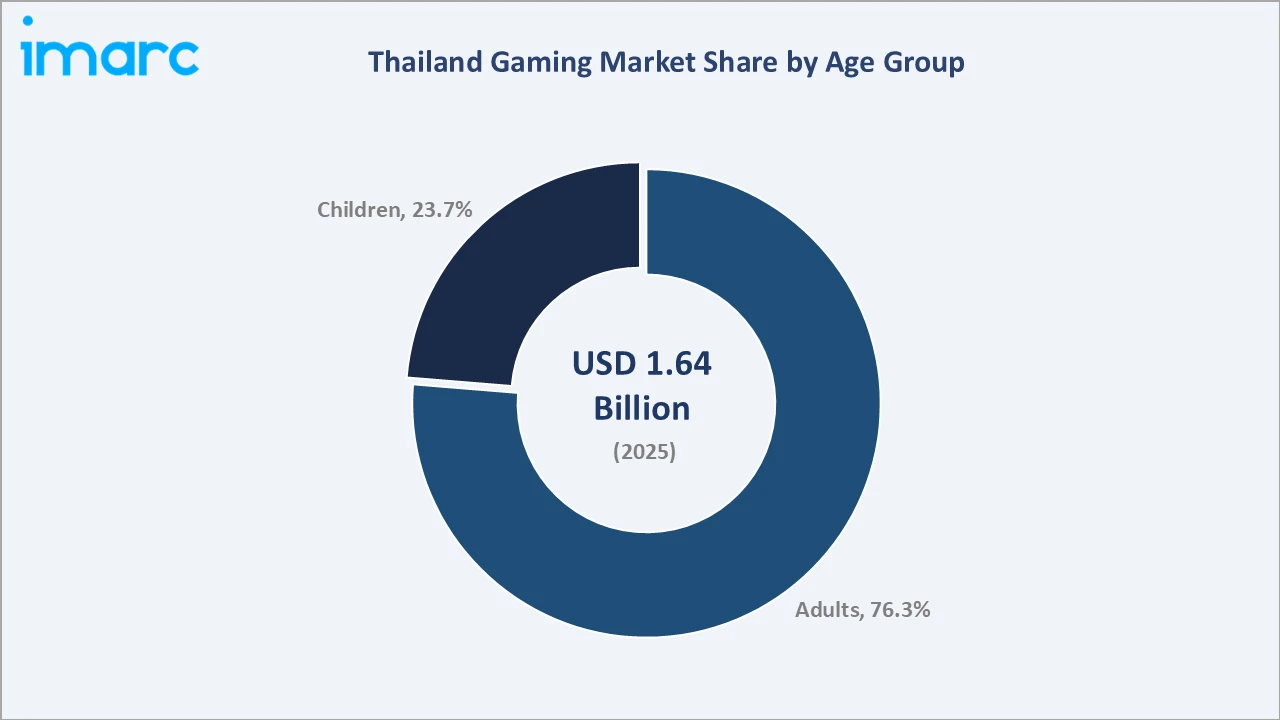
Children account for 23.7% of the segment, concentrated in casual, family-friendly, and educational titles typically accessed through shared household devices under parental oversight.
Regional Market Insights
|
Region |
Share (2025) |
Key Growth Drivers |
|
Bangkok |
34.8% |
Dense urban population, high smartphone penetration, strong esports fan culture, and concentration of digital-first consumers |
|
Eastern |
18.6% |
Expanding industrial employment base, rising disposable incomes, and growing mobile broadband coverage |
|
Southern |
16.7% |
Growing tourism-linked digital infrastructure, rising smartphone adoption, and an expanding youth population |
|
Northern |
14.2% |
Improving 4G and 5G coverage, growing urban centers, and increasing student and youth gaming communities |
|
Northeastern |
10.9% |
Rapid digital adoption, rising disposable incomes, and expanding tier-2 city participation |
|
Others |
4.8% |
Gradual infrastructure improvement and increasing smartphone affordability across remaining provincial areas |
Bangkok at 34.8% in 2025 leads the regional landscape, anchored by high urban population density, deep esports fan engagement, and mature digital-payment infrastructure.
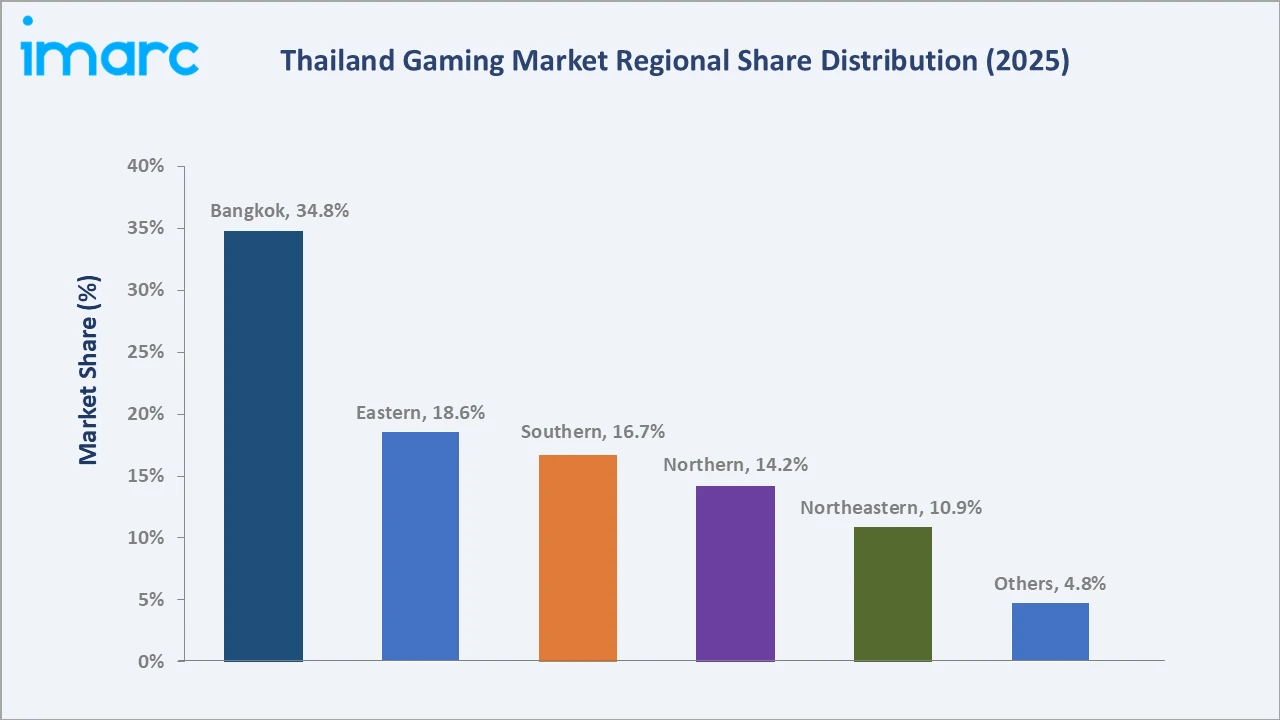
Northeastern, at 10.9%, is the fastest-growing region, supported by rapid smartphone adoption, expanding mobile broadband coverage, and rising participation from tier-2 and tier-3 provincial cities through 2034.
Competitive Landscape
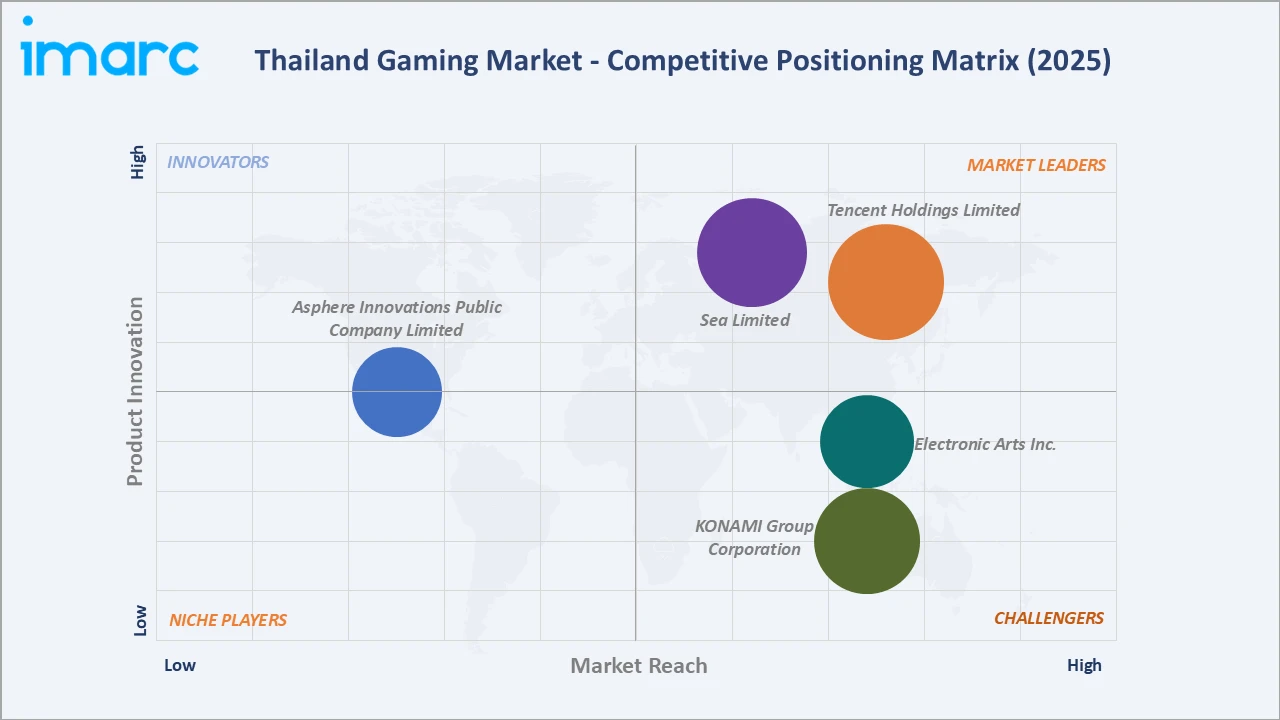
The Thailand gaming market is moderately concentrated, with global publishers leading player reach and monetization depth while regional and domestic operators compete on localized content and community engagement. Brand strength, engine technology, and payment integration form the key competitive moats shaping the market.
|
Company Name |
Brand / Key Product |
Position |
Strategic Focus |
|
Sea Limited |
Garena (Free Fire, Arena of Valor) |
Leader |
Mobile-first publishing platform with deep localization and esports investment across Southeast Asia |
|
Tencent Holdings Limited |
Goddess of Victory: NIKKE |
Leader |
Diversified global publisher leveraging cross-title IP and regional distribution partnerships |
|
Electronic Arts Inc. |
EA SPORTS FC Mobile |
Challenger |
Sports-focused publisher leveraging global franchise IP and live-service content |
|
KONAMI Group Corporation |
eFootball |
Challenger |
Sports-simulation publisher building steady engagement through franchise player content |
|
Asphere Innovations Public Company Limited |
PlayPark |
Emerging |
Regional publisher and portal operator offering localized MMO and casual game services across Southeast Asia |
Key players include Sea Limited, Tencent Holdings Limited, Electronic Arts Inc., KONAMI Group Corporation, and Asphere Innovations Public Company Limited, among others.
Key Company Profiles
Sea Limited
Sea Limited is a Singapore-headquartered technology company, operating Garena as its digital entertainment arm across Southeast Asia, including Thailand.
- Product Portfolio: Garena's mobile gaming portfolio spans battle royale and multiplayer online battle arena titles, supported by localized content and dedicated esports leagues.
- Recent Developments: Sea Limited continues to expand its digital entertainment and gaming ecosystem across Southeast Asia through investments in localized content, platform capabilities, and esports activities.
- Strategic Focus: Deepening community engagement through localized esports programming and continued investment in mobile-first live-service titles.
Tencent Holdings Limited
Tencent Holdings is a Chinese technology conglomerate and one of the world's largest video game publishers by revenue, reaching Thai players through its global publishing label, Level Infinite.
- Product Portfolio: Level Infinite's portfolio includes character-driven mobile titles distributed through official app-store channels across Southeast Asia, including Thailand.
- Recent Developments: The firm has continued to expand its mobile title portfolio and community engagement efforts across Thailand.
- Strategic Focus: Expanding cross-title community engagement and sustaining long-term monetization through season-based content updates.
Electronic Arts Inc.
Electronic Arts is a leading global publisher of sports and entertainment titles, maintaining a loyal mobile following among Thai players.
- Product Portfolio: Mobile sports portfolio offers card-collection and team-management gameplay built around global sports licenses.
- Recent Developments: The firm has continued to expand its mobile esports circuit and live-service content across Southeast Asian markets, including Thailand.
- Strategic Focus: Leveraging global sports licensing and franchise recognition to sustain a loyal mobile player base across the region.
Market Concentration Analysis
The Thailand gaming market is moderately concentrated, with global publishers such as Sea Limited and Tencent Holdings Limited, accounting for a substantial share of player engagement and monetization through mobile-first battle royale and MOBA titles.
Barriers to entry include high user-acquisition costs in a mobile-first market, the need for scalable live-service infrastructure, and the challenge of building sustained community engagement against established franchise titles. These factors favor well-capitalized incumbents with diversified regional portfolios.
Consolidation is gradually increasing as regional publishers bundle Thailand alongside neighboring Southeast Asian markets within unified content and marketing calendars, while smaller domestic operators focus on niche casual and community-driven titles.
Investment & Growth Opportunities
Fastest-Growing Segments
Advertising expands fastest among revenue type segments as free-to-play publishers diversify monetization beyond direct player spend. This is supporting more predictable monetization practices and encouraging investment in locally relevant gaming content and platforms.
Emerging Markets
Northeastern and Northern represent significant untapped opportunity for publishers able to deliver affordable, data-friendly titles and localized community content beyond the capital region.
Venture & Investment Trends
Investment continues to concentrate in mobile-first live-service platforms, esports organizations, and creator-economy tools that support sustained community engagement around flagship titles. Capital is also flowing into gaming industry marketing Thailand initiatives, including influencer partnerships and localized brand campaigns that build long-term player loyalty.
Future Market Outlook (2026-2034)
The Thailand gaming market is forecast to expand from USD 1.64 Billion in 2025 to USD 3.33 Billion by 2034 at a CAGR of 7.95%, adding roughly USD 1.69 Billion in incremental market value over the forecast period.
Three forces will shape the market through 2034: deepening mobile-payment and monetization infrastructure, the rise of live-service and season-based content models, and growing provincial digital adoption beyond Bangkok.
By 2034, the Thailand gaming market is expected to be defined by mature, live-service-led player engagement, with advertising and provincial regions accounting for a meaningfully higher share of overall market value than today.
Research Methodology
Primary Research
Primary research included structured conversations with publishing executives, esports organizers, payment-service providers, and digital marketing agencies, validating market sizing, segment mix, and regional demand patterns.
Secondary Research
Secondary sources included government digital-economy publications, telecom regulatory data, publisher investor disclosures, and industry press coverage of the Thailand gaming and esports ecosystem.
Forecasting Models
Market forecasts used top-down and bottom-up models combining player-base estimates, average revenue per user, platform mix evolution, and macroeconomic variables, with scenario analysis addressing regulatory and payment-infrastructure developments.
Thailand Gaming Market Report Coverage:
| Report Features | Details |
|---|---|
| Base Year of the Analysis | 2025 |
| Historical Period | 2020-2025 |
| Forecast Period | 2026-2034 |
| Units | Billion USD |
| Scope of the Report |
Exploration of Historical Trends and Market Outlook, Industry Catalysts and Challenges, Segment-Wise Historical and Future Market Assessment:
|
| Device Types Covered | Consoles, Mobiles and Tablets, Computers |
| Platforms Covered | Online, Offline |
| Revenue Types Covered | In-Game Purchase, Game Purchase, Advertising |
| Types Covered | Adventure/Role Playing Games, Puzzles, Social Games, Strategy, Stimulation, Others |
| Age Groups Covered | Adults, Children |
| Regions Covered | Bangkok, Eastern, Northeastern, Southern, Northern, Others |
| Companies Covered | Sea Limited, Tencent Holdings Limited, Electronic Arts Inc., KONAMI Group Corporation, Asphere Innovations Public Company Limited, etc. |
| Customization Scope | 10% Free Customization |
| Post-Sale Analyst Support | 10-12 Weeks |
| Delivery Format | PDF and Excel through Email (We can also provide the editable version of the report in PPT/Word format on special request) |
Key Benefits for Stakeholders:
- IMARC’s industry report offers a comprehensive quantitative analysis of various market segments, historical and current market trends, market forecasts, and dynamics of the Thailand gaming market from 2020-2034.
- The research report provides the latest information on the market drivers, challenges, and opportunities in the Thailand gaming market.
- Porter's five forces analysis assist stakeholders in assessing the impact of new entrants, competitive rivalry, supplier power, buyer power, and the threat of substitution. It helps stakeholders to analyze the level of competition within the Thailand gaming industry and its attractiveness.
- Competitive landscape allows stakeholders to understand their competitive environment and provides an insight into the current positions of key players in the market.
Frequently Asked Questions About the Thailand Gaming Market Report
The Thailand gaming market was valued at USD 1.64 Billion in 2025, driven by mobile-first engagement, rising in-game spending, and expanding esports viewership across the country.
The market is projected to grow at a CAGR of 7.95% from 2026-2034, reaching USD 3.33 Billion, supported by advertising growth and provincial digital expansion.
In-game purchase leads the revenue type segment at 48.7% in 2025, driven by cosmetic skins, seasonal battle passes, and gacha-style mechanics embedded in top-grossing battle royale and MOBA titles.
Adults command 76.3% of the age group segment in 2025, reflecting a maturing, higher-spending player base with strong preferences for live-service titles and season-based content.
Bangkok commands 34.8% share in 2025, led by dense urban connectivity, strong esports culture, and a large concentration of digital-first consumers.
Leading players include Sea Limited, Tencent Holdings Limited, Electronic Arts Inc., KONAMI Group Corporation, and Asphere Innovations Public Company Limited, among others.
Government recognition of esports as a professional sport has strengthened tournament infrastructure, sponsorship inflows, and community engagement around flagship mobile titles.
Piracy, limited domestic development capacity, and evolving payment and tax compliance requirements continue to constrain growth for both domestic and international operators.
Cloud streaming, AI-driven personalization, and embedded mobile payments are enabling publishers to deliver more accessible, higher-fidelity experiences to Thai players.
Need more help?
- Speak to our experienced analysts for insights on the current market scenarios.
- Include additional segments and countries to customize the report as per your requirement.
- Gain an unparalleled competitive advantage in your domain by understanding how to utilize the report and positively impacting your operations and revenue.
- For further assistance, please connect with our analysts.
 Request Customization
 Speak to an Analyst
 Request Brochure
 Inquire Before Buying
Benefits of Customization
- Personalize this research
- Triangulate with your data
- Get data as per your format and definition
- Gain a deeper dive into a specific application, geography, customer, or competitor
- Any level of personalization
Get in Touch With Us
UNITED STATES
Phone: +1-201-971-6302
INDIA
Phone: +91-120-433-0800
UNITED KINGDOM
Phone: +44-753-714-6104
Email: [email protected]
Client Testimonials




.webp)




.webp)













Related Reports

Choose your plan
*Please note that the prices mentioned below are starting prices for each bundle type. Kindly contact our team for further details.*
Single User License
- 1 User License, Access on 2 Devices
- PDF Report + Excel Dataset (Password Protected)
- Lifetime Access
- No Printing Rights
- 10% Free Report Customization
- 10–12 Weeks of Analyst Support
Five User License
- Access for 5 Users, 2 Devices per User
- PDF Report + Excel Dataset (Password Protected)
- Lifetime Access
- Dedicated Account Manager
- 12–14 Weeks of Analyst Support
- No Printing Rights
- 15% Free Report Customization
- 25% Discount on Your Next Purchase
Corporate User License
- Unlimited User Access (Within Your Organization)
- PDF Report + Excel Dataset
- Lifetime Access
- Dedicated Account Manager
- 14–20 Weeks of Analyst Support
- No Printing Rights
- 20% Free Report Customization
- 30% Discount on Your Next Purchase
Essential Insights
What's included:
3 reports
- Lifetime Access
- PDF Reports
- Excel Datasets
- 2 Weeks of Free Analyst Support
- 2 User Licenses
- Access on 2 Devices
- Printing Rights
- Complimentary PowerPoint (PPT) Version
- Complimentary License Upgrade
Professional Access
What's included:
5 reports
- Lifetime Access
- PDF Reports
- Excel Datasets
- 8 Weeks of Free Analyst Support
- 2 User Licenses
- Access on 2 Devices
- Printing Rights
- Complimentary PowerPoint (PPT) Version
- Complimentary License Upgrade
Business Advantage
What's included:
8 reports
- Lifetime Access
- PDF Reports
- Excel Datasets
- 14 Weeks of Free Analyst Support
- 2 User Licenses
- Access on 2 Devices
- Printing Rights
- Complimentary PowerPoint (PPT) Version
- Complimentary License Upgrade
Enterprise Intelligence
What's included:
10 reports
- Lifetime Access
- PDF Reports
- Excel Datasets
- 20 Weeks of Free Analyst Support
- 2 User Licenses
- Access on 2 Devices
- Printing Rights
- Complimentary PowerPoint (PPT) Version
- Complimentary License Upgrade