
Timing Belt Market Size, Share, Trends and Forecast by Drive Type, Component, Vehicle Type, Distribution Channel, and Region, 2026-2034
Timing Belt Market Size, Share, Trends & Forecast (2026-2034)
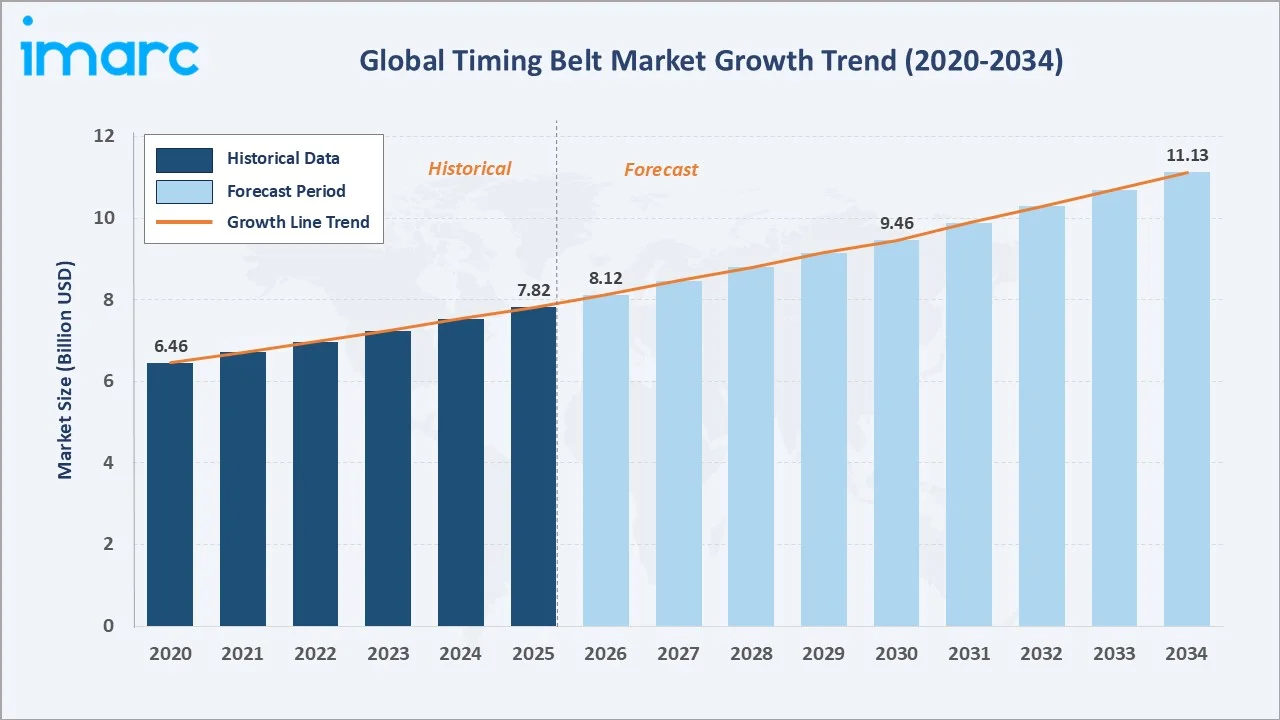
The global timing belt market size was valued at USD 7.82 Billion in 2025 and is estimated to reach USD 8.12 Billion in 2026. It is further projected to reach USD 11.13 Billion by 2034, growing at a CAGR of 3.89% during 2026-2034. The market is driven by rising global vehicle production, stringent emission regulations mandating fuel-efficient engine designs, and robust replacement demand in mature automotive aftermarkets.
Dry Belts leads drive type at 46.2%. Tensioner dominates the component segment at 31.8%. Asia Pacific commands 41.8% of the global market share.
Market Snapshot
|
Metric |
Value |
|
Base Year Market Size (2025) |
USD 7.82 Billion |
|
Market Size (2026) |
USD 8.12 Billion |
|
Forecast Market Size (2034) |
USD 11.13 Billion |
|
CAGR (2026-2034) |
3.89% |
|
Base Year |
2025 |
|
Historical Period |
2020-2025 |
|
Forecast Period |
2026-2034 |
|
Dominant Drive Type |
Dry Belts (46.2%, 2025) |
|
Dominant Component |
Tensioner (31.8%, 2025) |
|
Leading Region |
Asia Pacific (41.8%, 2025) |
The global timing belt market size increased from USD 6.46 Billion in 2020 to USD 7.82 Billion in 2025 and is estimated to reach USD 8.12 Billion in 2026. The market is further expected to grow to USD 9.46 Billion by 2030 and USD 11.13 Billion by 2034. Growth is underpinned by expanding global vehicle parc, evolving powertrain technologies, and rising demand for reliable engine timing components across OEM and aftermarket channels.
To get more information on this market, Request Sample
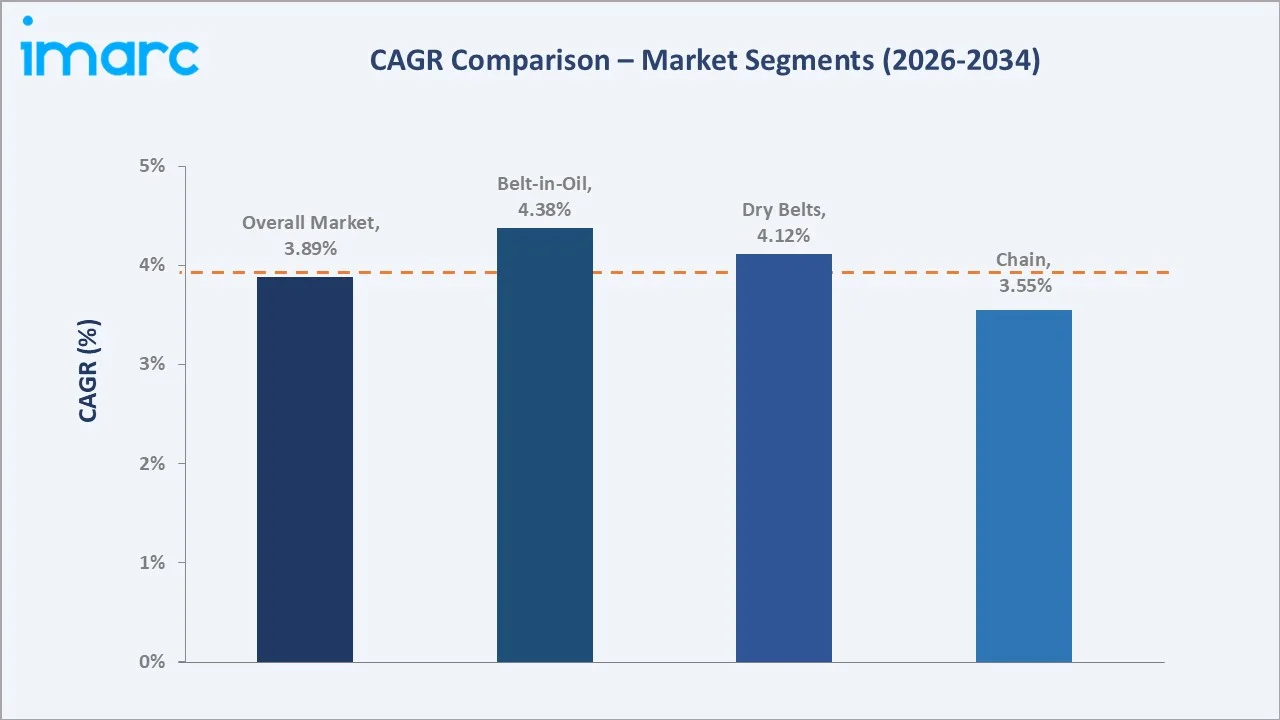
Belt-in-oil segment is the fastest-growing drive type through adoption of wet-running chain drive systems in modern downsized turbocharged engines. Dry belts sustain leadership through widespread application in passenger vehicles with conventional gasoline engines across global markets.
Executive Summary
The global timing belt market expanded from USD 7.82 Billion in 2025 to an estimated USD 8.12 Billion in 2026, driven by growing automotive production and stringent engine performance standards. The market's growth is underpinned by the automotive industry's push for fuel-efficient, low-emission powertrains requiring precisely timed engine components. The market is projected to reach USD 11.13 Billion by 2034. Dry Belts leads at 46.2% through broad application. Tensioner dominates components at 31.8%. Asia Pacific holds 41.8% regional share.
Key Market Insights
|
Insight |
Data |
|
Dominant Drive Type |
Dry Belts – 46.2% share (2025) |
|
Dominant Component |
Tensioner – 31.8% market share (2025) |
|
Leading Region |
Asia Pacific – 41.8% share (2025) |
|
Market Opportunity |
Expanding aftermarket replacement demand; growing EV-compatible component variants; rising production in Asia Pacific |
Key Analytical Observations Supporting the Above Data:
- Dry Belts at 46.2%: The Dry Belts segment leads due to its widespread use in conventional gasoline and diesel passenger vehicle engines. Its cost-effectiveness established OEM preference, and broad compatibility with existing vehicle platforms sustain its dominant market position across all major automotive producing regions, particularly in Asia Pacific and Europe.
- Tensioner at 31.8%: Tensioner leads the component segment as a critical element maintaining belt tension, preventing slippage, and ensuring engine timing precision. Every timing belt kit requires tensioner replacement, driving consistent demand through both OEM and aftermarket channels across all vehicle types globally.
- Asia Pacific at 41.8%: Asia Pacific leads regionally through its dominant position in global vehicle production, led by China, Japan, India, and South Korea. The region's massive vehicle parc, expanding middle-class ownership, and rapidly growing aftermarket replacement sector collectively sustain its commanding market share.
Timing Belt Market Overview
The global timing belt market serves as a critical sub-segment of the automotive powertrain components industry, supplying timing drive systems that synchronise engine valve operations with piston movement. Timing belts, chains, and associated components are essential for engine performance, fuel efficiency, and emission compliance.
The market ecosystem integrates raw material suppliers, precision belt manufacturers, tier-1 automotive component suppliers, OEM assembly lines, and a vast aftermarket distribution network. Rising vehicle production in Asia Pacific, tightening emission standards in Europe and North America, and growing vehicle age globally are the primary macroeconomic forces shaping market evolution.
Market Dynamics
To evaluate market opportunities, Request Sample
Market Drivers
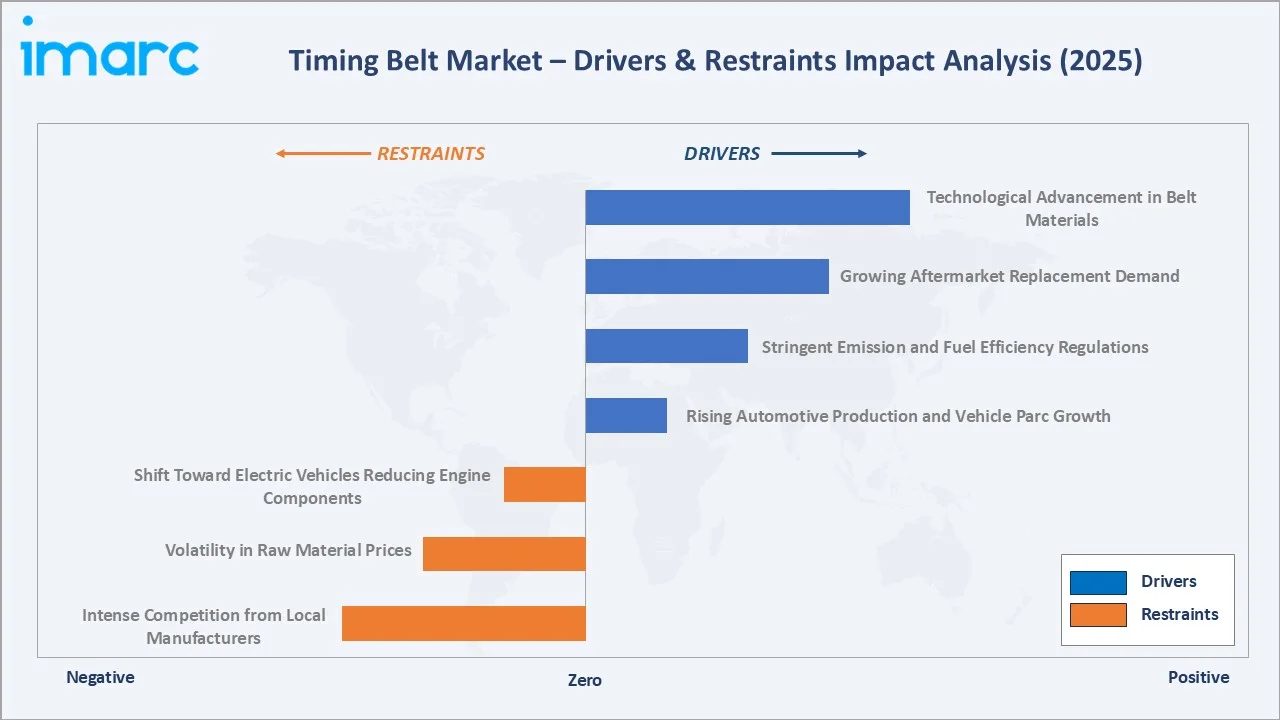
- Rising Automotive Production and Vehicle Parc Growth: Expanding global vehicle production, particularly in Asia Pacific markets led by China and India, is generating sustained demand for timing belt systems across all powertrain variants. The growing installed vehicle fleet creates parallel aftermarket replacement demand, with timing belt replacement intervals of 60,000–100,000 km ensuring recurring purchase cycles. Global vehicle production is projected to surpass 100 million units annually by 2030, directly expanding the addressable market for timing belt manufacturers and suppliers across OEM and aftermarket channels worldwide.
- Stringent Emission and Fuel Efficiency Regulations: Euro 7, BS-VI, and EPA Tier 3 regulations mandate precise engine timing for optimal combustion efficiency and emission reduction, making high-quality timing belt systems essential for regulatory compliance. Advanced timing systems enable variable valve timing (VVT) and other precision technologies that directly reduce fuel consumption and carbon emissions. Automakers are increasing investment in precision powertrain components to meet increasingly stringent global regulatory requirements, sustaining demand for high-performance timing belts and associated components throughout the forecast period.
- Growing Aftermarket Replacement Demand: The global vehicle parc continues to age, with average vehicle age rising in key markets including the US, Europe, and developing economies. Older vehicles require periodic timing belt replacement as a critical maintenance service, creating a stable and predictable demand stream independent of new vehicle production cycles. The expansion of organised aftermarket retail, increasing consumer awareness about preventive maintenance, and the growth of authorised service networks are all contributing to sustained aftermarket timing belt demand globally.
- Technological Advancement in Belt Materials: Development of high-strength composite materials including Kevlar fibre reinforcement, EPDM rubber compounds, and precision-formed polyurethane belts is extending timing belt service life and enabling deployment in more demanding engine environments. Advanced belt materials provide superior heat resistance, dimensional stability, and fatigue strength compared to conventional rubber belts. These material innovations are expanding the addressable application range for dry timing belts, competing effectively against chain drive systems in performance and longevity benchmarks across automotive OEM specifications.
Market Restraints
- Shift Toward Electric Vehicles Reducing Engine Components: The global transition toward battery electric vehicles (BEVs) represents a structural headwind for timing belt demand, as electric drivetrains eliminate internal combustion engine components including timing systems entirely. Major automotive markets including the EU, China, and the US are implementing phased ICE vehicle phase-out targets. While the transition remains gradual and hybrid powertrains still require timing systems, the long-term displacement of conventional engines constrains the market's growth potential over the forecast horizon, particularly in premium passenger vehicle segments.
- Volatility in Raw Material Prices: Timing belt manufacturing depends on synthetic rubber compounds, reinforcing fibres, and metal components whose prices are subject to significant volatility linked to crude oil prices, supply chain disruptions, and trade policy changes. Raw material cost fluctuations compress manufacturer margins and create pricing uncertainty across the supply chain. The challenge is particularly acute for smaller regional manufacturers with limited hedging capability, potentially affecting their competitive positioning against larger integrated suppliers with diversified procurement strategies.
- Intense Competition from Local Manufacturers: Low-cost timing belt manufacturers in China, India, and other emerging markets are aggressively competing on price in aftermarket segments, creating margin pressure for established global brands. These manufacturers are rapidly improving product quality through technology transfer and reverse engineering, narrowing the quality gap with premium brands. Price-sensitive aftermarket buyers in developing markets are increasingly substituting established OEM-equivalent brands with economy alternatives, eroding market share for premium global suppliers.
Market Opportunities
- Hybrid Vehicle Timing System Demand: Hybrid electric vehicles continue to require ICE-based timing systems alongside electric motors, sustaining demand for advanced timing belts and chains through the energy transition period. The growing hybrid vehicle parc across Europe, North America, and Asia Pacific presents a significant opportunity for timing belt manufacturers to develop application-specific products for hybrid powertrains with enhanced durability requirements.
- Emerging Market Aftermarket Expansion: Growing vehicle ownership in Southeast Asia, Latin America, Middle East, and Africa is creating rapidly expanding aftermarket opportunities as vehicle fleets age and require timing belt replacement. Establishing distribution networks and brand presence in these high-growth markets represents a strategic expansion opportunity for global timing belt manufacturers seeking to offset slower growth in mature Western markets.
Market Challenges
- Engine Downsizing Increasing Component Complexity: Modern downsized turbocharged engines operate under higher thermal and mechanical stress conditions than conventional engines, demanding timing belt materials with superior performance characteristics. Meeting these elevated specifications requires significant R&D investment in material science and manufacturing process innovation, increasing development costs and time-to-market for next-generation timing belt products.
- Counterfeit Products in the Aftermarket: The proliferation of counterfeit and substandard timing belt products in global aftermarket channels represents a significant challenge for established manufacturers, eroding brand equity and creating safety risks. Substandard belts can fail prematurely, causing catastrophic engine damage, raising liability concerns for both manufacturers and vehicle owners. Combating counterfeiting requires sustained investment in authentication technologies, distributor training programmes, and consumer education initiatives across all key markets.
Emerging Market Trends
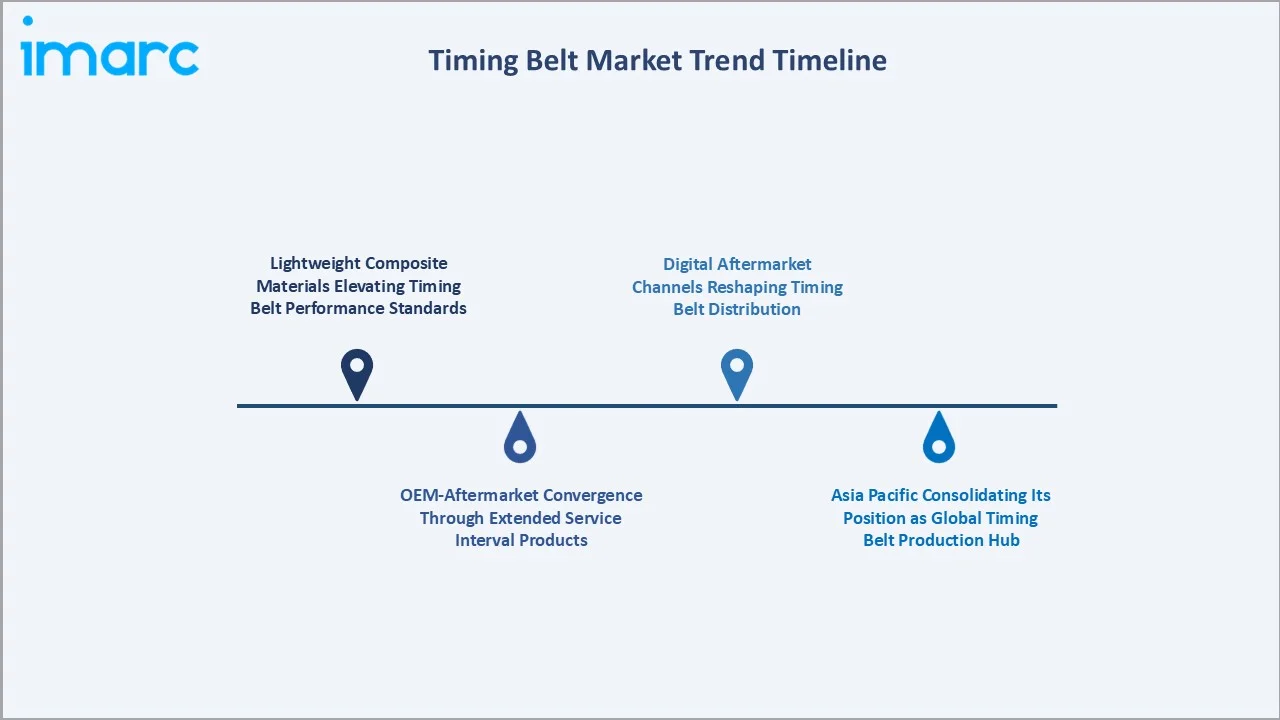
1. Lightweight Composite Materials Elevating Timing Belt Performance Standards
Advanced composite timing belts incorporating Kevlar and carbon fibre reinforcements are achieving performance parity with chain drive systems in terms of durability and service life, displacing chains in select powertrain applications while reducing vehicle weight for improved fuel efficiency.
2. OEM-Aftermarket Convergence Through Extended Service Interval Products
Manufacturers are developing extended-life timing belt kits targeting 150,000+ km service intervals, blurring the boundary between OEM replacement and aftermarket maintenance cycles. Extended service life products command premium pricing while reducing total replacement frequency, reshaping aftermarket revenue models.
3. Asia Pacific Consolidating Its Position as Global Timing Belt Production Hub
China, Japan, and South Korea are consolidating their position as primary global timing belt manufacturing centres through investment in precision manufacturing technology, supplier ecosystem development, and integration with regional OEM automotive supply chains serving both domestic and export markets.
4. Digital Aftermarket Channels Reshaping Timing Belt Distribution
E-commerce platforms are accelerating timing belt aftermarket sales by enabling direct-to-consumer and direct-to-workshop distribution, bypassing traditional multi-tier distribution networks. Digital platforms are expanding market access in geographically dispersed aftermarket segments and improving pricing transparency for timing belt replacement products.
Industry Value Chain Analysis
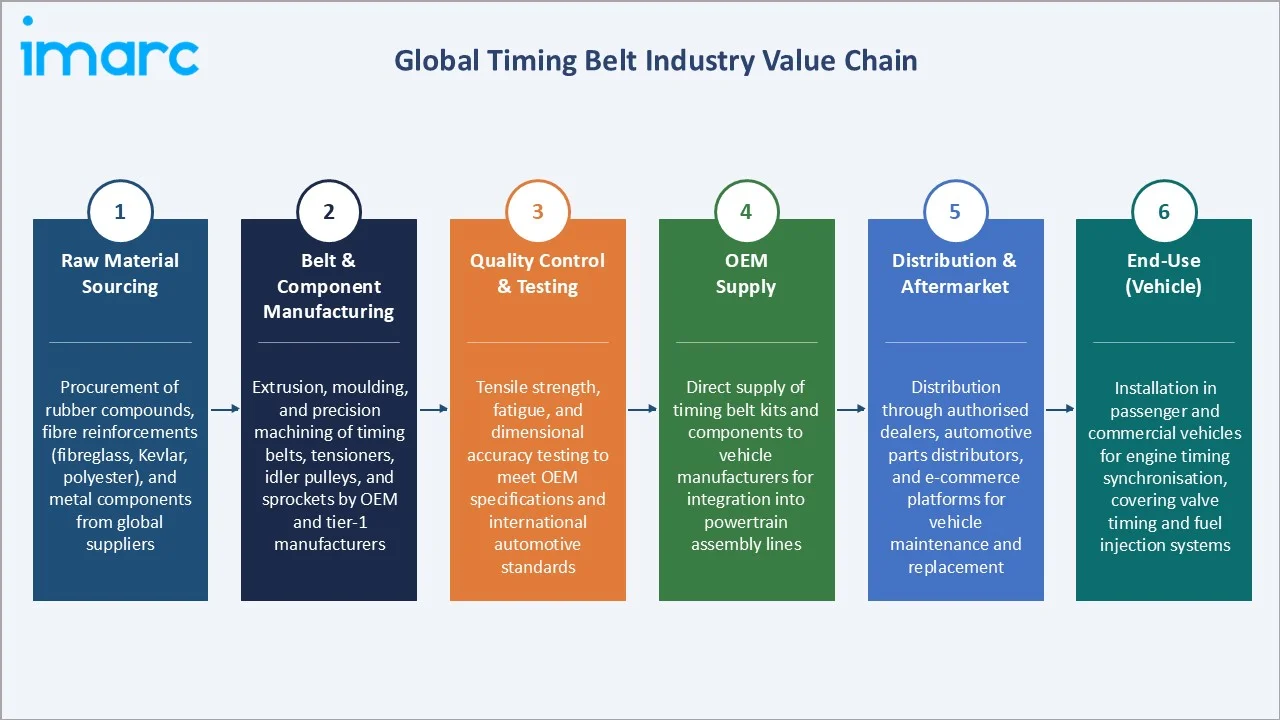
The timing belt industry value chain spans raw material procurement through end-use vehicle application, integrating specialised manufacturing processes, precision quality validation, and multi-channel distribution systems that serve both OEM and aftermarket customer segments globally.
|
Stage |
Key Activities & Participants |
|
Raw Material Sourcing |
Procurement of rubber compounds, fibre reinforcements (fibreglass, Kevlar, polyester), and metal components from global suppliers. |
|
Belt & Component Manufacturing |
Extrusion, moulding, and precision machining of timing belts, tensioners, idler pulleys, and sprockets by OEM and tier-1 manufacturers. |
|
Quality Control & Testing |
Tensile strength, fatigue, and dimensional accuracy testing to meet OEM specifications and international automotive standards. |
|
OEM Supply |
Direct supply of timing belt kits and components to vehicle manufacturers for integration into powertrain assembly lines. |
|
Distribution & Aftermarket |
Distribution through authorised dealers, automotive parts distributors, and e-commerce platforms for vehicle maintenance and replacement. |
|
End-Use (Vehicle) |
Installation in passenger and commercial vehicles for engine timing synchronisation, covering valve timing and fuel injection systems. |
The manufacturing stage is the value chain's most technically demanding, requiring precision extrusion, moulding, and reinforcement integration processes to achieve consistent dimensional accuracy and mechanical performance. The aftermarket distribution stage is commercially significant, providing recurring revenue through vehicle maintenance cycles independent of new vehicle production volumes.
Technology Landscape in the Timing Belt Industry
Fibre Reinforcement Technology
Timing belts incorporating high-tenacity fibre reinforcements including fibreglass, polyester, aramid (Kevlar), and carbon fibre achieve superior tensile strength, dimensional stability, and fatigue resistance. These materials enable extended service intervals and deployment in high-stress turbocharged engine environments that exceed conventional rubber belt capabilities.
Rubber Compound Innovation
Advanced EPDM, HNBR, and CR rubber formulations provide superior heat aging resistance, ozone resistance, and low-temperature flexibility compared to traditional neoprene belts. Modern rubber compounds extend timing belt service life to 150,000+ km in demanding OEM applications, reducing replacement frequency and total lifecycle cost for vehicle owners.
Precision Manufacturing and Tooth Profile Optimisation
Computer-controlled belt manufacturing with precision tooth profile geometry optimisation minimises meshing noise, reduces friction losses, and ensures accurate timing across all engine operating conditions. Advanced tooth profiles including STPD and HTD designs are achieving measurable improvements in power transmission efficiency and noise reduction compared to earlier trapezoidal tooth profiles.
Market Segmentation Analysis
The report covers the following segments:
|
Segment Category |
Leading Segment |
Market Share |
Year |
|
Drive Type |
Dry Belts |
46.2% |
2025 |
|
Component |
Tensioner |
31.8% |
2025 |
|
Distribution Channel |
🔒 |
🔒 |
2025 |
|
Vehicle Type |
🔒 |
🔒 |
2025 |
|
Region |
Asia Pacific |
41.8% |
2025 |

By Drive Type
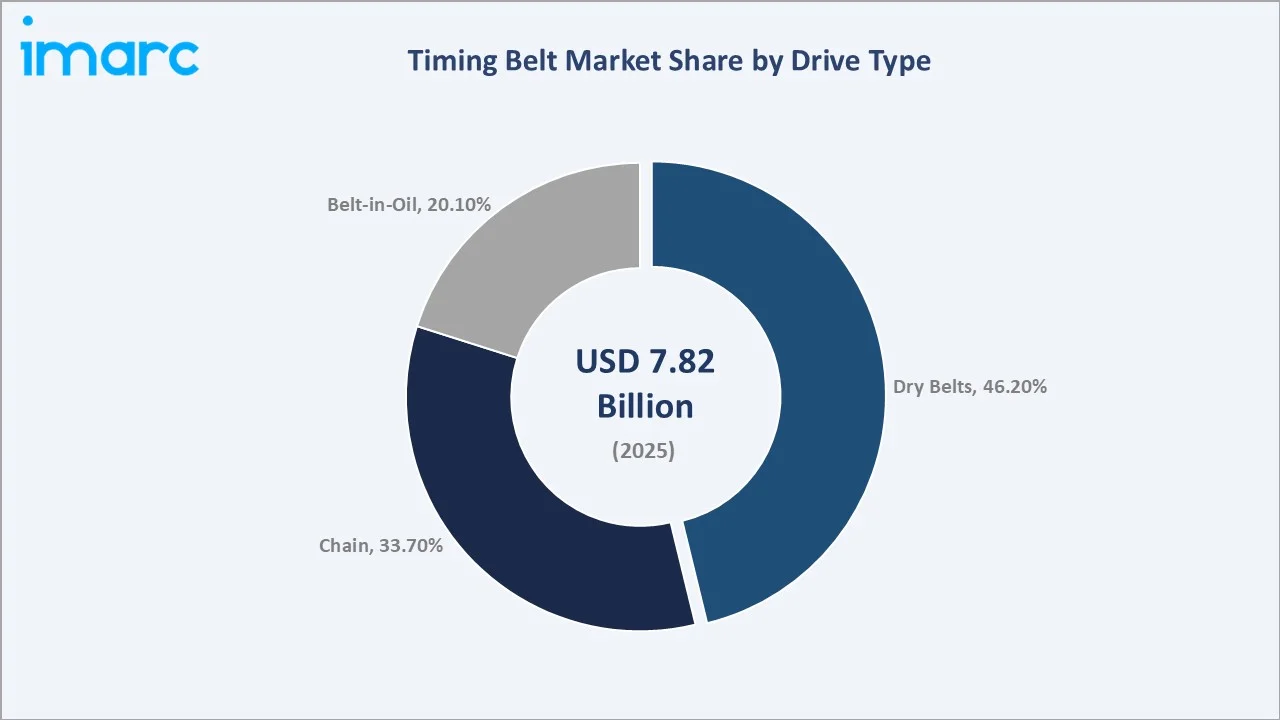
Dry Belts leads at 46.2% (2025). The Dry Belts segment encompasses conventional rubber-based synchronous belts widely used in passenger vehicle gasoline and diesel engines. Dry belts offer cost efficiency, low maintenance requirements, and compatibility with standard engine configurations, sustaining their dominant position across mainstream vehicle production globally.
To access detailed market analysis, Request Sample
Chain at 33.7% provides superior durability and is preferred in high-performance and heavy-duty applications. Belt in Oil at 20.1% is the fastest-growing segment, gaining traction in modern downsized engines where wet-running operation extends service life and reduces frictional losses compared to dry belt systems.
By Component
Tensioner leads at 31.8% (2025). Tensioners are mandatory replacement components in every timing belt service, ensuring consistent belt tension across varying thermal and load conditions. The tensioner segment's leadership reflects its universal application across all timing belt drive configurations and its critical role in preventing catastrophic timing failure.
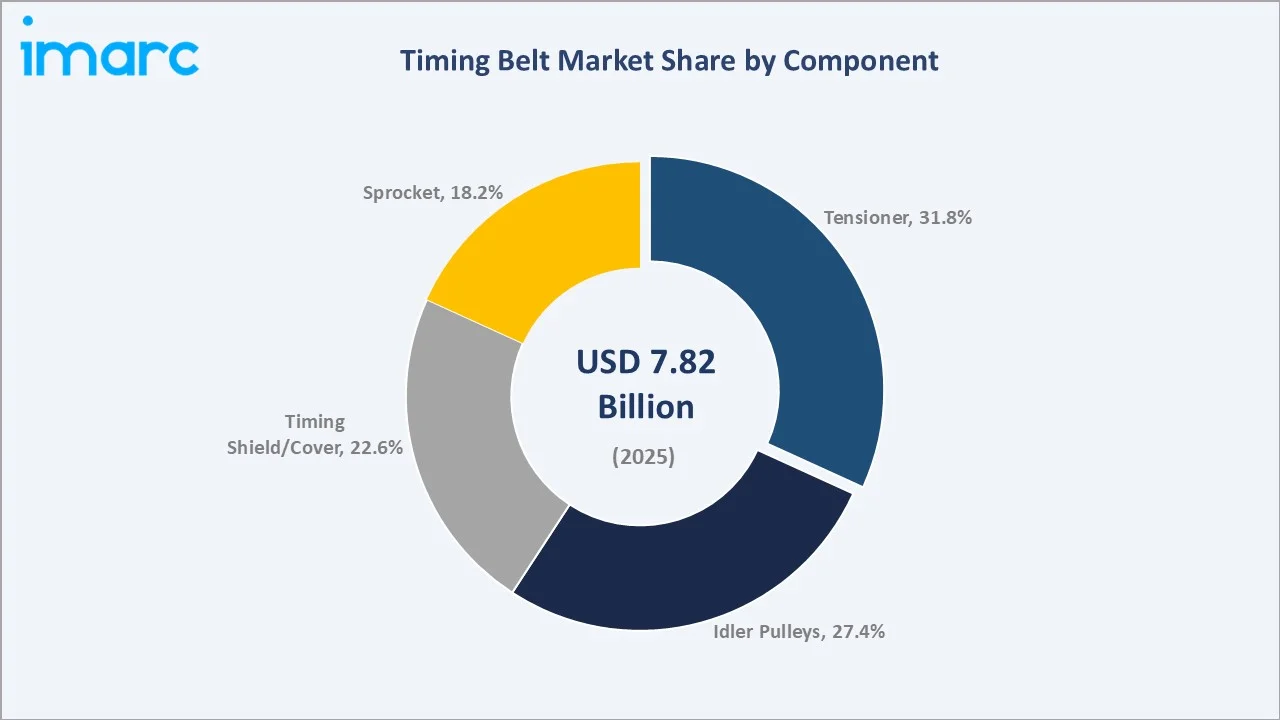
Idler Pulleys at 27.4% guide belt routing and are replaced alongside tensioners in complete timing kit services. Timing Shield/Cover at 22.6% protects the timing system from contamination and is increasingly supplied as part of complete timing kit packages. Sprocket at 18.2% completes the drive system and is replaced in high-mileage engine rebuilds and performance upgrades.
Regional Market Insights
|
Region |
Share (2025) |
Key Drivers & Characteristics |
|
Asia Pacific |
41.8% |
Dominant region driven by large-scale automotive manufacturing in China, Japan, India, and South Korea, supported by rapidly growing vehicle parc and expanding aftermarket demand. |
|
Europe |
26.4% |
Stringent emission regulations and high replacement cycle rates in mature automotive markets; strong presence of leading timing system OEM manufacturers. |
|
North America |
21.7% |
Well-established automotive aftermarket, high commercial vehicle penetration, and growing demand for precision-engineered timing components across passenger and heavy-duty segments. |
|
Latin America |
5.4% |
Brazil and Mexico drive regional demand through growing vehicle production and rising adoption of fuel-efficient engine technologies. |
|
Middle East and Africa |
4.7% |
Expanding automotive fleet and increasing import of timing components; growing aftermarket opportunity in the UAE, Saudi Arabia, and South Africa. |
Asia Pacific's 41.8% market leadership reflects China's position as the world's largest automotive production and sales market, combined with Japan's precision manufacturing legacy and India's rapidly growing vehicle fleet. Europe's 26.4% reflects its technologically advanced OEM base and high replacement cycle rates in ageing vehicle fleets.
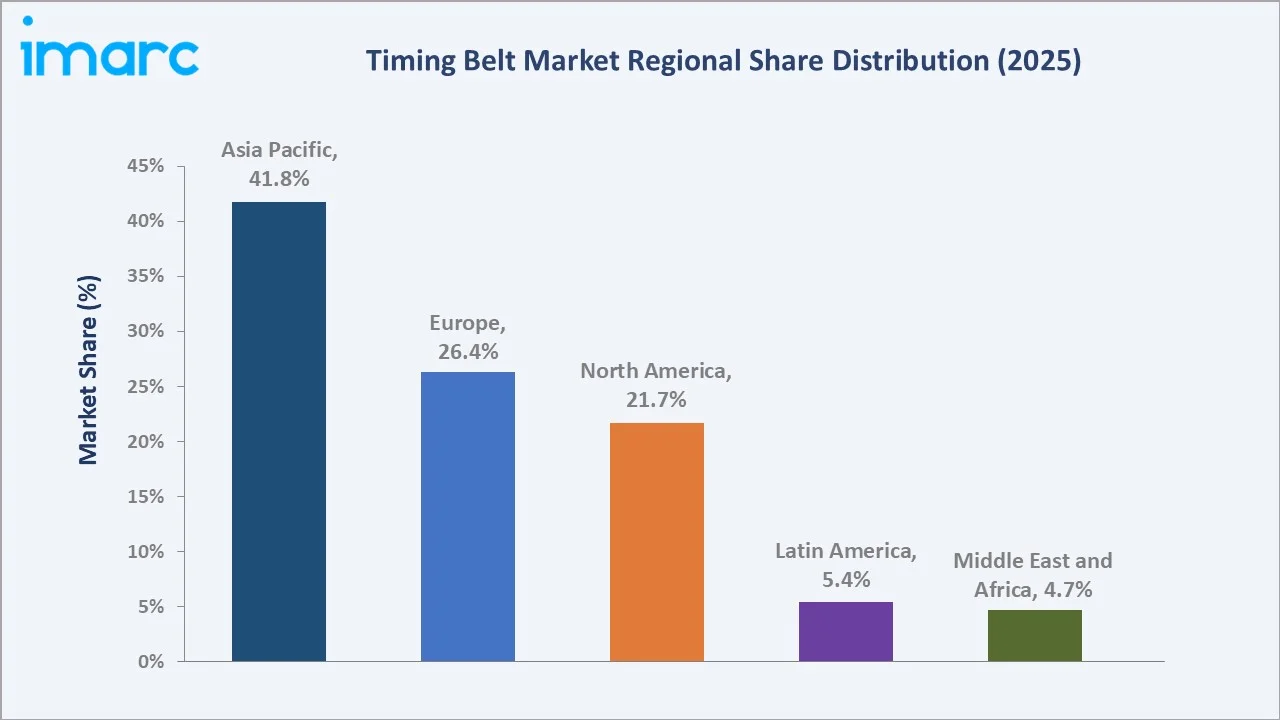
North America's 21.7% is supported by a mature but resilient aftermarket driven by the region's large average vehicle age and strong commercial vehicle segment. Latin America at 5.4% and Middle East and Africa at 4.7% represent the fastest-growing regions as rising vehicle ownership expands the addressable aftermarket replacement opportunity.
Competitive Landscape
The global timing belt market is characterised by moderate concentration, with established multinational manufacturers competing alongside regional suppliers across OEM and aftermarket segments. Competition is driven by product quality, service life performance, OEM certification status, distribution network depth, and pricing competitiveness across diverse geographic markets.
|
Company |
Key Products |
Market Position |
Core Strength |
|
Gates Corporation |
Automotive Timing Belts, RoadMax Timing Belts, RPM Timing Belts, PowerGrip Timing Kits |
Market Leader |
World's leading manufacturer of power transmission belts with the broadest timing belt portfolio. |
|
Dayco Incorporated |
Timing Belt in Oil, Dayco Timing Belt |
Strong Challenger |
Dayco Incorporated, operating under Hidden Harbor Capital Partners, have comprehensive engine management portfolio with strong OEM and aftermarket presence globally. |
|
Bando Chemical Industries, LTD. |
Synchro-Link Trapezoidal Timing Belts |
Innovator |
High-performance belt specialist with proprietary rubber compound technology for durability. |
|
JK Fenner |
Timing belts, V-belts, power transmission belts |
Innovator |
India's leading belt manufacturer with strong domestic and export market footprint. |
|
MAHLE GmbH |
Timing sets, tensioners, timing covers |
Market Challenger |
Comprehensive engine aftermarket portfolio with global distribution network across 140+ countries. |
Key players include Gates Corporation, Dayco Incorporated, Bando Chemical Industries, LTD., JK Fenner, MAHLE GmbH, and others.
Key Company Profiles
Gates Corporation
Gates Corporation is a global leader in power transmission belts and fluid power products, with its timing belt portfolio representing one of the broadest and most technically advanced product ranges in the automotive industry. Gates serves both OEM and aftermarket customers across more than 100 countries.
- Key Products: PowerGrip timing belts and kits, timing belt tensioners, idler pulleys, and complete timing component kits for passenger and commercial vehicle applications across all major engine platforms.
- Strategic Focus: Gates's strategic focus is on deepening its OEM supply relationships through technical co-development of next-generation timing systems, expanding its aftermarket distribution network in Asia Pacific and Latin America, and investing in digital catalogue tools and e-commerce platforms to capture growing online aftermarket purchasing demand across all key geographic markets.
Dayco Incorporated
Dayco is a global manufacturer and marketer of engine products and drive systems, offering a comprehensive timing belt and engine management portfolio that serves both OEM automotive manufacturers and the replacement aftermarket across more than 150 countries through its global distribution network.
- Key Products: Dayco timing belts and kits, automatic tensioners, idler pulleys, OEM timing chains, water pump and timing kit combinations, and engine management systems for passenger and commercial vehicle applications across domestic and import vehicle coverage.
- Strategic Focus: Dayco's strategic focus is on broadening its engine management product portfolio through new product development and technology partnerships, expanding aftermarket coverage for late-model vehicles across all major platforms, and investing in technical training and marketing support programmes for its distributor network to strengthen brand preference among professional automotive technicians globally.
Market Concentration Analysis
The global timing belt market exhibits moderate concentration, with the top five players accounting for an estimated 45–55% of global market revenue. The OEM segment is more concentrated, with established tier-1 suppliers holding dominant positions through long-term supply agreements.
Market concentration is evolving as leading players invest in product line extensions, geographic expansion, and digital aftermarket capabilities. The aftermarket segment remains more fragmented, with regional manufacturers and economy brands competing alongside global premium suppliers across price-sensitive vehicle owner segments in developing markets.
Investment & Growth Opportunities
Highest Growth Segments
Belt-in-Oil segment (~4.38% CAGR through advanced engine adoption), Asia Pacific region (~5.1% CAGR through vehicle parc expansion), and extended-life timing kit products (premium pricing with OEM co-development) represent the highest-growth investment vectors in the timing belt market through 2034.
Emerging Investment Opportunities
The hybrid vehicle timing system segment — requiring enhanced durability specifications for combined ICE and electric operation modes — represents an emerging high-value opportunity as hybrid vehicle penetration expands across all major automotive markets through the energy transition period.
Investment Themes
- Advanced material investment in HNBR and aramid reinforcement compounds enabling extended service intervals and premium positioning against conventional rubber timing belt products across OEM and aftermarket customer segments globally.
- Asia Pacific market penetration through local manufacturing partnerships, competitive pricing strategies, and distribution network development targeting the growing aftermarket replacement demand in China, India, and Southeast Asian automotive markets.
Future Market Outlook (2026-2034)
The global timing belt market is projected to grow from USD 7.82 Billion in 2025 to USD 8.12 Billion in 2026, reaching USD 11.13 Billion by 2034, registering a CAGR of 3.89% during 2026–2034. The market's anchor value of USD 9.46 Billion in 2030 reflects continued ICE vehicle dominance in the global fleet through mid-forecast period, supported by hybrid vehicle growth sustaining timing system demand.
Three structural forces define timing belt market growth through 2034: the persistence of ICE and hybrid powertrains in global automotive production through the energy transition; the expanding aftermarket replacement cycle driven by growing vehicle age in key markets; and the premium material technology shift enabling longer service intervals and commanding higher per-unit value across OEM and replacement channels.
Research Methodology
Primary Research
Primary research comprised structured interviews with timing belt industry stakeholders, including automotive OEM procurement directors, tier-1 component manufacturers, aftermarket distributors, automotive workshops, and industry association representatives across Asia Pacific, Europe, and North America.
Secondary Research
Secondary research encompassed automotive industry publications, OEM annual reports, aftermarket data providers, regulatory documentation, company financial filings, trade association data, and import-export statistics for timing belt and component categories. Over 55 secondary sources were reviewed.
Forecasting Models
Market revenue forecasts were developed using a vehicle parc-based bottom-up model: global vehicle fleet by powertrain type multiplied by timing belt replacement interval frequency and average replacement kit value, aggregated by region and segment with growth adjustments for EV penetration and aftermarket expansion rates.
Timing Belt Market Report Coverage:
| Report Features | Details |
|---|---|
| Base Year of the Analysis | 2025 |
| Historical Period | 2020-2025 |
| Forecast Period | 2026-2034 |
| Units | Billion USD |
| Scope of the Report | Exploration of Historical Trends and Market Outlook, Industry Catalysts and Challenges, Segment-Wise Historical and Future Market Assessment:
|
| Drive Types Covered | Dry Belts, Chain, Belt in Oil |
| Components Covered | Tensioner, Idler Pulleys, Timing Shield/Cover, Sprocket |
| Vehicle Types Covered | Passenger Vehicle, Commercial Vehicle |
| Distribution Channels Covered | OEM, Aftermarket |
| Regions Covered | Europe, North America, Asia Pacific, Latin America, Middle East and Africa |
| Companies Covered | Gates Corporation, Dayco Incorporated, Bando Chemical Industries, LTD., JK Fenner, MAHLE GmbH, etc. |
| Customization Scope | 10% Free Customization |
| Post-Sale Analyst Support | 10-12 Weeks |
| Delivery Format | PDF and Excel through Email (We can also provide the editable version of the report in PPT/Word format on special request) |
Frequently Asked Questions About the Timing Belt Market Report
The global timing belt market size was valued at USD 7.82 Billion in 2025, driven by rising vehicle production, stringent emission regulations requiring precision engine timing, and growing aftermarket replacement demand across ageing global vehicle fleets.
The timing belt market grows at a CAGR of 3.89% during 2026-2034, reaching USD 11.13 Billion by 2034. Growth is sustained by expanding Asia Pacific vehicle production, aftermarket replacement cycles, and hybrid vehicle powertrain demand partially offsetting the structural headwind from battery electric vehicle adoption.
Dry Belts leads at 46.2% through widespread application in conventional passenger vehicle gasoline and diesel engines, supported by cost efficiency and established OEM preference across mainstream vehicle production globally.
Tensioner leads at 31.8% as a mandatory replacement component in every timing belt service, ensuring consistent belt tension and engine timing precision across all vehicle types and drive configurations globally.
Asia Pacific leads at 41.8% through its dominant position in global vehicle production and the world's largest vehicle parc, led by China, Japan, India, and South Korea, with rapidly growing aftermarket replacement demand.
Leading companies include Gates Corporation, Dayco Incorporated, Bando Chemical Industries, LTD., JK Fenner, MAHLE GmbH, and others.
The timing belt market is projected to reach approximately USD 9.46 Billion by 2030, with Asia Pacific growing fastest as automotive production expands and aftermarket replacement demand matures across the region's large and ageing vehicle fleet.
Three priority investment opportunities include Belt-in-Oil segment growth through modern engine adoption, Asia Pacific aftermarket expansion through distribution network development, and hybrid vehicle timing system specialisation capturing premium specifications during the automotive energy transition period.
Need more help?
- Speak to our experienced analysts for insights on the current market scenarios.
- Include additional segments and countries to customize the report as per your requirement.
- Gain an unparalleled competitive advantage in your domain by understanding how to utilize the report and positively impacting your operations and revenue.
- For further assistance, please connect with our analysts.
 Request Customization
 Speak to an Analyst
 Request Brochure
 Inquire Before Buying
Benefits of Customization
- Personalize this research
- Triangulate with your data
- Get data as per your format and definition
- Gain a deeper dive into a specific application, geography, customer, or competitor
- Any level of personalization
Get in Touch With Us
UNITED STATES
Phone: +1-201-971-6302
INDIA
Phone: +91-120-433-0800
UNITED KINGDOM
Phone: +44-753-714-6104
Email: [email protected]
Client Testimonials













Related Reports

Choose your plan
*Please note that the prices mentioned below are starting prices for each bundle type. Kindly contact our team for further details.*
Single User License
- 1 User License, Access on 2 Devices
- PDF Report + Excel Dataset (Password Protected)
- Lifetime Access
- No Printing Rights
- 10% Free Report Customization
- 10–12 Weeks of Analyst Support
Five User License
- Access for 5 Users, 2 Devices per User
- PDF Report + Excel Dataset (Password Protected)
- Lifetime Access
- Dedicated Account Manager
- 12–14 Weeks of Analyst Support
- No Printing Rights
- 15% Free Report Customization
- 25% Discount on Your Next Purchase
Corporate User License
- Unlimited User Access (Within Your Organization)
- PDF Report + Excel Dataset
- Lifetime Access
- Dedicated Account Manager
- 14–20 Weeks of Analyst Support
- No Printing Rights
- 20% Free Report Customization
- 30% Discount on Your Next Purchase
Essential Insights
What's included:
3 reports
- Lifetime Access
- PDF Reports
- Excel Datasets
- 2 Weeks of Free Analyst Support
- 2 User Licenses
- Access on 2 Devices
- Printing Rights
- Complimentary PowerPoint (PPT) Version
- Complimentary License Upgrade
Professional Access
What's included:
5 reports
- Lifetime Access
- PDF Reports
- Excel Datasets
- 8 Weeks of Free Analyst Support
- 2 User Licenses
- Access on 2 Devices
- Printing Rights
- Complimentary PowerPoint (PPT) Version
- Complimentary License Upgrade
Business Advantage
What's included:
8 reports
- Lifetime Access
- PDF Reports
- Excel Datasets
- 14 Weeks of Free Analyst Support
- 2 User Licenses
- Access on 2 Devices
- Printing Rights
- Complimentary PowerPoint (PPT) Version
- Complimentary License Upgrade
Enterprise Intelligence
What's included:
10 reports
- Lifetime Access
- PDF Reports
- Excel Datasets
- 20 Weeks of Free Analyst Support
- 2 User Licenses
- Access on 2 Devices
- Printing Rights
- Complimentary PowerPoint (PPT) Version
- Complimentary License Upgrade