
Tractor Market Size, Share, Trends and Forecast by Power Output, Drive Type, Application, and Region, 2026-2034
Tractor Market Size, Share, Trends & Forecast (2026-2034)
The tractor market was valued at USD 44.42 Billion in 2025 and is projected to reach USD 61.27 Billion by 2034, exhibiting a CAGR of 3.53% during 2026-2034. Rising farm mechanization, expanding government subsidy programs, and increasing demand for higher-horsepower machines are the primary drivers shaping the market growth.
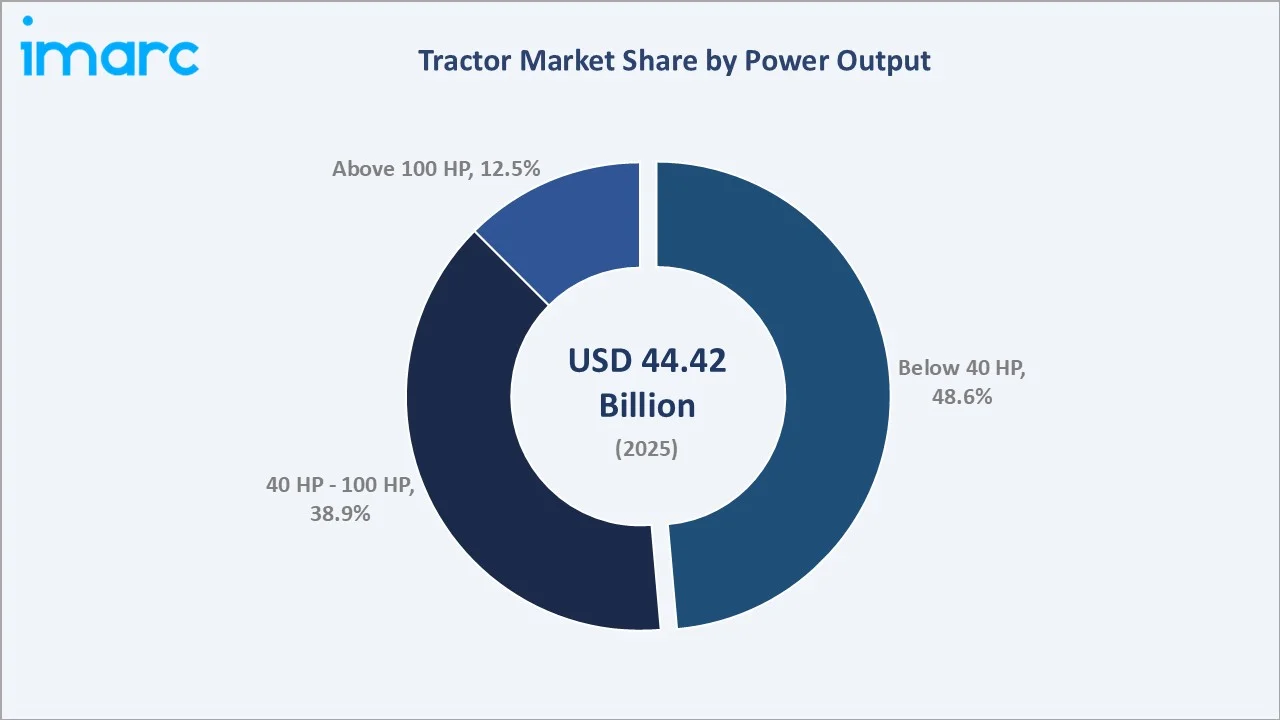
Below 40 HP leads the power output segment at 48.6%, 2-wheel drive dominates the drive type segment at 68.4%, and Asia-Pacific commands 46.5% regional share in 2025.
Market Snapshot
|
Metric |
Value |
|
Market Size (2025) |
USD 44.42 Billion |
|
Forecast Market Size (2034) |
USD 61.27 Billion |
|
CAGR (2026-2034) |
3.53% |
|
Base Year |
2025 |
|
Historical Period |
2020-2025 |
|
Forecast Period |
2026-2034 |
|
Largest Region |
Asia-Pacific (46.5%, 2025) |
|
Second Largest Region |
North America (21.3%, 2025) |
|
Leading Power Output |
Below 40 HP (48.6%, 2025) |
|
Leading Drive Type |
2-Wheel Drive (68.4%, 2025) |
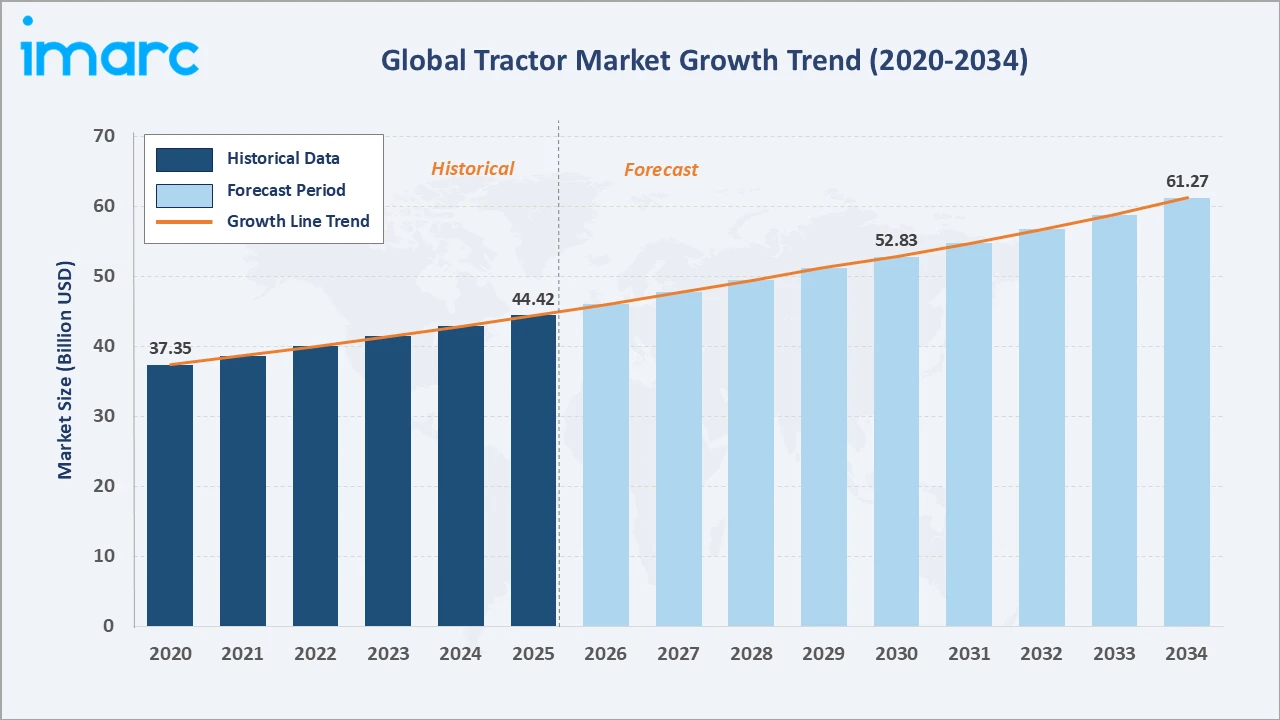
The tractor market expanded from USD 37.35 Billion in 2020 to USD 44.42 Billion in 2025, supported by rising rural mechanization and expanding equipment-financing access. Anchored at USD 52.83 Billion in 2030, the forecast to USD 61.27 Billion by 2034 is underpinned by continued replacement demand, precision-agriculture integration, and the gradual electrification of compact tractor platforms.
To get more information on this market, Request Sample
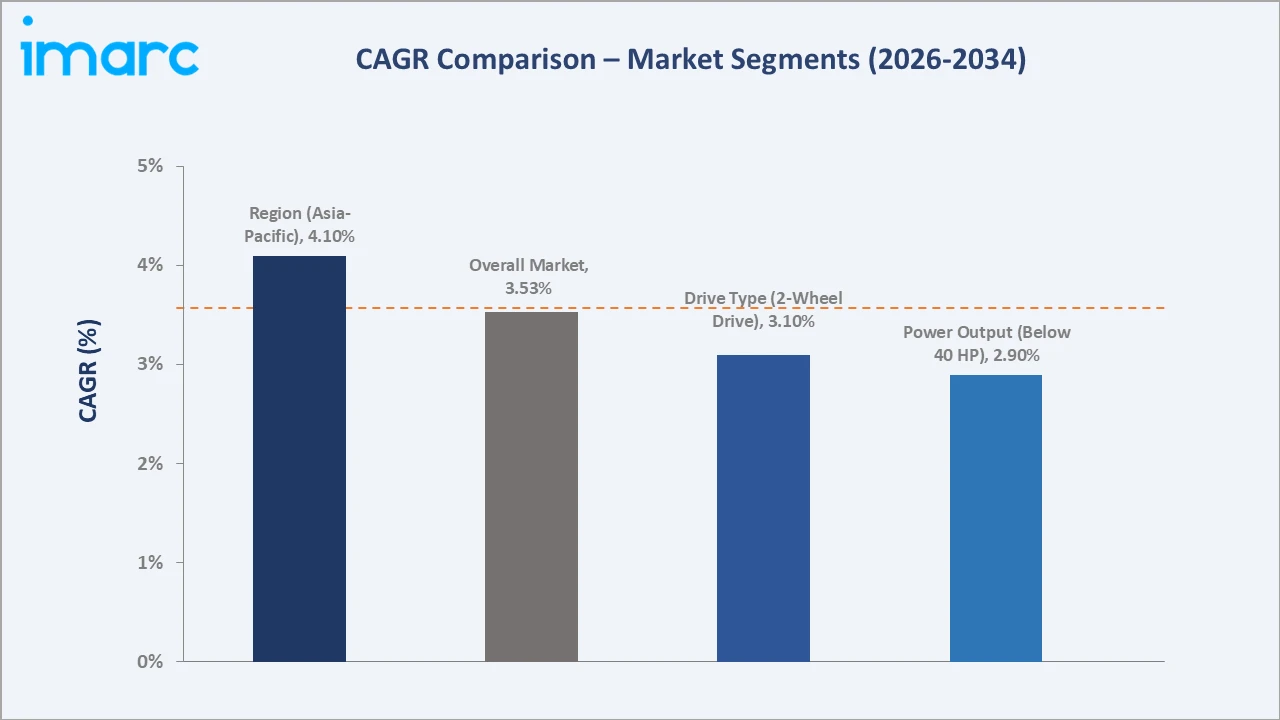
CAGR trajectories across power output, drive type, and regional sub-segments show above 100 HP, 4-wheel drive, and Middle East and Africa expanding faster than the overall 3.53% market CAGR, driven by rising demand for higher-output machines, improved traction requirements, and low existing mechanization penetration in emerging regions.
Executive Summary
The tractor market is progressing on a steady growth path, expanding from USD 37.35 Billion in 2020 to USD 61.27 Billion by 2034. Mechanization of smallholder farms, rising rural incomes, and the gradual shift from animal-drawn to engine-powered tractors are reshaping agricultural practices across developing economies, while mature markets replace aging fleets with higher-horsepower, technology-enabled machines.
Based on power output, below 40 HP accounts for 48.6% market share, reflecting continued reliance on compact machinery among small and marginal landholders, while 2-wheel drive leads the drive type segment at 68.4%, owing to lower acquisition and maintenance costs. Asia-Pacific leads the regional landscape with 46.5% share in 2025, supported by large farming populations across India and China.
Key Market Insights
|
Insight |
Data |
|
Leading Power Output |
Below 40 HP - 48.6% share (2025) |
|
Second Largest Power Output |
40 HP - 100 HP - 38.9% share (2025) |
|
Leading Drive Type |
2-Wheel Drive - 68.4% share (2025) |
|
Second Largest Drive Type |
4-Wheel Drive - 31.6% share (2025) |
|
Leading Region |
Asia-Pacific - 46.5% share (2025) |
|
Second Largest Region |
North America – 21.3% share (2025) |
|
Top Companies |
Deere & Company, CNH Industrial N.V., Mahindra & Mahindra Ltd., Kubota Corporation, AGCO Corporation |
Key Analytical Observations Supporting the Above Data:
- Below 40 HP dominance at 48.6% is sustained by affordability, fuel efficiency, ease of maintenance, and strong suitability for small-scale agricultural operations.
- 40 HP - 100 HP at 38.9% serves medium-sized commercial farms across North America, Europe, and parts of Latin America, balancing versatility with operating economics for row-crop and general-purpose tasks.
- 2-wheel drive leadership at 68.4% reflects lower upfront cost and simpler maintenance requirements, particularly across price-sensitive markets where 4-wheel drive traction is not essential for lighter field operations.
- 4-wheel drive share at 31.6% is supported by increasing mechanization on large commercial farms, where higher traction, improved field performance, and the ability to operate efficiently in challenging terrain justify the higher equipment cost.
- Asia-Pacific at 46.5% dominates regional share, anchored by India and China. India alone sold 915,474 tractor units in 2023, reflecting the scale of its farming base.
Tractor Market Overview
A tractor is a self-propelled agricultural vehicle engineered to deliver drawbar pull and power take-off output for ploughing, tilling, seeding, harvesting support, and haulage operations. The market spans compact, utility, row-crop, and specialty tractors sold through dealer networks and increasingly through digital and rental channels.
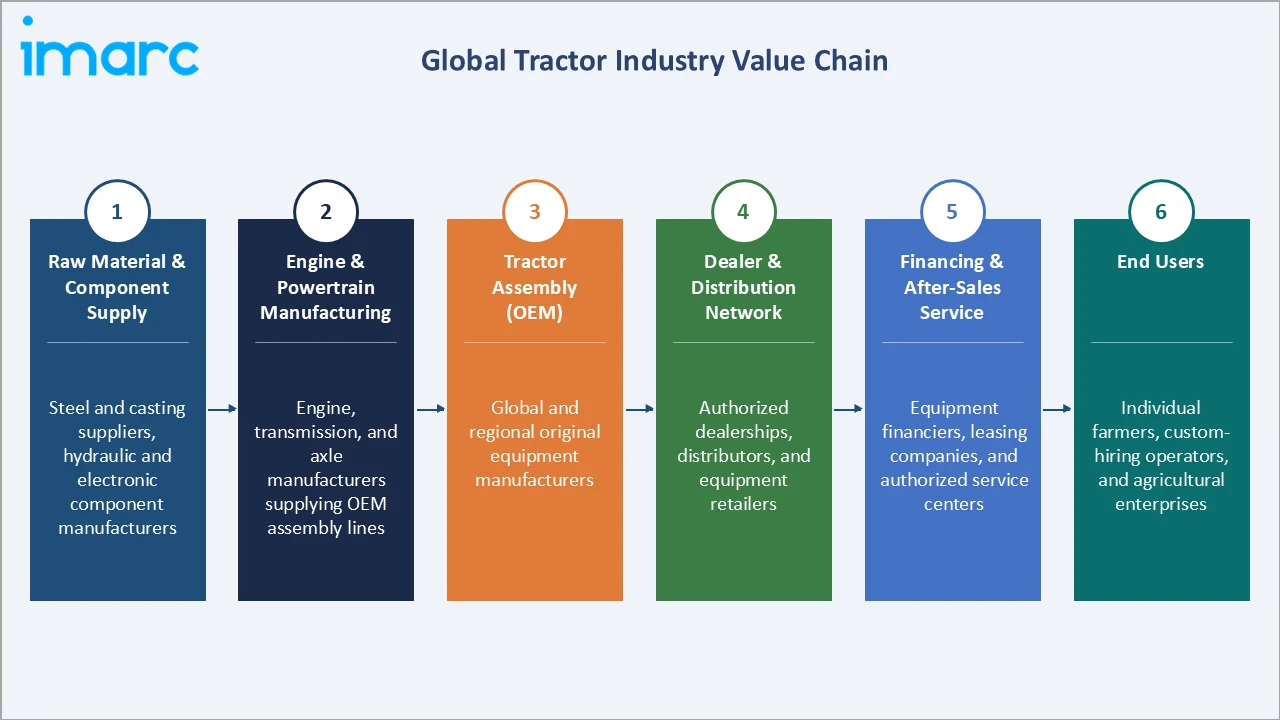
The global ecosystem integrates component and raw-material suppliers, engine and powertrain manufacturers, original equipment manufacturers, dealer and distribution networks, financing and leasing institutions, and end users spanning individual farmers and large agricultural enterprises. Macroeconomic factors, including farm income levels, interest rates, fuel prices, and government subsidy programs, collectively influence purchase timing and equipment specification across regions.
Market Dynamics
To evaluate market opportunities, Request Sample
Market Drivers
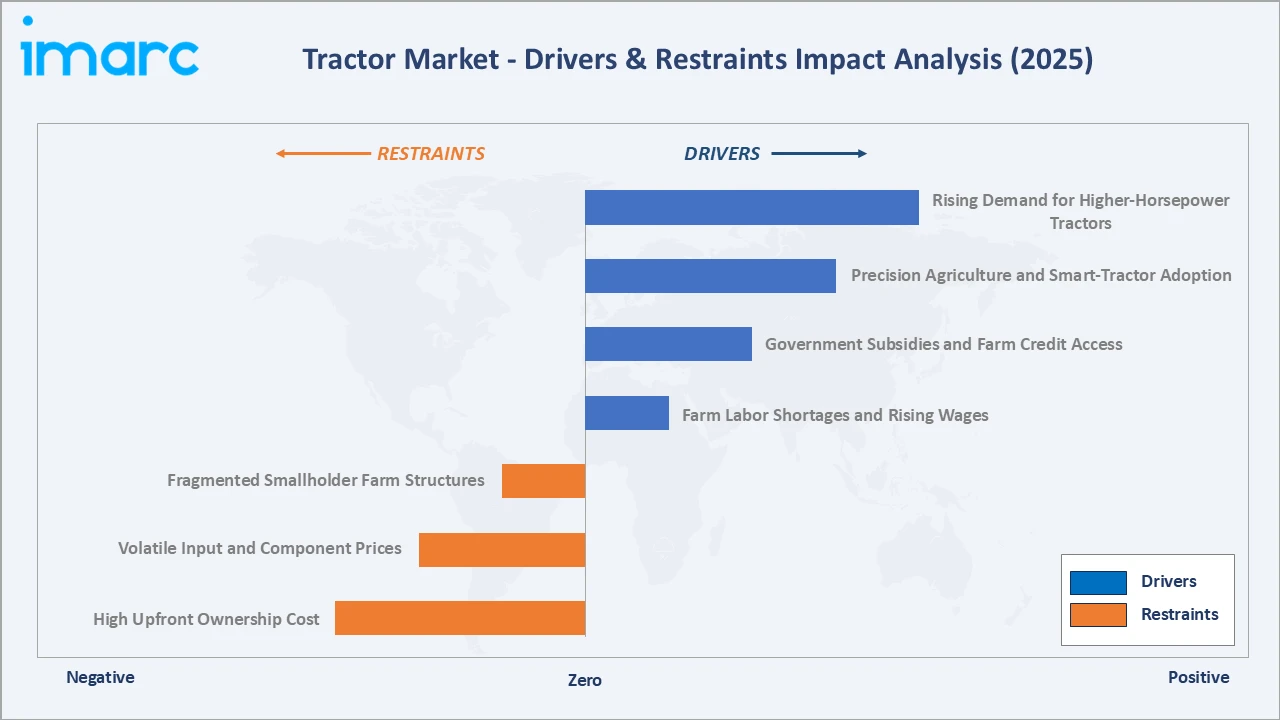
- Farm Labor Shortages and Rising Wages: Labor shortages and increasing agricultural wages are encouraging farmers to adopt tractors to improve operational efficiency and reduce dependence on manual labor. Mechanization helps maintain productivity while lowering long-term labor costs and supporting timely field operations.
- Government Subsidies and Farm Credit Access: Expanding subsidy schemes, low-interest equipment loans, and custom-hiring center programs are lowering the effective cost of tractor ownership for smallholder and marginal farmers.
- Precision Agriculture and Smart-Tractor Adoption: Growing integration of GPS-guided auto-steer, telematics, and variable-rate technology is lifting average selling prices and encouraging fleet upgrades among commercial farm operators.
- Rising Demand for Higher-Horsepower Tractors: Farm consolidation and expanding average holding sizes in mature markets are shifting purchase preference toward higher-horsepower, multi-function machines capable of covering larger acreages efficiently.
Market Restraints
- High Upfront Ownership Cost: Tractors require substantial initial investment, making them less affordable for small and medium-sized farmers. Fluctuations in raw material prices further increase manufacturing costs, putting upward pressure on equipment prices and slowing replacement demand.
- Volatile Input and Component Prices: Fluctuations in engine components, electronics, and specialty alloys create planning uncertainty for manufacturers and can delay fleet-replacement decisions among cost-sensitive buyers.
- Fragmented Smallholder Farm Structures: Small and scattered landholdings in several developing regions limit the economic case for individual tractor ownership, constraining unit growth outside rental and custom-hiring models.
Market Opportunities
- Tractor Rental and Custom-Hiring Platforms: Digitally enabled rental and custom-hiring services are opening access to mechanization for smallholder farmers who cannot justify individual ownership, expanding the addressable user base.
- Electrification of Compact Tractors: Battery-electric compact and utility tractors present a growing opportunity as OEMs pilot zero-emission platforms for orchards, vineyards, and municipal applications.
Market Challenges
- Emission and Regulatory Compliance: Progressively stringent emission norms across North America, Europe, and parts of Asia require sustained research and development investment, raising compliance costs for manufacturers.
- Aftermarket Servicing in Remote Areas: Limited dealer and service-center density in remote farming regions can extend downtime and discourage adoption of technologically advanced tractor models.
Emerging Market Trends
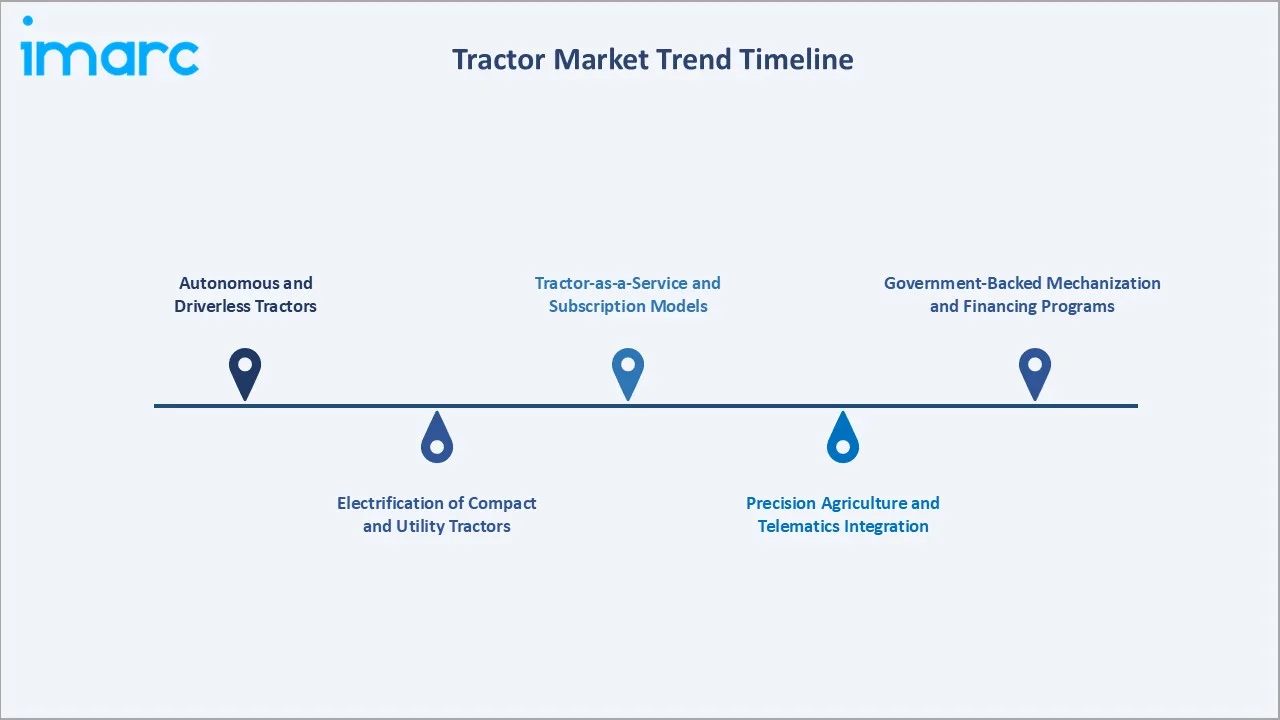
1. Autonomous and Driverless Tractors
Leading OEMs are piloting and progressively commercializing autonomous tractor platforms capable of operating with limited or no human supervision, addressing persistent labor shortages during peak planting and harvesting windows.
2. Electrification of Compact and Utility Tractors
Battery-electric compact tractors are moving from pilot programs to early commercial availability, supported by tightening emission regulations and growing demand for quieter, zero-emission equipment in specialty and municipal applications.
3. Precision Agriculture and Telematics Integration
Tractor manufacturers are increasingly integrating GPS guidance, telematics, and precision farming technologies to improve field efficiency and optimize resource utilization. Real-time equipment monitoring, predictive maintenance, and data-driven decision-making are enhancing productivity while reducing operating costs for farmers.
4. Tractor-as-a-Service and Subscription Models
Equipment-as-a-service and flexible subscription arrangements are gaining traction among cost-conscious farmers, allowing access to modern machinery without the capital burden of outright ownership.
5. Government-Backed Mechanization and Financing Programs
Expanding public financing schemes, mechanization subsidies, and custom-hiring center networks across developing economies are lowering barriers to first-time tractor ownership and supporting sustained unit-volume growth.
Industry Value Chain Analysis
The global tractor value chain spans six stages, from raw-material and component supply through end-user deployment and lifecycle support. Engine and powertrain manufacturing, OEM assembly, and dealer distribution capture the highest value-add, while financing and after-sales service increasingly influence long-term customer retention.
|
Stage |
Key Players / Examples |
|
Raw Material & Component Supply |
Steel and casting suppliers, hydraulic and electronic component manufacturers |
|
Engine & Powertrain Manufacturing |
Engine, transmission, and axle manufacturers supplying OEM assembly lines |
|
Tractor Assembly (OEM) |
Global and regional original equipment manufacturers |
|
Dealer & Distribution Network |
Authorized dealerships, distributors, and equipment retailers |
|
Financing & After-Sales Service |
Equipment financiers, leasing companies, and authorized service centers |
|
End Users |
Individual farmers, custom-hiring operators, and agricultural enterprises |
Vertically integrated manufacturers with proprietary engine and precision-technology capabilities are positioned to capture greater value than assemblers reliant on third-party components and distribution partners.
Technology Landscape in the Tractor Industry
Precision Agriculture and GPS Guidance
GPS-guided auto-steer, variable-rate application, and yield-mapping systems are becoming standard fitments on mid- and high-horsepower tractors, improving field efficiency and reducing input waste for commercial operators.
Electrification and Alternative Powertrains
Battery-electric and hybrid powertrains are advancing fastest in compact and utility tractor segments, where duty cycles and charging infrastructure requirements are more manageable than for high-horsepower row-crop machines.
Autonomous Operation and Smart Connectivity
Autonomy-ready platforms equipped with computer vision, LiDAR, and cloud connectivity are progressing from pilot deployments toward broader commercial availability, enabling remote fleet supervision and reduced dependence on operator availability.
Automation and Implement Integration
Tighter integration between tractors and attached implements, supported by standardized data protocols, such as ISOBUS, is enabling automated implement control and more consistent field-operation quality across brands.
Market Segmentation Analysis
The report covers the following segments:
|
Segment Category |
Leading Segment |
Market Share |
Year |
|
Power Output |
Below 40 HP |
48.6% |
2025 |
|
Drive Type |
2-Wheel Drive |
68.4% |
2025 |
|
Application |
Agriculture |
🔒 |
2025 |
|
Region |
Asia-Pacific |
46.5% |
2025 |

By Power Output
Below 40 HP commands a 48.6% majority share in 2025, driven by affordability, suitability for smallholder and marginal farms, and lower fuel and maintenance costs. The segment benefits from deep penetration across Asia-Pacific and parts of Latin America.
To access detailed market analysis, Request Sample
40 HP - 100 HP follows at 38.9% in 2025, serving medium-sized commercial farms that require greater versatility for row-crop and general-purpose operations.
By Drive Type
2-wheel drive dominates with 68.4% share in 2025, reflecting its lower acquisition and maintenance costs and adequate traction for lighter field operations across price-sensitive markets. The format remains the default choice for compact and entry-level tractor buyers.
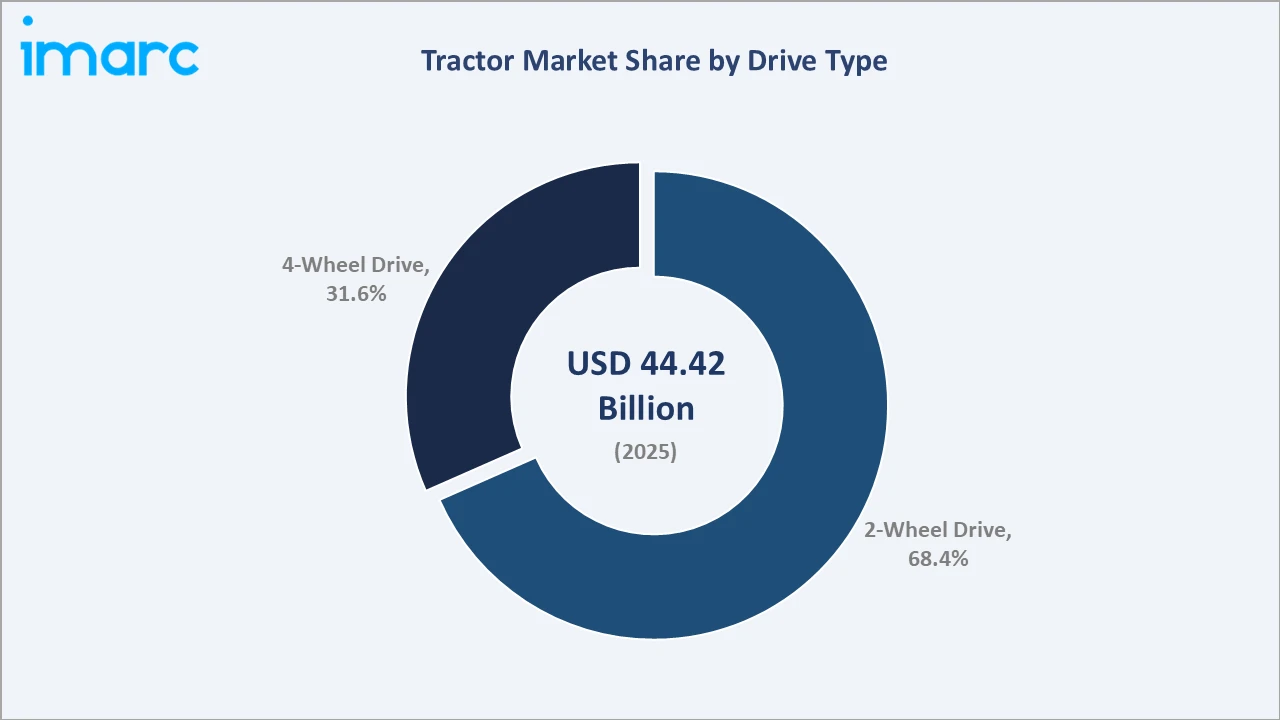
4-wheel drive, at 31.6% in 2025, is gaining ground in regions with heavier soils, larger farm sizes, and demand for improved traction and pulling power, supporting continued mix-shift toward higher-value configurations over the forecast period.
Regional Market Insights
|
Region |
Share (2025) |
Key Growth Drivers |
|
Asia-Pacific |
46.5% |
Large farming population, expanding rural credit access, and government-backed mechanization programs |
|
North America |
21.3% |
Farm consolidation, replacement demand, and adoption of precision and autonomous technology |
|
Europe |
19.7% |
Fleet modernization, emission-driven equipment upgrades, and strong presence of premium OEM brands |
|
Latin America |
7.3% |
Expanding arable land use, rising agricultural exports, and growing equipment-financing availability |
|
Middle East and Africa |
5.2% |
Low existing mechanization penetration and increasing public investment in agricultural productivity |
Asia-Pacific at 46.5% in 2025 leads the regional landscape, anchored by India and China. Large farming populations, expanding rural incomes, and government-backed mechanization schemes support sustained leadership across compact and mid-horsepower tractor segments.
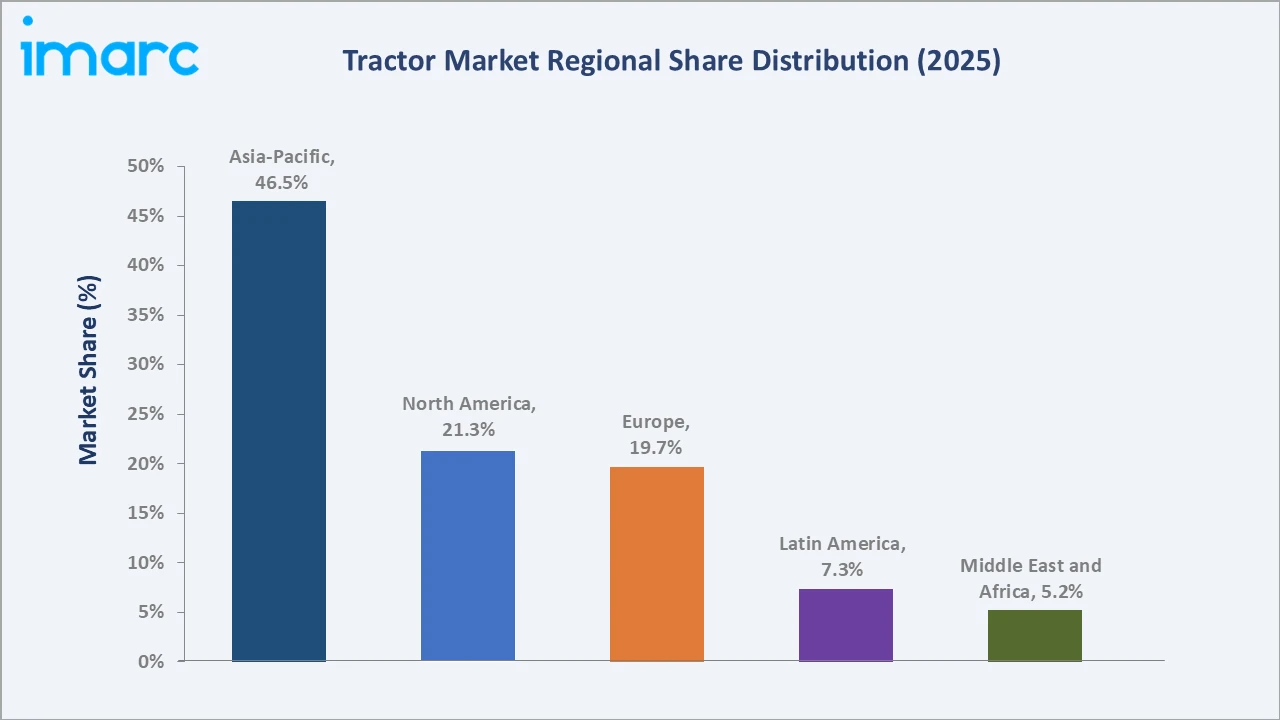
Middle East and Africa at 5.2% is expected to be the fastest growing through 2034. Low existing tractor density, expanding arable land development, and rising public investment in farm productivity are accelerating regional mechanization.
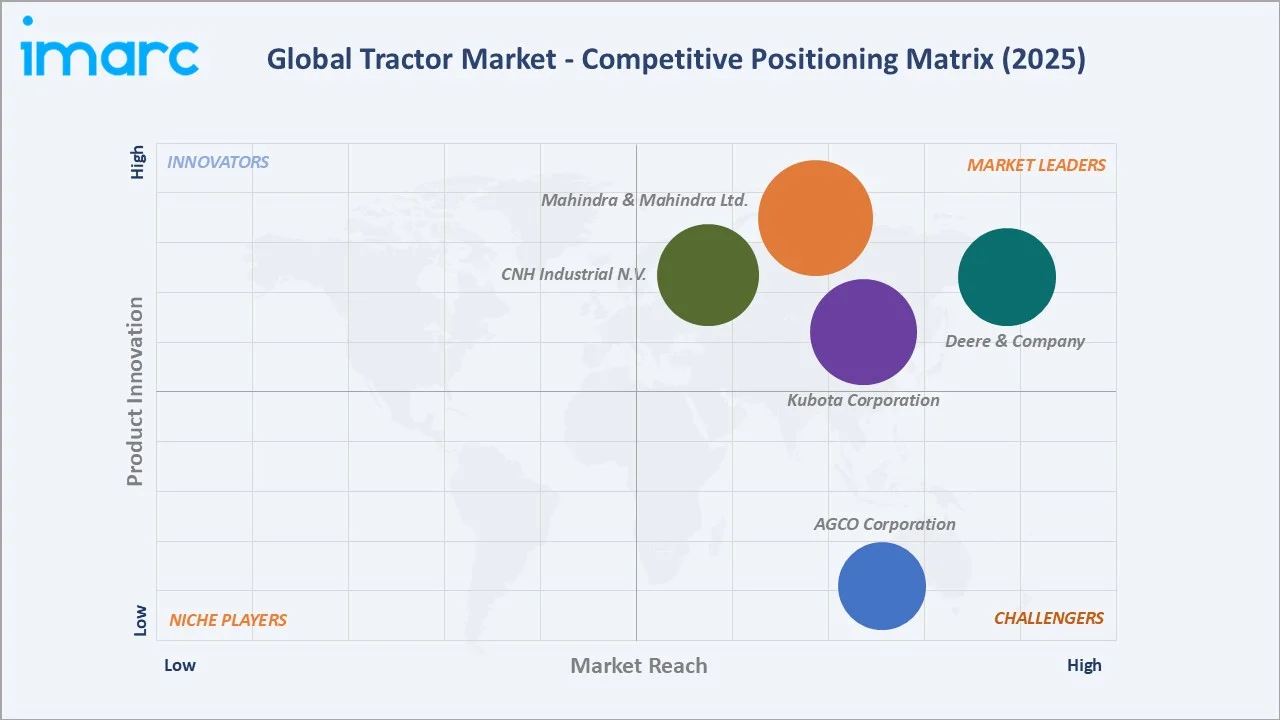
Competitive Landscape
The tractor market is moderately consolidated, with established full-line manufacturers leading on brand strength, dealer reach, and product breadth, while regional and specialty players compete on price, local service networks, and niche horsepower segments. Engine technology, precision-agriculture integration, and dealer-financing capability form the key competitive moats.
|
Company Name |
Brand / Key Product |
Position |
Strategic Focus |
|
Deere & Company |
John Deere |
Leader |
Expanding precision-agriculture and autonomy technology across the tractor portfolio |
|
CNH Industrial N.V. |
Case IH |
Leader |
Strengthening multi-brand portfolio and precision-technology integration |
|
Mahindra & Mahindra Ltd. |
Mahindra Tractors |
Leader |
Scaling compact and mid-horsepower volumes across emerging markets |
|
Kubota Corporation |
Kubota |
Leader |
Broadening full-line equipment portfolio beyond compact tractors |
|
AGCO Corporation |
Fendt |
Challenger |
Strengthening premium brands and precision-agriculture technology |
Key players include Deere & Company, CNH Industrial N.V., Mahindra & Mahindra Ltd., Kubota Corporation, and AGCO Corporation, among others.
Key Company Profiles
Deere & Company
Deere & Company is a leading global manufacturer of agricultural equipment operating under the John Deere brand, with a strong presence across the tractor market.
- Product Portfolio: John Deere tractors spanning compact, utility, and high-horsepower categories, supported by precision-agriculture and guidance technology.
- Recent Developments: The company has continued expanding its autonomous tractor technology and precision-agriculture software offerings, including demonstrations of driverless row-crop tractors at major industry events.
- Strategic Focus: Strengthening its technology-led leadership position across the global tractor market.
CNH Industrial N.V.
CNH Industrial N.V. is a global manufacturer of agricultural equipment operating under the Case IH brand, with a broad presence across the tractor market.
- Product Portfolio: Case IH tractors spanning compact utility to high-horsepower categories, supported by precision-technology solutions.
- Recent Developments: The company has continued investing in precision-agriculture technology and expanding its tractor product offerings.
- Strategic Focus: Broadening its tractor portfolio and precision-technology capabilities across core markets.
Mahindra & Mahindra Ltd.
Mahindra & Mahindra Ltd. is a leading global manufacturer of agricultural equipment operating under the Mahindra Tractors brand, with a strong presence across the tractor market.
- Product Portfolio: Mahindra Tractors spanning compact, utility, and mid-horsepower categories for diverse farming applications.
- Recent Developments: The company has continued expanding its manufacturing capacity and product offerings to strengthen its market position.
- Strategic Focus: Scaling tractor volumes across emerging markets while expanding its global footprint.
Market Concentration Analysis
The tractor market is moderately concentrated, with a small group of full-line manufacturers, including Deere & Company, CNH Industrial N.V., Mahindra & Mahindra Ltd., and Kubota Corporation, together accounting for a majority of global unit sales across power-output and regional segments.
Barriers to entry include the scale required for competitive engine and powertrain manufacturing, established dealer and service networks, and the capital intensity of precision-agriculture research and development. These factors favor well-capitalized incumbents with diversified regional footprints.
Consolidation continues through strategic acquisitions and regional joint ventures, particularly as mid-sized manufacturers seek scale in precision technology and emerging-market distribution. Partnerships between OEMs and technology providers are further reinforcing competitive positioning across the market's structured segments.
Investment & Growth Opportunities
Fastest-Growing Segments
40 HP - 100 HP is well positioned for steady expansion as medium-sized commercial farms upgrade fleets for greater versatility. Above 100 HP, though a smaller base at 12.5% share, is gaining traction as large-acreage operators prioritize output capacity and multi-implement compatibility.
Emerging Markets
Middle East and Africa represents the fastest-growing regional opportunity, anchored by low existing mechanization penetration and expanding public investment in agricultural productivity. Latin America similarly offers untapped potential as arable land use and agricultural exports continue to expand.
Venture & Investment Trends
Investment is increasingly concentrated in precision-agriculture software, autonomous-driving technology, and battery-electric powertrain development. Capital is also flowing into tractor-financing platforms and equipment-rental marketplaces that expand mechanization access across smallholder farming segments.
Future Market Outlook (2026-2034)
The tractor market is forecast to expand from USD 44.42 Billion in 2025 to USD 61.27 Billion by 2034 at a CAGR of 3.53%, adding roughly USD 16.85 Billion in incremental market value over the forecast period.
Four forces will shape the market through 2034: continued replacement and first-time mechanization demand across emerging economies; deeper integration of autonomous, electric, and precision-agriculture technology; expanding equipment-financing and rental ecosystems; and progressively stringent emission and safety regulation across mature markets.
By 2034, the tractor market is expected to be defined by technology-enabled, data-connected fleets, with autonomous and electric platforms accounting for a meaningfully higher share of new unit sales. Expanding mechanization access across Asia-Pacific, Middle East and Africa, and Latin America is expected to further support long-term volume growth.
Research Methodology
Primary Research
Primary research included structured interviews with OEM executives, dealer network representatives, equipment-financing providers, and agricultural policy specialists, validating market sizing, segment mix, and regional demand patterns.
Secondary Research
Secondary sources included national agriculture ministry publications, trade association data, company annual reports, investor presentations, and government statistical databases covering farm mechanization and equipment trade.
Forecasting Models
Market forecasts used top-down and bottom-up models combining historical unit-sales data, replacement-cycle analysis, farm-income trends, and macroeconomic variables. Scenario analysis addressed subsidy-policy shifts, commodity-price volatility, and technology-adoption pace.
Tractor Market Report Scope:
| Report Features | Details |
|---|---|
| Base Year of the Analysis | 2025 |
| Historical Period | 2020-2025 |
| Forecast Period | 2026-2034 |
| Units | Billion USD |
| Scope of the Report | Exploration of Historical Trends and Market Outlook, Industry Catalysts and Challenges, Segment-Wise Historical and Predictive Market Assessment:
|
| Power Outputs Covered | Below 40 HP, 40 HP - 100 HP, Above 100 HP |
| Drive Types Covered | 2-Wheel Drive, 4-Wheel Drive |
| Applications Covered | Agriculture, Construction, Mining, Forestry, Others |
| Regions Covered | Asia Pacific, Europe, North America, Latin America, Middle East and Africa |
| Countries Covered | United States, Canada, Germany, France, United Kingdom, Italy, Spain, Russia, China, Japan, India, South Korea, Australia, Indonesia, Brazil, Mexico |
| Companies Covered | Deere & Company, CNH Industrial N.V., Mahindra & Mahindra Ltd., Kubota Corporation, AGCO Corporation, etc. |
| Customization Scope | 10% Free Customization |
| Post-Sale Analyst Support | 10-12 Weeks |
| Delivery Format | PDF and Excel through Email (We can also provide the editable version of the report in PPT/Word format on special request) |
Key Benefits for Stakeholders:
- IMARC's report offers a comprehensive quantitative analysis of various market segments, historical and current market trends, market forecasts, and dynamics of the tractor market from 2020-2034.
- The research study provides the latest information on the market drivers, challenges, and opportunities in the global tractor market.
- The study maps the leading, as well as the fastest-growing, regional markets. It further enables stakeholders to identify the key country-level markets within each region.
- Porter's five forces analysis assists stakeholders in assessing the impact of new entrants, competitive rivalry, supplier power, buyer power, and the threat of substitution. It helps stakeholders to analyze the level of competition within the tractor industry and its attractiveness.
- The competitive landscape allows stakeholders to understand their competitive environment and provides insight into the current positions of key players in the market.
Frequently Asked Questions About the Tractor Market Report
The tractor market was valued at USD 44.42 Billion in 2025, driven by rising farm mechanization, government subsidy programs, and growing demand for higher-horsepower machines.
The market is projected to grow at a CAGR of 3.53% from 2026-2034, reaching USD 61.27 Billion, supported by continued mechanization and precision-agriculture adoption.
Below 40 HP leads at 48.6% share in 2025, driven by affordability and suitability for smallholder farms. The segment benefits from strong demand for general-purpose farming applications and ease of operation across fragmented agricultural landholdings.
2-wheel drive dominates at 68.4% share in 2025, owing to lower acquisition and maintenance costs. Its suitability for light- to medium-duty agricultural activities and relatively simple maintenance continue to support widespread adoption.
Asia-Pacific commands 46.5% share in 2025, led by large farming populations across India and China and expanding government mechanization support.
Leading players include Deere & Company, CNH Industrial N.V., Mahindra & Mahindra Ltd., Kubota Corporation, and AGCO Corporation, among others.
Precision-agriculture, autonomous operation, and electrification technologies are enabling more efficient, data-connected fleets, raising average selling prices and reshaping product development priorities.
High upfront ownership costs, raw-material price volatility, and fragmented smallholder farm structures in several developing regions constrain individual tractor ownership and unit growth.
Need more help?
- Speak to our experienced analysts for insights on the current market scenarios.
- Include additional segments and countries to customize the report as per your requirement.
- Gain an unparalleled competitive advantage in your domain by understanding how to utilize the report and positively impacting your operations and revenue.
- For further assistance, please connect with our analysts.
 Request Customization
 Speak to an Analyst
 Request Brochure
 Inquire Before Buying
Benefits of Customization
- Personalize this research
- Triangulate with your data
- Get data as per your format and definition
- Gain a deeper dive into a specific application, geography, customer, or competitor
- Any level of personalization
Get in Touch With Us
UNITED STATES
Phone: +1-201-971-6302
INDIA
Phone: +91-120-433-0800
UNITED KINGDOM
Phone: +44-753-714-6104
Email: [email protected]
Client Testimonials




.webp)




.webp)













Related Reports

Choose your plan
*Please note that the prices mentioned below are starting prices for each bundle type. Kindly contact our team for further details.*
Single User License
- 1 User License, Access on 2 Devices
- PDF Report + Excel Dataset (Password Protected)
- Lifetime Access
- No Printing Rights
- 10% Free Report Customization
- 10–12 Weeks of Analyst Support
Five User License
- Access for 5 Users, 2 Devices per User
- PDF Report + Excel Dataset (Password Protected)
- Lifetime Access
- Dedicated Account Manager
- 12–14 Weeks of Analyst Support
- No Printing Rights
- 15% Free Report Customization
- 25% Discount on Your Next Purchase
Corporate User License
- Unlimited User Access (Within Your Organization)
- PDF Report + Excel Dataset
- Lifetime Access
- Dedicated Account Manager
- 14–20 Weeks of Analyst Support
- No Printing Rights
- 20% Free Report Customization
- 30% Discount on Your Next Purchase
Essential Insights
What's included:
3 reports
- Lifetime Access
- PDF Reports
- Excel Datasets
- 2 Weeks of Free Analyst Support
- 2 User Licenses
- Access on 2 Devices
- Printing Rights
- Complimentary PowerPoint (PPT) Version
- Complimentary License Upgrade
Professional Access
What's included:
5 reports
- Lifetime Access
- PDF Reports
- Excel Datasets
- 8 Weeks of Free Analyst Support
- 2 User Licenses
- Access on 2 Devices
- Printing Rights
- Complimentary PowerPoint (PPT) Version
- Complimentary License Upgrade
Business Advantage
What's included:
8 reports
- Lifetime Access
- PDF Reports
- Excel Datasets
- 14 Weeks of Free Analyst Support
- 2 User Licenses
- Access on 2 Devices
- Printing Rights
- Complimentary PowerPoint (PPT) Version
- Complimentary License Upgrade
Enterprise Intelligence
What's included:
10 reports
- Lifetime Access
- PDF Reports
- Excel Datasets
- 20 Weeks of Free Analyst Support
- 2 User Licenses
- Access on 2 Devices
- Printing Rights
- Complimentary PowerPoint (PPT) Version
- Complimentary License Upgrade