
UAE Access Control Market Size, Share, Trends and Forecast by Component, Type, End User, and Region, 2026-2034
UAE Access Control Market Summary:
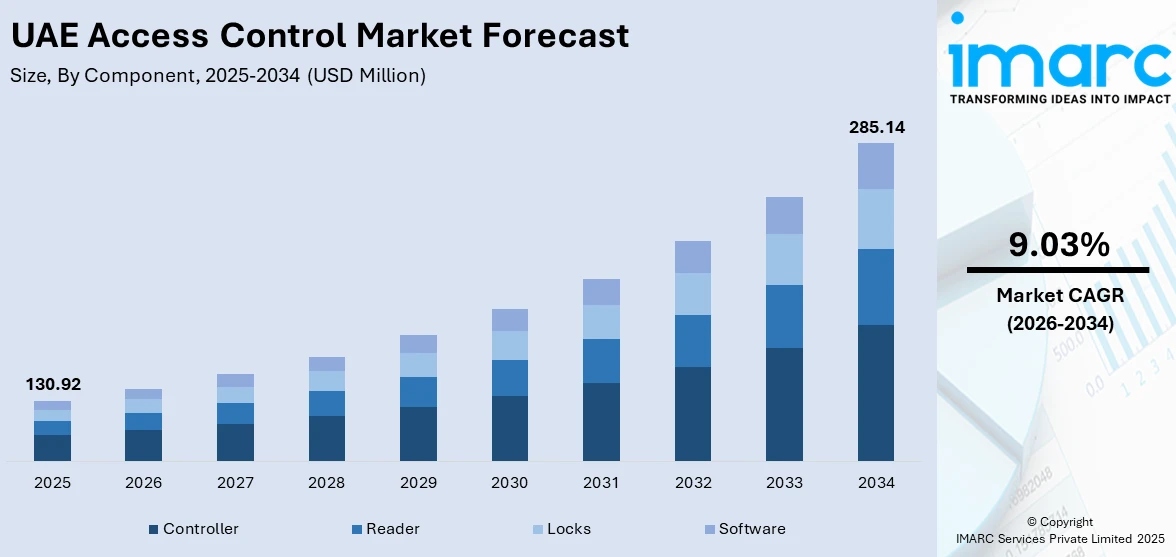
The UAE access control market size was valued at USD 130.92 Million in 2025 and is projected to reach USD 285.14 Million by 2034, growing at a compound annual growth rate of 9.03% from 2026-2034.
The market is driven by rapid urbanization, government-led smart city initiatives, and the increasing demand for advanced security solutions across commercial, residential, and government sectors. The growing adoption of biometric authentication, cloud-based management platforms, and IoT-enabled technologies is accelerating deployment across the country. Rising investments in infrastructure development, hospitality, and tourism are further propelling the need for sophisticated access management systems, contributing to the expanding UAE access control market share.
Key Takeaways and Insights:
- By Component: Controller dominates the market with a share of 32% in 2025, driven by its central role in managing access permissions, processing authentication requests, and integrating with diverse access points.
- By Type: Card based leads the market with a share of 55% in 2025, owing to its widespread adoption, cost-effectiveness, ease of deployment, and familiarity among end users across commercial and government installations.
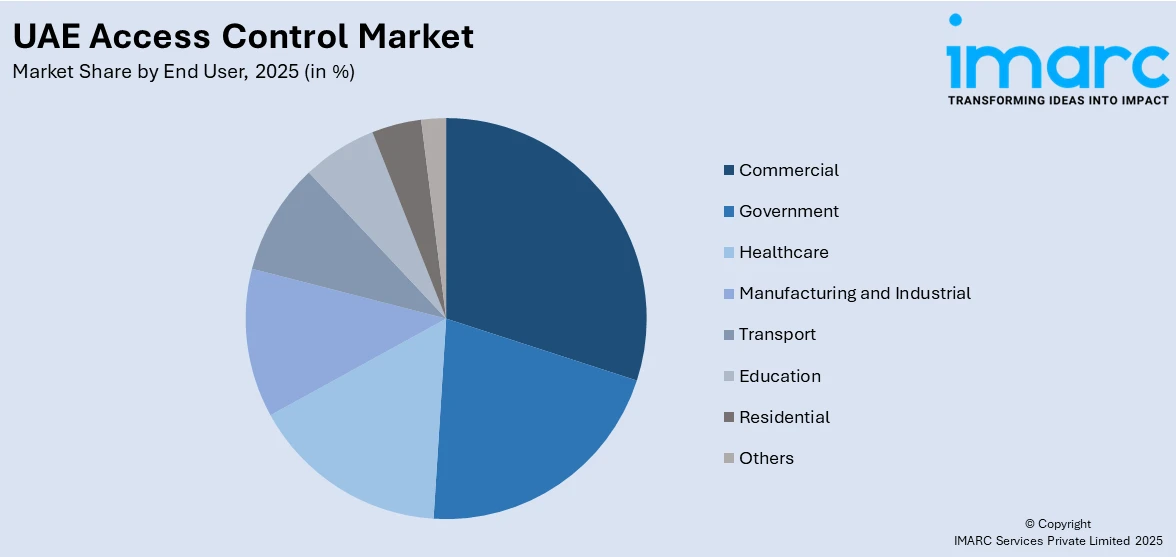
- By End User: Commercial represents the largest segment with a market share of 26% in 2025, driven by the expanding corporate office landscape, retail establishments, and hospitality sector requiring scalable and customizable security solutions.
- By Region: Dubai leads the market with a share of 40% in 2025, owing to its position as the leading commercial and tourism hub with extensive infrastructure development and smart city initiatives.
- Key Players: The UAE access control market exhibits moderate to highly competitive intensity, with established global security technology providers competing alongside regional system integrators and specialized solution providers across diverse end-user verticals and technology segments.
To get more information on this market Request Sample
The UAE access control market is experiencing robust growth fueled by the nation's ambitious smart city programs, particularly in Dubai and Abu Dhabi, which prioritize advanced security infrastructure across urban developments. The country's thriving construction sector, driven by mega-projects in hospitality, tourism, and commercial real estate, is creating substantial demand for integrated access management solutions. As per sources, in February 2026, Dubai activated 122 biometric smart gates at Dubai International Airport and Dubai World Central, enabling pre-registered travellers to clear immigration in as little as five seconds. Moreover, government mandates emphasizing public safety and data protection are further accelerating adoption across critical infrastructure. The increasing shift toward biometric authentication, cloud-based platforms, and IoT-enabled systems is transforming traditional security approaches, enabling real-time monitoring and centralized management capabilities.
UAE Access Control Market Trends:
Integration of Artificial Intelligence with Access Control Systems
The UAE access control market is witnessing a significant shift toward AI-powered security solutions that enhance threat detection and access management capabilities. As per sources, in 2025, Suprema showcased its AI‑enabled enterprise security and intelligent access control platform at Intersec Dubai, integrating advanced video analytics with access systems to enhance security efficacy. These intelligent systems analyze behavioral patterns, detect anomalies in real-time, and enable predictive security measures that go beyond traditional authentication methods. The integration of machine learning algorithms allows access control platforms to continuously improve accuracy and reduce false acceptance rates.
Convergence of Physical and Logical Access Control
Organizations across the UAE are increasingly adopting unified security platforms that merge physical access control with cybersecurity and IT network access management. In January 2026, HID showcased its unified, cyber‑secure trusted identity solutions at Intersec Dubai 2026, highlighting how integrated physical and digital access technologies strengthen overall security postures across enterprises. This convergence enables single-credential authentication for both building entry and digital resource access, streamlining security administration while eliminating silos between physical and cyber domains. The approach is gaining traction as enterprises seek holistic security governance frameworks that address the interconnected nature of modern threats.
Expansion of Mobile-First and Touchless Access Technologies
The UAE market is experiencing accelerated adoption of mobile credential-based and touchless access solutions driven by evolving workplace expectations and hygiene-conscious building management practices. In 2025, AMAG Technology highlighted mobile credentials as the new standard at Intersec Dubai, showcasing smartphone-based access solutions integrated across UAE enterprises for enhanced convenience, security, and operational efficiency. Moreover, smartphone-based credentials utilizing Bluetooth Low Energy and near-field communication technologies are replacing traditional physical cards, offering enhanced convenience and security through encrypted digital provisioning. This shift aligns with the broader digital transformation agenda across UAE enterprises and government entities seeking frictionless user experiences.
Market Outlook 2026-2034:
The UAE access control market is poised for sustained revenue growth throughout the forecast period, driven by continued infrastructure expansion, smart city developments, and heightened security requirements across all emirates. The market revenue trajectory is supported by increasing investments in biometric-based and cloud-managed solutions that offer superior scalability and operational efficiency. Government initiatives promoting digital transformation and mandatory security standards across commercial and residential developments are expected to create sustained revenue opportunities. The market generated a revenue of USD 130.92 Million in 2025 and is projected to reach a revenue of USD 285.14 Million by 2034, growing at a compound annual growth rate of 9.03% from 2026-2034.
UAE Access Control Market Report Segmentation:
|
Segment Category |
Leading Segment |
Market Share |
|
Component |
Controller |
32% |
|
Type |
Card Based |
55% |
|
End User |
Commercial |
26% |
|
Region |
Dubai |
40% |
Component Insights:
- Controller
- Reader
- Locks
- Software
Controller dominates with a market share of 32% of the total UAE access control market in 2025.
Controller holds the largest share in the UAE access control market, serving as the central intelligence hub that processes authentication requests, enforces access policies, and coordinates communication between readers, locks, and management software. As per sources, in 2025, Mercury Security’s access controller trend report noted that 72 % of security professionals consider the controller platform critical for PACS design, highlighting growing regional emphasis on secure, scalable controller systems. Furthermore, controllers act as the backbone of modern security infrastructure, enabling facility managers to define, monitor, and modify access permissions across multiple entry points simultaneously.
Advanced controller technologies featuring embedded processing capabilities, edge computing functionality, and seamless integration with cloud-based management platforms are gaining significant traction across the UAE market. The shift toward IP-based and open-architecture controllers allows organizations to deploy flexible, future-proof systems that accommodate evolving security requirements without complete hardware replacement. These modern controllers support multi-factor authentication workflows, real-time event logging, and remote configuration capabilities, making them indispensable for enterprises seeking comprehensive facility protection.
Type Insights:
- Card Based
- Contact
- Contactless
- Biometric Based
- Fingerprint
- Face Recognition
- Face Recognition and Fingerprint
- Iris Recognition
- Others
Card based leads with a share of 55% of the total UAE access control market in 2025.
Card based commands the leading share in the UAE access control market, driven by the technology's proven reliability, cost-effectiveness, and widespread familiarity across commercial, government, and residential end users. In January 2025, ZKTeco showcased its Armatura One platform, BioTime Cloud, and smart lock solutions at Intersec Dubai, highlighting integrated card- and biometric-based access control innovations across UAE enterprises. Furthermore, contactless smart cards utilizing radio-frequency identification and near-field communication technologies dominate this segment, offering convenient and rapid authentication for high-throughput environments such as corporate offices, transit facilities, and hospitality establishments.
The continued preference for card-based access solutions is reinforced by their compatibility with existing infrastructure and the relatively lower investment required compared to biometric alternatives. However, this segment is evolving through the integration of advanced encryption standards, multi-application capabilities, and hybrid credentials that combine card-based authentication with mobile and biometric factors. Organizations across the UAE are increasingly deploying dual-technology cards that support both legacy and modern protocols, ensuring seamless migration pathways.
End User Insights:
Access the comprehensive market breakdown Request Sample
- Government
- Commercial
- Healthcare
- Manufacturing and Industrial
- Transport
- Education
- Residential
- Others
Commercial exhibits a clear dominance with a 26% share of the total UAE access control market in 2025.
The commercial represents the largest end-user category in the UAE access control market, driven by the country's rapidly expanding corporate office landscape, retail sector, and world-class hospitality industry. In October 2025, Neurotechnology deployed advanced video analytics and validated access control across the Ras Al Khaimah free trade zone, enhancing secure vehicle and individual entry verification for over 35,000 registered companies. Dubai and Abu Dhabi’s global hub status drives steady demand for advanced access management systems supporting diverse tenants, visitors, and complex multi-floor security needs.
The growth for commercial is further supported by the increasing adoption of integrated security platforms that combine access control with video surveillance, intrusion detection, and building management systems. Enterprise-grade deployments are increasingly favoring cloud-managed solutions that enable centralized administration across multiple locations, real-time occupancy analytics, and seamless integration with human resource and facility management workflows. The rising emphasis on tenant experience, workplace safety, and regulatory compliance across commercial properties is compelling building operators to invest in intelligent access ecosystems that deliver operational efficiency alongside comprehensive security protection.

Regional Insights:
- Dubai
- Abu Dhabi
- Sharjah
- Others
Dubai dominates with a market share of 40% of the total UAE access control market in 2025.
Dubai holds the dominant position in the UAE access control market, driven by its status as the nation's commercial, tourism, and innovation capital. The emirate's ambitious infrastructure development programs, including large-scale mixed-use projects, hospitality expansions, and smart city initiatives, generate substantial demand for advanced access control solutions. Dubai's position as a global events destination and financial center necessitates sophisticated security deployments across convention centers, free zones, and corporate districts. The emirate's forward-thinking urban planning frameworks embed intelligent security infrastructure into every major development from the design stage onward.
The region’s proactive regulatory environment and emphasis on technology adoption further strengthen its market leadership in access control deployment. Dubai's smart city strategy integrates access management into broader urban governance frameworks, promoting interoperable and data-driven security ecosystems across public and private sectors. The presence of numerous multinational corporate headquarters, luxury hospitality brands, and world-class retail destinations creates a diverse demand landscape that supports sustained investment in cutting-edge technologies. Ongoing expansion of transportation infrastructure, tourism facilities, and residential communities continues to generate consistent opportunities for access control solution providers.
Market Dynamics:
Growth Drivers:
Why is the UAE Access Control Market Growing?
Government-Led Smart City and Digital Transformation Initiatives
The UAE government's strategic investment in smart city development across Dubai and Abu Dhabi is establishing a strong foundation for access control market expansion. In February 2025, Dubai Municipality launched the Building Intelligence Platform to digitally integrate smart building data, strengthening security, monitoring, and intelligent infrastructure planning across Dubai’s smart city ecosystem. Moreover, national digital transformation programs mandate the integration of intelligent security systems within urban infrastructure, transportation networks, and public facilities. These comprehensive frameworks require advanced authentication, real-time monitoring, and data-driven access management across government buildings and critical installations.
Rapid Expansion of Commercial Real Estate and Mega Infrastructure Projects
The UAE's thriving construction sector, characterized by large-scale commercial developments, mixed-use complexes, free zone expansions, and hospitality mega-projects, is fueling substantial demand for integrated access control solutions. In August 2025, AlFuttaim Technologies and Johnson Controls launched the OpenBlue smart building platform in the UAE to integrate real-time intelligence, energy efficiency, and operational insights across commercial developments. Furthermore, every new development necessitates comprehensive security infrastructure embedded from the architectural planning phase, incorporating access management into building design and operational workflows.
Rising Security Awareness and Regulatory Compliance Requirements
Increasing awareness of physical and cyber security threats across UAE organizations is accelerating investment in access control systems offering multi-layered authentication and comprehensive audit capabilities. According to reports, the Central Bank of the UAE mandated phasing out SMS-based one-time passwords, requiring financial institutions to adopt biometrics and risk-based authentication to strengthen security against fraud and cyber threats. Government regulations mandating security standards for commercial properties, healthcare facilities, educational institutions, and critical infrastructure are generating compliance-driven demand for certified solutions.
Market Restraints:
What Challenges the UAE Access Control Market is Facing?
High Initial Installation and Integration Costs
The substantial upfront investment required for deploying advanced access control systems, including hardware procurement, software licensing, network infrastructure, and professional installation services, presents a significant barrier for cost-sensitive organizations. Small and medium enterprises often face budget constraints limiting their ability to adopt comprehensive security solutions, while additional integration costs with existing building management systems further compound this financial challenge.
Interoperability Challenges Across Legacy and Modern Systems
Many existing UAE facilities operate legacy access control infrastructure based on proprietary protocols and closed architectures that resist seamless integration with newer standards-based technologies. The absence of universal interoperability standards creates complexity when organizations attempt to upgrade or expand their security systems. This fragmentation increases implementation timelines, raises customization costs, and limits hybrid deployment functionality, discouraging facility operators from pursuing modernization.
Data Privacy and Cybersecurity Concerns with Connected Systems
The increasing connectivity of access control systems through cloud platforms and IoT networks introduces vulnerabilities to cyber-attacks, data breaches, and unauthorized system manipulation. Organizations handling sensitive biometric data face heightened privacy compliance obligations requiring specialized storage and encryption protocols. These concerns, combined with potential reputational and regulatory consequences of data compromise, create hesitancy regarding adoption of fully connected access control architectures.
Competitive Landscape:
The UAE access control market features a dynamic competitive environment characterized by the presence of established global security technology providers, regional system integrators, and emerging specialized solution companies. Market participants compete across multiple dimensions including technological innovation, product portfolio breadth, service capabilities, and pricing strategies. The competitive landscape is shaped by ongoing investments in research and development focused on biometric accuracy, artificial intelligence (AI) integration, cloud platform capabilities, and mobile credential technologies. Strategic partnerships between technology providers and local system integrators play a crucial role in market penetration, as regional expertise in installation, customization, and after-sales support remains essential for successful deployments.
Recent Developments:
- In January 2025, UAE-based ScreenCheck announces to unveil advanced identification and access control solutions at Intersec Dubai 2025. The launch includes EvTrack visitor management, TANlock electromechanical locking systems, and an upgraded IDTech platform, strengthening integrated access control, data centre security, and credential management offerings across the Middle East and Africa.
UAE Access Control Market Report Coverage:
| Report Features | Details |
|---|---|
| Base Year of the Analysis | 2025 |
| Historical Period | 2020-2025 |
| Forecast Period | 2026-2034 |
| Units | Million USD |
| Scope of the Report |
Exploration of Historical Trends and Market Outlook, Industry Catalysts and Challenges, Segment-Wise Historical and Future Market Assessment:
|
| Components Covered | Controller, Reader, Locks, Software |
| Types Covered |
|
| End Users Covered | Government, Commercial, Healthcare, Manufacturing and Industrial, Transport, Education, Residential, Others |
| Regions Covered | Dubai, Abu Dhabi, Sharjah, Others |
| Customization Scope | 10% Free Customization |
| Post-Sale Analyst Support | 10-12 Weeks |
| Delivery Format | PDF and Excel through Email (We can also provide the editable version of the report in PPT/Word format on special request) |
Frequently Asked Questions About the UAE Access Control Market Report
The UAE access control market size was valued at USD 130.92 Million in 2025.
The UAE access control market is expected to grow at a compound annual growth rate of 9.03% from 2026-2034 to reach USD 285.14 Million by 2034.
Controller held the largest UAE access control market share, driven by its central role in processing authentication requests, enforcing access policies, coordinating communication between readers and locks, and integrating seamlessly with cloud-based management platforms across commercial and government facilities.
Key factors driving the UAE access control market include government-led smart city initiatives, rapid commercial real estate expansion, rising security awareness, increasing adoption of biometric and cloud-based technologies, and growing regulatory compliance requirements.
Major challenges include high initial installation and integration costs, interoperability issues between legacy and modern systems, data privacy and cybersecurity concerns with connected platforms, shortage of skilled security professionals, and budget constraints among small and medium enterprises.
Need more help?
- Speak to our experienced analysts for insights on the current market scenarios.
- Include additional segments and countries to customize the report as per your requirement.
- Gain an unparalleled competitive advantage in your domain by understanding how to utilize the report and positively impacting your operations and revenue.
- For further assistance, please connect with our analysts.
 Request Customization
 Speak to an Analyst
 Request Brochure
 Inquire Before Buying
Benefits of Customization
- Personalize this research
- Triangulate with your data
- Get data as per your format and definition
- Gain a deeper dive into a specific application, geography, customer, or competitor
- Any level of personalization
Get in Touch With Us
UNITED STATES
Phone: +1-201-971-6302
INDIA
Phone: +91-120-433-0800
UNITED KINGDOM
Phone: +44-753-714-6104
Email: [email protected]
Client Testimonials




.webp)




.webp)













Related Reports

Choose your plan
*Please note that the prices mentioned below are starting prices for each bundle type. Kindly contact our team for further details.*
Single User License
- 1 User License, Access on 2 Devices
- PDF Report + Excel Dataset (Password Protected)
- Lifetime Access
- No Printing Rights
- 10% Free Report Customization
- 10–12 Weeks of Analyst Support
Five User License
- Access for 5 Users, 2 Devices per User
- PDF Report + Excel Dataset (Password Protected)
- Lifetime Access
- Dedicated Account Manager
- 12–14 Weeks of Analyst Support
- No Printing Rights
- 15% Free Report Customization
- 25% Discount on Your Next Purchase
Corporate User License
- Unlimited User Access (Within Your Organization)
- PDF Report + Excel Dataset
- Lifetime Access
- Dedicated Account Manager
- 14–20 Weeks of Analyst Support
- No Printing Rights
- 20% Free Report Customization
- 30% Discount on Your Next Purchase
Essential Insights
What's included:
3 reports
- Lifetime Access
- PDF Reports
- Excel Datasets
- 2 Weeks of Free Analyst Support
- 2 User Licenses
- Access on 2 Devices
- Printing Rights
- Complimentary PowerPoint (PPT) Version
- Complimentary License Upgrade
Professional Access
What's included:
5 reports
- Lifetime Access
- PDF Reports
- Excel Datasets
- 8 Weeks of Free Analyst Support
- 2 User Licenses
- Access on 2 Devices
- Printing Rights
- Complimentary PowerPoint (PPT) Version
- Complimentary License Upgrade
Business Advantage
What's included:
8 reports
- Lifetime Access
- PDF Reports
- Excel Datasets
- 14 Weeks of Free Analyst Support
- 2 User Licenses
- Access on 2 Devices
- Printing Rights
- Complimentary PowerPoint (PPT) Version
- Complimentary License Upgrade
Enterprise Intelligence
What's included:
10 reports
- Lifetime Access
- PDF Reports
- Excel Datasets
- 20 Weeks of Free Analyst Support
- 2 User Licenses
- Access on 2 Devices
- Printing Rights
- Complimentary PowerPoint (PPT) Version
- Complimentary License Upgrade