
UAE Hospitality Market Size, Share, Trends and Forecast by Type, Segment, and Region, 2026-2034
UAE Hospitality Market Summary:
The UAE hospitality market grew from USD 25.17 Billion in 2025 to USD 26.42 Billion in 2026 and is projected to reach USD 38.95 Billion by 2034, growing at a compound annual growth rate of 4.97% from 2026-2034.
The UAE hospitality sector continues to thrive as a global tourism powerhouse, driven by visionary government initiatives, world-class infrastructure, and a diverse portfolio of accommodations catering to leisure, business, and cultural travelers. The market benefits from strategic positioning as an international hub connecting East and West, supported by robust aviation connectivity and ambitious tourism targets, which collectively strengthen the UAE hospitality market share.
Key Takeaways and Insights:
-
By Type: Chain hotels dominate the market with a share of 65% in 2025, owing to strong brand recognition, extensive global distribution networks, and standardized service quality that appeals to both business and leisure travelers. International hospitality chains continue to expand their footprint through strategic partnerships and franchise agreements.
-
By Segment: Luxury hotels lead the market with a share of 41% in 2025. This dominance is driven by the UAE's positioning as a premier destination for high-net-worth travelers seeking opulent experiences, iconic architectural landmarks, and exclusive amenities that define ultra-luxury hospitality.
-
By Region: Dubai represents the largest region with 62% share in 2025, driven by its status as a global tourism hub, home to iconic attractions, record-breaking infrastructure, and year-round events that attract millions of international visitors annually.
-
Key Players: Key players drive the UAE hospitality market by investing in innovative guest experiences, expanding brand portfolios, integrating sustainability practices, and leveraging digital transformation to enhance operational efficiency and customer engagement across diverse market segments.
The UAE hospitality market continues to demonstrate exceptional resilience and growth momentum, underpinned by strategic government investments and a thriving tourism ecosystem. The sector has witnessed unprecedented visitor arrivals, with Dubai welcoming 18.72 Million international overnight guests in 2024, representing a nine percent increase from 2023. Large-scale infrastructure development, including airport expansions, integrated resorts, and mixed-use tourism zones, is expanding accommodation capacity across luxury, mid-scale, and budget segments. Rising business travel activities linked to foreign investment inflows and regional headquarters expansion further supports hotel occupancy rates. Sustainability initiatives, smart hotel technologies, and experiential hospitality concepts are also reshaping service delivery and guest engagement. Strong government support through relaxed visa policies, long-stay residency programs, and tourism promotion campaigns enhances international appeal.
UAE Hospitality Market Trends:
Sustainability and Green Hospitality Transformation
Sustainability and green hospitality transformation are becoming strong growth drivers of the market in the UAE, as hotels increasingly align with national sustainability goals and global environmental standards. Properties are investing in energy-efficient systems, water conservation technologies, waste reduction programs, and eco-friendly building designs to lower operating costs and enhance brand appeal. Growing traveler awareness around sustainable tourism is encouraging demand for green-certified hotels and responsible luxury experiences. Government-backed sustainability frameworks further incentivize adoption, positioning environmentally responsible hospitality as a key differentiator that strengthens long-term competitiveness and investor confidence across the UAE market.
Ongoing Digital Innovations
Digital innovations are enhancing guest experiences, operational efficiency, and revenue optimization. Hotels are adopting smart room technologies, mobile check-in and keyless access systems, and artificial intelligence (AI)-powered concierge services to deliver seamless, personalized stays. Advanced data analytics enable hotels to understand guest preferences, optimize pricing strategies, and improve service quality. Contactless payments, digital loyalty platforms, and integrated booking systems further streamline customer journeys. Data from the Central Bank of the UAE (CBUAE) indicated a 15% rise in card transactions in 2024 relative to 2023. These innovations support higher occupancy rates, improve cost management, and position UAE hospitality providers as global leaders in technology-driven luxury and convenience.
Wellness Tourism and Experiential Travel Growth
Wellness tourism is experiencing significant growth across the UAE hospitality landscape, with hotels expanding beyond traditional spa facilities to offer holistic wellness programs. The five-star Jumeirah Marsa Al Arab hotel was set to debut in Dubai in 2024, featuring a 3,500 sq m spa and wellness center. Properties are developing comprehensive wellness centers featuring advanced treatments, such as cryotherapy, hyperbaric oxygen chambers, and precision wellness programs. The emphasis on experiential travel has also intensified, with travelers seeking cultural immersion, adventure tourism, and bespoke experiences that showcase local traditions. This trend is driving hotels to curate authentic Emirati cultural encounters and unique destination experiences.
Market Outlook 2026-2034:
The UAE hospitality market is positioned for sustained growth through the forecast period, driven by ambitious tourism targets and substantial infrastructure investments. The market generated revenue of USD 25.17 Billion in 2025, which is expected to reach USD 26.42 Billion in 2026 and further grow to USD 38.95 Billion by 2034, at a compound annual growth rate (CAGR) of 4.97% during 2026-2034. Expansion of luxury hotels, resorts, and mixed-use destinations is strengthening accommodation capacity across key emirates. Rising business travel, international events, and leisure tourism continue to drive high occupancy levels. Airline network broadening and visa-friendly policies further enhance market attractiveness. Increasing adoption of digital technologies and sustainability-focused hospitality practices is improving operational efficiency and guest experiences.
UAE Hospitality Market Report Segmentation:
| Segment Category | Leading Segment | Market Share |
|---|---|---|
| Type | Chain Hotels | 65% |
| Segment | Luxury Hotels | 41% |
| Region | Dubai | 62% |
Type Insights:
To get detailed segment analysis of this market, Request Sample
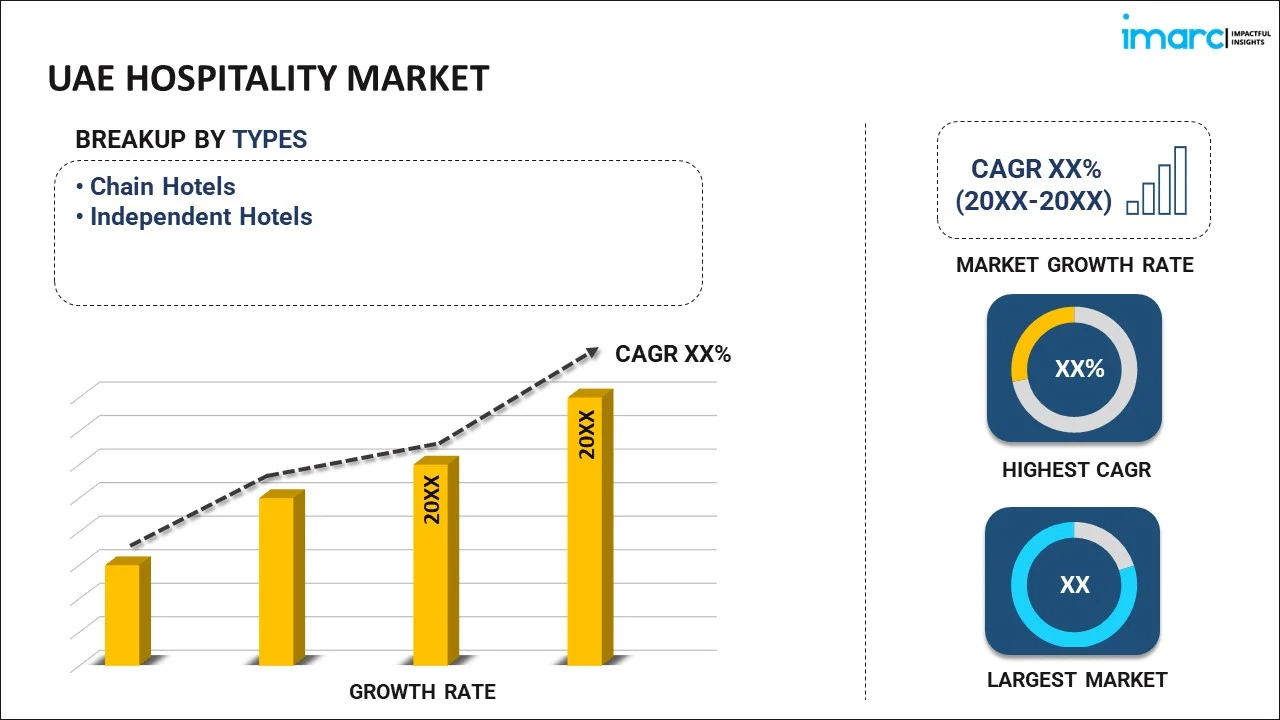
- Chain Hotels
- Independent Hotels
Chain hotels dominate with a market share of 65% of the total UAE hospitality market in 2025.
Chain hotels maintain their dominant position in the UAE hospitality market through extensive brand portfolios, global distribution networks, and loyalty programs that drive repeat visitation. International hospitality giants continue to expand their presence through strategic partnerships and management agreements. The segment benefits from standardized service quality, strong brand recognition, and sophisticated revenue management systems that optimize performance across diverse market conditions. Centralized procurement and marketing capabilities further strengthen cost efficiency and brand consistency across properties.
The chain hotel segment is witnessing significant expansion with major operators announcing ambitious development plans. As of March 21, 2024, there were 76 locations of Marriott Group Hotels and Resorts in the United Arab Emirates. Dubai was the emirate with the highest number of Marriott Group Hotels and Resorts in the UAE, featuring 54 locations, accounting for approximately 71% of all Marriott Group Hotels and Resorts in the country. This expansion reflects strong investor confidence in long-term tourism and hospitality growth and premium accommodation demand.

Segment Insights:
- Service Apartments
- Budget and Economy Hotels
- Mid and Upper Mid-scale Hotels
- Luxury Hotels
Luxury hotels lead with a share of 41% of the total UAE hospitality market in 2025.
Luxury hotels lead the UAE hospitality market due to the country’s strategic positioning as a global premium tourism and business destination. The UAE attracts high-net-worth individuals, international executives, and affluent leisure travelers seeking exceptional service standards, iconic architecture, and exclusive experiences. World-renowned landmarks, upscale shopping districts, and luxury entertainment offerings complement high-end accommodations. Strong air connectivity through global hubs like Dubai and Abu Dhabi further supports luxury travel inflows. As per the Centre’s statistics, passenger numbers at UAE airports increased from 114.8 Million in 2015 to 147.8 Million in 2024.
The segment is further strengthened by consistent government support for high-value tourism under national diversification strategies. Luxury hotels benefit from strong demand generated by international events, exhibitions, and premium leisure attractions, including destination resorts and cultural landmarks. High disposable incomes among residents and visitors support premium room rates, fine dining, and wellness services. Continuous investments in innovation, sustainability, and experiential offerings help luxury hotels maintain differentiation. These properties also achieve higher margins through integrated retail, dining, and lifestyle services, solidifying their dominance within the UAE hospitality market.
Regional Insights:
To get detailed regional analysis of this market, Request Sample
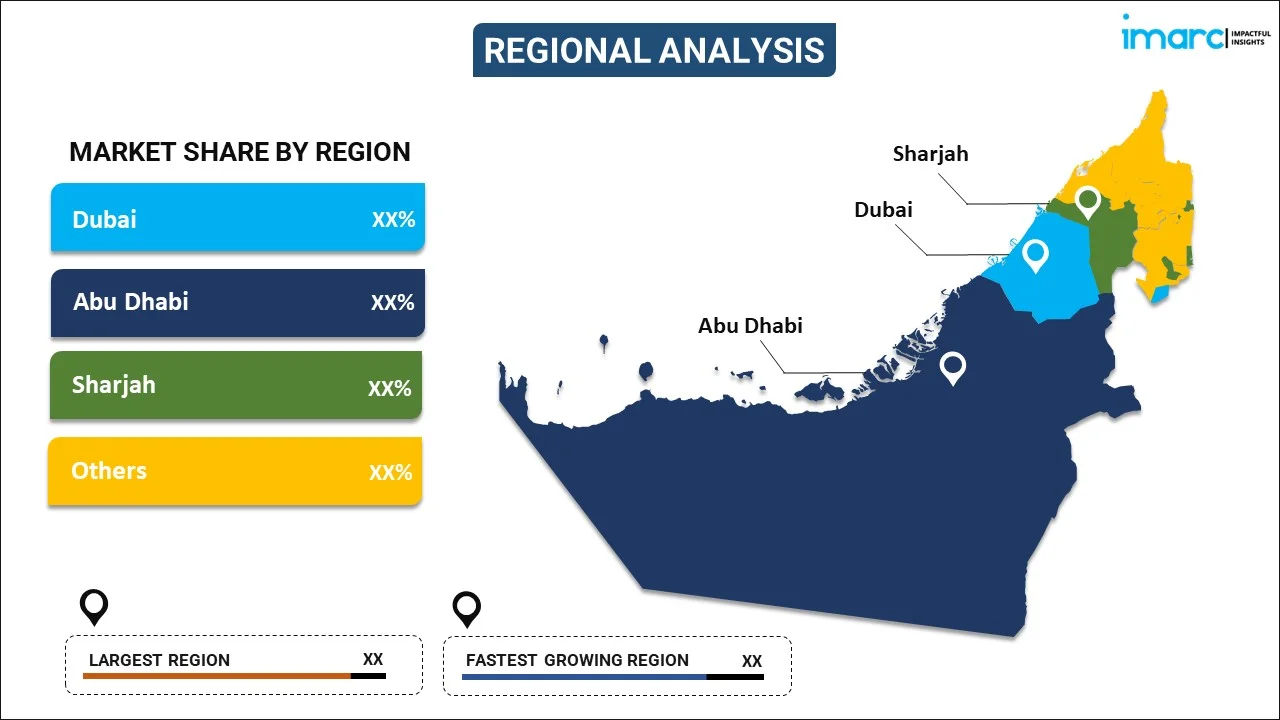
- Dubai
- Abu Dhabi
- Sharjah
- Others
Dubai exhibits a clear dominance with a 62% share of the total UAE hospitality market in 2025.
Dubai leads the UAE hospitality market due to its position as a global tourism, business, and aviation hub supported by world-class infrastructure and diversified attractions. The emirate attracts leisure tourists, business travelers, and transit passengers through its extensive airline connectivity, iconic landmarks, luxury retail, and year-round event calendar. Continuous investments in theme parks, beaches, cultural districts, and entertainment zones sustain high hotel occupancy levels. The development pipeline includes significant high-profile openings, including Ciel Dubai Marina, the world's tallest hotel at 377 meters with 1,004 rooms, which opened in November 2025.
The city’s hospitality dominance is further reinforced by its proactive government policies and investor-friendly environment that encourage hotel development across luxury, mid-scale, and budget segments. Dubai’s ability to host global exhibitions, conferences, and mega-events drives consistent demand for accommodation throughout the year. Strong brand presence from international hotel chains, coupled with innovative hospitality concepts and digital guest experiences, enhances competitiveness. Additionally, Dubai’s focus on sustainability, smart tourism initiatives, and premium lifestyle offerings ensures long-term growth and leadership within the UAE hospitality market.
Market Dynamics:
Growth Drivers:
Why is the UAE Hospitality Market Growing?
Strategic Government Tourism Initiatives and Policy Support
The UAE government continues to implement comprehensive tourism development strategies that directly support hospitality sector expansion. The Dubai Economic Agenda D33, launched in 2023, aims to double the emirate's GDP by 2033 through investments in tourism infrastructure, innovation, and global connectivity. Authorities actively promote international tourism through relaxed visa policies, long-term residency programs, and streamlined licensing for hospitality operators. Continuous upgrades to airports, roads, cruise terminals, and public transport improve visitor accessibility and mobility. Destination marketing campaigns reinforce the UAE’s global brand as a premium leisure and business destination. Public-private partnerships enable large-scale hospitality developments while reducing investor risk. Government-backed mega-projects integrate hotels with retail, culture, and entertainment, increasing average length of stay. Regulatory stability and transparent frameworks further boost investor confidence. Collectively, proactive policy support ensures steady hotel supply growth, attracts international brands, and sustains long-term demand, positioning hospitality as a resilient growth engine within the UAE economy.
Expansion of Luxury, Lifestyle, and Experiential Hospitality
Luxury and lifestyle hospitality development is a major driver of the market growth. The UAE caters to high-spending travelers seeking premium accommodation, bespoke services, and immersive experiences. Hotels increasingly differentiate through wellness offerings, signature dining, curated cultural experiences, and personalized guest journeys. Lifestyle hotels targeting younger demographics emphasize design, social spaces, and experiential stays. High-profile branded residences and integrated resort concepts further elevate demand. The willingness of consumers to pay premium rates supports strong average daily rates and revenue per available room. This premiumization trend encourages continuous reinvestment in renovations and new developments. Luxury hospitality also strengthens destination branding, reinforcing the UAE’s image as a global standard-setter. As experiential travel preferences grow, high-end and lifestyle hotels remain central to driving value growth in the hospitality market.
Digital Innovations and Sustainability Adoption
Digital transformation and sustainability are positively influencing the UAE hospitality industry. Technology is being used by hotels to offer contactless check-ins and departures, mobile concierge solutions, and tailored customer experience solutions. Analytical data solutions offer improved pricing solutions to hotels to better forecast demand. Sustainability practices initiated by hotels include eco-friendly building designs and practices to save water and reduce waste. Sustainable practices help reduce hotel operating expenses while increasing brand loyalty. Sustainability initiatives encouraged by governments aid hotels in acquiring green certifications to provide eco-responsible hotels to customers. Technology solutions help hotels to improve customer experience while assisting employees to become more productive. Customers are looking for hotels that offer contactless experiences as well as hotels that have adopted sustainability practices.
Market Restraints:
What Challenges the UAE Hospitality Market is Facing?
High Operating and Labor Costs
Growing operating costs are a major problem for the hospitality industry in the UAE. Recruitment of competent workers, lodging, utilities, and adherence to service quality standards are expensive for hotels. As properties compete for seasoned employees in a service-intensive sector, wage pressures rise. Despite efficiency attempts, energy and water expenses are still high because of the climate. Particularly for midscale and low-cost hotels, these cost constraints can reduce profit margins, compelling operators to constantly improve workforce patterns, procurement tactics, and operational effectiveness.
Market Oversupply and Intense Competition
Rapid hotel development has led to periods of room oversupply in key destinations, intensifying competition among operators. The average daily room price and occupancy rates are under pressure due to an expanding pipeline of new hotels. Newly opened hotels with aggressive pricing strategies and contemporary amenities must compete with established establishments. During off-peak times, oversupply issues are more severe, forcing hotels to rely on sales and discounts. Long-term profitability may be impacted by persistent rivalry, which may also postpone new developments' return on investment.
Seasonality and Demand Fluctuations
Seasonal demand variations remain a structural challenge for the UAE hospitality market. Extreme summer temperatures reduce leisure travel during certain months, leading to lower occupancy levels. Hotels must manage uneven cash flows and adjust staffing levels accordingly. Dependence on peak-season tourism places pressure on operators to maximize revenues within limited periods. While business travel and events provide some balance, seasonality still affects pricing stability, asset utilization, and operational planning, particularly for leisure-focused properties.
Competitive Landscape:
The UAE hospitality market features a highly competitive landscape, characterized by the presence of leading international hotel chains and prominent regional operators. Major global hospitality groups maintain significant market presence through diverse brand portfolios spanning luxury, lifestyle, midscale, and extended-stay segments. Competition intensifies, as operators differentiate through unique guest experiences, digital innovations, loyalty program enhancements, and sustainability initiatives. The market is transitioning from development-led expansion to a more mature investment phase, with investor focus shifting towards strategic acquisitions and asset repositioning. This evolution reflects a sophisticated investment landscape attracting regional family offices and international institutional capital seeking long-term value creation.
Recent Developments:
-
In December 2025, Arada launched Nest Hotel at Aljada in Sharjah, the first property under its new lifestyle hospitality brand. The 395-room midscale hotel, independently managed by Arada Hospitality and Entertainment, caters to business travelers, families, and students, featuring smart technology integration and direct access to Aljada's East Boulevard dining and entertainment district.
-
In September 2025, Accor broadened its midscale offerings in the UAE with the launch of Mercure Hotel Abu Dhabi Downtown, a 156-room establishment situated on Saeed Bin Ahmed Al Otaiba Street in the center of the capital. The hotel combines Mercure's well-known midscale brand with a distinct local character, featuring interiors inspired by Emirati culture and the UAE's natural scenery.
UAE Hospitality Market Report Coverage:
| Report Features | Details |
|---|---|
| Base Year of the Analysis | 2025 |
| Historical Period | 2020-2025 |
| Forecast Period | 2026-2034 |
| Units | Billion USD |
| Scope of the Report | Exploration of Historical and Forecast Trends, Industry Catalysts and Challenges, Segment-Wise Historical and Predictive Market Assessment:
|
| Types Covered | Chain Hotels, Independent Hotels |
| Segments Covered | Service Apartments, Budget and Economy Hotels, Mid and Upper Mid-scale Hotels, Luxury Hotels |
| Regions Covered | Dubai, Abu Dhabi, Sharjah, Others |
| Customization Scope | 10% Free Customization |
| Post-Sale Analyst Support | 10-12 Weeks |
| Delivery Format | PDF and Excel through Email (We can also provide the editable version of the report in PPT/Word format on special request) |
Frequently Asked Questions About the UAE Hospitality Market Report
The UAE hospitality market size increased from USD 25.17 Billion in 2025 to USD 26.42 Billion in 2026.
The UAE hospitality market is expected to grow at a compound annual growth rate of 4.97% from 2026-2034 to reach USD 38.95 Billion by 2034.
Chain hotels dominated the market with a share of 65%, driven by strong brand recognition, global distribution networks, standardized service quality, and loyalty programs that attract both business and leisure travelers.
Key factors driving the UAE hospitality market include strategic government tourism initiatives, rising international visitor arrivals and spending, major infrastructure investments, iconic hotel developments, and enhanced aviation connectivity.
Major challenges include potential oversupply risks in premium segments, rising operational costs from sustainability compliance and labor regulations, global economic uncertainties, geopolitical factors, and evolving traveler behavior patterns.
Need more help?
- Speak to our experienced analysts for insights on the current market scenarios.
- Include additional segments and countries to customize the report as per your requirement.
- Gain an unparalleled competitive advantage in your domain by understanding how to utilize the report and positively impacting your operations and revenue.
- For further assistance, please connect with our analysts.
 Request Customization
 Speak to an Analyst
 Request Brochure
 Inquire Before Buying
Benefits of Customization
- Personalize this research
- Triangulate with your data
- Get data as per your format and definition
- Gain a deeper dive into a specific application, geography, customer, or competitor
- Any level of personalization
Get in Touch With Us
UNITED STATES
Phone: +1-201-971-6302
INDIA
Phone: +91-120-433-0800
UNITED KINGDOM
Phone: +44-753-714-6104
Email: [email protected]
Client Testimonials




.webp)




.webp)













Related Reports

Choose your plan
*Please note that the prices mentioned below are starting prices for each bundle type. Kindly contact our team for further details.*
Single User License
- 1 User License, Access on 2 Devices
- PDF Report + Excel Dataset (Password Protected)
- Lifetime Access
- No Printing Rights
- 10% Free Report Customization
- 10–12 Weeks of Analyst Support
Five User License
- Access for 5 Users, 2 Devices per User
- PDF Report + Excel Dataset (Password Protected)
- Lifetime Access
- Dedicated Account Manager
- 12–14 Weeks of Analyst Support
- No Printing Rights
- 15% Free Report Customization
- 25% Discount on Your Next Purchase
Corporate User License
- Unlimited User Access (Within Your Organization)
- PDF Report + Excel Dataset
- Lifetime Access
- Dedicated Account Manager
- 14–20 Weeks of Analyst Support
- No Printing Rights
- 20% Free Report Customization
- 30% Discount on Your Next Purchase
Essential Insights
What's included:
3 reports
- Lifetime Access
- PDF Reports
- Excel Datasets
- 2 Weeks of Free Analyst Support
- 2 User Licenses
- Access on 2 Devices
- Printing Rights
- Complimentary PowerPoint (PPT) Version
- Complimentary License Upgrade
Professional Access
What's included:
5 reports
- Lifetime Access
- PDF Reports
- Excel Datasets
- 8 Weeks of Free Analyst Support
- 2 User Licenses
- Access on 2 Devices
- Printing Rights
- Complimentary PowerPoint (PPT) Version
- Complimentary License Upgrade
Business Advantage
What's included:
8 reports
- Lifetime Access
- PDF Reports
- Excel Datasets
- 14 Weeks of Free Analyst Support
- 2 User Licenses
- Access on 2 Devices
- Printing Rights
- Complimentary PowerPoint (PPT) Version
- Complimentary License Upgrade
Enterprise Intelligence
What's included:
10 reports
- Lifetime Access
- PDF Reports
- Excel Datasets
- 20 Weeks of Free Analyst Support
- 2 User Licenses
- Access on 2 Devices
- Printing Rights
- Complimentary PowerPoint (PPT) Version
- Complimentary License Upgrade