
UAE Kitchen Appliances Market Size, Share, Trends and Forecast by Product Type, Structure, Fuel Type, Application, Distribution Channel, and Region, 2026-2034
UAE Kitchen Appliances Market Size, Share, Trends & Forecast (2026-2034)
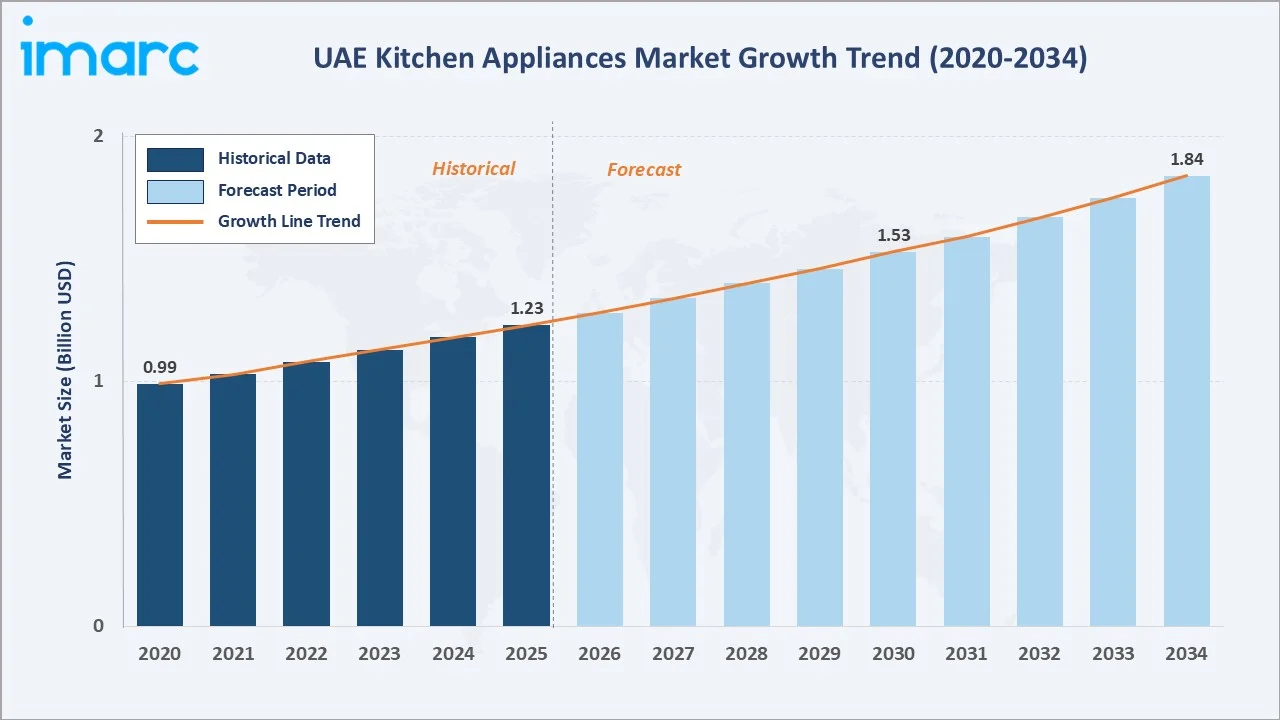
The UAE kitchen appliances market size was valued at USD 1.23 Billion in 2025 and USD 1.28 Billion in 2026 and is projected to reach USD 1.84 Billion by 2034, growing at a CAGR of 4.47% during 2026-2034. The market is driven by rapid urbanization, rising disposable incomes, and increasing demand for smart and energy-efficient kitchen solutions across the UAE residential and commercial sectors.
Expanding e-commerce infrastructure, growth in luxury real estate, and adoption of IoT-integrated kitchen ecosystems are further supporting market growth. Electricity dominates at 72.8%. Free Stand leads structure at 62.7%. Dubai commands 45.8% of the national market share.
Market Snapshot
|
Metric |
Value |
|
Base Year Market Size (2025) |
USD 1.23 Billion |
|
Market Size (2026) |
USD 1.28 Billion |
|
Forecast Market Size (2034) |
USD 1.84 Billion |
|
CAGR (2026-2034) |
4.47% |
|
Base Year |
2025 |
|
Historical Period |
2020-2025 |
|
Forecast Period |
2026-2034 |
|
Dominant Fuel Type |
Electricity (72.8%, 2025) |
|
Dominant Structure |
Free Stand (62.7%, 2025) |
|
Leading Region |
Dubai (45.8%, 2025) |
The UAE kitchen appliances market size increased from USD 0.99 Billion in 2020 to USD 1.23 Billion in 2025 and is estimated to reach USD 1.28 Billion in 2026. The market is further expected to grow to USD 1.53 Billion by 2030 and USD 1.84 Billion by 2034. The UAE kitchen appliances market is positioned as one of the Middle East's most dynamic appliance markets, driven by the country's ambitious real estate pipeline, a large and diverse expatriate population, and rapid adoption of smart home technologies.
To get more information on this market, Request Sample
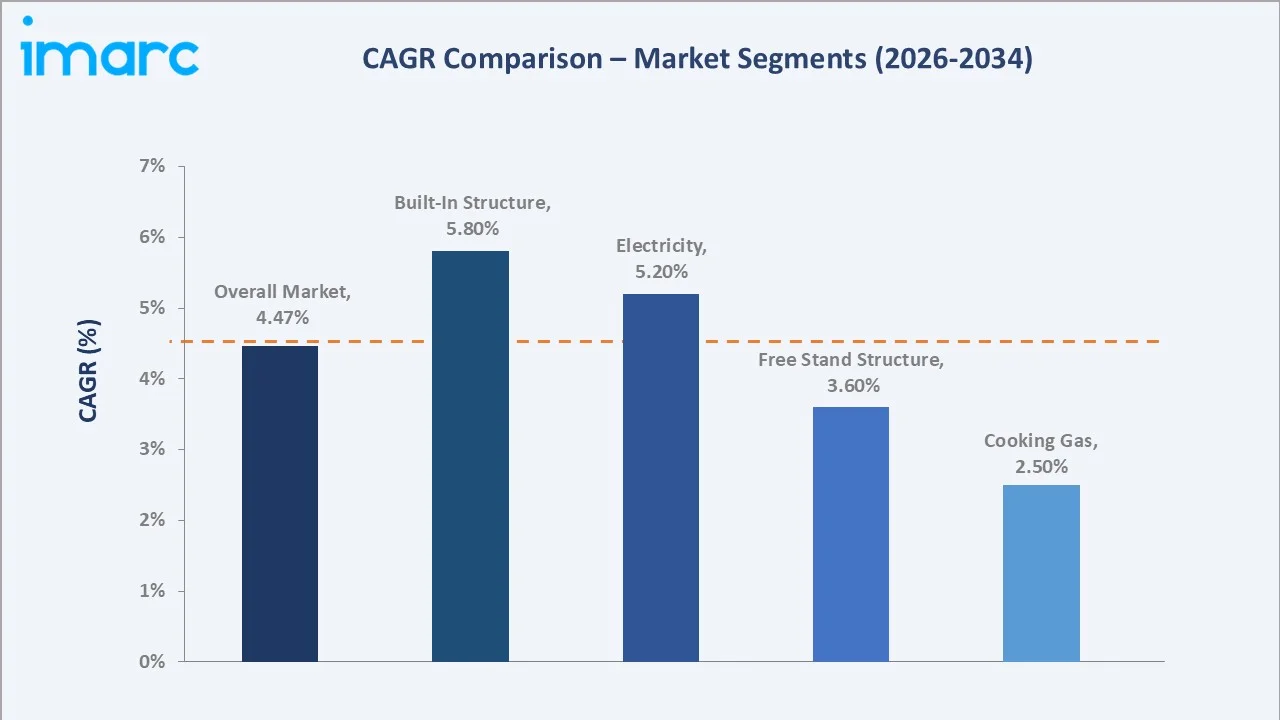
The electricity-powered appliance segment grows fastest at ~5.2% CAGR through rising consumer preference for induction cooktops, smart ovens, and IoT-enabled appliances. The built-in structure segment grows at ~5.8% CAGR through increasing adoption in luxury residential and modular kitchen projects.
Executive Summary
The UAE kitchen appliances market expanded from USD 1.23 Billion in 2025 to an estimated USD 1.28 Billion in 2026, cementing its position as the leading kitchen appliances market in the GCC. The market's growth is anchored by the UAE's robust real estate sector, high consumer spending on home renovation, and rapid penetration of modern retail formats and e-commerce platforms.
The market is projected to reach USD 1.84 Billion by 2034. The electricity-powered segment dominates at 72.8%, reflecting the shift toward modern and energy-efficient cooking solutions. Free-standing appliances lead at 62.7%, and Dubai commands 45.8% regional leadership.
Key Market Insights
|
Insight |
Data |
|
Dominant Fuel Type |
Electricity – 72.8% share (2025) |
|
Dominant Structure |
Free Stand – 62.7% market share (2025) |
|
Leading Region |
Dubai – 45.8% share (2025) |
|
Market Opportunity |
Smart appliance growth in luxury residential; commercial kitchen expansion; e-commerce penetration; built-in appliance demand in premium housing |
Key Analytical Observations Supporting the Above Data:
- Electricity at 72.8%: The electricity segment dominates through growing preference for induction cooktops, electric ovens, and smart appliances compatible with UAE's modern kitchen design and sustainability goals. Government clean energy initiatives reinforce this dominance.
- Free Stand at 62.7%: Free-standing appliances dominate due to their versatility, affordability, and ease of installation across varied kitchen configurations, particularly in apartment-style residences preferred by the UAE's large expatriate population.
- Dubai at 45.8%: Dubai leads due to its large affluent expatriate population, high purchasing power, premium retail infrastructure, strong hospitality sector, and continuous luxury real estate development driving appliance demand at scale.
UAE Kitchen Appliances Market Overview
The UAE kitchen appliances market is positioned at the intersection of rapid urban development, rising living standards, and a diverse multicultural population that drives varied cooking needs. The market's commercial structure reflects the UAE's unique demographic composition, with a large expatriate community creating heterogeneous demand patterns spanning budget, mid-range, and luxury appliance categories.
The UAE kitchen appliances ecosystem integrates international brand distribution, regional manufacturing, premium showrooms, hypermarket retail, and a rapidly growing online sales channel. Macroeconomic factors include strong FDI inflows into real estate, government-led smart city initiatives, rising hospitality sector investments, and a culture of home renovation among the country's expanding affluent middle class.
Market Dynamics
To evaluate market opportunities, Request Sample
Market Drivers
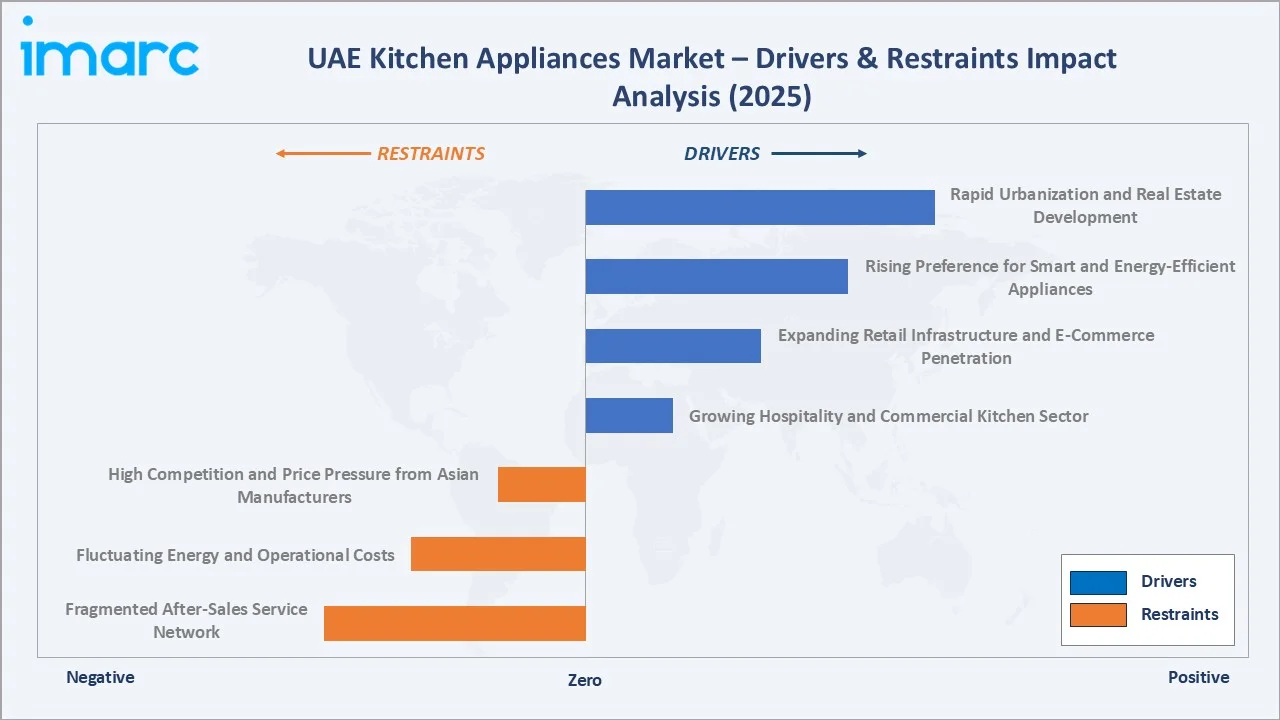
- Rapid Urbanization and Real Estate Development: Consistent residential and commercial construction activity is a primary driver of kitchen appliance demand in the UAE. Dubai and Abu Dhabi rank among the world's fastest-growing real estate markets, with tens of thousands of new residential units completed annually, directly stimulating demand across refrigerators, cooking appliances, and dishwashers. UAE's Vision 2030 and smart city projects generate millions of square meters of new residential space, each requiring fully equipped kitchens. This sustained construction pipeline ensures consistent first-time installation demand, making real estate the most commercially reliable driver in the UAE kitchen appliances market. Developers are increasingly specifying premium appliance brands as a standard feature, further elevating per-unit appliance value across the market. This trend is encouraging brands to establish direct developer partnerships, creating a structured specification sales channel alongside traditional retail.
- Rising Preference for Smart and Energy-Efficient Appliances: Growing consumer awareness of sustainability is accelerating adoption of smart kitchen appliances across the UAE. Consumers increasingly seek IoT-enabled appliances offering remote monitoring and energy consumption tracking. Government-backed frameworks including the UAE Energy Strategy 2050 are encouraging energy-efficient certified appliance adoption, stimulating demand for advanced kitchen solutions, particularly in Dubai's luxury residential and hospitality segments. This technology-driven demand is expanding the premium appliance segment and encouraging new market entrants with technology-first appliance platforms.
- Expanding Retail Infrastructure and E-Commerce Penetration: The UAE's well-developed retail ecosystem, spanning large-format electronics retailers, brand showrooms, and hypermarkets, provides broad consumer access to kitchen appliance brands. E-commerce growth is accelerating market expansion by enabling price comparison and home delivery that reduce purchase friction. Omnichannel retail strategies have significantly expanded consumer touchpoints, supporting above-average appliance sales growth across all price tiers. Digital marketing and influencer-led product launches are further driving consumer discovery and accelerating purchase decisions across the UAE's internet-savvy population.
- Growing Hospitality and Commercial Kitchen Sector: The UAE's world-class hospitality sector, encompassing luxury hotels, resorts, and catering services, is a significant driver of commercial kitchen appliance demand. With Dubai hosting millions of tourists annually and Abu Dhabi expanding hospitality infrastructure, demand for professional-grade refrigerators, dishwashers, and cooking appliances grows steadily. The commercial kitchen segment purchases appliances at higher per-unit values than residential buyers, elevating overall market revenue per unit. Catering operations, airline kitchens, and institutional food service providers add further volume to the commercial kitchen appliance demand base.
Market Restraints
- High Competition and Price Pressure from Asian Manufacturers: The UAE kitchen appliances market faces intense pricing pressure from competitively priced Asian manufacturers, particularly from China, South Korea, and India. Influx of low-cost alternatives has eroded premium margins for established European and American brands, forcing market-wide price rationalization. This pricing competition particularly impacts mid-range appliance segments, limiting per-unit revenue growth and challenging brand differentiation strategies in a price-conscious consumer base. The entry of new value-tier brands through e-commerce channels has further intensified this pricing pressure, reducing the premium that established brands can sustainably command.
- Fluctuating Energy and Operational Costs: Periodic fluctuations in energy prices and utility costs in the UAE can influence consumer purchasing decisions on high-energy-consumption appliances. The growing emphasis on energy-efficient purchasing decisions adds cost to product development as manufacturers invest in green certifications and advanced energy management systems. Additionally, import duties and logistics costs for international brands add to retail price inflation, dampening demand in lower and mid-range segments. Currency exchange rate fluctuations create additional cost variability for brands that import finished goods, making margin management more complex across annual planning cycles. These combined cost pressures constrain the market's ability to sustain consistent pricing strategies, particularly in competitive product categories.
- Fragmented After-Sales Service Network: The UAE's kitchen appliances market is challenged by an inconsistent after-sales service infrastructure, particularly for emerging or niche brands. Consumers face variable service quality, high repair costs, and limited availability of spare parts for certain imported appliance brands. This after-sales gap reduces consumer confidence, particularly for complex appliances such as dishwashers, water purifiers, and smart integrated kitchen systems. Addressing the service gap requires significant investment in local service center networks, certified technician training programs, and spare parts logistics, increasing the operational cost of market participation.
Market Opportunities
- Premium Built-In Kitchen Appliances in Luxury Residential Projects: The rising luxury real estate segment in Dubai and Abu Dhabi presents a significant opportunity for premium built-in kitchen appliances. High-net-worth buyers and property developers are increasingly specifying integrated kitchen systems as a differentiating factor. The built-in segment is growing faster than free-standing as urbanization intensifies and modular kitchen adoption increases in premium residential developments. This opportunity is particularly attractive for European premium brands such as BSH and Electrolux, whose design-led built-in ranges align with the aesthetic standards of the UAE's luxury real estate market.
- Smart Home Integration and IoT-Connected Kitchen Ecosystems: The growing smart home market in the UAE creates opportunities for appliance manufacturers to develop interconnected kitchen ecosystems. With smart home platform adoption rising, kitchen appliance brands offering seamless home automation integration are positioned for above-market growth. The commercial opportunity extends into hospitality technology, where smart inventory management through connected appliances creates operational efficiency value for hotel operators. Brands that invest in open-platform connectivity, enabling appliance integration with any smart home ecosystem, capture the widest addressable market while reducing consumer lock-in concerns. This opportunity rewards early movers who establish platform compatibility before the smart kitchen ecosystem standard consolidates.
Market Challenges
- Managing Product Obsolescence in Rapidly Evolving Smart Appliances: The rapid pace of technological innovation creates product lifecycle management challenges for manufacturers and retailers. Frequent platform updates, new feature launches, and evolving connectivity standards shorten replacement cycles while increasing consumer expectations. Manufacturers face pressure to balance innovation investment with commercially viable pricing, particularly as smart appliances command premium price points in an intensely competitive market. Establishing software update capabilities that extend the useful life of smart appliances is becoming a strategic imperative to address this challenge.
- Supply Chain Complexity and Import Dependency: The UAE kitchen appliances market is heavily dependent on global supply chains for finished goods and components, creating vulnerability to logistics disruptions, currency fluctuations, and geopolitical trade uncertainties. Managing supply chain resilience while maintaining competitive pricing remains a structural challenge for international brands. Building regional distribution buffer stock and diversifying supply chain sources are becoming essential risk management investments for brands committed to the UAE market. These supply chain investments increase operating capital requirements, creating a meaningful barrier for smaller brand entrants.
Emerging Market Trends
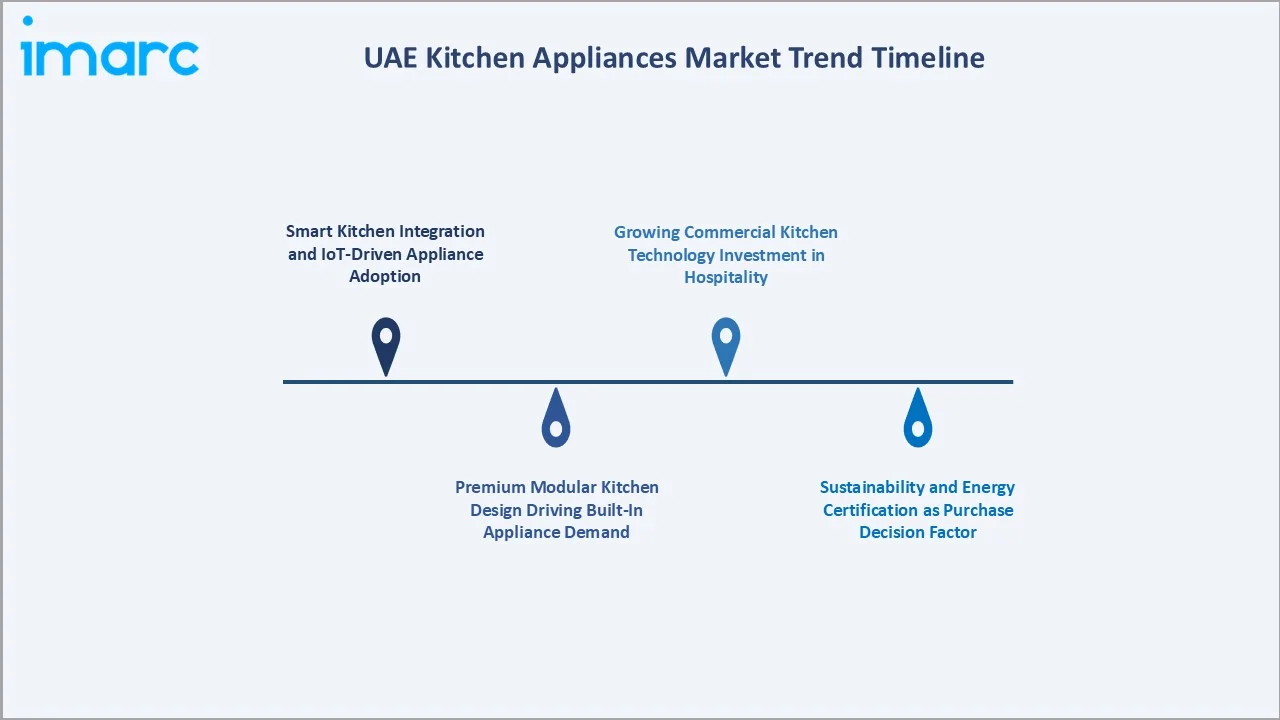
1. Smart Kitchen Integration and IoT-Driven Appliance Adoption
Smart kitchen integration and IoT adoption are driving demand for connected appliances with remote operation, voice control, and energy analytics. Consumers increasingly seek appliances compatible with smart home ecosystems. This trend encourages brands to launch feature-rich, technology-led kitchen collections, enhancing brand differentiation and creating premium revenue streams within the UAE market.
2. Premium Modular Kitchen Design Driving Built-In Appliance Demand
Growing consumer preference for modular kitchen designs in luxury and upper mid-market residential projects is driving demand for built-in appliances. Property developers and interior designers are increasingly specifying integrated kitchen systems, elevating the built-in segment's growth trajectory. This trend encourages European premium brands to expand UAE market presence with high-design kitchen solutions.
3. Sustainability and Energy Certification as Purchase Decision Factor
Rising environmental awareness and UAE government sustainability mandates are making energy efficiency certifications a key purchase decision factor. Consumers and developers are prioritizing appliances with high energy star ratings and eco-mode capabilities. This trend is accelerating product development investment in green technologies, creating a sustainable competitive advantage for brands that lead on energy performance metrics.
4. Growing Commercial Kitchen Technology Investment in Hospitality
The UAE's rapidly expanding hospitality sector is driving significant investment in commercial kitchen technologies. Hotels, restaurants, and catering operations are upgrading kitchen infrastructure with advanced appliances that enhance operational efficiency, food safety compliance, and energy management. This institutional demand is creating a structurally growing commercial kitchen sub-market with above-average per-unit appliance value.
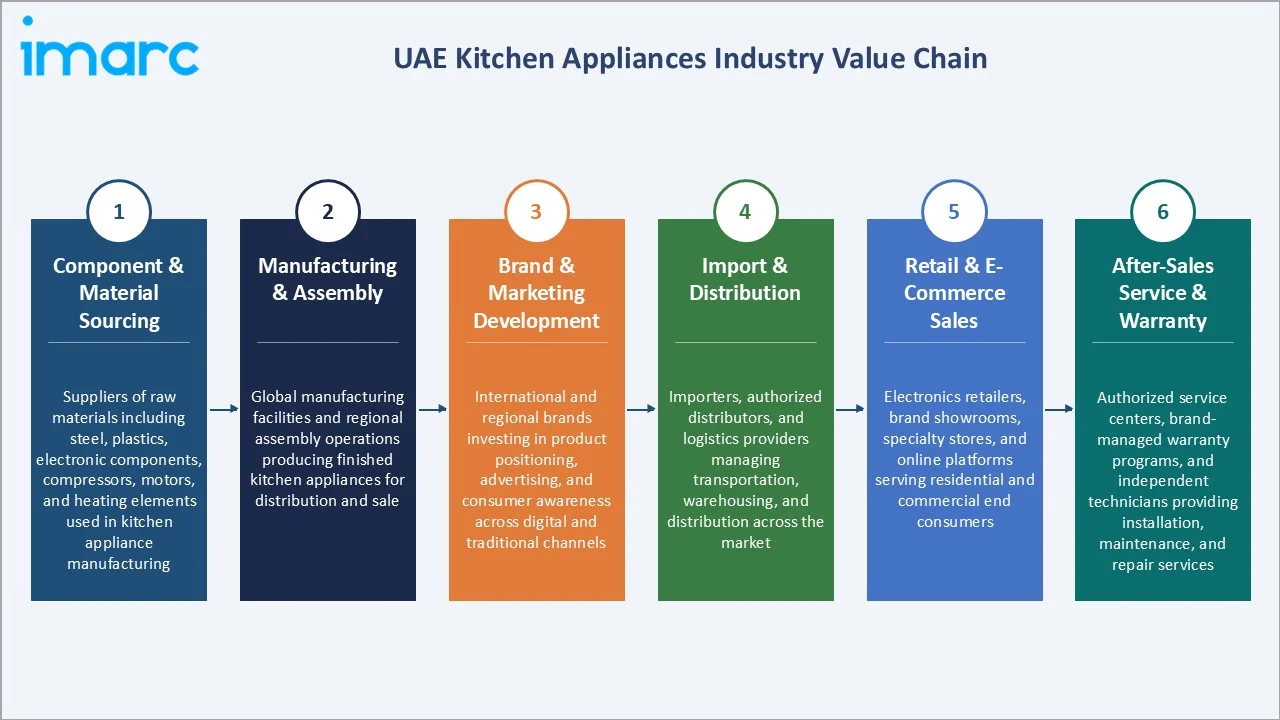
Industry Value Chain Analysis
The UAE kitchen appliances value chain is one of the most import-dependent of any consumer product category in the Middle East. The value chain's commercial structure creates the UAE's unique market dynamic, where international brand distribution competes across vastly different price points with overlapping commercial objectives for the UAE's diverse consumer segments.
|
Stage |
Key Participants |
|
Component & Material Sourcing |
Suppliers of raw materials including steel, plastics, electronic components, compressors, motors, and heating elements used in kitchen appliance manufacturing |
|
Manufacturing & Assembly |
Global manufacturing facilities and regional assembly operations producing finished kitchen appliances for distribution and sale |
|
Brand & Marketing Development |
International and regional brands investing in product positioning, advertising, and consumer awareness across digital and traditional channels |
|
Import & Distribution |
Importers, authorized distributors, and logistics providers managing transportation, warehousing, and distribution across the market |
|
Retail & E-Commerce Sales |
Electronics retailers, brand showrooms, specialty stores, and online platforms serving residential and commercial end consumers |
|
After-Sales Service & Warranty |
Authorized service centers, brand-managed warranty programs, and independent technicians providing installation, maintenance, and repair services |
The import and distribution stage is the most commercially consequential stage, where international brands invest significantly on marketing to maintain brand narrative authority in the UAE's highly competitive multi-brand appliance market and sustain consumer preference above purely price-driven purchase decisions.
Technology Landscape in the UAE Kitchen Appliances Industry
Smart Connectivity and IoT Integration Technologies
Smart connectivity and IoT integration technologies provide consumers with remote appliance monitoring, voice control through smart speakers, and intelligent energy management. These technologies enable brands to differentiate products, offer variety from entry-level to high-end smart appliances, and support innovation in user interface design, precision cooking, and ecosystem compatibility, strengthening the UAE's smart kitchen appliance market.
Energy Efficiency and Green Appliance Technologies
Energy efficiency and green appliance technologies integrate advanced compressor systems, inverter motors, and intelligent energy management platforms. Appliances equipped with these technologies deliver significant reductions in electricity consumption, addressing both consumer cost concerns and UAE government sustainability mandates. In alignment with the UAE Energy Strategy 2050, energy-efficient certifications are becoming standard requirements for premium residential project specifications.
Induction and Advanced Cooking Technologies
Induction and advanced cooking technologies are transforming conventional gas-dominated kitchen environments through precise, responsive, and energy-efficient heating platforms. Induction cooktops offer enhanced safety features particularly relevant in UAE apartment complexes, while rapid boil, precise temperature control, and smart recipe integration features attract tech-forward consumers. This technology transition is driving segment share shift from cooking gas toward electricity-powered appliances.
Market Segmentation Analysis
The report covers the following segments:
|
Segment Category |
Leading Segment |
Market Share |
Year |
|
Product Type |
🔒 |
🔒 |
2025 |
|
Structure |
Free Stand |
62.7% |
2025 |
|
Fuel Type |
Electricity |
72.8% |
2025 |
|
Application |
🔒 |
🔒 |
2025 |
|
Distribution Channel |
🔒 |
🔒 |
2025 |
|
Region |
Dubai |
45.8% |
2025 |

By Fuel Type
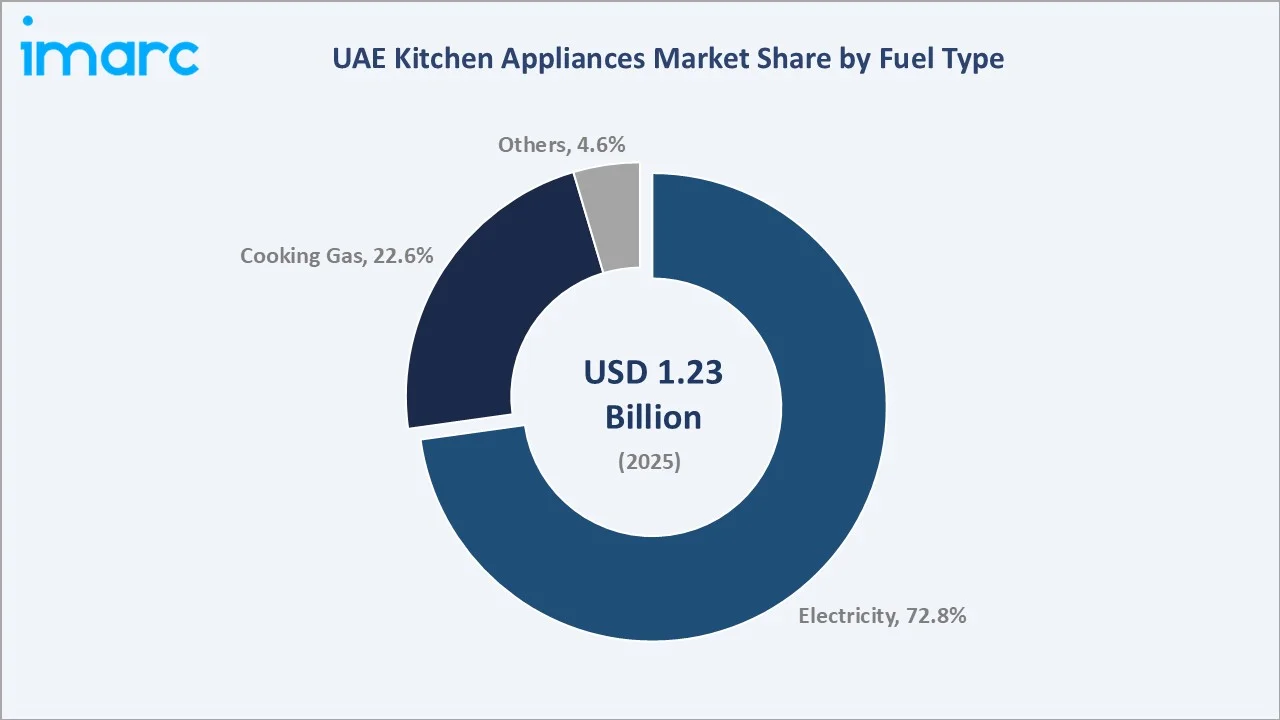
Electricity leads at 72.8% (2025). The electricity segment encompasses the UAE's most commercially diverse appliance range, from entry-level electric cookers to premium smart induction systems, covering modern kitchen design, smart home integration, and sustainability-driven consumer demand across the UAE's most commercially mature appliance market segment.
To access detailed market analysis, Request Sample
Cooking Gas at 22.6% maintains a significant commercial base, particularly among expatriate communities where gas cooking traditions are embedded.
By Structure
Free Stand leads at 62.7% (2025). This segment serves the UAE's predominantly apartment-based residential sector through versatile, cost-effective, and easily installable appliances that cater to the large transient expatriate population.
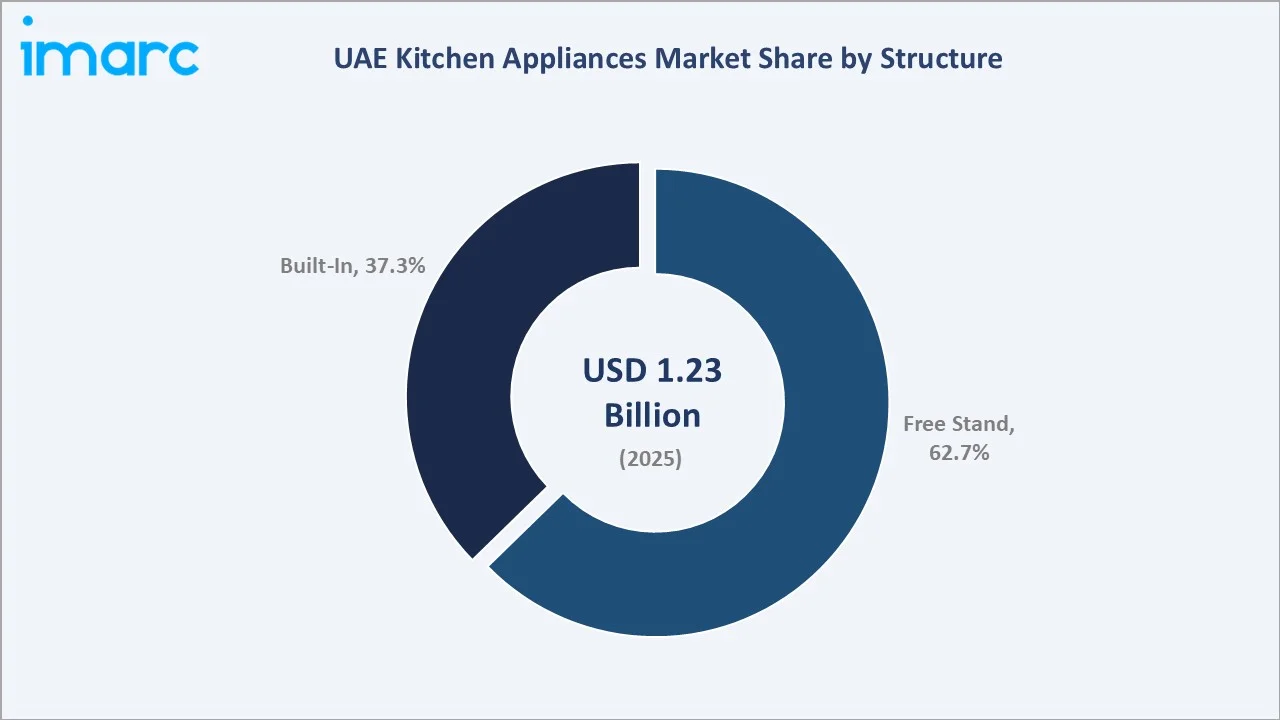
Built-In at 37.3% grows fastest through increasing adoption in luxury villa developments, premium apartment projects, and modular kitchen installations. As the UAE's real estate market gravitates toward owner-occupied luxury properties, built-in appliance integration is becoming a standard specification in new residential completions.
Regional Market Insights
|
Region |
Share (2025) |
Key Drivers & Characteristics |
|
Dubai |
45.8% |
Large urban population, high purchasing power, and premium retail infrastructure supporting sustained appliance demand. |
|
Abu Dhabi |
34.7% |
Government-driven residential construction, capital city growth, and expanding commercial sector supporting appliance procurement. |
|
Sharjah |
13.8% |
Growing mid-range residential sector and price-conscious consumer base driving steady appliance demand. |
|
Others |
5.7% |
Emerging residential developments in other emirates driving baseline appliance demand across value segments. |
Dubai's 45.8% market leadership reflects its dense urban population, the GCC's highest luxury retail density, dominant share of the UAE's expatriate population, and world-class hospitality and tourism infrastructure that creates consistent premium appliance procurement. Abu Dhabi's 34.7% reflects the capital's government-driven luxury residential construction, expanding commercial sector, and high-income government employee base.
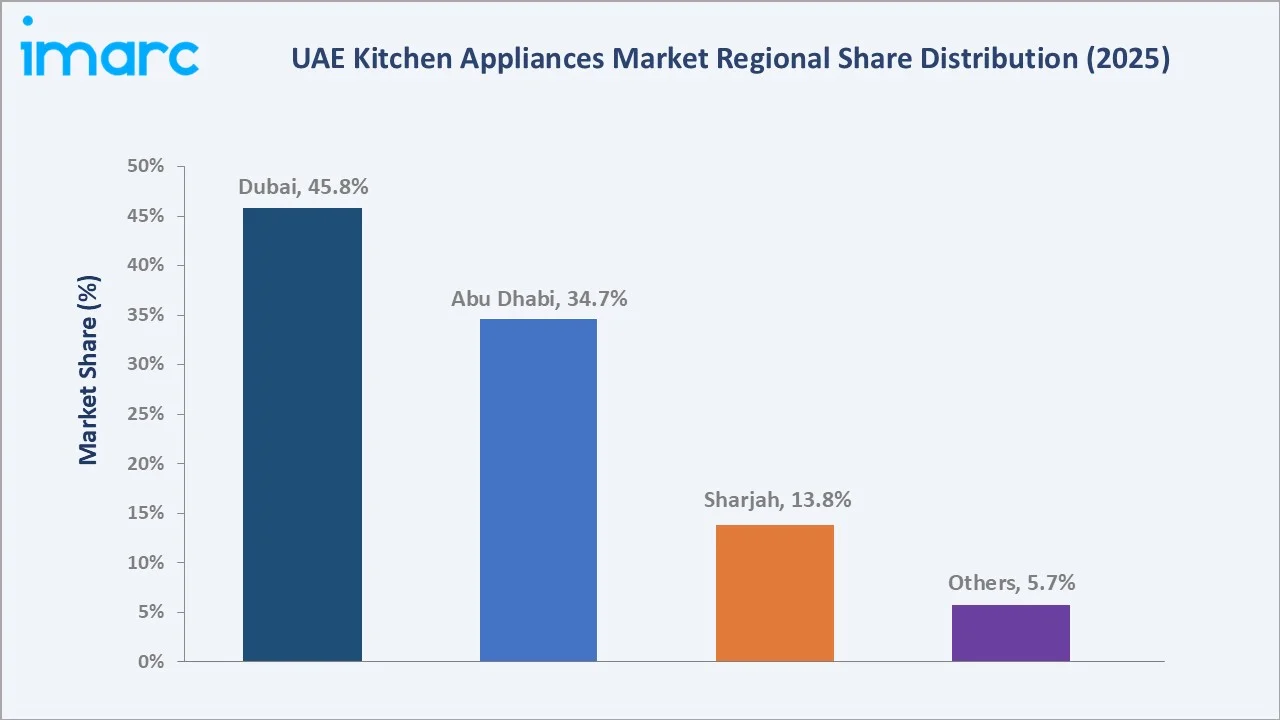
Sharjah's 13.8% reflects a price-sensitive but large consumer base that benefits from proximity to Dubai's retail infrastructure, with growing mid-range residential construction supporting steady appliance demand growth. Other Emirates' 5.7% represents the most commercially underdeveloped region but growing above the overall market CAGR as emerging industrial and tourism development creates first-generation premium appliance demand.
Competitive Landscape
The UAE kitchen appliances market competitive landscape is commercially stratified across global electronics leaders, European premium appliance specialists, and cost-competitive Asian manufacturers. Competition is intensifying due to growing e-commerce adoption, rising smart appliance demand, and increasing consumer access to international brands through digital platforms and authorized distribution expansion.
|
Company |
Key Brands |
Market Position |
Core Strength |
|
Samsung |
Refrigerators, Cooking Appliances, Dishwashers |
Market Leader |
Global electronics leader with the widest kitchen appliance portfolio, spanning refrigerators, microwave ovens, and smart appliances. |
|
LG Electronics |
Refrigerators, Cooking Appliances, Dishwashers, Dryers, Vacuum Cleaners |
Strong Challenger |
Korean technology brand with innovative home appliance solutions, recognized for energy efficiency and smart home integration. |
|
Midea Group |
Refrigerators, Dishwashers, Cooking Ranges, Microwave Ovens |
Cost Leader |
Chinese electronics giant offering competitively priced kitchen appliances with growing quality perception, capturing the value-seeking market tier. |
Key players include Samsung, LG Electronics, Midea Group, and others.
Key Company Profiles
Samsung
Samsung is one of the UAE's most widely distributed kitchen appliance brands, known for its expansive portfolio spanning refrigerators, microwave ovens, cooking ranges, and smart kitchen systems. Samsung's strong brand equity, technology leadership, and extensive authorized dealer network make it the market's most commercially dominant single brand.
- Key Brands: Refrigerators, Cooking Appliances, Dishwashers
- Strategic Focus: Maintaining market leadership through technology-forward smart appliance launches, energy efficiency positioning, and expansion of authorized retail partnerships across UAE emirates. Samsung is deepening integration between its kitchen appliances and the SmartThings home ecosystem, positioning the brand at the forefront of the UAE's smart kitchen transition. Continued investment in Bespoke product customization and premium retail experiences reinforces Samsung's leadership across both mass and luxury appliance segments.
LG Electronics
LG Electronics is a major player in the UAE kitchen appliances market, bridging the gap between premium performance and consumer accessibility through its diversified appliance portfolio. LG's emphasis on energy efficiency, InstaView door-in-door refrigerators, and smart kitchen connectivity has positioned the brand as a technology-driven strong challenger to market leadership.
- Key Brands: Refrigerators, Cooking Appliances, Dishwashers, Dryers, Vacuum Cleaners
- Strategic Focus: Growing market share through smart home ecosystem integration, premium product positioning, and expanding built-in appliance presence in the UAE's luxury residential segment. LG is increasing its focus on energy-efficient appliance categories aligned with UAE sustainability mandates, creating a green product portfolio that resonates with both developers and environmentally conscious consumers. Investment in after-sales service infrastructure and extended warranty programs is strengthening LG's long-term consumer relationship management in the UAE market.
Market Concentration Analysis
The UAE kitchen appliances market is moderately concentrated at the premium and luxury segments, with the key players commanding an estimated 35–45% of the UAE's organized branded kitchen appliance market by value, reflecting their broad portfolio coverage and extensive distribution networks. The market shows higher fragmentation in the mid-range segment, where European, American, and Chinese brands compete intensively on price, performance, and brand equity.
Market concentration is evolving through two opposing forces: Samsung and LG's continued product innovation and retail network expansion maintaining dominant combined market position, while European premium brands and value-focused Chinese manufacturers are simultaneously expanding market share at the premium and budget tiers respectively, gradually fragmenting the mid-market space.
Investment & Growth Opportunities
Highest Growth Segments
Built-in appliance segment (~5.8% CAGR through luxury real estate growth), electricity-powered appliances (~5.2% CAGR through smart appliance adoption), Abu Dhabi commercial kitchen sector (~4.9% CAGR through hospitality expansion), cooking gas (~2.5% CAGR), and premium modular kitchen systems represent the UAE's highest-growth kitchen appliances investment vectors through 2034.
Emerging Investment Opportunities
The UAE's smart home integration market, growing at 7–9% annually, represents the highest-CAGR kitchen appliances segment. The smart kitchen opportunity is driven by the UAE government's smart city mandates, high consumer technology adoption rates, and property developers' increasing inclusion of smart kitchen specifications as a premium residential differentiator.
Investment Themes
- Premium built-in appliance expansion through luxury residential project partnerships with UAE property developers, creating above-market growth opportunity through specified integration contracts.
- Smart kitchen ecosystem investment for UAE's most commercially dynamic appliance segment: IoT kitchen platform investment requires connectivity software, appliance integration hardware, and smart home partnership development.
- Commercial kitchen technology investment targeting UAE's hospitality sector expansion, where professional-grade kitchen appliance demand is growing above residential market CAGR through consistent hotel and restaurant sector growth.
Future Market Outlook (2026-2034)
The UAE kitchen appliances market is projected to grow from USD 1.23 Billion in 2025 to USD 1.28 Billion in 2026, reaching USD 1.84 Billion by 2034, registering a CAGR of 4.47% during 2026-2034. The market's anchor value of USD 1.53 Billion in 2030 represents a structural inflection point. The smart appliance segment is growing as the UAE's technology adoption culture creates the fastest-growing smart kitchen buyer base in the GCC.
Three structural forces define UAE kitchen appliances market growth through 2034: the UAE's continuous real estate development pipeline creating consistent new installation demand; the growing affluent middle class and expatriate professional population driving premiumization; and digital commerce maturation creating geographic appliance market democratization across all seven emirates.
Research Methodology
Primary Research
Primary research comprised structured interviews with UAE kitchen appliances industry stakeholders, including Retail Directors, Brand Managers, authorized distributor representatives, e-commerce category managers, and consumer survey data from UAE kitchen appliance buyers across Dubai, Abu Dhabi, and Sharjah, spanning premium, mid-range, and value segment buyers.
Secondary Research
Secondary research encompassed UAE trade import-export data, company annual reports, UAE real estate sector analysis, appliance industry association publications, investor presentations, and retail market studies. Over 50 secondary sources were reviewed including Euromonitor, GfK, and regional real estate market reports.
Forecasting Models
Market revenue forecasts were developed using a real estate completions-driven demand model: UAE residential and commercial unit completions by segment multiplied by appliance penetration rates and average ticket size per segment, creating total market revenue by segment aggregation. E-commerce growth multiplier and hospitality sector expansion factors applied across relevant categories.
UAE Kitchen Appliances Market Report Coverage:
| Report Features | Details |
|---|---|
| Base Year of the Analysis | 2025 |
| Historical Period | 2020-2025 |
| Forecast Period | 2026-2034 |
| Units | Billion USD |
| Scope of the Report |
Exploration of Historical Trends and Market Outlook, Industry Catalysts and Challenges, Segment-Wise Historical and Future Market Assessment:
|
| Product Types Covered | Refrigerators, Microwave Ovens, Induction Stoves, Dishwasher, Water Purifiers, Others |
| Structures Covered | Built-In, Free Stand |
| Fuel Types Covered | Cooking Gas, Electricity, Others |
| Applications Covered | Residential, Commercial |
| Distribution Channels Covered | Supermarkets and Hypermarkets, Specialty Stores, Online Stores, Departmental Stores, Others |
| Regions Covered | Dubai, Abu Dhabi, Sharjah, Others |
| Companies Covered | Samsung, LG Electronics, Midea Group, etc. |
| Customization Scope | 10% Free Customization |
| Post-Sale Analyst Support | 10-12 Weeks |
| Delivery Format | PDF and Excel through Email (We can also provide the editable version of the report in PPT/Word format on special request) |
Key Benefits for Stakeholders:
- IMARC’s industry report offers a comprehensive quantitative analysis of various market segments, historical and current market trends, market forecasts, and dynamics of the UAE kitchen appliances market from 2020-2034.
- The research report provides the latest information on the market drivers, challenges, and opportunities in the UAE kitchen appliances market.
- Porter's five forces analysis assist stakeholders in assessing the impact of new entrants, competitive rivalry, supplier power, buyer power, and the threat of substitution. It helps stakeholders to analyze the level of competition within the UAE kitchen appliances industry and its attractiveness.
- Competitive landscape allows stakeholders to understand their competitive environment and provides an insight into the current positions of key players in the market.
Frequently Asked Questions About the UAE Kitchen Appliances Market Report
UAE kitchen appliances market size is estimated at USD 1.28 Billion in 2026, driven by rapid urbanization, rising disposable incomes, and expanding smart appliance adoption. Growing e-commerce penetration, luxury real estate development, and hospitality sector expansion further support market growth across Dubai, Abu Dhabi, and Sharjah.
UAE kitchen appliances market grows at 4.47% CAGR during 2026-2034, reaching USD 1.84 Billion by 2034. Growth is sustained by the UAE's real estate development pipeline, growing smart appliance adoption, e-commerce expansion, and continuous hospitality sector investment.
Electricity leads at 72.8% through the UAE's dominant consumer preference for induction cooktops, electric ovens, and smart connected appliances that align with modern kitchen design and sustainability goals.
Free Stand leads at 62.7% through its versatility, cost-effectiveness, and suitability for the UAE's predominantly apartment-based residential sector and transient expatriate population that prefers flexible kitchen solutions.
Dubai leads at 45.8% through its large affluent expatriate population, high purchasing power, premium retail infrastructure, strong hospitality sector, and continuous luxury real estate development that drives appliance demand at scale.
Leading companies include Samsung, LG Electronics, Midea Group, and others.
The UAE kitchen appliances market is projected to reach approximately USD 1.53 Billion by 2030, with the smart appliance segment growing as the UAE's technology adoption culture accelerates IoT kitchen integration, e-commerce representing an increasing share of market revenue, and the built-in appliance segment surpassing 40% structural share.
Need more help?
- Speak to our experienced analysts for insights on the current market scenarios.
- Include additional segments and countries to customize the report as per your requirement.
- Gain an unparalleled competitive advantage in your domain by understanding how to utilize the report and positively impacting your operations and revenue.
- For further assistance, please connect with our analysts.
 Request Customization
 Speak to an Analyst
 Request Brochure
 Inquire Before Buying
Benefits of Customization
- Personalize this research
- Triangulate with your data
- Get data as per your format and definition
- Gain a deeper dive into a specific application, geography, customer, or competitor
- Any level of personalization
Get in Touch With Us
UNITED STATES
Phone: +1-201-971-6302
INDIA
Phone: +91-120-433-0800
UNITED KINGDOM
Phone: +44-753-714-6104
Email: [email protected]
Client Testimonials



















Related Reports

Choose your plan
*Please note that the prices mentioned below are starting prices for each bundle type. Kindly contact our team for further details.*
Single User License
- 1 User License, Access on 2 Devices
- PDF Report + Excel Dataset (Password Protected)
- Lifetime Access
- No Printing Rights
- 10% Free Report Customization
- 10–12 Weeks of Analyst Support
Five User License
- Access for 5 Users, 2 Devices per User
- PDF Report + Excel Dataset (Password Protected)
- Lifetime Access
- Dedicated Account Manager
- 12–14 Weeks of Analyst Support
- No Printing Rights
- 15% Free Report Customization
- 25% Discount on Your Next Purchase
Corporate User License
- Unlimited User Access (Within Your Organization)
- PDF Report + Excel Dataset
- Lifetime Access
- Dedicated Account Manager
- 14–20 Weeks of Analyst Support
- No Printing Rights
- 20% Free Report Customization
- 30% Discount on Your Next Purchase
Essential Insights
What's included:
3 reports
- Lifetime Access
- PDF Reports
- Excel Datasets
- 2 Weeks of Free Analyst Support
- 2 User Licenses
- Access on 2 Devices
- Printing Rights
- Complimentary PowerPoint (PPT) Version
- Complimentary License Upgrade
Professional Access
What's included:
5 reports
- Lifetime Access
- PDF Reports
- Excel Datasets
- 8 Weeks of Free Analyst Support
- 2 User Licenses
- Access on 2 Devices
- Printing Rights
- Complimentary PowerPoint (PPT) Version
- Complimentary License Upgrade
Business Advantage
What's included:
8 reports
- Lifetime Access
- PDF Reports
- Excel Datasets
- 14 Weeks of Free Analyst Support
- 2 User Licenses
- Access on 2 Devices
- Printing Rights
- Complimentary PowerPoint (PPT) Version
- Complimentary License Upgrade
Enterprise Intelligence
What's included:
10 reports
- Lifetime Access
- PDF Reports
- Excel Datasets
- 20 Weeks of Free Analyst Support
- 2 User Licenses
- Access on 2 Devices
- Printing Rights
- Complimentary PowerPoint (PPT) Version
- Complimentary License Upgrade