
UAE Private Equity Market Size, Share, Trends and Forecast by Fund Type and Region, 2026-2034
UAE Private Equity Market Size, Share, Trends & Forecast (2026-2034)
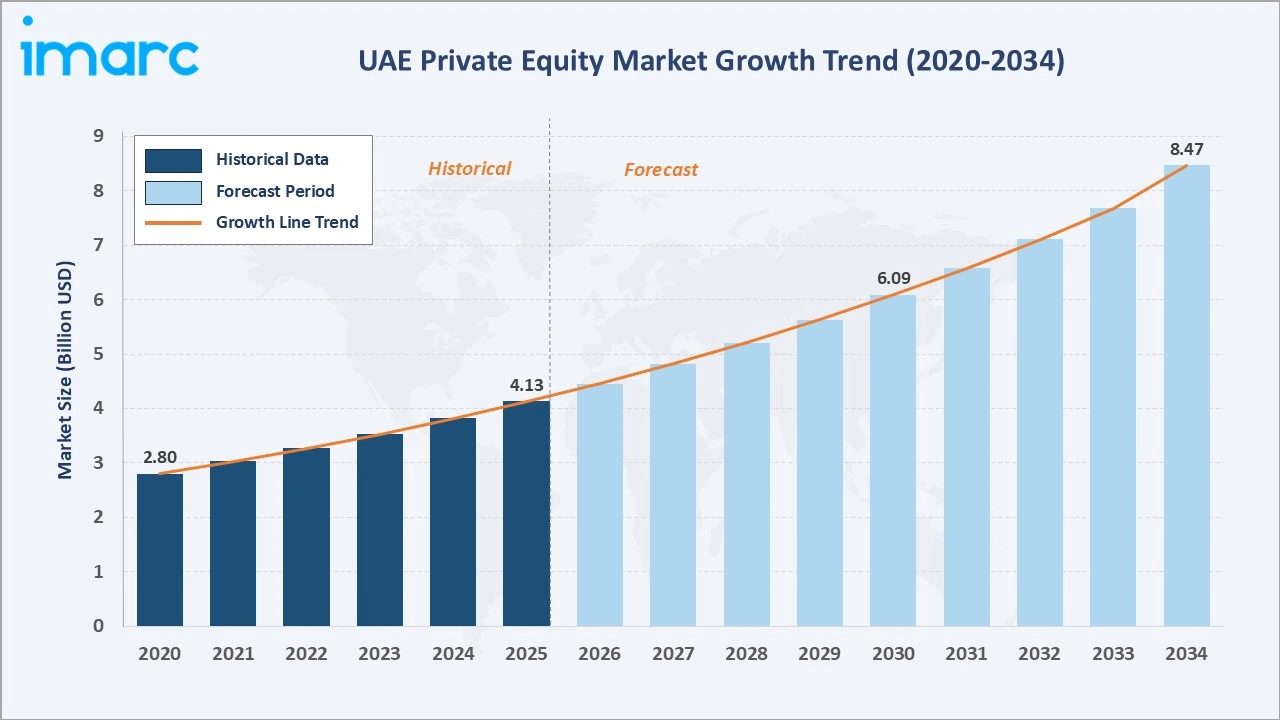
The UAE Private Equity market size grew from USD 4.13 Billion in 2025, reaching USD 4.46 Billion in 2026, and is projected to reach USD 8.47 Billion by 2034, exhibiting a CAGR of 8.06% during 2026-2034. The market is driven by economic diversification under Vision 2031, sovereign wealth fund co-investment activity, and a tax-neutral framework attracting global fund managers seeking high-growth Middle East exposure. Buyout funds lead at 32.8% followed by Venture Capital at 27.6%. Dubai commands 39.7% of total regional market share in 2025.
Market Snapshot
|
Metric |
Value |
|
Base Year Market Size (2025) |
USD 4.13 Billion |
|
Market Size (2026) |
USD 4.46 Billion |
|
Forecast Market Size (2034) |
USD 8.47 Billion |
|
CAGR (2026-2034) |
8.06% |
|
Base Year |
2025 |
|
Historical Period |
2020-2025 |
|
Forecast Period |
2026-2034 |
|
Dominant Fund Type |
Buyout (32.8%, 2025) |
|
Leading Region |
Dubai (39.7%, 2025) |
The UAE Private Equity market size increased from USD 2.80 Billion in 2020 to USD 4.13 Billion in 2025 and is estimated to reach USD 4.46 Billion in 2026. The market is further expected to grow to USD 6.09 Billion by 2030 and USD 8.47 Billion by 2034, underpinned by sovereign wealth fund activity, regulatory modernization, and Vision 2031-aligned economic diversification strategies.
To get more information on this market, Request Sample
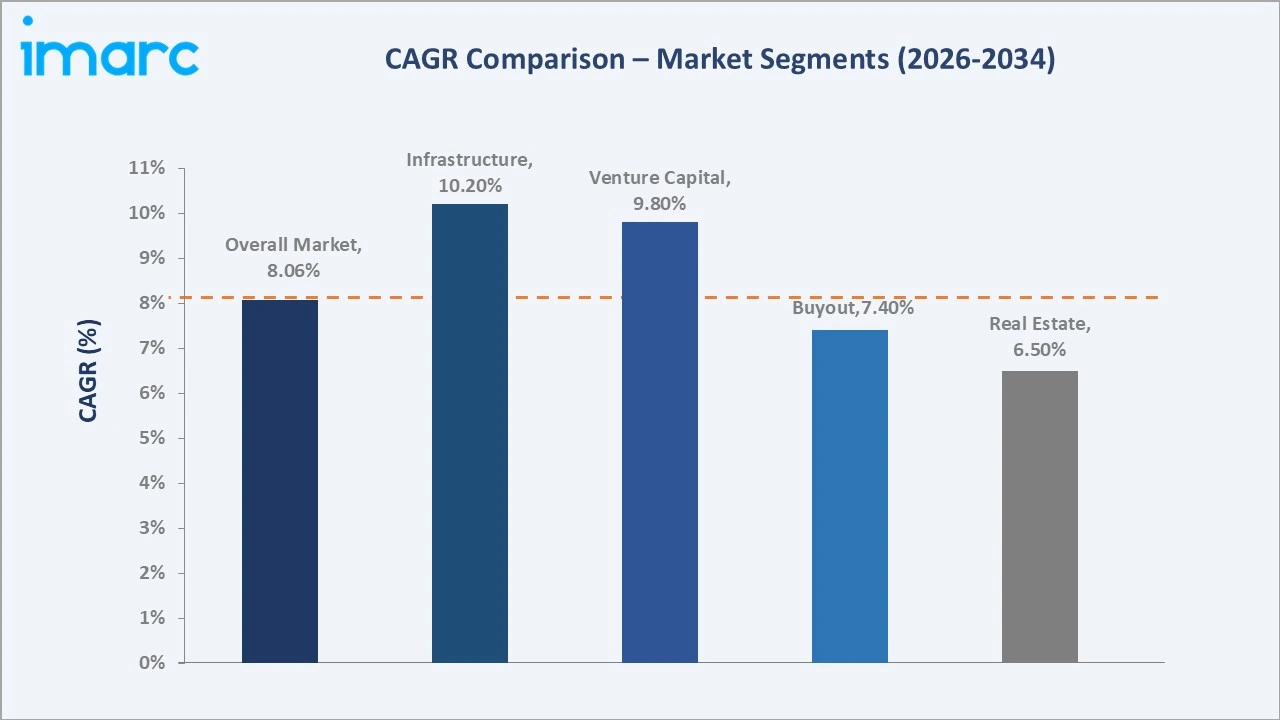
Infrastructure Funds lead segment growth at a projected 10.20% CAGR, followed by Venture Capital at 9.80%, reflecting government-driven infrastructure pipelines and a thriving startup ecosystem. The overall UAE PE market CAGR of 8.06% anchors a diversified growth profile across fund types, with Buyout Funds growing at 7.40% and Real Estate Funds at 6.50%, signaling a maturing market with differentiated return opportunities across strategies.
Executive Summary
The UAE Private Equity market expanded from USD 4.13 Billion in 2025 to an estimated USD 4.46 Billion in 2026, and is projected to reach USD 8.47 Billion by 2034, at a CAGR of 8.06%. The market benefits from a robust regulatory environment, strategic sovereign co-investments through entities such as Mubadala Investment Company and ADQ, and a tax-neutral framework that attracts global fund managers seeking high-growth Middle East exposure.
Buyout funds dominate the landscape, accounting for 32.8% of total market share in 2025. Dubai leads regionally with a 39.7% share, supported by its position as a global financial hub and home to the Dubai International Financial Centre (DIFC).
Key Market Insights
|
Category |
Insight |
|
Market Size (2025) |
USD 4.13 Billion |
|
Forecast (2034) |
USD 8.47 Billion at 8.06% CAGR |
|
Top Fund Type |
Buyout – 32.8% share in 2025 |
|
Leading Region |
Dubai – 39.7% share in 2025 |
|
Key Opportunity Sectors |
Healthcare, logistics, fintech, and renewable energy |
Key Analytical Observations Supporting the Above Data:
- Buyout at 32.8%: Buyout funds lead the UAE private equity market owing to the strong pipeline of mature family-owned conglomerates and government-linked enterprises undergoing ownership restructuring and professionalization.
- Dubai at 39.7%: Dubai leads regional market share owing to its position as the Middle East’s premier financial hub, anchored by DIFC’s world-class regulatory framework, deep pool of institutional and family office capital, and concentration of regional headquarters for global asset managers.
UAE Private Equity Market Overview
Global private equity assets under management surpassed USD 8 Trillion in 2024, with the MENA region accounting for an increasingly significant share of global deal flow. The country's integration into global financial networks, stable macroeconomic conditions, USD-pegged currency reducing FX risk for dollar-denominated funds, and proactive regulatory reforms position it as a premier alternative investment hub.
International fund managers including EQT, Eurazeo, and Permira have established or expanded regional offices in Dubai and Abu Dhabi, reflecting strong confidence in sustained UAE PE market growth. The global trend toward alternative asset diversification further supports UAE PE inflows, as institutional investors worldwide seek uncorrelated returns through exposure to high-growth emerging market economies aligned with national economic diversification agendas.
Market Dynamics
To evaluate market opportunities, Request Sample
Market Drivers
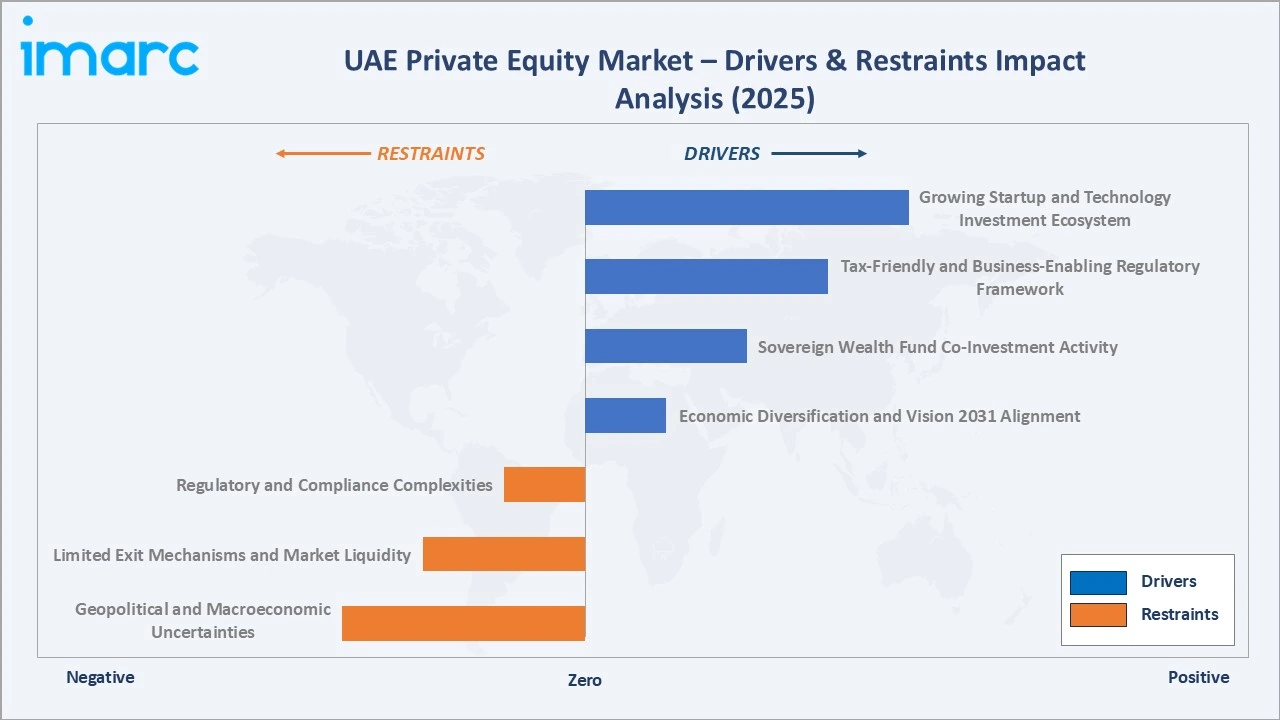
- Economic Diversification and Vision 2031 Alignment: UAE Vision 2031 targets non-oil GDP contribution exceeding 75%, with PE-backed investments in healthcare, logistics, and manufacturing central to this structural diversification. More than USD 20 Billion is channeled annually into strategic non-oil sectors through PE-aligned government and private co-investment frameworks. Free zone incentives and streamlined licensing procedures have reduced market entry barriers, enabling faster deployment timelines for global fund managers targeting UAE assets. The National Strategy for Advanced Technology further creates a robust pipeline of investable technology companies across AI, clean energy, and digital services sectors.
- Sovereign Wealth Fund Co-Investment Activity: Sovereign wealth deployed over various funds through PE co-investments, reducing perceived transaction risk and attracting international LP commitments to UAE-focused fund vehicles and co-investment platforms. Their participation signals government commitment to sector development and provides anchor capital that improves overall fund economics and deal structuring flexibility. Sovereign co-investors also bring deep sector expertise and regulatory access that commercial PE managers leverage to accelerate portfolio growth and exit readiness.
- Tax-Friendly and Business-Enabling Regulatory Framework: DIFC and ADGM offer zero capital gains tax, 100% foreign ownership, and world-class regulatory frameworks modeled on English common law, attracting financial institutions and PE and VC firms to establish UAE operations. Continuous regulatory innovation, including new LP-friendly fund structures and digital asset frameworks, maintains the UAE's competitive advantage as a PE domicile.
- Growing Startup and Technology Investment Ecosystem: UAE's fintech sector received investment, with e-commerce, health-tech, and logistics startups providing attractive early-stage and growth-stage PE opportunities across the GCC digital economy. Government-backed accelerator programs and innovation hubs within DIFC FinTech Hive and Hub71 in Abu Dhabi have cultivated a pipeline of venture-stage companies ready for institutional capital infusion and regional scale-up strategies. The rapid adoption of digital payments and embedded finance creates high-value exit opportunities for PE investors through strategic acquirer interest from global technology companies.
Market Restraints
- Regulatory and Compliance Complexities: Evolving compliance standards across DIFC and ADGM frameworks, combined with cross-border regulatory alignment requirements under FATF and AIFMD-equivalent rules, introduce operational complexity for fund managers structuring multi-jurisdiction PE vehicles. Increasing KYC/AML scrutiny from international LPs adds due diligence overhead and can extend fundraising timelines for newly established UAE-domiciled PE funds. Continuous updates to beneficial ownership registers and ESG disclosure requirements necessitate ongoing compliance investment that disproportionately burdens smaller managers.
- Limited Exit Mechanisms and Market Liquidity: The secondary PE market in the UAE remains nascent compared to mature markets in the US and UK, limiting liquidity options for LP investors seeking early exits from long-duration fund commitments in a rising rate and evolving macro environment. Limited public market depth on DFM and ADX relative to portfolio valuations constrains the IPO exit pathway, forcing reliance on trade sales and secondary buyouts that may compress realizable multiples for PE fund managers targeting portfolio monetization. The underdeveloped credit market for leveraged buyout financing also constrains deal structures available to international PE managers accustomed to high-leverage transactions.
- Geopolitical and Macroeconomic Uncertainties: Broader geopolitical uncertainties in the MENA region, including conflicts in neighboring territories and diplomatic tensions, can influence sovereign fund allocation priorities and temporarily affect PE deal activity across regional investment mandates. Oil price volatility, despite the UAE's diversification progress, still indirectly influences government spending priorities, affecting sovereign co-investment appetite and overall LP confidence in MENA-focused PE fund strategies. Global monetary tightening cycles and rising cost of capital in developed markets create valuation headwinds for UAE PE portfolios with significant cross-border exposures.
Market Opportunities
- Expansion into Healthcare and Education Sectors: Healthcare and education remain underpenetrated by PE capital in the UAE, presenting significant growth opportunities as government-led initiatives unlock private sector participation in social infrastructure sectors with long concession periods. Aging population demographics and rising medical tourism expenditure create durable demand for premium healthcare services, diagnostics, and pharmaceutical distribution platforms well-suited to PE-led operational transformation and regional consolidation. Digital health platforms and telemedicine solutions represent emerging sub-sectors where VC and growth equity PE investors can capture early-mover advantages.
- Digital Transformation and Technology-Focused Investments: Digital transformation across UAE industries creates PE investment opportunities in cloud infrastructure, AI-powered enterprise platforms, cybersecurity solutions, and smart city technology. The UAE's ambitious digital government agenda and smart economy initiatives generate procurement pipelines that PE-backed technology companies can target with specialized public sector solutions across healthcare, logistics, and education verticals. Blockchain and Web3 infrastructure investments within DIFC's regulatory sandbox provide PE firms with early-stage exposure to disruptive technologies reshaping traditional finance and asset management in the broader MENA region.
Market Challenges
- Talent Acquisition and Retention: Sourcing specialized talent in fund management, deal origination, portfolio operations, and sector advisory remains a structural constraint for UAE PE growth, requiring sustained investment in human capital development and international talent attraction. Competition for senior investment professionals from global financial institutions and technology firms creates wage inflation pressures that affect PE fund economics. Limited local supply of mid-career investment professionals with sector-specific expertise in healthcare, technology, or infrastructure compounds the talent deficit particularly at the vice-president to principal career levels critical to deal execution.
- Currency and Valuation Risks: Exchange rate exposure in cross-border PE transactions and portfolio company valuations denominated in non-USD currencies introduces financial risk that requires active hedging strategies, particularly for UAE funds investing across MENA in Egyptian Pound or Saudi Riyal. Mark-to-market valuation pressures from global equity market volatility affect LP satisfaction metrics and secondary market pricing for UAE-focused fund interests, creating reputational and regulatory pressure during quarterly reporting periods.
Emerging Market Trends
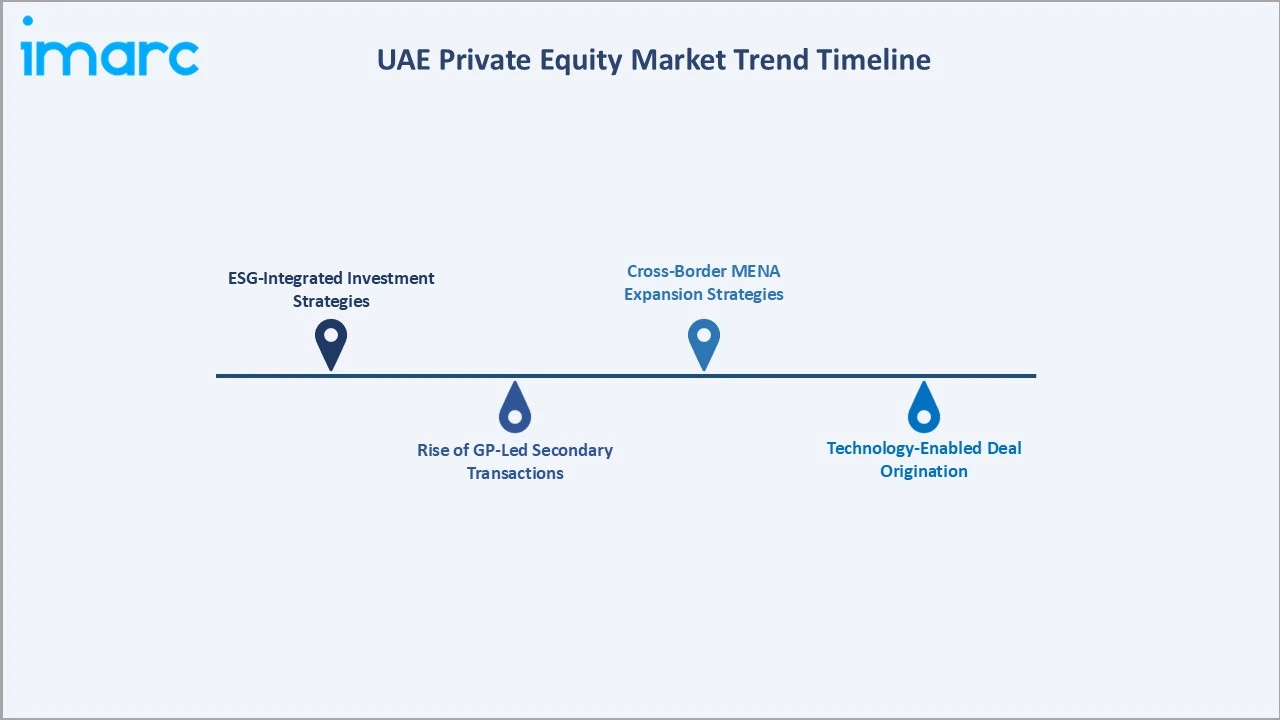
1. ESG-Integrated Investment Strategies
PE funds operating in the UAE increasingly embed environmental, social, and governance criteria into due diligence, deal structuring, and portfolio monitoring processes. ESG-aligned funds command premium valuations and attract institutional LP capital from European and North American investors subject to their own sustainability mandates.
2. Rise of GP-Led Secondary Transactions
GP-led secondaries and continuation vehicles are gaining significant traction in the UAE PE market, offering liquidity solutions for mature portfolio companies without requiring full exits to strategic buyers or public markets. This structure allows high-performing portfolio companies to remain under PE ownership while providing liquidity to existing LPs who seek capital returns ahead of the original fund term, broadening the investor base for UAE-focused PE platforms.
3. Technology-Enabled Deal Origination
AI-powered deal sourcing platforms and data analytics tools are reshaping how UAE-based PE managers identify, screen, and evaluate investment targets, compressing due diligence timelines and improving risk-adjusted return outcomes across all fund strategies. Proprietary data partnerships with regional chamber of commerce databases and trade registries allow PE managers to identify pre-market opportunities before they enter formal sale processes, providing competitive advantages in deal origination.
4. Cross-Border MENA Expansion Strategies
UAE PE firms are increasingly deploying capital across Saudi Arabia, Egypt, and broader MENA markets, leveraging the UAE's status as a regional base to access high-growth economies with favorable demographic and consumption dynamics. Saudi Arabia's Vision 2030 creates substantial co-investment opportunities for UAE-based PE managers with established Gulf relationships, as privatization mandates open previously restricted sectors to private capital deployment at scale.
Industry Value Chain Analysis
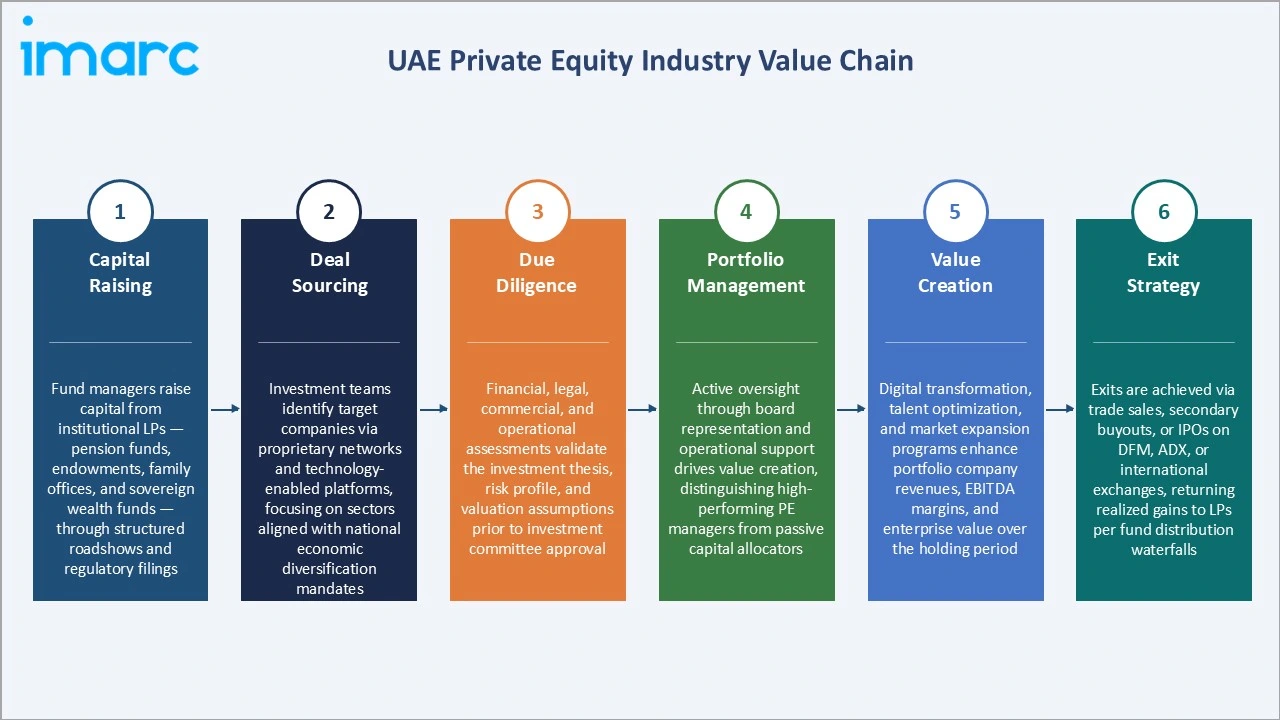
The UAE PE value chain encompasses six interdependent stages from capital formation to investor returns. The value chain's commercial structure creates the UAE's unique PE market dynamic, where sovereign-backed capital competes alongside global PE platforms at radically different deal sizes.
|
Stage |
Key Participants |
|
Capital Raising |
Fund managers raise capital from institutional LPs — pension funds, endowments, family offices, and sovereign wealth funds — through structured roadshows and regulatory filings. |
|
Deal Sourcing |
Investment teams identify target companies via proprietary networks and technology-enabled platforms, focusing on sectors aligned with national economic diversification mandates. |
|
Due Diligence |
Financial, legal, commercial, and operational assessments validate the investment thesis, risk profile, and valuation assumptions prior to investment committee approval. |
|
Portfolio Management |
Active oversight through board representation and operational support drives value creation, distinguishing high-performing PE managers from passive capital allocators. |
|
Value Creation |
Digital transformation, talent optimization, and market expansion programs enhance portfolio company revenues, EBITDA margins, and enterprise value over the holding period. |
|
Exit Strategy |
Exits are achieved via trade sales, secondary buyouts, or IPOs on DFM, ADX, or international exchanges, returning realized gains to LPs per fund distribution waterfalls. |
Portfolio management and value creation represent the most value-added stage, where active governance, strategic partnerships, and operational improvement initiatives drive superior exit outcomes for both fund managers and their LP investors.
Technology Landscape in the UAE PE Industry
AI-Driven Deal Origination and Screening
AI-driven deal screening and natural language processing tools reduce origination costs and improve target identification accuracy by 30–40% compared to traditional analyst-led sourcing methods. Proprietary AI platforms cross-reference trade registers, financial databases, and news feeds to surface pre-market investment opportunities, giving UAE-based PE managers a structural advantage in competitive deal processes.
Cloud-Based Fund Administration Platforms
Cloud-based fund administration platforms such as Allvue and Dynamo enhance operational efficiency for mid-market managers processing growing LP reporting and compliance requirements. These platforms reduce fund administration costs by 20–35% and improve reporting turnaround times, enabling smaller UAE PE firms to operate at institutional standards without proportionate back-office investment.
Blockchain and Digital Asset Infrastructure
Blockchain applications in smart contracts and real-time LP reporting are being piloted within DIFC's innovation sandbox environment, offering material cost reductions in fund operations. Cybersecurity investments have become mandatory for PE-backed fintech and digital infrastructure portfolios, reflecting heightened regulatory expectations from CBUAE, DIFC, and ADGM authorities regarding data protection and operational resilience.
Market Segmentation Analysis
The report covers the following segments:
|
Segment Category |
Leading Segment |
Market Share |
Year |
|
Fund Type |
Buyout |
32.8% |
2025 |
|
Region |
Dubai |
39.7% |
2025 |

Breakup by Fund Type
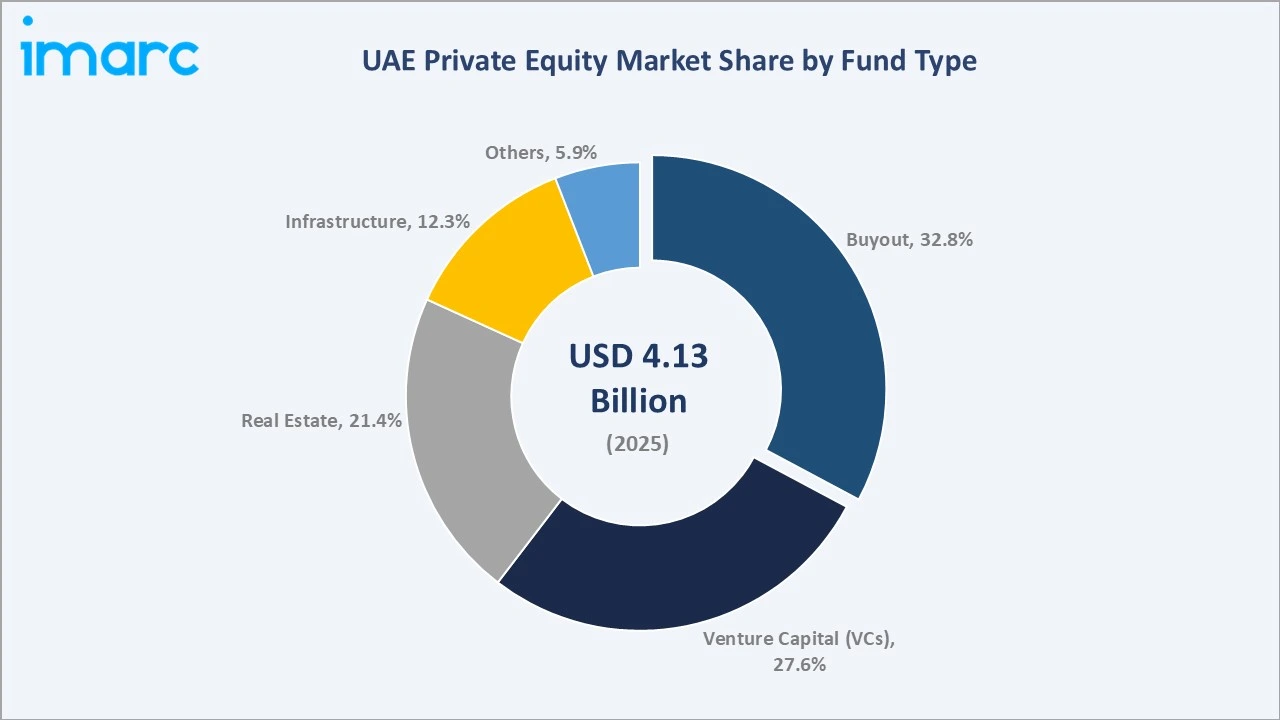
Buyout funds lead with a 32.8% share in 2025, followed by Venture Capital at 27.6%, Real Estate at 21.4%, and Infrastructure at 12.3%. This segmentation reflects the UAE market's maturity, where established buyout strategies coexist with a thriving VC ecosystem and growing infrastructure and real estate private capital mandates.
To access detailed market analysis, Request Sample
Buyout fund dominance is underpinned by a robust pipeline of family-owned business succession deals and government-linked enterprise privatizations, providing managers with access to cash-generative assets at defensible valuations.
Regional Market Insights
|
Region |
Share (2025) |
Key UAE Private Equity Market Drivers & Characteristics |
| Dubai | 39.7% | Driven by DIFC's concentration of global PE firms, common law legal framework, and world-class digital infrastructure that makes it the primary PE transaction and fund domicile hub across the GCC. |
| Abu Dhabi |
38.5% |
Supported by ADGM free zone and sovereign giants Mubadala and ADQ, focusing on energy transition, advanced manufacturing, and AI-aligned infrastructure and technology PE mandates. |
| Sharjah | 13.4% | Targets SME buyouts and manufacturing sector investments, benefiting from lower operating costs and technology PE interest through the Sharjah Research Technology and Innovation Park. |
| Others |
8.4% |
Ras Al Khaimah, Fujairah, and northern emirates attract industrial, tourism, and logistics PE capital, offering above-average growth from lower valuations and emerging free zones. |
Regionally, Dubai leads with 39.7%, followed by Abu Dhabi at 38.5%, Sharjah at 13.4%, and Other Emirates at 8.4% of total PE market share in 2025. This dual-hub dominance reflects the complementary roles of DIFC and ADGM in anchoring UAE PE activity.
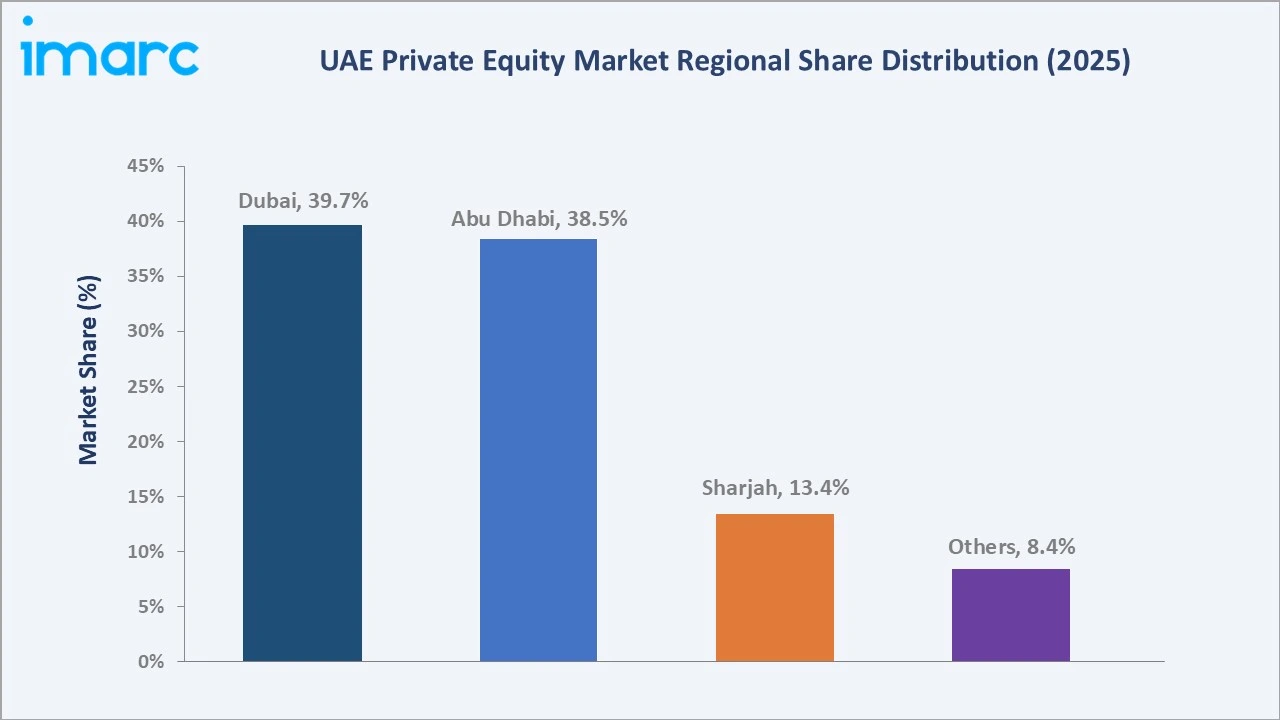
Dubai's 39.7% market leadership reflects DIFC's luxury retail density and the UAE's highest-concentration corporate investment procurement market.
Competitive Landscape
The UAE PE market features a diverse competitive landscape comprising sovereign wealth-backed entities, global buyout houses, and specialized regional managers. Market concentration is moderate at the top tier, with sovereign-backed institutions commanding the largest AUM while international managers compete for growth equity and buyout mandates.
|
Company |
Key Brands |
Market Position |
Core Strength |
| Mubadala Investment Company | Buyout, VC, Infrastructure PE |
Market Leader |
Largest UAE sovereign PE manager with a globally diversified portfolio across technology, healthcare, aerospace, and energy sectors. |
| Abu Dhabi Developmental Holding Company PJSC | Infrastructure, Buyout PE | Dominant Regional Player | Abu Dhabi government-backed platform with flagship PE investments across the UAE's strategic industrial and infrastructure sectors. |
| General Atlantic | Growth Equity, Technology PE | Leading Global Manager | Global growth equity platform with USD 84 Billion AUM, targeting high-growth technology and consumer companies across UAE and GCC. |
| EQT AB | Buyout, Infrastructure PE | Global Challenger | Stockholm-headquartered PE giant deploying capital into UAE's infrastructure and technology sector through its BPEA EQT regional platform. |
| Eurazeo | Growth, Buyout, VC | Regional Challenger | Paris-based diversified PE manager expanding MENA footprint through UAE growth equity mandates across consumer and technology sectors. |
Key players include Mubadala Investment Company, Abu Dhabi Developmental Holding Company PJSC, General Atlantic, EQT AB, Eurazeo, and others.
Key Company Profiles
Mubadala Investment Company
Mubadala Investment Company is Abu Dhabi's strategic sovereign investor, managing a globally diversified portfolio across technology, healthcare, aerospace, real estate, and renewable energy. With assets under management exceeding USD 280 Billion, it is the UAE's largest PE and alternative investment platform, operating across more than 50 countries and 13 industry sectors.
- Key Offerings: Mubadala offers direct PE investments, co-investment mandates, fund-of-funds programs, and venture capital deployment across Buyout, Infrastructure, Technology, and Healthcare segments. Its Capital Solutions division provides tailored financing structures for complex cross-border transactions.
- Strategic Focus: Mubadala's strategic focus centers on co-investing alongside global PE leaders including KKR, Advent International, and Silver Lake to achieve superior risk-adjusted returns while advancing UAE's economic diversification agenda under Vision 2031 priorities.
General Atlantic
General Atlantic is a leading global growth equity firm with USD 84 Billion in AUM, investing in high-growth technology, consumer, financial services, and healthcare companies across 20+ countries. The firm has built a strong MENA franchise through strategic investments in UAE-headquartered and GCC-regional digital businesses.
- Key Offerings: The firm provides growth equity capital ranging from USD 50 Million to USD 1 Billion per investment, alongside strategic advisory support for portfolio companies pursuing regional expansion, digital transformation, and talent capability building in fintech, digital platforms, logistics technology, and healthcare services.
- Strategic Focus: The firm focuses on technology-enabled business models with long-term structural growth tailwinds, leveraging its global network of 900+ portfolio companies for cross-border expansion support and market access facilitation in GCC and Asian markets.
Market Concentration Analysis
The UAE PE market exhibits moderate-to-high concentration at the top tier, with a small number of sovereign-backed and global PE institutions commanding most deployed capital. This structural concentration provides deal credibility and regulatory alignment benefits for co-investing international managers.
The mid-market segment demonstrates considerably more fragmented competitive dynamics, with numerous regional and sector-specialist managers competing for growth equity and VC mandates across healthcare, technology, and consumer sectors. This bifurcation creates distinct opportunities for emerging PE managers to build differentiated franchises through sector expertise, local market relationships, and specialized operational capabilities that larger generalist managers cannot easily replicate.
Investment and Growth Opportunities
Highest Growth Segments
Infrastructure PE (~10.20% CAGR through government-mandated pipeline), Venture Capital (~9.80% CAGR through fintech and health-tech growth), buyout funds (~7.4% projected CAGR), and real estate funds (~6.5% CAGR) represent the UAE PE market's highest-growth investment vectors through 2034.
Emerging Investment Opportunities
The UAE’s renewable energy infrastructure market represents one of the highest-conviction PE investment themes. ESG-aligned infrastructure funds benefit from 20–25 year government offtake agreements and alignment with the UAE's net-zero by 2050 mandate, expanding the fundraising universe for UAE PE managers targeting European and North American institutional capital seeking sustainability-linked alternative returns.
Investment Themes
- Healthcare and Life Sciences PE: UAE's healthcare expenditure is growing, driven by a growing expatriate population, medical tourism expansion, and government universal health coverage mandates. PE investments in hospitals, diagnostics, pharmaceutical distribution, and digital health platforms offer attractive return profiles with strong consolidation potential across the fragmented UAE and GCC healthcare markets.
- Renewable Energy Infrastructure: The UAE's net-zero by 2050 commitment drives massive PE deployment opportunities in solar, wind, and green hydrogen projects across Abu Dhabi, Dubai, and northern emirates. Infrastructure PE funds targeting clean energy assets benefit from 20–25 year government offtake agreements that provide investment-grade risk profiles and predictable USD-denominated cash flows highly attractive to global institutional LPs.
Future Market Outlook (2026-2034)
The UAE Private Equity market is projected to grow from USD 4.13 Billion in 2025 to USD 4.46 Billion in 2026, reaching USD 8.47 Billion by 2034, registering a CAGR of 8.06% during 2026-2034. The market's anchor value of USD 6.09 Billion in 2030 represents the UAE PE industry at a structural inflection point, where sovereign-backed capital deepens and global PE manager density reaches critical mass for secondary market development.
Technology-driven value creation will increasingly differentiate top-performing PE managers. Firms deploying AI tools in portfolio monitoring, digital transformation programs, and data-driven market entry strategies are expected to generate materially higher exit multiples than peers relying solely on financial engineering and leverage optimization.
Research Methodology
Primary Research
Primary research comprised structured interviews with UAE PE market stakeholders, including Fund Directors, Managing Partners, Deal Origination heads, legal advisors, and institutional investor representatives operating across DIFC and ADGM. Consumer and institutional sentiment surveys from LP organizations across Europe, North America, and Asia-Pacific provided direct data on UAE PE market attractiveness and capital deployment intentions.
Secondary Research
Secondary research encompassed regulatory filings, industry databases such as Preqin and PitchBook, sovereign wealth fund annual reports, DIFC and ADGM regulatory publications, World Bank Group data, and credible regional financial news sources. Market size estimations use bottom-up and top-down triangulation approaches validated against reported deal activity data and publicly disclosed fund performance metrics.
Forecasting Models
Market revenue forecasts were developed using a capital deployment stratification model: UAE PE AUM by fund type multiplied by average management fee and performance carry structures, creating total market revenue by segment aggregation. CAGR calculations are based on compound annual growth rate formulas applied to validated historical data from 2020–2025.
UAE Private Equity Market Report Coverage:
| Report Features | Details |
|---|---|
| Base Year of the Analysis | 2025 |
| Historical Period | 2020-2025 |
| Forecast Period | 2026-2034 |
| Units | Billion USD |
| Scope of the Report |
Exploration of Historical Trends and Market Outlook, Industry Catalysts and Challenges, Segment-Wise Historical and Future Market Assessment:
|
| Fund Types Covered | Buyout, Venture Capital (VCs), Real Estate, Infrastructure, Others |
| Regions Covered | Dubai, Abu Dhabi, Sharjah, Others |
| Companies Covered | Mubadala Investment Company, Abu Dhabi Developmental Holding Company PJSC, General Atlantic, EQT AB, Eurazeo, etc. |
| Customization Scope | 10% Free Customization |
| Post-Sale Analyst Support | 10-12 Weeks |
| Delivery Format | PDF and Excel through Email (We can also provide the editable version of the report in PPT/Word format on special request) |
Key Benefits for Stakeholders:
- IMARC’s industry report offers a comprehensive quantitative analysis of various market segments, historical and current market trends, market forecasts, and dynamics of the UAE private equity market from 2020-2034.
- The research report provides the latest information on the market drivers, challenges, and opportunities in the UAE private equity market.
- Porter's five forces analysis assist stakeholders in assessing the impact of new entrants, competitive rivalry, supplier power, buyer power, and the threat of substitution. It helps stakeholders to analyze the level of competition within the UAE private equity industry and its attractiveness.
- Competitive landscape allows stakeholders to understand their competitive environment and provides an insight into the current positions of key players in the market.
Frequently Asked Questions About the UAE Private Equity Market Report
The UAE Private Equity market size is estimated at USD 4.46 Billion in 2026, growing from USD 4.13 Billion in 2025, driven by economic diversification initiatives, sovereign co-investment activity, and rising VC deal flow across fintech and healthcare sectors.
The market is projected to reach USD 8.47 Billion by 2034, driven by economic diversification initiatives, sovereign co-investment activity, and rising VC deal flow. The market is further expected to reach USD 6.09 Billion by 2030, growing at a CAGR of 8.06%.
The UAE PE market is projected to grow at a compound annual growth rate (CAGR) of 8.06% during the forecast period 2026-2034, reflecting sustained momentum across all fund types.
Buyout funds lead the UAE PE market with 32.8% market share in 2025, followed by Venture Capital funds at 27.6%, Real Estate funds at 21.4%, and Infrastructure at 12.3%.
Dubai leads the UAE PE market with 39.7% share in 2025, followed closely by Abu Dhabi at 38.5%, driven by DIFC-anchored financial infrastructure and sovereign wealth activity.
Key players include Mubadala Investment Company, Abu Dhabi Developmental Holding Company PJSC, General Atlantic, EQT AB, Eurazeo, and others.
The UAE Private Equity market is projected to reach approximately USD 6.09 Billion by 2030, with infrastructure and VC segments growing above the overall market CAGR, sovereign co-investment deepening across clean energy and technology sectors, and DIFC's secondary market development creating new liquidity pathways for LP investors.
Key drivers include economic diversification under Vision 2031, sovereign wealth fund co-investments, tax-friendly regulatory frameworks in DIFC and ADGM, and a growing startup and technology investment ecosystem across the UAE and GCC.
Need more help?
- Speak to our experienced analysts for insights on the current market scenarios.
- Include additional segments and countries to customize the report as per your requirement.
- Gain an unparalleled competitive advantage in your domain by understanding how to utilize the report and positively impacting your operations and revenue.
- For further assistance, please connect with our analysts.
 Request Customization
 Speak to an Analyst
 Request Brochure
 Inquire Before Buying
Benefits of Customization
- Personalize this research
- Triangulate with your data
- Get data as per your format and definition
- Gain a deeper dive into a specific application, geography, customer, or competitor
- Any level of personalization
Get in Touch With Us
UNITED STATES
Phone: +1-201-971-6302
INDIA
Phone: +91-120-433-0800
UNITED KINGDOM
Phone: +44-753-714-6104
Email: [email protected]
Client Testimonials





















Related Reports

Choose your plan
*Please note that the prices mentioned below are starting prices for each bundle type. Kindly contact our team for further details.*
Single User License
- 1 User License, Access on 2 Devices
- PDF Report + Excel Dataset (Password Protected)
- Lifetime Access
- No Printing Rights
- 10% Free Report Customization
- 10–12 Weeks of Analyst Support
Five User License
- Access for 5 Users, 2 Devices per User
- PDF Report + Excel Dataset (Password Protected)
- Lifetime Access
- Dedicated Account Manager
- 12–14 Weeks of Analyst Support
- No Printing Rights
- 15% Free Report Customization
- 25% Discount on Your Next Purchase
Corporate User License
- Unlimited User Access (Within Your Organization)
- PDF Report + Excel Dataset
- Lifetime Access
- Dedicated Account Manager
- 14–20 Weeks of Analyst Support
- No Printing Rights
- 20% Free Report Customization
- 30% Discount on Your Next Purchase
Essential Insights
What's included:
3 reports
- Lifetime Access
- PDF Reports
- Excel Datasets
- 2 Weeks of Free Analyst Support
- 2 User Licenses
- Access on 2 Devices
- Printing Rights
- Complimentary PowerPoint (PPT) Version
- Complimentary License Upgrade
Professional Access
What's included:
5 reports
- Lifetime Access
- PDF Reports
- Excel Datasets
- 8 Weeks of Free Analyst Support
- 2 User Licenses
- Access on 2 Devices
- Printing Rights
- Complimentary PowerPoint (PPT) Version
- Complimentary License Upgrade
Business Advantage
What's included:
8 reports
- Lifetime Access
- PDF Reports
- Excel Datasets
- 14 Weeks of Free Analyst Support
- 2 User Licenses
- Access on 2 Devices
- Printing Rights
- Complimentary PowerPoint (PPT) Version
- Complimentary License Upgrade
Enterprise Intelligence
What's included:
10 reports
- Lifetime Access
- PDF Reports
- Excel Datasets
- 20 Weeks of Free Analyst Support
- 2 User Licenses
- Access on 2 Devices
- Printing Rights
- Complimentary PowerPoint (PPT) Version
- Complimentary License Upgrade