
UAE Residential Real Estate Market Size, Share, Trends and Forecast by Type, Region, 2026-2034
UAE Residential Real Estate Market Summary:
The UAE residential real estate market size increased from USD 19.63 Billion in 2025 to USD 20.97 Billion in 2026 and is projected to reach USD 35.54 Billion by 2034, growing at a compound annual growth rate of 6.82% from 2026-2034.
The UAE residential real estate market demonstrates robust momentum driven by strategic government initiatives promoting long-term residency, expanding expatriate population, and sustained economic diversification beyond oil dependency. The nation's positioning as a global business hub, combined with world-class infrastructure development and attractive lifestyle offerings, continues to attract international investors and high-net-worth individuals seeking premium residential properties across Dubai, Abu Dhabi, and emerging emirates.
Key Takeaways and Insights:
-
By Type: Condominiums and apartments dominated the market with 73% share in 2025, driven by urbanization trends, affordability considerations relative to villas, and the influx of young professionals and expatriate families seeking modern vertical living solutions in prime urban locations.
-
By Region: Dubai leads the market with a share of 44% in 2025, owing to its established position as the commercial and tourism capital, comprehensive freehold ownership regulations, premium lifestyle amenities, and continuous launch of iconic residential developments.
-
Key Players: The UAE residential real estate market exhibits a competitive landscape characterized by established master developers alongside boutique property firms. Market participants differentiate through location premiums, architectural innovation, branded residence partnerships, and flexible payment structures catering to diverse buyer segments from affordable housing to ultra-luxury properties.
The UAE's residential real estate sector continues its upward trajectory, underpinned by progressive visa reforms including the Golden Visa program and newly introduced Blue Residency permits that attract environmentally conscious investors. The market benefits from the nation's strategic geographic positioning between East and West, serving as a natural hub for international business and lifestyle migration. Dubai's residential sector recorded exceptional performance with significant increases in both sales prices and rental rates, while Abu Dhabi witnessed substantial transaction growth with multiple nationalities investing in the capital. The Northern Emirates, particularly Ras Al Khaimah and Sharjah, are emerging as viable alternatives offering affordability and waterfront living options. Infrastructure investments, including Etihad Rail connectivity, new metro expansions, and master-planned community developments, further enhance the market's long-term attractiveness for both end-users and investors.
UAE Residential Real Estate Market Trends:
Shift Towards Sustainable and Green Developments
Sustainability has emerged as a defining characteristic of the UAE's residential real estate landscape. For instance, in June 2025, BEEAH, a leader in sustainability with extensive experience in environment, energy, technology, real estate, and healthcare, unveiled Khalid Bin Sultan City, its inaugural real estate project, an innovative urban development designed to set new benchmarks for sustainable living in the region. Developers are increasingly embracing green building practices in response to consumer demand and national sustainability objectives. There is growing emphasis on integrating energy-efficient technologies, eco-friendly materials, and smart home systems into residential projects. Certifications such as LEED and Estidama are being actively pursued to enhance credibility and appeal to environmentally conscious buyers seeking future-ready living spaces.
Rising Demand for Branded Residences and Luxury Living
The UAE continues to attract high-net-worth individuals seeking ultra-luxury residential properties with international hospitality branding. Branded residences partnered with global luxury hotel chains and fashion houses offer premium lifestyle experiences combining world-class amenities with exclusive service standards. This trend reflects the market's evolution toward experiential living, where properties transcend mere accommodation to deliver comprehensive lifestyle propositions attracting discerning buyers from diverse global origins. For instance, in May 2024, Hilton and Al Hamra revealed plans for Waldorf Astoria Residences Ras Al Khaimah, marking the debut of the first Waldorf Astoria Residences as part of a managed resort in the UAE, set to open in 2026.
Expansion of Off-Plan Sales and Flexible Payment Structures
Off-plan property sales remain a key driver in the market, bolstered by flexible and innovative payment options that make investment more accessible. Developers are offering post-handover payment plans, lower down payment requirements, and extended installment schedules throughout the construction period. These approaches have broadened access to property ownership, allowing first-time buyers and investors to participate in the market. Additionally, buyers can benefit from potential capital appreciation during the development phase, enhancing the attractiveness of off-plan investments.
Market Outlook 2026-2034:
The UAE residential real estate market outlook remains positive, supported by ambitious government master plans, including the Dubai 2040 Urban Master Plan and Abu Dhabi Plan 2030, emphasizing sustainable urban development, transportation infrastructure enhancement, and smart city initiatives. The market continues attracting diverse buyer profiles ranging from young professionals to retirees, benefiting from specialized visa programs. Infrastructure investments in rail connectivity, airport expansions, and community developments enhance accessibility and livability across the emirates. The market generated a revenue of USD 19.63 Billion in 2025, which is expected to reach USD 20.97 Billion in 2026 and further grow to USD 35.54 Billion by 2034, at a compound annual growth rate of 6.82% from 2026-2034.
UAE Residential Real Estate Market Report Segmentation:
|
Segment Category |
Leading Segment |
Market Share |
|
Type |
Condominiums and Apartments |
73% |
|
Region |
Dubai |
44% |
Type Insights:
To get detailed segment analysis of this market Request Sample
- Condominiums and Apartments
- Villas and Landed Houses
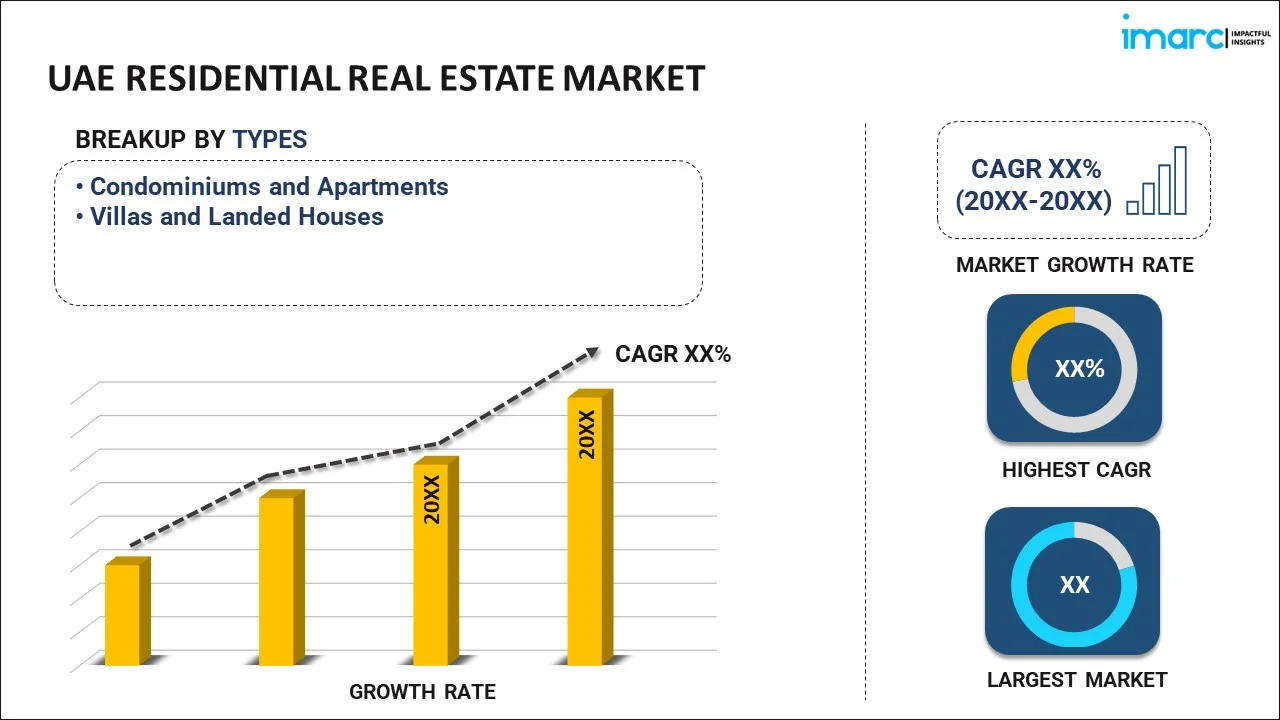
The condominiums and apartments segment dominates with a market share of 73% of the total UAE residential real estate market in 2025.
Condominiums and apartments represent the predominant property type across the UAE residential market, reflecting urbanization patterns and the practical preferences of the expatriate-majority population. These properties offer accessible entry points into premium locations, comprehensive building amenities including gymnasiums, swimming pools, and concierge services, while providing maintenance-free living suited to professional lifestyles. High-rise developments in master-planned communities feature proximity to commercial districts, entertainment venues, and transportation networks.
The apartment segment benefits from continuous supply expansion, with developers introducing varied configurations from studios to penthouse residences, catering to single professionals, young couples, and families. Modern developments incorporate smart home technologies, sustainable design elements, and flexible layouts adaptable to evolving lifestyle requirements. Urban areas, including Dubai Marina, Downtown Dubai, and Abu Dhabi's Al Reem Island, concentrate significant apartment inventory, attracting both owner-occupiers and rental investors seeking steady yields in high-demand locations.
Regional Insights:
To get detailed regional analysis of this market Request Sample
- Dubai
- Abu Dhabi
- Sharjah
- Others
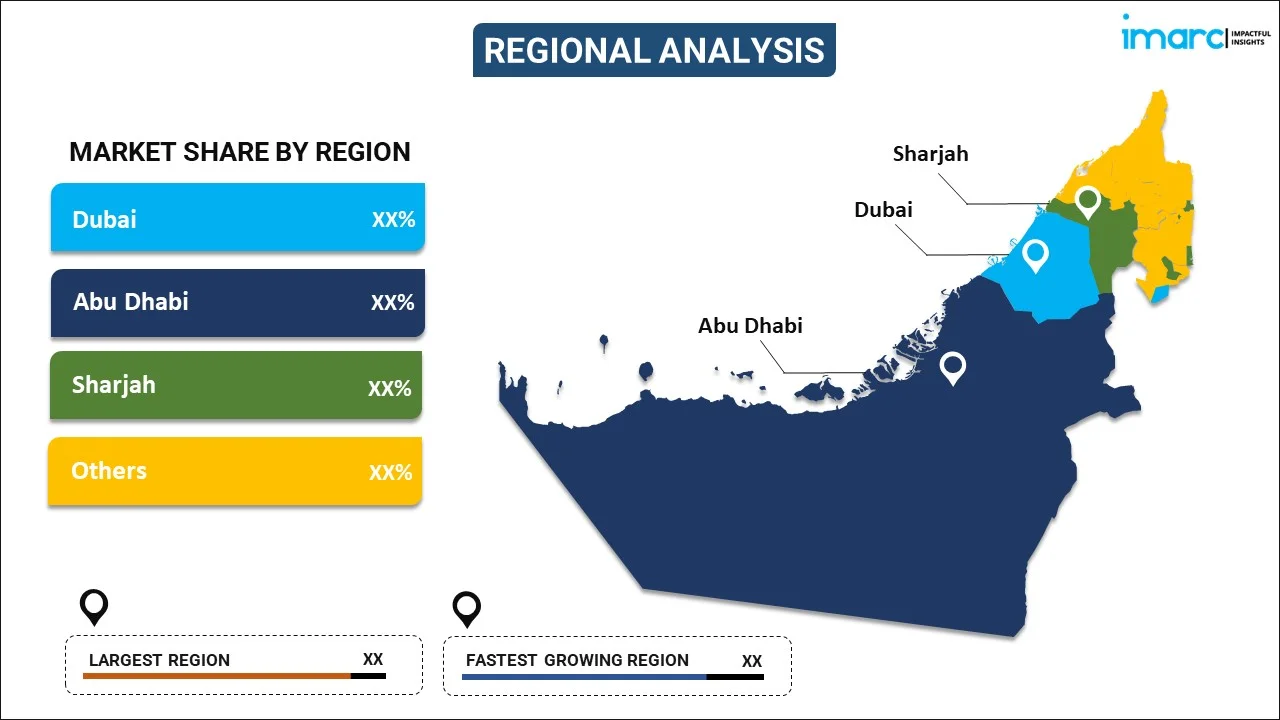
Dubai leads with a share of 44% of the total UAE residential real estate market in 2025.
Dubai maintains its position as the UAE's residential real estate epicenter, commanding the largest market share through its comprehensive regulatory framework enabling freehold foreign ownership, iconic developments, and a globally recognized lifestyle proposition. The emirate attracts diverse buyer demographics from end-users establishing primary residences to international investors seeking portfolio diversification. Dubai's residential market encompasses varied price segments from affordable housing in emerging communities to ultra-luxury branded residences in prime waterfront and downtown locations.
The emirate's residential landscape continues evolving through mega-project launches expanding into new growth corridors, including Dubai South, Expo City, and Dubai Islands. Government initiatives such as the First-Time Home Buyer Programme facilitate ownership accessibility, while infrastructure investments, including metro extensions and road network improvements, enhance connectivity across residential communities. Dubai's tourism sector growth further stimulates demand for short-term rental properties, creating additional investment avenues within the residential segment.

Market Dynamics:
Growth Drivers:
Why is the UAE Residential Real Estate Market Growing?
Progressive Government Initiatives and Visa Reforms
The UAE government has implemented transformative policy measures, significantly enhancing the residential real estate market's attractiveness to international investors and long-term residents. The expansion of the Golden Visa program, extending residency privileges to investors, entrepreneurs, specialized talents, and exceptional students, creates compelling ownership incentives for individuals previously limited to rental tenure. Introduction of retirement visas, remote work permits, and the innovative Blue Residency for environmental contributors broadens the eligible investor base while signaling the nation's commitment to diverse population growth. Property ownership regulations have evolved to permit non-GCC nationals freehold acquisition in designated zones, eliminating previous leasehold limitations that constrained foreign buyer participation. These progressive reforms collectively strengthen market confidence by providing legal clarity and long-term security for international property purchasers.
Sustained Economic Diversification and Population Growth
The UAE's strategic transition toward a diversified economy beyond hydrocarbon dependency creates sustained residential housing demand driven by employment growth across multiple sectors. The nation's positioning as a regional headquarters destination for multinational corporations, financial institutions, and technology companies generates continuous expatriate population inflows requiring quality housing solutions. Dubai’s population increased by 17,669 in a single month, marking one of the most rapid growth rates in the city’s history, according to the latest real-time figures from the emirate’s Population Clock. Tourism sector expansion, supported by infrastructure investments including airport capacity enhancements and hospitality developments, further stimulates residential demand from investors seeking rental yields and operational accommodation for seasonal visitors. The establishment of specialized economic zones, free trade areas, and industry-specific clusters throughout the emirates creates geographically distributed employment opportunities supporting residential development beyond traditional urban centers. Population projections indicate continued growth trajectories as the UAE maintains its competitive positioning for skilled workforce migration.
Strategic Infrastructure Development and Connectivity Enhancement
The UAE continues executing ambitious infrastructure programs enhancing residential property values and livability across emirates. The Etihad Rail network development provides transformative inter-emirate connectivity reducing travel times and expanding viable commuting ranges for residents employed in different locations than their housing. Metro system expansions in Dubai and planned implementations in Abu Dhabi improve urban mobility while increasing property premiums in station-adjacent locations. Master-planned community developments integrate essential amenities including schools, healthcare facilities, retail destinations, and recreational spaces within residential precincts, creating self-contained neighborhoods minimizing commuting requirements. Road network improvements, airport expansions, and port developments enhance overall accessibility supporting both residential demand from end-users and investment appeal for rental property stakeholders. Smart city initiatives incorporating digital infrastructure, sustainable utilities, and technology-enabled services distinguish UAE residential offerings within regional competition. For instance, in December 2025, the Sharjah Investment and Development Authority (Shurooq) announced outstanding performance across its real estate portfolio, with total investments and strategic partnerships amounting to AED 5.8 billion and a sales rate of 96.4% across its three flagship projects: Maryam Island, Sharjah Sustainable City, and Ajwan in Khorfakkan.
Market Restraints:
What Challenges the UAE Residential Real Estate Market is Facing?
Supply Saturation in Certain Market Segments
The UAE residential market is characterised by the challenge of supply saturation, especially in the luxury segments in the urban areas, where the construction of large inventory has been witnessed over the past few years. This surplus in the supply of similar products decreases the buyer's urgency and increases the sales cycle, and produces the effect of reducing price pressure at the over-supplied locations. The incentives to encourage absorption are introduced by developers, such as flexible payment architecture and lower service charges, however, the long-term processes of stabilizing the market imply that the supply-demand relationships need to be reestablished.
Affordability Constraints for Middle-Income Segments
Increasing residential prices and rental costs in high areas make house affordability beyond the reach of middle-income families and young professionals settling down. The disparity between the supply of luxury housing and affordable housing demand needs some strategic intervention, such as special affordable housing schemes and development incentives. The physical movement to the outskirts, where prices are lower, is incompatible with employment and transportation location factors, making it difficult to choose housing among cost-efficient consumers.
Global Economic Uncertainties and Interest Rate Sensitivity
The UAE residential market maintains sensitivity to global economic conditions and international monetary policy decisions affecting borrowing costs. Interest rate fluctuations impact mortgage affordability for financed purchasers while influencing investor calculations regarding leveraged property acquisitions. Currency movements affect purchasing power for international buyers whose home currency values fluctuate against the UAE dirham. Geopolitical developments and global economic cycles introduce demand variability requiring market participants to maintain adaptable strategies.
Competitive Landscape:
The UAE residential real estate market demonstrates a competitive structure encompassing established master developers commanding significant market presence alongside mid-tier developers and boutique firms targeting specialized segments. Market participants differentiate through location selection in premium areas, architectural design innovation, partnership with international luxury brands for branded residence concepts, and flexible payment structures accommodating diverse buyer financing preferences. Competition extends beyond product attributes to encompass customer experience throughout the purchase journey, including digital platforms, sales center presentations, and post-handover service quality. The market witnesses increasing consolidation as larger developers acquire strategic land banks while smaller participants face capital and regulatory compliance challenges. International developers continue entering the market through joint ventures and direct investments, introducing global design standards and operational practices. The competitive landscape encourages continuous product innovation, pricing optimization, and service enhancement, benefiting end consumers across market segments.
Recent Developments:
-
In October 2025, Mira Developments announced a Dh55 billion project between Abu Dhabi and Dubai comprising 14,000 apartments, 1,700 villas, hotels, schools, and comprehensive community amenities, representing one of the largest residential developments in the region.
-
In May 2024, DMCC and Signature Developers partnered to launch W Residences at Jumeirah Lakes Towers (JLT), expected to set new standards for hotel-branded residential living in Dubai.
UAE Residential Real Estate Market Report Coverage:
| Report Features | Details |
|---|---|
| Base Year of the Analysis | 2025 |
| Historical Period | 2020-2025 |
| Forecast Period | 2026-2034 |
| Units | Billion USD |
| Scope of the Report | Exploration of Historical and Forecast Trends, Industry Catalysts and Challenges, Segment-Wise Historical and Predictive Market Assessment:
|
| Types Covered | Condominiums and Apartments, Villas and Landed Houses |
| Regions Covered | Dubai, Abu Dhabi, Sharjah, Others |
| Customization Scope | 10% Free Customization |
| Post-Sale Analyst Support | 10-12 Weeks |
| Delivery Format | PDF and Excel through Email (We can also provide the editable version of the report in PPT/Word format on special request) |
Frequently Asked Questions About the UAE Residential Real Estate Market Report
The UAE residential real estate market size increased from USD 19.63 Billion in 2025 to USD 20.97 Billion in 2026.
The UAE residential real estate market is expected to grow at a compound annual growth rate of 6.82% from 2026-2034 to reach USD 35.54 Billion by 2034.
Condominiums and apartments dominated the market with a 73% share in 2025, driven by urbanization trends, affordability considerations, and the preference of expatriate populations for modern apartment living in prime urban locations with comprehensive amenities.
Key factors driving the UAE residential real estate market include progressive government visa reforms, sustained economic diversification, population growth driven by expatriate inflows, strategic infrastructure development, attractive investment returns, and the UAE's positioning as a global lifestyle and business destination.
Major challenges include supply saturation in certain luxury segments creating pricing pressure, affordability constraints for middle-income households, sensitivity to global economic conditions and interest rate fluctuations, and the need for continued regulatory refinement to maintain investor confidence.
Need more help?
- Speak to our experienced analysts for insights on the current market scenarios.
- Include additional segments and countries to customize the report as per your requirement.
- Gain an unparalleled competitive advantage in your domain by understanding how to utilize the report and positively impacting your operations and revenue.
- For further assistance, please connect with our analysts.
 Request Customization
 Speak to an Analyst
 Request Brochure
 Inquire Before Buying
Benefits of Customization
- Personalize this research
- Triangulate with your data
- Get data as per your format and definition
- Gain a deeper dive into a specific application, geography, customer, or competitor
- Any level of personalization
Get in Touch With Us
UNITED STATES
Phone: +1-201-971-6302
INDIA
Phone: +91-120-433-0800
UNITED KINGDOM
Phone: +44-753-714-6104
Email: [email protected]
Client Testimonials




.webp)




.webp)













Related Reports

Choose your plan
*Please note that the prices mentioned below are starting prices for each bundle type. Kindly contact our team for further details.*
Single User License
- 1 User License, Access on 2 Devices
- PDF Report + Excel Dataset (Password Protected)
- Lifetime Access
- No Printing Rights
- 10% Free Report Customization
- 10–12 Weeks of Analyst Support
Five User License
- Access for 5 Users, 2 Devices per User
- PDF Report + Excel Dataset (Password Protected)
- Lifetime Access
- Dedicated Account Manager
- 12–14 Weeks of Analyst Support
- No Printing Rights
- 15% Free Report Customization
- 25% Discount on Your Next Purchase
Corporate User License
- Unlimited User Access (Within Your Organization)
- PDF Report + Excel Dataset
- Lifetime Access
- Dedicated Account Manager
- 14–20 Weeks of Analyst Support
- No Printing Rights
- 20% Free Report Customization
- 30% Discount on Your Next Purchase
Essential Insights
What's included:
3 reports
- Lifetime Access
- PDF Reports
- Excel Datasets
- 2 Weeks of Free Analyst Support
- 2 User Licenses
- Access on 2 Devices
- Printing Rights
- Complimentary PowerPoint (PPT) Version
- Complimentary License Upgrade
Professional Access
What's included:
5 reports
- Lifetime Access
- PDF Reports
- Excel Datasets
- 8 Weeks of Free Analyst Support
- 2 User Licenses
- Access on 2 Devices
- Printing Rights
- Complimentary PowerPoint (PPT) Version
- Complimentary License Upgrade
Business Advantage
What's included:
8 reports
- Lifetime Access
- PDF Reports
- Excel Datasets
- 14 Weeks of Free Analyst Support
- 2 User Licenses
- Access on 2 Devices
- Printing Rights
- Complimentary PowerPoint (PPT) Version
- Complimentary License Upgrade
Enterprise Intelligence
What's included:
10 reports
- Lifetime Access
- PDF Reports
- Excel Datasets
- 20 Weeks of Free Analyst Support
- 2 User Licenses
- Access on 2 Devices
- Printing Rights
- Complimentary PowerPoint (PPT) Version
- Complimentary License Upgrade