
UAE Travel Insurance Market Size, Share, Trends and Forecast by Insurance Type, Coverage, Distribution Channel, End User, and Region, 2026-2034
UAE Travel Insurance Market Size, Share, Trends & Forecast (2026-2034)
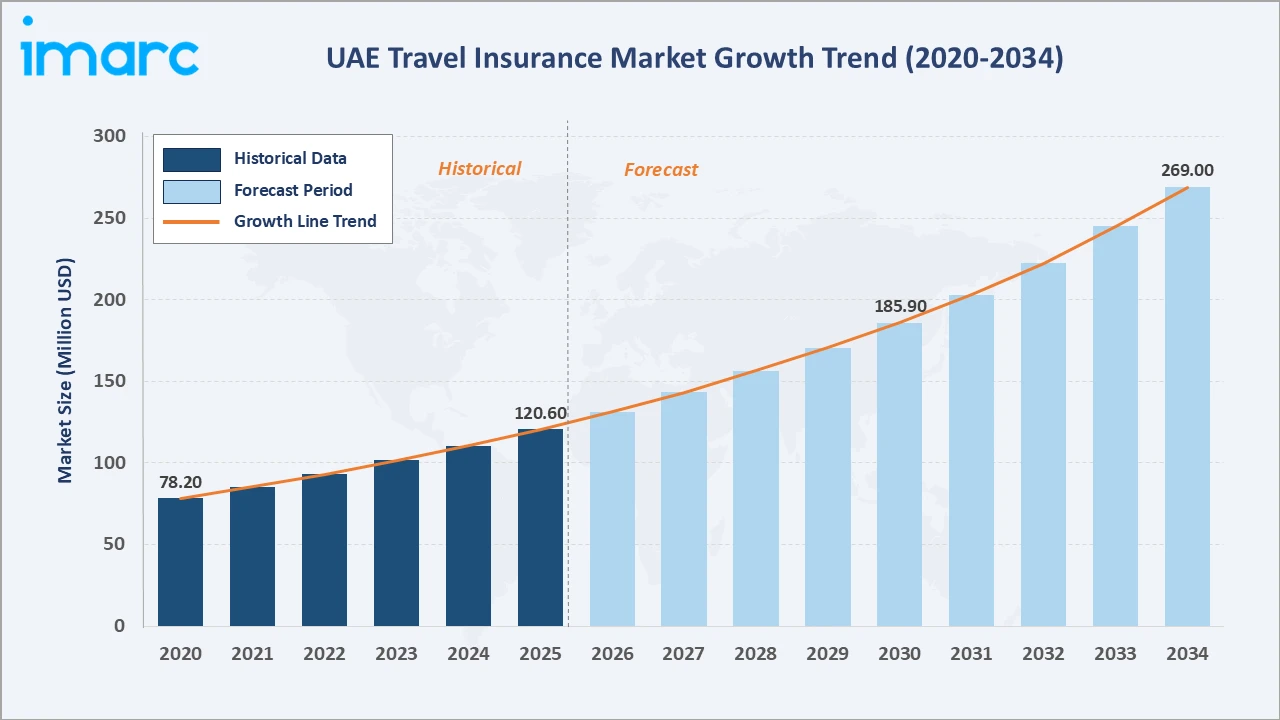
The UAE travel insurance market size stood at USD 120.6 Million in 2025 and is estimated to reach USD 131.5 Million in 2026. The market is projected to reach USD 269.0 Million by 2034, growing at a CAGR of 9.04% during 2026-2034. The market is driven by surging tourist arrivals, mandatory travel insurance regulations, and the growing digital platform adoption among expatriates and business travellers. Single-Trip Travel Insurance dominates at 61.4%. Medical Expenses leads coverage at 55.8%. Dubai commands 46.7% of the regional market share.
Expanding digital insurance platforms and embedded insurance through online travel agencies are further supporting market growth. Rising consumer awareness, government-mandated travel insurance requirements, and the UAE's large expatriate population generating year-round outbound travel demand are key structural growth drivers sustaining market expansion through the forecast period.
Market Snapshot
|
Metric |
Value |
|
Base Year Market Size (2025) |
USD 120.6 Million |
|
Market Size (2026) |
USD 131.5 Million |
|
Forecast Market Size (2034) |
USD 269.0 Million |
|
CAGR (2026-2034) |
9.04% |
|
Base Year |
2025 |
|
Historical Period |
2020-2025 |
|
Forecast Period |
2026-2034 |
|
Dominant Insurance Type |
Single-Trip Travel Insurance (61.4%, 2025) |
|
Dominant Coverage |
Medical Expenses (55.8%, 2025) |
|
Leading Region |
Dubai (46.7%, 2025) |
The India watch market size increased from USD 78.2 Million in 2020 to USD 120.6 Million in 2025 and is estimated to reach USD 131.5 Million in 2026. The market is further expected to grow to USD 185.9 Million by 2030 and USD 269.0 Billion by 2034. The travel insurance UAE market is positioned uniquely within the Gulf region, combining one of the world's highest tourist inflow rates, a rapidly growing expatriate population exceeding 88% of total residents, and strong government-mandated insurance requirements that sustain year-round structural demand across all traveller categories.
To get more information on this market, Request Sample
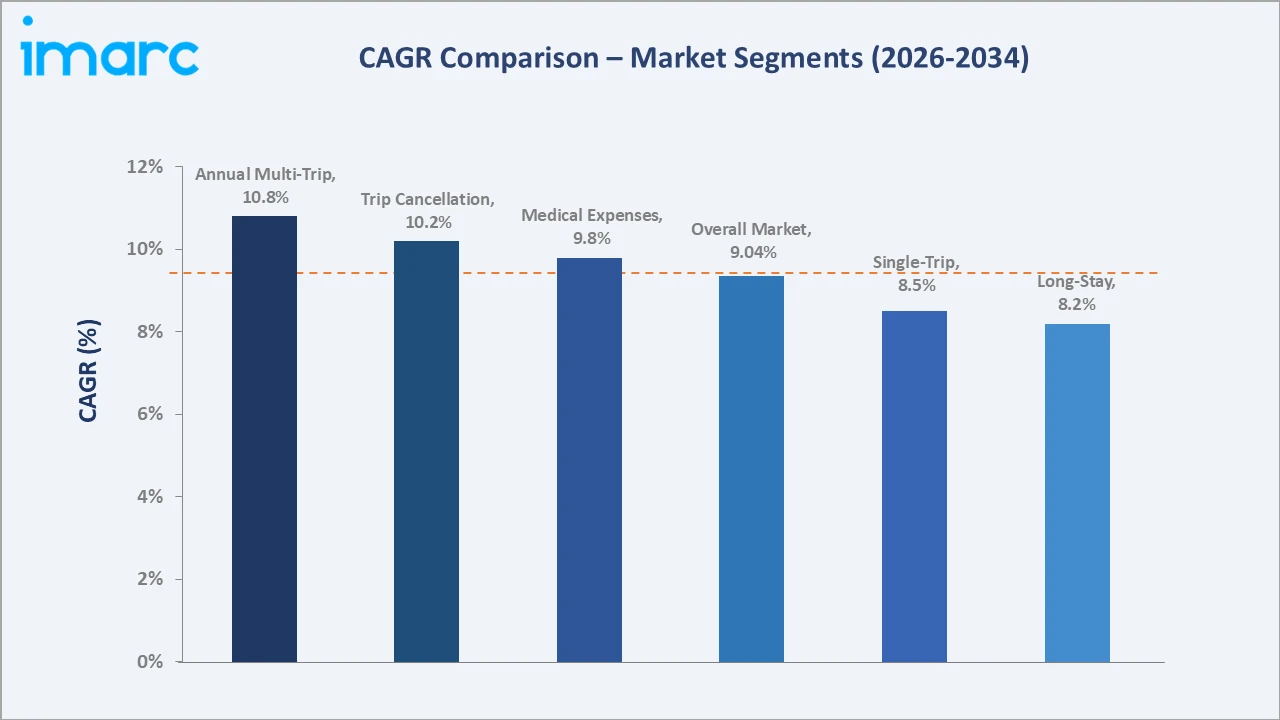
The Annual Multi-Trip Insurance segment grows fastest at ~10.8% CAGR through UAE's business travel growth, frequent flyer adoption, and digital subscription insurance models. Long-Stay Travel Insurance grows at ~8.2% CAGR through the UAE's large long-term expatriate community.
Executive Summary
The UAE travel insurance market size stood at USD 120.6 Million in 2025 and is estimated to reach USD 131.5 Million in 2026, growing at a CAGR of 9.04% through 2034, positioning the UAE among the Gulf region's most commercially dynamic insurance sub-markets.
The market is underpinned by the UAE's position as a global travel hub, with Dubai International Airport among the world's busiest international airports. Rising health-conscious travel behaviours, mandatory insurance mandates for certain visa categories, and the proliferation of digital insurance aggregators are supporting expansion. The market is projected to reach USD 269.0 Million by 2034 at a CAGR of 9.04%. Single-Trip Travel Insurance at 61.4% leads through tourist volume dominance. Medical Expenses coverage at 55.8% reflects fundamental risk protection priorities. Dubai commands 46.7% nationally.
Key market drivers include surging UAE inbound and outbound tourist arrivals creating direct demand for travel insurance products, government-mandated insurance requirements for certain visa categories establishing a non-discretionary policy purchase baseline, and the rapid expansion of digital insurance platforms enabling seamless policy issuance across mobile and web channels. Growing consumer awareness of travel risk and the UAE's large expatriate population generating year-round outbound travel further reinforce structural market demand through the forecast period.
Key Market Insights
| Insight | Data |
|---|---|
| Dominant Insurance Type | Single-Trip Travel Insurance – 61.4% share (2025) |
| Dominant Coverage | Medical Expenses – 55.8% market share (2025) |
| Leading Region | Dubai – 46.7% share (2025) |
| Market Opportunity | Digital-embedded travel insurance; Annual Multi-Trip subscription models; long-stay expatriate coverage; Sharjah and Abu Dhabi regional expansion |
Key Analytical Observations Supporting the Above Data:
- Single-Trip Travel Insurance at 61.4%: The segment dominates due to the UAE's status as a primary short-haul and long-haul tourist destination with high inbound and outbound visitor volumes. Affordable single-trip pricing and ease of online purchase drive mass-market uptake.
- Medical Expenses at 55.8%: Medical coverage dominates due to high international medical costs, traveller awareness of health risks, and regulatory guidelines encouraging medical protection as a baseline for UAE travel insurance UAE policies.
- Dubai at 46.7%: Dubai leads regionally due to its status as the UAE's primary tourist gateway, business travel hub, and highest-density expatriate and tourist population generating above-average travel insurance purchase frequency.
UAE Travel Insurance Market Overview
The UAE travel insurance market is commercially positioned at a unique intersection: one of the world's highest per-capita inbound tourist markets, an expatriate-majority resident population with persistent outbound travel demand, and an insurance regulatory environment progressively mandating travel coverage across visa and immigration requirements.
The market's commercial structure is characterized by the UAE's extraordinary visitor economy scale, digital insurance infrastructure maturity, and a highly competitive multi-insurer environment supported by international reinsurance capacity and local underwriting expertise across all travel risk categories.
Market Dynamics
To evaluate market opportunities, Request Sample
Market Drivers
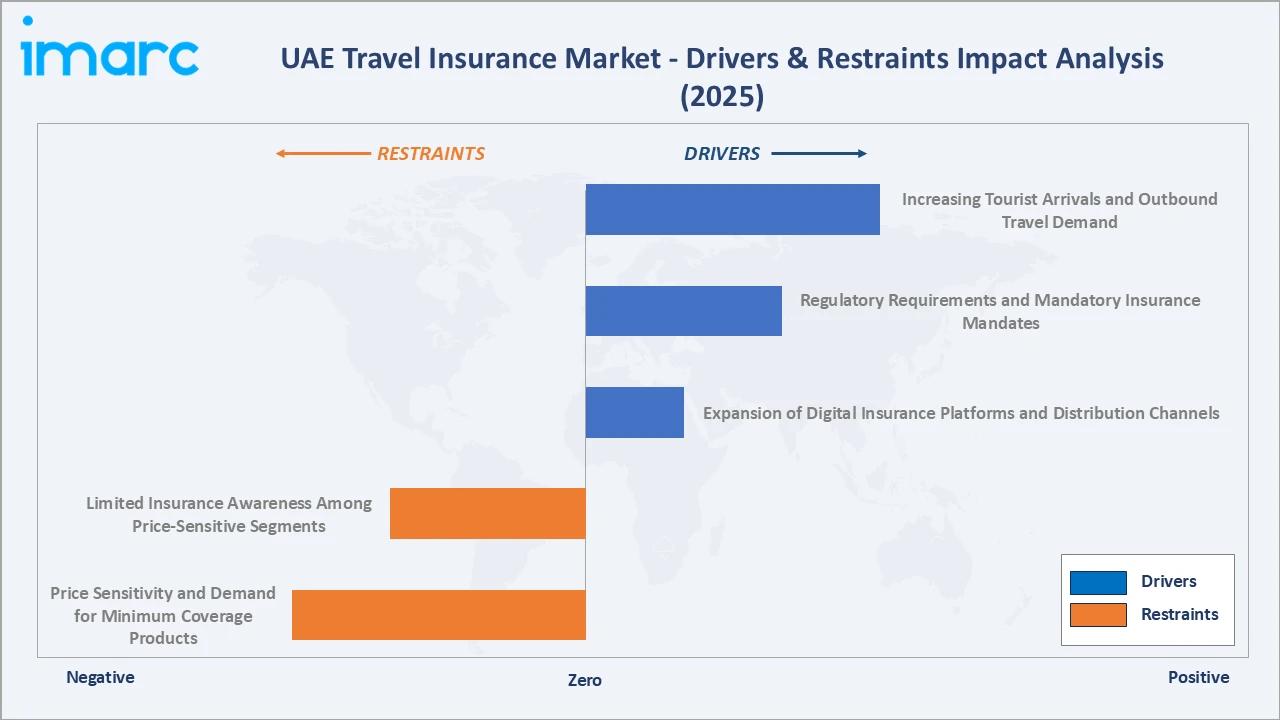
- Increasing Tourist Arrivals and Outbound Travel Demand: Growing inbound and outbound tourism volumes are generating consistent and broad-based demand for travel insurance products across all traveller segments. Rising passenger volumes across both leisure and business categories are creating a large addressable market for single-trip and multi-trip policy issuance through digital and traditional distribution channels, supporting sustainable premium income growth for licensed market participants.
- Regulatory Requirements and Mandatory Insurance Mandates: Government-mandated travel insurance requirements for specific visa and travel categories establish a structural, non-discretionary demand baseline across the market. Regulatory frameworks requiring travel insurance as a condition of entry or visa approval ensure predictable policy volumes for licensed insurers, while progressively expanding mandatory coverage categories are supporting sustained broader market penetration across multiple traveller segments and nationalities.
- Expansion of Digital Insurance Platforms and Distribution Channels: The accelerating growth of digital comparison portals, mobile-first insurance platforms, and API-integrated distribution channels is fundamentally increasing market accessibility and consumer reach. These platforms enable travellers to purchase, compare, and manage travel insurance policies seamlessly across all connected devices at competitive price points, significantly reducing friction in the purchase journey and expanding the insured population beyond traditional broker-dependent channels.
- Large Expatriate Population Sustaining Year-Round Insurance Demand: A substantial and economically active expatriate resident population generating consistent outbound travel for personal, medical, and professional purposes drives reliable year-round demand for annual multi-trip and long-stay insurance products. This demographic provides licensed insurers with a structurally stable recurring premium revenue base that is less cyclical than purely tourism-dependent traveller demand, supporting consistent underwriting performance throughout the forecast period.
Market Restraints
- Limited Insurance Awareness Among Price-Sensitive Segments: Certain traveller segments, particularly lower-income workers, budget tourists, and first-time international travellers, demonstrate limited awareness of travel insurance benefits and coverage scope. This awareness gap leads to persistent underinsurance and reduced voluntary policy uptake across a commercially significant portion of the potential insured population, constraining overall market penetration and limiting premium growth potential in the mass-market segment below its structural ceiling.
- Price Sensitivity and Demand for Minimum Coverage Products: Price-sensitive travellers across key consumer segments frequently opt for minimum-coverage policies designed primarily to satisfy mandatory regulatory or visa requirements rather than provide comprehensive risk protection. This behaviour constrains average premium values per policy and limits overall market revenue growth per insured life, creating structural pressure on insurer margins and reducing the addressable premium pool available for cross-selling and upselling higher-value coverage categories.
- Complex Claims Processing Affecting Consumer Retention: Lengthy documentation requirements and multi-step verification processes in travel insurance claims management reduce consumer satisfaction levels and policy renewal rates across the market. Operationally complex claims experiences create reputational challenges for insurers and meaningfully limit consumer conversion from single-trip purchasers to annual multi-trip policyholders, constraining the development of recurring premium relationships that support higher lifetime customer value and more predictable revenue.
Market Opportunities
- Embedded Insurance Integration at Point of Sale: Integrating travel insurance as a default or prominently offered option at travel booking checkpoints — including airline checkout flows, online travel agency platforms, and hotel booking portals — creates highly scalable distribution without proportional incremental acquisition cost. Embedded models enable insurers to reach previously uninsured traveller segments at the precise moment of purchase intent, capturing high conversion rates and expanding the insured population well beyond traditional direct and broker channel reach.
- Subscription-Based Annual Multi-Trip Product Development: Developing commercially differentiated subscription-based annual multi-trip insurance products tailored for the frequent and business traveller segment represents a distinct growth opportunity with compelling economics on both sides of the transaction. Subscription models offer insurers predictable recurring premium revenue and lower per-renewal acquisition costs, while delivering sustained cost savings and simplified coverage access for policyholders who travel multiple times per year, supporting higher customer lifetime values across a commercially attractive segment.
Market Challenges
- Regulatory Complexity Across Multi-Jurisdiction Coverage: Maintaining full compliance with varying insurance regulations, consumer protection frameworks, and mandatory coverage requirements across multiple destination markets creates significant underwriting and operational complexity for market participants. This challenge requires continuous policy term review, cross-jurisdictional regulatory monitoring, and legal infrastructure investment to ensure that global coverage terms remain valid, compliant, and commercially viable across the broad destination footprint that comprehensive travel insurance products typically cover.
- Claims Fraud and Loss Ratio Management: Rising incidences of fraudulent travel insurance claims across key coverage categories — including medical expense inflation, false trip cancellation claims, and staged baggage loss — are progressively increasing loss ratios for insurers across the market. Effectively managing claims fraud requires sustained investment in verification technology, data analytics, and anti-fraud infrastructure, while simultaneously balancing the competing expectation among legitimate claimants for rapid, frictionless settlement experiences that support policy renewal and positive brand reputation.
Emerging Market Trends
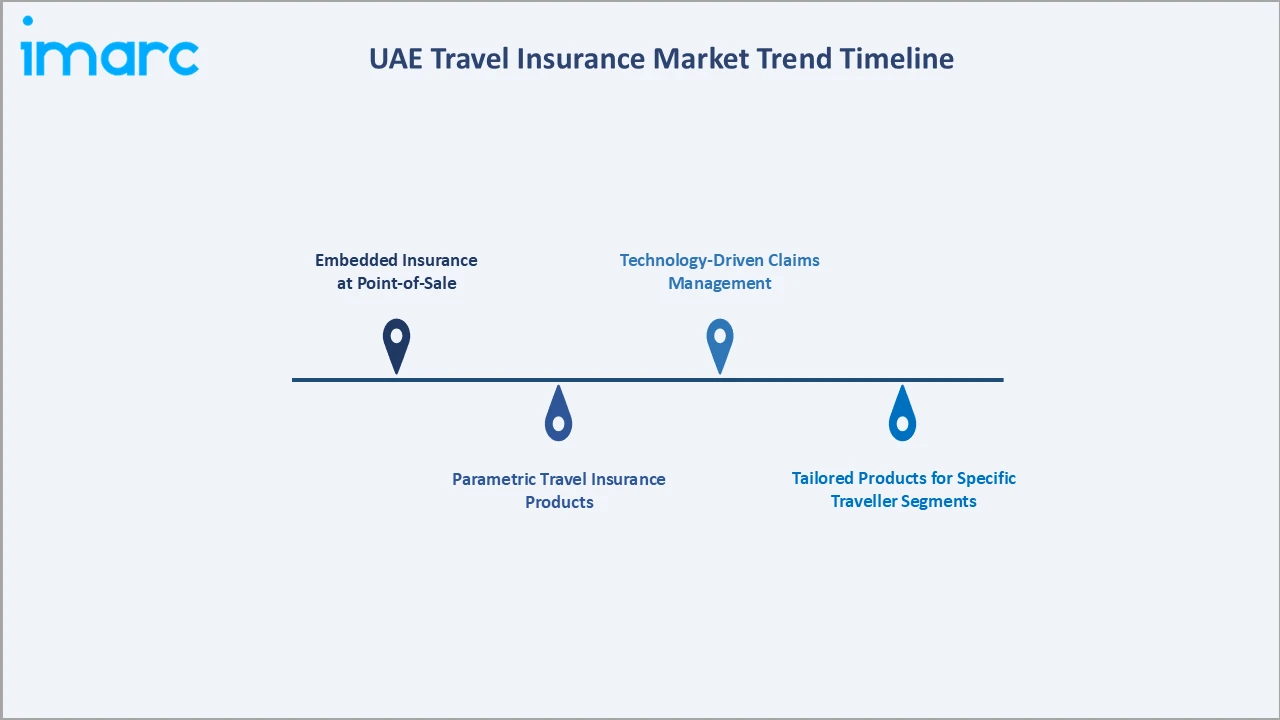
1. Embedded Insurance at Point-of-Sale
Embedded insurance integration at travel booking checkpoints is fundamentally transforming distribution models for travel insurance products across the market. By eliminating the separate purchase step and placing insurance as a contextually relevant option within the traveller's natural booking flow, embedded models significantly increase policy conversion rates, reduce consumer price sensitivity, and expand market penetration to previously uninsured segments. Insurers achieving preferred-provider positioning within major travel booking platforms gain above-proportional premium volume at below-average acquisition cost, creating a durable structural competitive advantage that is increasingly difficult for traditional distribution-dependent incumbents to replicate.
2. Parametric Travel Insurance Products
Parametric travel insurance triggers automatic, pre-agreed payouts based on objectively verifiable events such as flight delays exceeding defined thresholds, destination weather disruptions, or airline cancellations — is gaining meaningful commercial momentum across the market. These products fundamentally address the primary friction point in traditional travel insurance: the documentation-intensive, time-consuming claims process. By delivering instant, transparent settlement without requiring claimant documentation submission, parametric products are resonating strongly with time-sensitive business travellers and digitally sophisticated consumers who prioritize predictability and convenience over maximum coverage breadth, creating a distinct and commercially attractive premium product tier above standard travel insurance.
3. Technology-Driven Claims Management
Artificial intelligence and machine learning integration into travel insurance claims processing workflows is progressively reducing average settlement timelines, operational overhead, and loss ratios for market participants investing in these capabilities. Automated document verification tools, natural language processing for first-notice-of-loss submission, real-time fraud pattern detection systems, and digital self-service claims portals are collectively improving the end-to-end claimant experience across medical expense, trip cancellation, and baggage loss coverage categories. Insurers deploying these technology layers are measurably improving customer satisfaction scores and policy renewal rates compared with documentation-heavy manual claims processing models that remain prevalent among less digitally advanced market participants.
4. Tailored Products for Specific Traveller Segments
Product development specifically targeting commercially distinct traveller sub-segments — including long-stay visa holders, frequent business flyers, senior travellers, adventure sports participants, and large expatriate resident communities — is creating differentiated market opportunities beyond commoditised standard single-trip product categories. Flexible policy architectures incorporating customizable coverage periods, destination-specific risk riders, activity-based coverage extensions, and modular add-on structures are enabling insurers to address the precise risk profile and coverage priority of each traveller segment. This segmented product strategy supports premium pricing above the mass-market tier, reduces direct price competition on standardised products, and drives above-average customer retention rates across high-value recurring traveller profiles.
Industry Value Chain Analysis
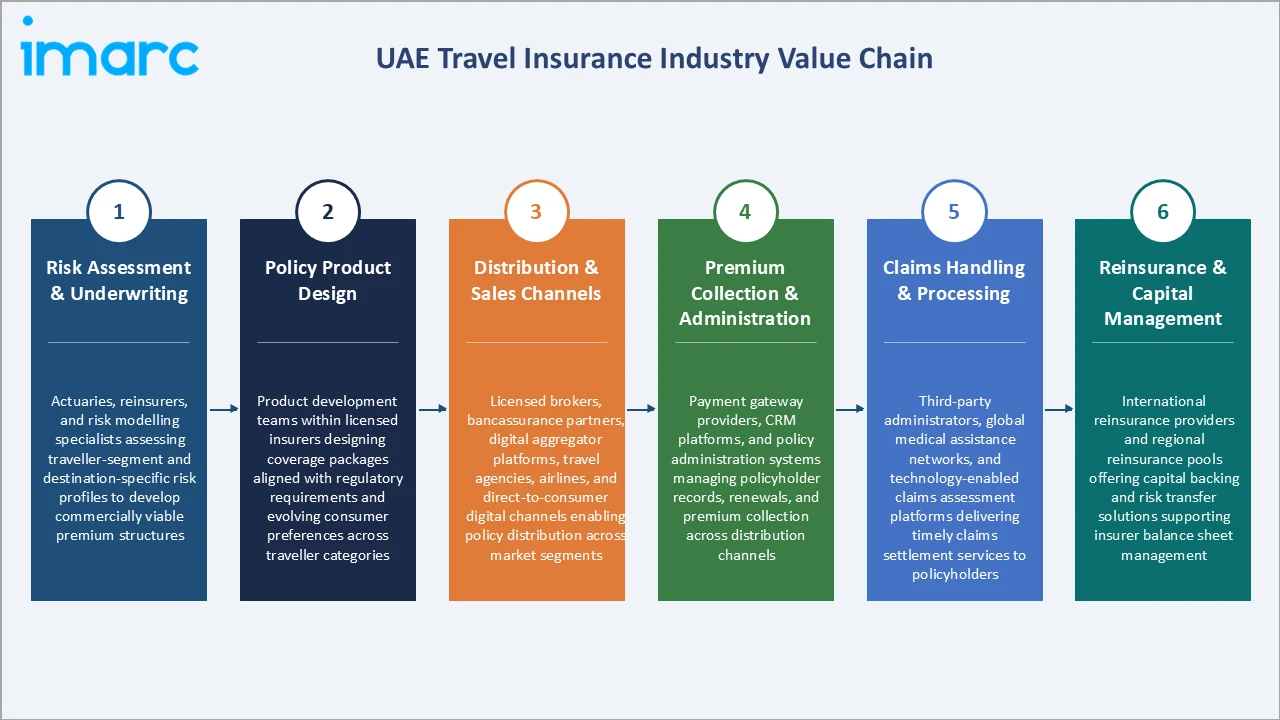
The travel insurance industry value chain encompasses a series of deeply interconnected stages, spanning from initial risk assessment and actuarial product design through policyholder distribution, premium administration, claims management, and reinsurance capital support. Each stage contributes distinct commercial value and operational capability to the overall market ecosystem, with competitive advantage in the industry increasingly determined by a participant's ability to achieve excellence across multiple value chain stages simultaneously rather than within a single function. Digital transformation is reshaping value chain economics at every stage, progressively reducing the cost of product distribution, accelerating claims settlement, and enabling more precise risk pricing through data-driven underwriting models.
| Stage | Key Participants |
|---|---|
| Risk Assessment & Underwriting | Actuaries, reinsurers, and risk modelling specialists assessing traveller-segment and destination-specific risk profiles to develop commercially viable premium structures |
| Policy Product Design | Product development teams within licensed insurers designing coverage packages aligned with regulatory requirements and evolving consumer preferences across traveller categories |
| Distribution & Sales Channels | Licensed brokers, bancassurance partners, digital aggregator platforms, travel agencies, airlines, and direct-to-consumer digital channels enabling policy distribution across market segments |
| Premium Collection & Administration | Payment gateway providers, CRM platforms, and policy administration systems managing policyholder records, renewals, and premium collection across distribution channels |
| Claims Handling & Processing | Third-party administrators, global medical assistance networks, and technology-enabled claims assessment platforms delivering timely claims settlement services to policyholders |
| Reinsurance & Capital Management | International reinsurance providers and regional reinsurance pools offering capital backing and risk transfer solutions supporting insurer balance sheet management |
The distribution and sales channel stage represents the most commercially competitive stage of the value chain, where digital aggregators, bancassurance partnerships, embedded travel platform integrations, and direct-to-consumer digital channels compete intensely for premium acquisition at scale. Participants investing in superior digital distribution capabilities, consumer experience design, and API connectivity with third-party travel platforms are structurally positioned to capture above-proportional market share growth across rapidly evolving traveller acquisition channels. The claims handling and processing stage is simultaneously undergoing significant technology-driven transformation, with artificial intelligence, automated document verification, and digital self-service platforms collectively reducing the operational cost per claim while improving settlement speed and claimant satisfaction — creating measurable renewal rate advantages for technologically advanced participants relative to incumbents reliant on manual processing workflows.
Technology Landscape in the UAE Travel Insurance Industry
Digital Insurance Platforms and API Integration
Digital insurance platforms and API-based integration technologies are enabling real-time policy issuance, instant premium calculation, dynamic product customisation, and seamless multi-device consumer journeys across the full travel insurance purchase and servicing lifecycle. These platforms facilitate deep connectivity between licensed insurers and travel booking systems, banking applications, corporate travel management platforms, and third-party digital distribution channels, eliminating legacy manual processes and enabling continuous, around-the-clock policy purchase availability across all traveller segments and geographic markets. As API ecosystems mature, insurers with well-documented integration standards are achieving distribution reach across hundreds of partner touchpoints without proportional increases in sales infrastructure cost, creating durable competitive advantages that are difficult for API-lagging incumbents to close quickly.
AI and Machine Learning in Claims Management
Artificial intelligence and machine learning technologies are fundamentally transforming travel insurance claims management by automating document verification workflows, enabling natural language processing for first-notice-of-loss submission across multiple languages, deploying real-time predictive analytics for fraud pattern detection, and supporting dynamic claims triage that routes complex cases to specialised adjusters while resolving straightforward claims automatically. These integrated technology capabilities are progressively reducing average claims settlement timelines from days to hours across standard coverage categories, simultaneously lowering operational cost per claim and improving policyholder satisfaction scores across key traveller segments. Insurers achieving meaningful reduction in claims processing cycle times are observing measurable improvements in policy renewal intent and net promoter scores, reinforcing the commercial case for sustained technology investment in claims automation infrastructure.
Blockchain and Smart Contracts for Policy Management
Blockchain technology and smart contract applications are being actively explored and incrementally deployed by insurers for immutable policy record management, automated parametric trigger execution, transparent premium escrow management, and frictionless cross-border claims settlement. Smart contracts — which self-execute pre-agreed claim payments upon verified trigger event confirmation without requiring manual claims assessment intervention — are particularly well-suited to parametric travel insurance structures involving flight delays, cancellations, and destination weather events where trigger data is objectively available from third-party data providers. A progressively supportive digital financial services regulatory environment provides commercially advantageous infrastructure for insurtech innovation in travel insurance product architecture and settlement technology, positioning early blockchain adopters within the travel insurance ecosystem for structural operational advantages as adoption scales.
Market Segmentation Analysis
The report covers the following segments:
| Segment Category | Leading Segment | Market Share | Year |
|---|---|---|---|
| Insurance Type | Single-Trip Travel Insurance | 61.4% | 2025 |
| Distribution Channel | 🔒 | 🔒 | 2025 |
| End User | 🔒 | 🔒 | 2025 |
| Coverage | Medical Expenses | 55.8% | 2025 |
| Region | Dubai | 46.7% | 2025 |

By Insurance Type
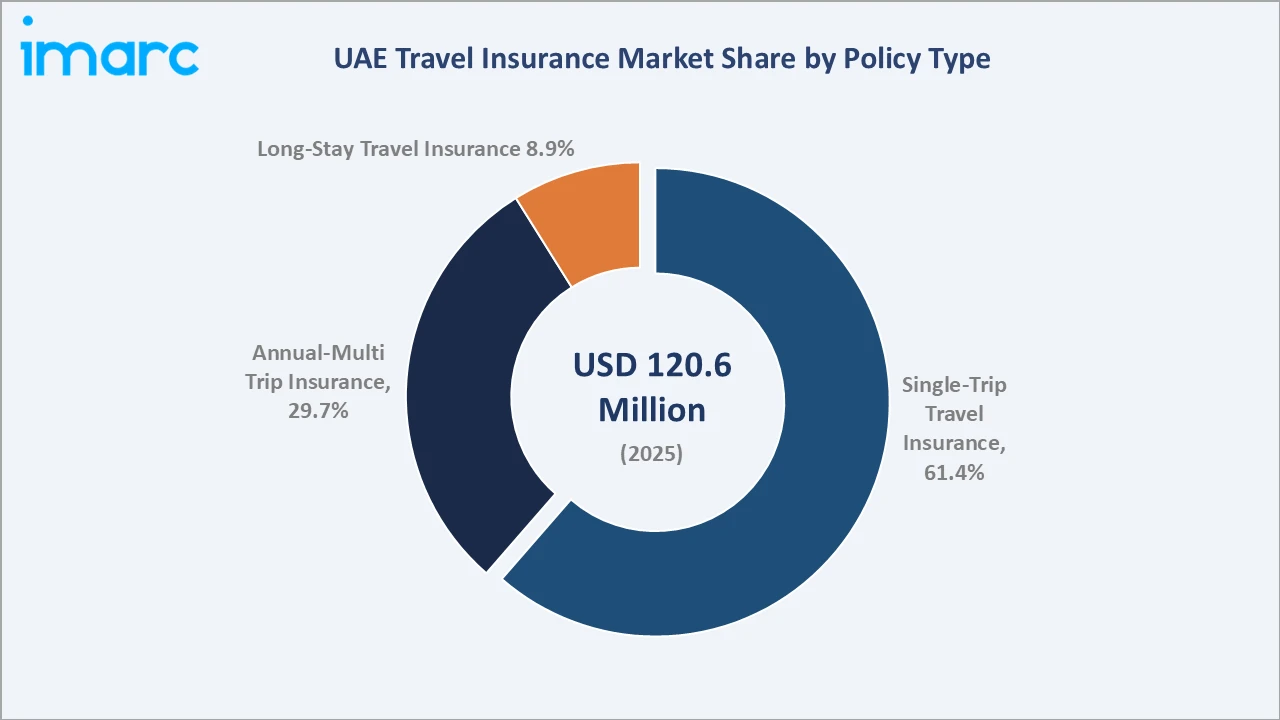
Single-Trip Travel Insurance leads at 61.4% (2025). The segment encompasses UAE's most commercially diverse traveller category, from inbound tourists and business visitors to UAE residents travelling abroad for holidays, covering the full spectrum of short-duration travel risk across medical, cancellation, and baggage coverage.
To access detailed market analysis, Request Sample
Annual Multi-Trip Insurance at 29.7% grows fastest at ~10.8% CAGR through the UAE's large frequent-flyer expatriate and business traveller base. Long-Stay Travel Insurance at 8.9% serves extended-duration travel including expatriate home-country visits and medical travel, representing the smallest but highest-value premium segment.
By Coverage
Medical Expenses coverage leads at 55.8% (2025). The Medical Expenses segment encompasses the UAE travel insurance market's most commercially essential coverage, driven by high international medical costs, rising health awareness, and regulatory encouragement for comprehensive health coverage in travel policies across all traveller segments.
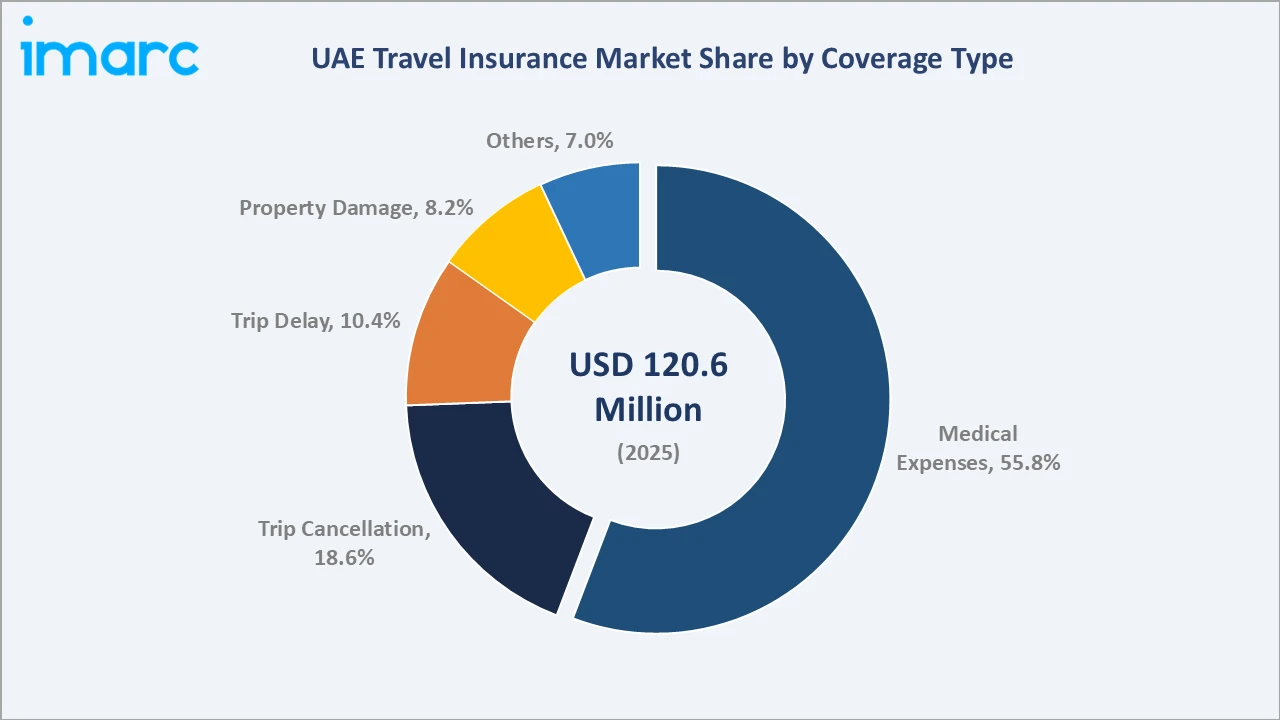
Trip Cancellation at 18.6% reflects post-pandemic consumer awareness of cancellation risk. Trip Delay at 10.4% is growing through increased demand for parametric and automatic payment products. Property Damage at 8.2% and Others at 7.0% include baggage, personal liability, and adventure sports add-ons.
Regional Insights
| Region | Market Share (%, 2025) | Key Characteristics |
|---|---|---|
| Dubai | 46.7% | UAE's primary tourism and business hub; home to the world's busiest international airport and highest concentration of financial and hospitality services. |
| Abu Dhabi | 32.5% | Capital emirate with expanding tourism infrastructure; Abu Dhabi International Airport growth underpinned by Abu Dhabi Tourism 2030 target of 39.3 million visitors. |
| Sharjah | 13.8% | Third-most populous emirate; budget travel hub served by Sharjah International Airport with strong secondary route demand. |
| Others | 7.0% | Commercially underserved emerging tourism corridor; Ras Al Khaimah's accelerating visitor growth represents the segment's highest near-term upside. |
Dubai's 46.7% market leadership reflects the emirate's status as the UAE's primary tourism and business gateway, the world's busiest international airport, and the highest-concentration of international financial services, hospitality, and retail sectors generating above-average business traveller volumes. Abu Dhabi's 32.5% reflects the capital's growing tourism infrastructure, Abu Dhabi International Airport's expansion, and the UAE government's Abu Dhabi Tourism 2030 target of 39.3 million visitors.
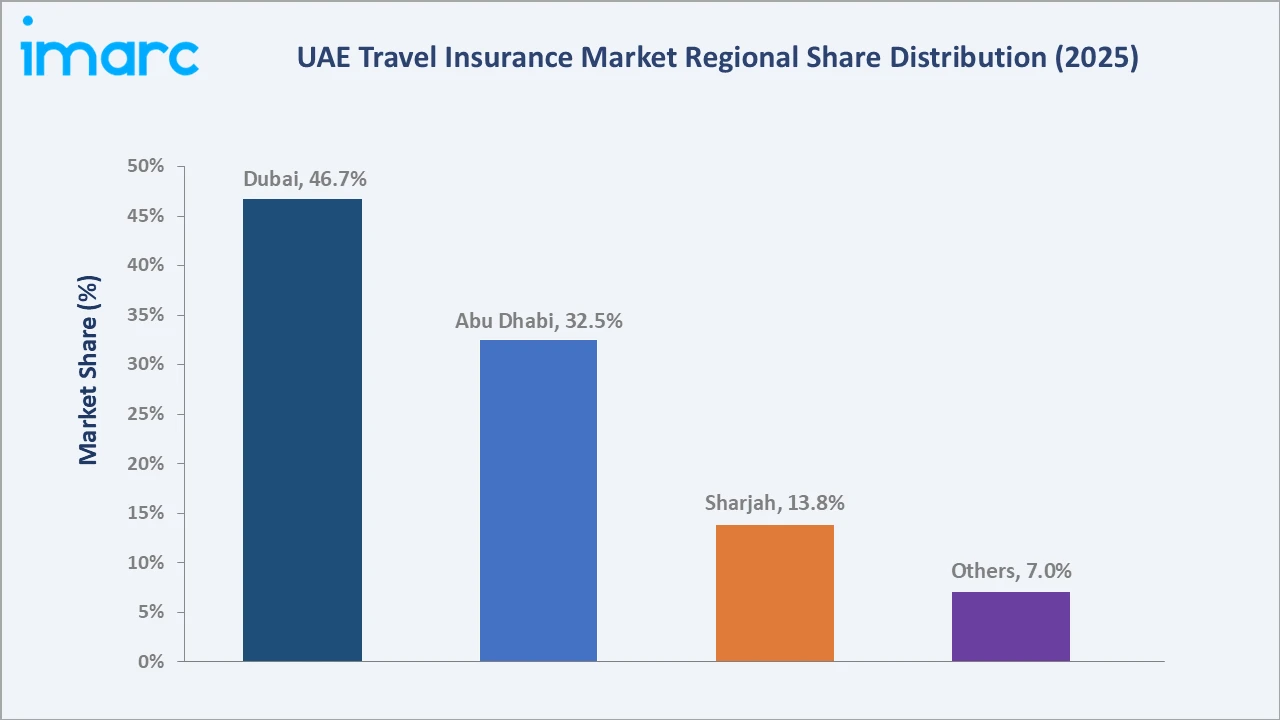
Sharjah's 13.8% reflects its status as the UAE's third-most populous emirate and a budget travel hub with Sharjah International Airport serving secondary route demand. The Others segment at 7.0%, including Ajman, Ras Al Khaimah, Fujairah, and Umm Al Quwain, represents the most commercially underserved regional opportunity as emerging tourism development in Ras Al Khaimah accelerates visitor arrival growth.
Competitive Landscape
The UAE travel insurance market competitive landscape is the most commercially stratified of any Gulf insurance sub-market. International insurers compete alongside regional specialists and domestic carriers, creating a multi-tier competitive environment. Competition is intensifying through digital platform distribution, embedded insurance partnerships, and product innovation in parametric and subscription-based travel coverage.
| Company | Key Products | Market Position | Core Strength |
|---|---|---|---|
| AIG Travel | Single-trip, annual multi-trip, and emergency medical evacuation | Market Leader | AIG Travel provides comprehensive travel insurance UAE solutions including emergency medical evacuation and global assistance services through its extensive network, commanding a strong institutional and high-net-worth individual traveller segment. |
| AXA Insurance Gulf | Individual and family travel insurance, annual multi-trip, and business travel | Strong Challenger | AXA Insurance Gulf offers a broad range of travel insurance products across individual, family, and corporate segments, leveraging its global brand recognition and UAE bancassurance distribution network for wide market penetration. |
| Orient Insurance PJSC | Single-trip and annual travel insurance, SME corporate travel programmes | Innovator | Orient Insurance PJSC is a Dubai-based insurer with strong travel insurance penetration through direct digital channels and SME corporate travel programmes, offering competitive premium pricing across standard product lines. |
| Abu Dhabi National Insurance Company (ADNIC) | Individual travel insurance, annual multi-trip, digital travel policies | Innovator | ADNIC offers travel insurance products with Abu Dhabi government-aligned distribution advantages, strong bancassurance partnerships with UAE banks, and growing digital platform capabilities targeting the Abu Dhabi regional market. |
The competitive landscape's most commercially significant dynamic is the digital aggregator platforms' structural competitive pressure on all traditional broker-distributed insurers. Policybazaar UAE, YallaCompare, and Souqalmal create transparent price comparison that commoditises standard travel insurance products while creating distribution efficiency gains for insurers with competitive digital pricing models.
Key Company Profiles
AIG Travel
AIG Travel is one of the world's leading travel insurance providers and a dominant player in the UAE travel insurance market, known for its comprehensive emergency assistance services, extensive global network, and diversified product portfolio covering individual, family, and corporate travellers.
- Key Products: Single-trip and annual multi-trip travel insurance, emergency medical evacuation, trip cancellation, and global travel assistance programmes.
- Strategic Focus: Maintaining leadership in the UAE high-value traveller segment through comprehensive coverage, premium service quality, and digital claims innovation.
AXA Insurance Gulf
AXA Insurance Gulf is a recognized international insurance group with a strong presence in the UAE travel insurance market, distributing a comprehensive range of individual and corporate travel products through bancassurance, broker, and direct digital channels.
- Key Products: Individual and family travel insurance, annual multi-trip policies, business travel programmes, and medical expense reimbursement plans.
- Strategic Focus: Leveraging bancassurance partnerships with major UAE banks to expand travel insurance distribution reach across all seven emirates.
Market Concentration Analysis
The UAE travel insurance market is moderately concentrated at the commercial and corporate travel segment, with AIG Travel and AXA Insurance Gulf commanding an estimated combined 35-40% of the UAE's commercial travel insurance market by premium value. The individual traveller segment is more fragmented, with domestic insurers such as OIC, Orient Insurance, and ADNIC competing effectively on price through digital aggregator platforms. The market's structural competitiveness is increasing as international insurtech entrants, enabled by the UAE Insurance Authority's Regulatory Sandbox, introduce digital-native products that challenge incumbent pricing models.
Market concentration is evolving through digital platform disruption: insurers investing in superior API connectivity with aggregator platforms and OTAs are gaining market share from traditional broker-dependent incumbents. Simultaneously, the corporate travel insurance segment remains concentrated among international carriers with established global assistance networks, sustaining premium product differentiation above the commoditised individual travel insurance tier.
Investment & Growth Opportunities
Highest Growth Segments
Annual Multi-Trip Insurance (~10.8% CAGR through UAE expatriate frequent-flyer demand), Long-Stay Travel Insurance (~8.2% CAGR through extended expatriate travel), Single-Trip Travel Insurance (~8.5% CAGR through tourist volume growth), parametric travel insurance products, and Abu Dhabi and Sharjah regional market expansion represent the UAE travel insurance market's highest-growth investment vectors through 2034.
Emerging Investment Opportunities
The UAE's digital-embedded travel insurance market, growing at 18-22% annually as OTAs and airlines integrate insurance at checkout, represents the UAE's highest-growth distribution channel for travel insurance UAE products. The parametric travel insurance market, triggered by flight delays and destination events, represents the most commercially novel product opportunity, targeting the UAE's premium business traveller segment with instant, documentation-free payouts.
Investment Themes
- Digital aggregator platform partnerships: UAE insurers achieving preferred-provider positioning on Policybazaar UAE, YallaCompare, and Souqalmal gain above-proportional premium volume growth through digital-native customer acquisition, creating above-market growth at below-average acquisition cost.
- Expatriate long-stay and annual multi-trip product investment: Developing expatriate-specific annual multi-trip and long-stay products with home-country healthcare network integration addresses the UAE's largest underserved travel insurance segment by volume and represents the most commercially sustainable recurring premium revenue stream.
Future Market Outlook (2026-2034)
The UAE travel insurance market stood at USD 120.6 Million in 2025 and is projected to reach USD 131.5 Million in 2026, reaching USD 269.0 Million by 2034, registering a CAGR of 9.04% during 2026-2034.
The market's anchor value of USD 185.9 Million in 2030 represents the UAE travel insurance industry at a structural inflection where digital-embedded distribution becomes the dominant channel, annual multi-trip products achieve mainstream penetration among UAE expatriates, and parametric insurance products create a new premium tier above standard coverage. Three structural forces define market growth through 2034: UAE's tourism expansion under Vision 2030 frameworks, regulatory evolution mandating broader insurance coverage, and digital platform infrastructure enabling unprecedented distribution scale across all traveller segments and nationality groups.
Research Methodology
Primary Research
Primary research comprised structured interviews with UAE travel insurance industry stakeholders, including Insurance Authority-licensed brokers, regional underwriting directors, digital platform product managers, travel agency distribution partners, and consumer survey data from UAE resident and tourist insurance buyers across Dubai, Abu Dhabi, and Sharjah, covering business, leisure, and expatriate traveller segments.
Secondary Research
Secondary research encompassed UAE Insurance Authority annual market reports, CBUAE financial stability reports, company annual reports, UAE tourism board statistics, IATA air passenger data, GCC insurance market analysis, and digital platform transaction data. Over 45 secondary sources reviewed across regulatory, industry, and academic databases.
Forecasting Models
Market revenue forecasts were developed using a traveller-segment revenue model: UAE inbound and outbound passenger volumes by segment multiplied by insurance attachment rates and average premium per segment, creating total market revenue by segment aggregation. Regulatory mandate multiplier applied across visa-linked insurance categories.
UAE Travel Insurance Market Report Coverage:
| Report Features | Details |
|---|---|
| Base Year of the Analysis | 2025 |
| Historical Period | 2020-2025 |
| Forecast Period | 2026-2034 |
| Units | Million USD |
| Scope of the Report |
Exploration of Historical Trends and Market Outlook, Industry Catalysts and Challenges, Segment-Wise Historical and Future Market Assessment:
|
| Insurance Types Covered | Single-Trip Travel Insurance, Annual-Multi Trip Insurance, Long-Stay Travel Insurance |
| Coverages Covered | Medical Expenses, Trip Cancellation, Trip Delay, Property Damage, Others |
| Distribution Channels Covered | Insurance Intermediaries, Bank, Insurance Companies, Insurance Aggregators, Insurance Brokers, Others |
| End Users Covered | Senior Citizens, Educational Travelers, Business Travelers, Family Travelers, Others |
| Regions Covered | Dubai, Abu Dhabi, Sharjah, Others |
| Companies Covered | AIG Travel, AXA Insurance Gulf, Orient Insurance PJSC, Abu Dhabi National Insurance Company (ADNIC), etc. |
| Customization Scope | 10% Free Customization |
| Post-Sale Analyst Support | 10-12 Weeks |
| Delivery Format | PDF and Excel through Email (We can also provide the editable version of the report in PPT/Word format on special request) |
Key Benefits for Stakeholders:
- IMARC’s industry report offers a comprehensive quantitative analysis of various market segments, historical and current market trends, market forecasts, and dynamics of the UAE travel insurance market from 2020-2034.
- The research report provides the latest information on the market drivers, challenges, and opportunities in the UAE travel insurance market.
- Porter's five forces analysis assist stakeholders in assessing the impact of new entrants, competitive rivalry, supplier power, buyer power, and the threat of substitution. It helps stakeholders to analyze the level of competition within the UAE travel insurance industry and its attractiveness.
- Competitive landscape allows stakeholders to understand their competitive environment and provides an insight into the current positions of key players in the market.
Frequently Asked Questions About the UAE Travel Insurance Market Report
The UAE travel insurance market size is estimated at USD 131.5 Million in 2026, driven by rising tourist arrivals, mandatory insurance regulations, and growing digital insurance platform adoption supporting travel insurance UAE product distribution.
The UAE travel insurance market grows at 9.04% CAGR during 2026-2034, reaching USD 269.0 Million by 2034. Growth is sustained by the UAE's tourism expansion, expatriate population travel demand, digital distribution platform growth, and evolving regulatory frameworks progressively mandating insurance coverage.
Single-Trip Travel Insurance leads at 61.4% through UAE's dominant inbound tourism volume and outbound leisure travel frequency, supported by affordable policy pricing and digital purchase availability.
Medical Expenses leads at 55.8% through high international medical cost awareness, regulatory encouragement of health coverage in travel policies, and fundamental risk protection priorities across all UAE traveller segments.
Dubai leads at 46.7% through its status as the world's busiest international airport, UAE's primary tourism gateway, and highest-density expatriate and business traveller population generating above-average travel insurance purchase frequency.
Leading companies include AIG Travel, AXA Insurance Gulf, Orient Insurance PJSC, and Abu Dhabi National Insurance Company (ADNIC), among others.
The UAE travel insurance market is projected to reach approximately USD 185.9 Million by 2030, with annual multi-trip insurance leading growth as digital platform distribution achieves mainstream penetration and embedded insurance at OTA checkouts becomes the standard purchase channel.
Three priority investment opportunities: digital-embedded travel insurance distribution partnerships with UAE OTAs and airlines capturing the fastest-growing acquisition channel, expatriate annual multi-trip product investment serving the UAE's 9 million expatriate frequent travellers, and parametric travel insurance product development for premium business traveller segments requiring instant, documentation-free claims payouts.
Need more help?
- Speak to our experienced analysts for insights on the current market scenarios.
- Include additional segments and countries to customize the report as per your requirement.
- Gain an unparalleled competitive advantage in your domain by understanding how to utilize the report and positively impacting your operations and revenue.
- For further assistance, please connect with our analysts.
 Request Customization
 Speak to an Analyst
 Request Brochure
 Inquire Before Buying
Benefits of Customization
- Personalize this research
- Triangulate with your data
- Get data as per your format and definition
- Gain a deeper dive into a specific application, geography, customer, or competitor
- Any level of personalization
Get in Touch With Us
UNITED STATES
Phone: +1-201-971-6302
INDIA
Phone: +91-120-433-0800
UNITED KINGDOM
Phone: +44-753-714-6104
Email: [email protected]
Client Testimonials


















Related Reports

Choose your plan
*Please note that the prices mentioned below are starting prices for each bundle type. Kindly contact our team for further details.*
Single User License
- 1 User License, Access on 2 Devices
- PDF Report + Excel Dataset (Password Protected)
- Lifetime Access
- No Printing Rights
- 10% Free Report Customization
- 10–12 Weeks of Analyst Support
Five User License
- Access for 5 Users, 2 Devices per User
- PDF Report + Excel Dataset (Password Protected)
- Lifetime Access
- Dedicated Account Manager
- 12–14 Weeks of Analyst Support
- No Printing Rights
- 15% Free Report Customization
- 25% Discount on Your Next Purchase
Corporate User License
- Unlimited User Access (Within Your Organization)
- PDF Report + Excel Dataset
- Lifetime Access
- Dedicated Account Manager
- 14–20 Weeks of Analyst Support
- No Printing Rights
- 20% Free Report Customization
- 30% Discount on Your Next Purchase
Essential Insights
What's included:
3 reports
- Lifetime Access
- PDF Reports
- Excel Datasets
- 2 Weeks of Free Analyst Support
- 2 User Licenses
- Access on 2 Devices
- Printing Rights
- Complimentary PowerPoint (PPT) Version
- Complimentary License Upgrade
Professional Access
What's included:
5 reports
- Lifetime Access
- PDF Reports
- Excel Datasets
- 8 Weeks of Free Analyst Support
- 2 User Licenses
- Access on 2 Devices
- Printing Rights
- Complimentary PowerPoint (PPT) Version
- Complimentary License Upgrade
Business Advantage
What's included:
8 reports
- Lifetime Access
- PDF Reports
- Excel Datasets
- 14 Weeks of Free Analyst Support
- 2 User Licenses
- Access on 2 Devices
- Printing Rights
- Complimentary PowerPoint (PPT) Version
- Complimentary License Upgrade
Enterprise Intelligence
What's included:
10 reports
- Lifetime Access
- PDF Reports
- Excel Datasets
- 20 Weeks of Free Analyst Support
- 2 User Licenses
- Access on 2 Devices
- Printing Rights
- Complimentary PowerPoint (PPT) Version
- Complimentary License Upgrade