
UK Grocery Retail Market Size, Share, Trends and Forecast by Product, Distribution Channel, and Region, 2026-2034
UK Grocery Retail Market Summary:
The UK grocery retail market grew from USD 300.2 Billion in 2025 to USD 307.8 Billion in 2026 and is projected to reach USD 361.1 Billion by 2034, growing at a compound annual growth rate of 2.02% from 2026-2034.
The UK grocery retail market is advancing steadily, driven by the growing adoption of digital shopping platforms, expanding private label offerings, and deepening consumer preference for value and convenience. Rising health consciousness, the integration of artificial intelligence across retail operations, and an increasing commitment to sustainability are further reshaping purchasing behaviors and retailer strategies, positioning the UK as one of Europe's most dynamic grocery retail markets with rising competitive intensity across all distribution channels, capturing a growing UK grocery retail market share.
Key Takeaways and Insights:
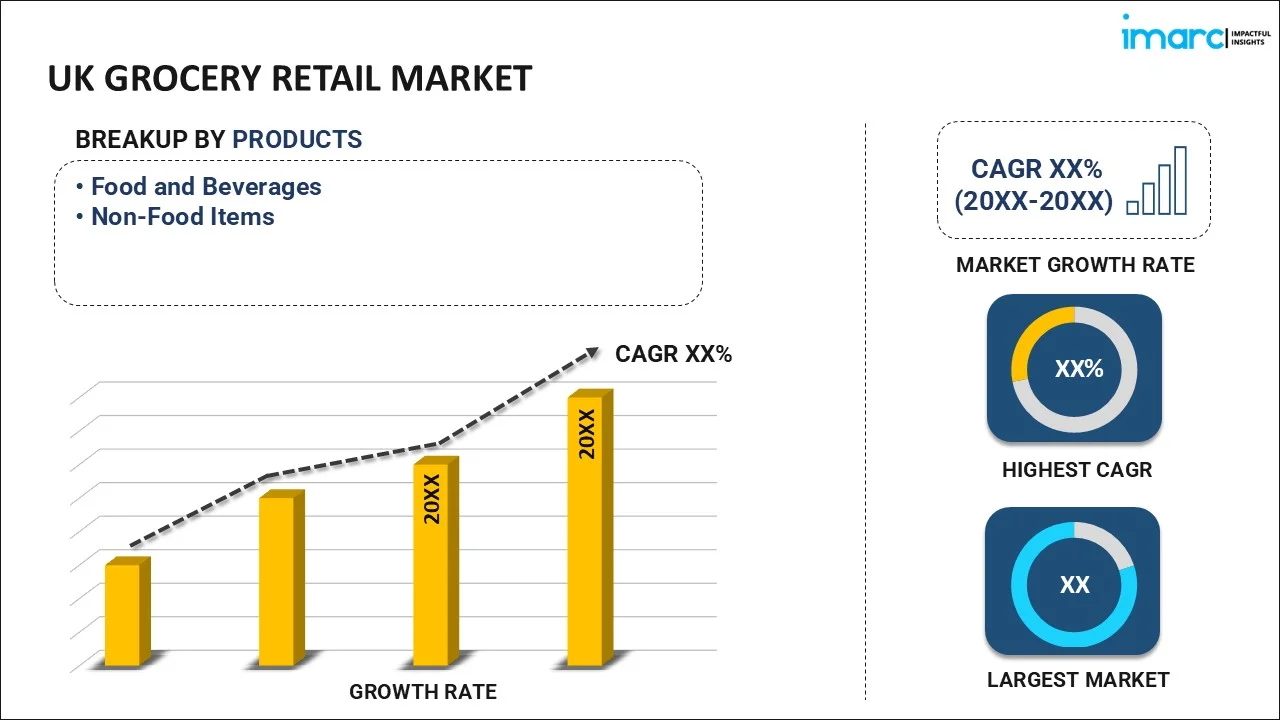
- By Product: Food and beverages dominate the market with a share of 81.3% in 2025, driven by essential daily consumption needs spanning fresh, packaged, and beverage categories across all household segments.
- By Distribution Channel: Hypermarkets and supermarkets lead the market with a share of 45.2% in 2025, benefiting from wide product assortments, competitive pricing strategies, and convenient one-stop shopping environments.
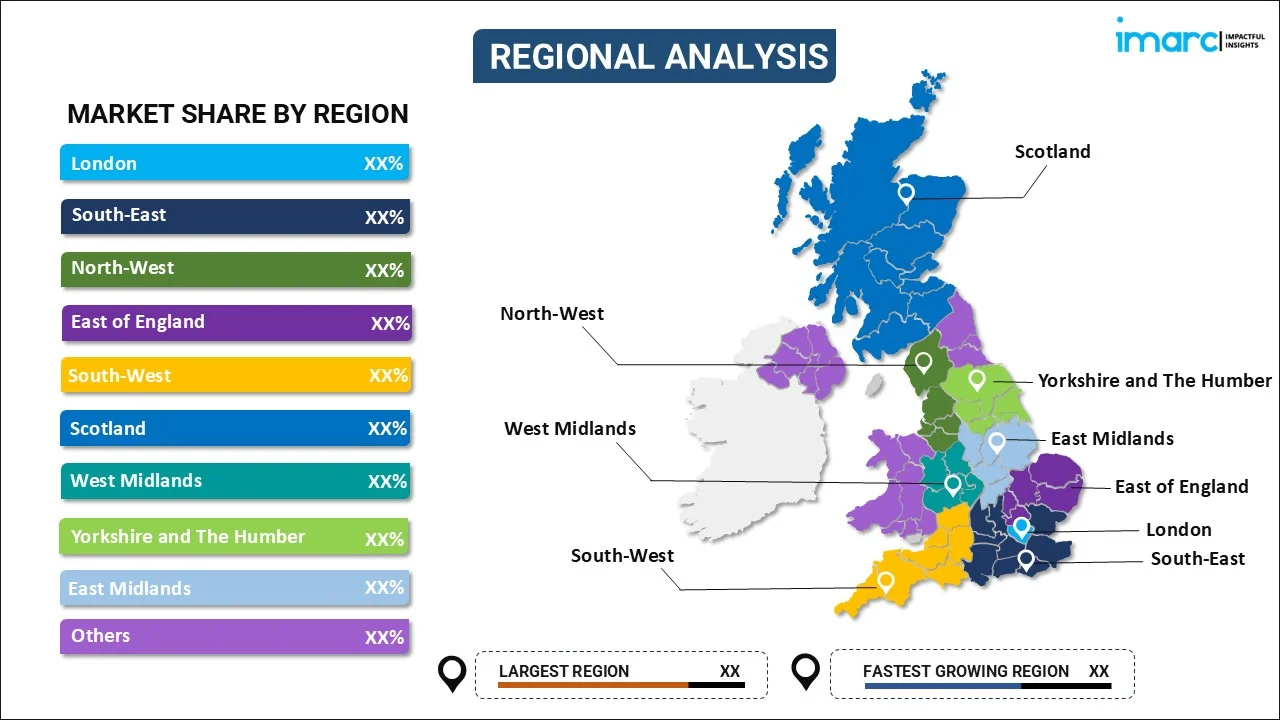
- By Region: London represents the largest segment with a market share of 16.8% in 2025, reflecting high population density, greater disposable incomes, and a high concentration of diverse retail formats.
- Key Players: The UK grocery retail market features intense competition among established major retailers competing on price, quality, convenience, and digital capabilities, with discounters gaining significant market share alongside traditional full-service supermarket chains.
The UK grocery retail market is experiencing a structural shift driven by evolving consumer priorities and rapid technological advancement. Major supermarkets are competing across price, product quality, and digital innovation to retain and expand their customer bases in an increasingly fragmented landscape. The growing footprint of discount retailers has intensified price competition, compelling traditional chains to enhance their private label ranges and loyalty schemes. Simultaneously, the rise of online and rapid delivery services is redefining convenience expectations, with platforms investing heavily in fulfilment infrastructure to meet growing demand. Growing consumer awareness around health and sustainability is influencing retailers to adopt more responsible sourcing and product selection strategies. Grocery chains are increasingly expanding affordable product ranges and emphasizing value-driven offerings while maintaining quality, helping attract a broader customer base, and strengthening their competitive position in the market.
UK Grocery Retail Market Trends:
Rapid Expansion of Private Label Product Ranges
UK grocery retailers are significantly broadening their own-brand product portfolios in response to sustained consumer demand for affordability and quality. Retailers across the spectrum are investing in premium own-label lines that challenge established branded products on taste and packaging while offering meaningful price savings. This strategy has proven particularly effective in capturing value-conscious shoppers without sacrificing margin. In January 2026, Sainsbury's reported that its premium "Taste the Difference" private-label range recorded a 15% sales increase, while broader own-brand penetration continued to gain across all grocery categories, reshaping brand loyalty dynamics and supporting UK grocery retail market growth.
Accelerating Integration of AI and Digital Technologies
Artificial intelligence is rapidly transforming operations across the UK grocery retail sector, from inventory management and demand forecasting to personalized customer engagement and checkout innovation. Retailers are deploying machine learning systems to optimize supply chains, predict shelf-level demand, and deliver hyper-personalized promotions through loyalty card ecosystems. These technologies improve operational efficiency while enhancing the overall shopping experience. In 2024, Waitrose expanded its strategic partnership with Blue Yonder, integrating AI-driven demand forecasting tools to improve stock availability, reduce waste, and raise customer satisfaction across its store network.
Growing Momentum Behind Sustainability Initiatives
UK grocery retailers are embedding sustainability principles deeply into their business models, driven by regulatory requirements, investor expectations, and rising consumer awareness. Initiatives range from minimizing plastic packaging and expanding refill systems to ambitious carbon reduction commitments and regenerative farming supplier partnerships. These efforts are increasingly influencing product sourcing, logistics, and store operations. Tesco is actively pursuing net-zero goals backed by concrete supplier engagement programs, working with more than 1,500 farmers under its Sustainable Agriculture Code while committing to achieving a 60% reduction in direct emissions by 2025 compared to a 2015 baseline.
.webp)
Market Outlook 2026-2034:
The UK grocery retail market is expected to experience steady growth in the coming years, driven by the continued development of online retail channels and ongoing digital innovation across the sector. Retailers are increasingly focusing on enhancing customer experience while expanding their private label offerings to strengthen brand loyalty. Companies that effectively combine competitive pricing with high product quality and sustainable practices are likely to strengthen their market position as competition intensifies and consumer expectations continue to evolve. The market generated a revenue of USD 300.2 Billion in 2025, which is expected to reach USD 307.8 Billion in 2026 and further grow to USD 361.1 Billion by 2034, at a compound annual growth rate of 2.02% from 2026-2034.
UK Grocery Retail Market Report Segmentation:
| Segment Category | Leading Segment | Market Share |
|---|---|---|
|
Product |
Food and Beverages |
81.3% |
|
Distribution Channel |
Hypermarkets and Supermarkets |
45.2% |
|
Region |
London |
16.8% |
Product Insights:
To get detailed segment analysis of this market Request Sample
- Food and Beverages
- Fresh Food
- Packaged Food
- Beverages
- Non-Food Items
- Household Cleaning Products
- Personal Care Products
- Pet Care Products
Food and beverages represent the largest share of 81.3% of the total UK grocery retail market in 2025.
The food and beverages segment dominates the UK grocery retail market, driven by its essential role in daily household consumption across urban and rural demographics. Consumers are increasingly prioritizing health-oriented purchasing decisions, fueling demand for fresh produce, plant-based alternatives, and functional beverages. Retailers are responding by broadening fresh food sourcing and expanding ready-to-eat meal solutions. The parallel growth of premium own-label food lines has also supported the segment's revenue contribution, as shoppers trade between value and quality within the same retail environment across hypermarkets, discount stores, and online channels.
Within the food and beverages segment, packaged food has demonstrated notable resilience amid inflationary pressures, with consumers gravitating toward private label packaged goods that offer comparable quality at lower price points. Fresh food remains the most visited category in-store, supporting high footfall for physical retail formats including supermarkets and hypermarkets. Beverages, encompassing both alcoholic and non-alcoholic options, continue to generate significant incremental revenue, with premium and low-alcohol product lines experiencing growing consumer adoption as health consciousness rises across UK shopping demographics.
Distribution Channel Insights:
- Hypermarkets and Supermarkets
- Convenience Stores
- Discount Stores
- Online
- Others
Hypermarkets and supermarkets lead the highest revenue share of 45.2% of the total UK grocery retail market in 2025.
Hypermarkets and supermarkets continue to anchor the UK grocery retail landscape by offering consumers broad product assortments, competitive pricing, and one-stop shopping convenience across large-format stores. Their ability to accommodate full weekly shopping missions, host fresh food counters, and integrate online ordering with in-store click-and-collect services gives them a structural advantage over smaller formats. Strategic investments in store refurbishment, electronic shelf labeling, and self-checkout technology are enhancing efficiency while improving customer experience across major retail chains serving millions of households.
The competitive strength of hypermarkets and supermarkets is further supported by the use of loyalty programs and continuous private label innovation. Retailers in this format increasingly utilize customer data collected through loyalty memberships to offer personalized promotions, targeted discounts, and tailored shopping experiences. By analyzing purchasing behavior, supermarkets can better align product offerings and pricing strategies with consumer preferences. At the same time, expanding private label ranges allows retailers to differentiate their product portfolios while maintaining competitive pricing. This combination of data-driven marketing and strong in-house brands helps supermarkets maintain a leading position despite rising competition from discount chains and online grocery platforms.
Regional Insights:
To get detailed regional analysis of this market Request Sample
- London
- South East
- North West
- East of England
- South West
- Scotland
- West Midlands
- Yorkshire and the Humber
- East Midlands
- Others
London exhibits a clear dominance with a 16.8% share of the total UK grocery retail market in 2025.
London leads the UK grocery retail market by region, underpinned by its population density, high average household incomes, and concentration of both premium grocery formats and discount outlets. The capital hosts the broadest diversity of retail formats, from luxury food halls and convenience stores to full-service supermarkets and dark stores supporting rapid online delivery. Its multicultural consumer base drives demand for international food categories, specialty ingredients, and ready-to-eat options that are less prevalent in smaller regional markets across England, Scotland, and Wales.
London’s grocery retail environment is strongly influenced by the growing prominence of online shopping and rapid delivery services. The city’s large population of busy professionals and commuters creates strong demand for convenient grocery options, including ready-to-eat meals, meal kits, and flexible home delivery services. Retailers maintain extensive store networks across the capital to serve both in-store shoppers and online order fulfillment. These physical outlets also function as key logistics and distribution points that support digital grocery operations, making London an essential market for retailers seeking to strengthen their omnichannel strategies and meet evolving consumer expectations.
Market Dynamics:
Growth Drivers:
Why is the UK Grocery Retail Market Growing?
Rising Consumer Adoption of Online and Digital Grocery Shopping
The growing penetration of online grocery retail across the UK is a pivotal driver of market expansion. Consumers are increasingly comfortable ordering groceries through digital platforms, mobile applications, and rapid delivery services, supported by expanding fulfilment infrastructure including automated warehouses and click-and-collect hubs. Supermarkets have invested substantially to meet this demand, extending digital capabilities from urban centers into suburban and regional markets. The ease and flexibility offered by digital grocery platforms are broadening online shopping accessibility to a larger consumer base while also motivating current users to place orders more regularly. Retailers are increasingly investing in automated fulfillment infrastructure and advanced logistics systems to improve delivery efficiency, reduce operational costs, and enhance service speed, particularly in densely populated urban markets.
Premiumization and Private Label Expansion Driving Revenue Growth
Retailers are capturing growing revenue from expanding private label programs across multiple price tiers, from entry-level value lines to premium own-brand ranges. The dominance of own-brand penetration rates in the UK grocery market has been achieved because of consumer demand to ensure quality at competitive prices. Premium branded products that are priced as a premium branded counterpart are doing better in their niche, such as ready meals, chilled products, and beverage shops, and this is encouraging the retailer to invest ever more in product development and packaging quality. This two-level approach helps retailers to sustain profit margins, build brand recognition, and keep those customers who may otherwise migrate to the discount stores. Investing in highly developed own brand lines, the grocery retailer can improve product differentiation, appeal to shoppers who are concerned about quality, and help to improve overall sales performance in the competitive UK grocery market.
Deployment of Artificial Intelligence Across Retail Operations
Artificial intelligence is fundamentally improving the operational efficiency and customer engagement capabilities of UK grocery retailers. Machine learning applications span demand forecasting, inventory optimization, personalized marketing, and automated checkout technologies, reducing waste, improving product availability, and enhancing the precision of promotional targeting. These capabilities contribute to stronger financial performance and greater customer satisfaction simultaneously. Retailers embedding AI into core operations are better positioned to respond to consumer behavior changes in real time, gaining a structural advantage in a highly competitive market. For instance, in 2024, Sainsbury's announced a five-year strategic partnership with Microsoft to integrate AI and machine learning capabilities into its operations, targeting sustained improvements in customer experience, store efficiency, and end-to-end supply chain performance across its entire retail network.
Market Restraints:
What Challenges the UK Grocery Retail Market is Facing?
Persistent Food Price Inflation and Cost-of-Living Pressures
The high price of food and the current squeeze on cost-of-living is limiting consumer expenditure in the UK grocery sector, which is tightening the basket value and putting pressure on shoppers to move to discount formats and cheaper own-label alternatives. The increasing cost of energy, labor, and raw materials is still straining the margins of retailers and restricting their ability to make long-term investments in prices. These inflation pressures provide a difficult operating condition that tempers market growth, especially for those mid-market and premium retail formats with a less adaptable cost structure.
Supply Chain Vulnerabilities and Import Dependency
The UK grocery retail market remains exposed to supply chain disruptions arising from extreme weather events, geopolitical pressures, and significant dependency on European Union agricultural imports, which supply approximately two-thirds of the country's fresh produce. Fresh food shortages driven by adverse weather patterns in key growing regions can rapidly affect product availability and pricing across supermarket categories, creating operational instability. These structural vulnerabilities limit the predictability of supply and add complexity for retailers managing vast, perishable product assortments under tightening cost constraints.
Rising Operational Costs Including Labor and Energy Expenditure
Grocery retailers are facing significant headwinds from escalating operational costs, including rising minimum wages, energy expenditure across large-format store estates, and increased logistics expenses associated with expanding omnichannel fulfilment capabilities. These pressures are compressing profitability and limiting retailers' ability to simultaneously invest in digital transformation, store modernization, and price competitiveness. Smaller regional operators are particularly exposed to these cost pressures, as they lack the scale economies and negotiating leverage available to major national supermarket chains.
Competitive Landscape:
The UK grocery retail market is characterized by intense competition among a diverse mix of national supermarket chains, value-focused discounters, online specialists, and convenience operators. Retailers are competing across multiple dimensions, including price competitiveness, private label breadth, digital innovation, sustainability credentials, and loyalty program sophistication. Discounters continue to gain share through store network expansion and quality improvements, while established supermarket leaders defend their positions through data-driven personalization and omnichannel investment. Consolidation trends and strategic format diversification are reshaping the competitive landscape, compelling all market participants to continuously refine their customer value propositions in response to evolving shopper expectations.
Recent Developments:
- In January 2026, Amazon introduced a rapid grocery delivery offering called Amazon Now, designed to provide a wide assortment of food items and everyday household essentials within a delivery window of 30 minutes or less. The service was first piloted in selected postal areas of Southwark in southeast London, with the company planning a broader rollout to additional locations in the following months.
UK Grocery Retail Market Report Coverage:
| Report Features | Details |
|---|---|
| Base Year of the Analysis | 2025 |
| Historical Period | 2020-2025 |
| Forecast Period | 2026-2034 |
| Units | Billion USD |
| Scope of the Report | Exploration of Historical Trends and Market Outlook, Industry Catalysts and Challenges, Segment-Wise Historical and Future Market Assessment:
|
| Products Covered |
|
| Distribution Channels Covered | Hypermarkets and Supermarkets, Convenience Stores, Discount Stores, Online, Others |
| Regions Covered | London, South East, North West, East of England, South West, Scotland, West Midlands, Yorkshire and The Humber, East Midlands, Others |
| Customization Scope | 10% Free Customization |
| Post-Sale Analyst Support | 10-12 Weeks |
| Delivery Format | PDF and Excel through Email (We can also provide the editable version of the report in PPT/Word format on special request) |
Frequently Asked Questions About the UK Grocery Retail Market Report
The UK grocery retail market size increased from USD 300.2 Billion in 2025 to USD 307.8 Billion in 2026.
The UK grocery retail market is expected to grow at a compound annual growth rate of 2.02% from 2026-2034, to reach USD 361.1 Billion by 2034.
Food and beverages, commanding a market share of 81.3% in 2025, leads the UK grocery retail market, driven by consistent household demand for fresh, packaged, and beverage categories across all consumer demographics and retail formats throughout the country.
Key factors driving the UK grocery retail market include rising online grocery adoption, accelerating integration of AI and digital technologies, expanding private label product ranges, growing sustainability initiatives, and increasing consumer demand for convenience and value-oriented shopping experiences across diverse retail formats.
Major challenges include persistent food price inflation constraining consumer spending, supply chain vulnerabilities from significant import dependency, rising labor and energy operational costs, intensifying discount competition, and the complexity of maintaining profitable omnichannel grocery retail operations at scale.
Need more help?
- Speak to our experienced analysts for insights on the current market scenarios.
- Include additional segments and countries to customize the report as per your requirement.
- Gain an unparalleled competitive advantage in your domain by understanding how to utilize the report and positively impacting your operations and revenue.
- For further assistance, please connect with our analysts.
 Request Customization
 Speak to an Analyst
 Request Brochure
 Inquire Before Buying
Benefits of Customization
- Personalize this research
- Triangulate with your data
- Get data as per your format and definition
- Gain a deeper dive into a specific application, geography, customer, or competitor
- Any level of personalization
Get in Touch With Us
UNITED STATES
Phone: +1-201-971-6302
INDIA
Phone: +91-120-433-0800
UNITED KINGDOM
Phone: +44-753-714-6104
Email: [email protected]
Client Testimonials




.webp)




.webp)













Related Reports

Choose your plan
*Please note that the prices mentioned below are starting prices for each bundle type. Kindly contact our team for further details.*
Single User License
- 1 User License, Access on 2 Devices
- PDF Report + Excel Dataset (Password Protected)
- Lifetime Access
- No Printing Rights
- 10% Free Report Customization
- 10–12 Weeks of Analyst Support
Five User License
- Access for 5 Users, 2 Devices per User
- PDF Report + Excel Dataset (Password Protected)
- Lifetime Access
- Dedicated Account Manager
- 12–14 Weeks of Analyst Support
- No Printing Rights
- 15% Free Report Customization
- 25% Discount on Your Next Purchase
Corporate User License
- Unlimited User Access (Within Your Organization)
- PDF Report + Excel Dataset
- Lifetime Access
- Dedicated Account Manager
- 14–20 Weeks of Analyst Support
- No Printing Rights
- 20% Free Report Customization
- 30% Discount on Your Next Purchase
Essential Insights
What's included:
3 reports
- Lifetime Access
- PDF Reports
- Excel Datasets
- 2 Weeks of Free Analyst Support
- 2 User Licenses
- Access on 2 Devices
- Printing Rights
- Complimentary PowerPoint (PPT) Version
- Complimentary License Upgrade
Professional Access
What's included:
5 reports
- Lifetime Access
- PDF Reports
- Excel Datasets
- 8 Weeks of Free Analyst Support
- 2 User Licenses
- Access on 2 Devices
- Printing Rights
- Complimentary PowerPoint (PPT) Version
- Complimentary License Upgrade
Business Advantage
What's included:
8 reports
- Lifetime Access
- PDF Reports
- Excel Datasets
- 14 Weeks of Free Analyst Support
- 2 User Licenses
- Access on 2 Devices
- Printing Rights
- Complimentary PowerPoint (PPT) Version
- Complimentary License Upgrade
Enterprise Intelligence
What's included:
10 reports
- Lifetime Access
- PDF Reports
- Excel Datasets
- 20 Weeks of Free Analyst Support
- 2 User Licenses
- Access on 2 Devices
- Printing Rights
- Complimentary PowerPoint (PPT) Version
- Complimentary License Upgrade