
United States Breast MRI Market Size, Share, Trends and Forecast by Product Type, Magnetic Field Strength, End User, and Region, 2026-2034
United States Breast MRI Market Summary:
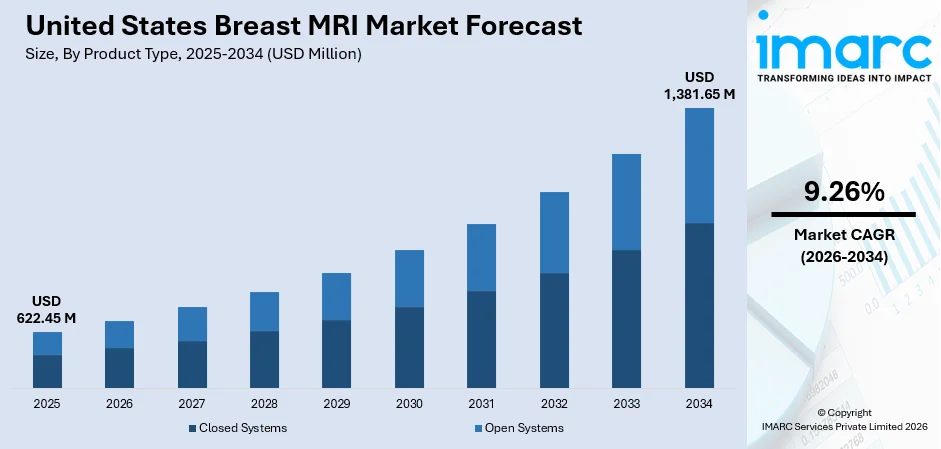
The United States breast MRI market size was valued at USD 622.45 Million in 2025 and is projected to reach USD 1381.65 Million by 2034, growing at a compound annual growth rate of 9.26% from 2026-2034.
The United States breast MRI market is gaining traction due to rising breast cancer cases, broader clinical use, and ongoing advances in MRI technology. AI-enabled imaging systems, updated screening recommendations promoting earlier detection, and greater focus on dense breast tissue evaluation are driving demand. High-field systems, shorter scan protocols, and risk-based screening models are improving workflows. Clinical trials supporting advanced MRI techniques are also boosting adoption across hospitals and diagnostic centers.
Key Takeaways and Insights:
- By Product Type: Closed systems dominate the market with a share of 68.4% in 2025, owing to their superior image quality, enhanced safety features, and ability to produce high-resolution diagnostic images essential for accurate breast cancer detection and treatment planning.
- By Magnetic Field Strength: High field strength leads the market with a share of 59.2% in 2025, driven by its ability to deliver detailed anatomical visualization and superior soft-tissue contrast, enabling more precise identification of small lesions and abnormalities in breast tissue.
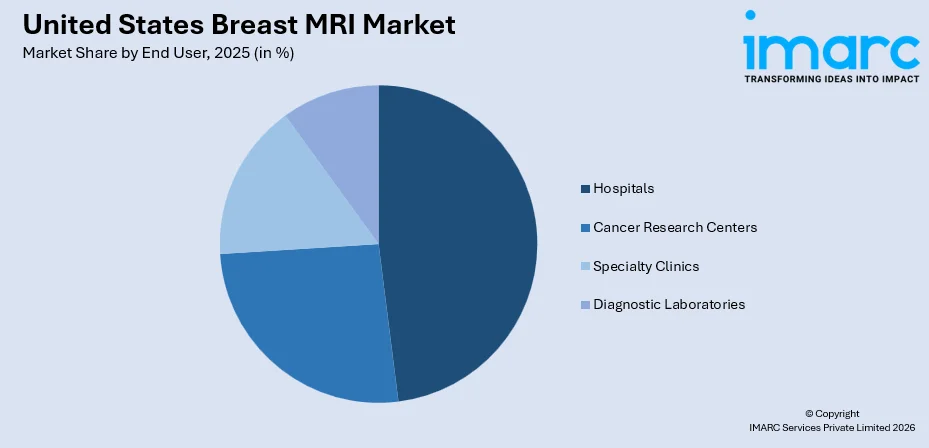
- By End User: Hospitals reign the market with a share of 47.6% in 2025. This dominance is driven by their comprehensive diagnostic infrastructure, availability of skilled radiologists, and capacity to manage high patient volumes requiring advanced breast MRI procedures.
- By Region: South comprises the largest region with 33.9% share in 2025, driven by a large and growing population base, expanding healthcare infrastructure, high breast cancer prevalence, and increasing investments in advanced diagnostic imaging facilities across major metropolitan areas.
- Key Players: The market is highly competitive, with major imaging companies focusing on high-field systems, AI-supported diagnostics, and faster scanning protocols. Providers compete through technological upgrades, partnerships with healthcare networks, and expanded service offerings across hospitals, specialty clinics, and diagnostic imaging centers.
To get more information on this market Request Sample
The United States breast MRI market is advancing as healthcare providers, technology developers, and regulatory bodies prioritize earlier and more accurate breast cancer detection. A significant driver shaping this progress is the growing integration of artificial intelligence into breast imaging workflows, enabling faster and more reliable diagnostic outcomes. For instance, in June 2025, the U.S. Food and Drug Administration granted De Novo authorization to Clairity Breast, the first AI-powered platform that predicts a woman's five-year breast cancer risk using only a standard mammogram, marking a landmark advancement in predictive imaging. Updated screening guidelines, expanding adoption of high-field MRI systems, and rising awareness around supplemental imaging for women with dense breast tissue are also contributing to a more favorable environment for market expansion. Besides this, increasing investments in abbreviated MRI protocols and personalized screening strategies further support broader clinical adoption across the country.
United States Breast MRI Market Trends:
Integration of AI-Powered Diagnostic Platforms
The United States is witnessing rapid adoption of artificial intelligence tools in breast MRI workflows, enabling radiologists to improve detection accuracy and streamline clinical decision-making. For instance, in April 2025, RadNet announced a definitive merger agreement to acquire iCAD, a leading AI-powered breast health solutions provider, integrating its ProFound AI suite into RadNet's DeepHealth platform. These advancements are strengthening the role of AI in enhancing sensitivity, reducing false positives, and supporting personalized risk stratification across breast imaging centers, contributing to United States breast MRI market growth.
Expansion of Abbreviated and Non-Contrast MRI Protocols
Abbreviated breast MRI protocols are gaining traction as a cost-effective and time-efficient alternative to full diagnostic scans, broadening screening accessibility for average-risk populations. Researchers at the University of Chicago Medical Center developed a novel imaging method called High Spectral and Spatial Resolution Imaging that detects cancer with reliability comparable to traditional contrast-enhanced techniques, eliminating the need for contrast agents. These innovations are accelerating the adoption of non-contrast MRI approaches, making breast MRI screening more practical and accessible across outpatient and community healthcare settings.
Growing Emphasis on Risk-Stratified Screening Approaches
Healthcare providers are increasingly shifting toward personalized, risk-based breast cancer screening pathways that tailor imaging frequency and modality to individual patient profiles. For example, in April 2024, the U.S. Preventive Services Task Force updated its guidelines to recommend biennial screening mammography starting at age 40, reflecting growing recognition of earlier breast cancer onset. Additionally, the FDA's mandate requiring mammography centers to notify patients about breast density is fueling supplemental MRI referrals, strengthening demand for advanced imaging among high-risk populations.
Market Outlook 2026-2034:
The United States breast MRI market is poised for sustained growth, supported by continuous technological innovation, expanding screening programs, and increasing clinical demand for precise diagnostic imaging. In line with this, rising breast cancer incidence, growing adoption of AI-enhanced MRI platforms, and expanding use of abbreviated scanning protocols are expected to drive higher adoption rates across hospitals, specialty clinics, and diagnostic laboratories. According to the latest CDC statistics, 279,731 new cases of breast cancer were diagnosed among women in the United States in 2022, while 42,213 women lost their lives to the disease in 2023. Furthermore, evolving federal screening guidelines, increasing awareness around dense breast tissue imaging, and continued investments in high-field MRI systems are anticipated to create a more robust and accessible breast MRI landscape across the country. The market generated a revenue of USD 622.45 Million in 2025 and is projected to reach a revenue of USD 1381.65 Million by 2034, growing at a compound annual growth rate of 9.26% from 2026-2034.
United States Breast MRI Market Report Segmentation:
|
Segment Category |
Leading Segment |
Market Share |
|
Product Type |
Closed Systems |
68.4% |
|
Magnetic Field Strength |
High Field Strength |
59.2% |
|
End User |
Hospitals |
47.6% |
|
Region |
South |
33.9% |
Product Type Insights:
- Closed Systems
- Open Systems
Closed systems dominate with a market share of 68.4% of the total United States breast MRI market in 2025.
Closed MRI systems maintain their dominant position in the United States breast MRI market due to their superior image quality, stronger magnetic fields, and enhanced diagnostic precision. These fully enclosed systems produce high-resolution images with minimal external interference, making them essential for detecting small breast lesions and micro-calcifications. Their advanced imaging capabilities support accurate tumor staging, treatment response monitoring, and surgical planning, reinforcing their widespread adoption across major healthcare facilities. For instance, at RSNA 2025, United Imaging highlighted its AI-enabled MRI advancements, featuring the FDA-cleared 3T uMR Ultra with motion visualization capabilities and the uAiFI.LIVE platform, enabling real-time dynamic imaging to transform MRI from static scans into motion-based physiological assessment.
The closed system technology development by leading manufacturers will result in enhanced market presence which they currently hold throughout the entire country. Hospitals and diagnostic centers prioritize closed MRI systems for their ability to accommodate advanced imaging sequences which breast cancer evaluation requires including diffusion-weighted imaging and dynamic contrast-enhanced protocols. The systems undergo continuous advancements in bore design and noise reduction technology which improves patient comfort while preserving their diagnostic capabilities. The increasing number of refurbished closed MRI systems that become available at reduced prices is helping mid-sized healthcare facilities and regional imaging networks to expand their access to these systems.
Magnetic Field Strength Insights:
- High Field Strength
- Low Field Strength
- Mid Field Strength
High field strength leads the market with a revenue share of 59.2% of the total United States breast MRI market in 2025.
High field strength MRI systems, operating at 1.5 Tesla and above, command the largest share of the United States breast MRI market owing to their exceptional signal-to-noise ratio and superior soft-tissue contrast resolution. These systems deliver detailed anatomical and functional imaging essential for identifying subtle breast abnormalities, guiding biopsy procedures, and assessing treatment efficacy. Their clinical versatility supports a wide range of breast imaging applications, from routine screening of high-risk patients to complex diagnostic evaluations. According to FDA estimates, nearly half of women aged 40 and older in the United States have dense breast tissue, a condition where high-field MRI offers significant diagnostic advantages over conventional mammography.
Academic medical centers and cancer research institutions increasingly prefer 3 Tesla MRI systems which strengthens the existing dominance of high-field strength platforms. The systems deliver improved spatial resolution together with enhanced acquisition speed which streamlines clinical operations and increases patient processing capacity. The diagnostic capabilities of high-field systems maintain expansion through ongoing improvements in gradient technology, coil development and image reconstruction method advances. The demand for high-field strength breast MRI systems has reached new heights because healthcare facilities continue to invest in modernizing their imaging equipment.
End User Insights:
Access the comprehensive market breakdown Request Sample
- Hospitals
- Cancer Research Centers
- Specialty Clinics
- Diagnostic Laboratories
Hospitals hold the largest share at 47.6% of the total United States breast MRI market in 2025.
Hospitals represent the dominant end-user segment in the United States breast MRI market, driven by their comprehensive diagnostic infrastructure, skilled radiology workforce, and ability to handle high patient volumes requiring advanced imaging services. Large hospital networks invest significantly in state-of-the-art MRI systems to support breast cancer screening, staging, and treatment monitoring programs. Their integrated care models enable seamless coordination between imaging, oncology, and surgical departments, enhancing clinical outcomes. According to the American Cancer Society, approximately 316,950 women were expected to be diagnosed with invasive breast cancer in the United States in 2025, underscoring the critical role hospitals play in managing diagnostic demand.
The ongoing development of breast imaging facilities at hospitals and the increased use of AI diagnostic systems are strengthening the hospital industry as its most important business sector. Health systems are implementing specialized breast MRI centers which use state-of-the-art bilateral coil systems and automated operational systems to enhance their diagnostic process and improve patient care. Hospitals receive multiple advantages from their strong reimbursement systems and established patient referral networks which direct high-risk individuals to additional breast MRI tests. Hospitals employ multidisciplinary oncology teams to enhance their patient care services which helps them maintain their leading position in the market.
Regional Insights:
- Northeast
- Midwest
- South
- West
The South exhibits a clear dominance with a 33.9% share of the total United States breast MRI market in 2025.
The South region leads the United States breast MRI market, supported by its large and diverse population, extensive hospital networks, and significant investments in healthcare infrastructure across major metropolitan centers such as Houston, Atlanta, Miami, and Dallas. Industry reports indicate that the U.S. population has expanded by more than 10 million people since 2020, with nearly three-quarters of this growth occurring in the South. From 2020 to 2025, the national population rose by 3.1%, while the South recorded the fastest regional growth at 6.0%. The region's high breast cancer incidence rates, particularly among minority populations facing screening disparities, drive sustained demand for advanced diagnostic imaging modalities. Expanding Medicaid coverage in several southern states and growing federal funding for cancer screening programs are enhancing patient access to breast MRI services.
Leading healthcare institutions in the South, including MD Anderson Cancer Center in Texas and Moffitt Cancer Center in Florida, are strengthening the region’s role in advanced breast cancer diagnostics. These centers continue to invest in next-generation imaging technologies, including high-resolution MRI systems and AI-supported diagnostic tools. Their focus on research, early detection programs, and clinical trials is accelerating the adoption of innovative screening approaches, reinforcing the South’s position as a key center for breast imaging innovation and improved patient outcomes.
Market Dynamics:
Growth Drivers:
Why is the United States Breast MRI Market Growing?
Rising Breast Cancer Prevalence and Screening Demand
The increasing incidence of breast cancer across the United States is a primary catalyst driving demand for advanced breast MRI procedures. Breast cancer remains the most commonly diagnosed cancer among American women, with rising detection rates attributed to improved screening awareness, expanded insurance coverage, and evolving clinical guidelines. The growing recognition of breast cancer's impact on younger women and racial minorities has prompted healthcare organizations to advocate for earlier and more comprehensive screening approaches, including supplemental MRI for high-risk populations. Research by the Radiological Society of North America (RSNA), based on data from seven outpatient centers in the New York region, reported that women aged 18 to 49 accounted for around 20–24% of all breast cancer diagnoses over an 11-year period. As more women enter structured screening programs at younger ages, the need for supplemental imaging modalities such as breast MRI is increasing, particularly for those with dense breast tissue, family histories of breast cancer, or genetic predispositions. This expanding screening landscape is strengthening demand across hospitals, imaging centers, and specialty clinics.
Technological Advancements in MRI Systems and Software
Continuous innovation in MRI hardware, software, and artificial intelligence is transforming breast cancer diagnostics in the United States. Manufacturers are developing next-generation closed MRI systems with improved gradient performance, dedicated bilateral breast coils, and faster acquisition protocols that enhance image quality while reducing scan times. These advancements enable more accurate detection of small tumors and better assessment of treatment response, expanding the clinical utility of breast MRI across diverse patient populations. The integration of AI-powered diagnostic platforms is further accelerating market growth. For instance, iCAD’s ProFound Detection Version 4.0 received FDA clearance in November 2024 for DBT screening. It delivers a 22% overall improvement in detecting aggressive cancers, including 50% better detection in dense tissue and 60% in invasive lobular cancers. Such innovations are improving radiologist efficiency, reducing reading times, and enhancing diagnostic confidence, making breast MRI a more accessible and effective screening tool for healthcare providers nationwide.
Federal Regulatory Mandates Supporting Supplemental Imaging
Federal regulatory initiatives are playing a pivotal role in expanding the adoption of breast MRI across the United States. The FDA's updated Mammography Quality Standards Act, which became effective in September 2024, now mandates that all mammography centers inform patients about their breast density and its implications for cancer detection. This regulatory change is increasing patient awareness and driving referrals for supplemental imaging, particularly breast MRI, among women identified with dense breast tissue. Additionally, 38 states and the District of Columbia have enacted legislation requiring patient notification of breast density, with several states also mandating insurance coverage for supplemental screening modalities. These policy developments are reducing financial barriers and expanding access to breast MRI services for millions of women across the country, creating a more supportive regulatory environment that sustains long-term market growth.
Market Restraints:
What Challenges the United States Breast MRI Market is Facing?
High Equipment and Operational Costs
The substantial capital investment required for acquiring, installing, and maintaining advanced breast MRI systems poses a significant barrier for many healthcare facilities, particularly smaller clinics and community hospitals. Closed high-field MRI systems can cost between one and three Million dollars, excluding ongoing maintenance, staffing, and facility modification expenses. These high costs limit adoption among resource-constrained providers and slow the expansion of breast MRI services into underserved and rural areas where diagnostic access remains limited.
Extended Scan Duration and Patient Discomfort
Despite advancements in abbreviated protocols, standard breast MRI examinations remain more time-consuming compared to mammography and ultrasound, typically requiring 30 to 60 minutes per session. The enclosed bore design of closed MRI systems can cause claustrophobia and anxiety in some patients, leading to scan interruptions or avoidance. These factors reduce patient compliance with recommended screening schedules and limit throughput capacity at imaging centers, presenting operational challenges for facilities managing high patient volumes.
Limited Reimbursement Consistency Across Payers
Inconsistent insurance coverage and reimbursement policies for breast MRI screening create financial uncertainty for both healthcare providers and patients. While supplemental breast MRI is recommended for high-risk women, coverage varies significantly across private insurers, Medicaid programs, and geographic regions. This inconsistency can discourage eligible patients from pursuing recommended imaging and limits healthcare facilities' willingness to invest in expanding breast MRI capacity, particularly in states with limited supplemental screening mandates.
Competitive Landscape:
The United States breast MRI market is characterized by intense competition among established medical imaging companies, emerging AI-driven diagnostic firms, and specialized breast imaging technology developers. Leading manufacturers are investing heavily in research and development to introduce advanced MRI systems with improved imaging performance, shorter scan times, and enhanced patient comfort. Strategic partnerships between imaging technology companies and healthcare providers are accelerating the deployment of AI-powered diagnostic platforms and expanding clinical adoption. Companies are also focusing on product portfolio diversification, regulatory approvals, and geographic expansion to strengthen their market position and capture growing demand for precision breast cancer diagnostics.
Recent Developments:
- In December 2025, DeepHealth launched its AI-powered Breast Suite, supporting over 10 million mammograms annually. The suite improves detection by 21%, including 23% more cancers found in dense breasts. It integrates cancer detection, risk assessment, and workflow tools with cloud-based multi-modality viewing, including MRI and ultrasound, enhancing diagnostic accuracy and radiologist efficiency.
- In July 2025, SimonMed Imaging introduced Mammogram+ and Mammogram+ Heart, AI-enhanced screening services combining dual AI review with radiologist oversight. The tools improve early breast cancer detection and assess breast arterial calcification for heart risk. Integrated with advanced imaging pathways, including MRI follow-up when indicated, they support more personalized, preventive care nationwide.
United States Breast MRI Market Report Coverage:
|
Report Features |
Details |
|
Base Year of the Analysis |
2025 |
|
Historical Period |
2020-2025 |
|
Forecast Period |
2026-2034 |
|
Units |
Million USD |
|
Scope of the Report |
Exploration of Historical Trends and Market Outlook, Industry Catalysts and Challenges, Segment-Wise Historical and Future Market Assessment:
|
|
Product Types Covered |
Closed Systems, Open Systems |
|
Magnetic Field Strengths Covered |
High Field Strength, Low Field Strength, Mid Field Strength |
|
End Users Covered |
Hospitals, Cancer Research Centers, Specialty Clinics, Diagnostic Laboratories |
|
Regions Covered |
Northeast, Midwest, South, West |
|
Customization Scope |
10% Free Customization |
|
Post-Sale Analyst Support |
10-12 Weeks |
|
Delivery Format |
PDF and Excel through Email (We can also provide the editable version of the report in PPT/Word format on special request) |
Frequently Asked Questions About the United States Breast MRI Market Report
The United States breast MRI market size was valued at USD 622.45 Million in 2025.
The United States breast MRI market is expected to grow at a compound annual growth rate of 9.26% from 2026-2034 to reach USD 1381.65 Million by 2034.
Closed systems dominated the market with a share of 68.4%, owing to their superior image quality, stronger magnetic fields, enhanced diagnostic precision, and widespread adoption across hospitals and imaging centers for accurate breast cancer detection.
Key factors driving the United States breast MRI market include rising breast cancer prevalence, expanding screening guidelines, technological advancements in MRI systems, growing AI integration in diagnostic workflows, and federal mandates supporting supplemental breast imaging.
Major challenges include high equipment and operational costs, extended scan duration causing patient discomfort, limited reimbursement consistency across insurance providers, claustrophobia concerns with closed systems, and restricted access to breast MRI services in rural and underserved areas.
Need more help?
- Speak to our experienced analysts for insights on the current market scenarios.
- Include additional segments and countries to customize the report as per your requirement.
- Gain an unparalleled competitive advantage in your domain by understanding how to utilize the report and positively impacting your operations and revenue.
- For further assistance, please connect with our analysts.
 Request Customization
 Speak to an Analyst
 Request Brochure
 Inquire Before Buying
Benefits of Customization
- Personalize this research
- Triangulate with your data
- Get data as per your format and definition
- Gain a deeper dive into a specific application, geography, customer, or competitor
- Any level of personalization
Get in Touch With Us
UNITED STATES
Phone: +1-201-971-6302
INDIA
Phone: +91-120-433-0800
UNITED KINGDOM
Phone: +44-753-714-6104
Email: [email protected]
Client Testimonials




.webp)




.webp)













Related Reports

Choose your plan
*Please note that the prices mentioned below are starting prices for each bundle type. Kindly contact our team for further details.*
Single User License
- 1 User License, Access on 2 Devices
- PDF Report + Excel Dataset (Password Protected)
- Lifetime Access
- No Printing Rights
- 10% Free Report Customization
- 10–12 Weeks of Analyst Support
Five User License
- Access for 5 Users, 2 Devices per User
- PDF Report + Excel Dataset (Password Protected)
- Lifetime Access
- Dedicated Account Manager
- 12–14 Weeks of Analyst Support
- No Printing Rights
- 15% Free Report Customization
- 25% Discount on Your Next Purchase
Corporate User License
- Unlimited User Access (Within Your Organization)
- PDF Report + Excel Dataset
- Lifetime Access
- Dedicated Account Manager
- 14–20 Weeks of Analyst Support
- No Printing Rights
- 20% Free Report Customization
- 30% Discount on Your Next Purchase
Essential Insights
What's included:
3 reports
- Lifetime Access
- PDF Reports
- Excel Datasets
- 2 Weeks of Free Analyst Support
- 2 User Licenses
- Access on 2 Devices
- Printing Rights
- Complimentary PowerPoint (PPT) Version
- Complimentary License Upgrade
Professional Access
What's included:
5 reports
- Lifetime Access
- PDF Reports
- Excel Datasets
- 8 Weeks of Free Analyst Support
- 2 User Licenses
- Access on 2 Devices
- Printing Rights
- Complimentary PowerPoint (PPT) Version
- Complimentary License Upgrade
Business Advantage
What's included:
8 reports
- Lifetime Access
- PDF Reports
- Excel Datasets
- 14 Weeks of Free Analyst Support
- 2 User Licenses
- Access on 2 Devices
- Printing Rights
- Complimentary PowerPoint (PPT) Version
- Complimentary License Upgrade
Enterprise Intelligence
What's included:
10 reports
- Lifetime Access
- PDF Reports
- Excel Datasets
- 20 Weeks of Free Analyst Support
- 2 User Licenses
- Access on 2 Devices
- Printing Rights
- Complimentary PowerPoint (PPT) Version
- Complimentary License Upgrade