
United States Citric Acid Market Size, Share, Trends and Forecast by Application, Form, and Region, 2026-2034
United States Citric Acid Market Size, Share, Trends & Forecast (2026-2034)
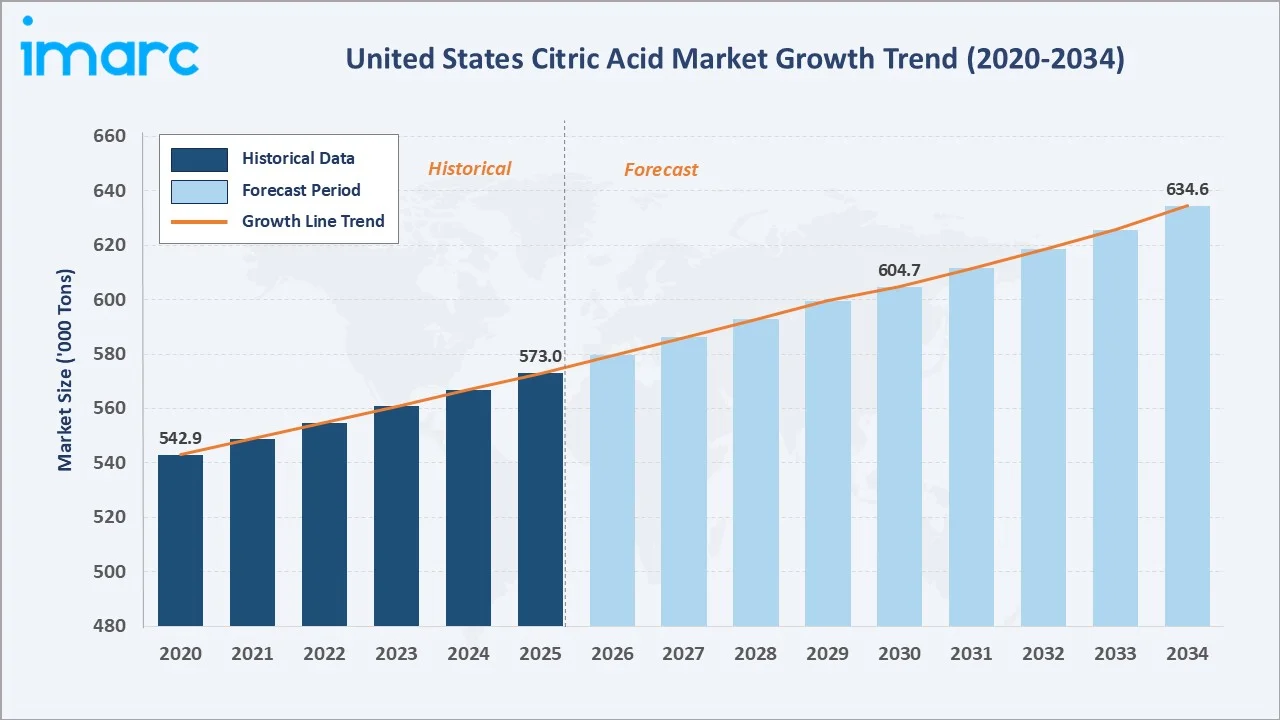
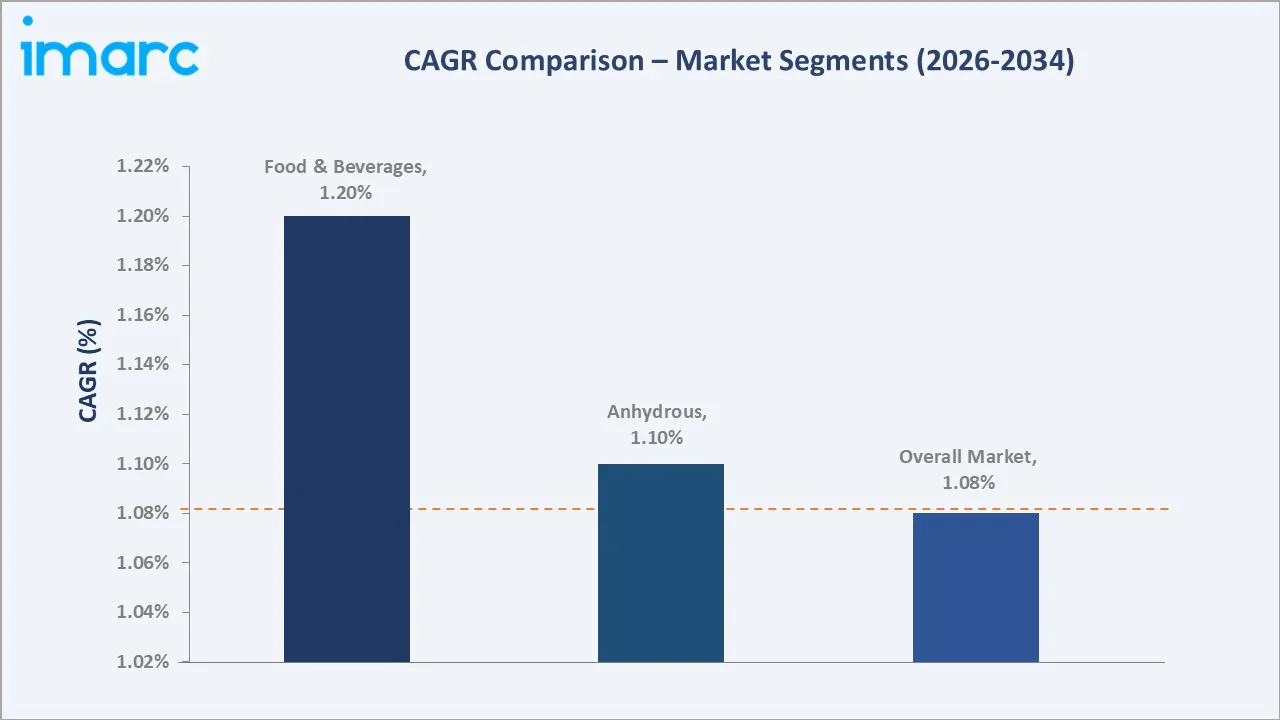
The United States citric acid market reached 5,73,000 Tons in 2025 and is projected to reach 6,34,600 Tons by 2034, growing at a CAGR of 1.08% during 2026-2034. Sustained demand from the food and beverage industry as a natural acidulant and preservative, growing household detergent and cleaner formulation requirements, pharmaceutical excipient consumption, and the clean label trend driving reformulation toward naturally-derived acidulants are the primary growth catalysts.
Market Snapshot
|
Metric |
Value |
|
Market Volume (2025) |
5,73,000 Tons |
|
Forecast Market Volume (2034) |
6,34,600 Tons |
|
CAGR (2026-2034) |
1.08% |
|
Base Year |
2025 |
|
Historical Period |
2020-2025 |
|
Forecast Period |
2026-2034 |
The South leads regionally with a 36.8% market share in 2025, driven by the region’s large food and beverage manufacturing base, significant household detergent and cleaning product manufacturing, and major chemical distribution hubs. Anhydrous commands the dominant 67.9% form share, reflecting its preferred status for dry food and beverage formulations, pharmaceutical tablet manufacturing, and industrial cleaning powder applications where moisture-free, free-flowing powder characteristics are essential for handling and formulation uniformity.
To get more information on this market, Request Sample
The market is sustained by three structural demand forces: the food and beverage industry’s continued dependence on citric acid as a primary GRAS-listed acidulant, pH regulator, and natural preservative across beverages, confectionery, and processed foods; the household cleaning product market’s adoption of citric acid as an environmentally preferable replacement for phosphates in descaling and cleaning applications; and the pharmaceutical sector’s requirement for citric acid and citrate salts as tablet excipients, effervescent buffer systems, and active pharmaceutical ingredient stabilizers.
Executive Summary
The United States citric acid market is experiencing steady growth, supported by the enduring importance of citric acid as a foundational ingredient across food and beverage, household cleaning, and pharmaceutical applications. The market reached 5,73,000 Tons in 2025 and is forecast to reach 6,34,600 Tons by 2034, growing at a CAGR of 1.08%.
Anhydrous accounts for 67.9% of the form segment in 2025, reflecting its universal applicability across food and beverage dry mix, confectionery, tablet manufacturing, and powder detergent applications where dry, free-flowing powder handling is required. Food and beverages at 58.7% of the application segment reflect citric acid’s indispensable role as the US food industry’s most widely used acidulant, deployed across carbonated beverages, fruit drinks, confectionery, processed meats, dairy products, and canned goods.
The South leads regionally at 36.8%, reflecting the region’s concentration of food processing, beverage bottling, and chemical manufacturing activity. Key players serve US demand through a combination of domestic fermentation production, imports from European and Asian producers, and extensive distribution infrastructure.
Key Market Insights
|
Insight |
Data |
|
Largest Form |
Anhydrous – 67.9% share (2025) |
|
Second Largest Form |
Liquid – 32.1% share (2025) |
|
Largest Application |
Food and Beverages – 58.7% share (2025) |
|
Second Largest Application |
Household Detergents and Cleaners – 18.6% share (2025) |
|
Leading Region |
South – 36.8% share (2025) |
|
Top Companies |
Cargill, Incorporated, Archer Daniels Midland Company, Jungbunzlauer Holding AG, Hawkins, Inc. |
Key Analytical Observations Supporting the Above Data:
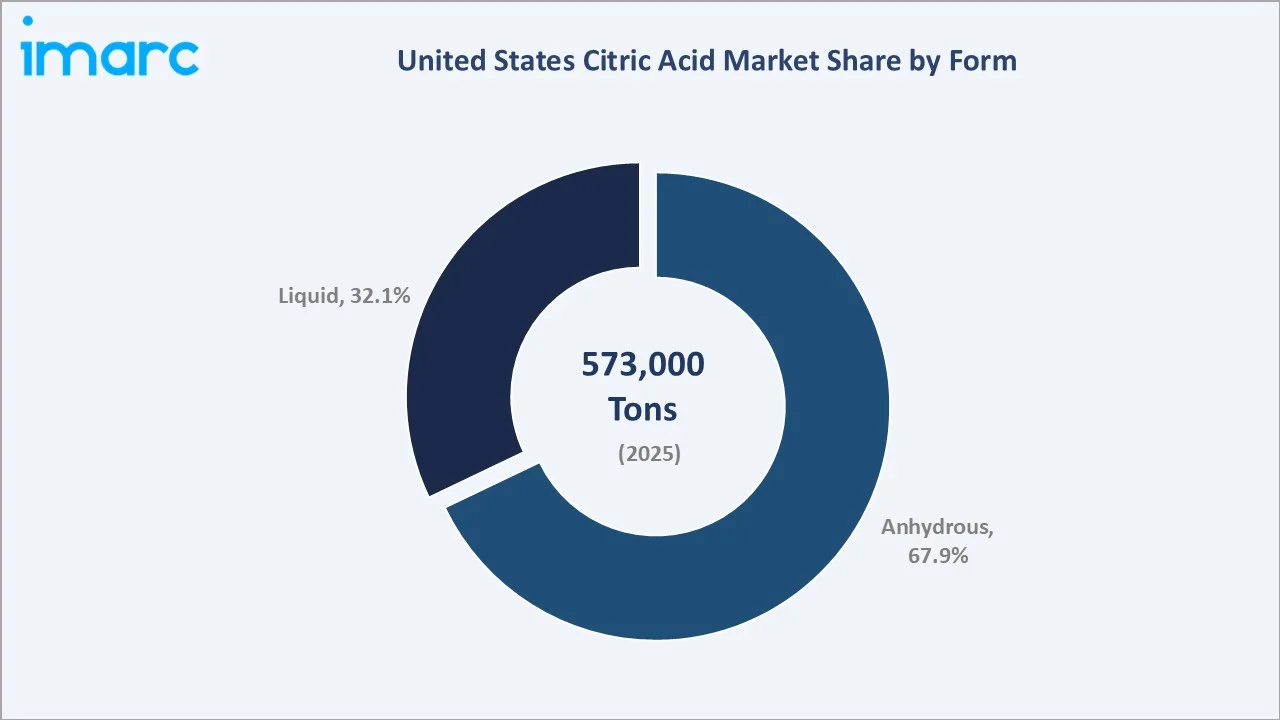
- Anhydrous at 67.9% (2025) leads the form segment as the dominant food and beverage, pharmaceutical tablet, and powder detergent applications require a dry, free-flowing powder form that anhydrous citric acid provides. Anhydrous citric acid’s lower water activity, higher purity content per unit weight, and superior shelf stability in dry mix formulations make it the default choice for the majority of industrial application categories.
- Food and Beverages at 58.7% share (2025) reflects citric acid’s status as the most widely used acidulant in the US food industry, listed as GRAS (Generally Recognized as Safe) under 21 CFR 184.1033. Carbonated beverages, fruit juices, sports drinks, confectionery, and processed food products collectively consume the majority of the United States citric acid volume, with beverage formulations representing the single largest sub-segment.
- Household detergents and cleaners at 18.6% (2025) reflect the significant adoption of citric acid as a phosphate replacement in dishwasher detergents, descaling products, and multi-surface cleaners following EPA and state-level phosphate bans. Citric acid’s chelating properties enable effective limescale and mineral deposit removal while satisfying biodegradability requirements for environmentally-preferable product certification.
- The South’s 36.8% share (2025) reflects the region’s concentration of food and beverage manufacturing across Texas, Florida, Georgia, and North Carolina, the largest chemical distribution hubs in Atlanta, Dallas, and Houston, and significant household product manufacturing capacity that collectively sustain the highest regional citric acid consumption volume.
United States Citric Acid Market Overview
Citric acid is a weak organic tricarboxylic acid widely found in citrus fruits and produced commercially through the submerged fermentation of corn-derived glucose or dextrose by Aspergillus niger. The United States market is predominantly import-supplied from Chinese and European producers, with limited domestic fermentation capacity, creating supply chain dependency that has become a strategic consideration for industrial consumers following trade policy disruptions.
Macroeconomic drivers include the restaurant and foodservice sales projected to reach USD 1.55 trillion in 2026, up 4.8% from 2025, according to the National Restaurant Association’s 2026 State of the Industry Report, representing a structurally stable base demand for citric acid; the household cleaning products market growing at 3–5% annually driven by hygiene awareness and premium product adoption; and pharmaceutical companies have announced commitments of more than USD 350 billion toward U.S. manufacturing investments, providing consistent excipient demand.
Market Dynamics
To evaluate market opportunities, Request Sample
Market Drivers
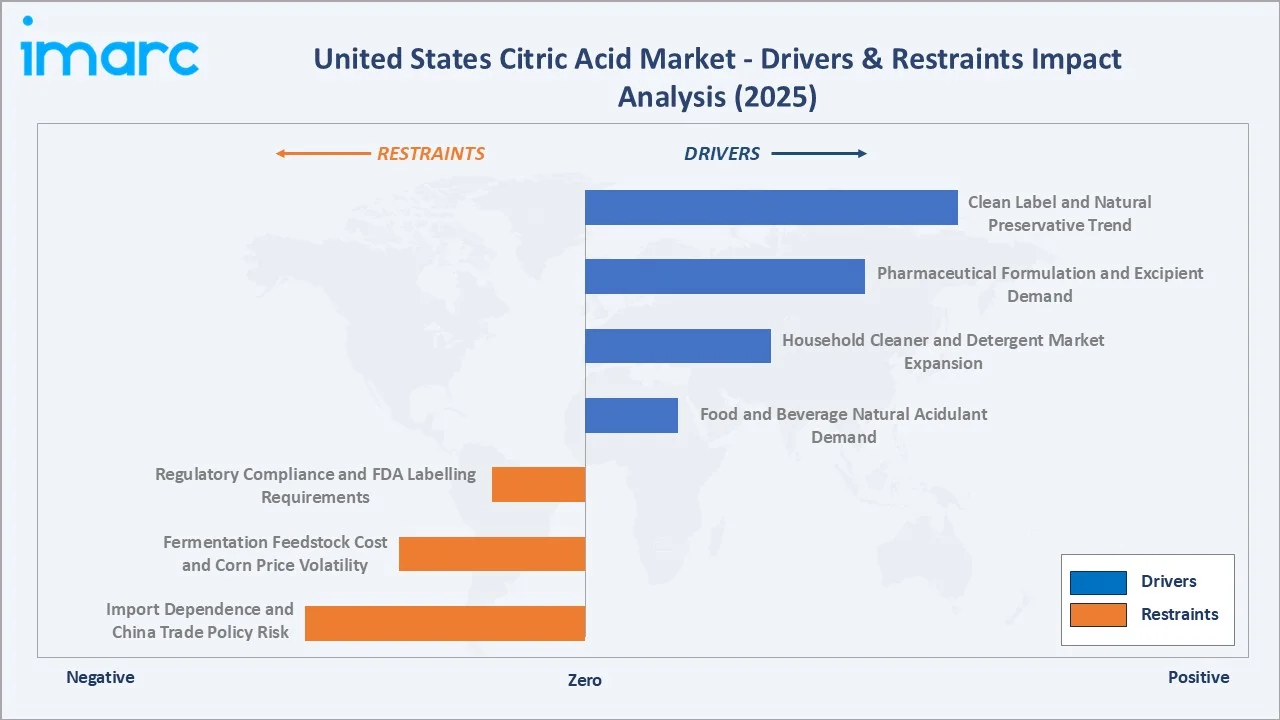
- Food and Beverage Natural Acidulant Demand: Citric acid is the most widely used acidulant in the US food industry, providing tartness, pH control, flavor enhancement, and preservation across virtually every major food and beverage category. The continuing growth of the US packaged food market, the shift toward natural and clean label formulations, and the reformulation of existing products away from synthetic acidulants are collectively sustaining stable to growing citric acid volumes in the food and beverage sector.
- Household Cleaner and Detergent Market Expansion: The US household cleaning product market’s transition away from phosphate-based descalers and multi-surface cleaners toward citric acid-based formulations is a sustained structural driver. Citric acid’s calcium chelation properties make it effective for limescale removal in dishwashers, coffee machines, and bathroom fixtures, while its biodegradability and GRAS safety profile align with the growing consumer preference for environmentally preferable household products.
- Pharmaceutical Formulation and Excipient Demand: Citric acid and its sodium, potassium, and calcium citrate salts are used extensively in pharmaceutical formulations as effervescent buffer systems, tablet excipients, oral liquid pH adjusters, and active ingredient stabilizers. The US pharmaceutical manufacturing sector’s continued growth, including the biosimilars and generic drug market expansion, sustains consistent pharmaceutical-grade citric acid demand that is relatively price-insensitive and quality-specification-driven.
- Clean Label and Natural Preservative Trend: The sustained consumer trend toward transparent, naturally-derived ingredient lists is driving food and beverage manufacturers to reformulate products using citric acid as a replacement for synthetic preservatives, artificial acidulants, and chemical pH regulators. This trend supports incremental volume growth in citric acid consumption beyond natural background demand growth in established application categories.
Market Restraints
- Import Dependence and China Trade Policy Risk: The United States imports the majority of its citric acid requirements, predominantly from China, which controls approximately 65-70% of global citric acid production capacity. US anti-dumping and countervailing duty orders on Chinese citric acid, combined with broader US-China trade policy uncertainty, create significant supply chain risk and price volatility exposure for United States citric acid consumers.
- Fermentation Feedstock Cost and Corn Price Volatility: Citric acid production economics are directly linked to corn and glucose syrup feedstock pricing, as over 90% of US and global citric acid is produced through fermentation of corn-derived substrates. Corn price volatility driven by weather events, energy policy (ethanol mandates), and global agricultural commodity cycles creates input cost uncertainty that affects producer margins and consumer pricing stability.
- Regulatory Compliance and FDA Labelling Requirements: The US FDA’s strict requirements for food-grade citric acid quality standards, pharmaceutical-grade USP and FCC purity specifications, and accurate ingredient labelling create compliance costs for both producers and industrial users. Pharmaceutical and food-grade specification compliance requires continuous analytical testing and quality management investment that adds cost to the supply chain.
Market Opportunities
- Domestic Fermentation Capacity Investment: The US market’s significant import dependence and the strategic vulnerability highlighted by supply chain disruptions during 2020–2022 are creating commercial opportunities for domestic citric acid fermentation investment. Federal programs supporting domestic chemical manufacturing, combined with near-term US-China trade policy uncertainty creating demand for supply chain diversification, represent a structural commercial case for new domestic citric acid production capacity.
- Pharmaceutical and Nutraceutical Formulation Growth: The US pharmaceutical market’s continued expansion, including the growing nutraceutical and dietary supplement sector, is creating above-market demand growth for citric acid in effervescent tablet and powder formulations, oral rehydration solutions, mineral supplement formulations, and probiotic product acidification.
Market Challenges
- Price Competition from Low-Cost Asian Imports: Despite US anti-dumping and countervailing duty orders on Chinese citric acid, price competition from lower-cost Asian import sources, including India, Thailand, and other fermentation producers outside duty order coverage, continues to pressure pricing for domestic and European-sourced citric acid.
- Supply Chain Concentration Risk Management: The high concentration of global citric acid production in China creates structural supply chain vulnerability for US industrial consumers, particularly in pharmaceutical and food safety-critical applications where supply interruption would trigger product recalls or manufacturing shutdowns.
Emerging Market Trends
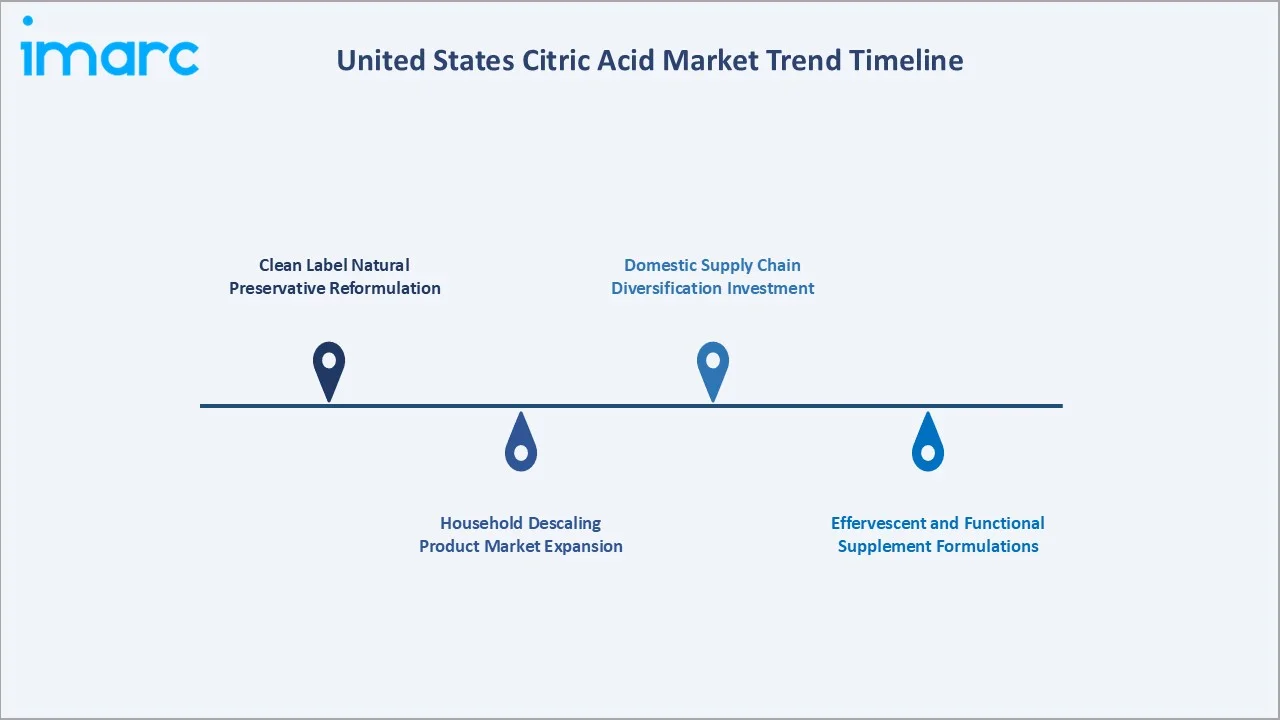
1. Clean Label Natural Preservative Reformulation
Leading US food and beverage brands, including PepsiCo, Kraft Heinz, and General Mills, have accelerated clean label reformulation programs that are replacing synthetic acidulants, artificial preservatives, and chemical pH regulators with citric acid and citrate salts in hundreds of product lines. This reformulation trend is creating incremental citric acid volume demand that supplements natural consumption growth in established application categories, particularly in the processed food, beverage, and personal care product segments.
2. Household Descaling Product Market Expansion
The rapid growth of premium household cleaning and appliance care products, including dishwasher cleaners, coffee machine descalers, shower head cleaners, and washing machine cleaners, is creating a significant new citric acid consumption category. Brands including Affresh, Lemi Shine, and private label equivalents are expanding retail distribution, with the category growing at 8–12% annually, driven by the proliferation of hard water-sensitive household appliances and consumer willingness to pay premium prices for effective, natural-ingredient cleaning products.
3. Effervescent and Functional Supplement Formulations
The US dietary supplement and functional food market’s rapid growth is creating significant new citric acid demand in effervescent tablet and sachet formulations. Products including vitamin C effervescent tablets, electrolyte powders, probiotic sachets, and mineral supplement formulations use citric acid as both an effervescent buffer component and a flavor enhancement ingredient. The direct-to-consumer supplement market, growing at above 8% annually, represents one of the highest-growth end markets for pharmaceutical-grade citric acid.
4. Domestic Supply Chain Diversification Investment
Post-2020 supply chain disruption awareness is driving US industrial consumers and chemical distributors toward multi-sourcing strategies that reduce dependence on a single-source Chinese citric acid supply. Jungbunzlauer’s European production, Bartek Ingredients’ North American facilities, and smaller specialty producers are benefiting from long-term supply agreement interest from US pharmaceutical and food manufacturers seeking supply chain diversification, even at cost premiums above Chinese spot pricing.
Industry Value Chain Analysis
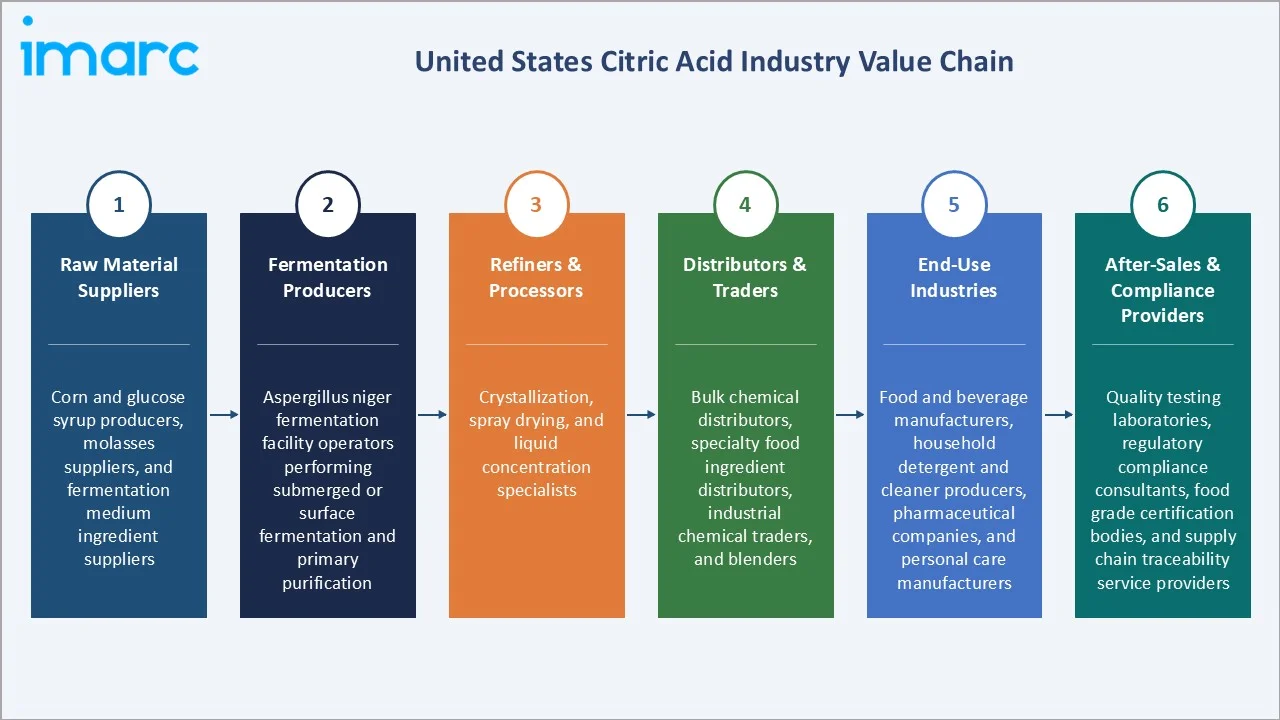
The value chain spans from fermentation feedstock supply through production, refining, distribution, and end-use application across food and beverage, household cleaning, pharmaceutical, and industrial sectors. The production tier is predominantly offshore in China and Europe, with the US market supply primarily sourced through import channels distributed by specialist chemical distributors and food ingredient suppliers.
|
Stage |
Key Players / Examples |
|
Raw Material Suppliers |
Corn and glucose syrup producers, molasses suppliers, and fermentation medium ingredient suppliers |
|
Fermentation Producers |
Aspergillus niger fermentation facility operators performing submerged or surface fermentation and primary purification |
|
Refiners & Processors |
Crystallization, spray drying, and liquid concentration specialists |
|
Distributors & Traders |
Bulk chemical distributors, specialty food ingredient distributors, industrial chemical traders, and blenders |
|
End-Use Industries |
Food and beverage manufacturers, household detergent and cleaner producers, pharmaceutical companies, and personal care manufacturers |
|
After-Sales & Compliance Providers |
Quality testing laboratories, regulatory compliance consultants, food grade certification bodies, and supply chain traceability service providers |
Technology Landscape in the United States Citric Acid Industry
Aspergillus Niger Submerged Fermentation
Over 90% of the United States citric acid supply is produced through the submerged fermentation of corn-derived glucose or molasses-derived sucrose by Aspergillus niger fungi. The fermentation process operates in large-scale stainless steel bioreactors under carefully controlled temperature, pH, and oxygen conditions over 5–10 day fermentation cycles. Downstream processing involves calcium citrate precipitation, sulphuric acid conversion, active carbon decolorization, ion exchange purification, crystallization, and spray drying to produce food-grade anhydrous or monohydrate citric acid meeting FCC and USP purity specifications.
Liquid Citric Acid Processing
Liquid citric acid offers handling efficiency advantages for high-volume continuous manufacturing operations in beverage, liquid detergent, and industrial processing applications. Liquid delivery eliminates dust handling requirements, reduces dissolution energy, and enables metered in-line dosing that improves formulation accuracy and reduces labor cost in large-scale production environments. The liquid form segment’s growth is driven by the beverage and liquid cleaning product manufacturing sectors’ preference for liquid ingredient systems in automated continuous production lines.
Citrate Salt Derivatives
Sodium citrate, potassium citrate, calcium citrate, and trisodium citrate are produced through the neutralization of citric acid with the corresponding metal hydroxides or carbonates. These citrate salts serve as buffering agents, sequestrants, and emulsifying salts in food applications, mineral supplement active ingredients in nutraceuticals, and anticoagulant additives in blood banking. The United States citric salt market represents a significant derivative demand category that commands higher unit pricing than citric acid itself, and is growing at above-citric-acid-market rates driven by pharmaceutical and nutraceutical adoption.
Market Segmentation Analysis
The report covers the following segments:
|
Segment Category |
Leading Segment |
Market Share |
Year |
|
Form |
Anhydrous |
67.9% |
2025 |
|
Application |
Food and Beverages |
58.7% |
2025 |
|
Region |
South |
36.8% |
2025 |

By Form
Anhydrous leads with a 67.9% share of the market in 2025, reflecting its universal applicability across the majority of United States citric acid application categories. In food and beverages, anhydrous citric acid is the standard form for dry mix beverages, confectionery, snack seasoning, and powdered soft drink formulations requiring precise dosing of dry ingredients.
To access detailed market analysis, Request Sample
Liquid at 32.1% serves the beverage manufacturing, liquid detergent production, and industrial processing sectors, where aqueous solution delivery is preferred for high-volume continuous manufacturing. Liquid citric acid eliminates the dust generation, dissolving equipment, and handling complexity of powder form, enabling direct in-line metered dosing in automated production systems.
By Application
Food and beverages lead with a 58.7% share in 2025. Citric acid’s GRAS status, universal flavor acceptance, effective pH buffering, and natural origin make it the preferred acidulant across the US food industry. Carbonated beverages and fruit drinks represent the single largest food and beverage sub-application, with each liter of carbonated soft drink typically containing 0.3–0.8 grams of citric acid for tartness and pH adjustment.
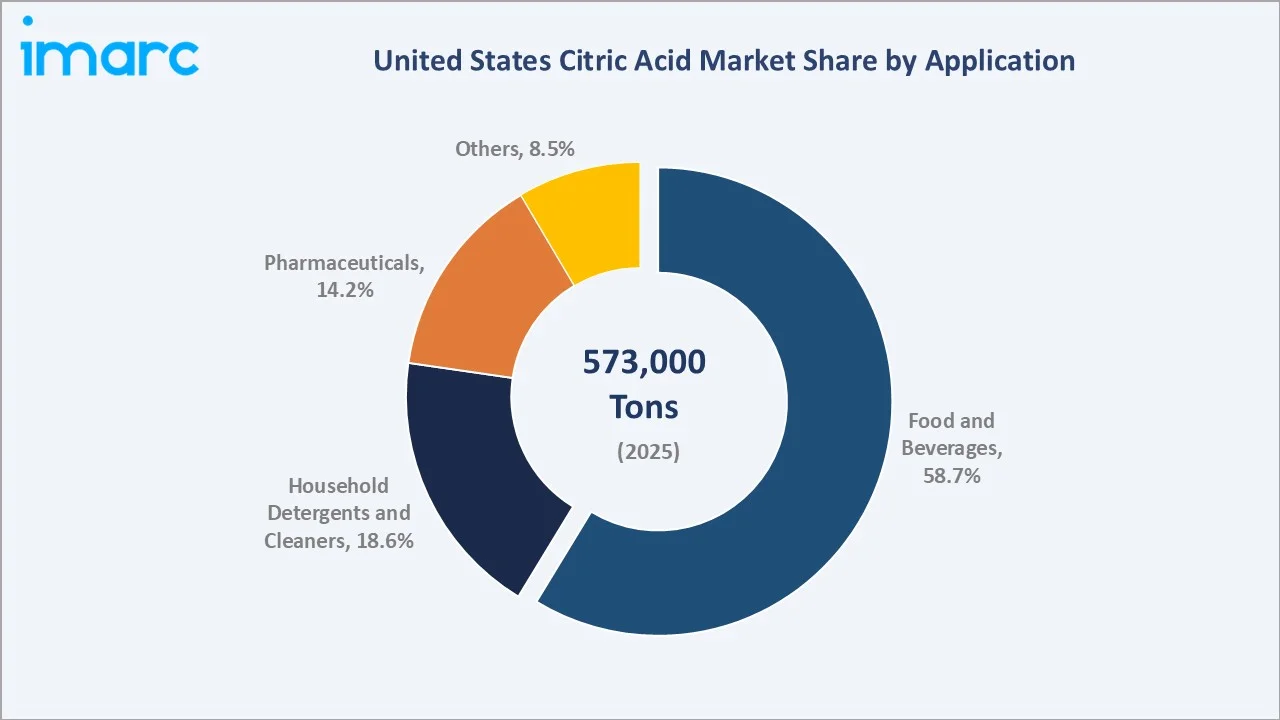
Household detergents and cleaners at 18.6% encompasses dishwasher detergents, descaling products, bathroom cleaners, and multi-surface cleaners formulated with citric acid as a chelating and descaling active ingredient. Pharmaceuticals at 14.2% represent the highest-value application segment by unit pricing, encompassing excipient and effervescent buffer applications for both prescription and over-the-counter drug formulations.
Regional Market Insights
The South’s dominant position (36.8%, 2025) reflects the region’s unparalleled concentration of food processing and beverage bottling facilities across Texas, Florida, Georgia, and North Carolina, combined with major chemical distribution infrastructure in Atlanta, Dallas, and Houston that serves as the primary receiving and redistribution hub for the majority of United States citric acid imports arriving through Gulf Coast ports.
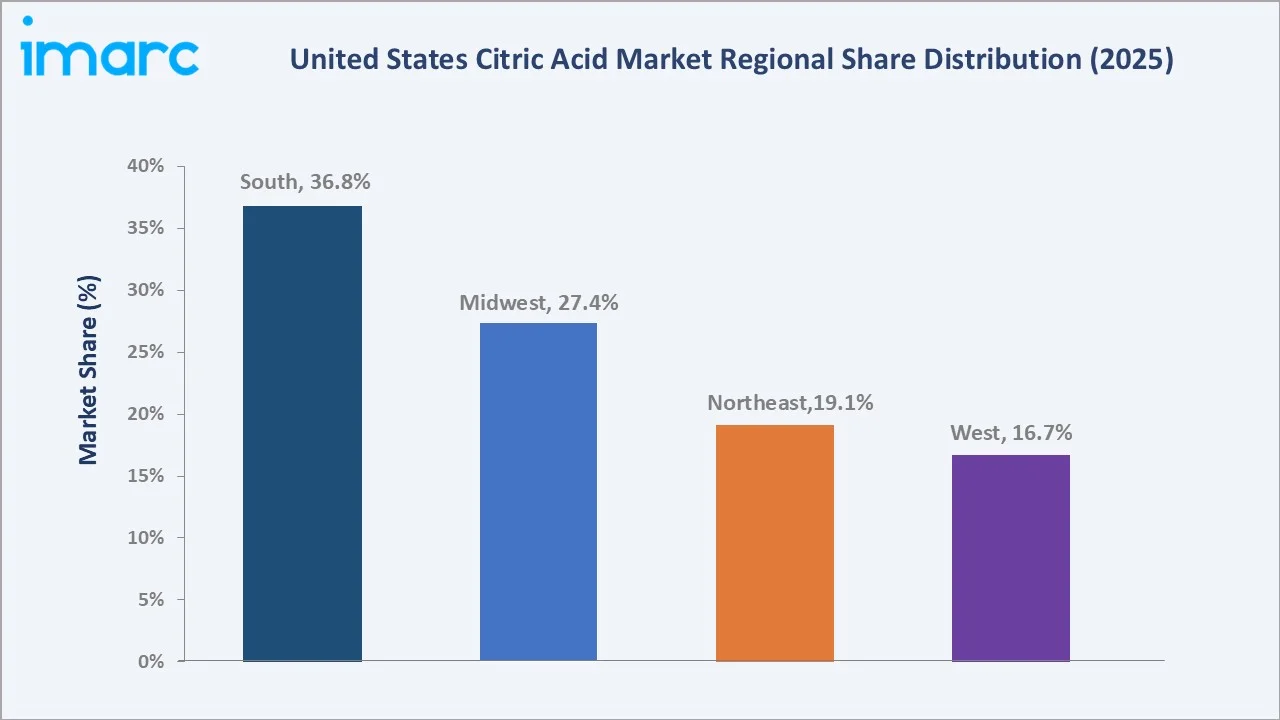
The Midwest at 27.4% benefits from its position at the center of US corn production and fermentation industry, with proximity to grain feedstock reducing input logistics cost for the limited domestic citric acid production capacity, and established food ingredient distribution infrastructure serving the region’s large food processing sector.
|
Region |
Share (2025) |
Key Growth Drivers |
|
South |
36.8% |
Large food and beverage manufacturing base, significant household detergent and cleaning product manufacturing, major distribution hubs, and proximity to Gulf Coast chemical processing infrastructure |
|
Midwest |
27.4% |
Corn production and fermentation feedstock proximity, established food and beverage processing industry, large agricultural ingredient distribution network, and significant pharmaceutical manufacturing activity |
|
Northeast |
19.1% |
Concentrated pharmaceutical manufacturing base, large urban food and beverage consumption market, established specialty chemical distribution infrastructure, and strong household consumer product brands |
|
West |
16.7% |
Large food and beverage market driven by California’s food processing sector, growing natural and organic product segment creating premium citric acid demand, and active pharmaceutical and personal care manufacturing |
The Northeast at 19.1% reflects its concentration of pharmaceutical manufacturing and large urban population centers, creating high food and beverage processing activity. The West at 16.7% is driven by California’s large food processing and natural food manufacturing sector and the growing organic and clean label product market, creating above-average demand for premium and non-GMO certified citric acid.
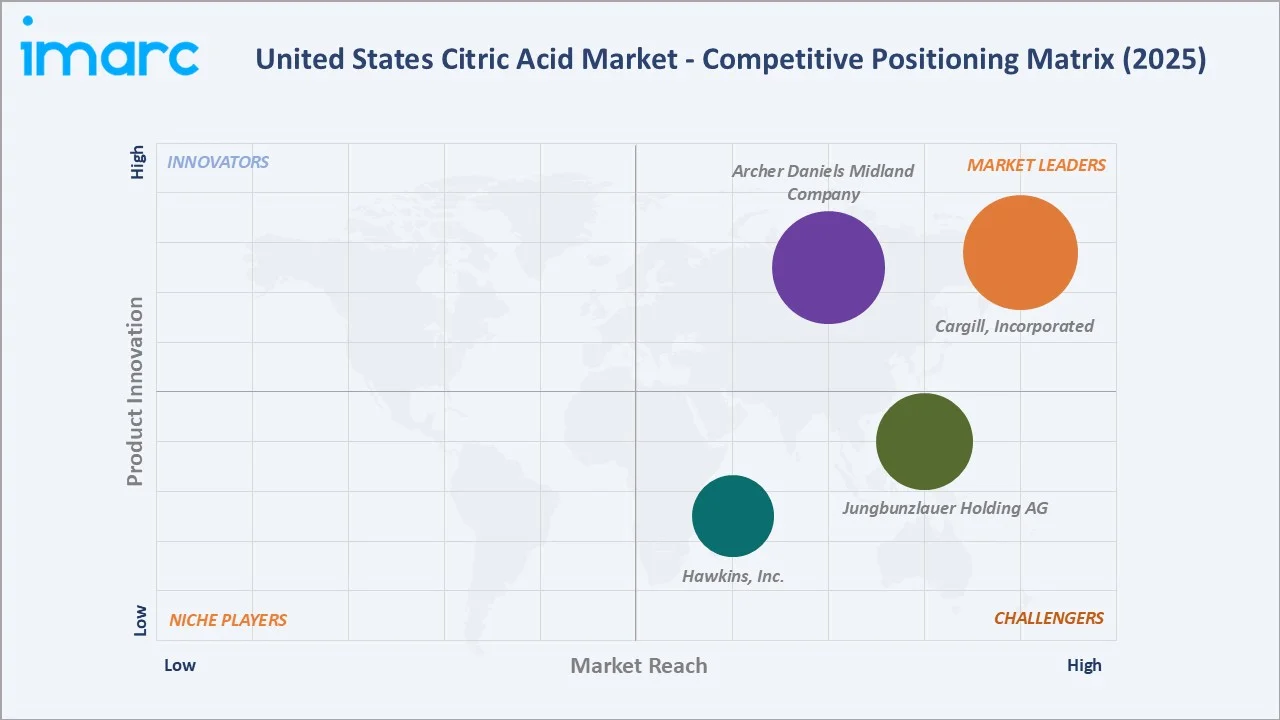
Competitive Landscape
The United States citric acid market exhibits moderate concentration at the production level, with global citric acid supply dominated by Chinese manufacturers serving the US market predominantly through import channels.
|
Company Name |
Product Range |
Market Position |
Core Strength |
|
Cargill, Incorporated |
Cargill Citric Acid (Anhydrous, liquid)
|
Market Leader |
Vertically integrated corn processing capability and deep food and beverage OEM relationships |
|
Archer Daniels Midland Company |
Citric Acid, Sodium Citrate |
Market Leader |
Integrated agricultural supply chain, large citric acid production capacity, and broad distribution across food, pharma, and industrial markets |
|
Jungbunzlauer Holding AG |
Citric Acid Anhydrous, Citric Acid Monohydrate, LIQUINAT, Trisodium Citrate Anhydrous, Trisodium Citrate Dihydrate, Tripotassium Citrate, Monosodium Citrate |
Strong Challenger |
Specialty ingredient expertise, strong pharmaceutical and food grade quality positioning, and global supply capability with US distribution |
|
Hawkins, Inc. |
Liquid Citric Acid, Dry Citric Acid USP-FCC |
Challenger |
Regional US distribution strength, competitive pricing in standard grades, and established food and industrial customer relationships |
The competitive dynamics of the market are primarily shaped by price competition from Chinese import supply, with quality differentiation (food vs pharmaceutical grade, non-GMO certification, supply chain transparency) providing the primary basis for premium pricing by European and North American suppliers.
Key Company Profiles
Cargill, Incorporated
Cargill, Incorporated, is one of the world’s largest agricultural commodity processors and food ingredient suppliers. The company’s citric acid business operates through its food ingredients and bioindustrial divisions, supplying food-grade and industrial-grade citric acid and citrate salts to US food, beverage, and industrial customers.
- Product Portfolio: Food-grade anhydrous and monohydrate citric acid, liquid citric acid solutions, sodium citrate, potassium citrate, trisodium citrate, and citrate blends for food, beverage, and industrial applications.
- Strategic Focus: Integrated agricultural supply chain leverage for cost-competitive citric acid supply; food and beverage OEM relationship depth; sustainable sourcing program positioning for clean label customer segments.
Archer Daniels Midland Company
Archer Daniels Midland Company is one of the world’s largest agricultural processing and food ingredient companies. The company’s Carbohydrate Solutions segment produces citric acid through fermentation of corn-derived glucose.
- Product Portfolio: ADM citric acid (food and industrial grades), citrate salts portfolio, fermentation-derived organic acids, and specialty food ingredient solutions incorporating citric acid as a component.
- Recent Developments: In February 2026, Archer Daniels Midland Company reported FY2025 net earnings of USD 1.1 billion and adjusted net earnings of USD 1.7 billion, with adjusted EPS of USD 3.43. The company expects 2026 adjusted EPS of USD 3.60–4.25 and projected capital expenditure of USD 1.3–1.5 billion.
- Strategic Focus: Domestic corn fermentation competitive advantage; food and beverage customer solutions incorporating citric acid in broader ingredient packages; bio-based chemical platform development leveraging citric acid fermentation infrastructure.
Market Concentration Analysis
The United States citric acid market exhibits moderate concentration at the supply level, with global production dominated by Chinese fermentation producers supplying the majority of US import volume. At the US distribution and market-facing supply level, the top five suppliers collectively account for approximately 60–70% of organized distribution channel revenues, with the remainder distributed among specialty distributors, traders, and direct import buyers.
Anti-dumping and countervailing duty orders on Chinese citric acid (imposed by the US International Trade Commission since 2009) create a structural market intervention that influences competitive dynamics, but have not prevented the re-establishment of Chinese supply dominance through quota and duty payment or through sourcing from non-duty-affected countries.
Investment & Growth Opportunities
Fastest Growing Segments
Pharmaceutical and nutraceutical-grade citric acid (~2.5% CAGR), household descaling and cleaning product applications (~3–4% annual growth), and sustainable/non-GMO certified citric acid commanding premium pricing represent the highest-value growth investment vectors within the United States citric acid market through 2034. Effervescent supplement formulations represent one of the fastest-growing individual application sub-categories, driven by the functional food and sports nutrition market.
Domestic Production Investment Opportunity
The structural vulnerability of the United States citric acid supply, demonstrated by the 2020–2022 supply chain disruptions, combined with ongoing US-China trade policy uncertainty, is creating a commercial window for new domestic citric acid fermentation capacity investment. Feasibility analyses for corn-based citric acid fermentation in the US Midwest indicate commercially viable economics at a moderate scale, given current price premiums for non-Chinese supply in pharmaceutical and clean-label food applications.
Technology Investment Trends
- Precision fermentation technology investment is attracting attention for citric acid production through engineered yeast and bacterial fermentation systems that may offer efficiency advantages over traditional Aspergillus niger processes, including higher yields, faster fermentation cycles, and compatibility with alternative feedstocks, including agricultural waste streams.
- Non-GMO and organic-certified citric acid supply chain development is attracting investment from specialty ingredient companies seeking premium positioning in the rapidly growing natural and organic food manufacturing segment, where documentation of non-GMO corn substrate sourcing supports price premiums above commodity-grade citric acid.
Future Market Outlook (2026-2034)
The United States citric acid market is positioned for moderate, stable volume growth through 2034. From 5,73,000 Tons in 2025, the market is projected to reach 6,34,600 Tons by 2034, representing a total incremental volume of 61,600 Tons at a CAGR of 1.08%.
This moderate growth trajectory reflects citric acid’s mature market position in its primary food and beverage application, combined with stronger growth in household cleaning, pharmaceutical, and premium clean-label applications that collectively represent incremental volume above the baseline food and beverage growth rate.
The market’s strategic evolution will be shaped by trade policy developments affecting the economics of Chinese import supply, the potential emergence of meaningful domestic fermentation capacity, and the growing commercial importance of quality differentiation as premium segments grow their share of total market volume. Suppliers who invest in quality certification, supply chain transparency, and application technical support will be best positioned to capture the premium pricing segments growing faster than the overall market CAGR.
Research Methodology
Primary Research
Primary research comprised structured interviews with over 60 industry participants in 2024–2025, including citric acid producers, US specialty chemical distributors, food and beverage ingredient procurement managers, pharmaceutical excipient buyers, household detergent formulators, and food industry regulatory consultants. Expert input validated market volume estimates, segment growth rates, and regional demand patterns.
Secondary Research
Secondary research encompassed citric acid producer annual reports and investor presentations, US International Trade Commission trade remedy case data, FDA GRAS notification database, US Department of Agriculture corn production and processing statistics, US Department of Commerce import trade data from USITC DataWeb, and industry publications including Food Technology, Chemical & Engineering News, American Chemical Society publications, and USITC quarterly trade statistics.
Forecasting Models
Market volume estimations were derived using top-down and bottom-up forecasting, incorporating US food and beverage production volume growth projections, household cleaning product market growth trends, pharmaceutical manufacturing output data, import trade volume analysis, and domestic production capacity estimates. The base-case CAGR of 1.08% reflects consensus estimates validated against food industry production growth projections and import trade data trends for 2026–2034.
Report Coverage:
| Report Features | Details |
|---|---|
| Base Year of the Analysis | 2025 |
| Historical Period | 2020-2025 |
| Forecast Period | 2026-2034 |
| Units | ‘000 Tons |
| Scope of the Report | Exploration of Historical Trends and Market Outlook, Industry Catalysts and Challenges, Segment-Wise Historical and Future Market Assessment:
|
| Applications Coverage | Food and Beverages, Household Detergents and Cleaners, Pharmaceuticals, Others |
| Forms Coverage | Anhydrous, Liquid |
| Regions Covered | Northeast, Midwest, South, West |
| Companies Covered | Cargill, Incorporated, Archer Daniels Midland Company, Jungbunzlauer Holding AG, Hawkins, Inc., etc. |
| Customization Scope | 10% Free Customization |
| Post-Sale Analyst Support | 10-12 Weeks |
| Delivery Format | PDF and Excel through Email (We can also provide the editable version of the report in PPT/Word format on special request) |
Frequently Asked Questions About the United States Citric Acid Market Report
The United States citric acid market reached 573,000 Tons in 2025 and is projected to reach 634,600 Tons by 2034.
The market is expected to grow at a CAGR of 1.08% during 2026-2034, driven by food and beverage industry growth, household detergent and cleaner adoption, pharmaceutical excipient demand, and clean label reformulation trends.
The South leads with a 36.8% share in 2025, driven by the region’s large food and beverage manufacturing base, significant household detergent and cleaning product manufacturing, and major chemical distribution hubs serving as the primary receiving point for United States citric acid imports.
Anhydrous leads with a 67.9% share in 2025, reflecting its universal applicability across dry food and beverage formulations, pharmaceutical tablet manufacturing, and powder detergent applications requiring moisture-free, free-flowing powder characteristics.
Food and beverages lead with a 58.7% share in 2025, reflecting citric acid’s indispensable role as the most widely used acidulant in the US food industry across carbonated beverages, confectionery, processed foods, and dairy products.
Some of the key players include Cargill, Incorporated, Archer Daniels Midland Company, Jungbunzlauer Holding AG, and Hawkins, Inc.
Key drivers include food and beverage industry natural acidulant demand, household cleaning product reformulation toward citric acid-based descaling and chelating agents, pharmaceutical excipient consumption, and the clean label trend driving reformulation toward naturally-derived acidulants.
Key opportunities include domestic citric acid fermentation capacity investment to address supply chain vulnerability, premium pharmaceutical and nutraceutical grade supply with non-GMO and sustainability certification, and household descaling product market expansion as a rapidly growing natural cleaning ingredients category.
Need more help?
- Speak to our experienced analysts for insights on the current market scenarios.
- Include additional segments and countries to customize the report as per your requirement.
- Gain an unparalleled competitive advantage in your domain by understanding how to utilize the report and positively impacting your operations and revenue.
- For further assistance, please connect with our analysts.
 Request Customization
 Speak to an Analyst
 Request Brochure
 Inquire Before Buying
Benefits of Customization
- Personalize this research
- Triangulate with your data
- Get data as per your format and definition
- Gain a deeper dive into a specific application, geography, customer, or competitor
- Any level of personalization
Get in Touch With Us
UNITED STATES
Phone: +1-201-971-6302
INDIA
Phone: +91-120-433-0800
UNITED KINGDOM
Phone: +44-753-714-6104
Email: [email protected]
Client Testimonials




.webp)




.webp)













Related Reports

Choose your plan
*Please note that the prices mentioned below are starting prices for each bundle type. Kindly contact our team for further details.*
Single User License
- 1 User License, Access on 2 Devices
- PDF Report + Excel Dataset (Password Protected)
- Lifetime Access
- No Printing Rights
- 10% Free Report Customization
- 10–12 Weeks of Analyst Support
Five User License
- Access for 5 Users, 2 Devices per User
- PDF Report + Excel Dataset (Password Protected)
- Lifetime Access
- Dedicated Account Manager
- 12–14 Weeks of Analyst Support
- No Printing Rights
- 15% Free Report Customization
- 25% Discount on Your Next Purchase
Corporate User License
- Unlimited User Access (Within Your Organization)
- PDF Report + Excel Dataset
- Lifetime Access
- Dedicated Account Manager
- 14–20 Weeks of Analyst Support
- No Printing Rights
- 20% Free Report Customization
- 30% Discount on Your Next Purchase
Essential Insights
What's included:
3 reports
- Lifetime Access
- PDF Reports
- Excel Datasets
- 2 Weeks of Free Analyst Support
- 2 User Licenses
- Access on 2 Devices
- Printing Rights
- Complimentary PowerPoint (PPT) Version
- Complimentary License Upgrade
Professional Access
What's included:
5 reports
- Lifetime Access
- PDF Reports
- Excel Datasets
- 8 Weeks of Free Analyst Support
- 2 User Licenses
- Access on 2 Devices
- Printing Rights
- Complimentary PowerPoint (PPT) Version
- Complimentary License Upgrade
Business Advantage
What's included:
8 reports
- Lifetime Access
- PDF Reports
- Excel Datasets
- 14 Weeks of Free Analyst Support
- 2 User Licenses
- Access on 2 Devices
- Printing Rights
- Complimentary PowerPoint (PPT) Version
- Complimentary License Upgrade
Enterprise Intelligence
What's included:
10 reports
- Lifetime Access
- PDF Reports
- Excel Datasets
- 20 Weeks of Free Analyst Support
- 2 User Licenses
- Access on 2 Devices
- Printing Rights
- Complimentary PowerPoint (PPT) Version
- Complimentary License Upgrade