
United States Conveyor Belt Market Size, Share, Trends and Forecast by Type, End Use, and Region, 2026-2034
United States Conveyor Belt Market Summary:
The United States conveyor belt market size was valued at USD 1.34 Billion in 2025 and is projected to reach USD 1.74 Billion by 2034, growing at a compound annual growth rate of 2.96% from 2026-2034.
The United States conveyor belt market is experiencing steady expansion driven by increasing industrial automation and material handling requirements across diverse sectors. The growing demand for efficient logistics solutions, particularly in manufacturing and retail distribution centers, is propelling market growth. Technological advancements integrating artificial intelligence and IoT-enabled monitoring systems are enhancing operational efficiency while minimizing spillage and workplace injuries, further boosting product adoption across industrial applications.
Key Takeaways and Insights:
- By Type: Medium-weight conveyor belt dominates the market with a share of 45% in 2025, due to its versatility and cost-effectiveness across manufacturing, logistics, and food processing applications, it provides an optimal balance of load-bearing capacity and operational flexibility for a wide range of industrial operations.
- By End Use: Manufacturing leads the market with a share of 30% in 2025, driven by rising automation in production facilities and increasing demand for efficient material handling systems, supported by reshoring initiatives and significant investments in facility modernization nationwide.
- Key Players: The United States conveyor belt market exhibits a moderately competitive landscape with established domestic manufacturers and global players vying for market share through technological innovations, strategic partnerships, product portfolio expansions, and investments in sustainable and energy-efficient conveyor solutions.
The United States conveyor belt market is primarily being driven by the increasing product utilization in the retail and e-commerce industry. Conveyor belts assist manufacturers and retailers to sort goods and increase their delivery efficiency across distribution networks. In December 2024, Motion Industries agreed to acquire the U.S.‑based International Conveyor and Rubber to expand its conveyor belt and systems offerings across the eastern U.S., strengthening service coverage for industrial customers. The integration of connected devices with artificial intelligence and machine learning solutions is enhancing productivity while minimizing operational risks. Additionally, conveyor belts are widely deployed for baggage handling at airports, food processing facilities, packaging operations, and transporting raw materials in mining operations. The introduction of activated roller belt technology to transform bulk package flow into single-file streams is also positively impacting market growth.
United States Conveyor Belt Market Trends:
Integration of IoT and Smart Monitoring Systems
The integration of Internet of Things technology and AI-driven sensors is revolutionizing conveyor systems across the United States. Real-time smart sensor monitoring ensures predictive maintenance capabilities, allowing operators to identify potential issues before costly breakdowns occur. In December 2025, industrial IoT provider Treon announced its AI‑first predictive maintenance solution, Treon Flow for Material Handling, is now available on the Amazon Marketplace to help U.S. enterprises detect faults early and scale intelligent maintenance across thousands of assets. These advanced systems detect irregularities in temperature, vibration, and belt alignment, significantly reducing unplanned downtime.
Growing Adoption of Sustainable and Energy-Efficient Conveyor Solutions
Sustainability is emerging as a major driver in industrial innovation within the conveyor belt sector. Manufacturers are increasingly developing conveyor belts made from recycled materials and bio-based polymers utilizing low-carbon production processes. For example, Ammeraal Beltech’s AMMdurance rPET conveyor belts incorporate fabric produced from recycled PET bottles, with each square meter using the equivalent of about 14 bottles and reducing CO₂ emissions by up to 70% compared to conventional belts. Energy-efficient systems featuring low-friction belts and regenerative drives are gaining traction among environmentally conscious industrial operators.
Rising Demand for Modular and Flexible Conveyor Configurations
Flexibility is becoming essential in today's evolving industrial landscape, driving increased adoption of modular conveyor systems. These systems allow businesses to quickly adapt to fluctuating production demands and changing operational requirements. In March 2025, Interroll introduced its next‑generation Modular Conveyor Platform (MCP PLAY), designed to simplify planning, speed up commissioning, and enhance flexibility for automated material handling projects across manufacturing and distribution centers. The modular approach supports scalability and cost-efficiency while enabling manufacturers to reconfigure conveyor layouts without significant downtime.
Market Outlook 2026-2034:
The United States conveyor belt market is poised for sustained growth throughout the forecast period, driven by expanding industrial automation, growing e-commerce logistics infrastructure, and increasing investments in manufacturing modernization. The ongoing shift toward smart factories incorporating AI-powered conveyor systems and digital twin technologies will further accelerate market expansion. Rising demand from mining, food processing, and aviation sectors, coupled with advancements in energy-efficient belt materials and IoT-enabled monitoring solutions, continues to create lucrative opportunities for market participants. The market generated a revenue of USD 1.34 Billion in 2025 and is projected to reach a revenue of USD 1.74 Billion by 2034, growing at a compound annual growth rate of 2.96% from 2026-2034.
United States Conveyor Belt Market Report Segmentation:
| Segment Category | Leading Segment | Market Share |
|---|---|---|
| Type | Medium-Weight Conveyor Belt | 45% |
| End Use | Manufacturing | 30% |
Type Insights:
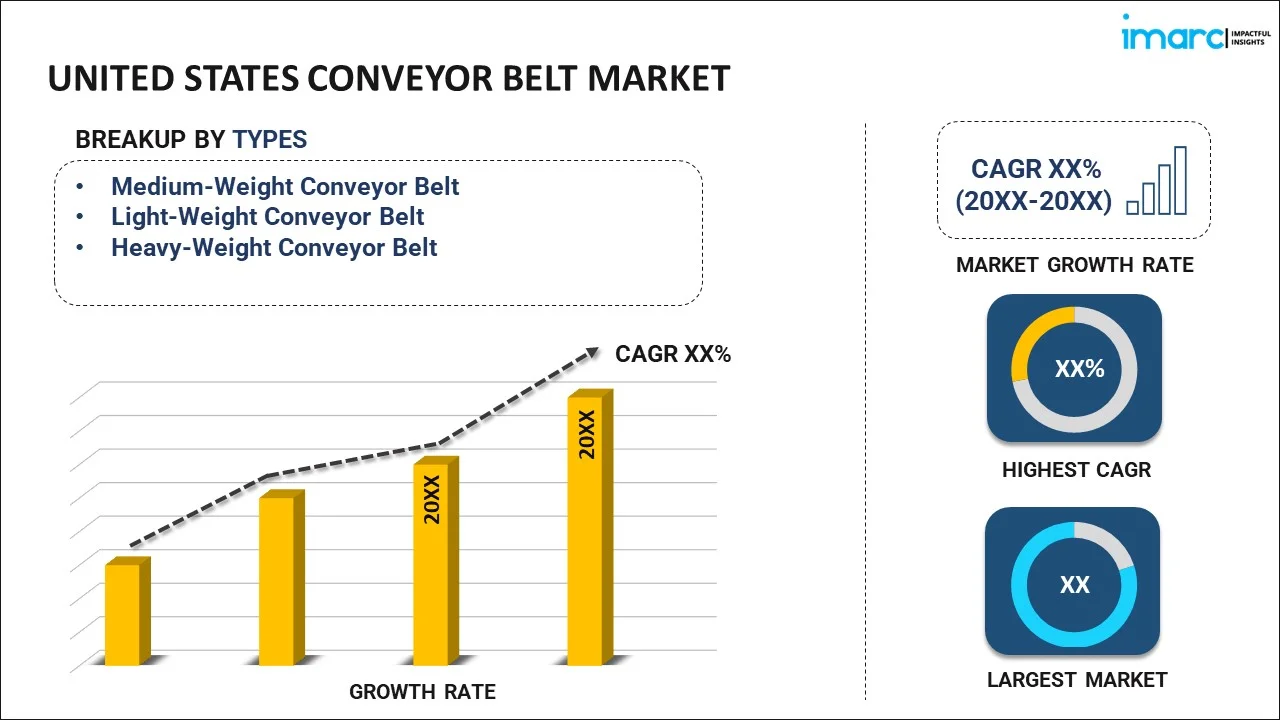
To get detailed segment analysis of this market Request Sample
- Medium-Weight Conveyor Belt
- Light-Weight Conveyor Belt
- Heavy-Weight Conveyor Belt
The medium-weight conveyor belt dominates with a market share of 45% of the total United States conveyor belt market in 2025.
Medium-weight conveyor belts have emerged as the leading segment in the United States market due to their exceptional versatility and cost-effectiveness across a wide range of industrial applications. These belts provide an optimal balance between load-bearing capacity and operational flexibility, making them ideal for manufacturing, food processing, packaging, and logistics operations. In July 2025, Intralox highlighted its S570 Tight Transfer belting and nosebar transfer unit, which are designed to lower total system costs and improve throughput in beverage and packaged goods handling, underscoring innovation in medium‑weight and modular conveyor solutions across key U.S. industries. Their ability to handle moderate loads efficiently while maintaining durability has positioned them as the preferred choice for facilities seeking reliable material handling solutions.
The dominance of medium-weight conveyor belts is further reinforced by advancements in material science that have enabled the development of highly durable yet flexible belt designs capable of withstanding diverse operating conditions. Industries requiring consistent throughput without the heavy-duty specifications of mining operations increasingly favor these versatile conveyor solutions. The growing emphasis on automation in manufacturing and distribution centers continues to drive demand for medium-weight configurations that offer excellent performance-to-cost ratios.

End Use Insights:
- Mining and Metallurgy
- Manufacturing
- Chemicals, Oils and Gases
- Aviation
- Others
The manufacturing leads with a share of 30% of the total United States conveyor belt market in 2025.
The manufacturing sector's dominance in the United States conveyor belt market reflects the nation's robust industrial infrastructure and accelerating adoption of automation technologies. Manufacturing facilities across automotive, electronics, consumer goods, and industrial equipment production increasingly rely on conveyor systems to streamline assembly lines and enhance throughput. The integration of smart conveyor technologies enables real-time monitoring and optimization of material flow across production environments.
The sector's continued expansion is driven by reshoring initiatives bringing manufacturing operations back to the United States and substantial investments in facility modernization. Manufacturers are prioritizing conveyor systems offering flexibility, easy maintenance, and compatibility with robotic automation. The growing emphasis on lean manufacturing principles and just-in-time production methodologies further amplifies demand for efficient conveyor belt solutions that maximize operational productivity.
Regional Insights:
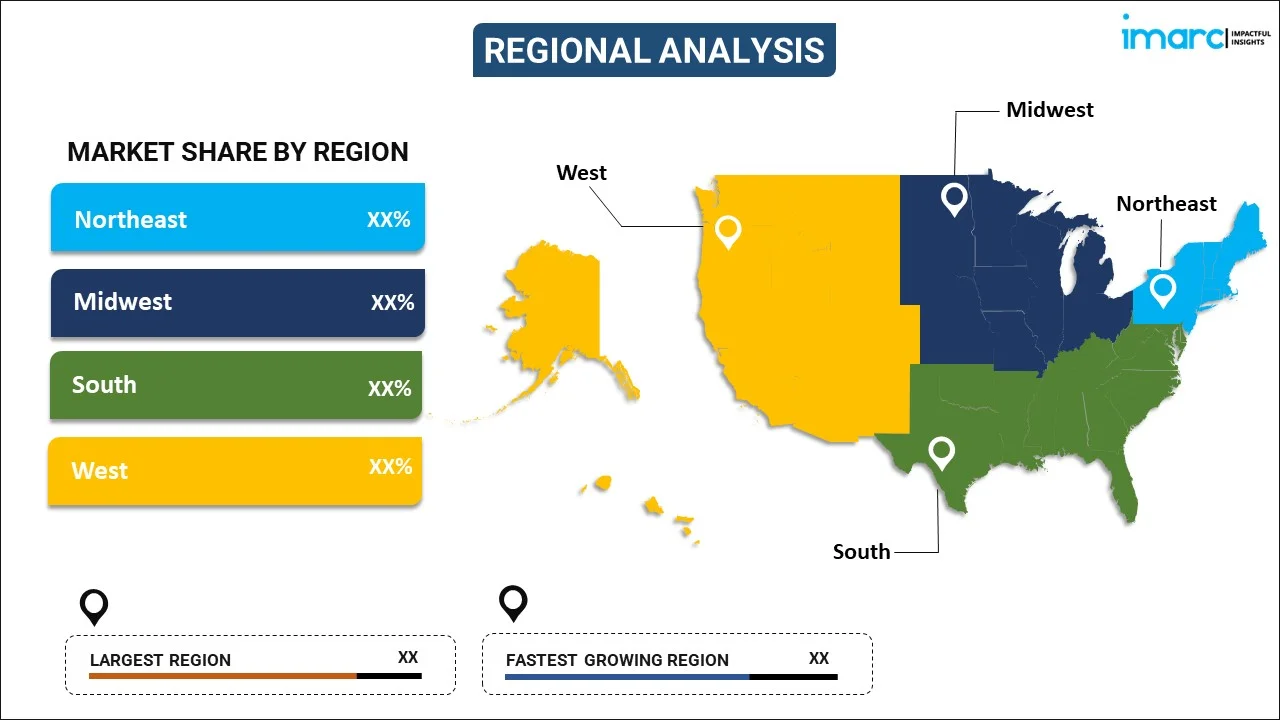
To get detailed regional analysis of this market Request Sample
- Northeast
- Midwest
- South
- West
The Northeast region represents a significant market for conveyor belts driven by its concentration of manufacturing facilities, pharmaceutical production centers, and major port operations. The region's dense logistics infrastructure supporting e-commerce fulfillment centers creates substantial demand for automated material handling solutions. Ongoing modernization of aging industrial facilities and warehouse automation investments continue to drive conveyor belt adoption across diverse applications.
The Midwest region holds a prominent position in the conveyor belt market owing to its strong automotive manufacturing base and extensive agricultural processing operations. The region's strategic location as a distribution hub supports growing demand for warehouse conveyor systems. Expanding food processing facilities and grain handling operations further contribute to sustained market growth across this industrially diverse region.
The South region is experiencing robust growth in conveyor belt demand driven by expanding manufacturing operations and significant investments in new production facilities. The region's favorable business environment attracts automotive plants, aerospace manufacturers, and distribution centers requiring advanced material handling infrastructure. Growing petrochemical and energy sector activities along the Gulf Coast further amplify demand for heavy-duty conveyor solutions.
The West region demonstrates strong conveyor belt market growth supported by its thriving technology sector, expanding e-commerce fulfillment infrastructure, and significant mining operations. The region's focus on sustainable manufacturing practices drives demand for energy-efficient conveyor solutions. Growing food and beverage processing industries along with aviation sector expansion at major airports continue to create substantial opportunities for market participants.
Market Dynamics:
Growth Drivers:
Why is the United States Conveyor Belt Market Growing?
Expanding E-Commerce and Warehouse Automation
The rapid expansion of e-commerce in the United States has significantly amplified demand for conveyor systems in warehousing and distribution centers. The United States e-commerce market size reached USD 1,236.5 Billion in 2025, and it is expected to reach USD 2,160.3 Billion by 2034, reflecting strong growth that is driving investments in material handling infrastructure. As consumer expectations for faster delivery times continue to rise, logistics operators are investing heavily in automated material handling infrastructure. Conveyor belts serve as the backbone of modern fulfillment centers, enabling high-speed sorting, picking, and packaging operations. The average warehouse size has increased substantially, necessitating advanced conveyor solutions capable of handling higher volumes efficiently. Major retailers and third-party logistics providers are deploying sophisticated conveyor networks integrated with robotics and AI-driven sorting systems to optimize throughput.
Industrial Automation and Smart Manufacturing Initiatives
The global trend toward industrial automation is significantly driving conveyor belt market growth in the United States. As industries focus on enhancing productivity, reducing labor costs, and improving operational efficiency, demand for automated material handling systems continues to accelerate. In September 2025, Daifuku Intralogistics America Corporation announced the grand opening of its expanded 634,000 sq ft facility in Hobart, Indiana, scaling its manufacturing capacity to deliver advanced intralogistics and conveyor automation solutions to customers across North America. Conveyor belts are integral to automated production environments, enabling continuous and uninterrupted material flow while reducing dependence on manual labor. The adoption of Industry 4.0 principles incorporating smart sensors, predictive maintenance capabilities, and real-time data analytics is transforming conveyor systems into intelligent components of connected manufacturing ecosystems.
Government Investment in Critical Mineral Infrastructure
Substantial government investments are transforming the conveyor belt industry through infrastructure modernization and mining sector expansion. Federal initiatives supporting domestic mineral production have allocated significant funding for industrial facilities and next-generation mining technologies. For example, in November 2025, the U.S. Department of Energy announced up to $355 million in funding opportunities to expand domestic production of critical materials and establish “Mine of the Future” proving grounds for advanced mining technologies, efforts aimed at strengthening supply chains where conveyor systems are essential for material handling. These investments target critical mineral supply chains spanning mining, processing, and manufacturing operations where conveyor belts play essential roles in material handling. The strategic emphasis on securing domestic supply chains for critical minerals used in clean energy technologies and defense applications is driving demand for heavy-duty conveyor solutions.
Market Restraints:
What Challenges the United States Conveyor Belt Market is Facing?
High Initial Investment and Installation Costs
The substantial capital investment required to purchase and install modern conveyor belt systems presents a significant barrier, particularly for small and medium-sized enterprises. The upfront costs associated with advanced conveyor technologies incorporating smart sensors, automation capabilities, and custom configurations can be prohibitive for businesses with limited budgets or those operating in competitive low-margin industries.
Raw Material Price Volatility
Fluctuating prices of key raw materials including rubber, polymers, and steel significantly impact conveyor belt manufacturing costs and market pricing dynamics. Supply chain disruptions and commodity market volatility create uncertainty for both manufacturers and end-users, potentially affecting investment decisions and project timelines across various industrial sectors dependent on conveyor belt infrastructure.
Skilled Labor Shortages for Installation and Maintenance
The shortage of skilled technicians capable of installing, maintaining, and operating sophisticated conveyor systems poses challenges for market expansion. As conveyor technologies become increasingly complex with integrated sensors and automation features, the demand for specialized technical expertise exceeds available workforce supply, potentially limiting adoption rates and extending equipment downtime during maintenance periods.
Competitive Landscape:
The United States conveyor belt market exhibits a moderately competitive structure characterized by the presence of both established domestic manufacturers and international players. Companies compete on the basis of product quality, technological innovation, service capabilities, and pricing strategies. Strategic partnerships, acquisitions, and facility expansions are common approaches employed by market participants to strengthen their competitive positions and expand geographic reach. The emphasis on developing energy-efficient, sustainable, and IoT-enabled conveyor solutions is intensifying as manufacturers seek to differentiate their offerings. Key players are investing significantly in research and development to introduce advanced belt materials, smart monitoring systems, and modular configurations that address evolving customer requirements across diverse industrial applications.
Recent Developments:
- In October 2025, Conveyor Technology Inc. unveiled its new TechRoll™ Electric Drum Motor with advanced Predictive Failure Analysis at the EATS Chicago trade show, boosting conveyor uptime, efficiency and real‑time monitoring for food processing systems. The innovation pairs next‑generation motor performance with intelligent failure prediction to reduce downtime.
United States Conveyor Belt Market Report Coverage:
| Report Features | Details |
|---|---|
| Base Year of the Analysis | 2025 |
| Historical Period | 2020-2025 |
| Forecast Period | 2026-2034 |
| Units | Billion USD |
| Scope of the Report | Exploration of Historical Trends and Market Outlook, Industry Catalysts and Challenges, Segment-Wise Historical and Future Market Assessment:
|
| Types Covered | Medium-Weight Conveyor Belt, Light-Weight Conveyor Belt, Heavy-Weight Conveyor Belt |
| End Uses Covered | Mining and Metallurgy, Manufacturing, Chemicals, Oils and Gases, Aviation, Others |
| Regions Covered | Northeast, Midwest, South, West |
| Customization Scope | 10% Free Customization |
| Post-Sale Analyst Support | 10-12 Weeks |
| Delivery Format | PDF and Excel through Email (We can also provide the editable version of the report in PPT/Word format on special request) |
Frequently Asked Questions About the United States Conveyor Belt Market Report
The United States conveyor belt market size was valued at USD 1.34 Billion in 2025.
The United States conveyor belt market is expected to grow at a compound annual growth rate of 2.96% from 2026-2034 to reach USD 1.74 Billion by 2034.
Medium-weight conveyor belts dominated the market with 45% share, attributed to their versatility, cost-effectiveness, and widespread adoption across manufacturing, logistics, and food processing industries, offering optimal balance between load-bearing capacity and operational flexibility for diverse applications.
Key factors driving the United States conveyor belt market include expanding e-commerce and warehouse automation requirements, industrial automation initiatives, government investments in critical mineral infrastructure, and increasing adoption of IoT-enabled smart conveyor systems.
Major challenges include high initial investment and installation costs, raw material price volatility affecting manufacturing costs, skilled labor shortages for installation and maintenance, and competition from alternative material handling solutions in certain applications.
Need more help?
- Speak to our experienced analysts for insights on the current market scenarios.
- Include additional segments and countries to customize the report as per your requirement.
- Gain an unparalleled competitive advantage in your domain by understanding how to utilize the report and positively impacting your operations and revenue.
- For further assistance, please connect with our analysts.
 Request Customization
 Speak to an Analyst
 Request Brochure
 Inquire Before Buying
Benefits of Customization
- Personalize this research
- Triangulate with your data
- Get data as per your format and definition
- Gain a deeper dive into a specific application, geography, customer, or competitor
- Any level of personalization
Get in Touch With Us
UNITED STATES
Phone: +1-201-971-6302
INDIA
Phone: +91-120-433-0800
UNITED KINGDOM
Phone: +44-753-714-6104
Email: sales@imarcgroup.com
Client Testimonials




.webp)




.webp)













Related Reports

Choose your plan
*Please note that the prices mentioned below are starting prices for each bundle type. Kindly contact our team for further details.*
Single User License
- 1 User License, Access on 2 Devices
- PDF Report + Excel Dataset (Password Protected)
- Lifetime Access
- No Printing Rights
- 10% Free Report Customization
- 10–12 Weeks of Analyst Support
Five User License
- Access for 5 Users, 2 Devices per User
- PDF Report + Excel Dataset (Password Protected)
- Lifetime Access
- Dedicated Account Manager
- 12–14 Weeks of Analyst Support
- No Printing Rights
- 15% Free Report Customization
- 25% Discount on Your Next Purchase
Corporate User License
- Unlimited User Access (Within Your Organization)
- PDF Report + Excel Dataset
- Lifetime Access
- Dedicated Account Manager
- 14–20 Weeks of Analyst Support
- No Printing Rights
- 20% Free Report Customization
- 30% Discount on Your Next Purchase
Essential Insights
What's included:
3 reports
- Lifetime Access
- PDF Reports
- Excel Datasets
- 2 Weeks of Free Analyst Support
- 2 User Licenses
- Access on 2 Devices
- Printing Rights
- Complimentary PowerPoint (PPT) Version
- Complimentary License Upgrade
Professional Access
What's included:
5 reports
- Lifetime Access
- PDF Reports
- Excel Datasets
- 8 Weeks of Free Analyst Support
- 2 User Licenses
- Access on 2 Devices
- Printing Rights
- Complimentary PowerPoint (PPT) Version
- Complimentary License Upgrade
Business Advantage
What's included:
8 reports
- Lifetime Access
- PDF Reports
- Excel Datasets
- 14 Weeks of Free Analyst Support
- 2 User Licenses
- Access on 2 Devices
- Printing Rights
- Complimentary PowerPoint (PPT) Version
- Complimentary License Upgrade
Enterprise Intelligence
What's included:
10 reports
- Lifetime Access
- PDF Reports
- Excel Datasets
- 20 Weeks of Free Analyst Support
- 2 User Licenses
- Access on 2 Devices
- Printing Rights
- Complimentary PowerPoint (PPT) Version
- Complimentary License Upgrade