
United States Electronic Bill Presentment Payment Market Size, Share, Trends and Forecast by Product, Application, Channel, End User, and Region, 2026-2034
United States Electronic Bill Presentment Payment Market Summary:
The United States electronic bill presentment payment market size was valued at USD 54.45 Billion in 2025 and is projected to reach USD 117.09 Billion by 2034, growing at a compound annual growth rate of 8.88% from 2026-2034. The United States electronic bill presentment payment market is experiencing robust expansion driven by increasing consumer preference for digital billing solutions, widespread smartphone adoption, and the growing emphasis on operational efficiency across industries. The proliferation of secure payment gateways, coupled with real-time payment infrastructure developments, is encouraging businesses to transition from traditional paper-based billing to electronic systems. Government initiatives promoting digital transformation and environmental sustainability through reduced paper consumption further accelerate market adoption. Financial institutions and billers are investing substantially in modernizing payment platforms to meet evolving consumer expectations for seamless, omnichannel billing experiences, strengthening the United States electronic bill presentment payment market share.
Key Takeaways and Insights:
- By Product: Electronic bill payment dominates the market with a share of 52% in 2025, owing to its streamlined transaction processing capabilities, enhanced security features, and growing consumer preference for instant payment confirmations. Rising adoption of automated billing systems is fueling the segment expansion.
- By Application: Billers lead the market with a share of 38% in 2025. This dominance is driven by the critical need for organizations to optimize cash flow management, reduce operational costs associated with paper billing, and enhance customer engagement through digital communication channels.
- By Channel: Web holds the largest segment with a market share of 33% in 2025, reflecting the established infrastructure of online banking portals and biller websites that provide secure, accessible platforms for bill presentment and payment processing.
- By End User: BFSI exhibits a clear dominance in the market with 22% share in 2025, reflecting strong institutional investment in digital payment infrastructure and the sector's leadership in adopting advanced billing technologies to serve millions of customers efficiently.
- By Region: South represents the largest region with a share of 38% in 2025, driven by rapid population growth, expanding fintech ecosystems in Texas and Florida, favorable regulatory environments, and increasing digital payment adoption across diverse industries.
- Key Players: Key players drive the United States electronic bill presentment payment market by expanding omnichannel payment capabilities, investing in AI-powered billing solutions, and strengthening partnerships with financial institutions. Their focus on fraud prevention, real-time payment processing, and seamless integration with existing enterprise systems boosts adoption rates across sectors.
The United States electronic bill presentment payment market continues to demonstrate strong momentum as digital transformation reshapes how consumers and businesses manage financial transactions. The shift toward paperless billing solutions reflects broader trends in consumer behavior, with mobile devices emerging as the preferred channel for bill payments. According to a Federal Reserve study released in 2025, United States consumers made an average of 48 payments per month in 2024, with mobile device payments increasing substantially from just four payments monthly in 2018 to eleven payments in 2024. This behavioral shift, combined with institutional investments in real-time payment infrastructure and the expansion of digital wallet acceptance, creates favorable conditions for sustained market growth. Organizations across utilities, telecommunications, healthcare, and financial services are prioritizing electronic billing adoption to enhance operational efficiency, reduce processing costs, and improve customer satisfaction.
United States Electronic Bill Presentment Payment Market Trends:
Real-Time Payment Infrastructure Expansion
The acceleration of real-time payment adoption is transforming electronic bill presentment and payment across the United States. Financial institutions are increasingly leveraging instant payment networks to enable immediate bill settlement, enhancing customer convenience and improving cash flow predictability for billers. The Clearing House's RTP network processed over 87 million transactions totaling approximately USD 69 Billion in the third quarter of 2024, representing significant year-over-year growth. This infrastructure expansion enables businesses to offer instant payment confirmations and real-time reconciliation capabilities that traditional payment methods cannot match.
Mobile-First Billing Experience Enhancement
Consumer preference for mobile billing solutions continues to reshape market dynamics as organizations prioritize smartphone-optimized payment experiences. Digital wallet integration has become essential for modern billing platforms, with acceptance of solutions including Apple Pay, Google Pay, and PayPal expanding rapidly across biller networks. Mobile wallets have overtaken traditional ACH transactions in popularity for bill payments, signaling a fundamental shift in consumer payment preferences. Organizations are investing in responsive mobile interfaces, push notification systems, and biometric authentication to deliver frictionless bill payment experiences that meet evolving consumer expectations.
AI-Powered Billing Intelligence Adoption
Artificial intelligence and machine learning technologies are revolutionizing electronic bill presentment and payment through enhanced personalization, predictive analytics, and automated customer communications. Billers are deploying AI-powered chatbots and virtual assistants to handle routine inquiries, process payments, and resolve billing disputes efficiently. These intelligent systems analyze payment patterns to predict potential delinquencies, enabling proactive intervention strategies. Advanced fraud detection algorithms leverage machine learning to identify suspicious transactions in real-time, strengthening security while maintaining seamless customer experiences across all payment channels.
Market Outlook 2026-2034:
The United States electronic bill presentment payment market outlook remains highly favorable as digital transformation initiatives accelerate across industries. Organizations increasingly recognize the operational efficiencies and cost savings associated with electronic billing systems, driving sustained investment in platform modernization and infrastructure upgrades. The convergence of real-time payment networks, mobile-first consumer preferences, and advanced analytics capabilities positions the market for robust expansion throughout the forecast period. Growing emphasis on seamless customer experiences further reinforces market momentum. The market generated a revenue of USD 54.45 Billion in 2025 and is projected to reach a revenue of USD 117.09 Billion by 2034, growing at a compound annual growth rate of 8.88% from 2026-2034.
United States Electronic Bill Presentment Payment Market Report Segmentation:
| Segment Category | Leading Segment | Market Share |
|---|---|---|
| Product | Electronic Bill Payment | 52% |
| Application | Billers | 38% |
| Channel | Web | 33% |
| End User | BFSI | 22% |
| Region | South | 38% |
Product Insights:
To get detailed segment analysis of this market Request Sample
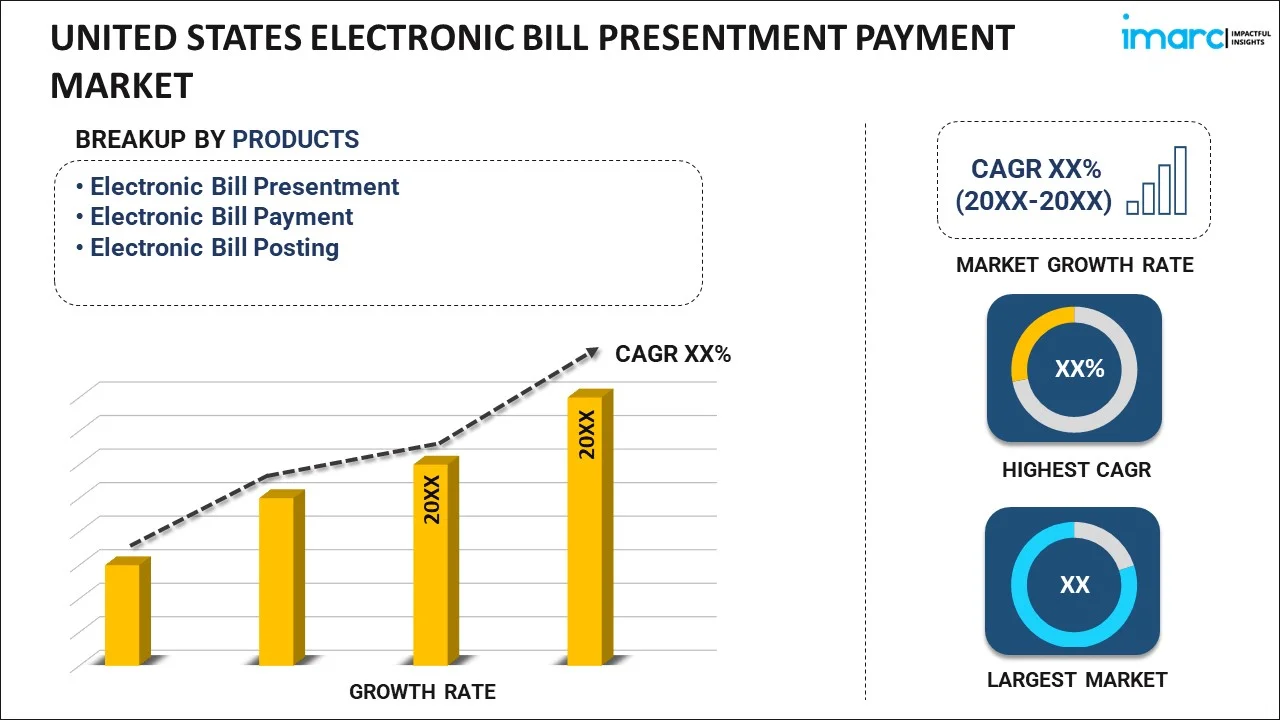
- Electronic Bill Presentment
- Electronic Bill Payment
- Electronic Bill Posting
Electronic bill payment dominates with a market share of 52% of the total United States electronic bill presentment payment market in 2025.
Electronic bill payment represents the cornerstone of digital billing infrastructure, enabling consumers and businesses to execute secure transactions through multiple channels including web portals, mobile applications, and integrated banking platforms. The segment's dominance reflects the critical importance of payment execution within the broader EBPP ecosystem. According to industry report, Americans received and paid more than 16.8 Billion monthly bills in 2023, representing consumer spending of approximately USD 5.6 Trillion annually on recurring payments alone.
The electronic bill payment segment continues to evolve through enhanced security protocols, expanded payment method acceptance, and improved reconciliation capabilities. Organizations are prioritizing instant payment confirmation, automated payment scheduling, and seamless integration with enterprise resource planning systems. The growing adoption of digital wallets, account-to-account transfers, and real-time payment networks strengthens the segment's position as businesses seek to reduce payment processing times and associated operational costs while improving overall financial management efficiency.
Application Insights:
- Billers
- Consumers
- Bill Consolidator
- Banks and Financial Institution
Billers lead with a share of 38% of the total United States electronic bill presentment payment market in 2025.
Billers represent the primary drivers of electronic bill presentment payment adoption, as organizations across utilities, telecommunications, healthcare, and financial services seek to optimize billing operations and improve customer engagement. The segment's leadership reflects the substantial investment by enterprises in modernizing legacy billing systems to support omnichannel communication and payment acceptance. Research indicates that businesses implementing EBPP solutions can reduce customer service call volumes by up to 10% while increasing customer engagement by 30% through enhanced digital communication capabilities.
The billers segment benefits from growing recognition of electronic billing's operational advantages, including reduced document delivery costs, accelerated payment collection, and improved cash flow visibility. Organizations are implementing advanced analytics to optimize billing cycles, personalize customer communications, and predict payment behaviors effectively. The integration of automated payment reminders, flexible payment plan options, and self-service account management capabilities enables billers to enhance customer satisfaction while simultaneously reducing administrative overhead and streamlining operational processes.
Channel Insights:
- Application Programming Interface (API)
- Mobile
- Web
- IVR
- POS
- Kiosk
Web exhibits a clear dominance with a 33% share of the total United States electronic bill presentment payment market in 2025.
Web-based billing platforms remain the foundational channel for electronic bill presentment and payment, providing secure, accessible interfaces for bill viewing, account management, and payment processing. The segment's leadership reflects the established infrastructure of online banking portals, biller websites, and aggregator platforms that serve millions of consumers daily. The McKinsey 2024 Digital Payments Consumer Survey indicates that nearly nine out of ten Americans currently use some form of digital payments, with web portals serving as primary access points for recurring bill management.
Web channels continue to evolve through enhanced user experience design, improved security protocols, and expanded payment method acceptance. Organizations are investing in responsive design implementations that optimize viewing across devices while maintaining consistent functionality and seamless navigation. The integration of guest checkout options, saved payment credentials, and automated payment scheduling features addresses consumer preferences for convenience and efficiency in managing recurring financial obligations. These advancements strengthen web platforms as essential touchpoints for digital billing interactions.

End User Insights:
- BFSI
- Insurance
- Healthcare
- IT and Telecom
- Retail
- Education
- Media and Entertainment
- Manufacturing
- Others
BFSI represents the leading segment with a 22% share of the total United States electronic bill presentment payment market in 2025.
The banking, financial services, and insurance sector demonstrates leadership in electronic bill presentment payment adoption, driven by substantial institutional investment in digital payment infrastructure and the imperative to serve large customer bases efficiently. Financial institutions leverage EBPP platforms to deliver credit card statements, loan payment notifications, and account communications while enabling seamless payment processing. A 2025 Association for Financial Professionals survey revealed that 79% of United States organizations were targets of payments fraud in 2024, underscoring the sector's focus on implementing secure, advanced billing solutions.
BFSI organizations continue to expand electronic billing capabilities through integration with real-time payment networks, enhanced mobile banking applications, and AI-powered customer service tools. The sector prioritizes regulatory compliance, data security, and customer experience optimization in platform development initiatives. The growing adoption of open banking frameworks and embedded finance solutions creates additional opportunities for EBPP integration across financial service delivery channels. These developments position financial institutions to deliver more comprehensive and seamless billing experiences to their customers.
Regional Insights:
To get detailed regional analysis of this market Request Sample
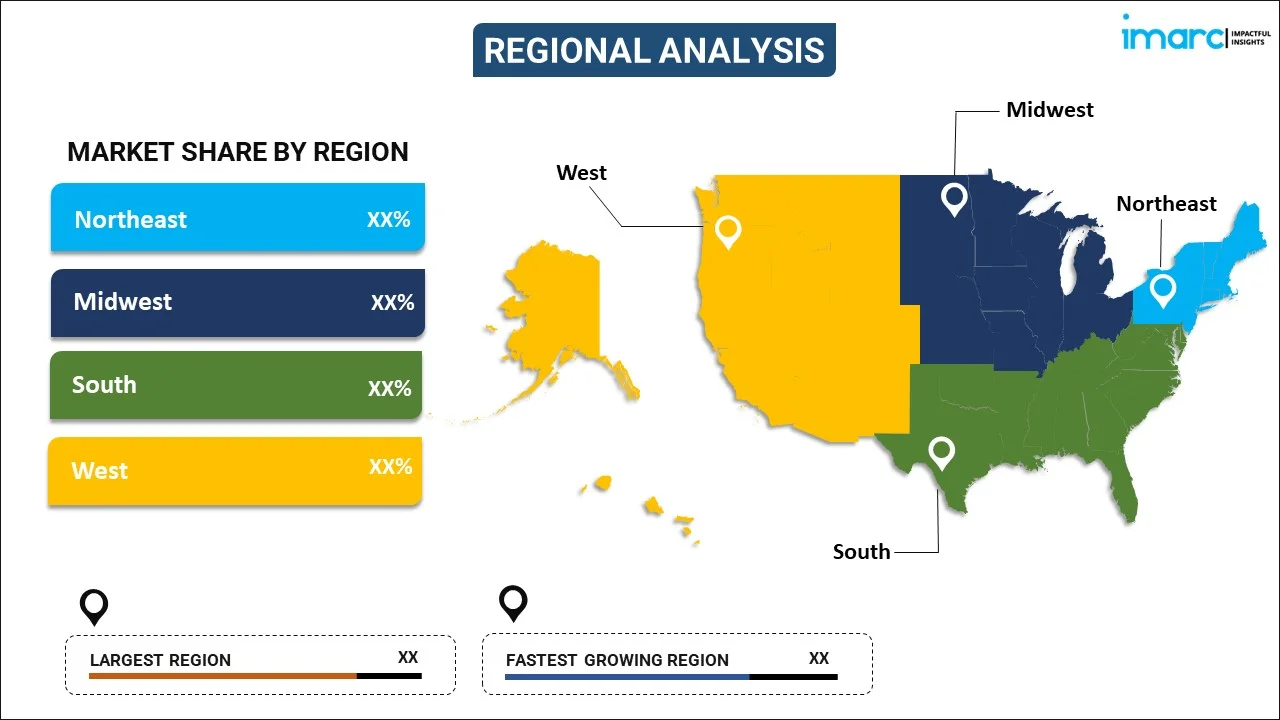
- Northeast
- Midwest
- South
- West
South dominates the market with a share of 38% of the total United States electronic bill presentment payment market in 2025.
The South demonstrates market leadership driven by rapid population growth, expanding fintech ecosystems, and favorable business environments that attract technology investment. States including Texas and Florida serve as major hubs for digital payment innovation, with fintech-friendly regulatory frameworks encouraging market development. According to industry analysis, Florida emerged as the third most active state for fintech activity, securing 146 deals and replacing Texas in that position, reflecting the region's growing prominence in the financial technology landscape.
The region benefits from diverse industry presence across energy, healthcare, telecommunications, and retail sectors, all of which represent significant adopters of electronic bill presentment payment solutions. Lower operating costs compared to coastal technology centers attract businesses seeking cost-effective digital transformation pathways. The concentration of major utility providers, telecommunications companies, and healthcare systems in the South creates substantial demand for scalable, efficient billing platforms that can serve large, geographically distributed customer bases.
Market Dynamics:
Growth Drivers:
Why is the United States Electronic Bill Presentment Payment Market Growing?
Rising Consumer Preference for Digital Payment Convenience
Consumer expectations for seamless, instant payment experiences continue to drive electronic bill presentment payment market expansion across the United States. The proliferation of smartphones and high-speed internet connectivity enables consumers to manage financial obligations from anywhere, at any time, fundamentally changing expectations for billing interactions. Research indicates that mobile devices remain the top choice for bill payments, with 68% of Americans using smartphones for bill payment activities. The convenience of digital wallets, automated payment scheduling, and instant confirmation features addresses consumer demand for frictionless financial management. Organizations recognizing these shifting preferences invest substantially in platform modernization to deliver the intuitive, mobile-optimized experiences that contemporary consumers expect. The growing importance of customer experience as a competitive differentiator motivates businesses to enhance digital billing capabilities continuously.
Operational Efficiency and Cost Reduction Imperatives
Organizations across industries increasingly recognize electronic bill presentment payment as a strategic tool for operational optimization and cost management. The transition from paper-based billing to digital systems delivers measurable reductions in printing, postage, and document handling expenses. Industry analysis indicates that businesses implementing EBPP solutions can reduce document delivery costs by approximately 50% while improving payment collection efficiency. Additionally, automated reconciliation capabilities reduce manual processing requirements and associated labor costs. The integration of electronic billing with enterprise resource planning systems streamlines financial operations and improves cash flow visibility. Government initiatives supporting digital transformation, including the recent executive order mandating transition to electronic payments for federal disbursements, further accelerate organizational adoption of electronic billing infrastructure.
Real-Time Payment Infrastructure Development
The expansion of real-time payment networks creates new opportunities for electronic bill presentment payment innovation and adoption. Financial institutions and billers leverage instant payment capabilities to offer immediate bill settlement, enhancing customer satisfaction while improving cash flow predictability. In October 2025, the RTP network's transaction limit increased from $1 Million to $10 Million, enabling businesses to process larger payments instantly around the clock. This infrastructure development enables sophisticated billing solutions that combine real-time payment processing with integrated messaging, automated reconciliation, and enhanced fraud protection capabilities. The convergence of real-time payment rails with electronic billing platforms positions the market for continued innovation and expansion.
Market Restraints:
What Challenges the United States Electronic Bill Presentment Payment Market is Facing?
Cybersecurity Threats and Fraud Concerns
The proliferation of sophisticated cyber threats targeting digital payment systems presents ongoing challenges for market participants. Phishing attacks, business email compromise schemes, and data breaches require continuous investment in security infrastructure and fraud prevention technologies. Organizations must balance security requirements with user experience considerations to maintain customer trust while protecting sensitive financial information.
Legacy System Integration Complexity
Many organizations operate legacy billing and enterprise systems that present integration challenges for modern electronic bill presentment payment platforms. The complexity of migrating from established infrastructure to contemporary solutions requires significant investment in technology resources, staff training, and process redesign. Organizations with dispersed billing systems across multiple departments face particular challenges in consolidating electronic billing capabilities.
Digital Accessibility and Adoption Barriers
Certain consumer segments, particularly older populations and those in underserved communities, face barriers to electronic billing adoption due to limited technology access, digital literacy constraints, or preference for traditional payment methods. Organizations must maintain multi-channel payment options while encouraging digital migration, creating operational complexity and cost considerations that can slow electronic billing deployment.
Competitive Landscape:
The United States electronic bill presentment payment market exhibits a moderately fragmented competitive landscape characterized by the presence of established payment technology providers, specialized billing solutions vendors, and emerging fintech innovators. Market participants differentiate through platform capabilities, integration flexibility, industry vertical expertise, and customer service quality. Strategic partnerships between technology providers, financial institutions, and enterprise software vendors expand market reach and enhance solution capabilities. Organizations compete on the basis of omnichannel payment acceptance, real-time processing capabilities, security certifications, and advanced analytics features. The market continues to witness consolidation activity as larger players acquire specialized providers to strengthen product portfolios and expand customer bases across industry verticals.
Recent Developments:
- In October 2024, Truist Financial Corporation unveiled a comprehensive electronic bill presentment and payment platform designed to streamline billing, accelerate payments, and enhance security for its commercial and corporate clients. The solution, which launched on November 1, 2024, offers automated workflows, flexible payment channels including online, mobile, and IVR options, and robust fraud protection capabilities.
- In September 2024, Paymentus announced an agreement with Altera Digital Health Inc. to offer its electronic bill presentment and payments platform in conjunction with Altera's suite of healthcare IT solutions. The partnership addresses key components of revenue cycle management for physician practices, hospitals, and health networks by enabling real-time patient billing information delivery and streamlined payment processing.
United States Electronic Bill Presentment Payment Market Report Coverage:
| Report Features | Details |
|---|---|
| Base Year of the Analysis | 2025 |
| Historical Period | 2020-2025 |
| Forecast Period | 2026-2034 |
| Units | Billion USD |
| Scope of the Report | Exploration of Historical Trends and Market Outlook, Industry Catalysts and Challenges, Segment-Wise Historical and Future Market Assessment:
|
| Products Covered | Electronic Bill Presentment, Electronic Bill Payment, Electronic Bill Posting |
| Applications Covered | Billers, Consumers, Bill Consolidator, Banks and Financial Institution |
| Channels Covered | Application Programming Interface (API), Mobile, Web, Email, IVR, POS, Kiosk |
| End Users Covered | BFSI, Insurance, Healthcare, IT and Telecom, Retail, Education, Media and Entertainment, Manufacturing, Others |
| Regions Covered | Northeast, Midwest, South, West |
| Customization Scope | 10% Free Customization |
| Post-Sale Analyst Support | 10-12 Weeks |
| Delivery Format | PDF and Excel through Email (We can also provide the editable version of the report in PPT/Word format on special request) |
Frequently Asked Questions About the United States Electronic Bill Presentment Payment Market Report
The United States electronic bill presentment payment market size was valued at USD 54.45 Billion in 2025.
The United States electronic bill presentment payment market is expected to grow at a compound annual growth rate of 8.88% from 2026-2034 to reach USD 117.09 Billion by 2034.
Electronic bill payment dominated the market with a share of 52%, driven by its streamlined transaction processing capabilities, enhanced security features, and growing consumer preference for instant payment confirmations.
Key factors driving the United States electronic bill presentment payment market include rising consumer preference for digital payment convenience, operational efficiency and cost reduction imperatives, and real-time payment infrastructure development.
Major challenges include cybersecurity threats and fraud concerns, legacy system integration complexity, digital accessibility barriers for certain consumer segments, regulatory compliance requirements, and the need to maintain multi-channel payment options during digital migration.
Need more help?
- Speak to our experienced analysts for insights on the current market scenarios.
- Include additional segments and countries to customize the report as per your requirement.
- Gain an unparalleled competitive advantage in your domain by understanding how to utilize the report and positively impacting your operations and revenue.
- For further assistance, please connect with our analysts.
 Request Customization
 Speak to an Analyst
 Request Brochure
 Inquire Before Buying
Benefits of Customization
- Personalize this research
- Triangulate with your data
- Get data as per your format and definition
- Gain a deeper dive into a specific application, geography, customer, or competitor
- Any level of personalization
Get in Touch With Us
UNITED STATES
Phone: +1-201-971-6302
INDIA
Phone: +91-120-433-0800
UNITED KINGDOM
Phone: +44-753-714-6104
Email: [email protected]
Client Testimonials




.webp)




.webp)













Related Reports

Choose your plan
*Please note that the prices mentioned below are starting prices for each bundle type. Kindly contact our team for further details.*
Single User License
- 1 User License, Access on 2 Devices
- PDF Report + Excel Dataset (Password Protected)
- Lifetime Access
- No Printing Rights
- 10% Free Report Customization
- 10–12 Weeks of Analyst Support
Five User License
- Access for 5 Users, 2 Devices per User
- PDF Report + Excel Dataset (Password Protected)
- Lifetime Access
- Dedicated Account Manager
- 12–14 Weeks of Analyst Support
- No Printing Rights
- 15% Free Report Customization
- 25% Discount on Your Next Purchase
Corporate User License
- Unlimited User Access (Within Your Organization)
- PDF Report + Excel Dataset
- Lifetime Access
- Dedicated Account Manager
- 14–20 Weeks of Analyst Support
- No Printing Rights
- 20% Free Report Customization
- 30% Discount on Your Next Purchase
Essential Insights
What's included:
3 reports
- Lifetime Access
- PDF Reports
- Excel Datasets
- 2 Weeks of Free Analyst Support
- 2 User Licenses
- Access on 2 Devices
- Printing Rights
- Complimentary PowerPoint (PPT) Version
- Complimentary License Upgrade
Professional Access
What's included:
5 reports
- Lifetime Access
- PDF Reports
- Excel Datasets
- 8 Weeks of Free Analyst Support
- 2 User Licenses
- Access on 2 Devices
- Printing Rights
- Complimentary PowerPoint (PPT) Version
- Complimentary License Upgrade
Business Advantage
What's included:
8 reports
- Lifetime Access
- PDF Reports
- Excel Datasets
- 14 Weeks of Free Analyst Support
- 2 User Licenses
- Access on 2 Devices
- Printing Rights
- Complimentary PowerPoint (PPT) Version
- Complimentary License Upgrade
Enterprise Intelligence
What's included:
10 reports
- Lifetime Access
- PDF Reports
- Excel Datasets
- 20 Weeks of Free Analyst Support
- 2 User Licenses
- Access on 2 Devices
- Printing Rights
- Complimentary PowerPoint (PPT) Version
- Complimentary License Upgrade