
United States Enterprise Content Management Market Size, Share, Trends and Forecast by Component, Enterprise Size, Deployment Mode, End Use Industry, and Region, 2026-2034
United States Enterprise Content Management Market Summary:
The United States enterprise content management market size was valued at USD 20,242.85 Million in 2025 and is projected to reach USD 39,589.26 Million by 2034, growing at a compound annual growth rate of 7.74% from 2026-2034. The United States enterprise content management market is experiencing robust expansion driven by accelerating digital transformation initiatives across industries, increasing adoption of cloud-based solutions, and the growing need for regulatory compliance and data governance. Organizations are investing substantially in ECM platforms to manage escalating volumes of unstructured content, enhance operational efficiency, and improve collaboration capabilities. The integration of artificial intelligence and machine learning technologies into ECM solutions is revolutionizing content automation, enabling intelligent document processing and advanced analytics capabilities.
Key Takeaways and Insights:
By Component: Solution dominates the market with a share of 72% in 2025, driven by the comprehensive functionality offered by document management systems, web content management platforms, and workflow automation tools that enable organizations to streamline content-centric operations while ensuring regulatory compliance and enhancing collaborative capabilities across distributed workforces.
By Enterprise Size: Large enterprises lead the market with a share of 57% in 2025, attributed to their substantial investments in advanced digital technology solutions for transitioning from paper-based to digital workflows, complex content management requirements across multiple departments, and stringent regulatory compliance needs necessitating enterprise-grade ECM platforms.
By Deployment Mode: Cloud-based represents the largest segment with a market share of 61% in 2025, owing to its superior scalability, cost-effectiveness through subscription-based pricing models, enhanced accessibility for remote workforces, seamless integration with collaboration suites, and reduced infrastructure maintenance requirements.
By End Use Industry: Banking, Financial Services and Insurance (BFSI) exhibits a market share of 19% in 2025, driven by the sector's stringent document control requirements, regulatory compliance mandates, high volumes of sensitive customer information requiring secure storage, and the need for comprehensive audit trail capabilities.
Key Players: The United States enterprise content management market exhibits a moderately consolidated competitive landscape, with technology giants and specialized ECM vendors competing across enterprise segments. Major players are intensifying their focus on AI-powered automation, cloud-native architectures, and vertical-specific solutions to capture market share.
The United States enterprise content management market is positioned at the forefront of global digital transformation, driven by the nation's advanced IT infrastructure, high enterprise technology adoption rates, and robust ecosystem of solution providers. Organizations across industries are increasingly recognizing the necessity of digitizing their content to enhance operational efficiency, improve customer engagement, and maintain competitive advantage. The market is characterized by growing demand for intelligent content services that leverage artificial intelligence for automated document classification, predictive content recommendations, and enhanced search capabilities. The rise of hybrid work models has further accelerated ECM adoption, as businesses seek cloud-based solutions that enable seamless access to documents and information regardless of physical location while maintaining robust security and compliance controls.
United States Enterprise Content Management Market Trends:
Integration of Artificial Intelligence and Machine Learning
The integration of artificial intelligence and machine learning technologies is fundamentally transforming enterprise content management capabilities across the United States market. Organizations are deploying AI-powered ECM solutions that enable intelligent document processing, automated content classification, and natural language processing for enhanced search functionality. Leading vendors are embedding generative AI capabilities within their platforms to enable content summarization, automated metadata extraction, and intelligent workflow automation, significantly reducing manual processing time and improving decision-making accuracy.
Accelerated Adoption of Cloud-Native Architectures
The transition to cloud-native enterprise content management architectures is accelerating across United States organizations, driven by the need for scalable storage solutions, enhanced remote collaboration capabilities, and reduced infrastructure overhead. Cloud-based ECM solutions are offering superior flexibility and lower upfront costs compared to on-premises alternatives. Organizations are increasingly adopting hybrid deployment models that maintain sensitive archives in internal data centers while leveraging SaaS platforms for collaboration and workflow management, enabling phased migration strategies that address skills gaps and budget constraints while progressing toward comprehensive cloud adoption.
Rising Demand for Content Federation and Unified Platforms
Organizations across the United States are increasingly demanding content federation capabilities that enable unified access to information distributed across multiple repositories and enterprise applications. The proliferation of content silos across disparate systems has created operational inefficiencies and compliance risks, driving investment in federated search and content integration solutions. Modern ECM platforms are incorporating advanced federation services that provide secure connections, metadata mapping, and content normalization across third-party systems including Microsoft SharePoint, legacy repositories, and enterprise applications. This trend reflects the market's evolution toward intelligent content services platforms that serve as unified gateways to enterprise information assets.
Market Outlook 2026-2034:
The United States enterprise content management market is poised for sustained expansion throughout the forecast period, underpinned by continuing digital transformation investments, increasing regulatory compliance requirements, and the proliferation of unstructured data across enterprise environments. Organizations are anticipated to increase investments in AI-enabled content intelligence platforms that transform unstructured data into actionable business insights, while cloud-native deployments continue gaining momentum across enterprise segments. The integration of ECM with collaboration suites, enterprise resource planning systems, and customer relationship management platforms will drive enhanced interoperability and workflow automation capabilities. The market generated a revenue of USD 20,242.85 Million in 2025 and is projected to reach a revenue of USD 39,589.26 Million by 2034, growing at a compound annual growth rate of 7.74% from 2026-2034.
United States Enterprise Content Management Market Report Segmentation:
| Segment Category | Leading Segment | Market Share |
|---|---|---|
| Component | Solution | 72% |
| Enterprise Size | Large Enterprises | 57% |
| Deployment Mode | Cloud-based | 61% |
| End Use Industry | BFSI | 19% |
Component Insights:
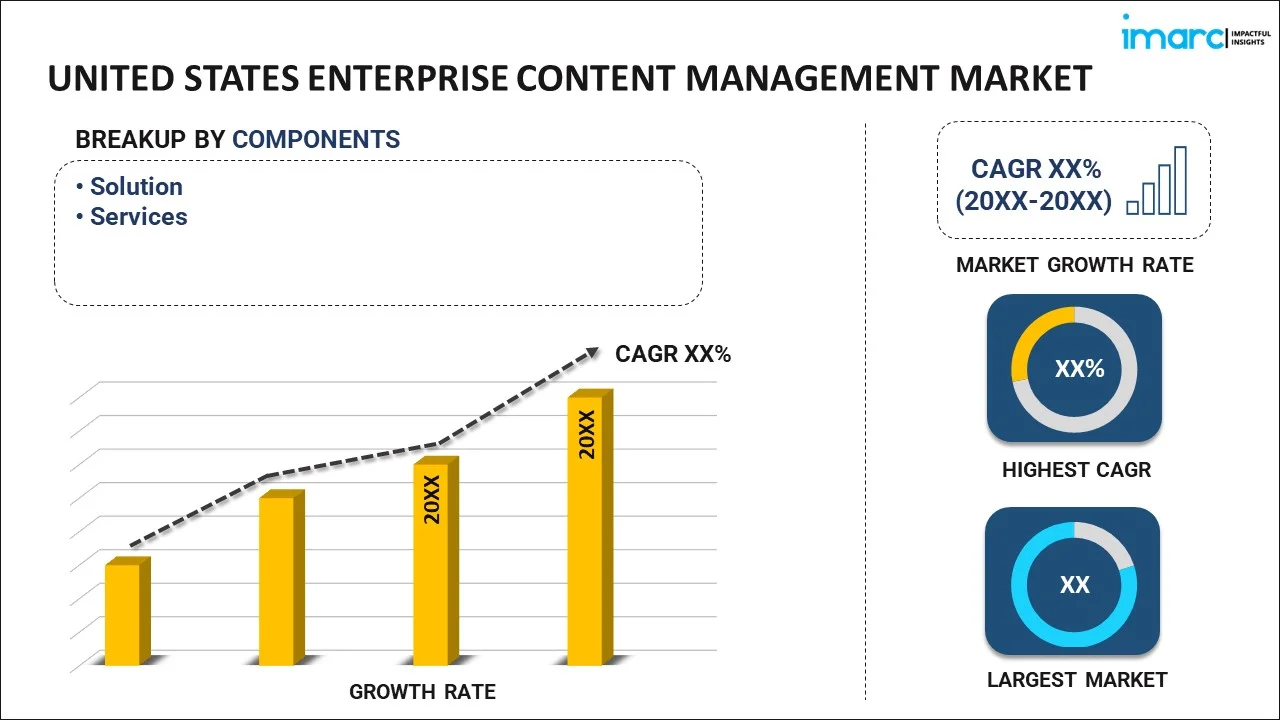
To get detailed segment analysis of this market , Request Sample
- Solution
- Document Management System (DMS)
- Web Content Management (WCM)
- Document-Centric Collaboration (DCC)
- Records Management
- Document Imaging
- Business Process Management (BPM)
- Others
- Services
- Professional
- Managed
The solution dominates with a market share of 72% of the total United States enterprise content management market in 2025.
The solution segment's commanding market position reflects the comprehensive functionality required by United States enterprises for effective content lifecycle management. Document management systems, web content management platforms, and business process management solutions collectively address the core operational requirements of organizations seeking to digitize content operations, automate workflows, and ensure regulatory compliance.
The increasing complexity of enterprise content environments is driving demand for integrated solution platforms that unify document management, records management, and digital asset management capabilities. Organizations are prioritizing solutions that incorporate advanced features including intelligent document processing, automated content classification, and seamless integration with collaboration tools. In April 2024, OpenText announced the release of various artificial intelligence upgrades as part of OpenText Cloud Editions (CE) 24.2, including generative AI capabilities and enhanced enterprise content management features, demonstrating the market's trajectory toward AI-enabled solution platforms.
Enterprise Size Insights:
- Small and Medium-sized Enterprises
- Large Enterprises
The large enterprises lead with a share of 57% of the total United States enterprise content management market in 2025.
Large enterprises command the dominant market share due to their complex content management requirements spanning multiple departments, geographies, and business functions. These organizations generate and manage substantially higher volumes of digital content requiring enterprise-grade ECM platforms with advanced governance, compliance, and collaboration capabilities. The substantial IT budgets of large enterprises enable investment in comprehensive ECM implementations that address sophisticated workflow automation, records management, and digital asset management requirements.
Large enterprises are increasingly investing in advanced digital technology solutions to transform their businesses from paper-based to fully digital operations. The complex regulatory environments in which large enterprises operate, particularly in financial services, healthcare, and government sectors, necessitate ECM solutions with robust audit trail capabilities, retention policy enforcement, and comprehensive compliance management features. These organizations prioritize platforms that deliver enterprise-grade security, seamless integration with existing business applications, and scalable architectures supporting future growth.
Deployment Mode Insights:
- On-premises
- Cloud-based
The cloud-based segment exhibits a clear dominance with a 61% share of the total United States enterprise content management market in 2025.
Cloud-based enterprise content management solutions have emerged as the preferred deployment model for United States organizations seeking scalable, accessible, and cost-effective content management capabilities. The subscription-based pricing model eliminates substantial upfront capital expenditure requirements while providing flexibility to scale resources according to organizational needs. Cloud deployment enables seamless content access for distributed workforces, supporting the hybrid and remote work models that have become prevalent across American enterprises.
The cloud-based segment is experiencing accelerated growth as organizations increasingly plan to migrate their workloads to cloud platforms. Cloud-based ECM solutions offer significant operating cost reductions compared to on-premises alternatives, making them increasingly attractive to cost-conscious enterprises. Organizations are adopting hybrid deployment patterns that maintain sensitive archives in internal data centers while leveraging SaaS platforms for collaboration and workflow automation, enabling phased migration strategies that address data sovereignty concerns while capturing cloud benefits.

End Use Industry Insights:
- Telecom and IT
- Banking, Financial Services and Insurance (BFSI)
- Retail
- Education
- Manufacturing
- Media and Entertainment
- Government
- Healthcare
- Others
The Banking, Financial Services and Insurance (BFSI) holds a 19% share of the total United States enterprise content management market in 2025.
The BFSI sector represents a critical vertical for enterprise content management adoption, driven by the industry's stringent regulatory compliance requirements, high volumes of sensitive customer documentation, and the necessity for secure, auditable content management systems. Financial institutions manage substantial volumes of customer information, compliance materials, financial statements, and transactional records that require robust document control, retention policy enforcement, and comprehensive audit trail capabilities.
The BFSI sector is driven by growing adoption of digital banking services, increasing regulatory scrutiny, and the need for automated compliance management. Financial institutions are prioritizing ECM solutions that enable secure storage and management of sensitive information while providing real-time monitoring, validation, and control capabilities. The integration of ECM with workflow automation, case management, and digital records management is enabling financial services organizations to achieve greater operational efficiency while maintaining rigorous compliance standards.
Regional Insights:
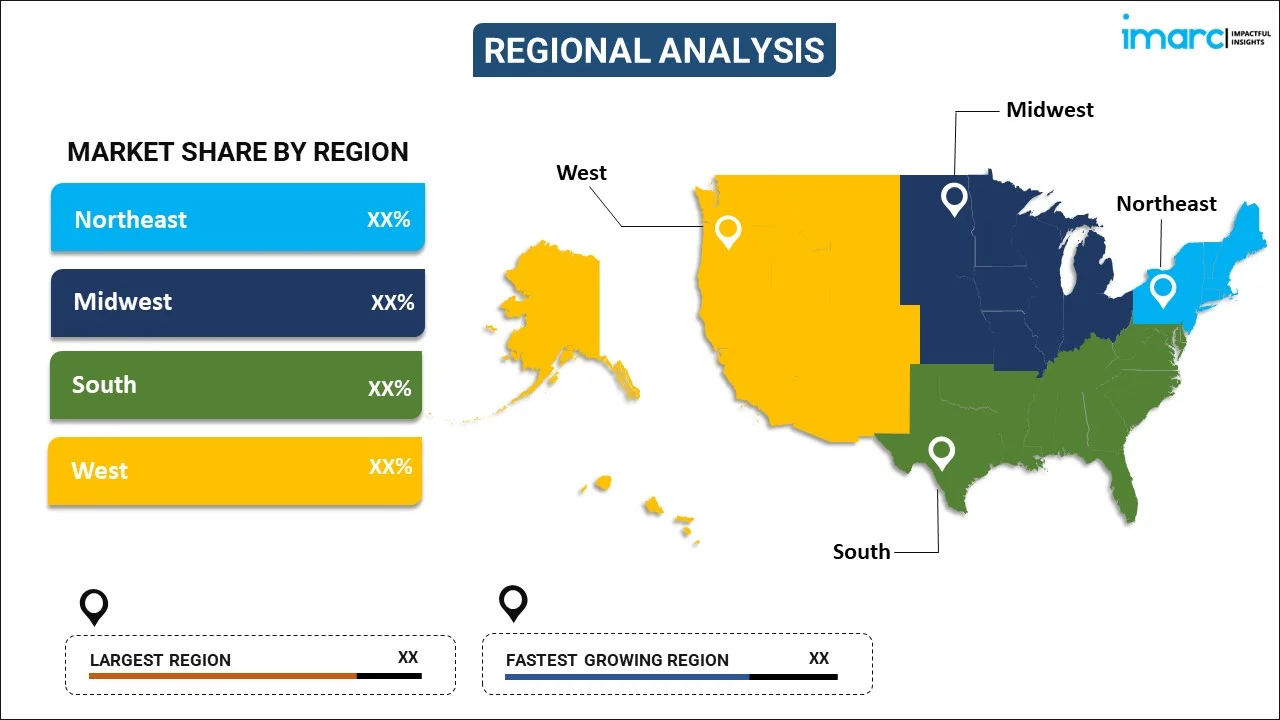
To get detailed regional analysis of this market , Request Sample
- Northeast
- Midwest
- South
- West
The Northeast represents a significant market for enterprise content management solutions, driven by the concentration of financial services, healthcare, and professional services organizations in major metropolitan areas including New York, Boston, and Philadelphia. The region's robust regulatory environment and high density of Fortune 500 headquarters create substantial demand for enterprise-grade ECM platforms.
The Midwest region demonstrates steady enterprise content management adoption, particularly within manufacturing, healthcare, and insurance sectors concentrated in cities such as Chicago, Detroit, and Minneapolis. Organizations in this region are increasingly investing in ECM solutions to digitize legacy paper-based processes, improve operational efficiency, and enhance collaboration capabilities across distributed operations.
The South region exhibits accelerating enterprise content management growth, fueled by the expansion of technology, healthcare, and energy sectors in metropolitan centers including Atlanta, Dallas, Houston, and Miami. The region's rapidly growing business environment and increasing digital transformation investments are driving demand for cloud-based ECM solutions that enable scalable content management capabilities.
The West region leads in enterprise content management innovation, anchored by the technology sector concentration in Silicon Valley, Seattle, and Los Angeles. The region's technology-forward business culture drives early adoption of AI-enabled ECM platforms, cloud-native architectures, and advanced content intelligence solutions. Technology companies headquartered in the West are pioneering new approaches to content management that are subsequently adopted across other regions.
Market Dynamics:
Growth Drivers:
Why is the United States Enterprise Content Management Market Growing?
Accelerating Digital Transformation Initiatives
Digital transformation has emerged as a pivotal driver for enterprise content management adoption across United States organizations. Businesses are increasingly recognizing the necessity of digitizing their content to enhance operational efficiency, improve customer engagement, and maintain competitive advantage in rapidly evolving markets. The transition from traditional paper-based processes to digital workflows necessitates robust ECM platforms capable of managing, organizing, and distributing content efficiently. Organizations are investing in comprehensive ECM implementations that address document digitization, workflow automation, and collaborative content creation requirements. The integration of ECM with broader enterprise systems including customer relationship management, enterprise resource planning, and human capital management platforms is enabling seamless content flows that support end-to-end business processes.
Increasing Regulatory Compliance Requirements
The growing complexity of regulatory requirements across industries is compelling United States organizations to invest in enterprise content management solutions that ensure compliance and governance. Data privacy regulations, industry-specific mandates, and evolving audit requirements demand comprehensive document control, retention policy enforcement, and audit trail capabilities. Organizations are prioritizing ECM platforms that provide systematic approaches to records management, enabling secure storage and management of sensitive information while ensuring regulatory adherence. The increasing focus on compliance has positioned ECM as a critical component of enterprise risk management strategies, driving investment in solutions that maintain data integrity, implement access controls, and enable secure collaboration while meeting regulatory requirements.
Proliferation of Unstructured Data and Remote Work Models
The exponential growth of unstructured data generated by organizations is driving substantial demand for enterprise content management solutions capable of efficiently managing, organizing, and extracting value from diverse content types. With data volumes forecasted to exceed 180 zettabytes globally, businesses require robust ECM platforms that can handle documents, images, videos, emails, and other unstructured content throughout their lifecycles. The rise of remote and hybrid work models has further accelerated ECM adoption, as organizations seek solutions that enable seamless content access and collaboration regardless of employee location. Cloud-based ECM platforms provide the accessibility, real-time collaboration, and version control capabilities required to support distributed workforces while maintaining security and compliance standards.
Market Restraints:
What Challenges the United States Enterprise Content Management Market is Facing?
Legacy System Integration Complexity
Organizations across the United States face significant challenges in integrating enterprise content management solutions with existing legacy systems and content repositories. The complexity of migrating content from older platforms to modern ECM solutions poses technical and budgetary constraints that can delay adoption timelines. Some enterprises report project timelines delayed due to legacy system compatibility issues, highlighting the integration challenges prevalent across the market.
Data Security and Privacy Concerns
Data security and privacy concerns continue to represent significant barriers to enterprise content management adoption, particularly for organizations managing sensitive customer information or operating in highly regulated industries. Some of the organizations report challenges due to concerns over data security and privacy risks, impacting ECM implementation decisions. Organizations must carefully evaluate vendor security capabilities, data residency requirements, and access control mechanisms to ensure adequate protection of confidential content.
High Implementation and Maintenance Costs
The substantial investment required for comprehensive enterprise content management implementations presents a significant barrier for organizations, particularly small and medium-sized enterprises with constrained IT budgets. Implementation costs encompass software licensing, professional services for configuration and customization, user training, and ongoing maintenance expenses. The total cost of ownership considerations, including infrastructure requirements for on-premises deployments and subscription costs for cloud platforms, require careful evaluation against expected return on investment.
Competitive Landscape:
The United States enterprise content management market exhibits a moderately consolidated competitive landscape characterized by the presence of established technology giants and specialized content services vendors. Major players are intensifying competition through continuous innovation in artificial intelligence capabilities, cloud-native architectures, and vertical-specific solutions. Microsoft has continued to gain market share through its integration of content services within the Microsoft 365 ecosystem and adoption of generative AI capabilities. OpenText maintains its leadership position through comprehensive content lifecycle management solutions and strategic acquisitions. Hyland Software has undergone significant transformation, repositioning from traditional ECM toward AI-driven content intelligence and automation. The competitive dynamics are characterized by strategic partnerships, technology integrations, and focused investments in AI-powered automation that enhance content processing efficiency and enable intelligent workflow orchestration across enterprise environments.
Recent Developments:
-
In April 2024, Hyland launched Hyland Experience Automate (Hx Automate), one of the first offerings from its next-generation, cloud-based platform Hyland Experience, enabling integration with existing Hyland platforms while delivering advanced automation capabilities.
United States Enterprise Content Management Market Report Coverage:
| Report Features | Details |
|---|---|
| Base Year of the Analysis | 2025 |
| Historical Period | 2020-2025 |
| Forecast Period | 2026-2034 |
| Units | Million USD |
| Scope of the Report | Exploration of Historical and Forecast Trends, Industry Catalysts and Challenges, Segment-Wise Historical and Predictive Market Assessment:
|
| Components Covered |
|
| Enterprise Sizes Covered | Small and Medium-sized Enterprises, Large Enterprises |
| Deployment Modes Covered | On-premises, Cloud-based |
| End Use Industries Covered | Telecom and IT, Banking Financial Services and Insurance (BFSI), Retail, Education, Manufacturing, Media and Entertainment, Government, Healthcare, Others |
| Regions Covered | Northeast, Midwest, South, West |
| Customization Scope | 10% Free Customization |
| Post-Sale Analyst Support | 10-12 Weeks |
| Delivery Format | PDF and Excel through Email (We can also provide the editable version of the report in PPT/Word format on special request) |
Frequently Asked Questions About the United States Enterprise Content Management Market Report
The United States enterprise content management market size was valued at USD 20,242.85 Million in 2025.
The United States enterprise content management market is expected to grow at a compound annual growth rate of 7.74% from 2026-2034 to reach USD 39,589.26 Million by 2034.
The solution dominated the market with a 72% share in 2025, driven by the comprehensive functionality offered by document management systems, web content management platforms, and business process management solutions that enable organizations to streamline content operations while ensuring regulatory compliance.
Key factors driving the United States enterprise content management market include accelerating digital transformation initiatives across industries, increasing adoption of cloud-based ECM solutions for scalability and remote workforce support, growing regulatory compliance requirements, and the integration of artificial intelligence and machine learning technologies for intelligent content automation.
Major challenges include legacy system integration complexity, data security and privacy concerns, high implementation and maintenance costs, organizational change management requirements, and the need for skilled personnel to manage and optimize ECM platforms.
Need more help?
- Speak to our experienced analysts for insights on the current market scenarios.
- Include additional segments and countries to customize the report as per your requirement.
- Gain an unparalleled competitive advantage in your domain by understanding how to utilize the report and positively impacting your operations and revenue.
- For further assistance, please connect with our analysts.
 Request Customization
 Speak to an Analyst
 Request Brochure
 Inquire Before Buying
Benefits of Customization
- Personalize this research
- Triangulate with your data
- Get data as per your format and definition
- Gain a deeper dive into a specific application, geography, customer, or competitor
- Any level of personalization
Get in Touch With Us
UNITED STATES
Phone: +1-201-971-6302
INDIA
Phone: +91-120-433-0800
UNITED KINGDOM
Phone: +44-753-714-6104
Email: [email protected]
Client Testimonials




.webp)




.webp)













Related Reports

Choose your plan
*Please note that the prices mentioned below are starting prices for each bundle type. Kindly contact our team for further details.*
Single User License
- 1 User License, Access on 2 Devices
- PDF Report + Excel Dataset (Password Protected)
- Lifetime Access
- No Printing Rights
- 10% Free Report Customization
- 10–12 Weeks of Analyst Support
Five User License
- Access for 5 Users, 2 Devices per User
- PDF Report + Excel Dataset (Password Protected)
- Lifetime Access
- Dedicated Account Manager
- 12–14 Weeks of Analyst Support
- No Printing Rights
- 15% Free Report Customization
- 25% Discount on Your Next Purchase
Corporate User License
- Unlimited User Access (Within Your Organization)
- PDF Report + Excel Dataset
- Lifetime Access
- Dedicated Account Manager
- 14–20 Weeks of Analyst Support
- No Printing Rights
- 20% Free Report Customization
- 30% Discount on Your Next Purchase
Essential Insights
What's included:
3 reports
- Lifetime Access
- PDF Reports
- Excel Datasets
- 2 Weeks of Free Analyst Support
- 2 User Licenses
- Access on 2 Devices
- Printing Rights
- Complimentary PowerPoint (PPT) Version
- Complimentary License Upgrade
Professional Access
What's included:
5 reports
- Lifetime Access
- PDF Reports
- Excel Datasets
- 8 Weeks of Free Analyst Support
- 2 User Licenses
- Access on 2 Devices
- Printing Rights
- Complimentary PowerPoint (PPT) Version
- Complimentary License Upgrade
Business Advantage
What's included:
8 reports
- Lifetime Access
- PDF Reports
- Excel Datasets
- 14 Weeks of Free Analyst Support
- 2 User Licenses
- Access on 2 Devices
- Printing Rights
- Complimentary PowerPoint (PPT) Version
- Complimentary License Upgrade
Enterprise Intelligence
What's included:
10 reports
- Lifetime Access
- PDF Reports
- Excel Datasets
- 20 Weeks of Free Analyst Support
- 2 User Licenses
- Access on 2 Devices
- Printing Rights
- Complimentary PowerPoint (PPT) Version
- Complimentary License Upgrade