
United States IT Spending Market Size, Share, Trends and Forecast by Types, Company Size, and Region, 2026-2034
United States IT Spending Market Summary:
The United States IT spending market size was valued at USD 1.47 Trillion in 2025 and is projected to reach USD 2.03 Trillion by 2034, growing at a compound annual growth rate of 3.65% from 2026-2034.
The United States IT spending market is experiencing robust expansion fueled by accelerating digital transformation initiatives across industries. Organizations are prioritizing investments in enterprise software solutions, cloud infrastructure, and cybersecurity capabilities to enhance operational efficiency. The widespread adoption of artificial intelligence technologies is reshaping technology procurement strategies, while hybrid work models continue driving sustained demand for communication services and computing devices.
Key Takeaways and Insights:
- By Types: Enterprise software dominates the market with a share of 36% in 2025, owing to escalating demand for cloud-based applications, enterprise resource planning systems, and customer relationship management solutions integrating artificial intelligence capabilities.
- By Company Size: Total spending by company having more than 2000 employees leads the market with a share of 50% in 2025. This dominance is driven by large enterprises requiring comprehensive digital infrastructure, advanced cybersecurity frameworks, and extensive cloud deployments.
- By Region: South represents the largest region with 33% share in 2025, driven by the rapid expansion of technology hubs across Texas, Florida, and Georgia with favorable business climates and growing data center infrastructure.
- Key Players: Key players drive the United States IT spending market by expanding product portfolios, integrating artificial intelligence capabilities, and strengthening cloud service offerings through strategic acquisitions and partnerships with enterprise customers.
The United States IT spending market is driven by the need for digital transformation in every industry. This need arises from the understanding that upgrading technology infrastructure is important to ensure continued competitive advantage in a digital marketplace. The development and adoption of artificial intelligence and machine learning are driving an unprecedented need for computing, specialized software, and advanced data management. Businesses are pouring investments into the development of intelligent automation solutions to improve efficiency and simplify processes. The development of hybrid work culture setups has driven investments in collaboration software and communications platforms designed to enable easy connectivity between remote workers. Cloud computing adoption has continued to rise, driven by the need for innovative and agile technology infrastructure. Cybersecurity investments have continued to show steady growth driven by the need to ensure security against ever-increasing threats. The development and adoption of business intelligence software are offering businesses the ability to make strategic insights and changes to improve competitiveness.
United States IT Spending Market Trends:
Accelerating Artificial Intelligence Integration Across Enterprise Operations
Artificial intelligence is fundamentally transforming enterprise technology strategies, with organizations embedding AI capabilities throughout their operational frameworks. According to industry surveys, 78% of organizations now use AI in at least one business function, up from 55% in 2023. Businesses are deploying generative AI tools to automate workflows, enhance customer interactions, and generate actionable insights from vast data repositories. The focus has shifted from experimental AI implementations toward practical applications delivering measurable business outcomes. Enterprise adoption encompasses predictive analytics, natural language processing, and intelligent automation solutions that streamline processes across departments including sales, marketing, and customer service functions.
Cloud-First Strategies and Hybrid Infrastructure Adoption
Businesses are adopting cloud-first strategies more frequently while keeping hybrid infrastructure setups that strike a balance between cost, security, and performance. Businesses can increase their operational flexibility and scalability by switching to cloud-native apps. As companies look to optimize workload placement among many providers, multi-cloud methods are increasingly commonplace. Containerization and microservices designs, which facilitate agile development methods and allow for the quick deployment of new capabilities across distributed settings, are given top priority in infrastructure modernization projects.
Elevated Focus on Cybersecurity and Zero-Trust Frameworks
The heightened threat environment is compelling organizations to prioritize cybersecurity investments across all operational domains. According to industry reports, 63% of organizations worldwide have fully or partially implemented a zero-trust strategy, mitigating up to 25% of overall enterprise risk. Zero-trust security architectures are gaining widespread adoption as enterprises recognize the inadequacy of perimeter-based defenses in distributed computing environments. Organizations are implementing advanced threat detection systems, endpoint protection platforms, and identity access management solutions to safeguard critical assets. Security strategies increasingly incorporate artificial intelligence to enable proactive threat identification and automated response capabilities strengthening organizational resilience.
Market Outlook 2026-2034:
The market for IT spending in the United States is showing steady growth momentum due to the expansion of artificial intelligence use across industries and the acceleration of digital transformation activities. In order to improve operational capabilities and preserve competitive positioning in quickly changing markets, organizations continue to prioritize technology investments. As companies adopt scalable computing architectures and modernize outdated systems, enterprise software solutions and cloud infrastructure services serve as the main growth accelerators. The need for secure connectivity solutions and communication tools is sustained by the ongoing development of remote and hybrid work practices. Investments in cybersecurity continue to rise as businesses deal with complex threat environments. The market generated a revenue of USD 1.47 Trillion in 2025 and is projected to reach a revenue of USD 2.03 Trillion by 2034, growing at a compound annual growth rate of 3.65% from 2026-2034.
United States IT Spending Market Report Segmentation:
|
Segment Category |
Leading Segment |
Market Share |
|
Types |
Enterprise Software |
36% |
|
Company Size |
Total Spending by Company Having More Than 2000 Employees |
50% |
|
Region |
South |
33% |
Types Insights:
To get more information of this market, Request Sample
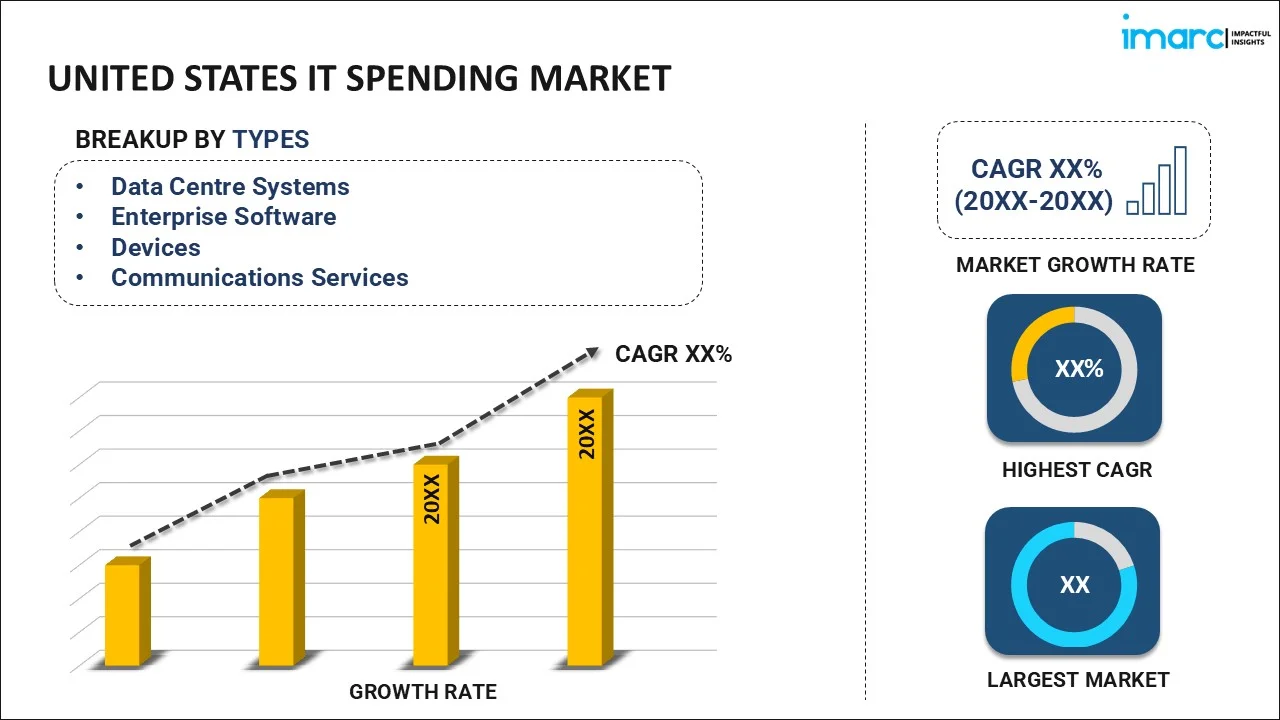
- Data Centre Systems
- Enterprise Software
- Devices
- Communications Services
Enterprise software dominates with a market share of 36% of the total United States IT spending market in 2025.
Enterprise software remains the cornerstone of organizational technology investments, encompassing comprehensive solutions for business operations management and customer engagement. Organizations prioritize software platforms that deliver integrated capabilities spanning enterprise resource planning, customer relationship management, and business intelligence functions. The segment benefits from accelerating cloud migration initiatives as businesses transition from legacy on-premises systems to scalable software-as-a-service deployments. According to the industry reports, US software spending was projected to increase by 10.7% in 2025.
The integration of artificial intelligence capabilities within enterprise software platforms is driving substantial investment growth across all industry verticals. Organizations are adopting intelligent software solutions that leverage machine learning algorithms to automate routine tasks, generate predictive insights, and optimize business processes. The evolution toward agentic AI platforms is reshaping enterprise software architectures, with vendors embedding autonomous capabilities within core application suites that enable greater operational efficiency and enhanced decision-making across functional departments.
Company Size Insights:
- Total Spending by Company Having Less Than 300 Employees
- Total Spending by Company Having 300-2000 Employees
- Total Spending by Company Having More Than 2000 Employees
Total spending by company having more than 2000 employees leads with a share of 50% of the total United States IT spending market in 2025.
Large enterprises with more than 2000 employees drive the majority of IT spending through comprehensive investments in advanced computing infrastructure, sophisticated software ecosystems, and enterprise-grade security solutions. These organizations require scalable platforms capable of supporting complex global operations, extensive data processing requirements, and stringent compliance mandates. Fortune 500 companies are at the forefront of technology adoption, commanding substantial portions of enterprise technology investments while implementing digital transformation initiatives that modernize legacy systems and enhance competitive positioning.
The technology investment strategies of large enterprises increasingly focus on artificial intelligence infrastructure and capabilities that drive operational efficiency and competitive differentiation. Major technology companies have announced unprecedented capital expenditure commitments to support enterprise AI requirements across cloud and data center operations. Organizations are prioritizing investments in generative AI platforms, machine learning tools, and intelligent automation solutions that enhance workforce productivity, streamline business processes, and enable data-driven decision-making across all functional departments and operational areas.
Regional Insights:

To get more information of this market, Request Sample
- Northeast
- Midwest
- South
- West
The South exhibits a clear dominance with a 33% share of the total United States IT spending market in 2025.
The South has emerged as a primary destination for technology investments, benefiting from favorable business environments, competitive operating costs, and expanding digital infrastructure capabilities. States including Texas, Florida, and Georgia attract substantial corporate technology investments through business-friendly regulatory frameworks and growing talent pools. The region's strategic geographic positioning and robust power grid infrastructure further strengthen its appeal for enterprises seeking reliable technology deployment locations and long-term operational stability for mission-critical applications.
The continued expansion of hyperscale data centers and cloud infrastructure facilities across the South region reinforces its leadership position in the national IT spending landscape. In October 2025, over 550 upcoming data center projects across the United States are expected to add over 90 GW of capacity, with substantial development activity concentrated in southern states. Major metropolitan areas, including Dallas-Fort Worth, Atlanta, and Austin have established themselves as prominent technology hubs attracting enterprise investments and fostering innovation ecosystems.
Market Dynamics:
Growth Drivers:
Why is the United States IT Spending Market Growing?
Accelerating Digital Transformation Across Industries
Digital transformation has become an organizational imperative across all industry sectors, driving sustained technology investment growth throughout the United States economy. According to industry survey, over 80% of CIOs expect to increase their investments in 2025 in foundational capabilities and technologies such as cybersecurity, AI/GenAI, business intelligence and data analytics, and integration technologies. Enterprises recognize that modernizing their technological foundations is essential for maintaining competitive positioning, enhancing customer experiences, and achieving operational excellence in an increasingly digital marketplace. Organizations are undertaking comprehensive initiatives to migrate legacy systems to modern platforms, implement cloud-native architectures, and integrate advanced analytics capabilities that enable data-driven decision-making. The transformation agenda encompasses all aspects of business operations, from customer-facing applications to back-office processes and supply chain management systems. Companies are investing in platforms that enable seamless integration across diverse technology ecosystems while supporting rapid innovation and continuous improvement. The scope of digital transformation extends beyond technology implementation to encompass organizational change management, workforce upskilling, and cultural evolution that enables enterprises to fully realize the benefits of their technology investments. Industries including financial services, healthcare, retail, and manufacturing are leading transformation efforts as competitive pressures create urgency for technological modernization initiatives.
Proliferation of Artificial Intelligence and Machine Learning Technologies
The rapid advancement and widespread adoption of artificial intelligence technologies represents a transformative force driving IT spending growth across the United States market. Organizations are deploying AI capabilities throughout their operations, leveraging machine learning algorithms to automate routine processes, generate predictive insights, and enhance decision-making quality. The emergence of generative AI has created unprecedented demand for computing infrastructure, specialized software platforms, and supporting technologies that enable organizations to develop and deploy AI-powered applications. Enterprises are investing in AI platforms that integrate seamlessly with existing systems while providing scalable foundations for expanding intelligent capabilities over time. The adoption of AI extends across all functional areas, encompassing applications in customer service automation, financial forecasting, supply chain optimization, and workforce management. Organizations recognize that AI competency is increasingly essential for competitive differentiation, driving accelerated investment in both infrastructure and talent development. The evolution toward agentic AI introduces new paradigms for autonomous operations that promise further transformation of business processes and technology requirements across enterprise environments.
Heightened Focus on Cybersecurity and Data Protection
The escalating sophistication and frequency of cyber threats compels organizations to prioritize security investments across all domains of their IT infrastructure. Enterprises face an increasingly complex threat landscape characterized by advanced persistent threats, ransomware campaigns, and state-sponsored attacks that target critical systems and sensitive data. The expanding attack surface created by cloud adoption, remote work models, and Internet of Things deployments amplifies security challenges and requires comprehensive defensive strategies. Organizations are implementing zero-trust security architectures that eliminate implicit trust assumptions and enforce continuous verification across all access requests. Investment priorities span endpoint protection platforms, network security solutions, identity and access management systems, and security operations capabilities that enable rapid threat detection and response. Regulatory compliance requirements continue expanding, creating additional pressure for security investment as organizations navigate evolving data protection mandates across jurisdictions. The convergence of security with artificial intelligence introduces new capabilities for proactive threat identification while simultaneously creating novel attack vectors that require protective measures and continued vigilance across enterprise environments.
Market Restraints:
What Challenges the United States IT Spending Market is Facing?
Persistent Technology Skills Shortage and Talent Gap
The technology sector continues to face critical talent gaps that limit the ability of organizations to successfully implement and manage technology investments. The fast pace of technology advancements, especially with respect to artificial intelligence, cybersecurity, and cloud computing, has translated into a perpetual gap between skills and demands. There have been efforts to hire and retain skilled professionals with expertise in niche fields, thereby making it difficult for organizations to successfully undertake technology projects and maximize their return on technology investments.
High Implementation Costs and Budget Constraints
The significant expense involved in adopting advanced technology sets certain hurdles for all types and sizes of businesses to adopt and advance their technological framework. Implementation and execution of enterprise technology involve considerable investment in terms of capital outlay for infrastructure and software, and associated technology investments for all types and sizes of business. The uncertainties associated with economic conditions and inflation create technology investment challenges for business enterprises. Their spending goals are often hindered by the need to balance investment with prevailing economic constraints.
Complexity and Challenges in Compliance
The ever-changing regulatory environment poses compliance risks, which have an influence on investing and executing technologies. The requirements for compliance, failing which heavy penalties are imposed, result in significant investment in monitoring and reporting, which is an additional overhead and negatively impacts innovation projects. The lack of clarity regarding new regulations, especially those related to artificial intelligence, further hamps investment as organizations wait to make decisions until new regulations become clearer.
Competitive Landscape:
The IT spending market in the United States is shown to be very competitive and dominated by existing technology firms and relatively new innovative technology firms. Market players engage in competition on many fronts such as product features, customer support expertise, pricing models, and further customer support excellence. Major technology firms engage in innovations that entail integrating artificial intelligence skills across their product portfolios as a way of catering to meeting ever-changing technology needs. Other partnerships and acquisitions contribute towards increasing solution portfolios and further improving market positions for technology firms. Cloud providers engage in very stiff competition as they attempt to gain more of the IT spending from businessmen through innovative solutions and further solutions tailored to specific market fields. Other technology firms engage in platform integration and further development of technology solutions as a way of increasing wallet shares from existing clients.
Recent Developments:
- In September 2025: Five additional AI data center locations in the US have been unveiled by OpenAI, Oracle, and SoftBank under their Stargate infrastructure platform. With a total investment of USD 400 billion, the expansion increases Stargate's capacity to 7 GW. Several states, including Texas, Michigan, Wisconsin, Georgia, Ohio, and Pennsylvania, will host the data center locations.
- In January 2025: In order to develop AI-enabled data centers for training AI models and deploying AI and cloud-based applications worldwide, Microsoft announced plans to invest over $80 billion in fiscal year 2025. The company's dedication to developing American AI infrastructure is demonstrated by the fact that more than half of this investment is going to the US.
United States IT Spending Market Report Scope:
| Report Features | Details |
|---|---|
| Base Year of the Analysis | 2025 |
| Historical Period | 2020-2025 |
| Forecast Period | 2026-2034 |
| Units | Trillion USD |
| Scope of the Report | Exploration of Historical Trends and Market Outlook, Industry Catalysts and Challenges, Segment-Wise Historical and Predictive Market Assessment:
|
| Types Covered | Data Centre Systems, Enterprise Software, Devices, Communications Services |
| Company Sizes Covered | Total Spending by Company Having Less Than 300 Employees, Total Spending by Company Having 300-2000 Employees, Total Spending by Company Having More Than 2000 Employees |
| Regions Covered | Northeast, Midwest, South, West |
| Customization Scope | 10% Free Customization |
| Post-Sale Analyst Support | 10-12 Weeks |
| Delivery Format | PDF and Excel through Email (We can also provide the editable version of the report in PPT/Word format on special request) |
Frequently Asked Questions About the United States IT Spending Market Report
The United States IT spending market size was valued at USD 1.47 Trillion in 2025.
The United States IT spending market is expected to grow at a compound annual growth rate of 3.65% from 2026-2034 to reach USD 2.03 Trillion by 2034.
Enterprise software dominated the market with a share of 36%, driven by accelerating cloud adoption, artificial intelligence integration, and enterprise demand for comprehensive software solutions enabling digital transformation.
Key factors driving the United States IT spending market include accelerating digital transformation initiatives, widespread artificial intelligence adoption, escalating cybersecurity investments, cloud computing expansion, and hybrid work models.
Major challenges include persistent technology skills shortages and talent gaps, high implementation costs, budget constraints amid economic uncertainty, evolving regulatory complexity, and data privacy compliance requirements across jurisdictions.
Need more help?
- Speak to our experienced analysts for insights on the current market scenarios.
- Include additional segments and countries to customize the report as per your requirement.
- Gain an unparalleled competitive advantage in your domain by understanding how to utilize the report and positively impacting your operations and revenue.
- For further assistance, please connect with our analysts.
 Request Customization
 Speak to an Analyst
 Request Brochure
 Inquire Before Buying
Benefits of Customization
- Personalize this research
- Triangulate with your data
- Get data as per your format and definition
- Gain a deeper dive into a specific application, geography, customer, or competitor
- Any level of personalization
Get in Touch With Us
UNITED STATES
Phone: +1-201-971-6302
INDIA
Phone: +91-120-433-0800
UNITED KINGDOM
Phone: +44-753-714-6104
Email: [email protected]
Client Testimonials




.webp)




.webp)













Related Reports

Choose your plan
*Please note that the prices mentioned below are starting prices for each bundle type. Kindly contact our team for further details.*
Single User License
- 1 User License, Access on 2 Devices
- PDF Report + Excel Dataset (Password Protected)
- Lifetime Access
- No Printing Rights
- 10% Free Report Customization
- 10–12 Weeks of Analyst Support
Five User License
- Access for 5 Users, 2 Devices per User
- PDF Report + Excel Dataset (Password Protected)
- Lifetime Access
- Dedicated Account Manager
- 12–14 Weeks of Analyst Support
- No Printing Rights
- 15% Free Report Customization
- 25% Discount on Your Next Purchase
Corporate User License
- Unlimited User Access (Within Your Organization)
- PDF Report + Excel Dataset
- Lifetime Access
- Dedicated Account Manager
- 14–20 Weeks of Analyst Support
- No Printing Rights
- 20% Free Report Customization
- 30% Discount on Your Next Purchase
Essential Insights
What's included:
3 reports
- Lifetime Access
- PDF Reports
- Excel Datasets
- 2 Weeks of Free Analyst Support
- 2 User Licenses
- Access on 2 Devices
- Printing Rights
- Complimentary PowerPoint (PPT) Version
- Complimentary License Upgrade
Professional Access
What's included:
5 reports
- Lifetime Access
- PDF Reports
- Excel Datasets
- 8 Weeks of Free Analyst Support
- 2 User Licenses
- Access on 2 Devices
- Printing Rights
- Complimentary PowerPoint (PPT) Version
- Complimentary License Upgrade
Business Advantage
What's included:
8 reports
- Lifetime Access
- PDF Reports
- Excel Datasets
- 14 Weeks of Free Analyst Support
- 2 User Licenses
- Access on 2 Devices
- Printing Rights
- Complimentary PowerPoint (PPT) Version
- Complimentary License Upgrade
Enterprise Intelligence
What's included:
10 reports
- Lifetime Access
- PDF Reports
- Excel Datasets
- 20 Weeks of Free Analyst Support
- 2 User Licenses
- Access on 2 Devices
- Printing Rights
- Complimentary PowerPoint (PPT) Version
- Complimentary License Upgrade