
United States Jewelry Market Size, Share, Trends and Forecast by Product, Material, and Region, 2026-2034
United States Jewelry Market Size, Share, Trends & Forecast (2026-2034)
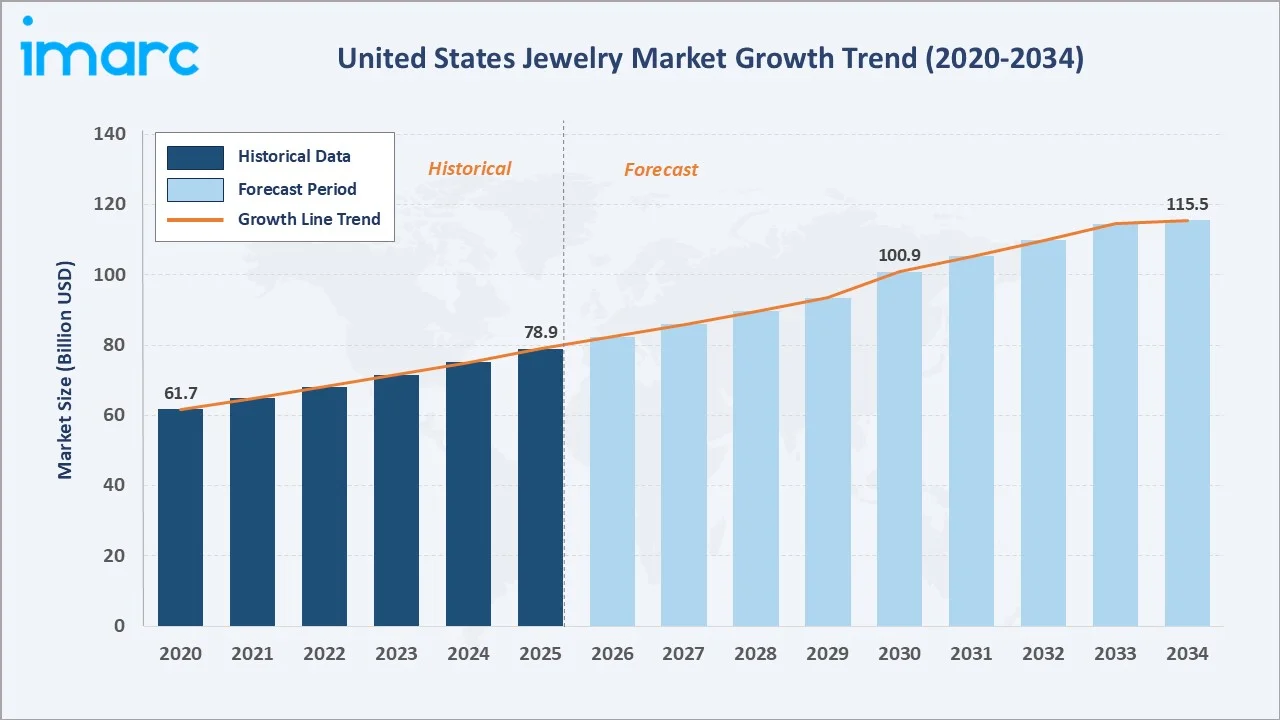
The United States jewelry market reached USD 78.9 Billion in 2025 and is projected to reach USD 115.5 Billion by 2034, growing at a CAGR of 5.05% during 2026-2034. The market is driven by rising consumer spending on luxury and self-purchase jewelry, expanding e-commerce and DTC channels, growing lab-grown diamond adoption, and strong bridal jewelry demand. In 2025, the United States recorded 2,011,044 weddings, with couples spending an average of $32,899 per wedding. The substantial expenditure associated with weddings is supporting demand for engagement rings, wedding bands, bridal jewelry, and luxury accessories. Rings lead products at 31.6%. Gold leads materials at 42.7%. The South leads regionally at 34.5%.
Market Snapshot
|
Metric |
Value |
|
Market Size (2025) |
USD 78.9 Billion |
|
Forecast Market Size (2034) |
USD 115.5 Billion |
|
CAGR (2026-2034) |
5.05% |
|
Base Year |
2025 |
|
Historical Period |
2020-2025 |
|
Forecast Period |
2026-2034 |
|
Leading Product |
Ring (31.6%, 2025) |
|
Leading Material |
Gold (42.7%, 2025) |
|
Leading Region |
South (34.5%, 2025) |
The United States jewelry market has grown steadily from USD 61.7 Billion in 2020 to USD 78.9 Billion in 2025, driven by resilient consumer appetite for luxury personal adornment, a post-pandemic surge in bridal and gifting jewelry purchases, the democratization of fine jewelry through DTC digital brands, and gold's sustained appeal as both a fashion accessory and a store of value. The market is projected to reach USD 100.9 Billion by 2030 and USD 115.5 Billion by 2034.
To get more information on this market, Request Sample
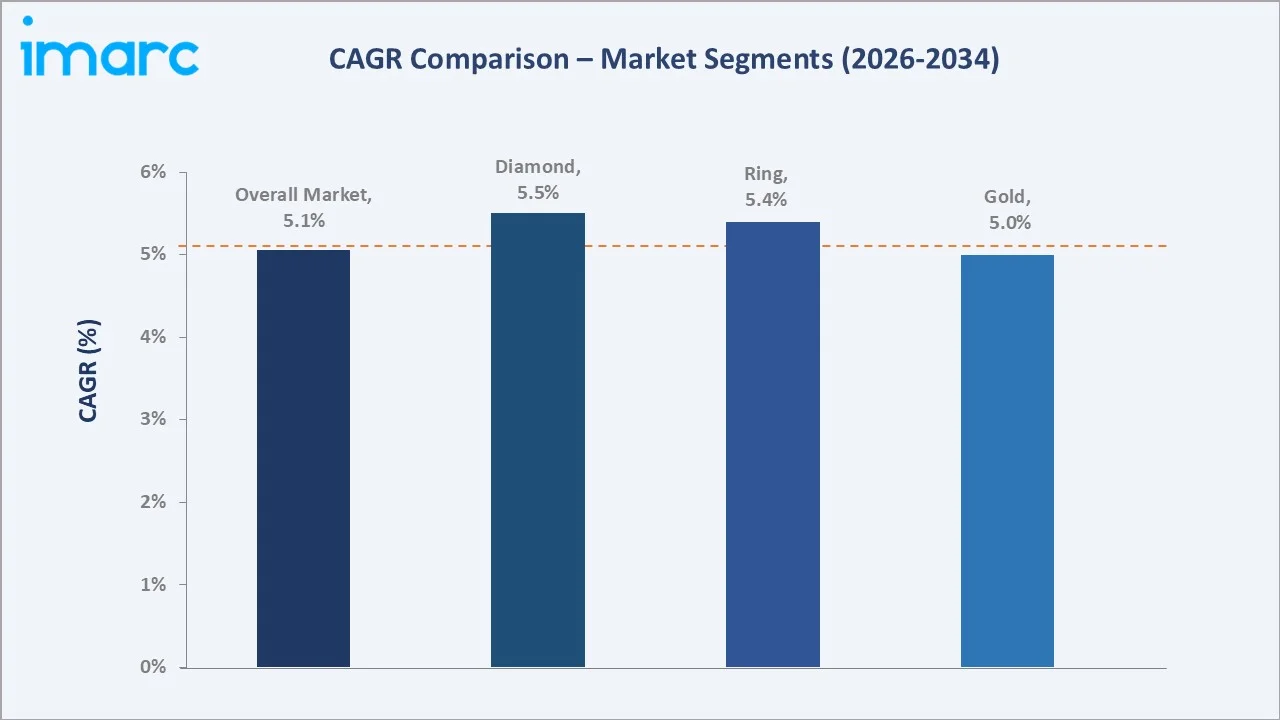
Diamond material grows at ~5.5% CAGR through lab-grown diamond adoption accelerating accessible luxury entry. Ring product grows at ~5.4% CAGR through sustained bridal demand and self-purchase stacking ring trends. Gold grows at ~5.0% CAGR through both fashion jewelry demand and gold's store-of-value positioning amid broader macroeconomic uncertainty.
Executive Summary
The United States jewelry market is the largest national jewelry retail market, encompassing a diverse spectrum of consumers, price points, and purchase occasions from bridal engagement and wedding bands to everyday fashion jewelry, anniversary gifts, self-purchase accessories, and investment-grade fine jewelry.
Ring leads product share at 31.6%, anchored by bridal engagement rings alongside fashion stacking rings, anniversary bands, and birthstone rings that sustain year-round demand across consumer segments. Gold leads material share at 42.7%, reflecting its timeless luxury positioning, strong cultural gifting traditions, and growing investment-linked demand as gold prices reached all-time highs in 2024-2025. The South leads regionally at 34.5%, reflecting the US's largest regional population concentration, strong gifting culture, and a large and growing affluent consumer base in cities.
Key Market Insights
|
Insight |
Data |
|
Leading Product |
Ring - 31.6% share (2025) |
|
Leading Material |
Gold - 42.7% share (2025) |
|
Leading Region |
South - 34.5% share (2025) |
|
Market Opportunity |
Lab-grown diamonds; DTC digital brands; AR try-on; sustainable jewelry; self-purchase occasion |
Key Analytical Observations Supporting the Above Data:
- Ring at 31.6%: Rings dominate through the country's robust bridal market, compounded by the millennial and Gen Z stacking ring trend, fashion cocktail rings, and birthstone and signet ring categories sustaining high-frequency fashion ring purchases beyond the bridal occasion.
- Gold at 42.7%: Gold dominates through its timeless appeal across fashion and fine jewelry categories, versatility in yellow, white, and rose gold variants that serve diverse consumer aesthetic preferences, and growing investment-linked demand as gold price appreciation to record levels in 2024-2025 reinforced perceptions of gold jewelry as a store of value.
- South at 34.5%: The South leads through the combined population weight of Texas, Florida, Georgia, and other Southeastern states, alongside a strong gifting and bridal culture, a growing upper-middle-class consumer demographic in major Sun Belt metros, and significant concentration of specialty jewelry retail chains serving large suburban and mall-anchored shopping footprints.
United States Jewelry Market Overview
The United States jewelry market encompasses the retail sale of fine jewelry, fashion jewelry, and bridal/ceremonial jewelry across product categories including rings (engagement, wedding bands, fashion, birthstone), necklaces (chains, pendants, chokers), earrings (studs, hoops, drop), bracelets (bangles, tennis, charm), and others (brooches, anklets). Materials span gold, diamond, platinum, silver, and others, including gemstones, pearls, and alternative metals. Distribution channels include jewelry specialty retailers, department stores, e-commerce platforms, and growing DTC digital-first brand websites.
Market Dynamics
To evaluate market opportunities, Request Sample
Market Drivers
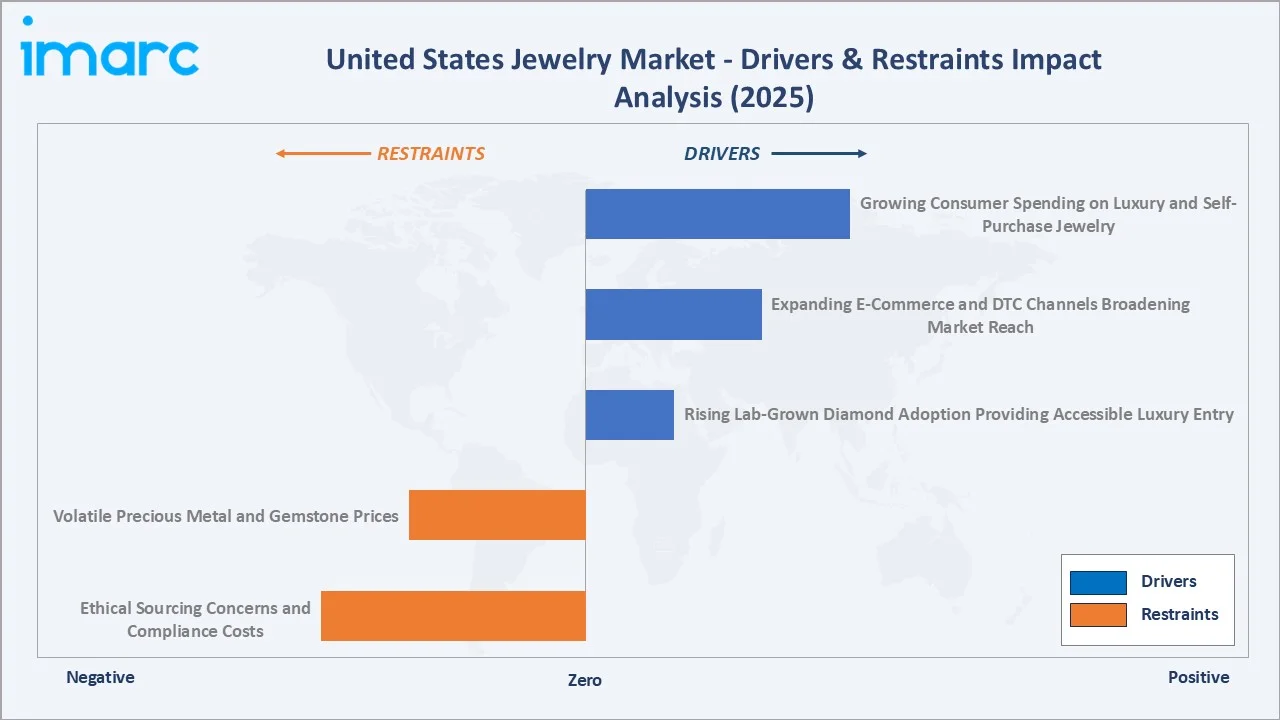
- Growing Consumer Spending on Luxury and Self-Purchase Jewelry: Rising US disposable incomes, particularly among millennial and Gen Z consumers who have entered peak earning years, are driving sustained growth in jewelry spending across both luxury and accessible luxury segments. The "self-purchase" jewelry occasion, consumers buying jewelry for themselves rather than receiving it as a gift, has grown substantially, with women's self-purchase accounting for more of fine jewelry sales.
- Expanding E-Commerce and DTC Channels Broadening Market Reach: Online jewelry sales accelerated during the COVID-19 period's channel shift and sustained by the continued success of DTC digital-first jewelry brands. Major brands have demonstrated that consumers will confidently purchase fine and bridal jewelry online when supported by high-quality photography, 360-degree product visualization, augmented reality try-on tools, flexible returns, and transparent gemstone certification information.
- Rising Lab-Grown Diamond Adoption Providing Accessible Luxury Entry: Lab-grown diamond adoption is the most structurally significant market development in US jewelry retail, enabling millions of previously excluded consumers to access diamond jewelry at discounts to mined equivalents. In March 2024, Kendra Scott introduced its Lab-Grown Diamond Collection, expanding its fine jewelry portfolio with more accessible diamond offerings. Designed in Austin, Texas, the collection reflects the brand’s focus on design innovation and affordability, providing consumers with lab-grown diamond styles at a comparatively attainable price point.
Market Restraints
- Volatile Precious Metal and Gemstone Prices: Gold price volatility creates significant cost pressure and pricing uncertainty for US jewelry retailers and manufacturers. Higher gold prices compress retail margins when retailers absorb cost increases to maintain price competitiveness or reduce consumer purchase volumes when price increases are passed through. Similarly, diamond price volatility creates inventory and margin management challenges across the retail supply chain.
- Ethical Sourcing Concerns and Compliance Costs: Growing consumer awareness of supply chain sustainability and conflict-mineral risks creates reputational and compliance challenges for US jewelry retailers. Certification for conflict-free diamond sourcing, supply chain due diligence requirements, and evolving reporting expectations from institutional investors create compliance cost burdens and supply chain transparency investment requirements that particularly challenge smaller independent jewelers and importers without established audit infrastructure.
Market Opportunities
- Expansion of Organized and Ethnic Jewelry Retail: In December 2025, Malabar Gold & Diamonds expanded its North American retail footprint with the opening of two new showrooms in the United States and Canada. The new Austin, Texas location represents the brand’s seventh showroom in the United States, bringing its total retail network across North America to 10 showrooms. Growing demand for Indian-inspired, bridal, gold, diamond, and customized jewelry creates opportunities for international brands to broaden their customer base while also attracting mainstream consumers.
- Augmented Reality and Digital Innovation in Jewelry Retail: AR jewelry try-on technology, enabling consumers to virtually visualize rings, necklaces, and earrings on their own image before purchasing, is transforming online jewelry purchase confidence and conversion rates. Personalization technology enabling rapid customization of engraving, stone selection, and metal choice at the point of digital sale is also significantly increasing average order values for DTC jewelry brands.
Market Challenges
- Department Store Channel Contraction and Foot Traffic Decline: Traditional department store jewelry counters face structural challenges as department store foot traffic and overall department store retail performance have declined significantly. The consolidation and closure of department store jewelry departments is reducing one of the legacy distribution channels for branded jewelry manufacturers and creating retail real estate transition challenges for brands historically reliant on department store distribution.
- Competition from Alternative Luxury Spending and Experiences: US consumer discretionary spending faces intensifying competition across luxury goods, experiential travel, fitness and wellness, and digital entertainment categories that compete for the consumer wallet alongside jewelry. Post-pandemic consumer preference for experience spending versus goods spending created headwinds for jewelry retail, as travel and hospitality spending recovered, requiring jewelry brands to articulate compelling emotional and value propositions beyond functional accessory alternatives.
Emerging Market Trends
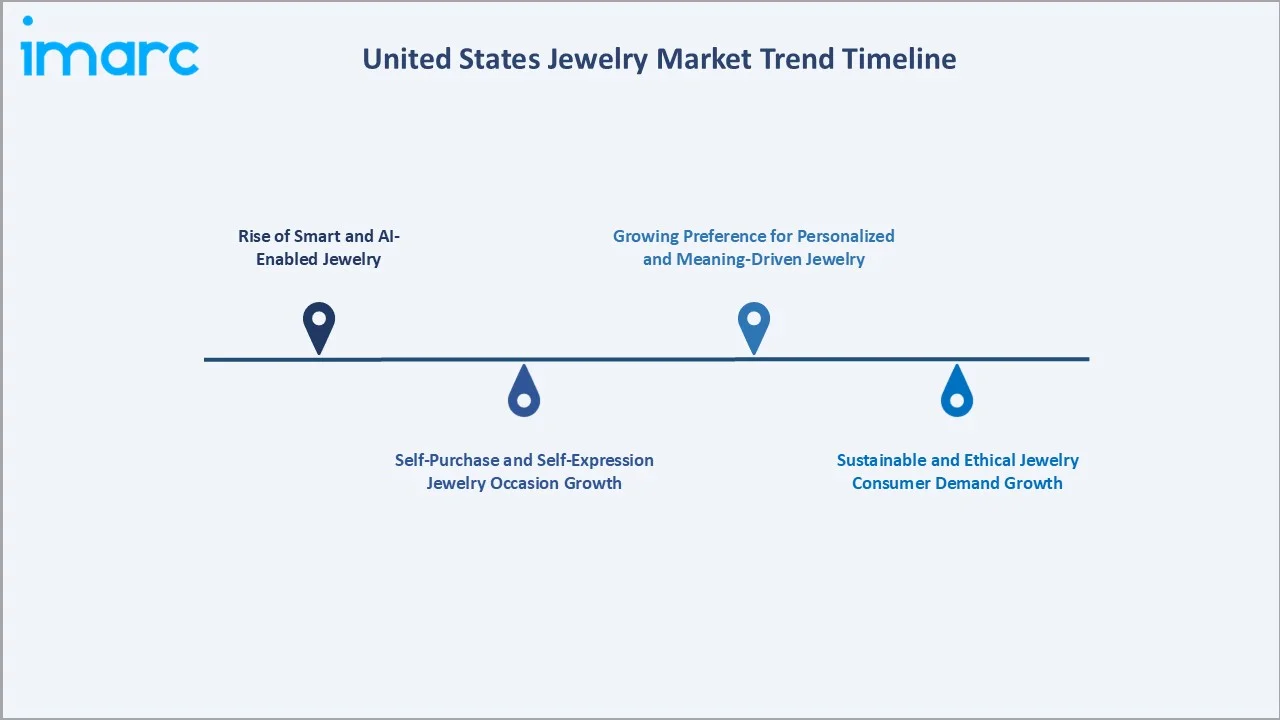
1. Rise of Smart and AI-Enabled Jewelry
In August 2026, TOTWOO launched its Smart Locket in the United States, combining traditional jewelry design with digital memory features and AI-powered experiences. The product builds on the brand’s Connected Jewelry concept by shifting wearable technology beyond fitness and health tracking toward emotional connection, digital memories, and personalized interactions. The launch highlights a growing trend toward integrating digital connectivity, AI features, and personalized experiences into traditional jewelry. This is expanding the category beyond aesthetics, creating demand for wearable products that combine fashion with emotional engagement and interactive technology.
2. Self-Purchase and Self-Expression Jewelry Occasion Growth
The "self-purchase" jewelry occasion, representing women (and increasingly men) buying jewelry for themselves as personal expression, milestone celebration, or everyday accessory, has grown from a secondary to a primary market driver for many DTC jewelry brands. This occasions diversification sustains jewelry purchase activity beyond the traditional holiday, Valentine's Day, and bridal gifting concentration.
3. Growing Preference for Personalized and Meaning-Driven Jewelry
In May 2026, Eclara Jewelry introduced a new Nature-Inspired Engagement Ring Collection, featuring alternative gemstones, organic design elements, and story-led styling. The collection reflects growing demand for engagement rings that emphasize personal meaning, individuality, and shared experiences rather than traditional measures of luxury such as carat size alone. The launch reflects an emerging trend toward engagement rings centered on individual expression, symbolic design, and alternative gemstones rather than conventional luxury cues. This shift is encouraging jewelry brands to develop more distinctive, story-driven collections tailored to changing consumer preferences.
4. Sustainable and Ethical Jewelry Consumer Demand Growth
US consumer demand for sustainably sourced, ethically produced jewelry is driving supply chain transparency investment across the retail spectrum. This sustainability trend is creating brand premium positioning opportunity for jewelry companies that authenticate and communicate ethical sourcing credentials, particularly among the sustainability-motivated millennial and Gen Z consumer segments that represent the US jewelry market's long-term growth driver.
Industry Value Chain Analysis
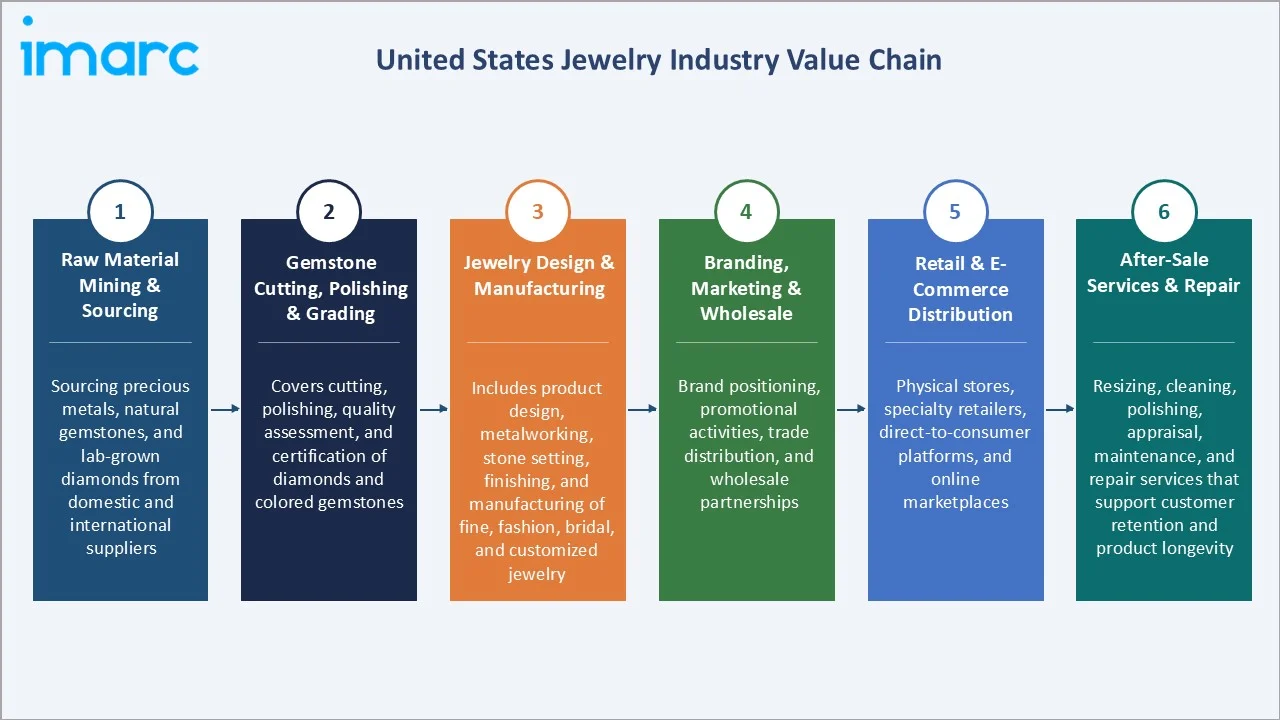
The US jewelry market value chain integrates raw material mining and sourcing, gemstone cutting and polishing, jewelry design and manufacturing, branding and wholesale distribution, retail and e-commerce channels, and after-sale services including repair, resizing, and appraisal.
|
Stage |
Key Participants |
|
Raw Material Mining & Sourcing |
Sourcing precious metals, natural gemstones, and lab-grown diamonds from domestic and international suppliers. |
|
Gemstone Cutting, Polishing & Grading |
Covers cutting, polishing, quality assessment, and certification of diamonds and colored gemstones. |
|
Jewelry Design & Manufacturing |
Includes product design, metalworking, stone setting, finishing, and manufacturing of fine, fashion, bridal, and customized jewelry. |
|
Branding, Marketing & Wholesale |
Brand positioning, promotional activities, trade distribution, and wholesale partnerships. |
|
Retail & E-Commerce Distribution |
Physical stores, specialty retailers, direct-to-consumer platforms, and online marketplaces. |
|
After-Sale Services & Repair |
Resizing, cleaning, polishing, appraisal, maintenance, and repair services that support customer retention and product longevity. |
Branding and retail represent the highest-value stages in the US jewelry value chain, where design narrative, brand prestige, and consumer experience command premium pricing far above material cost-based valuations. Lab-grown diamond producers are disrupting the raw material mining stage by enabling vertically integrated DTC brands to bypass traditional mined diamond supply chains entirely.
Technology Landscape in the United States Jewelry Industry
Lab-Grown Diamond and Gemstone Production Technology
Chemical vapor deposition (CVD) and high-pressure, high-temperature (HPHT) technologies produce gem-quality lab-grown diamonds physically, chemically, and optically identical to mined diamonds. CVD technology, depositing carbon atom-by-atom onto a diamond seed crystal in a plasma chamber, has achieved significant cost reduction through process optimization, enabling lab-grown diamonds to retail at discounts while maintaining certification. Lab-grown colored gemstone production through flux growth and hydrothermal methods is extending the accessible luxury concept to sapphires, rubies, and emeralds, creating new product innovation opportunities for US jewelry brands.
Augmented Reality and Digital Visualization Technology
Augmented reality jewelry try-on technology, enabling consumers to virtually visualize rings, necklaces, and earrings using smartphone cameras or web-based AR tools, is transforming online jewelry purchase conversion rates and customer satisfaction. 3D product rendering technology, creating photorealistic digital imagery of ring configurations with selectable stone shapes, carat weights, and metal colors, enables virtually unlimited visual product presentation without physical inventory for DTC online jewelry configurators.
Blockchain and Supply Chain Traceability Technology
Blockchain-based jewelry provenance tracking, recording diamond, gold, and gemstone origin, custody chain, and certification data on immutable distributed ledgers, is enabling US jewelry brands to verify and communicate ethical sourcing claims with unprecedented transparency. These technologies address consumer demand for verified ethical sourcing while creating competitive differentiation for transparency-forward jewelry brands in the sustainability-motivated consumer segment.
Market Segmentation Analysis
The report covers the following segments:
|
Segment Category |
Leading Segment |
Market Share |
Year |
|
Product |
Ring |
31.6% |
2025 |
|
Material |
Gold |
42.7% |
2025 |
|
Region |
South |
34.5% |
2025 |

By Product
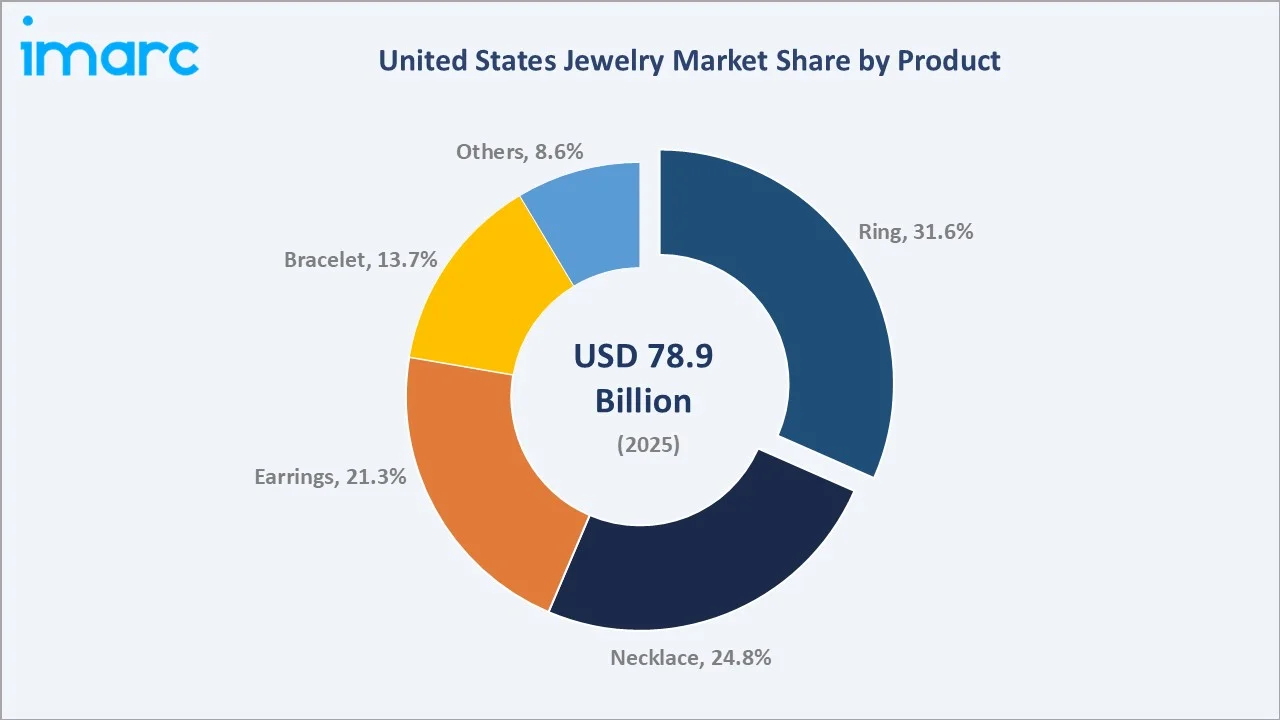
Rings lead at 31.6% (2025), driven by fashion ring trends including stacking rings, birthstone rings, and statement cocktail rings. Rings grow at ~5.4% CAGR through 2034, the strongest product CAGR, through sustained bridal market depth and self-purchase ring occasion expansion among millennial and Gen Z female consumers.
To access detailed market analysis, Request Sample
Necklaces hold a 24.8% share through versatility as both gifting and self-purchase jewelry across all price segments, growing at ~5.1% CAGR through layered necklace styling trends and personalized pendant demand. Earrings at 21.3% reflect everyday earring fashion demand and growing hoop and statement earring preferences. Bracelets at 13.7% include charm bracelets, tennis bracelets, and bangles. Others at 8.6% encompass brooches, body jewelry, and anklets.
By Material
Gold leads at 42.7% (2025) through its timeless luxury positioning across yellow, white, and rose gold variants, and the structural demand of the bridal market where gold serves as the dominant engagement ring and wedding band setting material. Gold grows at ~5.0% CAGR through both fashion jewelry demand and investment-linked consumption as record gold prices strengthen store-of-value purchase rationale for fine gold jewelry.
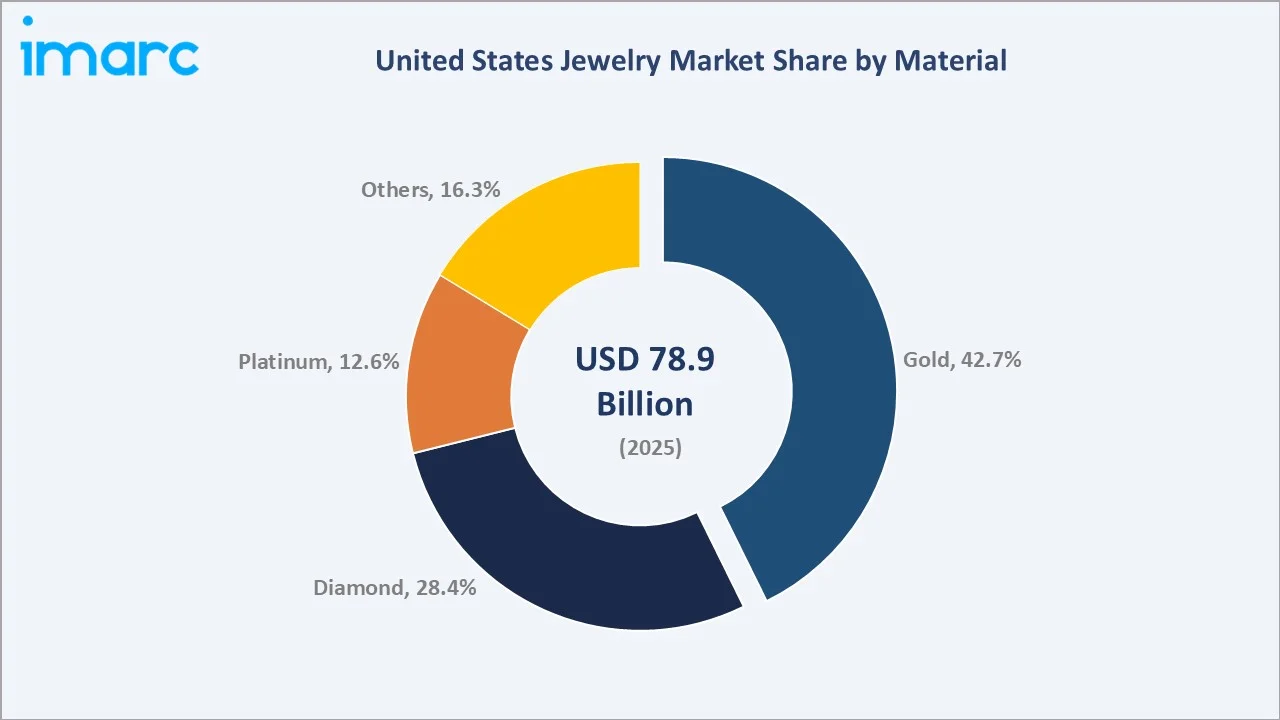
Diamond at 28.4% is growing at ~5.5% CAGR, driven by lab-grown diamond adoption expanding the accessible luxury diamond market. Platinum at 12.6% maintains share through premium bridal and fine jewelry applications where platinum's durability and dense white-metal aesthetic command premium positioning. Others at 16.3% includes silver, gemstones, pearls, and alternative metals growing through fashion jewelry and DTC brand product ranges.
Regional Market Insights
|
Region |
Share (2025) |
Key United States Jewelry Market Drivers & Characteristics |
|
South |
34.5% |
Benefits from a large consumer base, expanding metropolitan markets, and strong demand for bridal, gifting, gold, and diamond jewelry. Population and economic growth further support jewelry retail expansion. |
|
West |
25.8% |
Characterized by affluent consumers, strong luxury spending, and early adoption of sustainable, personalized, and innovative jewelry designs, particularly in major California markets. |
|
Northeast |
22.4% |
Supported by high-income urban consumers, premium retail networks, and demand for designer and vintage jewelry. |
|
Midwest |
17.3% |
Demonstrates steady demand for bridal, traditional, and accessible fine jewelry, supported by established retail networks and a broad middle-income consumer base. |
The South's 34.5% dominance reflects its population leadership and the particular strength of gifting culture across Texas, Georgia, and Florida consumer markets. The West's 25.8% share reflects California's enormous consumer market scale and the Bay Area's disproportionately high-income demographics generating strong fine jewelry demand.
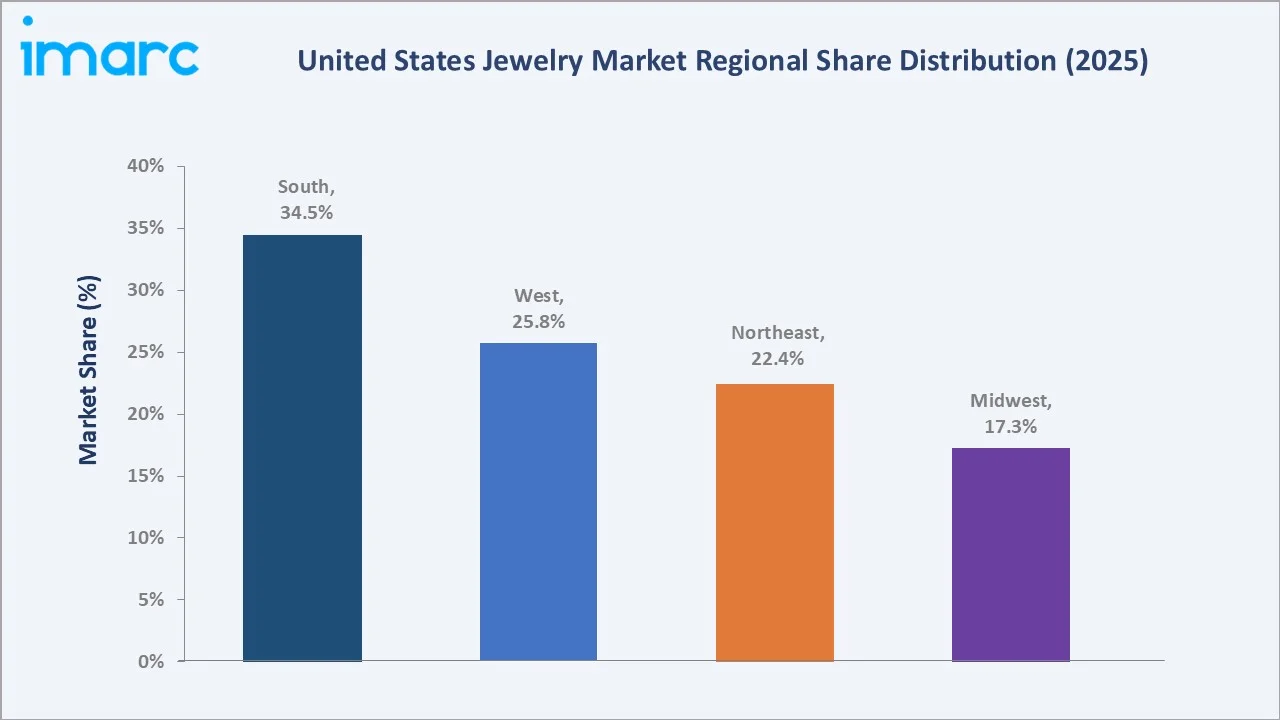
The Northeast's 22.4% reflects New York City's unique dual role as both a major fine jewelry retail market and the physical headquarters of the US diamond and precious gemstone wholesale trade. The Midwest's 17.3% reflects stable mid-market jewelry demand, with particular strength in traditional bridal jewelry categories and branded jewelry chain penetration through mall-format retail.
Competitive Landscape
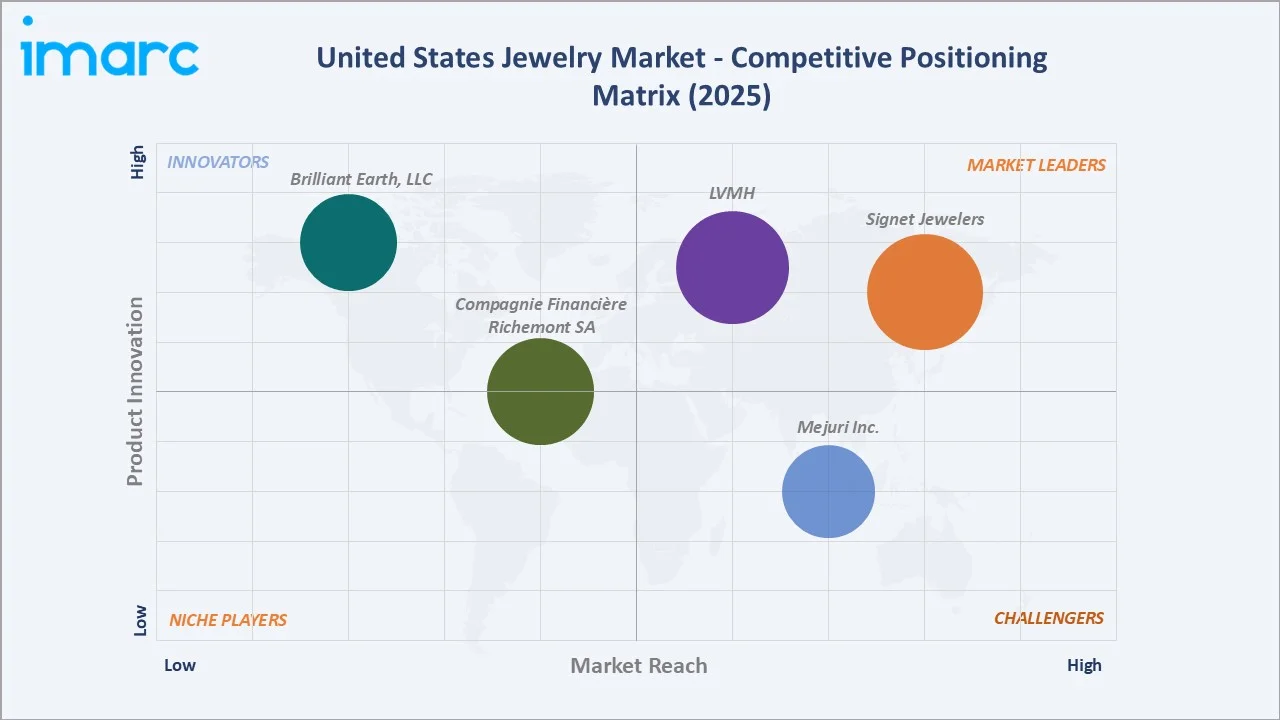
The United States jewelry market is moderately fragmented, with a multi-tier competitive structure encompassing global luxury brands, specialty jewelry retail chains, DTC digital-first platforms, and a large independent jeweler community. Competition centers on brand prestige and heritage, product design innovation, gemstone sourcing transparency, digital channel capability, and price-quality positioning across consumer segments.
|
Company |
Key Brands |
Market Position |
Core Strength |
|
Signet Jewelers |
Kay Jewelers, Zales, Jared, Banter by Piercing Pagoda, Diamonds Direct, Blue Nile |
Market Leader |
Signet Jewelers is the largest retailer of diamond jewelry in the United States, holding the major market position in the US specialty jewelry sector. |
|
LVMH |
Bvlgari, Chaumet, Fred, Repossi |
Market Leader |
LVMH plays a dominant role in the United States jewelry market primarily through its landmark acquisition of the iconic Tiffany & Co. |
|
Compagnie Financière Richemont SA |
Buccellati, Cartier, Van Cleef & Arpels, Vhernier |
Established Player |
Compagnie Financière Richemont SA plays a dominant role in the United States high-end jewelry market through its premier "Jewellery Maisons” |
|
Brilliant Earth, LLC |
Brilliant Earth |
Innovator |
Brilliant Earth specializing in ethically sourced engagement rings and sustainable luxury pieces. |
|
Mejuri Inc. |
Mejuri |
Challenger |
Mejuri Inc. promoting self-purchased fine jewelry for everyday wear. |
Competitive dynamics are rapidly evolving toward DTC digital capability, lab-grown gemstone integration, and sustainability positioning as the primary differentiation dimensions.
Key Company Profiles
Signet Jewelers
Signet Jewelers is one of the largest retail jewelry companies by revenue, operating various stores across the US through its Kay Jewelers, Zales, Jared, Banter by Piercing Pagoda, Blue Nile, and other brand portfolio. The company's "Connected Commerce" strategy, integrating digital DTC capabilities with its physical retail footprint through virtual try-on, digital ring builders, and flexible financing, represents the US jewelry industry's most advanced omnichannel bridal jewelry platform. Signet has integrated lab-grown diamonds across all major brands, making it the largest US retailer of lab-grown diamond jewelry.
- Key Brands: Kay Jewelers, Zales, Jared, Banter by Piercing Pagoda, Diamonds Direct, Blue Nile.
- Strategic Focus: Scaling AI-powered virtual try-on and personalization across Kay and Jared, expanding Blue Nile online bridal market share, growing lab-grown diamond category revenue, advancing flexible financing to drive accessible luxury jewelry purchase conversion.
Compagnie Financière Richemont SA
Compagnie Financière Richemont SA is a luxury goods group with a strong presence in jewelry, watches, fashion, and accessories. Its portfolio includes several internationally recognized maisons, and the company focuses on premium craftsmanship, brand heritage, selective distribution, and global luxury retail expansion.
- Key Brands: Buccellati, Cartier, Van Cleef & Arpels, Vhernier.
- Strategic Focus: Strengthening its luxury Maisons, including Cartier, Van Cleef & Arpels, Buccellati, and Vhernier, through sustained investment in craftsmanship, creativity, product innovation, and brand desirability.
Market Concentration Analysis
The United States jewelry market is moderately fragmented at the retail level, with Signet Jewelers holding an estimated 8-10% of total US jewelry retail revenue, the single largest share but far from market dominance. The independent jewelers operating across the US collectively represent approximately 30-35% of total retail volume, reflecting the jewelry market's highly localized purchasing behavior, trust-based customer relationships, and geographic fragmentation across suburban and small-market communities that large chains underserve. M&A activity is consolidating the organized specialty retail tier, but the overall market remains significantly fragmented below the top-5 brand level.
Investment & Growth Opportunities
Highest Growth Segments
Diamond material (~5.5% CAGR est.) through lab-grown adoption, ring product (~5.4% CAGR est.) through bridal and self-purchase, DTC digital fine jewelry brand development, sustainable and ethical jewelry certification premium positioning, and AR-enhanced online jewelry retail experience development represent the US jewelry market's highest-priority investment vectors through 2034.
Investment Themes
- DTC Digital Fine Jewelry Brand Platform Investment: The success of various brands demonstrates the commercial viability of building significant jewelry revenue through DTC digital channels with superior product design, transparent pricing, and ethical sourcing credentials. Investment in DTC fine jewelry platforms combining lab-grown and ethically sourced materials, strong visual brand identity, and frictionless digital purchase experiences targeting millennial and Gen Z self-purchase and gifting occasions represents a high-growth investment theme.
- Lab-Grown Diamond and Sustainable Material Supply Chain Development: As lab-grown diamond retail adoption accelerates, investment in CVD diamond production capacity, quality certification infrastructure, and sustainable precious metal sourcing creates supply chain positioning opportunities for both direct producers and jewelry brands seeking to control sustainable material supply chains. Companies establishing certified sustainable material supply chains will command brand premium positioning and distribution access in the rapidly growing sustainability-motivated US fine jewelry consumer segment.
Future Market Outlook (2026-2034)
The United States jewelry market is projected to grow from USD 78.9 Billion in 2025 to USD 115.5 Billion by 2034, delivering a 5.05% CAGR over the forecast period through sustained bridal jewelry demand, lab-grown diamond mainstream adoption, DTC digital channel expansion, self-purchase occasion growth, and premium material market development. The market's anchor value of USD 100.9 Billion in 2030, representing the milestone at which DTC digital brands achieve category-defining scale and lab-grown diamonds account for the majority of US engagement ring diamond sales.
Three structural forces are expected to define the US jewelry market through 2034. First, the lab-grown diamond transition will become complete across the US mid-market jewelry segment by 2028-2030, with lab-grown diamonds representing the majority of engagement ring diamond sales as continued CVD production efficiency improvements drive further retail price deflation. Second, the DTC digital-first jewelry channel will achieve structural parity with traditional specialty retail for the millennial and Gen Z consumer cohorts that will represent the US jewelry market's primary purchasing demographic through 2034. Third, the self-purchase jewelry occasion will become the primary market growth driver beyond bridal, as millennial and Gen Z female consumers normalize purchasing fine jewelry as personal expression and life milestone celebration outside of traditional gifting occasions.
Research Methodology
Primary Research
Primary research comprised in-depth interviews with senior executives from jewelry retail chains, DTC fine jewelry brands, wholesale diamond and gemstone suppliers, jewelry manufacturers, retail industry analysts, certified gemologists, and investment professionals specializing in luxury goods. Discussions validated market size estimates, assessed product and material segment dynamics, evaluated competitive positioning, and gathered qualitative insights on lab-grown diamond adoption trajectories, DTC channel growth rates, and regional market development across the US jewelry industry.
Secondary Research
Secondary research encompassed company annual reports, jewelry labeling guides and enforcement actions, gemological research publications, Jewelers of America industry statistics, industry survey data, member research, spending insights, US Census retail trade statistics, specialist jewelry industry trade publications, and reputed market intelligence publications. These resources analyzed market trends, consumer spending patterns, competitive positioning, and regional market dynamics across the US jewelry industry.
Forecasting Models
Forecasting models were developed using historical retail jewelry market data (2020-2025), US consumer disposable income projections, bridal market demographic data, lab-grown diamond adoption curve modeling, e-commerce channel penetration forecasts, gold and precious metal price trend analysis, and macroeconomic retail spending indicators. The analysis incorporated both top-down and bottom-up approaches, validated through primary research cross-referencing, to generate reliable US jewelry market forecasts through 2034.
United States Jewelry Market Report Coverage:
| Report Features | Details |
|---|---|
| Base Year of the Analysis | 2025 |
| Historical Period | 2020-2025 |
| Forecast Period | 2026-2034 |
| Units | Billion USD |
| Scope of the Report | Exploration of Historical and Forecast Trends, Industry Catalysts and Challenges, Segment-Wise Historical and Predictive Market Assessment:
|
| Products Covered | Necklace, Ring, Earrings, Bracelet, Others |
| Materials Covered | Gold, Platinum, Diamond, Others |
| Regions Covered | Northeast, Midwest, South, and West |
| Companies Covered | Signet Jewelers, LVMH, Compagnie Financière Richemont SA, Brilliant Earth, LLC, Mejuri Inc., etc. |
| Customization Scope | 10% Free Customization |
| Post-Sale Analyst Support | 10-12 Weeks |
| Delivery Format | PDF and Excel through Email (We can also provide the editable version of the report in PPT/Word format on special request) |
Key Benefits for Stakeholders:
- IMARC’s report offers a comprehensive quantitative analysis of various market segments, historical and current market trends, market forecasts, and dynamics of the United States jewelry market from 2020-2034.
- The research study provides the latest information on the market drivers, challenges, and opportunities in the United States jewelry market.
- Porter's five forces analysis assist stakeholders in assessing the impact of new entrants, competitive rivalry, supplier power, buyer power, and the threat of substitution. It helps stakeholders to analyze the level of competition within the United States jewelry industry and its attractiveness.
- Competitive landscape allows stakeholders to understand their competitive environment and provides an insight into the current positions of key players in the market.
Frequently Asked Questions About the United States Jewelry Market Report
The United States jewelry market reached USD 78.9 Billion in 2025, driven by sustained bridal jewelry demand, growing self-purchase consumer occasions, lab-grown diamond adoption expanding accessible luxury, expanding e-commerce and DTC channels, and gold jewelry demand supported by record precious metal prices.
The market is projected to grow at a CAGR of 5.05% during 2026-2034, reaching USD 115.5 Billion by 2034, through lab-grown diamond mainstream adoption, DTC digital brand expansion, self-purchase occasion growth, sustained bridal market depth, and sustainable jewelry premiumization.
Rings lead at 31.6% (2025) through bridal engagement ring demand, stacking ring fashion trends, and self-purchase birthstone and fashion rings. Rings grow at ~5.4% CAGR through sustained bridal and self-purchase occasion expansion.
Gold leads at 42.7% (2025) through timeless luxury positioning across yellow, white, and rose gold variants, bridal jewelry demand, and investment-linked consumption supported by record gold prices.
The South leads at 34.5% (2025) through the region's largest US population concentration, strong gifting and bridal culture across Texas, Florida, and the Southeast, and a growing affluent consumer base in Houston, Dallas, Miami, and Atlanta metropolitan markets.
Leading companies include Signet Jewelers, LVMH, Compagnie Financière Richemont SA, Brilliant Earth, LLC, and Mejuri Inc., among others.
The market is projected to reach approximately USD 100.9 Billion by 2030, reflecting the US market milestone as DTC digital brands achieve category scale, lab-grown diamonds capture the majority of mid-market engagement ring sales, and self-purchase jewelry occasions mature as a year-round demand driver.
Priority investment opportunities include DTC digital fine jewelry brand platforms targeting millennial and Gen Z self-purchase occasions, lab-grown diamond and sustainable material supply chain development, AR and AI-powered online jewelry retail technology, sustainable jewelry certification and brand premium development, and personalization-enabled custom jewelry platforms.
Need more help?
- Speak to our experienced analysts for insights on the current market scenarios.
- Include additional segments and countries to customize the report as per your requirement.
- Gain an unparalleled competitive advantage in your domain by understanding how to utilize the report and positively impacting your operations and revenue.
- For further assistance, please connect with our analysts.
 Request Customization
 Speak to an Analyst
 Request Brochure
 Inquire Before Buying
Benefits of Customization
- Personalize this research
- Triangulate with your data
- Get data as per your format and definition
- Gain a deeper dive into a specific application, geography, customer, or competitor
- Any level of personalization
Get in Touch With Us
UNITED STATES
Phone: +1-201-971-6302
INDIA
Phone: +91-120-433-0800
UNITED KINGDOM
Phone: +44-753-714-6104
Email: sales@imarcgroup.com
Client Testimonials




.webp)




.webp)













Related Reports

Choose your plan
*Please note that the prices mentioned below are starting prices for each bundle type. Kindly contact our team for further details.*
Single User License
- 1 User License, Access on 2 Devices
- PDF Report + Excel Dataset (Password Protected)
- Lifetime Access
- No Printing Rights
- 10% Free Report Customization
- 10–12 Weeks of Analyst Support
Five User License
- Access for 5 Users, 2 Devices per User
- PDF Report + Excel Dataset (Password Protected)
- Lifetime Access
- Dedicated Account Manager
- 12–14 Weeks of Analyst Support
- No Printing Rights
- 15% Free Report Customization
- 25% Discount on Your Next Purchase
Corporate User License
- Unlimited User Access (Within Your Organization)
- PDF Report + Excel Dataset
- Lifetime Access
- Dedicated Account Manager
- 14–20 Weeks of Analyst Support
- No Printing Rights
- 20% Free Report Customization
- 30% Discount on Your Next Purchase
Essential Insights
What's included:
3 reports
- Lifetime Access
- PDF Reports
- Excel Datasets
- 2 Weeks of Free Analyst Support
- 2 User Licenses
- Access on 2 Devices
- Printing Rights
- Complimentary PowerPoint (PPT) Version
- Complimentary License Upgrade
Professional Access
What's included:
5 reports
- Lifetime Access
- PDF Reports
- Excel Datasets
- 8 Weeks of Free Analyst Support
- 2 User Licenses
- Access on 2 Devices
- Printing Rights
- Complimentary PowerPoint (PPT) Version
- Complimentary License Upgrade
Business Advantage
What's included:
8 reports
- Lifetime Access
- PDF Reports
- Excel Datasets
- 14 Weeks of Free Analyst Support
- 2 User Licenses
- Access on 2 Devices
- Printing Rights
- Complimentary PowerPoint (PPT) Version
- Complimentary License Upgrade
Enterprise Intelligence
What's included:
10 reports
- Lifetime Access
- PDF Reports
- Excel Datasets
- 20 Weeks of Free Analyst Support
- 2 User Licenses
- Access on 2 Devices
- Printing Rights
- Complimentary PowerPoint (PPT) Version
- Complimentary License Upgrade