
United States Offshore Support Vessels Market Size, Share, Trends and Forecast by Type, Water Depth, Fuel, Service Type, and Application, 2026-2034
United States Offshore Support Vessels Market Summary:
The United States offshore support vessels market size was valued at USD 4.63 Billion in 2025 and is projected to reach USD 7.56 Billion by 2034, growing at a compound annual growth rate of 5.58% from 2026-2034. The market growth is driven by sustained offshore drilling activities in the Gulf of Mexico, growing deepwater and ultra-deepwater exploration initiatives, and emerging opportunities in offshore wind farm development along the Atlantic coast. The expanding domestic energy infrastructure, coupled with technological advancements in vessel design including dynamic positioning systems and hybrid propulsion technologies, is reinforcing the operational capabilities and efficiency of the offshore support vessel fleet. Additionally, the ongoing modernization of aging vessels and strategic fleet expansions by major operators are expanding the United States offshore support vessels market share.
Key Takeaways and Insights:
- By Type: Anchor handling towing supply vessel dominates the market with a share of 34% in 2025, supported by its expertise in handling heavy anchors and mooring activities for floating production units.
- By Water Depth: Shallow water leads the market with a share of 60% in 2025, driven by the cost-efficiency and prolonged production from mature oil fields.
- By Fuel: Fuel oil accounts for the largest share of 75% in 2025, reflecting the established infrastructure and reliability requirements for heavy-duty offshore operations.
- By Service Type: Logistics & cargo management represents 25% of the market in 2025, supporting the continuous transportation of equipment, supplies, and personnel between onshore facilities and offshore installations.
- By Application: Oil and gas applications dominate with a 70% share in 2025, driven by extensive exploration and production activities in the Gulf of Mexico.
- Key Players: The competitive landscape features established maritime service providers, specialized vessel operators, and integrated energy logistics companies competing through fleet modernization, technological capabilities, and operational reliability. Market participants are differentiating through advanced vessel specifications, safety protocols, and service diversification strategies.
The Gulf of Mexico remains the cornerstone of United States offshore operations, accounting for approximately 14% of total US oil production with output reaching 1.8 million barrels per day. The importance of the region is heightened by active field development projects, with twelve new fields set to begin production in 2024 and 2025. These fields encompass several subsea tieback developments and projects utilizing new floating production units, necessitating comprehensive vessel support for installation, maintenance, and logistics operations. These specialized vessels serve as the vital supply chain backbone for offshore platforms, facilitating the continuous movement of personnel, drilling equipment, consumable materials, and production infrastructure across vast oceanic distances. The sector supports a complex ecosystem of offshore activities ranging from exploratory drilling campaigns to mature field production operations and decommissioning projects.
United States Offshore Support Vessels Market Trends:
Digital Automation and Smart Fleet Management
Offshore support vessel operators are rapidly integrating advanced digital technologies to enhance operational efficiency, safety, and cost-effectiveness. These systems encompass remote monitoring capabilities, real-time data analytics, autopilot navigation, and predictive maintenance platforms that enable precise route planning, fuel optimization, and proactive equipment fault detection. A massive number of offshore support vessels globally are now equipped with internet of things (IoT)-based monitoring systems that provide continuous data tracking and analytics, allowing operators to anticipate maintenance requirements and avoid unexpected operational disruptions. In 2024, after a retrofit project, TDI-Brooks’ latest research vessel reached the U.S. East Coast, where it will conduct offshore wind operations. As per TDI-Brooks, the vessel offers extensive offshore support, featuring subsea services, construction aid, exploration, production, AUV, ROV, and diving support, while serving military operations, scientific marine research, and survey mapping.
Hybrid Propulsion and Alternative Fuel Adoption
The offshore support vessel industry is undergoing a significant transformation toward environmentally sustainable propulsion systems, driven by regulatory pressures and operational cost considerations. In January 2024, SEACOR Marine Holdings announced the acquisition of four advanced battery energy storage systems from Kongsberg Maritime AS. The advanced hybrid power system was announced to be implemented on four of SEACOR Marine’s Platform Supply Vessels (PSV) to improve the Company’s management of energy use and emissions on these ships. The contract comprises four vessels including SEACOR Ohio, SEACOR Alps, SEACOR Andes, and SEACOR Atlas. Installation was anticipated to start in December 2024 and finish by the second quarter of 2025. After installation, over 50% of SEACOR Marine’s PSV fleet will operate on hybrid power.
Offshore Wind Market Expansion and Vessel Diversification
The emergence of the United States offshore wind sector is creating substantial demand for specialized support vessels beyond traditional oil and gas applications. In July 2024, Maersk Supply Service established Maersk Offshore Wind as a dedicated entity focused exclusively on offshore wind installation services, reflecting strategic repositioning to capture growing renewable energy opportunities. The offshore wind industry has committed record investments exceeding USD 3 billion in supply chain infrastructure during 2023 alone. With 4 gigawatts of offshore wind capacity under active construction at projects including Vineyard Wind, Revolution Wind, and Coastal Virginia Offshore Wind, and federal targets projecting 30 gigawatts by 2030, the sector is expected to generate revenue in project investments supporting.
Market Outlook 2026-2034:
The United States offshore support vessels market is positioned for sustained expansion through the forecast period, supported by continued offshore energy development across both conventional and renewable sectors. The Gulf of Mexico will maintain its position as the primary driver of vessel demand, with sustained production from existing fields complemented by new field developments utilizing advanced subsea and floating production technologies. The market generated a revenue of USD 4.63 Billion in 2025 and is projected to reach a revenue of USD 7.56 Billion by 2034, growing at a compound annual growth rate of 5.58% from 2026-2034. Deepwater and ultra-deepwater exploration activities are expected to intensify, particularly as operators pursue high-potential reserves at increasingly challenging depths and distances from shore, requiring sophisticated vessel capabilities for anchor handling, platform supply, and subsea construction support.
United States Offshore Support Vessels Market Report Segmentation:
|
Segment Category |
Leading Segment |
Market Share |
|
Type |
Anchor Handling Towing Supply Vessel |
34% |
|
Water Depth |
Shallow Water |
60% |
|
Fuel |
Fuel Oil |
75% |
|
Service Type |
Logistics & Cargo Management |
25% |
|
Application |
Oil and Gas Applications |
70% |
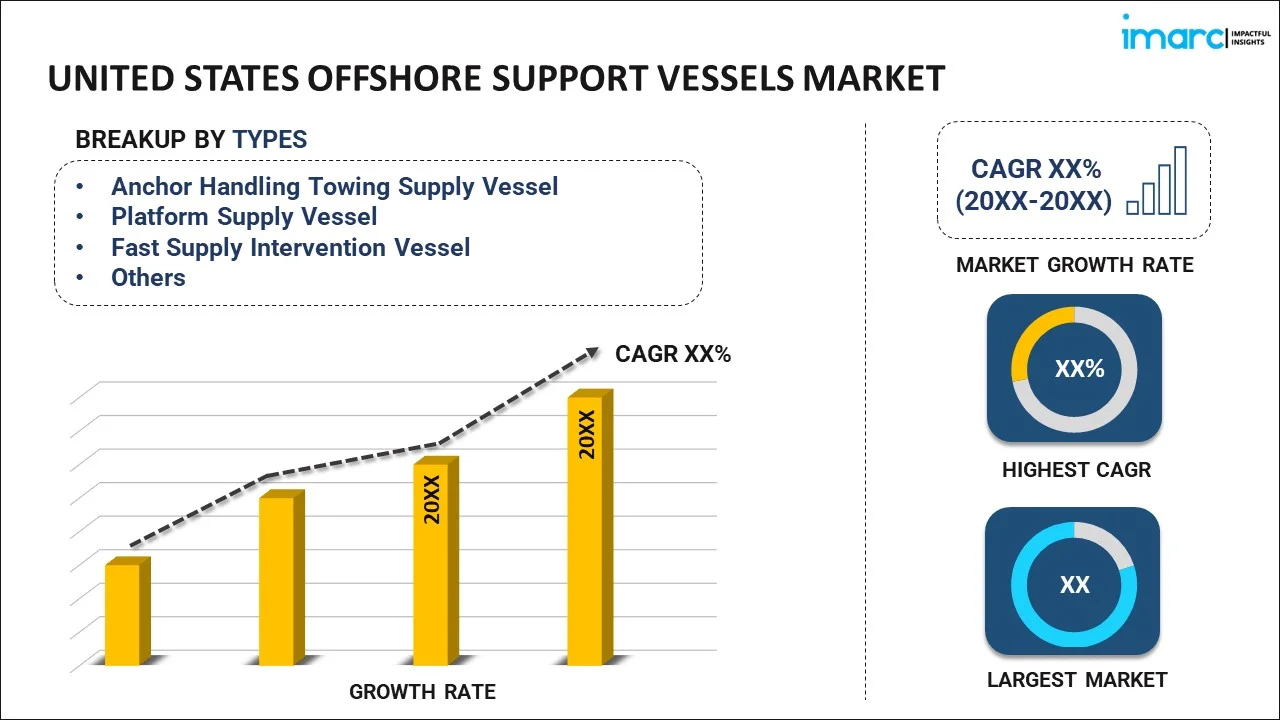
Type Insights:
To get detailed segment analysis of this market, Request Sample
- Anchor Handling Towing Supply Vessel
- Platform Supply Vessel
- Fast Supply Intervention Vessel
- Multi-Purpose Service Vessel
- Others
Anchor handling towing supply vessel dominates with a market share of 34% of the total United States offshore support vessels market in 2025.
Anchor handling towing supply vessels represent the most critical vessel category in offshore operations, combining powerful anchor handling capabilities with general supply and towing functions. These specialized vessels are engineered with robust winch systems, dedicated towing pins, and stern rollers that enable precise management of heavy anchor chains and mooring lines weighing thousands of tons. Their primary function involves positioning and securing floating production units, semi-submersible drilling rigs, and tension leg platforms during installation, relocation, and retrieval operations. The vessels feature dynamic positioning systems that maintain stable positioning without anchoring, crucial for deepwater operations where traditional anchoring is impractical.
The dominance of anchor handling towing supply vessels reflects the continued expansion of floating production systems in deepwater environments where fixed platforms are technically unfeasible or economically prohibitive. These vessels provide indispensable support during critical phases of offshore field development, including the initial mooring of floating production storage and offloading units, the periodic adjustment of mooring systems to account for environmental conditions and equipment wear, and the eventual decommissioning and removal of offshore structures. The technical sophistication of modern anchor handling vessels has advanced substantially, with many equipped with automated winch control systems, advanced thruster configurations for precise positioning, and fire-fighting capabilities for emergency response. Their versatility extends beyond anchor handling to encompass towing operations for large offshore structures, supply duties for remote installations, and standby safety functions during drilling operations, making them multifunctional assets that justify their premium charter rates and dominant market position.
Water Depth Insights:
- Shallow Water
- Deepwater
Shallow water leads with a share of 60% of the total United States offshore support vessels market in 2025.
Shallow water offshore operations maintain commanding market dominance due to the concentration of mature producing fields and the economic advantages associated with operations in water depths below 1,000 feet. The Gulf of Mexico's shelf areas, particularly offshore Louisiana and Texas, contain extensive shallow water infrastructure including thousands of production platforms and wellheads that have been in operation for decades. These fields continue to generate substantial production volumes despite their maturity, requiring consistent vessel support for routine supply deliveries, personnel transfers, and maintenance operations. Shallow water vessels benefit from reduced operational complexity compared to deepwater units, requiring less sophisticated positioning systems and specialized equipment, which translates to lower capital costs and operational expenses.
The technical and financial accessibility of shallow water operations makes them particularly attractive for smaller independent operators and companies focused on maximizing near-term production from established assets. Many shallow water platforms have undergone multiple phases of enhanced recovery operations and infill drilling campaigns that extend field life and maintain production rates, sustaining demand for vessel services over extended periods. Additionally, shallow water fields serve as training grounds for developing deepwater operational expertise and provide relatively stable cash flows that can fund exploration activities in more challenging environments. The established regulatory framework, well-understood geological characteristics, and extensive existing infrastructure in shallow water areas reduce project risks and capital requirements, enabling continued investment in these regions even during periods of oil price volatility that constrain deepwater development.

Fuel Insights:
- Fuel Oil
- LNG
Fuel oil exhibits a clear dominance with a 75% share of the total United States offshore support vessels market in 2025.
Conventional fuel oil propulsion systems maintain overwhelming market dominance in the offshore support vessel sector, driven by their established reliability, proven performance in demanding marine environments, and comprehensive supporting infrastructure. Diesel fuel oil provides the power density and operational characteristics required for the heavy-duty operations that characterize offshore support activities, including high-torque anchor handling operations, extended transit voyages with substantial cargo loads, and dynamic positioning requirements that demand continuous high-power output. The global marine fuel supply infrastructure is optimized for conventional fuel oil, ensuring reliable availability at competitive prices across major offshore operating regions.
The economic considerations surrounding fuel choice extend beyond direct fuel costs to encompass vessel capital expenditures, maintenance expenses, and operational flexibility. Conventional fuel oil systems require lower initial capital investment compared to alternative fuel configurations, avoiding the substantial costs associated with dual-fuel systems, specialized storage tanks, and advanced fuel management systems. Maintenance procedures for fuel oil engines are standardized and well-established, with global availability of spare parts, qualified technicians, and repair facilities ensuring minimal downtime.
Service Type Insights:
- Technical Services
- Inspection & Survey
- Crew Management
- Logistics & Cargo Management
- Anchor Handling & Seismic Support
- Others
Logistics & cargo management lead with a share of 25% of the total United States offshore support vessels market in 2025.
Logistics and cargo management services constitute the operational backbone of offshore energy production, encompassing the complex coordination and execution of supply chain activities that sustain remote offshore installations. These services involve the transportation of diverse cargo categories including drilling equipment, production consumables, fuel, freshwater, dry bulk materials, liquid mud systems, and excess fuel storage, all delivered on precise schedules to prevent operational disruptions. Platform supply vessels dedicated to logistics operations are purpose-designed with specialized cargo decks, liquid mud systems, fuel tanks, and crane systems that enable efficient loading, transport, and discharge of supplies.
The criticality of logistics services stems from the zero-inventory operating philosophy prevalent in offshore operations, where platform storage capacity is intentionally minimized to reduce weight and complexity, necessitating frequent supply deliveries to maintain production continuity. Any disruption in supply chain logistics can result in production shutdowns costing operators hundreds of thousands of dollars per day in lost revenue, creating strong economic incentives for reliable vessel services and sophisticated logistics planning. Modern logistics operations increasingly incorporate digital coordination platforms that provide real-time visibility of cargo movements, vessel locations, and delivery schedules, enabling operators to anticipate and respond to changing operational requirements. The logistics segment also includes return cargo operations, transporting produced fluids, waste materials, and equipment back to shore for processing or disposal, adding another layer of complexity to vessel operations and scheduling.
Application Insights:
- Oil and Gas Applications
- Offshore Applications
Oil and gas applications exhibit a clear dominance with a 70% share of the total United States offshore support vessels market in 2025.
The oil and gas sector maintains commanding dominance in offshore support vessel utilization, driven by the extensive and continuous operational requirements of offshore exploration, drilling, production, and decommissioning activities. The Gulf of Mexico exemplifies this dominance, with operations dispersed across thousands of platforms and subsea installations requiring comprehensive vessel support. Exploration drilling campaigns demand intensive vessel support for rig positioning, supply logistics, and safety standby services, while production operations require continuous supply deliveries, maintenance support, and produced fluid transport. In 2024, DOF secured a major subsea contract in the United States Gulf of Mexico encompassing engineering, procurement, construction, and offshore installation of water injection flowlines, hull piping, and related subsea infrastructure, exemplifying the diverse and technically sophisticated vessel services required by modern offshore oil and gas operations.
The complexity and scale of offshore oil and gas operations create multifaceted vessel demand spanning the complete project lifecycle from initial seismic surveys through field development, production optimization, and eventual decommissioning. Platform supply vessels maintain production continuity through regular delivery of consumables, equipment, and personnel, while anchor handling vessels support rig movements between drilling locations and provide emergency towing services. Specialized construction support vessels facilitate subsea infrastructure installation, including pipeline laying, manifold installation, and subsea tree connections that link wellheads to production platforms. The deepwater segment presents particularly intensive vessel requirements, with operations at 5,000 feet water depth and beyond demanding sophisticated dynamic positioning capabilities, specialized equipment handling systems, and enhanced safety protocols.
Region Insights:
To get detailed segment analysis of this market, Request Sample
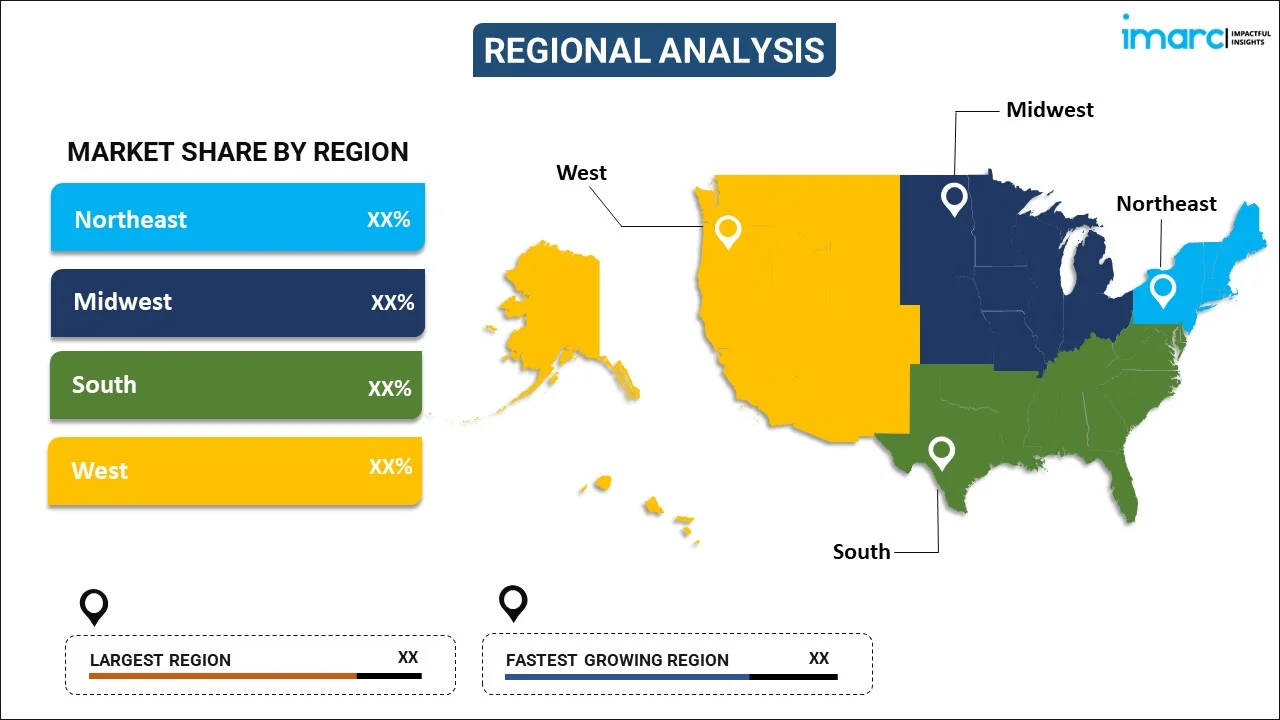
- Northeast
- Midwest
- South
- West
The Northeast region exhibits moderate offshore support vessel activity concentrated primarily along Atlantic coastal waters where emerging offshore wind development initiatives are creating new demand for specialized construction and maintenance support capabilities. Traditional oil and gas operations remain limited in this region, though recent federal lease area designations for renewable energy projects are attracting vessel operators seeking diversification opportunities beyond hydrocarbon-focused markets.
The Midwest region demonstrates minimal direct offshore support vessel market participation due to its landlocked geographic positioning and absence of oceanic access points for traditional offshore energy operations. However, the region serves as an important manufacturing and fabrication hub for vessel components, marine equipment, and specialized offshore infrastructure that supports Gulf Coast and coastal operational requirements.
The South region dominates the United States offshore support vessels market, anchored by extensive Gulf of Mexico operations that account for the overwhelming majority of domestic offshore drilling, production, and maritime logistics activities. Major port facilities across Louisiana and Texas serve as primary operational hubs where vessel operators maintain shore bases, coordinate cargo logistics, and execute crew changes supporting hundreds of offshore platforms.
The West region maintains limited offshore support vessel operations primarily concentrated in Pacific coastal waters off California where modest oil and gas production activities persist alongside emerging offshore wind exploration initiatives. The region's offshore vessel requirements remain substantially smaller compared to Gulf Coast operations, though environmental considerations and renewable energy development may gradually expand specialized vessel demand.
Market Dynamics:
Growth Drivers:
Why is the United States Offshore Support Vessels Market Growing?
Expanding Offshore Wind Energy Development
The emergence of commercial-scale offshore wind development along the United States Atlantic coast represents a transformative growth opportunity for offshore support vessel operators, creating demand for specialized vessel services distinct from traditional oil and gas applications. In 2025, the eastern state of Maryland has initiated an unexpected request for proposals for offshore wind energy after Trump's recent setback in renewable energy laws. The Maryland State Procurement Office and the Department of General Services are looking for developers to engage in a 20-year power purchase agreement for a venture associated with the Delmarva Peninsula. Apart from this, the offshore wind sector is driving unprecedented vessel acquisition and construction activities, which is further driving the need for efficient support vessels.
Deepwater and Ultra-Deepwater Exploration Advancement
The progressive advancement into deepwater and ultra-deepwater environments represents a fundamental driver of offshore support vessel demand, as operations in these challenging conditions require sophisticated vessel capabilities and intensive support services. Deepwater drilling in the Gulf of Mexico has expanded substantially over recent decades, with major deepwater platforms currently in operation. In 2025, President Donald Trump signed an executive order designed to enhance the deep-sea mining sector, representing his most recent effort to increase U.S. access to nickel, copper, and various other essential minerals that are extensively utilized in the economy. The directive, which Trump signed privately in a new tab, aims to initiate mining in U.S. and international waters to counteract China's extensive dominance in the essential minerals sector.
Sustained Offshore Hydrocarbon Development and Production Activities
Continued emphasis on offshore oil and gas extraction as a strategic component of domestic energy security is driving persistent demand for specialized maritime support capabilities across Gulf of Mexico operations and emerging Atlantic frontier developments. Operators are maintaining active drilling programs targeting both proven reserves in mature fields and exploratory prospects in underexplored basins, requiring comprehensive vessel support for platform installation, supply logistics, and subsea infrastructure deployment. The economic viability of offshore projects at current commodity price levels sustains investment appetite for field development initiatives that necessitate extensive vessel mobilization throughout multi-year project lifecycles. In 2025, the Department of the Interior revealed a Secretary’s Order named “Unleashing American Offshore Energy,” instructing the Bureau of Ocean Energy Management to follow federal law to end the restrictive Biden 2024–2029 National Outer Continental Shelf Oil and Gas Leasing Program and substitute it with a new, extensive 11th National Outer Continental Shelf Oil and Gas Leasing Program by October 2026. In line with this directive, the Department is publishing the Secretary’s Draft Proposed Program for the 11th National Outer Continental Shelf Oil and Gas Leasing Program. These measures demonstrate the Trump administration’s ongoing dedication to reclaiming American Energy Dominance by substituting the most minimal offshore leasing plan ever released by an administration with one that comprehensively meets the country’s increasing energy demands.
Market Restraints:
What Challenges the United States Offshore Support Vessels Market is Facing?
High Capital Investment Requirements and Economic Cyclicality
The offshore support vessel industry requires substantial capital commitments for vessel construction, maintenance, and technology upgrades, creating significant financial barriers to market entry and fleet expansion. Modern offshore support vessels represent capital-intensive assets with construction costs ranging from tens of millions to over one hundred million dollars for sophisticated deepwater-capable vessels equipped with advanced dynamic positioning systems, specialized cargo handling equipment, and enhanced safety systems. Additionally, vessels require ongoing capital expenditures for regulatory compliance, technology upgrades, and major maintenance activities including drydocking at five-year intervals, creating continuous financial obligations regardless of market conditions or vessel utilization levels.
Jones Act Compliance and Domestic Vessel Construction Costs
The Merchant Marine Act of 1920, commonly known as the Jones Act, mandates that vessels engaged in transportation of cargo or passengers between United States ports must be United States-built, United States-owned, United States-crewed, and United States-flagged. While this legislation supports domestic shipbuilding and maritime employment, it substantially increases vessel construction costs and limits vessel supply available for United States offshore operations. Vessel construction costs in United States shipyards typically exceed comparable international shipyard costs by factors of two to three times or more, reflecting higher labor costs, smaller construction volumes that limit economies of scale, and regulatory compliance requirements. The cost differential creates significant economic challenges for vessel operators competing for charter contracts in price-sensitive markets, as the higher capital costs must be recovered through charter rates while remaining competitive with internationally-built vessels operating in global markets.
Regulatory Uncertainty and Political Policy Shifts
The offshore support vessel market faces substantial uncertainty stemming from shifting political priorities and regulatory frameworks affecting both offshore oil and gas development and offshore renewable energy initiatives. Changes in presidential administrations have historically resulted in significant policy modifications regarding offshore leasing programs, environmental review requirements, and renewable energy development priorities, creating planning challenges for vessel operators and offshore energy developers. Political uncertainty creates a cautious investment environment where exploration and production operators adopt "wait and see" attitudes, deferring major project commitments until policy directions become clearer and regulatory approval pathways are better defined. This hesitancy manifests in reduced offshore drilling activities, delayed field development decisions, and lower vessel utilization rates as operators prioritize preservation of financial flexibility over aggressive growth strategies.
Competitive Landscape:
The United States offshore support vessels market exhibits moderate competitive intensity characterized by established maritime service providers operating diverse vessel portfolios alongside specialized operators focusing on particular vessel categories or geographic operating regions. Market participants compete primarily through fleet capability differentiation, operational safety records, vessel availability, and pricing strategies that balance utilization optimization with margin preservation objectives. The competitive environment reflects significant barriers to entry including substantial capital requirements, regulatory compliance complexity, and relationship-dependent contract award processes that favor incumbents with proven operational track records. Industry consolidation trends have periodically reshaped competitive dynamics as financial stress during market downturns triggers asset acquisitions, corporate restructurings, and fleet rationalization initiatives. The emergence of offshore wind support opportunities is introducing new competitive dimensions as traditional oil and gas vessel operators encounter specialized renewable energy service providers with distinct operational capabilities and client relationship networks, potentially fragmenting competitive landscapes across application segments.
Recent Developments:
- In March 2025, Energy service firm and tanker operator AET shared specifics on its intended transformation of a support vessel into a hybrid electric ship with the longest range globally. Located in Galveston, Texas, and part of Malaysia’s MISC, the company indicates that one of its purpose-built Lightering Support Vessels is chosen for the hybrid conversion initiative. The company manages a fleet of these ships, stating it has conducted over 15,500 STS transfers, establishing itself as a market leader in the U.S. Gulf area. It also offers lightering services in offshore Uruguay and the Brazilian Basin.
United States Offshore Support Vessels Market Report Coverage:
|
Report Features |
Details |
|
Base Year of the Analysis |
2025 |
|
Historical Period |
2020-2025 |
|
Forecast Period |
2026-2034 |
|
Units |
Billion USD |
|
Scope of the Report |
Exploration of Historical Trends and Market Outlook, Industry Catalysts and Challenges, Segment-Wise Historical and Future Market Assessment:
|
|
Types Covered |
Anchor Handling Towing Supply Vessel, Platform Supply Vessel, Fast Supply Intervention Vessel, Multi-Purpose Service Vessel, Others |
|
Water Depths Covered |
Shallow Water, Deepwater |
|
Fuels Covered |
Fuel Oil, LNG |
|
Service Types Covered |
Technical Services, Inspection & Survey, Crew Management, Logistics & Cargo Management, Anchor Handling & Seismic Support, Others |
|
Applications Covered |
Oil and Gas Applications, Offshore Applications |
|
Regions Covered |
Northeast, Midwest, South, West |
|
Customization Scope |
10% Free Customization |
|
Post-Sale Analyst Support |
10-12 Weeks |
|
Delivery Format |
PDF and Excel through Email (We can also provide the editable version of the report in PPT/Word format on special request) |
Frequently Asked Questions About the United States Offshore Support Vessels Market Report
The United States offshore support vessels market size was valued at USD 4.63 Billion in 2025.
The United States offshore support vessels market is expected to grow at a compound annual growth rate of 5.58% from 2026-2034 to reach USD 7.56 Billion by 2034.
Anchor handling towing supply vessel dominated the market with a share of 34% in 2025, driven by its specialized capabilities in managing heavy anchors and mooring operations for floating production units and drilling rigs.
Key factors driving the United States offshore support vessels market include sustained offshore drilling activities in the Gulf of Mexico with twelve new fields scheduled to commence production during 2024-2025, expanding offshore wind energy development along the Atlantic coast with 4 gigawatts currently under construction, advancement into deepwater and ultra-deepwater exploration requiring sophisticated vessel capabilities, and ongoing fleet modernization incorporating digital automation and hybrid propulsion technologies.
Major challenges include high capital investment requirements for vessel construction and maintenance creating barriers to market entry, Jones Act compliance mandates resulting in vessel construction costs two to three times higher than international shipyards, economic cyclicality tied to oil price volatility affecting vessel demand and charter rates, regulatory uncertainty and political policy shifts creating hesitancy in offshore development investments, and the need for substantial infrastructure investments to support emerging offshore wind sector requirements including specialized installation vessels and port facilities.
Need more help?
- Speak to our experienced analysts for insights on the current market scenarios.
- Include additional segments and countries to customize the report as per your requirement.
- Gain an unparalleled competitive advantage in your domain by understanding how to utilize the report and positively impacting your operations and revenue.
- For further assistance, please connect with our analysts.
 Request Customization
 Speak to an Analyst
 Request Brochure
 Inquire Before Buying
Benefits of Customization
- Personalize this research
- Triangulate with your data
- Get data as per your format and definition
- Gain a deeper dive into a specific application, geography, customer, or competitor
- Any level of personalization
Get in Touch With Us
UNITED STATES
Phone: +1-201-971-6302
INDIA
Phone: +91-120-433-0800
UNITED KINGDOM
Phone: +44-753-714-6104
Email: [email protected]
Client Testimonials




.webp)




.webp)













Related Reports

Choose your plan
*Please note that the prices mentioned below are starting prices for each bundle type. Kindly contact our team for further details.*
Single User License
- 1 User License, Access on 2 Devices
- PDF Report + Excel Dataset (Password Protected)
- Lifetime Access
- No Printing Rights
- 10% Free Report Customization
- 10–12 Weeks of Analyst Support
Five User License
- Access for 5 Users, 2 Devices per User
- PDF Report + Excel Dataset (Password Protected)
- Lifetime Access
- Dedicated Account Manager
- 12–14 Weeks of Analyst Support
- No Printing Rights
- 15% Free Report Customization
- 25% Discount on Your Next Purchase
Corporate User License
- Unlimited User Access (Within Your Organization)
- PDF Report + Excel Dataset
- Lifetime Access
- Dedicated Account Manager
- 14–20 Weeks of Analyst Support
- No Printing Rights
- 20% Free Report Customization
- 30% Discount on Your Next Purchase
Essential Insights
What's included:
3 reports
- Lifetime Access
- PDF Reports
- Excel Datasets
- 2 Weeks of Free Analyst Support
- 2 User Licenses
- Access on 2 Devices
- Printing Rights
- Complimentary PowerPoint (PPT) Version
- Complimentary License Upgrade
Professional Access
What's included:
5 reports
- Lifetime Access
- PDF Reports
- Excel Datasets
- 8 Weeks of Free Analyst Support
- 2 User Licenses
- Access on 2 Devices
- Printing Rights
- Complimentary PowerPoint (PPT) Version
- Complimentary License Upgrade
Business Advantage
What's included:
8 reports
- Lifetime Access
- PDF Reports
- Excel Datasets
- 14 Weeks of Free Analyst Support
- 2 User Licenses
- Access on 2 Devices
- Printing Rights
- Complimentary PowerPoint (PPT) Version
- Complimentary License Upgrade
Enterprise Intelligence
What's included:
10 reports
- Lifetime Access
- PDF Reports
- Excel Datasets
- 20 Weeks of Free Analyst Support
- 2 User Licenses
- Access on 2 Devices
- Printing Rights
- Complimentary PowerPoint (PPT) Version
- Complimentary License Upgrade