
United States Product Information Management Market Size, Share, Trends and Forecast by Deployment Type, Component Type, Organization Size, Vertical, and Region, 2026-2034
United States Product Information Management Market Summary:
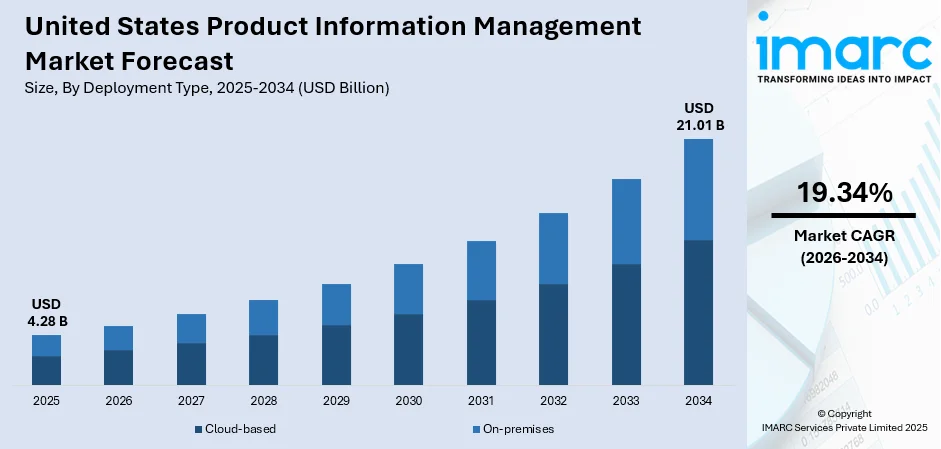
The United States product information management market size was valued at USD 4.28 Billion in 2025 and is projected to reach USD 21.01 Billion by 2034, growing at a compound annual growth rate of 19.34% from 2026-2034.
The fast rise of e-commerce and digital commerce platforms, increasing usage of cloud-based solutions, and the escalating demand for centralized product data management across various sales channels are all contributing factors to the strong growth of the US product information management market. To improve operations, remove data silos, and provide consistent product experiences across omnichannel touchpoints, businesses are making significant investments in digital transformation projects. Automation, data enrichment, and personalization capabilities are being improved by the incorporation of AI and machine learning into PIM solutions, which is increasing the market share of product information management in the United States.
Key Takeaways and Insights:
-
By Deployment Type: Cloud-based dominates the market with 68% share in 2025, driven by their scalability, flexibility, and cost-effectiveness compared to on-premises alternatives. Businesses are increasingly transitioning to cloud-native platforms to enable remote collaboration, real-time data management, and seamless integration with existing enterprise systems.
-
By Component Type: Software leads with a share of 74% in 2025, owing to the growing demand for advanced PIM solutions that offer AI-powered data enrichment, automated workflows, and multi-channel syndication capabilities. Organizations are prioritizing software investments to enhance product data accuracy and accelerate time-to-market.
-
By Organization Size: Large enterprises hold the largest revenue share of 57% in 2025. This dominance is driven by the complex product catalog management requirements, multi-channel distribution needs, and substantial IT budgets that enable comprehensive PIM implementations across global operations.
-
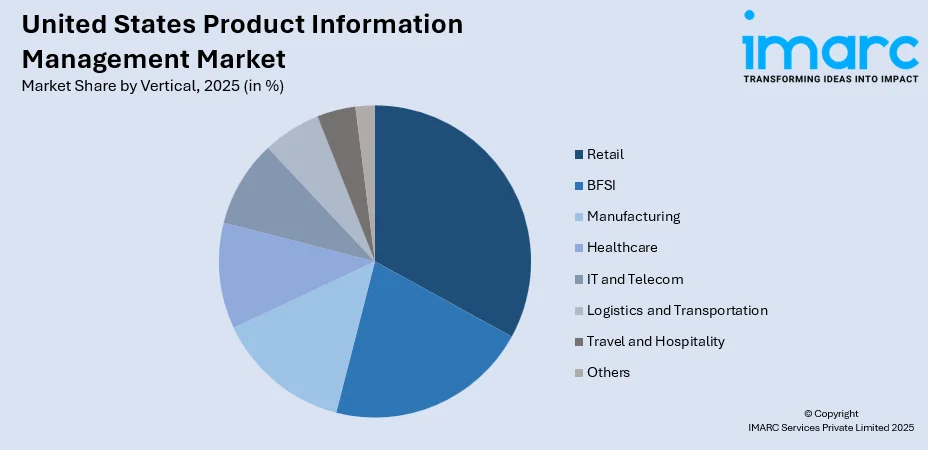
By Vertical: Retail dominates with market share of 20% in 2025, supported by the explosive growth of e-commerce, increasing consumer expectations for consistent product information, and the need to manage extensive product catalogs across multiple online marketplaces and physical stores.
-
Key Players: The United States product information management market exhibits moderate to high competitive intensity, with global technology corporations competing alongside specialized PIM vendors across various market segments and deployment models.
To get more information on this market Request Sample
The United States product information management market is characterized by its widespread adoption across diverse industry verticals, including retail, manufacturing, healthcare, information technology, telecom, and banking, financial services, and insurance. The integration of PIM with catalog management, business process management, and data quality processes allows businesses to navigate complex data intricacies efficiently and channelize it to desired distribution channels. For instance, in February 2024, Salsify launched its AI-powered PXM Advance platform, enabling brands to validate product content and accelerate time-to-market through enhanced automation capabilities. As industries increasingly recognize the importance of structured and accurate product information, the United States product information management market is poised for sustained growth over the forecasted period.
United States Product Information Management Market Trends:
Artificial Intelligence and Machine Learning Integration
The manner in which companies deal with product information will soon undergo a radical change due to the integration of artificial intelligence and machine learning concepts with product information management. Based on AI, product information can be automatically classified, perfected, and verified, thus helping reduce errors and optimize operations. These highly intelligent tools enhance customer experiences with capabilities that enable massive data enrichment, automated content generation, and personalized product recommendation. Companies are leveraging AI capabilities for better product representation, optimized titles and descriptions, and search engine visibility.
Cloud-Based Solutions Driving Market Transformation
Because of its increased security features, scalability, and flexibility, cloud-based PIM systems are becoming more and more popular. Without the need for internal IT staff, centralized SaaS solutions eliminate geographical infrastructure restrictions and provide automatic feature updates. Teams may easily handle product data from any location with cloud deployments, which improves departmental communication and allows for quick expansion without the maintenance burden of on-premises systems. As companies look for quicker deployments and lower total cost of ownership, this trend toward cloud-native designs is more noticeable.
Omnichannel Commerce Integration Requirements
The explosive growth of omnichannel retailing is driving demand for PIM solutions that can deliver consistent product experiences across all customer touchpoints. Retailers must synchronize product information across e-commerce websites, mobile applications, social commerce platforms, marketplaces, and physical stores. Consumer expectations for brand consistency across all channels are intensifying, with businesses requiring seamless data syndication capabilities to maintain accurate product information across multiple platforms simultaneously.
Market Outlook 2026-2034:
The United States product information management market is projected to experience substantial revenue growth. The market generated a revenue of USD 4.28 Billion in 2025 and is projected to reach a revenue of USD 21.01 Billion by 2034, growing at a compound annual growth rate of 19.34% from 2026-2034. This growth trajectory is underpinned by accelerating digital transformation initiatives, the rising importance of data-driven product management strategies, and increasing adoption of AI-enhanced PIM capabilities. Enterprise investments in cloud-based solutions and omnichannel commerce platforms will continue driving market expansion as organizations prioritize accurate, consistent, and enriched product content delivery across all sales channels.
United States Product Information Management Market Report Segmentation:
|
Segment Category |
Leading Segment |
Market Share |
|
Deployment Type |
Cloud-based |
68% |
|
Component Type |
Software |
74% |
|
Organization Size |
Large Enterprises |
57% |
|
Vertical |
Retail |
20% |
Deployment Type Insights:
- Cloud-based
- On-premises
Cloud-based holds with 68% share in United States product information management market in 2025.
Cloud-based product information management solutions are experiencing accelerated adoption as organizations recognize the advantages of SaaS deployment models. These platforms eliminate the need for substantial upfront capital expenditure and reduce ongoing IT maintenance burdens while providing automatic software updates and enhanced security features. Cloud-native architectures enable seamless integration with existing enterprise systems including ERP, CRM, and e-commerce platforms, creating unified digital ecosystems that support efficient product data workflows.
The transition to cloud-based PIM is particularly pronounced among enterprises pursuing digital transformation strategies. Organizations are increasingly prioritizing cloud migration initiatives as part of their broader technology modernization efforts, recognizing the strategic value of flexible and scalable infrastructure. Cloud PIM solutions offer dynamic scalability to accommodate peak seasonal traffic, real-time collaboration capabilities across geographically distributed teams, and reduced time-to-value through faster implementation timelines compared to traditional on-premises deployments. The ability to access product information from any location enhances workforce productivity and supports remote working arrangements that have become essential in modern business environments.
Component Type Insights:
- Software
- Single Domain
- Multi-Domain
- Services
- Consulting and System Integration
- Training, Support and Maintenance
Software leads with 74% share in United States product information management market in 2025.
The software component encompasses comprehensive PIM platforms that provide centralized repositories for managing, enriching, and distributing product information across multiple channels. Modern PIM software solutions incorporate advanced features including automated data validation, bulk content enrichment, multi-channel syndication, and digital shelf analytics. These capabilities enable organizations to maintain data accuracy, reduce time-to-market for new products, and deliver consistent brand experiences across all customer touchpoints.
Enterprise adoption of PIM software is driven by the increasing complexity of product catalogs and the need for sophisticated data management tools. Organizations managing extensive product portfolios require software solutions capable of handling millions of SKUs, supporting multiple languages and currencies, and ensuring compliance with regional regulatory requirements. The integration of artificial intelligence enhances software capabilities by automating repetitive tasks such as data categorization, attribute extraction, and content optimization.
Organization Size Insights:
- Small and Medium-sized Enterprises
- Large Enterprises
Large enterprises dominate with 57% share in United States product information management market in 2025.
Large enterprises continue to account for the dominant share of the United States product information management market because of the scale and complexity of their operations. These organizations typically manage vast and diverse product catalogs that span multiple business units, brands, and regions, making centralized control over product data a necessity rather than a convenience. Consistency, accuracy, and governance of information become harder to maintain as internal teams, external partners, and digital channels increase in number.
To address these challenges, large enterprises rely on mature PIM solutions that can handle high data volumes while supporting structured collaboration across departments. These platforms enable standardized processes for data creation, validation, enrichment, and approval, reducing operational friction and internal dependency on manual coordination. Strong role-based access controls, traceability of changes, and system-level accountability also help enterprises meet internal governance and compliance requirements. Over time, PIM systems become deeply embedded within enterprise IT ecosystems, acting as a foundational layer that supports operational efficiency, brand integrity, and long-term scalability across the organization.
Vertical Insights:
Access the comprehensive market breakdown Request Sample
- BFSI
- Manufacturing
- Retail
- Healthcare
- IT and Telecom
- Logistics and Transportation
- Travel and Hospitality
- Others
Retail holds 20% share in United states product information management market in 2025.
The retail vertical dominates PIM adoption due to the sector's inherent dependence on accurate, comprehensive, and engaging product information to drive sales and customer satisfaction. Retailers manage extensive product catalogs spanning thousands of SKUs across multiple categories, requiring sophisticated systems to maintain consistency across e-commerce websites, mobile applications, marketplaces, and physical store environments. The continued growth of online retail has amplified the importance of PIM in supporting digital commerce strategies and omnichannel customer experiences.
Retail organizations leverage PIM solutions to streamline product launches, optimize marketplace listings, and ensure brand consistency across all customer touchpoints. The rise of retail media networks operated by major retailers has further intensified the need for accurate and consistent product data to support effective advertising across digital platforms. Modern consumers expect seamless shopping experiences regardless of whether they engage with brands through desktop websites, mobile devices, social commerce channels, or traditional brick-and-mortar locations.
Regional Insights:
- Northeast
- Midwest
- South
- West
Northeast represents a significant market driven by the concentration of major retail headquarters, financial services institutions, and technology companies in metropolitan areas like New York and Boston, supporting substantial enterprise PIM implementations and digital commerce initiatives.
Midwest demonstrates growing PIM adoption among manufacturing and distribution companies seeking enhanced product data management for B2B commerce applications. Industrial sectors leverage PIM solutions to streamline complex supply chain operations and support multi-channel distribution strategies.
South is experiencing rapid e-commerce growth driving demand for PIM solutions among retailers and consumer goods companies. Expanding logistics infrastructure and increasing digital commerce penetration are accelerating adoption across diverse industry verticals throughout the region.
West leads in cloud-based PIM adoption and AI-powered product experience management implementations, supported by its concentration of technology companies and innovative startups. Silicon Valley's influence drives advanced digital transformation strategies and cutting-edge PIM solution deployments.
Market Dynamics:
Growth Drivers:
Why is the United States Product Information Management Market Growing?
Rapid E-commerce Expansion and Digital Commerce Growth
The exponential growth of e-commerce in the United States is fundamentally driving demand for sophisticated product information management solutions. Online retail continues its upward trajectory, with e-commerce sales expanding significantly year-over-year and capturing an increasing share of total retail transactions. This digital commerce expansion requires businesses to manage and distribute product information across multiple online channels effectively, from company-owned websites to third-party marketplaces and social commerce platforms. Retailers and brands recognize that accurate, comprehensive, and compelling product content directly influences purchasing decisions, search visibility, and conversion rates. The proliferation of online marketplaces and the growing importance of digital shelf optimization have made centralized product data management essential for competitive success in the digital retail landscape.
Enterprise Digital Transformation Initiatives
Organizations across industries are accelerating digital transformation strategies that place product information management at the center of their technology investments. Businesses recognize that data-driven product management serves as a competitive differentiator, enabling faster decision-making, improved operational efficiency, and enhanced customer experiences. The integration of PIM with enterprise resource planning systems, customer relationship management platforms, and digital experience platforms creates unified data ecosystems that support streamlined operations. Companies leveraging centralized product data management report measurable improvements in time-to-market for new products, reduced data errors, and enhanced team productivity. The shift toward composable commerce architectures is further driving PIM adoption as organizations seek modular, API-first solutions that integrate seamlessly with their existing technology stacks.
Increasing Demand for Omnichannel Customer Experiences
Consumer expectations for seamless, consistent shopping experiences across all channels are intensifying demand for PIM solutions. Modern shoppers interact with brands through numerous touchpoints including websites, mobile applications, social media platforms, physical stores, and emerging channels such as voice commerce and connected devices. Research indicates that omnichannel shoppers spend significantly more than single-channel customers, reinforcing the business case for unified product data management. Businesses require PIM capabilities that ensure product information remains accurate and consistent whether customers are browsing online, comparing products on mobile devices, or shopping in physical retail locations. The growing importance of buy online, pick up in-store services and other hybrid fulfillment options further emphasizes the need for synchronized product data across digital and physical channels.
Market Restraints:
What Challenges the United States Product Information Management Market is Facing?
High Implementation Costs and Resource Requirements
The substantial upfront investment required for comprehensive PIM implementations presents a significant barrier for many organizations. Enterprise-grade solutions often require extensive customization, data migration, and integration services that add considerable costs beyond initial software licensing. Organizations must also invest in training programs to ensure staff can effectively utilize PIM capabilities, further extending implementation timelines and budget requirements.
Integration Complexities with Legacy Systems
Integrating PIM solutions with existing enterprise systems including legacy ERP platforms, CRM applications, and e-commerce infrastructure often proves technically challenging and time-consuming. Many organizations operate multiple disparate systems with proprietary data schemas, requiring custom middleware development and extensive data mapping efforts. These integration complexities can result in prolonged implementation timelines, increased project costs, and potential data synchronization issues.
Data Quality and Governance Challenges
Maintaining accurate and consistent product data across disparate sources remains a persistent challenge for organizations implementing PIM solutions. Research indicates that a significant majority of businesses struggle with data silos that hinder effective product information management. Establishing comprehensive data governance policies, defining data ownership responsibilities, and ensuring compliance with evolving regulatory requirements demand ongoing effort and organizational commitment.
Competitive Landscape:
The United States product information management market features a competitive landscape characterized by the presence of established enterprise software vendors, specialized PIM solution providers, and innovative cloud-native platforms. Market participants compete across multiple dimensions including solution functionality, deployment flexibility, integration capabilities, pricing models, and customer support services. The market exhibits ongoing consolidation activity as larger technology companies acquire specialized PIM vendors to enhance their product portfolios and expand market reach. Competition is intensifying around artificial intelligence capabilities, with vendors investing heavily in AI-powered features for automated content enrichment, intelligent data validation, and predictive analytics. Cloud-native platforms are gaining market share from traditional on-premises solutions, driving incumbents to accelerate their cloud transformation strategies. Strategic partnerships between PIM vendors and major e-commerce platforms, marketplace operators, and system integrators are shaping competitive dynamics and go-to-market approaches.
United States Product Information Management Market Report Coverage:
| Report Features | Details |
|---|---|
| Base Year of the Analysis | 2025 |
| Historical Period | 2020-2025 |
| Forecast Period | 2026-2034 |
| Units | Million USD |
| Scope of the Report | Exploration of Historical and Forecast Trends, Industry Catalysts and Challenges, Segment-Wise Historical and Predictive Market Assessment:
|
| Deployment Types Covered | Cloud-based, On-premises |
| Component Types Covered |
|
| Organization Sizes Covered | Small and Medium-sized Enterprises, Large Enterprises |
| Verticals Covered | BFSI, Manufacturing, Retail, Healthcare, IT and Telecom, Logistics and Transportation, Travel and Hospitality, Others |
| Regions Covered | Northeast, Midwest, South, West |
| Customization Scope | 10% Free Customization |
| Post-Sale Analyst Support | 10-12 Weeks |
| Delivery Format | PDF and Excel through Email (We can also provide the editable version of the report in PPT/Word format on special request) |
Frequently Asked Questions About the United States Product Information Management Market Report
The United States product information management market size was valued at USD 4.28 Billion in 2025.
The United States product information management market is expected to grow at a compound annual growth rate of 19.34% from 2026-2034 to reach USD 21.01 Billion by 2034.
Cloud-based deployment dominated the market with approximately 68% revenue share in 2025, driven by scalability advantages, reduced infrastructure costs, and seamless integration capabilities with enterprise systems.
Key factors driving the United States product information management market include rapid e-commerce expansion and digital commerce growth, enterprise digital transformation initiatives, increasing demand for omnichannel customer experiences, and adoption of AI-powered data management capabilities.
Major challenges include high implementation costs and resource requirements, integration complexities with legacy enterprise systems, data quality and governance challenges, varying skill levels among internal teams, and the need to manage increasing product data complexity across expanding sales channels.
Need more help?
- Speak to our experienced analysts for insights on the current market scenarios.
- Include additional segments and countries to customize the report as per your requirement.
- Gain an unparalleled competitive advantage in your domain by understanding how to utilize the report and positively impacting your operations and revenue.
- For further assistance, please connect with our analysts.
 Request Customization
 Speak to an Analyst
 Request Brochure
 Inquire Before Buying
Benefits of Customization
- Personalize this research
- Triangulate with your data
- Get data as per your format and definition
- Gain a deeper dive into a specific application, geography, customer, or competitor
- Any level of personalization
Get in Touch With Us
UNITED STATES
Phone: +1-201-971-6302
INDIA
Phone: +91-120-433-0800
UNITED KINGDOM
Phone: +44-753-714-6104
Email: [email protected]
Client Testimonials




.webp)




.webp)













Related Reports

Choose your plan
*Please note that the prices mentioned below are starting prices for each bundle type. Kindly contact our team for further details.*
Single User License
- 1 User License, Access on 2 Devices
- PDF Report + Excel Dataset (Password Protected)
- Lifetime Access
- No Printing Rights
- 10% Free Report Customization
- 10–12 Weeks of Analyst Support
Five User License
- Access for 5 Users, 2 Devices per User
- PDF Report + Excel Dataset (Password Protected)
- Lifetime Access
- Dedicated Account Manager
- 12–14 Weeks of Analyst Support
- No Printing Rights
- 15% Free Report Customization
- 25% Discount on Your Next Purchase
Corporate User License
- Unlimited User Access (Within Your Organization)
- PDF Report + Excel Dataset
- Lifetime Access
- Dedicated Account Manager
- 14–20 Weeks of Analyst Support
- No Printing Rights
- 20% Free Report Customization
- 30% Discount on Your Next Purchase
Essential Insights
What's included:
3 reports
- Lifetime Access
- PDF Reports
- Excel Datasets
- 2 Weeks of Free Analyst Support
- 2 User Licenses
- Access on 2 Devices
- Printing Rights
- Complimentary PowerPoint (PPT) Version
- Complimentary License Upgrade
Professional Access
What's included:
5 reports
- Lifetime Access
- PDF Reports
- Excel Datasets
- 8 Weeks of Free Analyst Support
- 2 User Licenses
- Access on 2 Devices
- Printing Rights
- Complimentary PowerPoint (PPT) Version
- Complimentary License Upgrade
Business Advantage
What's included:
8 reports
- Lifetime Access
- PDF Reports
- Excel Datasets
- 14 Weeks of Free Analyst Support
- 2 User Licenses
- Access on 2 Devices
- Printing Rights
- Complimentary PowerPoint (PPT) Version
- Complimentary License Upgrade
Enterprise Intelligence
What's included:
10 reports
- Lifetime Access
- PDF Reports
- Excel Datasets
- 20 Weeks of Free Analyst Support
- 2 User Licenses
- Access on 2 Devices
- Printing Rights
- Complimentary PowerPoint (PPT) Version
- Complimentary License Upgrade