
United States Rechargeable Battery Market Size, Share, Trends and Forecast by Battery Type, Capacity, Application, and Region, 2026-2034
United States Rechargeable Battery Market Summary:
The United States rechargeable battery market size was valued at USD 35.40 Billion in 2025 and is projected to reach USD 66.72 Billion by 2034, growing at a compound annual growth rate of 7.30% from 2026-2034. The United States rechargeable battery market is experiencing robust growth driven by the accelerating adoption of electric vehicles, expanding grid-scale energy storage deployments, and rising demand for portable consumer electronics. The transition toward sustainable transportation and renewable energy integration is creating unprecedented demand for high-performance battery solutions. Federal policies and incentives have catalyzed substantial private investments in domestic battery manufacturing infrastructure, strengthening supply chain resilience. Technological advancements in battery chemistry, energy density improvements, and cost reductions are enhancing commercial viability across automotive, industrial, and consumer applications. The convergence of electrification trends, environmental regulations, and energy security priorities continues to propel the United States rechargeable battery market share.
Key Takeaways and Insights:
- By Battery Type: Li-ion batteries dominate the market with a share of 60% in 2025, owing to their superior energy density, extended cycle life, and versatile application across electric vehicles, energy storage systems, and consumer electronics. Continuous advancements in cathode chemistry and manufacturing processes are reinforcing lithium-ion technology adoption.
- By Capacity: 1300 - 2700 mAh leads the market with a share of 21% in 2025. This dominance is driven by widespread utilization in smartphones, tablets, portable electronic devices, and power tools where balanced energy capacity and compact form factors are essential requirements for optimal performance.
- By Application: Automobile applications hold the largest segment with a market share of 35% in 2025, reflecting the accelerating transition toward electric mobility, supportive government incentives, expanding charging infrastructure, and automaker commitments to vehicle electrification programs throughout the nation.
- By Region: South represents the largest region with 35% share in 2025, driven by substantial manufacturing investments in Georgia, Tennessee, Kentucky, and North Carolina, favorable business climates, proximity to transportation corridors, and strategic automaker partnerships establishing battery production facilities.
- Key Players: Key players drive the United States rechargeable battery market by expanding domestic manufacturing capacity, investing in research and development for next-generation technologies, and forming strategic partnerships with automakers. Their focus on cost reduction, performance optimization, supply chain localization, and sustainability initiatives strengthen market competitiveness while ensuring consistent product availability across diverse industry applications.
The United States rechargeable battery market is undergoing transformational growth as electrification trends reshape transportation, energy, and electronics sectors. According to the US Energy Information Administration, cumulative utility-scale battery storage capacity exceeded 26 gigawatts in 2024, with operators adding 10.4 gigawatts of new capacity during the year. The automotive sector remains the primary demand driver as electric vehicle adoption accelerates nationwide, supported by federal tax credits and state incentives. Lithium-ion technology continues to dominate commercial applications due to established manufacturing infrastructure, proven performance characteristics, and declining production costs. Emerging battery chemistries including lithium iron phosphate are gaining market penetration, particularly in energy storage and entry-level electric vehicle segments. The localization of battery supply chains through gigafactory investments positions the United States as a significant player in the global battery manufacturing landscape.
United States Rechargeable Battery Market Trends:
Rapid Expansion of Grid-Scale Energy Storage Deployments
The United States is experiencing unprecedented growth in utility-scale battery energy storage systems as renewable energy integration accelerates nationwide. Grid operators are deploying large-format battery installations to enhance power system flexibility, manage peak demand periods, and support the intermittent nature of solar and wind generation. Regulatory frameworks and market designs are evolving to recognize the value batteries provide for grid reliability, frequency regulation, and capacity services. This trend is transforming energy infrastructure planning as utilities increasingly incorporate storage solutions into resource portfolios for transmission and distribution system optimization.
Domestic Manufacturing Capacity Expansion and Supply Chain Localization
Battery manufacturers are establishing substantial production facilities across the United States to strengthen domestic supply chains and reduce dependence on imported components. The emergence of a concentrated manufacturing corridor spanning southern and midwestern states reflects strategic industry clustering around automotive production centers. Investment priorities include electrode and cell manufacturing capabilities alongside upstream material processing infrastructure. This reshoring trend is creating specialized workforce development initiatives and research partnerships to support the expanding battery manufacturing ecosystem throughout multiple regions.
Advancement of Battery Chemistry and Performance Optimization
Technological innovation in rechargeable battery chemistry continues driving performance improvements across energy density, charging speed, and cycle life parameters. The US Department of Energy announced $42 Million in funding through the ARPA-E Electric Vehicles for American Low-Carbon Living (EVs4ALL) program for 12 projects developing next-generation battery technologies, including solid-state lithium metal batteries, sodium-ion batteries, and cobalt- and nickel-free cathodes. Research institutions and manufacturers are developing next-generation cathode formulations that reduce reliance on critical minerals while maintaining or enhancing performance characteristics. Solid-state battery technology represents a significant area of development promising enhanced safety and energy density for future applications. These advancements are enabling new use cases across sectors while improving the economic competitiveness of battery-powered solutions.
Market Outlook 2026-2034:
The United States rechargeable battery market outlook remains exceptionally favorable as electrification momentum builds across transportation and stationary energy applications. Sustained demand from the electric vehicle sector, combined with accelerating grid storage deployments, will continue driving market expansion throughout the forecast period. Federal and state policy frameworks supporting clean energy adoption, charging infrastructure expansion, and domestic manufacturing incentives create favorable conditions for sustained investment and capacity growth. Consumer electronics innovation and industrial electrification provide additional growth vectors complementing automotive and energy storage applications. The market generated a revenue of USD 35.40 Billion in 2025 and is projected to reach a revenue of USD 66.72 Billion by 2034, growing at a compound annual growth rate of 7.30% from 2026-2034.
United States Rechargeable Battery Market Report Segmentation:
| Segment Category | Leading Segment | Market Share |
|---|---|---|
| Battery Type | Li-ion Batteries | 60% |
| Capacity | 1300 - 2700 mAh | 21% |
| Application | Automobile Applications | 35% |
| Region | South | 35% |
Battery Type Insights:
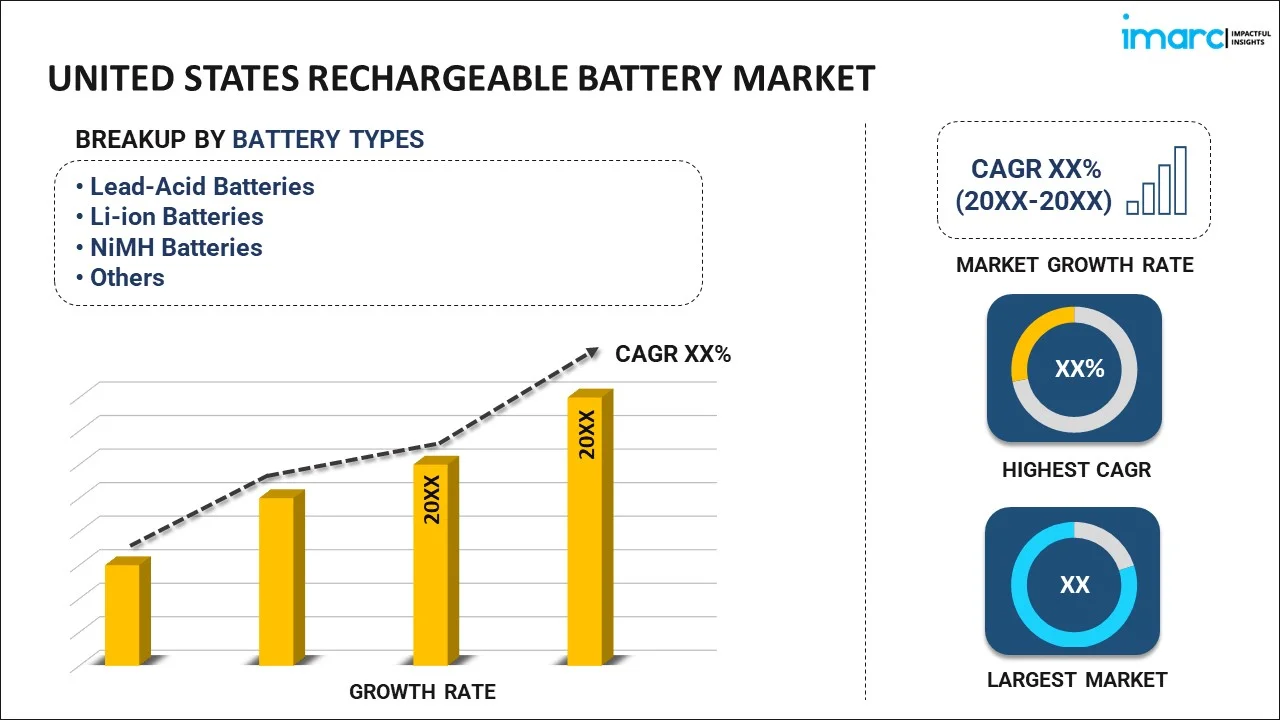
To get detailed segment analysis of this market Request Sample
- Lead-Acid Batteries
- Li-ion Batteries
- NiMH Batteries
- NiCd Batteries
- Others
Li-ion batteries dominate with a market share of 60% of the total United States rechargeable battery market in 2025.
Lithium-ion batteries command the largest market share due to their exceptional energy density, extended operational lifespan, and declining manufacturing costs that have enhanced economic viability across applications. The technology's versatility enables deployment in electric vehicles, grid-scale energy storage, consumer electronics, and industrial equipment. According to the International Energy Agency, battery manufacturing capacity in the United States has doubled since 2022, reaching more than 200 gigawatt-hours in 2024, with nearly 700 gigawatt-hours of additional capacity under construction.
The dominance of lithium-ion technology reflects substantial investments in domestic manufacturing infrastructure and ongoing improvements in battery performance characteristics. Advancements in cathode chemistry, including nickel manganese cobalt and lithium iron phosphate formulations, continue expanding application possibilities. The automotive sector drives primary demand growth as automakers accelerate electric vehicle production programs requiring high-capacity battery packs. Energy storage applications represent a rapidly expanding segment leveraging lithium-ion technology for grid stabilization and renewable energy integration services.
Capacity Insights:
- 150 - 1000 mAh
- 1300 - 2700 mAh
- 3000 - 4000 mAh
- 4000 - 6000 mAh
- 6000 - 10000 mAh
- More than 10000 mAh
1300 - 2700 mAh leads with a share of 21% of the total United States rechargeable battery market in 2025.

The 1300 - 2700 mAh capacity segment maintains market leadership driven by extensive utilization in smartphones, tablets, portable computing devices, and professional power tools requiring balanced energy storage and compact dimensions. This capacity range delivers optimal performance for applications demanding moderate runtime and convenient form factors suitable for everyday consumer and professional use. The proliferation of connected devices and mobile computing continues generating sustained demand for batteries within this capacity specification across diverse market segments.
Technological improvements in energy density enable manufacturers to deliver enhanced performance within established form factors, extending device operational duration without increasing physical dimensions. According to industry analysis, consumer electronics refresh cycles encompassing wearables and IoT devices continue supporting demand within this capacity segment. Power tool manufacturers leverage this capacity range for cordless professional equipment requiring reliable energy delivery across extended work sessions while maintaining ergonomic handling characteristics.
Application Insights:
- Consumer Electronics
- Industrial Applications
- Automobile Applications
- Defence
- Others
The automobile applications exhibit a clear dominance with a 35% share of the total United States rechargeable battery market in 2025.
Automobile applications dominate the rechargeable battery market as electric vehicle adoption accelerates across passenger and commercial vehicle segments. The transition toward electrified transportation is driven by stringent emission regulations, consumer environmental awareness, and improving vehicle performance and affordability. Automakers have committed substantial capital toward electric vehicle development programs requiring high-capacity battery systems. Over the past decade, manufacturers announced approximately $198 Billion in investments for battery and electric vehicle manufacturing in the United States, according to industry reports.
Federal tax credits for electric vehicle purchases and battery component manufacturing have stimulated market development and consumer adoption rates. The automotive sector's battery requirements span hybrid electric vehicles utilizing smaller packs to full battery electric vehicles requiring large-format systems delivering extended driving ranges. Charging infrastructure expansion across highway corridors and urban centers addresses range anxiety concerns while supporting adoption growth. Continuous improvements in charging speed capabilities and battery durability characteristics enhance the value proposition for battery electric vehicles across consumer demographics.
Regional Insights:
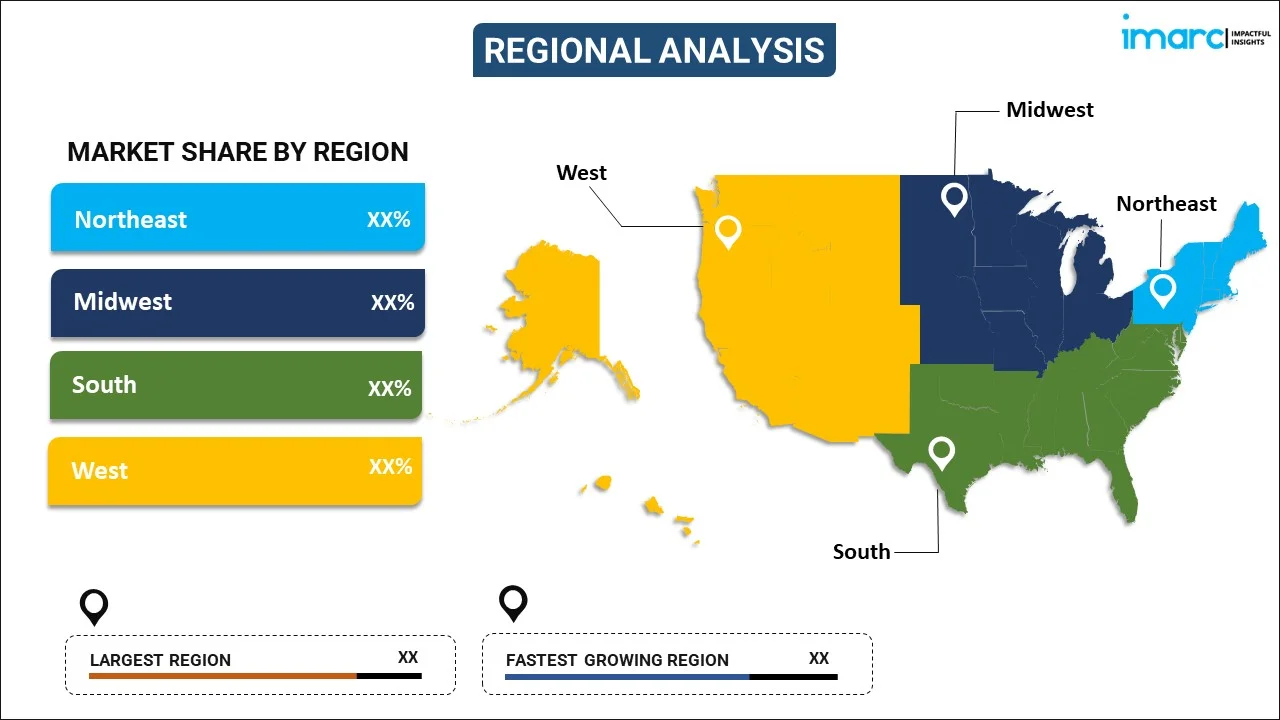
To get detailed regional analysis of this market Request Sample
- Northeast
- Midwest
- South
- West
South represents the leading segment with a 35% share of the total United States rechargeable battery market in 2025.
The South dominates the United States rechargeable battery market driven by substantial manufacturing investments concentrating production facilities across Georgia, Tennessee, Kentucky, and North Carolina. The Department of Energy highlighted these states as likely to experience the most production capacity growth by the end of the decade. Favorable business environments, available industrial sites, proximity to automotive assembly plants, and workforce development initiatives have attracted major domestic and international battery manufacturers establishing operations throughout the region.
Strategic partnerships between automakers and battery producers have generated substantial facility announcements creating significant manufacturing employment opportunities across southern states. The establishment of an interconnected battery manufacturing corridor supports supply chain efficiency while fostering technology clusters and specialized workforce development initiatives. Transportation infrastructure, port access, and utility connectivity provide operational advantages supporting large-scale battery production requirements. State-level incentive programs and workforce training partnerships further strengthen the region's competitive positioning for continued investment.
Market Dynamics:
Growth Drivers:
Why is the United States Rechargeable Battery Market Growing?
Accelerating Electric Vehicle Adoption and Transportation Electrification
The rapid expansion of electric vehicle adoption represents a primary growth driver for the United States rechargeable battery market as consumers and commercial fleet operators transition from internal combustion vehicles to battery-powered alternatives. Federal and state policies supporting clean transportation through purchase incentives, infrastructure investments, and emission regulations create favorable conditions for sustained electric vehicle market penetration. Automakers across domestic and international manufacturers have committed to expanding electric vehicle offerings with aggressive production targets requiring substantial battery supply chain development. Consumer awareness about environmental benefits, improving vehicle performance characteristics, and declining ownership costs contribute to accelerating adoption rates across passenger and commercial vehicle categories. The convergence of regulatory pressure, technological advancement, and shifting consumer preferences positions electric mobility as a transformational force reshaping automotive industry dynamics and battery demand patterns throughout the forecast period.
Grid-Scale Energy Storage Integration with Renewable Generation
The integration of renewable energy sources into electrical grids is driving substantial demand for battery energy storage systems capable of managing intermittent generation patterns and providing grid stability services. Utility-scale battery installations enable efficient utilization of solar and wind resources by storing excess generation during periods of high production and dispatching electricity during peak demand intervals. Power system operators recognize batteries as essential infrastructure for achieving reliability objectives while accommodating increasing renewable energy penetration levels. Regulatory frameworks and market structures are evolving to appropriately value the flexibility and reliability services batteries provide to electrical networks. The expansion of renewable energy capacity across states creates corresponding requirements for storage solutions to maintain grid balance and power quality standards. Battery storage represents a critical enabling technology for the broader clean energy transition providing operational flexibility previously delivered by conventional generation resources.
Federal Policy Support and Domestic Manufacturing Incentives
Comprehensive federal policies supporting clean energy and domestic manufacturing have created powerful incentives driving substantial investment in battery production capacity throughout the United States. According to the US Department of the Treasury, $173 Billion in private-sector investment has been announced across the US clean vehicle and battery supply chain since federal clean energy legislation was enacted. Tax credits for electric vehicle purchases, battery component manufacturing, and critical mineral processing encourage supply chain localization and reduce dependence on imported materials. Grant programs and loan guarantees support facility construction and technology development across the battery value chain from raw material processing through cell manufacturing and recycling operations. These policy mechanisms address energy security concerns while fostering economic development and job creation in communities hosting new manufacturing facilities. The alignment of environmental objectives, industrial policy priorities, and economic development interests creates durable support for continued battery sector investment. Sustained policy frameworks provide planning certainty enabling long-term capital commitments necessary for establishing globally competitive domestic battery manufacturing capabilities.
Market Restraints:
What Challenges the United States Rechargeable Battery Market is Facing?
Critical Raw Material Supply Chain Vulnerabilities
The rechargeable battery market faces challenges related to concentrated global supply chains for critical minerals including lithium, cobalt, nickel, and graphite. Geographic concentration of mining and refining capacity creates vulnerability to supply disruptions, price volatility, and geopolitical tensions affecting material availability. Limited domestic resources for certain critical inputs necessitate continued reliance on international suppliers, presenting supply security concerns for manufacturers dependent on imported materials. Developing alternative domestic sources and recycling capabilities requires substantial time and capital investments.
High Capital Requirements for Manufacturing Scale-Up
Establishing competitive battery manufacturing operations requires substantial capital investments spanning facility construction, equipment procurement, workforce training, and technology development. The capital-intensive nature of battery production presents barriers for new market entrants while requiring established manufacturers to carefully manage investment timing relative to market demand trajectories. First-of-a-kind domestic projects may encounter additional costs and challenges in optimizing production processes and achieving targeted yield rates. Market uncertainties and policy changes can affect investment decisions and project timelines.
Intense Global Competition and Cost Pressures
Domestic battery manufacturers face competitive pressure from established international producers benefiting from economies of scale, integrated supply chains, and government support programs. Cost differentials between domestic and imported battery cells present challenges for achieving competitive pricing without significant manufacturing scale advantages. Rapid technological evolution requires continuous investment in research and development to maintain performance leadership and cost competitiveness. Market participants must balance capital deployment between expanding current technology capacity and developing next-generation solutions.
Competitive Landscape:
The United States rechargeable battery market exhibits a competitive structure characterized by established international battery manufacturers, domestic producers, and strategic joint ventures between automakers and battery specialists. Market participants compete across technology development, manufacturing scale, cost efficiency, and customer relationships with automotive original equipment manufacturers. Strategic partnerships enable participants to combine manufacturing expertise with automaker demand commitments, facilitating investment in dedicated production capacity. Competition extends beyond pricing to encompass battery performance characteristics, supply reliability, and technical support capabilities. The market structure encourages technology advancement as participants pursue differentiation through improved energy density, charging speed, and cycle life specifications. Domestic manufacturing expansion is reshaping competitive dynamics as new facilities achieve operational scale.
Recent Developments:
- In July 2025, Panasonic Energy officially began operations at its new lithium-ion battery manufacturing facility in De Soto, Kansas, marking a major expansion of its North American production footprint. The state-of-the-art plant focuses on mass production of advanced 2170 cylindrical lithium-ion battery cells for electric vehicles and is expected to reach an annual capacity of approximately 32 gigawatt-hours, significantly boosting regional EV battery supply.
- In April 2024, Green Li-ion launched North America's first commercial-scale plant in Atoka, Oklahoma, dedicated to producing recycled lithium-ion battery materials using its patented Green-hydrorejuvenation technology. This facility converts unsorted black mass from spent batteries into battery-grade precursor cathode active material, significantly reducing greenhouse gas emissions by up to ninety percent compared to traditional methods.
Report Coverage:
| Report Features | Details |
|---|---|
| Base Year of the Analysis | 2025 |
| Historical Period | 2020-2025 |
| Forecast Period | 2026-2034 |
| Units | Billion USD |
| Scope of the Report | Exploration of Historical and Forecast Trends, Industry Catalysts and Challenges, Segment-Wise Historical and Predictive Market Assessment:
|
| Battery Types Covered | Lead-Acid Batteries, Li-ion Batteries, NiMH Batteries, NiCd Batteries, Others |
| Capacities Covered | 150 - 1000 mAh, 1300 - 2700 mAh, 3000 - 4000 mAh, 4000 - 6000 mAh, 6000 - 10000 mAh, More than 10000 mAh |
| Applications Covered | Consumer Electronics, Industrial Applications, Automobile Applications, Defence, Others |
| Regions Covered | Northeast, Midwest, South, West |
| Customization Scope | 10% Free Customization |
| Post-Sale Analyst Support | 10-12 Weeks |
| Delivery Format | PDF and Excel through Email (We can also provide the editable version of the report in PPT/Word format on special request) |
Frequently Asked Questions About the United States Rechargeable Battery Market Report
The United States rechargeable battery market size was valued at USD 35.40 Billion in 2025.
The United States rechargeable battery market is expected to grow at a compound annual growth rate of 7.30% from 2026-2034 to reach USD 66.72 Billion by 2034.
Li-ion batteries dominated the market with a share of 60%, driven by superior energy density, versatile applications across electric vehicles and energy storage, and declining manufacturing costs.
Key factors driving the United States rechargeable battery market include accelerating electric vehicle adoption, expanding grid-scale energy storage deployments, federal manufacturing incentives, and technological advancements improving battery performance and cost competitiveness.
Major challenges include critical raw material supply chain vulnerabilities, high capital requirements for manufacturing scale-up, intense global competition affecting cost structures, workforce development needs, and policy uncertainties impacting long-term investment planning.
Need more help?
- Speak to our experienced analysts for insights on the current market scenarios.
- Include additional segments and countries to customize the report as per your requirement.
- Gain an unparalleled competitive advantage in your domain by understanding how to utilize the report and positively impacting your operations and revenue.
- For further assistance, please connect with our analysts.
 Request Customization
 Speak to an Analyst
 Request Brochure
 Inquire Before Buying
Benefits of Customization
- Personalize this research
- Triangulate with your data
- Get data as per your format and definition
- Gain a deeper dive into a specific application, geography, customer, or competitor
- Any level of personalization
Get in Touch With Us
UNITED STATES
Phone: +1-201-971-6302
INDIA
Phone: +91-120-433-0800
UNITED KINGDOM
Phone: +44-753-714-6104
Email: [email protected]
Client Testimonials




.webp)




.webp)













Related Reports

Choose your plan
*Please note that the prices mentioned below are starting prices for each bundle type. Kindly contact our team for further details.*
Single User License
- 1 User License, Access on 2 Devices
- PDF Report + Excel Dataset (Password Protected)
- Lifetime Access
- No Printing Rights
- 10% Free Report Customization
- 10–12 Weeks of Analyst Support
Five User License
- Access for 5 Users, 2 Devices per User
- PDF Report + Excel Dataset (Password Protected)
- Lifetime Access
- Dedicated Account Manager
- 12–14 Weeks of Analyst Support
- No Printing Rights
- 15% Free Report Customization
- 25% Discount on Your Next Purchase
Corporate User License
- Unlimited User Access (Within Your Organization)
- PDF Report + Excel Dataset
- Lifetime Access
- Dedicated Account Manager
- 14–20 Weeks of Analyst Support
- No Printing Rights
- 20% Free Report Customization
- 30% Discount on Your Next Purchase
Essential Insights
What's included:
3 reports
- Lifetime Access
- PDF Reports
- Excel Datasets
- 2 Weeks of Free Analyst Support
- 2 User Licenses
- Access on 2 Devices
- Printing Rights
- Complimentary PowerPoint (PPT) Version
- Complimentary License Upgrade
Professional Access
What's included:
5 reports
- Lifetime Access
- PDF Reports
- Excel Datasets
- 8 Weeks of Free Analyst Support
- 2 User Licenses
- Access on 2 Devices
- Printing Rights
- Complimentary PowerPoint (PPT) Version
- Complimentary License Upgrade
Business Advantage
What's included:
8 reports
- Lifetime Access
- PDF Reports
- Excel Datasets
- 14 Weeks of Free Analyst Support
- 2 User Licenses
- Access on 2 Devices
- Printing Rights
- Complimentary PowerPoint (PPT) Version
- Complimentary License Upgrade
Enterprise Intelligence
What's included:
10 reports
- Lifetime Access
- PDF Reports
- Excel Datasets
- 20 Weeks of Free Analyst Support
- 2 User Licenses
- Access on 2 Devices
- Printing Rights
- Complimentary PowerPoint (PPT) Version
- Complimentary License Upgrade