
United States Scintillator Market Size, Share, Trends and Forecast by Composition of Material, End Product, Application, and Region, 2026-2034
United States Scintillator Market Summary:
The United States scintillator market size was valued at USD 199.9 Million in 2025 and is projected to reach USD 283.0 Million by 2034, growing at a compound annual growth rate of 3.95% from 2026-2034. The United States scintillator market is experiencing sustained growth driven by increasing demand across medical imaging, homeland security, and nuclear energy applications. Advancements in radiation detection technologies, particularly in PET and CT scanner systems, are enhancing diagnostic capabilities in healthcare settings. Stringent regulatory requirements for radiation safety in nuclear facilities and heightened border security measures are accelerating adoption of sophisticated scintillation detectors. Growing research investments in high-energy physics and quantum science applications are creating additional opportunities for advanced scintillator materials, positioning the market for continued expansion across the United States scintillator market share.
Key Takeaways and Insights:
- By Composition of Material: In-organic scintillators dominate the market with a share of 57% in 2025, owing to their superior light yield, high density, and excellent energy resolution capabilities. Their widespread adoption in advanced medical imaging and radiation detection systems supports continued market leadership.
- By End Product: Fixed, installed, and automatic instruments lead the market with a share of 52% in 2025. This dominance is driven by the growing deployment of permanent radiation monitoring systems in nuclear facilities, healthcare institutions, and critical infrastructure protection applications.
- By Application: Homeland security and defense holds the largest segment with a market share of 31% in 2025, reflecting the critical role of scintillation detectors in border protection, cargo screening, and radiological threat prevention across federal and state security operations.
- By Region: South represents the largest region with 30% share in 2025, driven by concentration of defense installations, nuclear facilities, and major medical research centers in states including Texas, Florida, and Georgia.
- Key Players: Key players drive the United States scintillator market by expanding product portfolios, advancing crystal growth technologies, and strengthening partnerships with government agencies and healthcare providers. Their investments in research and development, manufacturing capacity expansion, and strategic acquisitions support market penetration across diverse radiation detection applications.
The United States scintillator market continues to evolve with technological innovations driving enhanced detection capabilities across critical sectors. Medical imaging applications remain a cornerstone of market demand, with scintillators serving as essential components in PET scanners, CT systems, and SPECT devices that support cancer diagnosis and cardiovascular assessments. The healthcare sector's emphasis on early disease detection and precision diagnostics is accelerating adoption of high-performance scintillation materials. In January 2025, the US Department of Energy announced USD 71 Million in funding for 25 quantum physics initiatives, including projects focused on radiation detection technologies and dark matter research utilizing advanced scintillator systems. This significant federal investment underscores the strategic importance of scintillation technologies in advancing both scientific research and national security applications.
United States Scintillator Market Trends:
Advancement in Quantum Shell Nanoparticle Scintillators
Research institutions are developing next-generation scintillator materials utilizing quantum shell nanoparticles that offer unprecedented performance characteristics. Scientists at Argonne National Laboratory have pioneered quantum shell scintillators composed of spherical particles measuring 20 billionths of a meter, featuring intricate core-shell structures of cadmium sulfide and cadmium selenide. These materials achieve single-digit nanosecond lifetime while preserving efficiency levels equal to traditional scintillators, supporting the United States scintillator market growth and enabling applications in ultrafast radiation detection and high-resolution X-ray imaging.
Integration of Artificial Intelligence in Radiation Detection Systems
The convergence of artificial intelligence with scintillation detection technologies is transforming radiation monitoring capabilities across multiple sectors. AI-powered analysis systems are enhancing threat identification accuracy while reducing false alarm rates in security applications. Machine learning algorithms enable automated spectral analysis and isotope identification, streamlining detection workflows for first responders and security personnel. These intelligent systems continuously improve through training on diverse radiation signatures, adapting to complex environments and emerging threats. The integration extends across healthcare, defense, and industrial applications, where predictive analytics optimize detector performance and maintenance scheduling while supporting real-time decision-making in critical radiation safety scenarios.
Expansion of Perovskite Scintillator Development for Medical Imaging
Perovskite-based scintillators are emerging as promising materials for next-generation medical imaging and timing applications. Two-dimensional lithium-doped hybrid organic-inorganic perovskite crystals and all-inorganic perovskite nanocrystals demonstrate high light yields exceeding 20 photons per keV with fast decay times under 15 nanoseconds. Research institutions are exploring strategies to enhance coincidence timing resolution through light-matter interactions and Purcell-enhanced scintillators, advancing capabilities for time-of-flight positron emission tomography systems. These developments address growing demand for improved image quality, reduced radiation exposure, and enhanced diagnostic precision in clinical settings.
Market Outlook 2026-2034:
The United States scintillator market outlook remains positive as technological advancements and expanding applications drive sustained demand across healthcare, security, and energy sectors. Continued federal investment in radiation detection research and nuclear safety infrastructure supports long-term market expansion. Growing adoption of advanced diagnostic imaging technologies in healthcare and increasing emphasis on nuclear facility safety monitoring will continue supporting market momentum throughout the forecast period. Additionally, emerging opportunities in quantum physics research and environmental monitoring applications are creating new avenues for scintillator deployment across scientific and industrial domains. The market generated a revenue of USD 199.9 Million in 2025 and is projected to reach a revenue of USD 283.0 Million by 2034, growing at a compound annual growth rate of 3.95% from 2026-2034.
United States Scintillator Market Report Segmentation:
|
Segment Category |
Leading Segment |
Market Share |
|
Composition of Material |
In-Organic Scintillators |
57% |
|
End Product |
Fixed, Installed, and Automatic Instruments |
52% |
|
Application |
Homeland Security and Defense |
31% |
|
Region |
South |
30% |
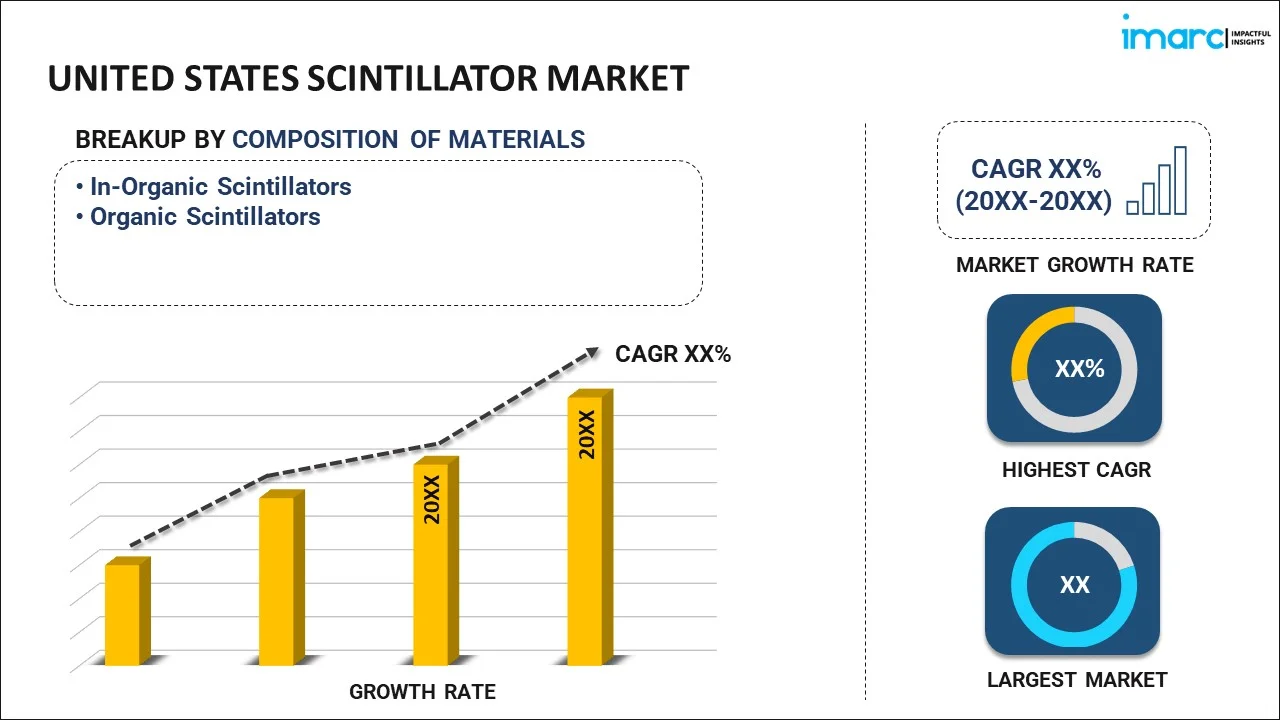
Composition of Material Insights:
To get detailed segment analysis of this market, Request Sample
- In-Organic Scintillators
- Alkali Halides
- Oxide Based Scintillators
- Others
- Organic Scintillators
- Single Crystal
- Liquid Scintillators
- Plastic Scintillators
In-organic scintillators dominate with a market share of 57% of the total United States scintillator market in 2025.
In-organic scintillators maintain market leadership due to their exceptional performance characteristics in high-energy radiation detection applications. Materials including sodium iodide, cesium iodide, and lutetium-yttrium oxyorthosilicate offer superior light yield and energy resolution essential for precise gamma-ray spectroscopy. These properties make them indispensable for medical imaging systems where diagnostic accuracy directly impacts patient outcomes in cancer detection and cardiovascular assessments. Their thermal stability and radiation hardness further enhance reliability across demanding operational environments in healthcare and security applications.
The segment benefits from continuous material science innovations enhancing detector performance. Leading manufacturers are expanding domestic production capabilities through new crystal growth facilities dedicated to advanced in-organic scintillator manufacturing. These investments increase supply chain resilience while supporting growing demand from healthcare and defense sectors. Enhanced manufacturing techniques improve crystal quality and consistency, enabling superior detector performance across critical applications. Such strategic capacity expansions reflect industry confidence in sustained market demand for high-performance crystalline scintillators serving radiation detection requirements.
End Product Insights:
- Personal or Pocket Size Instruments
- Hand-Held Instruments
- Fixed, Installed, and Automatic Instruments
Fixed, installed, and automatic instruments lead with a share of 52% of the total United States scintillator market in 2025.
Fixed radiation detection systems dominate the market driven by extensive deployment across nuclear power facilities, healthcare institutions, and critical infrastructure protection applications. These systems provide continuous real-time monitoring capabilities essential for maintaining safety standards and regulatory compliance. Nuclear power plants rely on permanently installed scintillation detectors for reactor monitoring and environmental surveillance throughout operational lifecycles. Their robust construction and reliable performance make them ideal for demanding environments requiring uninterrupted radiation measurement and safety assurance.
The healthcare sector's expansion of diagnostic imaging capabilities strengthens demand for fixed scintillator-based systems. Modern PET/CT scanner installations require sophisticated detector arrays utilizing high-performance scintillation crystals that deliver exceptional image quality and diagnostic precision. Leading manufacturers continue advancing scintillator detector technologies with enhanced sensitivity and improved response characteristics, supporting the growing installed base of medical imaging equipment. These developments enable healthcare providers to achieve superior diagnostic outcomes while optimizing patient throughput in clinical settings.
Application Insights:
- Healthcare
- Nuclear Power Plants
- Manufacturing Industries
- Homeland Security and Defense
- Others
Homeland security and defense exhibits clear dominance with a 31% share of the total United States scintillator market in 2025.
The homeland security and defense sector drives significant scintillator demand through extensive radiation detection requirements at border crossings, transportation hubs, and critical facilities. The Department of Homeland Security supports development of advanced scintillation technologies through programs including Exploratory Research and Small Business Innovative Research initiatives focused on detecting radioactive substances and preventing radiological threats. Federal agencies continuously invest in next-generation detection systems capable of identifying concealed nuclear materials while minimizing false alarms that disrupt commercial operations and emergency response protocols.
Advanced detector systems combining large volume scintillators with sophisticated electronics enable real-time detection of radioactive materials in moving vehicles at highway speeds. These integrated solutions leverage spectroscopic identification capabilities to distinguish threat signatures from naturally occurring radioactive materials, minimizing false alarms while maintaining operational efficiency. Continued government procurement programs demonstrate sustained federal commitment to enhancing radiation detection capabilities across national borders and critical infrastructure protection applications. Ongoing investments in next-generation detection technologies reinforce the strategic importance of scintillation-based systems for comprehensive homeland security operations nationwide.
Regional Insights:
To get detailed regional analysis of this market, Request Sample
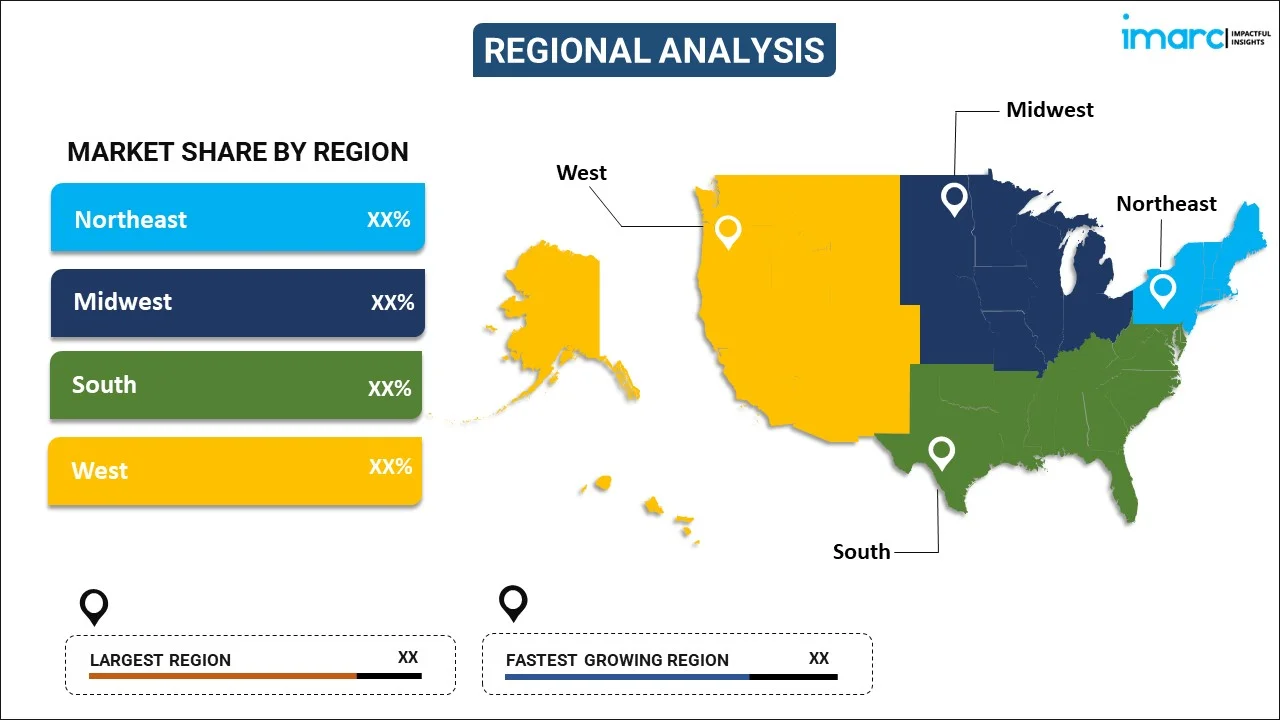
- Northeast
- Midwest
- South
- West
South represents the leading segment with a 30% share of the total United States scintillator market in 2025.
The South maintains market leadership supported by concentration of defense installations, nuclear facilities, and major medical research centers across Texas, Florida, Georgia, and Tennessee. The region hosts significant nuclear power generation capacity requiring extensive radiation monitoring infrastructure throughout reactor operations and environmental surveillance programs. Military bases and defense contractors located across the South drive consistent demand for radiation detection equipment supporting national security applications. Strategic positioning of homeland security operations along Gulf Coast borders further strengthens regional scintillator adoption.
Additionally, major healthcare systems in metropolitan areas including Houston, Atlanta, and Miami drive substantial demand for diagnostic imaging equipment incorporating scintillation detectors. Leading cancer treatment centers and academic medical institutions throughout the region continuously invest in advanced PET/CT scanning capabilities requiring high-performance scintillator arrays. The presence of prominent research universities conducting nuclear physics and materials science investigations creates additional demand for specialized scintillation materials. Growing population demographics and healthcare infrastructure expansion across Southern states reinforce long-term market growth prospects.
Market Dynamics:
Growth Drivers:
Why is the United States Scintillator Market Growing?
Expanding Medical Imaging Applications and Healthcare Adoption
The healthcare sector represents a primary growth driver for the United States scintillator market as medical facilities expand diagnostic imaging capabilities. Scintillators serve as critical components in positron emission tomography, computed tomography, and single-photon emission computed tomography systems essential for cancer diagnosis, cardiovascular assessments, and neurological evaluations. The rising prevalence of chronic diseases including cancer and cardiovascular conditions necessitates advanced imaging technologies supporting early detection and treatment monitoring. Growing emphasis on precision medicine and personalized treatment planning accelerates adoption of high-resolution imaging systems dependent on superior scintillation materials. Healthcare providers continue investing in state-of-the-art diagnostic equipment to improve patient outcomes and operational efficiency.
Heightened Homeland Security and Defense Requirements
National security priorities drive sustained investment in radiation detection technologies utilizing scintillators for border protection, cargo screening, and radiological threat prevention. Federal agencies including the Department of Homeland Security and Department of Defense continuously support development and deployment of advanced detection systems. The requirement to identify concealed radioactive materials in vehicles, containers, and personnel necessitates sophisticated scintillation-based detectors offering high sensitivity and spectroscopic identification capabilities. In December 2024, Idaho National Laboratory developed TRIPWIRE technology utilizing thin scintillating fibers for radiation detection over large areas, winning a 2024 R&D 100 Award and demonstrating continued innovation in security applications. Government programs supporting nuclear non-proliferation and emergency preparedness strengthen market fundamentals.
Nuclear Power Plant Safety and Regulatory Compliance
The nuclear energy sector generates consistent demand for scintillators through radiation monitoring requirements essential for safe plant operations and regulatory compliance. Nuclear facilities deploy scintillation detectors for reactor monitoring, environmental surveillance, and personnel dosimetry throughout operational lifecycles. Stringent safety standards established by the United States Nuclear Regulatory Commission (NRC) mandate comprehensive radiation detection systems across all nuclear installations. The domestic nuclear power industry operating nationwide requires continuous investment in monitoring infrastructure utilizing advanced scintillator materials. Emerging interest in small modular reactors and next-generation nuclear technologies creates additional opportunities for radiation detection system deployments.
Market Restraints:
What Challenges the United States Scintillator Market is Facing?
High Production Costs and Material Expenses
The manufacturing of high-performance scintillator crystals involves significant production costs associated with specialized crystal growth processes, rare earth materials, and stringent quality control requirements. These elevated costs limit adoption among price-sensitive end users and smaller organizations seeking radiation detection capabilities, constraining broader market penetration and restricting accessibility for emerging research institutions and developing industrial applications.
Supply Chain Vulnerabilities and Material Dependencies
Limited domestic production of certain rare earth elements creates supply chain vulnerabilities affecting scintillator manufacturing. Dependencies on imported raw materials expose manufacturers to geopolitical risks, trade disruptions, and price volatility that impact production planning and cost management, potentially delaying critical defense and healthcare projects while increasing uncertainty for long-term procurement strategies.
Technical Scalability and Performance Trade-offs
Scaling production of advanced scintillator materials while maintaining performance specifications presents technical challenges for manufacturers. Achieving consistent crystal quality across larger production volumes requires sophisticated manufacturing processes that carefully balance throughput requirements with stringent performance standards demanded by medical imaging and security applications, often necessitating substantial capital investments in specialized equipment.
Competitive Landscape:
The United States scintillator market features competition among established manufacturers and specialized technology providers serving diverse radiation detection applications. Companies focus on advancing material science capabilities, expanding production capacity, and developing integrated detector solutions combining scintillators with photodetectors and signal processing electronics. Strategic partnerships between scintillator manufacturers and medical device companies accelerate technology adoption in healthcare applications. Market participants invest in research collaborations with national laboratories and universities to develop next-generation scintillator materials offering enhanced performance characteristics.
United States Scintillator Market Report Coverage:
| Report Features | Details |
|---|---|
| Base Year of the Analysis | 2025 |
| Historical Period | 2020-2025 |
| Forecast Period | 2026-2034 |
| Units | Million USD |
| Scope of the Report | Exploration of Historical Trends and Market Outlook, Industry Catalysts and Challenges, Segment-Wise Historical and Future Market Assessment:
|
| Composition of Materials Covered |
|
| End Products Covered |
Personal or Pocket Size Instruments, Hand-Held Instruments, Fixed, Installed, and Automatic Instruments |
| Applications Covered | Healthcare, Nuclear Power Plants, Manufacturing Industries, Homeland Security and Defense, Others |
| Region Covered | Northeast, Midwest, South, West |
| Customization Scope | 10% Free Customization |
| Post-Sale Analyst Support | 10-12 Weeks |
| Delivery Format | PDF and Excel through Email (We can also provide the editable version of the report in PPT/Word format on special request) |
Frequently Asked Questions About the United States Scintillator Market Report
The United States scintillator market size was valued at USD 199.9 Million in 2025.
The United States scintillator market is expected to grow at a compound annual growth rate of 3.95% from 2026-2034 to reach USD 283.0 Million by 2034.
In-organic scintillators dominated the market with a share of 57%, driven by superior light yield, high density, and excellent energy resolution capabilities essential for advanced medical imaging and radiation detection applications.
Key factors driving the United States scintillator market include expanding medical imaging applications, heightened homeland security requirements, nuclear power plant safety monitoring needs, and growing investments in quantum physics research.
Major challenges include high production costs for advanced scintillator crystals, supply chain vulnerabilities for rare earth materials, technical scalability limitations, and performance trade-offs in mass production of specialized detection materials.
Need more help?
- Speak to our experienced analysts for insights on the current market scenarios.
- Include additional segments and countries to customize the report as per your requirement.
- Gain an unparalleled competitive advantage in your domain by understanding how to utilize the report and positively impacting your operations and revenue.
- For further assistance, please connect with our analysts.
 Request Customization
 Speak to an Analyst
 Request Brochure
 Inquire Before Buying
Benefits of Customization
- Personalize this research
- Triangulate with your data
- Get data as per your format and definition
- Gain a deeper dive into a specific application, geography, customer, or competitor
- Any level of personalization
Get in Touch With Us
UNITED STATES
Phone: +1-201-971-6302
INDIA
Phone: +91-120-433-0800
UNITED KINGDOM
Phone: +44-753-714-6104
Email: [email protected]
Client Testimonials




.webp)




.webp)













Related Reports

Choose your plan
*Please note that the prices mentioned below are starting prices for each bundle type. Kindly contact our team for further details.*
Single User License
- 1 User License, Access on 2 Devices
- PDF Report + Excel Dataset (Password Protected)
- Lifetime Access
- No Printing Rights
- 10% Free Report Customization
- 10–12 Weeks of Analyst Support
Five User License
- Access for 5 Users, 2 Devices per User
- PDF Report + Excel Dataset (Password Protected)
- Lifetime Access
- Dedicated Account Manager
- 12–14 Weeks of Analyst Support
- No Printing Rights
- 15% Free Report Customization
- 25% Discount on Your Next Purchase
Corporate User License
- Unlimited User Access (Within Your Organization)
- PDF Report + Excel Dataset
- Lifetime Access
- Dedicated Account Manager
- 14–20 Weeks of Analyst Support
- No Printing Rights
- 20% Free Report Customization
- 30% Discount on Your Next Purchase
Essential Insights
What's included:
3 reports
- Lifetime Access
- PDF Reports
- Excel Datasets
- 2 Weeks of Free Analyst Support
- 2 User Licenses
- Access on 2 Devices
- Printing Rights
- Complimentary PowerPoint (PPT) Version
- Complimentary License Upgrade
Professional Access
What's included:
5 reports
- Lifetime Access
- PDF Reports
- Excel Datasets
- 8 Weeks of Free Analyst Support
- 2 User Licenses
- Access on 2 Devices
- Printing Rights
- Complimentary PowerPoint (PPT) Version
- Complimentary License Upgrade
Business Advantage
What's included:
8 reports
- Lifetime Access
- PDF Reports
- Excel Datasets
- 14 Weeks of Free Analyst Support
- 2 User Licenses
- Access on 2 Devices
- Printing Rights
- Complimentary PowerPoint (PPT) Version
- Complimentary License Upgrade
Enterprise Intelligence
What's included:
10 reports
- Lifetime Access
- PDF Reports
- Excel Datasets
- 20 Weeks of Free Analyst Support
- 2 User Licenses
- Access on 2 Devices
- Printing Rights
- Complimentary PowerPoint (PPT) Version
- Complimentary License Upgrade