
United States Smart Display Market Size, Share, Trends and Forecast by Type, Display Size, Resolution, End User, and Region, 2026-2034
United States Smart Display Market Size Overview :
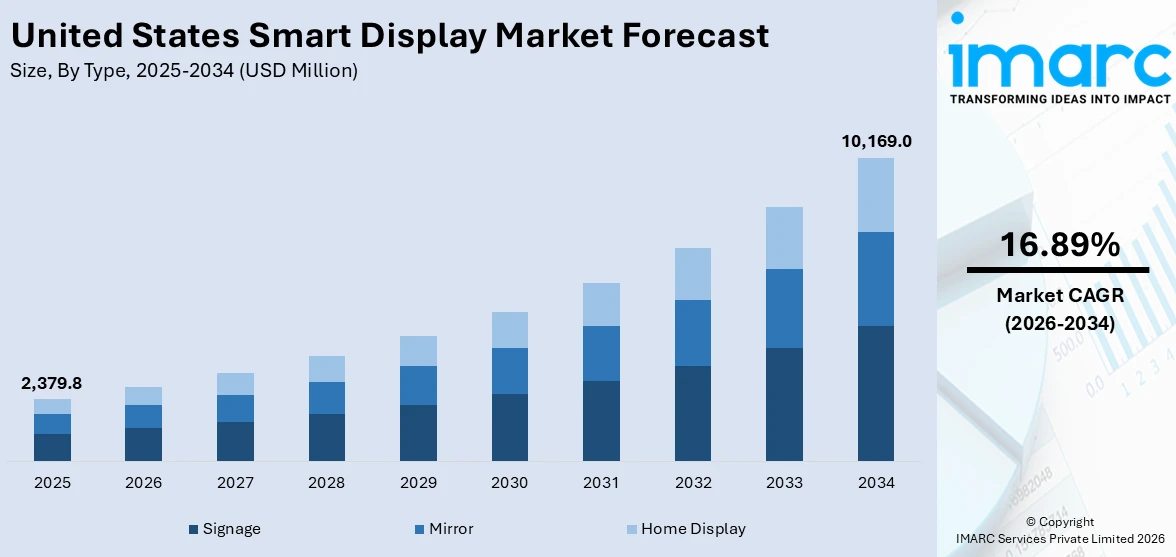
The United States smart display market size was valued at USD 2,379.8 Million in 2025 and is projected to reach USD 10,169.0 Million by 2034, growing at a compound annual growth rate of 16.89% from 2026-2034.
The market is driven by the rapid expansion of smart home ecosystems, growing deployment of digital signage across commercial environments, and continuous advancements in AI-integrated and ultra-high-definition display technologies. Increasing adoption of IoT-enabled devices, rising consumer preference for interactive visual interfaces, and robust investment in retail and enterprise communication solutions further amplify demand across the country, collectively reinforcing the growth trajectory of the United States smart display market share.
Key Takeaways and Insights:
- By Type: Signage dominates the market with a share of 44.2% in 2025, driven by widespread deployment across retail stores, transportation hubs, and commercial spaces seeking dynamic, targeted digital communication solutions.
- By Display Size: Between 32 and 52 inch leads the market with a share of 38.5% in 2025, owing to the ideal balance of screen visibility, installation versatility, and affordability across retail and indoor commercial applications.
- By Resolution: UHD represents the largest segment with a market share of 42.3% in 2025, driven by demand for superior visual clarity in commercial signage, automotive displays, and premium consumer electronics environments.
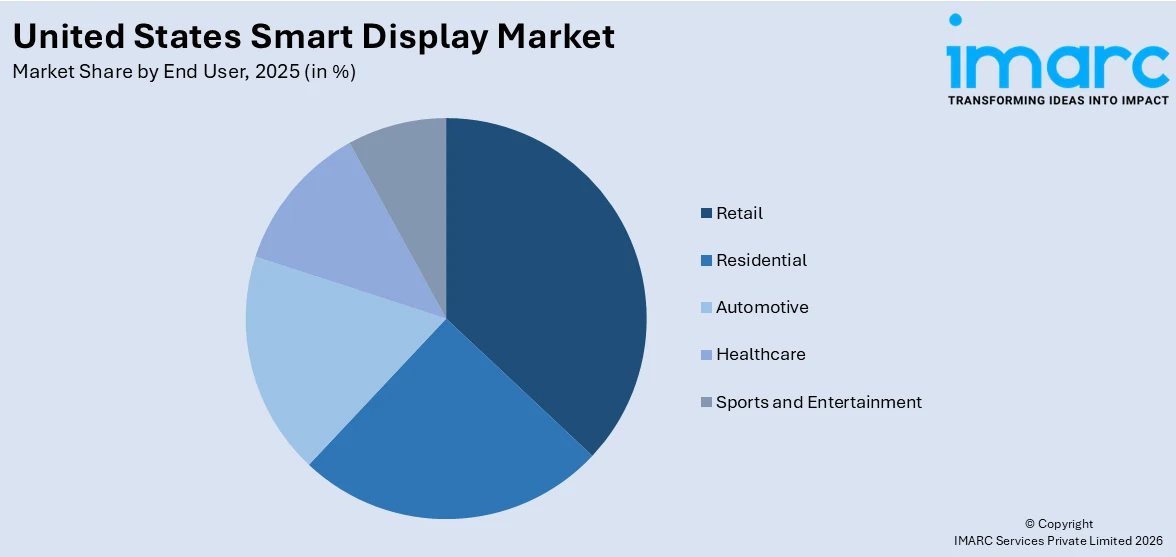
- By End User: Retail dominates the market with a share of 30.4% in 2025, owing to adoption of interactive digital displays to enhance customer engagement, promotional communication, and in-store marketing strategies.
- By Region: South leads the market with a share of 32.6% in 2025, driven by rapid commercial development, a high density of retail establishments, and significant corporate headquarters relocation activity.
- Key Players: The United States smart display market features a highly competitive landscape with global technology conglomerates and specialized display manufacturers competing across premium and mid-range price tiers, driving continuous product innovation and software ecosystem development. The market continues to attract new entrants targeting niche commercial verticals.
To get more information on this market Request Sample
The United States smart display market is experiencing robust and sustained growth, propelled by a confluence of technological, commercial, and consumer-driven forces. The rapid expansion of smart home ecosystems has created substantial demand for voice-activated, AI-integrated display devices that serve as centralized control hubs for connected environments. In November 2024, Amazon introduced the Echo Show 21 and upgraded Echo Show 15 with enhanced smart home hub capabilities, Wi-Fi 6E connectivity, and improved audio-visual performance to strengthen its smart display portfolio. Simultaneously, commercial sectors including retail, healthcare, and transportation are leveraging advanced digital signage solutions to deliver dynamic, personalized content experiences. The proliferation of ultra-high-definition display technologies, coupled with improvements in touchscreen interactivity and wireless connectivity, continues to elevate the functional appeal of smart displays across diverse end-user verticals. The growing emphasis on sustainability and energy efficiency in display technologies is further encouraging both consumer and enterprise adoption, reinforcing the market's expansive growth trajectory.
United States Smart Display Market Trends:
AI-Powered Personalization Reshaping Display Interactions
The integration of artificial intelligence (AI) into smart display systems is fundamentally transforming how users interact with visual interfaces across residential and commercial environments. AI-powered displays adapt content dynamically based on user behavior, preferences, and contextual signals, creating highly personalized experiences. In February 2025, Amazon introduced “Alexa+,” a generative AI-powered assistant capable of natural conversations, remembering user preferences, and autonomously managing smart home tasks across Echo Show devices. In smart homes, these devices anticipate user needs and proactively deliver relevant information, while in commercial settings they enable responsive audience engagement.
Retail Sector Accelerating Smart Signage Adoption
Retail operators across the United States are rapidly deploying smart digital signage solutions to enhance customer engagement and streamline in-store communication. Dynamic displays enable real-time promotional updates, interactive product exploration, and personalized shopper experiences that static signage cannot deliver. As per sources, Walmart announced the rollout of digital price labels across more than 2,300 U.S. stores, enabling real-time updates on over 120,000 products and significantly improving in-store operational efficiency. Cloud-connected display networks allow centralized content management across multiple store locations simultaneously, improving operational efficiency while ensuring brand consistency. The convergence of digital advertising technologies with in-store display platforms is creating measurable, data-driven marketing outcomes, reinforcing smart signage as a strategic priority within the evolving retail landscape.
Transition Toward Ultra-High-Definition and Next-Generation Display Technologies
Consumer and enterprise demand for superior visual clarity is driving a decisive shift toward ultra-high-definition and advanced display technologies across the United States smart display market. OLED and emerging microLED panels deliver exceptional contrast, vibrant color reproduction, and improved energy efficiency compared to conventional display solutions. In May 2024, Apple Inc. unveiled the iPad Pro featuring a breakthrough Ultra Retina XDR display built on tandem OLED technology, delivering exceptional brightness, contrast, and color precision. Healthcare, automotive, and premium retail segments are among the early adopters benefiting from enhanced imaging capabilities. As manufacturing costs for advanced panel technologies continue declining, broader market segments are gaining access to premium display performance, accelerating widespread industry transition.
Market Outlook 2026-2034:
The United States smart display market is poised for sustained and significant expansion, driven by continuous advancements in display technologies, deepening smart home penetration, and accelerating commercial adoption across retail, healthcare, and automotive sectors. Growing enterprise investment in AI-integrated signage solutions, expanding smart city infrastructure, and rising consumer demand for interactive visual interfaces will collectively sustain strong revenue momentum. The market's long-term outlook remains highly favorable, supported by robust innovation pipelines and broadening application opportunities across diverse end-user verticals nationwide. The market generated a revenue of USD 2,379.8 Million in 2025 and is projected to reach a revenue of USD 10,169.0 Million by 2034, growing at a compound annual growth rate of 16.89% from 2026-2034.
United States Smart Display Market Report Segmentation:
| Segment Category | Leading Segment | Market Share |
|---|---|---|
|
Type |
Signage |
44.2% |
|
Display Size |
Between 32 and 52 Inch |
38.5% |
|
Resolution |
UHD |
42.3% |
|
End User |
Retail |
30.4% |
|
Region |
South |
32.6% |
Type Insights:
- Signage
- Mirror
- Home Display
Signage dominates with a market share of 44.2% of the total United States smart display market in 2025.
Signage leads the United States smart display market, driven by its extensive deployment across retail environments, transportation hubs, corporate campuses, and public venues. Digital signage delivers dynamic, targeted content that enhances customer engagement, brand visibility, and real-time operational communication. In February 2026, retail leaders including Kroger and CVS expanded in-store digital screen deployments across hundreds of U.S. locations, enabling real-time promotional content and interactive product discovery to enhance shopper engagement. The versatility of signage formats, encompassing video walls, interactive kiosks, menu boards, and wayfinding displays which make them indispensable across high-traffic commercial environments.
Signage solutions are increasingly integrated with AI-powered audience analytics and programmatic advertising platforms, enabling businesses to deliver hyper-targeted content based on demographic signals, foot traffic patterns, and contextual data. This evolution transforms digital signage from a passive communication medium into an active, revenue-generating channel. Retailers, quick-service restaurants, and enterprise operators continue deepening investments as measurable return-on-investment models become more accessible and sophisticated, cementing signage as the most commercially impactful smart display format across the United States market landscape.
Display Size Insights:
- Below 32 Inch
- Between 32 and 52 Inch
- Above 52 Inch
Between 32 and 52 inch leads with a share of 38.5% of the total United States smart display market in 2025.
Between 32 and 52 inch leads the United States smart display market, reflecting its optimal balance of screen visibility, installation versatility, and cost efficiency. Displays within this range are extensively deployed across retail stores, healthcare facilities, educational institutions, and corporate environments where clear, readable content delivery is essential. Their compatibility with standard mounting infrastructure and commercial media players makes them the preferred choice for digital menu boards, wayfinding systems, and promotional communications across diverse indoor commercial settings.
This mid-range screen format effectively addresses the requirements of both enterprise and small-to-medium business operators seeking impactful visual communication without premium large-format investment. Their manageable physical footprint enables flexible installation across constrained or varied architectural environments. Ongoing improvements in panel resolution, energy efficiency, and touch interactivity within this size category continue enhancing their functional appeal. As businesses across multiple verticals modernize their communication infrastructure, the Between 32 and 52 inch segment remains the most strategically accessible and widely adopted display format in the market.
Resolution Insights:
- UHD
- FHD
- HD
UHD exhibits a clear dominance with a 42.3% share of the total United States smart display market in 2025.
UHD leads the United States smart display market, driven by accelerating demand for superior visual clarity across commercial signage, automotive displays, and premium consumer electronics. Ultra-high-definition panels deliver exceptional image resolution that enhances advertising effectiveness, product presentation quality, and viewer engagement across all deployment contexts. In January 2025, LG Electronics USA and BrightSign announced the launch of a new series of UHD digital signage displays for U.S. customers, integrating BrightSignOS to enable advanced content delivery across retail, transportation, and enterprise environments.
Declining component costs have progressively made UHD technology accessible beyond premium applications, enabling adoption across mid-market retail, healthcare, and enterprise communication segments. Advanced image processing capabilities embedded within modern display systems further optimize visual output, ensuring compelling performance regardless of source content resolution. As commercial operators prioritize differentiated customer experiences and enterprises invest in sophisticated communication environments, UHD displays have transitioned from aspirational to essential, solidifying their dominant position within the evolving United States smart display resolution landscape throughout the forecast period.
End User Insights:
Access the comprehensive market breakdown Request Sample
- Residential
- Retail
- Automotive
- Healthcare
- Sports and Entertainment
Retail leads with a market share of 30.4% of the total United States smart display market in 2025.
Retail segment leads the United States smart display market, reflecting the sector's extensive reliance on digital displays for customer engagement, promotional communication, and operational efficiency. From interactive product discovery kiosks and dynamic menu boards in food service venues to promotional aisle signage, retail operators leverage smart displays to create compelling, personalized shopping experiences. The convergence of digital-out-of-home advertising with in-store signage ecosystems enables sophisticated, data-driven marketing campaigns that measurably influence consumer purchasing decisions across brick-and-mortar environments nationwide.
Retail increasingly integrates smart displays within broader omnichannel marketing strategies, ensuring visual consistency and real-time campaign synchronization across physical and digital touchpoints. Cloud-connected display networks enable instant promotional updates across geographically distributed store portfolios, dramatically improving marketing agility and operational responsiveness. As competitive pressures intensify across retail verticals, investment in immersive, interactive display solutions has transitioned from discretionary to strategically essential, cementing retail as the most significant and commercially dynamic end-user segment within the United States smart display market.
Regional Insights:
- Northeast
- Midwest
- South
- West
South dominates with a market share of 32.6% of the total United States smart display market in 2025.
South region dominates the United States smart display market, supported by high commercial real estate activity, a dense concentration of retail establishments, and significant corporate headquarters relocation trends that amplify enterprise demand for advanced display solutions. Major metropolitan centers including Atlanta, Dallas, and Miami drive substantial signage deployments across transportation infrastructure, shopping districts, and entertainment venues. Pro-business regulatory environments encourage sustained technology investment and smart city initiatives, further reinforcing the South's leadership position within the national smart display landscape.
Expanding urban and suburban populations across Southern states generate growing consumer demand for smart home display devices, while large-scale retail development projects create consistent commercial signage opportunities for display manufacturers and solution providers. The region's rapidly developing healthcare infrastructure and expanding sports and entertainment venues further diversify smart display demand across multiple verticals. This combination of commercial vitality, population growth, and enterprise investment activity collectively establishes the South as the most commercially dynamic and opportunity-rich regional market within the United States smart display industry.
Market Dynamics:
Growth Drivers:
Why is the United States Smart Display Market Growing?
Rising Penetration of Smart Home Ecosystems
The rapid expansion of smart home adoption across American households is a primary catalyst driving growth within the United States smart display market. Consumers are deploying interconnected networks of smart speakers, thermostats, security cameras, and voice-activated displays that centralize home management through intuitive visual interfaces. As per sources, 48% of American homes reported owning at least one smart home device, reflecting substantial consumer penetration of connected technologies that underpin demand for visual smart displays. Smart displays serve as intelligent command centers, enabling seamless interaction with connected appliances and platforms. Growing emphasis on home automation for enhanced convenience, energy management, and security strengthens adoption significantly across diverse household income segments nationwide.
Expanding Applications Across Healthcare and Automotive Sectors
The growing deployment of smart display solutions within healthcare and automotive sectors is creating substantial new demand streams beyond traditional retail and residential applications. Healthcare facilities leverage advanced displays for patient wayfinding, appointment communication, and clinical coordination, improving operational efficiency and patient experience simultaneously. In 2025, U.S. provider ARcare expanded digital signage across 87 healthcare facilities using cloud‑connected displays to deliver dynamic patient outreach, service information, and regional messaging. Automotive manufacturers integrate sophisticated digital instrument clusters, infotainment screens, and rear-seat entertainment systems into new vehicle models as standard features. These sector-specific applications broaden the addressable market considerably, introducing new buyer categories with distinct performance requirements and long-term technology investment commitments.
Increasing Enterprise Investment in Digital Communication Infrastructure
Organizations across the United States are substantially increasing investment in intelligent digital communication infrastructure to enhance internal coordination, customer engagement, and brand communication effectiveness. Corporate campuses, financial institutions, hospitality operators, and educational institutions are replacing outdated static communication systems with networked smart display solutions offering real-time content flexibility and centralized management capabilities. In 2025, the University of Florida deployed a campus‑wide digital signage network with more than 200 screens, replacing static boards and enabling real‑time content updates for students, visitors, and staff. The growing recognition of smart displays as strategic communication assets rather than discretionary technology expenditures is accelerating procurement cycles and expanding average deployment scales, creating sustained enterprise-driven demand momentum throughout the forecast period.
Market Restraints:
What Challenges the United States Smart Display Market is Facing?
High Initial Investment and Total Cost of Ownership
The substantial upfront capital requirements associated with deploying premium smart display systems represent a significant restraint, particularly for small and medium-sized businesses with constrained technology budgets. High-resolution hardware, professional installation, software licensing, and ongoing technical support collectively create elevated total cost of ownership. Budget-constrained organizations frequently delay planned investments or opt for lower-specification alternatives, moderating market penetration across cost-sensitive segments.
Data Privacy and Cybersecurity Concerns
The network connectivity of smart display systems creates exposure to data privacy risks and cybersecurity vulnerabilities that generate hesitancy among enterprise buyers. Displays collecting audience analytics and user interaction data face growing regulatory scrutiny and heightened consumer privacy expectations. Potential system breaches risk compromising sensitive organizational communications, requiring costly additional security infrastructure investments that complicate procurement decisions and extend deployment timelines across commercial environments.
Technical Complexity and Integration Challenges
Managing large-scale smart display networks presents meaningful operational challenges for organizations lacking dedicated technical expertise. Integration with existing enterprise IT frameworks, inventory management platforms, and marketing systems often demands significant customization, extending implementation timelines and increasing project costs. The ongoing requirement for skilled personnel to configure, maintain, and update content management systems creates resource constraints that moderate broader smart display adoption across certain organizational segments.
Competitive Landscape:
The United States smart display market features a highly competitive landscape with global technology conglomerates, specialized display manufacturers, and innovative software platform providers competing across commercial signage, residential, and enterprise segments. Leading participants differentiate through continuous display technology innovation, AI integration capabilities, and strategic partnerships with retailers, systems integrators, and enterprise procurement organizations. Competitive positioning increasingly emphasizes end-to-end solutions encompassing hardware, content management software, and audience analytics services, reflecting a broader industry transition toward service-centric business models. Substantial research and development investment drives advances in resolution, energy efficiency, and connectivity, deepening customer relationships and sustaining competitive advantages across the evolving marketplace.
Recent Developments:
- In January 2025, SMART Technologies launched the SMART Board® Mini interactive podium, M Pro High Secure TAA Interactive Display, and SMART OneLaunch at ISE 2025, offering 4K UHD screens, AI-enabled video, and secure interactive tools to enhance hybrid learning, enterprise collaboration, and government applications across the United States.
United States Smart Display Market Report Coverage:
| Report Features | Details |
|---|---|
| Base Year of the Analysis | 2025 |
| Historical Period | 2020-2025 |
| Forecast Period | 2026-2034 |
| Units | Million USD |
| Scope of the Report | Exploration of Historical and Forecast Trends, Industry Catalysts and Challenges, Segment-Wise Historical and Predictive Market Assessment:
|
| Types Covered | Signage, Mirror, Home Display |
| Display Sizes Covered | Below 32 Inch, Between 32 and 52 Inch, Above 52 Inch |
| Resolutions Covered | UHD, FHD, HD |
| End Users Covered | Residential, Retail, Automotive, Healthcare, Sports and Entertainment |
| Regions Covered | Northeast, Midwest, South, West |
| Customization Scope | 10% Free Customization |
| Post-Sale Analyst Support | 10-12 Weeks |
| Delivery Format | PDF and Excel through Email (We can also provide the editable version of the report in PPT/Word format on special request) |
Frequently Asked Questions About the United States Smart Display Market Report
The United States smart display market size was valued at USD 2,379.8 Million in 2025.
The United States smart display market is expected to grow at a compound annual growth rate of 16.89% from 2026-2034 to reach USD 10,169.0 Million by 2034.
Signage held the largest United States smart display market share, driven by widespread commercial deployment across retail environments, transportation hubs, corporate campuses, and public venues seeking dynamic, targeted digital communication solutions.
Key factors driving the United States smart display market include expanding smart home ecosystems, accelerating retail digital signage deployment, advancements in UHD and AI-integrated display technologies, and growing demand for interactive commercial communication solutions across diverse industries nationwide.
Major challenges include high upfront investment costs, cybersecurity vulnerabilities in networked environments, complex content management requirements, limited technical expertise among smaller operators, and integration difficulties with existing enterprise IT infrastructure, collectively moderating adoption across cost-sensitive and resource-constrained buyer segments.
Need more help?
- Speak to our experienced analysts for insights on the current market scenarios.
- Include additional segments and countries to customize the report as per your requirement.
- Gain an unparalleled competitive advantage in your domain by understanding how to utilize the report and positively impacting your operations and revenue.
- For further assistance, please connect with our analysts.
 Request Customization
 Speak to an Analyst
 Request Brochure
 Inquire Before Buying
Benefits of Customization
- Personalize this research
- Triangulate with your data
- Get data as per your format and definition
- Gain a deeper dive into a specific application, geography, customer, or competitor
- Any level of personalization
Get in Touch With Us
UNITED STATES
Phone: +1-201-971-6302
INDIA
Phone: +91-120-433-0800
UNITED KINGDOM
Phone: +44-753-714-6104
Email: [email protected]
Client Testimonials




.webp)




.webp)













Related Reports

Choose your plan
*Please note that the prices mentioned below are starting prices for each bundle type. Kindly contact our team for further details.*
Single User License
- 1 User License, Access on 2 Devices
- PDF Report + Excel Dataset (Password Protected)
- Lifetime Access
- No Printing Rights
- 10% Free Report Customization
- 10–12 Weeks of Analyst Support
Five User License
- Access for 5 Users, 2 Devices per User
- PDF Report + Excel Dataset (Password Protected)
- Lifetime Access
- Dedicated Account Manager
- 12–14 Weeks of Analyst Support
- No Printing Rights
- 15% Free Report Customization
- 25% Discount on Your Next Purchase
Corporate User License
- Unlimited User Access (Within Your Organization)
- PDF Report + Excel Dataset
- Lifetime Access
- Dedicated Account Manager
- 14–20 Weeks of Analyst Support
- No Printing Rights
- 20% Free Report Customization
- 30% Discount on Your Next Purchase
Essential Insights
What's included:
3 reports
- Lifetime Access
- PDF Reports
- Excel Datasets
- 2 Weeks of Free Analyst Support
- 2 User Licenses
- Access on 2 Devices
- Printing Rights
- Complimentary PowerPoint (PPT) Version
- Complimentary License Upgrade
Professional Access
What's included:
5 reports
- Lifetime Access
- PDF Reports
- Excel Datasets
- 8 Weeks of Free Analyst Support
- 2 User Licenses
- Access on 2 Devices
- Printing Rights
- Complimentary PowerPoint (PPT) Version
- Complimentary License Upgrade
Business Advantage
What's included:
8 reports
- Lifetime Access
- PDF Reports
- Excel Datasets
- 14 Weeks of Free Analyst Support
- 2 User Licenses
- Access on 2 Devices
- Printing Rights
- Complimentary PowerPoint (PPT) Version
- Complimentary License Upgrade
Enterprise Intelligence
What's included:
10 reports
- Lifetime Access
- PDF Reports
- Excel Datasets
- 20 Weeks of Free Analyst Support
- 2 User Licenses
- Access on 2 Devices
- Printing Rights
- Complimentary PowerPoint (PPT) Version
- Complimentary License Upgrade