
United States Smart TV Market Size, Share, Trends and Forecast by Resolution Type, Screen Size, Screen Type, Technology, Platform, Distribution Channel, Application, and Region, 2026-2034
United States Smart TV Market Summary:
The United States smart TV market size was valued at USD 73,118.04 Million in 2025 and is projected to reach USD 86,181.27 Million by 2034, growing at a compound annual growth rate of 1.84% from 2026-2034.
The market for smart TVs in the US is steadily growing as customers want cutting-edge display technologies and embrace streaming-centric entertainment. Viewing habits across the country are changing due to the growing popularity of integrated home entertainment systems, the spread of over-the-top video providers, and the increasing use of linked devices. Households looking for immersive viewing experiences continue to be drawn to innovations in display resolution, voice-activated controls, and seamless ecosystem connectivity, establishing the US as a developed but developing hub for smart TV adoption and US smart TV market share growth.
Key Takeaways and Insights:
- By Resolution Type: 4K UHD TV dominates the market with a share of 55% in 2025, owing to its ability to deliver exceptional picture clarity and immersive viewing experiences at increasingly accessible price points. Rising availability of ultra-high-definition streaming content and consumer preference for superior visual quality are fueling continued segment expansion.
- By Screen Size: 46 to 55 inches leads the market with a share of 31% in 2025. This dominance is driven by the optimal balance between immersive viewing and practical space requirements that this screen size category offers for typical American living rooms and home entertainment setups.
- By Screen Type: Flat exhibits a clear dominance in the market with 88% share in 2025, reflecting strong consumer preference for versatile mounting options, streamlined aesthetics, and wide viewing angles that flat-panel designs provide across diverse residential and commercial environments.
- By Technology: Light emitting diode (LED) prevails the market with a share of 50% in 2025, owing to its energy efficiency, competitive pricing, and reliable performance that appeals to cost-conscious consumers seeking quality displays without premium pricing of advanced technologies.
- By Platform: Android represents the largest segment with a market share of 31% in 2025, because of its vast application ecosystem, easy-to-use interface, and smooth integration with Google services, which appeal to American homes with digital devices looking for content accessibility.
- By Distribution Channel: Online comprises the largest segment with 54% share in 2025, reflecting the convenience of e-commerce platforms, competitive pricing, extensive product comparisons, and doorstep delivery that appeal to technology-savvy consumers across the United States.
- By Application: Residential holds the largest share at 78% in 2025, driven by growing consumer demand for home entertainment solutions, streaming content consumption, and the central role smart televisions play in modern American households for family entertainment and connectivity.
- By Region: South comprises the largest region with 35% share in 2025, driven by the substantial population concentration across states like Texas, Florida, and Georgia, combined with rising disposable incomes and strong consumer appetite for home entertainment upgrades.
- Key Players: Key players drive the United States smart TV market by expanding product portfolios, improving display technologies, and strengthening nationwide distribution. Their investments in research and development, strategic partnerships, and competitive pricing strategies boost awareness and accelerate adoption across diverse consumer segments. Some of the key players operating in the market include Koninklijke Philips N.V., LG Electronics Inc., Samsung Electronics Co. Ltd, Sharp Electronics Corporation, and Sony Electronics Inc.
As customer choices and technical advancements change the home entertainment scene, the US smart TV industry is growing. By leveraging cutting-edge display technologies, better audio systems, and smooth integration with smart home ecosystems, manufacturers are concentrating on providing better picture quality. In an increasingly competitive market, voice-activated controls and content recommendations driven by artificial intelligence are becoming typical features that set premium products apart. As households favor on-demand content access over traditional broadcasting forms, the fundamental transition toward streaming-based entertainment consumption continues to accelerate. In order to meet the increasing demand from consumers, hardware manufacturers are expanding the capabilities of their smart TVs, while traditional broadcasters and content suppliers are accelerating their digital plans. Technology companies and content platforms are working together strategically to create integrated entertainment experiences that encourage replacement cycles and draw in new smart TV buyers from a variety of demographic groups across the country. Consumer interest in upgrading current television sets with cutting-edge smart functionality that improves everyday entertainment routines is being strengthened by rising expectations for individualized viewing experiences and the growing availability of high-quality streaming material.
United States Smart TV Market Trends:
Streaming Dominance Reshaping Viewing Habits
There is an extraordinary demand for smart televisions with integrated streaming capabilities as a result of the growth of streaming platforms, which are radically changing how American families view television programming. Manufacturers are pre-installing popular apps and optimizing user interfaces for easy content discovery as consumers prioritize direct access to over-the-top services without the need for external devices. The adoption of smart TVs is being accelerated by this shift in behavior toward on-demand viewing, which is bolstering the growth of the US smart TV market.
Integration with Smart Home Ecosystems
Voice-controlled operation and smooth connectivity with other intelligent devices throughout the home are made possible by smart televisions, which are increasingly acting as pivotal hubs in linked home environments. In order to improve user convenience and extend functionality beyond conventional entertainment uses, manufacturers are integrating compatibility with popular voice assistants and smart home protocols. Technology-savvy customers looking for unified control over their home automation systems and entertainment experiences through a single interface are drawn to this ecosystem integration. Upgrades to smart televisions are becoming more and more popular as entertainment and home control features come together.
Advancement in Premium Display Technologies
As manufacturers strive to provide better visual experiences with organic light-emitting diode, quantum dot, and mini-LED panels, the television market is witnessing tremendous innovation in display technology. Brighter images, deeper contrast ratios, and more accurate color reproduction are made possible by these developments, which appeal to discriminating customers looking for cinematic excellence in their homes. Premium technologies are becoming more widely available to broad audiences due to declining price premiums for sophisticated displays. The appeal of next-generation display improvements is further reinforced by enhanced motion handling and gaming capabilities.
Market Outlook 2026-2034:
The United States smart TV market is poised for steady expansion as consumer demand for enhanced home entertainment solutions continues to strengthen alongside technological advancements in display quality and connectivity features. Manufacturers are focusing on artificial intelligence integration, improved gaming capabilities, and energy-efficient designs to differentiate their offerings and capture market share. The market generated a revenue of USD 73,118.04 Million in 2025 and is projected to reach a revenue of USD 86,181.27 Million by 2034, growing at a compound annual growth rate of 1.84% from 2026-2034. The expanding availability of ultra-high-definition content, growing smart home adoption, and replacement demand from households upgrading aging television sets are expected to sustain market momentum throughout the forecast period.
United States Smart TV Market Report Segmentation:
|
Segment Category |
Leading Segment |
Market Share |
|
Resolution Type |
4K UHD TV |
55% |
|
Screen Size |
46 to 55 Inches |
31% |
|
Screen Type |
Flat |
88% |
|
Technology |
Light Emitting Diode (LED) |
50% |
|
Platform |
Android |
31% |
|
Distribution Channel |
Online |
54% |
|
Application |
Residential |
78% |
|
Region |
South |
35% |
Resolution Type Insights:
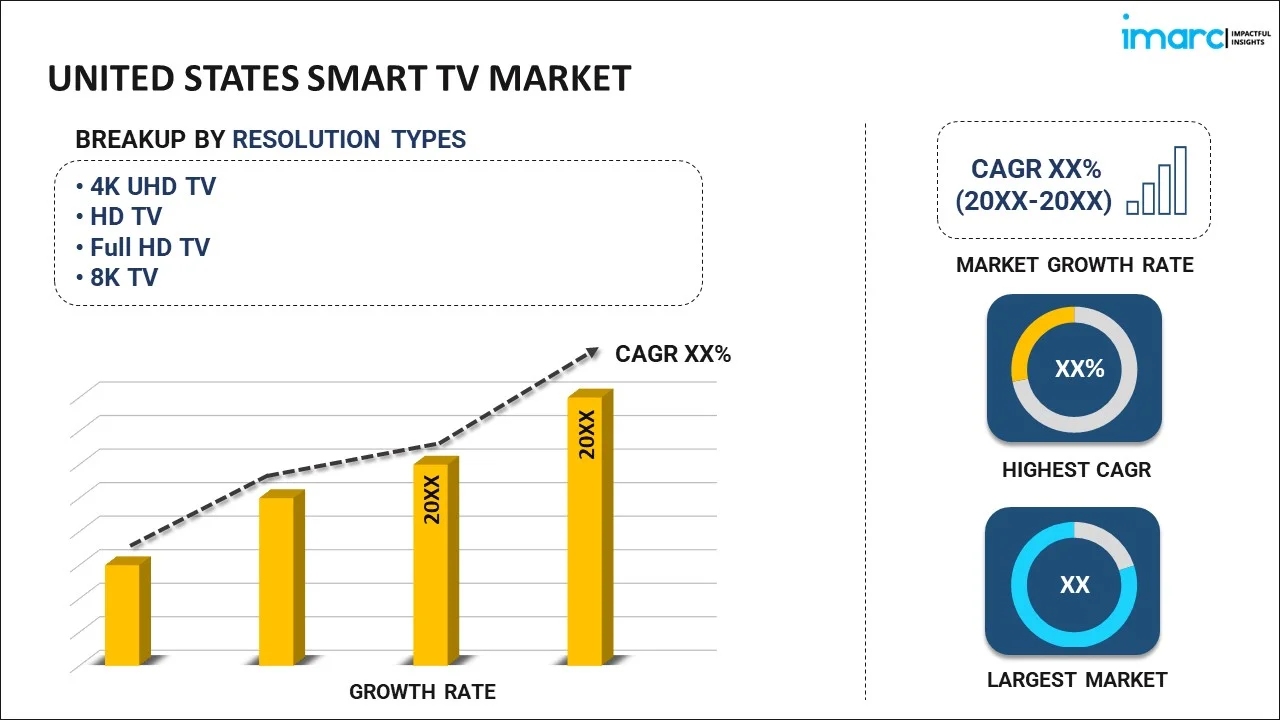
To get detailed segment analysis of this market, Request Sample
- 4K UHD TV
- HD TV
- Full HD TV
- 8K TV
4K UHD TV dominates with a market share of 55% of the total United States smart TV market in 2025.
The 4K UHD TV segment continues to lead the resolution category as consumers increasingly prioritize ultra-high-definition viewing experiences for streaming content, gaming, and home entertainment applications. The segment benefits from widespread availability of native 4K content across major streaming platforms combined with competitive pricing that has made this resolution accessible to mainstream buyers. American households have broadly embraced 4K television technology, reflecting the segment's maturation and continued consumer preference for superior picture clarity that enhances everyday viewing experiences.
Consumer demand for 4K UHD televisions is further supported by advancements in upscaling technologies that enhance lower-resolution content to near-native quality. Manufacturers continue to expand their 4K offerings across various price points, enabling budget-conscious consumers to access premium viewing experiences without significant financial investment. The gaming industry's embrace of 4K resolution, particularly with latest-generation consoles supporting native ultra-high-definition output, has created additional demand among entertainment enthusiasts seeking optimal visual performance from their home setups. Growing content libraries and declining hardware costs continue reinforcing segment leadership.
Screen Size Insights:
- Below 32 Inches
- 32 to 45 Inches
- 46 to 55 Inches
- 56 to 65 Inches
- Above 65 Inches
46 to 55 inches leads with a share of 31% of the total United States smart TV market in 2025.
The 46 to 55 inches screen size segment maintains its leadership position by offering optimal viewing dimensions for typical American living spaces without overwhelming room layouts. This screen size category provides immersive entertainment experiences while remaining practical for wall mounting and furniture integration in standard residential settings. The segment attracts both first-time buyers seeking reasonable screen real estate and upgraders replacing older, smaller televisions with more capable displays that enhance content enjoyment. Modern interior design preferences favor this balanced screen dimension that complements contemporary living room aesthetics.
Retailers report that televisions within this size range consistently deliver strong sales performance due to their versatility across different room configurations and viewing distances. The pricing structure of this segment positions it favorably between compact models and premium large-format displays, appealing to value-conscious consumers seeking meaningful screen size improvements. Families particularly favor this size category for shared viewing experiences that accommodate multiple viewers comfortably. The segment also benefits from widespread availability across brands and technology tiers, ensuring consumers can find suitable options regardless of budget constraints or feature preferences.

Screen Type Insights:
- Flat
- Curved
Flat exhibits a clear dominance with 88% share of the total United States smart TV market in 2025.
The flat screen type segment overwhelmingly dominates consumer preferences due to its practical mounting flexibility, consistent viewing quality from multiple angles, and seamless integration with contemporary interior design aesthetics. Flat-panel televisions offer uniform picture quality across wide seating arrangements, making them ideal for family rooms and spaces where multiple viewers watch simultaneously from different positions. The segment's dominance reflects consumer prioritization of functionality and versatility over specialized viewing experiences. Modern home layouts increasingly favor streamlined visual elements that flat screens deliver effortlessly.
Manufacturing efficiencies in flat-panel production have driven competitive pricing that further reinforces consumer preference for this screen configuration. The widespread availability of wall mounting solutions and furniture designed specifically for flat televisions has created an ecosystem that supports continued segment leadership. Retailers indicate that flat-screen models consistently outsell curved alternatives across all price points, reflecting practical considerations that influence household purchasing decisions in the competitive television marketplace. Additionally, flat screens accommodate varied room lighting conditions more effectively and integrate seamlessly with soundbars and home theater accessories that complement modern entertainment setups.
Technology Insights:
- Liquid Crystal Display (LCD)
- Light Emitting Diode (LED)
- Organic Light Emitting Diode (OLED)
- Quantum Dot Light Emitting Diode (QLED)
Light emitting diode (LED) represents the leading segment with 50% share of the total United States smart TV market in 2025.
LED technology maintains market leadership through its combination of reliable performance, energy efficiency, and competitive pricing that appeals to mainstream consumers seeking quality displays without premium costs. The technology offers excellent brightness levels suitable for varied lighting conditions and delivers consistent picture quality across extended usage periods. LED televisions provide entry points for budget-conscious households while offering adequate performance for streaming, broadcasting, and casual gaming applications. The technology continues evolving with improved backlighting systems that enhance visual performance without significant price increases.
The mature manufacturing infrastructure supporting LED production enables competitive pricing that sustains market share despite growing interest in advanced display technologies. Modern LED televisions consume significantly less power compared to previous-generation displays, appealing to environmentally conscious consumers and those seeking reduced electricity costs. The technology's proven reliability and broad availability across retail channels reinforce its position as the dominant choice for value-oriented television purchases nationwide. Consistent manufacturer support ensures ongoing software compatibility and feature enhancements that extend product lifespans and deliver sustained value for household investments in LED television technology.
Platform Insights:
- Android
- Roku
- WebOS
- Tizen OS
- iOS
- MyHomeScreen
- Others
Android dominates the market with a market share of 31% of the total United States smart TV market in 2025.
The Android platform leads smart TV operating systems through its extensive application ecosystem, intuitive interface design, and seamless integration with services that American consumers widely utilize daily. The platform offers access to thousands of applications enabling personalized entertainment experiences tailored to individual preferences and viewing habits. Android-powered televisions benefit from regular software updates that enhance functionality and security while maintaining compatibility with evolving streaming services and smart home protocols. Continuous platform improvements ensure long-term relevance and feature parity with emerging entertainment technologies.
Consumer familiarity with Android through smartphone usage translates to comfortable adoption of the platform on television devices, reducing learning curves for new smart TV owners. Major television manufacturers have increasingly adopted Android TV platforms, expanding availability across various price segments and brand offerings throughout the marketplace. The platform's voice search capabilities enable hands-free content discovery and smart home control, addressing consumer demand for convenient, connected entertainment experiences. Cross-device synchronization features allow seamless content sharing between smartphones, tablets, and televisions, creating unified entertainment ecosystems that enhance overall user satisfaction and platform loyalty.
Distribution Channel Insights:
- Offline
- Online
Online holds the largest share with 54% of the total United States smart TV market in 2025.
The online distribution channel commands majority market share as consumers increasingly prefer the convenience, competitive pricing, and extensive product selection offered by e-commerce platforms for television purchases. Digital marketplaces enable comprehensive specification comparisons, customer reviews, and price tracking that empower informed purchasing decisions. Major online retailers offer free delivery, easy returns, and installation services that reduce traditional barriers to remote purchasing of large consumer electronics. Enhanced logistics networks have significantly improved delivery timelines and product handling for oversized items.
The channel's dominance reflects broader retail transformation as technology-savvy American consumers embrace digital shopping experiences for high-value electronics. According to Best Buy's reporting, the retailer processes approximately 70% of online orders directly from store locations, demonstrating how traditional retailers have adapted fulfillment strategies to capture e-commerce demand. Traditional retailers have adapted fulfillment strategies to capture e-commerce demand by integrating online ordering with store-based inventory and pickup options. Promotional events, bundled offerings, and subscription incentives offered by online platforms continue to attract price-sensitive consumers seeking maximum value from their smart television investments. The ability to research extensively before purchasing, combined with flexible payment options and protection plans available online, reinforces consumer confidence in digital channels for significant household electronics acquisitions.
Application Insights:
- Residential
- Commercial
Residential accounts for the highest revenue with 78% share of the total United States smart TV market in 2025.
The residential application segment dominates as smart televisions have become central entertainment hubs within American households, serving diverse functions from streaming content consumption to gaming and video communications. Families increasingly rely on smart televisions for shared entertainment experiences, educational content access, and connectivity with extended family through video calling applications. The segment benefits from multi-room television ownership patterns as households equip bedrooms, family rooms, and recreation spaces with connected displays. Growing emphasis on home-based leisure activities continues reinforcing demand for quality entertainment systems across diverse household configurations.
Home renovation and remodeling activities frequently include television upgrades as homeowners invest in enhanced entertainment capabilities for modernized living spaces. The segment's sustained growth reflects cultural shifts toward home-based entertainment consumption that accelerated during recent years and continues to influence household technology investment priorities. Rising preferences for personalized viewing experiences within private residential settings further strengthen segment performance. Additionally, remote work arrangements have increased time spent at home, encouraging households to invest in premium smart television technology that enhances daily entertainment routines and supports flexible lifestyle patterns across generations.
Regional Insights:
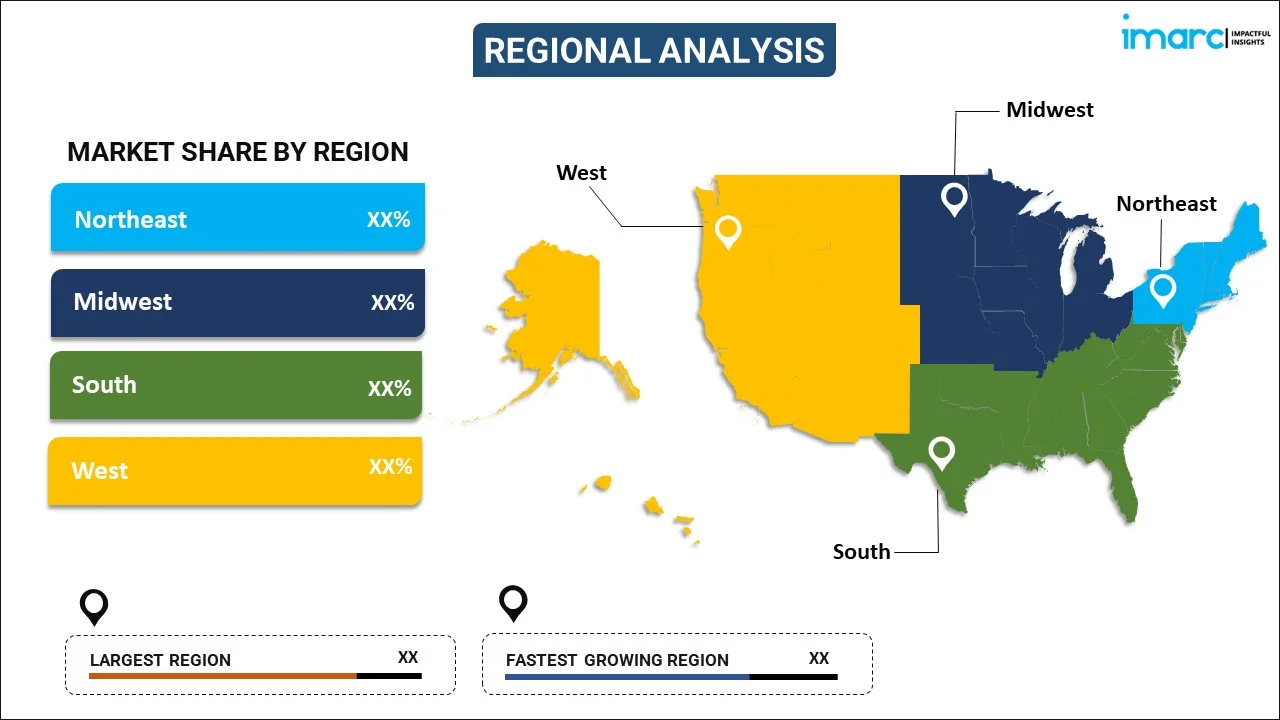
To get detailed regional analysis of this market, Request Sample
- Northeast
- Midwest
- South
- West
South leads the market with a 35% share of the total United States smart TV market in 2025.
The South region maintains its leading position through significant population concentration across major metropolitan areas combined with strong economic growth supporting consumer electronics purchases. The region's demographic profile includes substantial young families and working professionals who prioritize home entertainment investments and technology upgrades. Rapid suburban development and new home construction across Southern states create replacement and first-time purchase demand that sustains regional market leadership. Population migration patterns continue favoring Southern states, further expanding the consumer base for smart television products.
Rising disposable incomes and favorable cost of living conditions in many Southern markets enable households to allocate discretionary spending toward premium home entertainment systems. The region benefits from extensive retail presence including major electronics chains and online fulfillment centers that ensure product availability and competitive pricing. Cultural preferences for home-based entertainment and family gatherings contribute to above-average smart television adoption rates compared to other United States regions. Additionally, warm climate conditions encourage indoor leisure activities during summer months, reinforcing household investment in quality entertainment systems that enhance domestic comfort and family connectivity throughout the year.
Market Dynamics:
Growth Drivers:
Why is the United States Smart TV Market Growing?
Proliferation of Streaming Services and Cord-Cutting Trends
The sustained migration of American consumers from traditional cable and satellite subscriptions to streaming-based entertainment is fundamentally reshaping television purchasing decisions and driving demand for smart televisions with integrated streaming capabilities. Households are increasingly prioritizing direct access to over-the-top content platforms without requiring external devices, prompting television manufacturers to optimize their smart TV ecosystems for seamless content discovery and consumption. The expansion of streaming service portfolios, including both subscription and advertising-supported tiers, provides diverse entertainment options that justify smart television investments. According to Nielsen's reporting, streaming viewership in the United States reached 44.8% of total television usage in May 2025, surpassing combined broadcast and cable viewing for the first time in history, representing a transformational milestone that underscores consumer preference shifts. This behavioral transformation continues accelerating replacement cycles as households seek television sets equipped with modern smart platforms capable of supporting evolving streaming ecosystems.
Integration with Connected Home Ecosystems
Smart televisions are increasingly serving as central control hubs within connected home environments, enabling voice-commanded operation and seamless communication with other intelligent devices throughout the household. Manufacturers have embedded compatibility with major voice assistants including Amazon Alexa and Google Assistant, transforming televisions from passive display devices into interactive smart home controllers. This ecosystem integration appeals to technology-forward consumers seeking unified management of lighting, security, climate control, and entertainment systems through their television interfaces. The convergence of entertainment and home automation functionality expands the value proposition of smart televisions beyond traditional viewing, justifying premium pricing and accelerating household upgrade decisions.
Technological Advancements in Display Quality and Features
Continuous innovation in display technologies including organic light-emitting diodes, quantum dots, and mini-LED backlighting is driving consumer interest in television upgrades that deliver meaningfully improved visual experiences. Manufacturers are introducing enhanced brightness levels, deeper contrast ratios, wider color gamuts, and improved high dynamic range performance that distinguish new models from existing household televisions. These technological advancements create compelling upgrade propositions for households seeking cinema-quality viewing experiences in domestic settings. Gaming capabilities have emerged as significant purchase drivers as latest-generation consoles support advanced features including variable refresh rates, automatic low latency modes, and high frame rate outputs that require compatible display technology. In July 2025, Samsung introduced its 2025 OLED TV lineup in the United States featuring Samsung Vision AI technology with advanced glare-free screens and up to 30% brightness improvements, demonstrating ongoing manufacturer commitment to display technology advancement.
Market Restraints:
What Challenges the United States Smart TV Market is Facing?
Limited Native Ultra-High-Definition Content Availability
Despite widespread adoption of 4K and emerging 8K televisions, native ultra-high-definition content remains limited across many broadcasting and streaming platforms, reducing the perceived value proposition for resolution upgrades. Content creators and distributors face significant production and infrastructure investments required to capture, process, and deliver native high-resolution programming at scale. This content gap between display capabilities and available programming can dampen consumer enthusiasm for premium-priced televisions when immediate visual benefits remain constrained by source material limitations.
Intensifying Price Competition from Budget Manufacturers
Aggressive pricing strategies from emerging manufacturers are compressing profit margins across the smart television industry and challenging established brands to maintain value propositions that justify premium positioning. Budget-oriented brands have achieved substantial quality improvements while maintaining significantly lower price points, attracting cost-conscious consumers who prioritize affordability over brand prestige. This competitive pressure constrains industry revenue growth and challenges manufacturers to differentiate through features and services rather than core display functionality.
Data Privacy and Cybersecurity Concerns
Growing consumer awareness of data collection practices embedded within smart television platforms raises privacy concerns that may influence purchasing decisions and feature utilization patterns. Smart televisions collect viewing behavior, voice commands, and usage patterns that some consumers perceive as intrusive surveillance within private household spaces. Publicized security vulnerabilities and data breach incidents across connected device categories have heightened consumer skepticism about smart home technologies, potentially slowing adoption among privacy-conscious households.
Competitive Landscape:
The United States smart TV market exhibits intense competition as established global manufacturers and emerging brands vie for consumer attention through continuous technological innovation and strategic pricing. Leading companies are differentiating through advanced display technologies, proprietary smart platforms, and integrated ecosystem experiences that create brand loyalty beyond individual product purchases. Competition extends beyond hardware specifications to encompass content partnerships, advertising revenue models, and smart home integration capabilities that enhance long-term consumer value. Manufacturers are investing significantly in research and development to advance display quality, energy efficiency, and artificial intelligence-powered features that address evolving consumer expectations and establish competitive advantages in the crowded marketplace.
Some of the key players include:
- Koninklijke Philips N.V.
- LG Electronics Inc.
- Samsung Electronics Co. Ltd
- Sharp Electronics Corporation
- Sony Electronics Inc.
United States Smart TV Market Report Coverage:
| Report Features | Details |
|---|---|
| Base Year of the Analysis | 2025 |
| Historical Period | 2020-2025 |
| Forecast Period | 2026-2034 |
| Units | Million USD |
| Scope of the Report |
Exploration of Historical and Forecast Trends, Industry Catalysts and Challenges, Segment-Wise Historical and Predictive Market Assessment:
|
| Resolution Types Covered | 4K UHD TV, HD TV, Full HD TV, 8K TV |
| Screen Sizes Covered | Below 32 Inches, 32 to 45 Inches, 46 to 55 Inches, 56 to 65 Inches, Above 65 Inches |
| Screen Types Covered | Flat, Curved |
| Technologies Covered | Liquid Crystal Display (LCD), Light Emitting Diode (LED), Organic Light Emitting Diode (OLED), Quantum Dot Light Emitting Diode (QLED) |
| Platforms Covered | Android, Roku, WebOS, Tizen OS, iOS, MyHomeScreen, Others |
| Distribution Channels Covered | Offline, Online |
| Applications Covered | Residential, Commercial |
| Regions Covered | Northeast, Midwest, South, West |
| Companies Covered | Koninklijke Philips N.V., LG Electronics Inc., Samsung Electronics Co. Ltd, Sharp Electronics Corporation, Sony Electronics Inc., etc. |
| Customization Scope | 10% Free Customization |
| Post-Sale Analyst Support | 10-12 Weeks |
| Delivery Format | PDF and Excel through Email (We can also provide the editable version of the report in PPT/Word format on special request) |
Frequently Asked Questions About the United States Smart TV Market Report
The United States smart TV market size was valued at USD 73,118.04 Million in 2025.
The United States smart TV market is expected to grow at a compound annual growth rate of 1.84% from 2026-2034 to reach USD 86,181.27 Million by 2034.
4K UHD TV dominated the market with a share of 55%, driven by exceptional picture clarity, widespread streaming content availability, and increasingly accessible pricing that appeals to mainstream American consumers.
Key factors driving the United States smart TV market include proliferation of streaming services, integration with smart home ecosystems, technological advancements in display technologies, and growing consumer preference for connected entertainment experiences.
Major challenges include limited native ultra-high-definition content availability, intensifying price competition from budget manufacturers, data privacy and cybersecurity concerns, and market saturation in mature household segments.
Need more help?
- Speak to our experienced analysts for insights on the current market scenarios.
- Include additional segments and countries to customize the report as per your requirement.
- Gain an unparalleled competitive advantage in your domain by understanding how to utilize the report and positively impacting your operations and revenue.
- For further assistance, please connect with our analysts.
 Request Customization
 Speak to an Analyst
 Request Brochure
 Inquire Before Buying
Benefits of Customization
- Personalize this research
- Triangulate with your data
- Get data as per your format and definition
- Gain a deeper dive into a specific application, geography, customer, or competitor
- Any level of personalization
Get in Touch With Us
UNITED STATES
Phone: +1-201-971-6302
INDIA
Phone: +91-120-433-0800
UNITED KINGDOM
Phone: +44-753-714-6104
Email: [email protected]
Client Testimonials




.webp)




.webp)













Related Reports

Choose your plan
*Please note that the prices mentioned below are starting prices for each bundle type. Kindly contact our team for further details.*
Single User License
- 1 User License, Access on 2 Devices
- PDF Report + Excel Dataset (Password Protected)
- Lifetime Access
- No Printing Rights
- 10% Free Report Customization
- 10–12 Weeks of Analyst Support
Five User License
- Access for 5 Users, 2 Devices per User
- PDF Report + Excel Dataset (Password Protected)
- Lifetime Access
- Dedicated Account Manager
- 12–14 Weeks of Analyst Support
- No Printing Rights
- 15% Free Report Customization
- 25% Discount on Your Next Purchase
Corporate User License
- Unlimited User Access (Within Your Organization)
- PDF Report + Excel Dataset
- Lifetime Access
- Dedicated Account Manager
- 14–20 Weeks of Analyst Support
- No Printing Rights
- 20% Free Report Customization
- 30% Discount on Your Next Purchase
Essential Insights
What's included:
3 reports
- Lifetime Access
- PDF Reports
- Excel Datasets
- 2 Weeks of Free Analyst Support
- 2 User Licenses
- Access on 2 Devices
- Printing Rights
- Complimentary PowerPoint (PPT) Version
- Complimentary License Upgrade
Professional Access
What's included:
5 reports
- Lifetime Access
- PDF Reports
- Excel Datasets
- 8 Weeks of Free Analyst Support
- 2 User Licenses
- Access on 2 Devices
- Printing Rights
- Complimentary PowerPoint (PPT) Version
- Complimentary License Upgrade
Business Advantage
What's included:
8 reports
- Lifetime Access
- PDF Reports
- Excel Datasets
- 14 Weeks of Free Analyst Support
- 2 User Licenses
- Access on 2 Devices
- Printing Rights
- Complimentary PowerPoint (PPT) Version
- Complimentary License Upgrade
Enterprise Intelligence
What's included:
10 reports
- Lifetime Access
- PDF Reports
- Excel Datasets
- 20 Weeks of Free Analyst Support
- 2 User Licenses
- Access on 2 Devices
- Printing Rights
- Complimentary PowerPoint (PPT) Version
- Complimentary License Upgrade