
United States Tire Market Size, Share, Trends and Forecast by Design, End-Use, Vehicle Type, Distribution Channel, Season, and Region, 2026-2034
United States Tire Market Size, Share, Trends & Forecast (2026-2034)
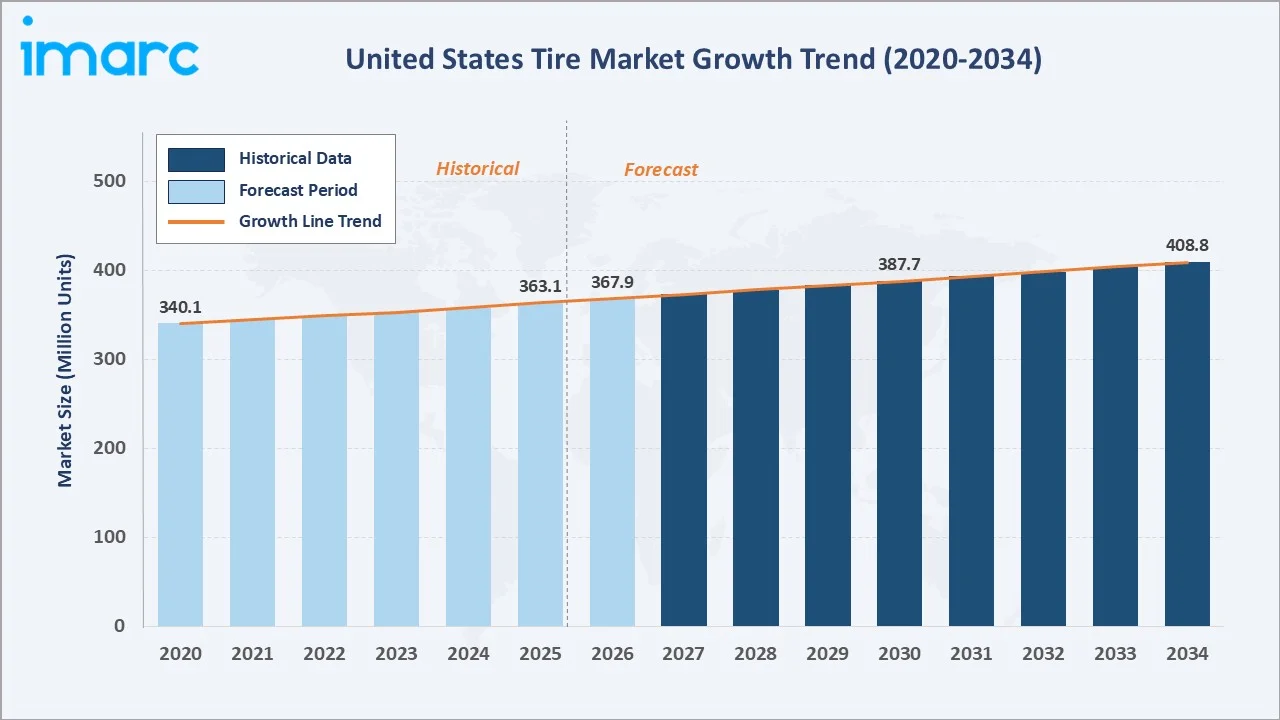
The United States tire market grew from 363.1 Million Units in 2025 to 367.9 Million Units in 2026 and is projected to reach 408.8 Million Units by 2034, growing at a CAGR of 1.32% during 2026-2034. The market outlook is influenced by evolving consumer preferences, technological advancements in tire design, and the increasing adoption of high-performance and specialized tire products.
Radial leads the design segment at 72.5%, replacement dominates the end use segment at 71.5%, and South commands 37.5% regional share.
Market Snapshot
|
Metric |
Value |
|
Base Year Market Size (2025) |
363.1 Million Units |
|
Market Size (2026) |
367.9 Million Units |
|
Forecast Market Size (2034) |
408.8 Million Units |
|
CAGR (2026-2034) |
1.32% |
|
Base Year |
2025 |
|
Historical Period |
2020-2025 |
|
Forecast Period |
2026-2034 |
|
Largest Region |
South (37.5%, 2025) |
|
Second Largest Region |
West (24.5%, 2025) |
|
Leading Design |
Radial (72.5%, 2025) |
|
Leading End Use |
Replacement (71.5%, 2025) |
The United States tire market size increased from 340.1 Million Units in 2020 to 363.1 Million Units in 2025 and is estimated to reach 367.9 Million Units in 2026. The market is further expected to grow to 387.7 Million Units in 2030 and 408.8 Million Units by 2034. The market growth is supported by continued fleet expansion, steady replacement demand driven by an aging vehicle fleet, and deepening penetration of radial tires across all vehicle categories.
To get more information on this market, Request Sample
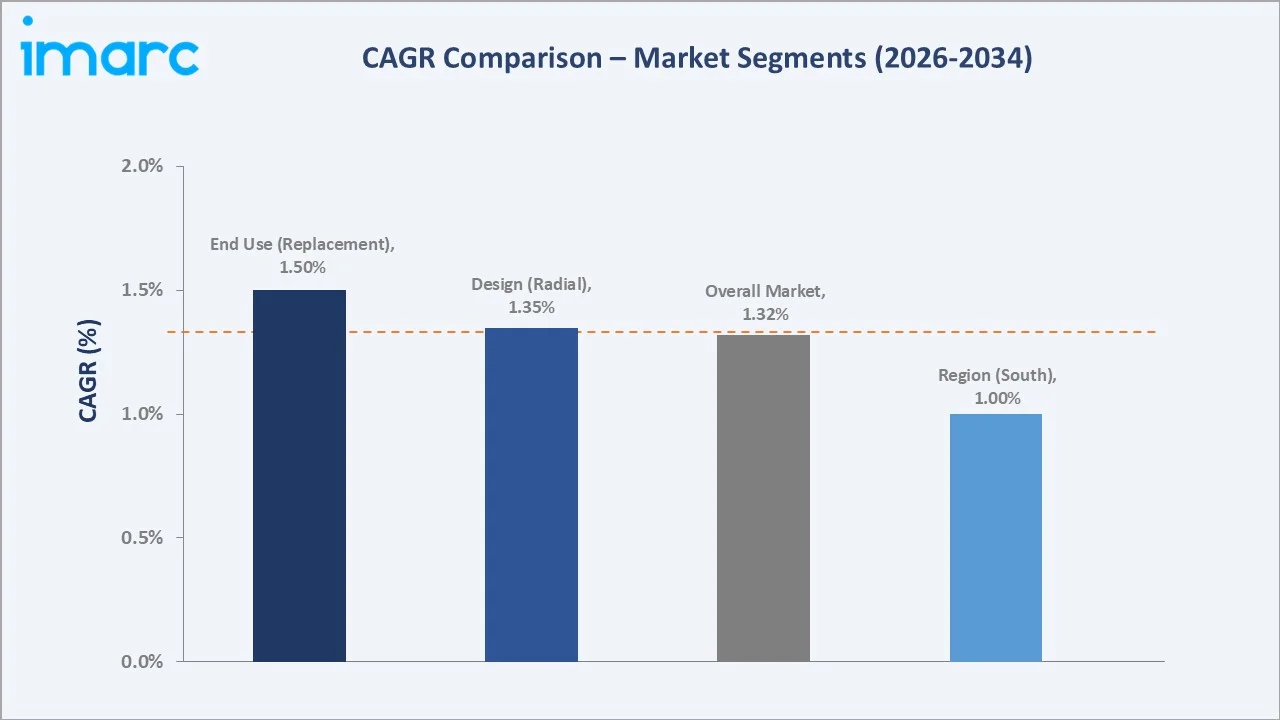
CAGR trajectories across design and end use sub-segments, together with regional patterns, show replacement and West expanding faster than the overall 1.32% market CAGR, driven by rising freight activity, growing SUV and light truck demand, and expanding commercial vehicle utilization across these regions.
Executive Summary
The United States tire market expanded from 363.1 Million Units in 2025 to an estimated 367.9 Million Units in 2026, reflecting steady replacement demand and continued vehicle usage across passenger and commercial segments. The market is further influenced by growing demand for durable, fuel-efficient, and performance-oriented tire products.
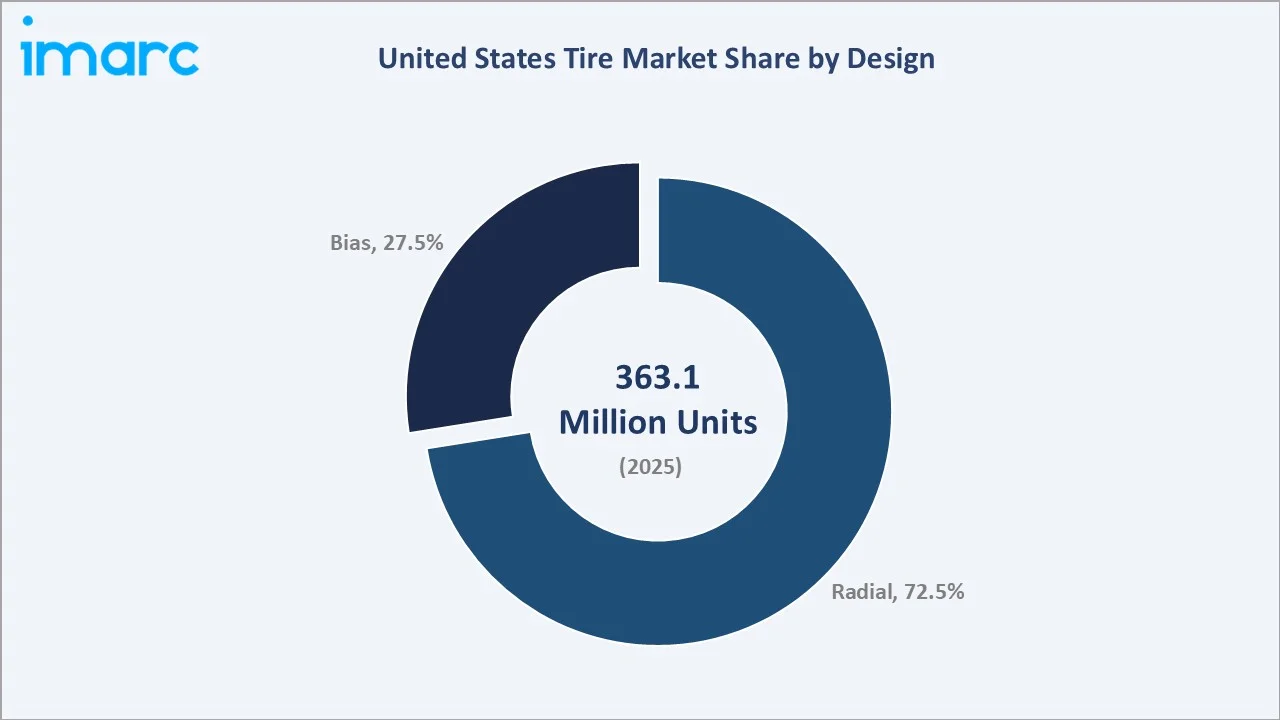
Radial dominates with a 72.5% design share in 2025, reflecting its broad adoption across vehicle categories due to superior performance, fuel efficiency, and road safety characteristics. Replacement commands 71.5% of end use demand in 2025, underpinned by the large installed vehicle base and sustained demand for maintenance and vehicle upkeep. South accounts for 37.5% of regional demand, supported by high vehicle ownership rates, extensive freight networks, and a dense base of tire retailers and automotive service centers.
Key Market Insights
|
Insight |
Data |
|
Leading Design |
Radial - 72.5% share (2025) |
|
Second Largest Design |
Bias - 27.5% share (2025) |
|
Leading End Use |
Replacement - 71.5% share (2025) |
|
Second Largest End Use |
OEM - 28.5% share (2025) |
|
Leading Region |
South - 37.5% share (2025) |
|
Second Largest Region |
West - 24.5% share (2025) |
|
Top Companies |
Michelin, The Goodyear Tire & Rubber Company, Bridgestone Corporation, Continental AG, Pirelli & C. S.p.A. |
Key Analytical Observations Expanding On the Data Above:
- Radial dominance at 72.5% is supported by widespread adoption across passenger vehicles, SUVs, and light trucks, where superior ride quality, fuel economy, and tread life justify the premium over bias alternatives.
- Bias at 27.5% retains significance in specialty and off-road segments, including agricultural, mining, and construction equipment, where high load capacity and puncture resistance are prioritized.
- Replacement share at 71.5% is driven by the large installed vehicle base, recurring tire replacement cycles, and consistent maintenance demand across passenger and commercial vehicles.
- OEM at 28.5% is directly correlated with new vehicle production schedules, making it more sensitive to automotive industry cycles, consumer confidence trends, and disruptions in global component supply.
- South at 37.5% leads regional demand, anchored by high vehicle ownership per household, elevated freight transport activity, and a broad network of tire dealerships and automotive service chains serving both urban and rural consumers.
United States Tire Market Overview
A tire is a rubber product fitted around a vehicle wheel to provide traction, support vehicle weight, absorb road impacts, and enable safe and efficient movement. Tires are classified by construction design, primarily radial and bias. Tire selection varies based on vehicle type, operating conditions, load requirements, and intended application, influencing performance, durability, and overall driving efficiency.
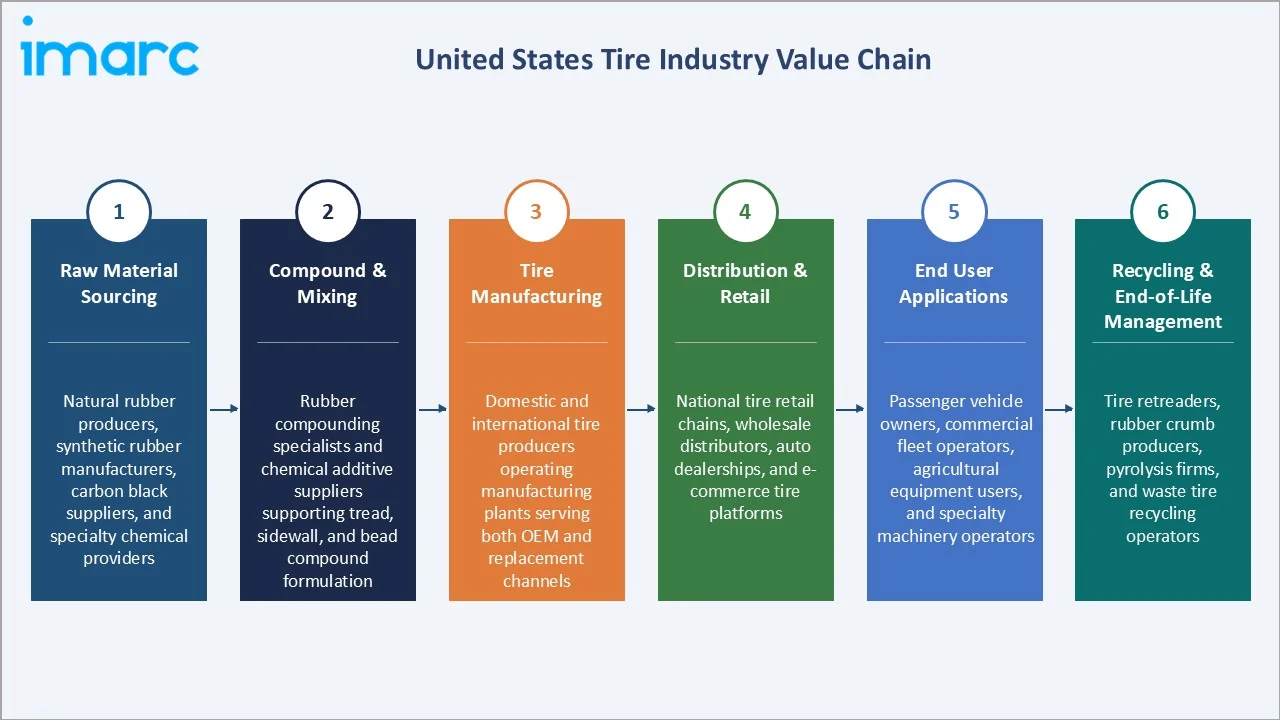
The ecosystem integrates natural and synthetic rubber producers, carbon black and chemical compound suppliers, domestic and international tire manufacturers, wholesale distributors, vehicle dealers, and a broad network of independent tire retailers and automotive service centers.
Market Dynamics
To evaluate market opportunities, Request Sample
Market Drivers
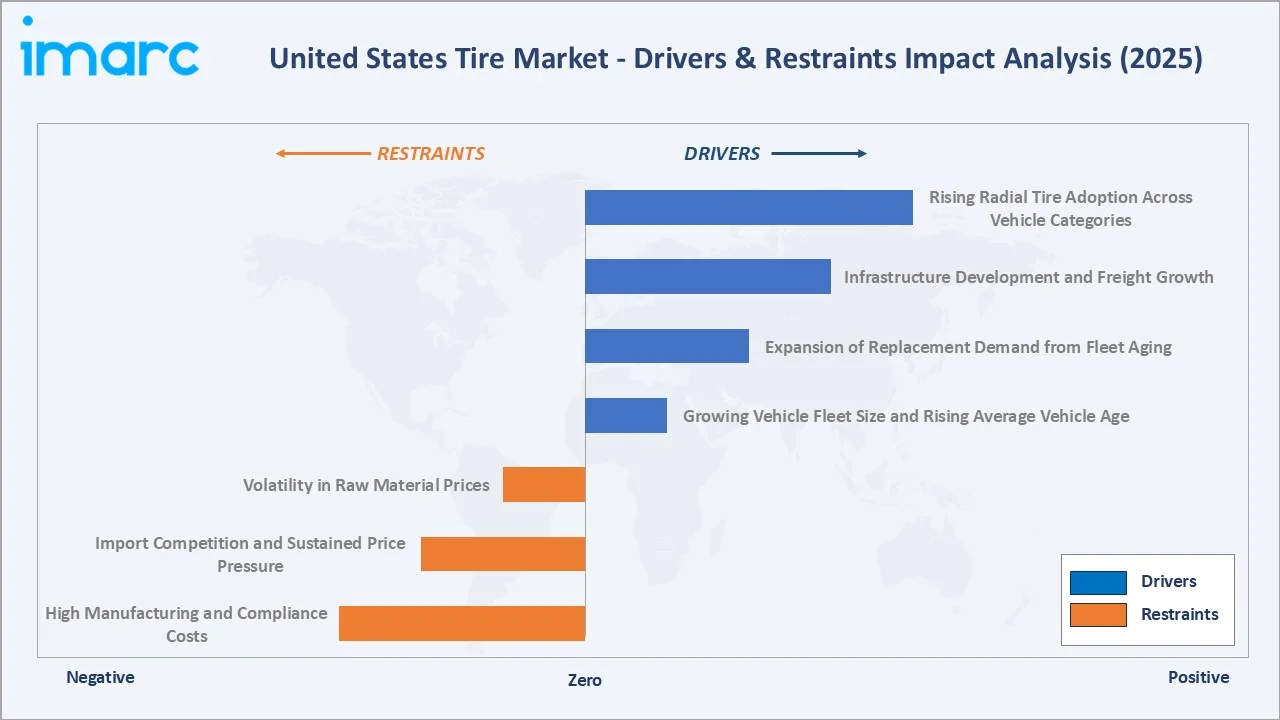
- Growing Vehicle Fleet Size and Rising Average Vehicle Age: Steady expansion of the registered passenger and commercial vehicle fleet, combined with rising vehicle age, sustains consistent replacement tire demand across the United States, supporting long-term market stability.
- Expansion of Replacement Demand from Fleet Aging: The growing share of older vehicles on United States roads increases the frequency of tire replacements as aging vehicles require more frequent maintenance and tire renewal, reinforcing replacement demand across passenger and commercial vehicle segments.
- Infrastructure Development and Freight Growth: Sustained investment in road infrastructure and growing e-commerce-driven freight activity is increasing commercial vehicle utilization rates, which accelerates tire wear cycles and drives higher replacement frequency among fleet operators and logistics companies. As per IMARC Group, the United States e-commerce market size reached USD 1,236.5 Billion in 2025.
- Rising Radial Tire Adoption Across Vehicle Categories: Continued migration from bias to radial construction, especially in light commercial vehicle and specialty segments, is expanding the addressable base for radial tire manufacturers, supporting both volume and average selling price improvement.
Market Restraints
- Volatility in Raw Material Prices: Fluctuations in natural rubber, synthetic rubber, and carbon black prices create margin pressure for tire manufacturers and can disrupt production planning and inventory cycles.
- Import Competition and Sustained Price Pressure: A significant volume of tires imported from lower-cost manufacturing regions creates persistent pricing competition in the replacement segment, constraining profitability for domestic producers.
- High Manufacturing and Compliance Costs: Rising labor, energy, logistics, and regulatory compliance costs increase the overall cost of tire production in the United States, limiting pricing flexibility and placing pressure on manufacturers’ profit margins.
Market Opportunities
- EV-Driven Product Development: The accelerating adoption of EVs is creating demand for tires with higher load ratings, lower rolling resistance, and reduced noise profiles, presenting manufacturers with an opportunity to develop and position premium product lines tailored to EV performance requirements within both the OEM and replacement channels.
- Smart Tire Technology Commercialization: Embedded pressure monitoring, temperature sensing, and connectivity features in next-generation tire products offer differentiation and value-added pricing opportunities in commercial fleet and premium passenger segments.
Market Challenges
- Supply Chain Complexity for Natural Rubber: Geographic concentration of natural rubber cultivation in Southeast Asia exposes manufacturers to supply disruptions, weather-related crop variability, and logistics cost fluctuations.
- Consumer Price Sensitivity in Replacement Channel: Price-sensitive consumers in the mass replacement market tend to trade down during economic downturns, limiting premium tire adoption and creating revenue pressure for manufacturers targeting higher-margin product categories.
Emerging Market Trends
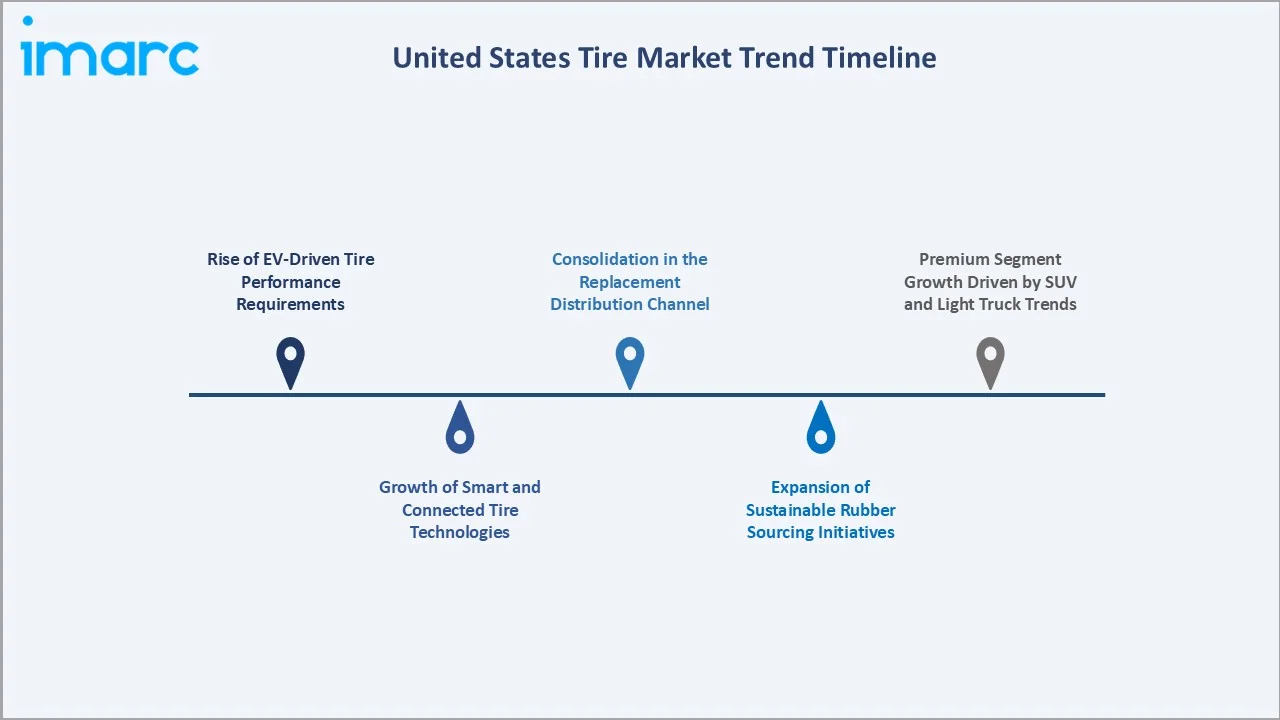
1. Rise of EV-Driven Tire Performance Requirements
The growing adoption of EVs is reshaping tire performance specifications across passenger and light truck categories, with vehicle manufacturers requiring higher load index ratings, lower rolling resistance, and quieter tread profiles. Tire makers are actively reformulating compounds and tread architectures in response, capturing premium OEM and replacement demand as EV adoption expands.
2. Growth of Smart and Connected Tire Technologies
Sensors embedded in tires can transmit real-time pressure, temperature, and tread wear data to fleet management systems, reducing unplanned downtime and improving safety compliance. This also enables predictive maintenance by allowing fleet operators to identify potential tire issues early and schedule servicing before failures occur.
3. Expansion of Sustainable Rubber Sourcing Initiatives
Leading manufacturers are pursuing certified sustainable natural rubber sourcing, synthetic rubber alternatives derived from bio-based feedstocks, and recycled material integration to reduce supply chain carbon intensity and meet growing ESG reporting requirements from fleet customers and institutional buyers.
4. Consolidation in the Replacement Distribution Channel
The US tire market is experiencing consolidation across the replacement distribution channel as national tire retailers expand their footprints through acquisitions of independent dealers. This trend is strengthening purchasing power, broadening service networks, and reshaping the competitive landscape of the market. Greater channel integration is also improving pricing efficiency and service consistency across urban and suburban markets.
5. Premium Segment Growth Driven by SUV and Light Truck Trends
Sustained consumer preference for SUVs, crossovers, and light trucks in the United States is expanding demand for larger-format, higher-margin tires. This shift benefits manufacturers with strong portfolios in these vehicle categories, supporting average selling price improvement even in a moderate overall volume growth environment.
Industry Value Chain Analysis
The United States tire market value chain spans six stages, from raw material sourcing through end-of-life recycling. Manufacturing and distribution stages capture the highest value-add, while regulatory compliance and product performance capabilities increasingly determine sustainable competitive position in a market shaped by safety standards, fleet requirements, and evolving vehicle technology.
|
Stage |
Key Players / Examples |
|
Raw Material Sourcing |
Natural rubber producers, synthetic rubber manufacturers, carbon black suppliers, and specialty chemical providers supplying tire compounding inputs |
|
Compound & Mixing |
Rubber compounding specialists and chemical additive suppliers supporting tread, sidewall, and bead compound formulation |
|
Tire Manufacturing |
Domestic and international tire producers operating manufacturing plants serving both OEM and replacement channels |
|
Distribution & Retail |
National tire retail chains, wholesale distributors, auto dealerships, and e-commerce tire platforms supplying the replacement market |
|
End User Applications |
Passenger vehicle owners, commercial fleet operators, agricultural equipment users, and specialty machinery operators |
|
Recycling & End-of-Life Management |
Tire retreaders, rubber crumb producers, pyrolysis firms, and waste tire recycling operators |
Vertically integrated tire manufacturers with direct OEM supply relationships and proprietary distribution networks are positioned to capture greater value across the chain than independent distributors or retailers. Manufacturing and brand equity at the consumer-facing retail stage represent the two highest-value positions, while raw material sourcing and recycling remain more commoditized segments of the overall value chain.
Technology Landscape in the United States Tire Industry
Advanced Rubber Compounding and Material Science
Tire manufacturers are investing in new rubber compound formulations incorporating silica, resins, and bio-based materials to achieve lower rolling resistance, improved wet traction, and extended tread life. Innovation in the US tire material market is accelerating, with manufacturers advancing bio-sourced rubber alternatives and next-generation silica compounds that support both fuel economy compliance across conventional vehicles and the specific low-rolling-resistance requirements of EVs, where tire energy efficiency directly affects range performance.
Smart Tire and Embedded Sensor Technology
Tire pressure monitoring systems (TPMS) are standard across vehicle categories in the United States. Next-generation smart tires embed multi-parameter sensors transmitting real-time tire condition data to vehicle systems and fleet telematics platforms, enabling predictive maintenance and improving safety outcomes.
Automation in Tire Manufacturing
Advanced robotics and automated building drum systems are improving manufacturing consistency, reducing labor intensity, and enabling faster production changeovers between tire sizes and specifications. These investments are particularly relevant as manufacturers adapt production lines to accommodate the growing diversity of SUV, light truck, and EV-specific tire formats across the United States market.
Digital Retail and E-Commerce Platforms
Digital channels are transforming how replacement tires are sold, with online tire purchase and installation scheduling services growing rapidly. This shift is enabling new consumer-direct business models and creating pricing transparency across the replacement distribution channel.
Market Segmentation Analysis
The report covers the following segments:
|
Segment Category |
Leading Segment |
Market Share |
Year |
|
Design |
Radial |
72.5% |
2025 |
|
End Use |
Replacement |
71.5% |
2025 |
|
Vehicle Type |
Passenger Cars |
🔒 |
2025 |
|
Distribution Channel |
Offline |
🔒 |
2025 |
|
Season |
All Season Tires |
🔒 |
2025 |
|
Region |
South |
37.5% |
2025 |

By Design
Radial commands a 72.5% majority share in 2025, driven by its universal adoption across passenger cars, SUVs, light trucks, and most commercial vehicle categories. Radial tire construction delivers superior fuel economy, longer tread life, better road-holding characteristics, and improved ride quality relative to bias alternatives, making it the standard specification for virtually all new passenger and commercial vehicles produced in the United States.
To access detailed market analysis, Request Sample
Bias at 27.5% in 2025 retains significance in specialized applications, including agriculture, construction, mining, and certain industrial segments, where high load-bearing capability, puncture resistance, and low-speed durability outweigh the fuel efficiency advantages of radial construction.
By End Use
Replacement leads with 71.5% share in 2025, reflecting the structural demand advantage created by an aging vehicle fleet and the predictable replacement cycle for passenger and light commercial tires. The segment benefits from consistent consumer maintenance spending across economic cycles and is less susceptible to automotive production downturns than the OEM segment.
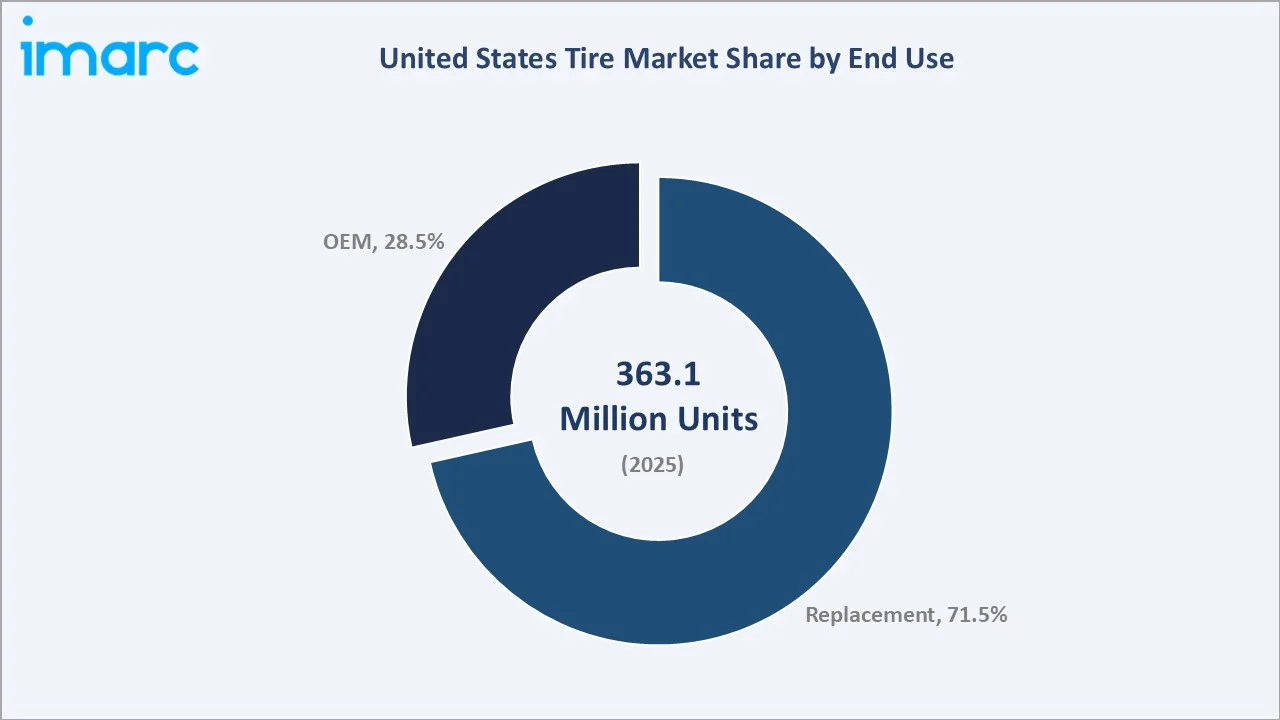
OEM at 28.5% is directly tied to new vehicle production volumes, which fluctuate with automotive industry cycles, consumer confidence levels, and availability of key manufacturing inputs such as semiconductors and battery components for EVs.
Regional Market Insights
|
Region |
Share (2025) |
Key Growth Drivers |
|
South |
37.5% |
Large vehicle fleet, high freight activity, dense tire retail network, and favorable weather conditions supporting year-round driving and tire wear |
|
West |
24.5% |
High SUV and light truck penetration, expanding logistics infrastructure, and growing commercial fleet utilization across major freight corridors |
|
Midwest |
20.5% |
Strong agricultural and commercial vehicle base, extensive road freight networks, and consistent replacement demand across both rural and urban vehicle segments |
|
Northeast |
17.5% |
High vehicle density in urban corridors, seasonal tire change cycles, and elevated consumer spending on premium tire products |
South at 37.5% in 2025 leads the regional landscape, supported by a large registered vehicle fleet concentration, high per-household vehicle ownership, and a dense network of tire retailers and automotive service centers across urban and suburban markets. A large commercial freight corridor running through the region also sustains commercial tire demand.
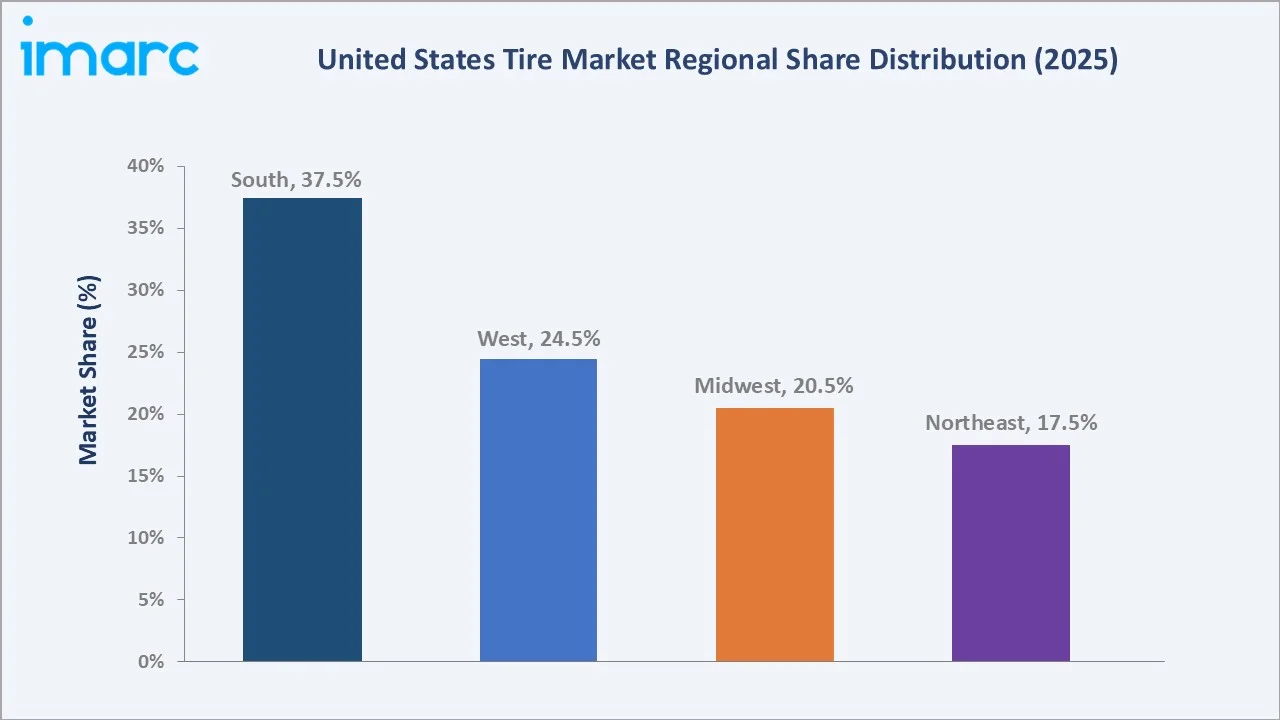
West at 24.5% reflects strong vehicle ownership, high replacement tire demand, and substantial commercial transportation activity across the region.
Competitive Landscape
The United States tire market is moderately concentrated, with a small number of globally scaled manufacturers holding significant market share in both the OEM and replacement channels. Manufacturing scale, distribution network reach, brand equity, and product portfolio breadth across vehicle categories form the primary competitive differentiators across the industry.
|
Company Name |
Brand / Key Product |
Position |
Strategic Focus |
|
Michelin |
Michelin, BF Goodrich |
Leader |
Expanding premium tire portfolio and sustainable rubber sourcing across passenger and commercial segments |
|
The Goodyear Tire & Rubber Company |
Goodyear, Cooper |
Leader |
Broadening digital retail capabilities and expanding product portfolio across replacement and OEM channels |
|
Bridgestone Corporation |
Bridgestone, Firestone |
Leader |
Growing replacement channel presence through fleet service partnerships and advancing sustainable tire material development |
|
Continental AG |
Continental, General Tire |
Challenger |
Expanding OEM supply relationships and developing smart tire technologies for connected vehicle platforms |
|
Pirelli & C. S.p.A. |
Pirelli |
Challenger |
Strengthening premium and ultra-high-performance tire positioning across passenger and sports vehicle segments |
Key players include Michelin, The Goodyear Tire & Rubber Company, Bridgestone Corporation, Continental AG, and Pirelli & C. S.p.A., among others.
Key Company Profiles
Michelin
Michelin is a French multinational tire manufacturer headquartered in Clermont-Ferrand, France, and one of the world's largest tire producers with significant manufacturing and distribution operations across the United States.
- Product Portfolio: Passenger, light truck, commercial vehicle, agricultural, and specialty tires under the Michelin and BF Goodrich brands, along with roadside assistance and fleet management services.
- Recent Developments: Michelin has been pursuing strategic initiatives to strengthen its product portfolio, expand its manufacturing capabilities, and advance its market position across key regions including the United States.
- Strategic Focus: Broadening the premium tire product range across passenger, SUV, and commercial vehicle categories, while reinforcing commitments to sustainable rubber sourcing across both OEM supply and aftermarket replacement channels.
The Goodyear Tire & Rubber Company
The Goodyear Tire & Rubber Company is an American multinational tire manufacturer headquartered in Akron, Ohio, and one of the largest tire producers in the United States with extensive domestic manufacturing and a global retail network.
- Product Portfolio: Passenger, SUV, light truck, commercial, and specialty tires under the Goodyear and Cooper brand names, along with commercial fleet solutions and tire management services.
- Recent Developments: The Goodyear Tire & Rubber Company has been implementing operational and strategic initiatives to optimize its brand portfolio, strengthen distribution capabilities, and enhance its competitive position across key markets in North America, including the United States.
- Strategic Focus: Strengthening digital retail infrastructure and widening product coverage across the replacement and OEM channels, while consolidating its competitive footing across the United States tire market.
Bridgestone Corporation
Bridgestone Corporation is a Japanese multinational tire and rubber company headquartered in Tokyo, Japan, and the world's largest tire manufacturer by revenue, with significant manufacturing, retail, and fleet service operations across the United States.
- Product Portfolio: Passenger, light truck, commercial vehicle, agricultural, and specialty tires under the Bridgestone and Firestone brands, along with fleet management solutions and retail automotive services.
- Recent Developments: Bridgestone Corporation has been pursuing initiatives to strengthen its manufacturing efficiency, expand its product and service offerings, and advance its competitive position across consumer and commercial tire segments in the United States.
- Strategic Focus: Deepening replacement channel reach through fleet service collaborations, driving progress in sustainable tire material development, and building on premium product positioning across the United States market.
Market Concentration Analysis
The United States tire market is moderately concentrated, with the top three manufacturers, Michelin, The Goodyear Tire & Rubber Company, and Bridgestone Corporation, collectively accounting for a substantial share of both OEM supply and replacement channel volume, reflecting the scale and brand equity required to serve large vehicle manufacturers and national retail chains.
Barriers to entry include significant capital investment requirements for manufacturing facilities, the need for established OEM homologation approvals, strong brand recognition in the replacement channel, and the logistics infrastructure required to serve a geographically diverse market of over 330 million consumers.
Consolidation is gradually increasing, as tire manufacturers expand through acquisitions and strategic partnerships, while collaborations with fleet service providers and automotive technology companies are further shaping competitive positioning.
Investment & Growth Opportunities
Fastest-Growing Segments
Replacement is expanding fastest among end use categories, driven by rising average vehicle age and consistent consumer maintenance spending. The segment also benefits from frequent tire replacement cycles across passenger and commercial vehicles, maintaining steady demand through routine maintenance and vehicle servicing.
Emerging Regions
West is witnessing strong growth potential, supported by high vehicle ownership, substantial commercial transportation activity, and steady replacement tire demand. The region also offers opportunities for tire retailers and service providers to expand distribution networks and strengthen aftermarket service coverage.
Venture & Investment Trends
Capital is flowing into sustainable tire material research, smart tire sensor platforms, and digital retail infrastructure for the replacement market. Investment interest is also focused on tire recycling and end-of-life processing technologies, driven by regulatory pressures and OEM sustainability commitments that require verified tire material recovery and traceability.
Future Market Outlook (2026-2034)
The United States tire market is projected to grow from 363.1 Million Units in 2025 to 367.9 Million Units in 2026, reaching 408.8 Million Units by 2034, registering a CAGR of 1.32% during 2026-2034.
Four forces will shape the market through 2034: continued fleet growth and vehicle aging sustaining replacement demand; deepening radial tire penetration in remaining specialty segments; commercialization of smart tire technologies across commercial and premium passenger segments; and ongoing consolidation in the replacement distribution channel reshaping retail competition.
By 2034, the United States tire market is expected to be defined by greater replacement demand, wider adoption of connected tire technologies, and more integrated distribution networks. The market will also see greater emphasis on tire durability, fuel efficiency, and performance as consumers and fleet operators prioritize long term operating value.
Research Methodology
Primary Research
Primary research included structured interviews with tire manufacturing executives, OEM procurement specialists, aftermarket distribution professionals, fleet operators, and automotive retail industry participants, validating market sizing, segment mix, and regional demand patterns.
Secondary Research
Secondary sources included the Department of Transportation vehicle registration and fleet data, National Highway Traffic Safety Administration standards documentation, and annual reports, press releases, and investor presentations from listed tire manufacturers and distributors.
Forecasting Models
Market forecasts used top-down and bottom-up models combining registered vehicle counts, replacement tire cycle estimates, OEM vehicle production volume data, and macroeconomic variables including fuel prices and consumer spending trends. Scenario analysis addressed commodity price trajectories, automotive production volumes, and import competition dynamics.
Report Coverage:
| Report Features | Details |
|---|---|
| Base Year of the Analysis | 2025 |
| Historical Period | 2020-2025 |
| Forecast Period | 2026-2034 |
| Units | Million Units |
| Scope of the Report | Exploration of Historical Trends and Market Outlook, Industry Catalysts and Challenges, Segment-Wise Historical and Future Market Assessment:
|
| Designs Covered | Radial, Bias |
| End-Uses Covered | OEM, Replacement |
| Vehicle Types Covered | Passenger Cars, Light Commercial Vehicles, Medium and Heavy Commercial Vehicles, Two Wheelers, Three Wheelers, Off-The-Road (OTR) |
| Distribution Channels Covered | Offline, Online |
| Seasons Covered | All Season Tires, Winter Tires, Summer Tires |
| Regions Covered | Northeast, Midwest, South, West |
| Companies Covered | Michelin, The Goodyear Tire & Rubber Company, Bridgestone Corporation, Continental AG, Pirelli & C. S.p.A., etc. |
| Customization Scope | 10% Free Customization |
| Post-Sale Analyst Support | 10-12 Weeks |
| Delivery Format | PDF and Excel through Email (We can also provide the editable version of the report in PPT/Word format on special request) |
Frequently Asked Questions About the United States Tire Market Report
The United States tire market size is estimated at 367.9 Million Units in 2026, driven by a large aging vehicle fleet, consistent replacement demand, and steady commercial vehicle utilization across freight and logistics sectors.
The market is projected to grow at a CAGR of 1.32% from 2026-2034, reaching 408.8 Million Units, supported by steady fleet expansion, consistent replacement demand from an aging vehicle fleet, and evolving product requirements driven by the growing adoption of EVs.
Radial leads the design segment at 72.5% in 2025, driven by universal adoption across passenger vehicles, SUVs, light trucks, and most commercial vehicle categories due to superior performance characteristics.
Replacement dominates the end use segment at 71.5% in 2025, reflecting the structural demand advantage of an aging vehicle fleet and the consistent recurring cycle of tire replacement across passenger and commercial segments.
South commands 37.5% share in 2025, led by high freight activity and an extensive network of tire retailers and automotive service centers.
Leading players include Michelin, The Goodyear Tire & Rubber Company, Bridgestone Corporation, Continental AG, and Pirelli & C. S.p.A., among others.
The United States tire market presents significant opportunities in EV-driven product development, with manufacturers investing in tires that meet the specific load rating and low-rolling-resistance requirements of EVs. Growing demand for smart tire technologies across commercial fleets, rising consumer preference for premium tire products in the SUV and light truck segments, and expanding replacement demand driven by an aging vehicle fleet are further areas of opportunity through 2034.
The United States tire market faces persistent challenges from volatility in natural rubber and synthetic rubber prices, which create margin pressure across the supply chain. Consumer price sensitivity in the mass replacement channel further limits the pace at which manufacturers can transition toward higher-margin premium product lines.
Need more help?
- Speak to our experienced analysts for insights on the current market scenarios.
- Include additional segments and countries to customize the report as per your requirement.
- Gain an unparalleled competitive advantage in your domain by understanding how to utilize the report and positively impacting your operations and revenue.
- For further assistance, please connect with our analysts.
 Request Customization
 Speak to an Analyst
 Request Brochure
 Inquire Before Buying
Benefits of Customization
- Personalize this research
- Triangulate with your data
- Get data as per your format and definition
- Gain a deeper dive into a specific application, geography, customer, or competitor
- Any level of personalization
Get in Touch With Us
UNITED STATES
Phone: +1-201-971-6302
INDIA
Phone: +91-120-433-0800
UNITED KINGDOM
Phone: +44-753-714-6104
Email: [email protected]
Client Testimonials




.webp)




.webp)













Related Reports

Choose your plan
*Please note that the prices mentioned below are starting prices for each bundle type. Kindly contact our team for further details.*
Single User License
- 1 User License, Access on 2 Devices
- PDF Report + Excel Dataset (Password Protected)
- Lifetime Access
- No Printing Rights
- 10% Free Report Customization
- 10–12 Weeks of Analyst Support
Five User License
- Access for 5 Users, 2 Devices per User
- PDF Report + Excel Dataset (Password Protected)
- Lifetime Access
- Dedicated Account Manager
- 12–14 Weeks of Analyst Support
- No Printing Rights
- 15% Free Report Customization
- 25% Discount on Your Next Purchase
Corporate User License
- Unlimited User Access (Within Your Organization)
- PDF Report + Excel Dataset
- Lifetime Access
- Dedicated Account Manager
- 14–20 Weeks of Analyst Support
- No Printing Rights
- 20% Free Report Customization
- 30% Discount on Your Next Purchase
Essential Insights
What's included:
3 reports
- Lifetime Access
- PDF Reports
- Excel Datasets
- 2 Weeks of Free Analyst Support
- 2 User Licenses
- Access on 2 Devices
- Printing Rights
- Complimentary PowerPoint (PPT) Version
- Complimentary License Upgrade
Professional Access
What's included:
5 reports
- Lifetime Access
- PDF Reports
- Excel Datasets
- 8 Weeks of Free Analyst Support
- 2 User Licenses
- Access on 2 Devices
- Printing Rights
- Complimentary PowerPoint (PPT) Version
- Complimentary License Upgrade
Business Advantage
What's included:
8 reports
- Lifetime Access
- PDF Reports
- Excel Datasets
- 14 Weeks of Free Analyst Support
- 2 User Licenses
- Access on 2 Devices
- Printing Rights
- Complimentary PowerPoint (PPT) Version
- Complimentary License Upgrade
Enterprise Intelligence
What's included:
10 reports
- Lifetime Access
- PDF Reports
- Excel Datasets
- 20 Weeks of Free Analyst Support
- 2 User Licenses
- Access on 2 Devices
- Printing Rights
- Complimentary PowerPoint (PPT) Version
- Complimentary License Upgrade