
Vietnam AI in Agriculture Market Size, Share, Trends and Forecast by Offering, Technology, Application, and Region, 2026-2034
Vietnam AI in Agriculture Market Summary:
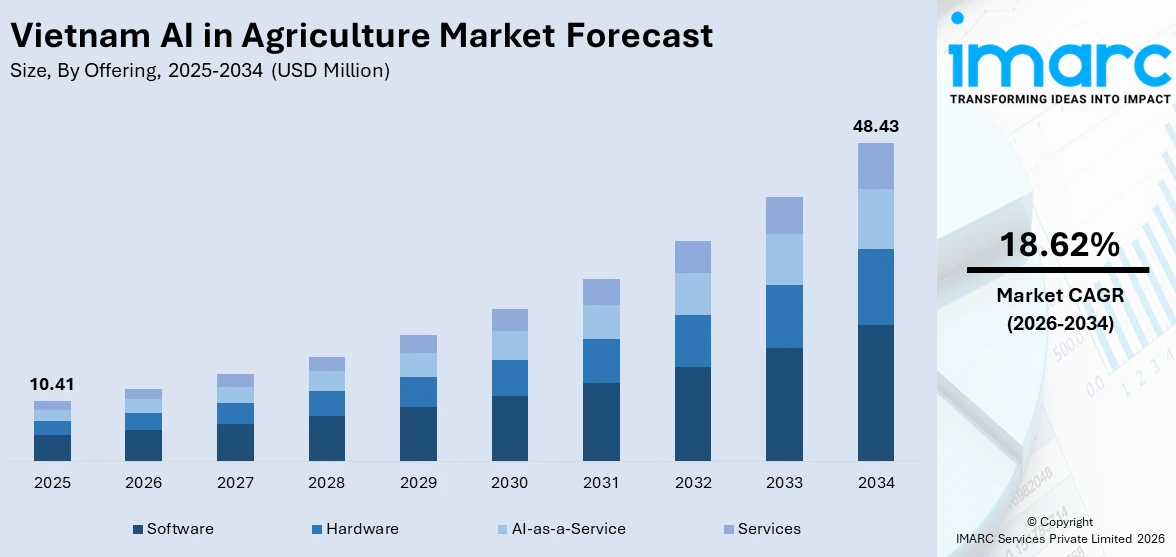
The Vietnam AI in agriculture market size was valued at USD 10.41 Million in 2025 and is projected to reach USD 48.43 Million by 2034, growing at a compound annual growth rate of 18.62% from 2026-2034.
As Vietnam accelerates its digital transformation goal throughout farming operations and food production systems, the country's AI in agriculture sector is growing rapidly. Artificial intelligence technology adoption is being bolstered by government-backed programs encouraging smart farming, growing needs for food security, and growing climate sensitivity. Revolutionizing conventional farming methods, innovations in precision crop management, drone-based analytics, IoT-enabled soil monitoring, and predictive intelligence platforms are establishing Vietnam as a new center for AI-driven agricultural innovation and boosting the country's market share in AI in agriculture.
Key Takeaways and Insights:
- By Offering: Software dominates the market with a share of 38% in 2025, because Vietnamese farmers can now optimize inputs and boost production thanks to the expanding use of AI-powered farm management tools, crop analytics apps, and real-time decision-support systems.
- By Technology: Machine learning leads the market with a share of 51% in 2025, motivated by its fundamental function in facilitating yield forecasting, automated pest identification, predictive crop analytics, and soil health evaluation throughout Vietnam's varied agricultural terrain.
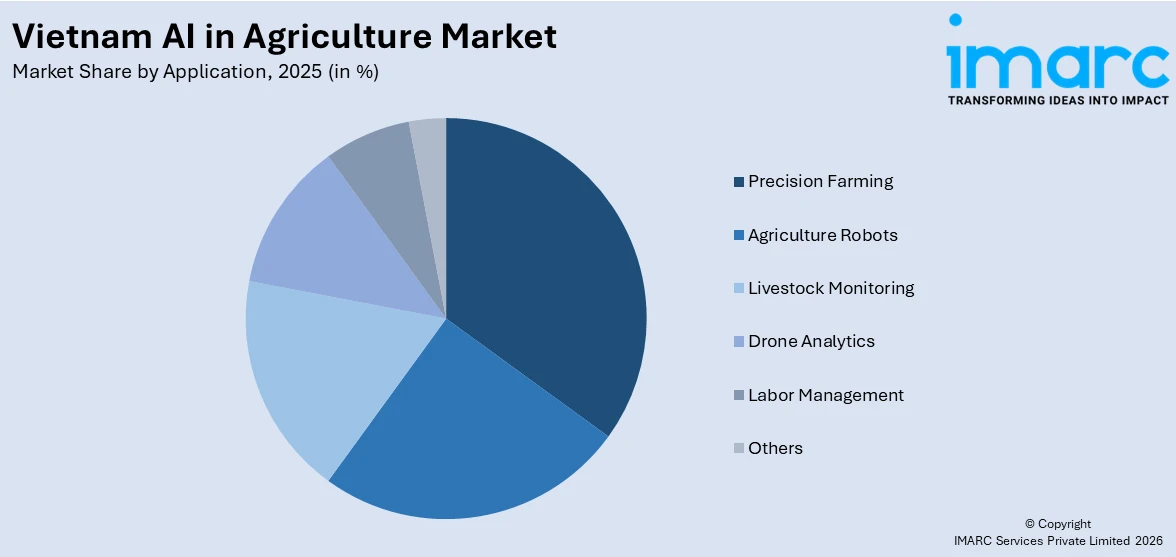
- By Application: Precision farming holds the largest share with 30% in 2025, demonstrating the high need for data-driven farming methods that maximize resource use, lessen their negative effects on the environment, and improve the quality of the product for important commodities like coffee and rice.
- Key Players: By developing AI-powered precision tools, fortifying alliances with academic institutions, growing IoT-based monitoring systems, and investing in reasonably priced smart farming technologies that hasten adoption across smallholder and commercial farming operations, major players propel the Vietnam AI in agriculture market.
To get more information on this market Request Sample
The Vietnam AI in agriculture market is advancing as government programs, technology providers, and farming communities collaborate to modernize agricultural practices and strengthen food production resilience. A significant factor shaping this progress is the country’s commitment to digital transformation in agriculture, supported by policies such as Resolution 57-NQ/TW issued in December 2024, which identified science, technology, and innovation as primary drivers for economic modernization. For instance, Vietnam’s agritech startup Enfarm, which leverages AI and IoT to optimize crop nutrition, secured seed funding in December 2025 led by Touchstone Partners, with its platform delivering a 30% reduction in fertilizer use alongside a 30% increase in crop yields for coffee and durian farmers in southern Vietnam. Expanding AI capabilities, growing investment flows into agritech ventures, and the integration of smart farming solutions into national agricultural strategies are contributing to a more productive and sustainable farming ecosystem across the country.
Vietnam AI in Agriculture Market Trends:
Rising Adoption of AI-Powered Smart Farming Platforms
AI-driven smart farming technologies that combine crop analytics, automated suggestions, and real-time soil sensing to increase agricultural output are becoming more popular in Vietnam. The expansion of the Vietnam AI in agriculture market is being supported by government digitization initiatives, mobile-based analytics platforms, and collaborations with technology providers that are improving smallholder and commercial farmers' access to sophisticated farm intelligence. With the use of these platforms, growers can make data-driven decisions about fertilizer optimization, irrigation control, and planting dates, increasing yields while using less resources. Cloud-based advising tools, machine learning algorithms, and Internet of Things connection are coming together to speed up the adoption of precision agriculture across a variety of farming operations.
Expansion of Drone and Computer Vision Technologies in Crop Management
Drones with AI-powered computer vision systems are increasingly being used in Vietnam's agricultural environment for precise spraying, insect identification, and crop health monitoring. In order to create cutting-edge pest and disease detection systems that use edge-compatible technologies for real-time field diagnostics, government organizations and commercial technology companies are working together. Through automated diagnostics and real-time aerial monitoring, these technologies are assisting farmers in reducing needless chemical applications, implementing tailored pesticide strategies, and improving crop quality overall. Both smallholder and large-scale farming enterprises are adopting commercial drones more widely as a result of their rising affordability and developing rural connectivity infrastructure.
Integration of AI in Post-Harvest Processing and Supply Chain Optimization
AI technologies are increasingly being applied beyond cultivation to enhance post-harvest processing and supply chain management in Vietnam’s agriculture sector. For example, South Korea-based S&E Company announced in December 2025 the expansion of its AI-driven agricultural data analytics and pre-trading platform B•good into Vietnam, integrating AI-based price and yield forecasting with a digital marketplace connecting producers and institutional buyers. Machine vision-based grading and sorting systems for products such as seafood, coffee, and fruits are reducing human error and improving export compliance, while predictive algorithms are optimizing cold-chain logistics to minimize spoilage.
Market Outlook 2026-2034:
The Vietnam AI in agriculture market is poised for sustained expansion, supported by continued policy emphasis on agricultural modernization, growing investment in agritech ventures, and rising demand for climate-resilient farming solutions. The market generated a revenue of USD 10.41 Million in 2025 and is projected to reach a revenue of USD 48.43 Million by 2034, growing at a compound annual growth rate of 18.62% from 2026-2034. Higher income streams are anticipated as precision agricultural equipment, AI-powered crop management software, and IoT-enabled monitoring systems are used more often. A suitable environment is being created for wider AI integration throughout Vietnam's agricultural value chain by the government's promises to digital transformation under the National Strategy on AI until 2030, growing foreign alliances, and a supportive startup ecosystem. The nation's aspirations to rank among the top three ASEAN countries in AI research and development by 2030 serve to further solidify the market's long-term growth trajectory.
Vietnam AI in Agriculture Market Report Segmentation:
|
Segment Category |
Leading Segment |
Market Share |
|
Offering |
Software |
38% |
|
Technology |
Machine Learning |
51% |
|
Application |
Precision Farming |
30% |
Offering Insights:
- Software
- Hardware
- AI-as-a-Service
- Services
Software dominates with a market share of 38% of the total Vietnam AI in agriculture market in 2025.
As farmers and agribusinesses increasingly use AI-powered platforms for crop monitoring, soil analytics, and farm management optimization, the software sector dominates the Vietnam AI in agriculture market. For small and medium-sized farms, the increasing availability of software solutions that are mobile-friendly and cloud-based has greatly reduced entry hurdles. These platforms allow farmers to maximize fertilizer application and enhance crop growth by combining real-time data from soil sensors and smartphone applications to provide accurate nutrient readings along with practical advice. Software adoption is being further accelerated throughout the nation's different farming communities by government digitalization programs and growing collaborations between technology providers and agricultural cooperatives.
Software solutions are also playing a critical role in enabling predictive analytics for yield forecasting, market price monitoring, and resource allocation planning across Vietnam’s agriculture sector. The Vietnamese government’s emphasis on digital transformation and its national strategies for smart agriculture are further accelerating software adoption. For example, Vietnam’s Ministry of Science and Technology announced in 2025 a national tech exchange platform aimed at connecting agritech startups with research institutions and corporations, with a specific focus on AI-driven agricultural software solutions to strengthen the digital farming ecosystem.
Technology Insights:
- Machine Learning
- Computer Vision
- Predictive Analytics
Machine learning leads with a share of 51% of the total Vietnam AI in agriculture market in 2025.
The majority of AI applications in Vietnam's agriculture industry are based on machine learning, which powers features like yield prediction, precision fertilizer management, and automated crop disease diagnosis. The technology is essential for making well-informed decisions because it can interpret vast amounts of agricultural data from sensors, drones, and satellite pictures. In order to provide more accurate yield forecasts for important crops like rice, sophisticated machine learning models integrated into soil monitoring equipment are making it possible to precisely estimate soil moisture, electrical conductivity, and other crucial factors. A wider range of agricultural activities may now receive intelligent insights thanks to the integration of these models into field-level equipment, which is bridging the gap between sophisticated data analytics and useful farm-level application.
Machine learning's increasing application in a variety of agricultural use cases is solidifying its leading position in the technological market. Machine learning algorithms are being incorporated into a variety of farm management workflows, from automated insect identification and animal health monitoring to intelligent irrigation systems. With growing private sector investment propelling innovation across crop analytics, disease prediction, and resource optimization platforms that address the particular challenges of the nation's diverse farming landscape, the fast growth of Vietnam's AI startup ecosystem is speeding up the development and commercialization of machine learning solutions tailored for Vietnamese agricultural conditions.
Application Insights:
Access the comprehensive market breakdown Request Sample
- Precision Farming
- Agriculture Robots
- Livestock Monitoring
- Drone Analytics
- Labor Management
- Others
Precision farming holds the largest share at 30% of the total Vietnam AI in agriculture market in 2025.
Due to the pressing requirement to maximize resource use throughout its primarily smallholder farming systems, precision farming is the most popular application area in Vietnam's AI-driven agricultural environment. Farmers are able to increase yields while lowering input costs thanks to AI-powered precision tools including satellite-guided planting technology, sensor-based nutrient management systems, and smart irrigation controllers. Artificial intelligence-powered precision management approaches are being progressively included into national programs that support the growing of high-quality, low-emission crops. Pilot models have shown significant gains in yield performance and reductions in production costs. A solid basis for further technology adoption throughout the nation's major cropping systems is being established by the combination of commercial precision farming technologies and government-sponsored agricultural modernization initiatives.
The expanding adoption of precision farming practices is also being supported by international research collaborations and government extension programs aimed at scaling smart agriculture technologies. The application of AI-driven precision tools is particularly significant for Vietnam's rice and coffee sectors, which collectively represent a substantial share of the country's agricultural output and export revenue. International agricultural research institutions are actively showcasing precision innovations in Vietnam, highlighting technologies such as precision mechanized direct seeding, site-specific nutrient management, and drone-enabled monitoring that are reshaping cultivation practices in major production regions. These collaborations are strengthening the knowledge base and technical capacity needed to expand precision farming across diverse agro-climatic zones throughout the country.
Regional Insights:
- Northern Vietnam
- Central Vietnam
- Southern Vietnam
Northern Vietnam is steadily expanding its AI in agriculture adoption, supported by the concentration of technology research institutions and government agencies in Hanoi. The region’s focus on rice cultivation and livestock farming is driving demand for AI-powered crop monitoring and precision nutrient management solutions. Initiatives by universities such as Hanoi University of Science and Technology, which launched Vietnam’s first specialized engineering program in generative AI in May 2024, are building a skilled workforce that supports agricultural technology development in the region.
Central Vietnam is emerging as a significant area for AI-driven agricultural innovation, particularly in the coffee-growing highlands where precision farming technologies are gaining traction. The region’s vulnerability to climate change impacts, including droughts and flooding, is accelerating adoption of predictive analytics and smart irrigation systems. Enfarm’s AI-powered soil monitoring platform has seen particularly strong adoption among coffee and durian growers in the Central Highlands, where its technology has helped farmers optimize fertilizer application and improve crop performance.
Southern Vietnam represents the most active hub for AI in agriculture, anchored by the Mekong Delta’s position as the country’s largest agricultural production zone. The region benefits from a strong concentration of agritech startups based in Ho Chi Minh City, robust investment flows, and the government’s one-million-hectare low-emission rice program focused in the Mekong Delta. The presence of international research institutions such as IRRI and extensive pilot projects covering precision farming and drone analytics are further strengthening AI adoption across southern farming communities.
Market Dynamics:
Growth Drivers:
Why is the Vietnam AI in Agriculture Market Growing?
Government Digital Transformation and Policy Support
Vietnam's government is actively driving agricultural modernization through comprehensive digital transformation strategies and supportive policy frameworks that prioritize AI adoption. National-level resolutions have identified science, technology, and innovation as the main drivers for modernizing production forces, with agriculture designated as a priority sector for technology-led growth. The government is implementing programs that directly integrate AI technologies into farming operations, prioritizing agriculture alongside finance and education for digital advancement. Progressive deployment of drones, IoT sensors, artificial intelligence, and agricultural robots across large-scale production areas reflects this commitment. These government-led initiatives are creating a stable and predictable environment for technology adoption, reducing investment risk for both domestic and international AI solution providers, and laying the groundwork for sustained market expansion.
Rising Food Security Demands and Climate Change Adaptation
Vietnam's agriculture sector faces escalating pressure from climate change impacts, including rising sea levels, saltwater intrusion in key delta regions, irregular weather patterns, and increasing pest outbreaks, all of which threaten the productivity and sustainability of farming operations. As one of the world's most climate-vulnerable countries, Vietnam is turning to AI technologies to build more resilient agricultural systems that can adapt to changing environmental conditions while meeting growing domestic and global food demands. National programs promoting low-emission and high-quality crop cultivation are increasingly incorporating precision management techniques powered by artificial intelligence. AI-powered tools including predictive weather analytics, automated irrigation management, and disease detection systems are enabling farmers to proactively respond to climate variability rather than reactively managing crop losses. This growing intersection of climate adaptation and food security imperatives is sustaining strong demand for AI-driven agricultural solutions.
Expanding Agritech Investment and Startup Ecosystem
Vietnam's agritech sector is experiencing a significant surge in venture capital investment and startup activity, creating a dynamic ecosystem that accelerates the development and commercialization of AI-powered agricultural solutions. Private investment in Vietnamese AI startups has grown substantially in recent years, with momentum continuing as major global investors and regional venture capital firms from across Asia actively channel resources into the country's technology sector. Within the agricultural domain specifically, funding for agritech ventures has shown remarkable growth, with multiple companies securing significant funding rounds for AI and IoT-based agricultural platforms. The passage of Vietnam's Law on Artificial Intelligence, which provides AI enterprises with the highest level of incentives and establishes a dedicated national development fund, is expected to further stimulate investment flows and strengthen the startup ecosystem supporting agricultural AI innovation.
Market Restraints:
What Challenges the Vietnam AI in Agriculture Market is Facing?
Fragmented Smallholder Farm Structure
Vietnam's agricultural landscape is predominantly characterized by small-scale farming operations, with the majority of farms operating on limited plots of land. This fragmented structure creates significant challenges for the large-scale deployment of AI technologies, as the cost of implementing precision sensors, drones, and software platforms is often prohibitive for individual smallholders. The lack of consolidated farming areas also complicates data collection and the development of scalable AI models that require large, uniform datasets to deliver accurate predictions and recommendations.
Limited Rural Digital Infrastructure and Connectivity
Despite strong urban digital connectivity, many rural and remote agricultural areas in Vietnam continue to face insufficient internet coverage, unreliable power supply, and limited access to digital devices required for AI-enabled farming solutions. While mobile connectivity has expanded considerably across the population, high-speed broadband essential for real-time data processing and cloud-based AI applications remains unevenly distributed. This digital divide restricts the deployment of IoT sensor networks, drone analytics platforms, and cloud-dependent farm management tools in the areas where agricultural production is most concentrated.
Shortage of Skilled AI Professionals and Digital Literacy Gaps
The Vietnam AI in agriculture market faces constraints from a persistent shortage of high-quality AI professionals who can develop, deploy, and maintain agricultural technology solutions. The shortage of skilled talent remains one of the most significant challenges facing AI solution providers in the country. Additionally, limited digital literacy among farming communities, particularly among older farmers in rural areas, creates adoption barriers that slow the uptake of AI-powered tools and platforms even when affordable solutions are available.
Competitive Landscape:
The Vietnam AI in agriculture market features a competitive landscape characterized by a mix of domestic agritech startups, international technology providers, and government-backed research institutions working to advance smart farming solutions. Companies are focusing on developing affordable, localized AI platforms tailored to Vietnam’s diverse agricultural conditions, particularly for rice and coffee cultivation. Competition is driven by investments in IoT-enabled monitoring systems, machine learning-based analytics, and precision farming technologies. Strategic partnerships between technology firms, academic institutions, and agricultural cooperatives are fostering innovation and accelerating product deployment. As the regulatory environment matures with the passage of Vietnam’s AI Law, market players are strengthening their compliance frameworks while capitalizing on available incentives to expand their operations and strengthen their market positioning.
Vietnam AI in Agriculture Market Report Coverage:
| Report Features | Details |
|---|---|
| Base Year of the Analysis | 2025 |
| Historical Period | 2020-2025 |
| Forecast Period | 2026-2034 |
| Units | Million USD |
| Scope of the Report |
Exploration of Historical Trends and Market Outlook, Industry Catalysts and Challenges, Segment-Wise Historical and Future Market Assessment:
|
| Offerings Covered | Software, Hardware, AI-as-a-Service, Services |
| Technologies Covered | Machine Learning, Computer Vision, Predictive Analytics |
| Applications Covered | Precision Farming, Agriculture Robots, Livestock Monitoring, Drone Analytics, Labor Management, Others |
| Regions Covered | Northern Vietnam, Central Vietnam, Southern Vietnam |
| Customization Scope | 10% Free Customization |
| Post-Sale Analyst Support | 10-12 Weeks |
| Delivery Format | PDF and Excel through Email (We can also provide the editable version of the report in PPT/Word format on special request) |
Frequently Asked Questions About the Vietnam AI in Agriculture Market Report
The Vietnam AI in agriculture market size was valued at USD 10.41 Million in 2025.
The Vietnam AI in agriculture market is expected to grow at a compound annual growth rate of 18.62% from 2026-2034 to reach USD 48.43 Million by 2034.
Software, holding the largest revenue share of 38%, leads the market as Vietnamese farmers and agribusinesses increasingly adopt AI-powered platforms for real-time crop monitoring, soil analytics, and farm management optimization.
Key factors driving the Vietnam AI in agriculture market include government digital transformation policies, rising food security and climate adaptation needs, expanding agritech investment, precision farming adoption, and growing AI startup ecosystem support.
Major challenges include fragmented smallholder farm structures limiting scalable AI deployment, limited rural digital infrastructure and connectivity, shortage of skilled AI professionals, digital literacy gaps among farming communities, and high upfront technology costs.
Need more help?
- Speak to our experienced analysts for insights on the current market scenarios.
- Include additional segments and countries to customize the report as per your requirement.
- Gain an unparalleled competitive advantage in your domain by understanding how to utilize the report and positively impacting your operations and revenue.
- For further assistance, please connect with our analysts.
 Request Customization
 Speak to an Analyst
 Request Brochure
 Inquire Before Buying
Benefits of Customization
- Personalize this research
- Triangulate with your data
- Get data as per your format and definition
- Gain a deeper dive into a specific application, geography, customer, or competitor
- Any level of personalization
Get in Touch With Us
UNITED STATES
Phone: +1-201-971-6302
INDIA
Phone: +91-120-433-0800
UNITED KINGDOM
Phone: +44-753-714-6104
Email: [email protected]
Client Testimonials




.webp)




.webp)













Related Reports

Choose your plan
*Please note that the prices mentioned below are starting prices for each bundle type. Kindly contact our team for further details.*
Single User License
- 1 User License, Access on 2 Devices
- PDF Report + Excel Dataset (Password Protected)
- Lifetime Access
- No Printing Rights
- 10% Free Report Customization
- 10–12 Weeks of Analyst Support
Five User License
- Access for 5 Users, 2 Devices per User
- PDF Report + Excel Dataset (Password Protected)
- Lifetime Access
- Dedicated Account Manager
- 12–14 Weeks of Analyst Support
- No Printing Rights
- 15% Free Report Customization
- 25% Discount on Your Next Purchase
Corporate User License
- Unlimited User Access (Within Your Organization)
- PDF Report + Excel Dataset
- Lifetime Access
- Dedicated Account Manager
- 14–20 Weeks of Analyst Support
- No Printing Rights
- 20% Free Report Customization
- 30% Discount on Your Next Purchase
Essential Insights
What's included:
3 reports
- Lifetime Access
- PDF Reports
- Excel Datasets
- 2 Weeks of Free Analyst Support
- 2 User Licenses
- Access on 2 Devices
- Printing Rights
- Complimentary PowerPoint (PPT) Version
- Complimentary License Upgrade
Professional Access
What's included:
5 reports
- Lifetime Access
- PDF Reports
- Excel Datasets
- 8 Weeks of Free Analyst Support
- 2 User Licenses
- Access on 2 Devices
- Printing Rights
- Complimentary PowerPoint (PPT) Version
- Complimentary License Upgrade
Business Advantage
What's included:
8 reports
- Lifetime Access
- PDF Reports
- Excel Datasets
- 14 Weeks of Free Analyst Support
- 2 User Licenses
- Access on 2 Devices
- Printing Rights
- Complimentary PowerPoint (PPT) Version
- Complimentary License Upgrade
Enterprise Intelligence
What's included:
10 reports
- Lifetime Access
- PDF Reports
- Excel Datasets
- 20 Weeks of Free Analyst Support
- 2 User Licenses
- Access on 2 Devices
- Printing Rights
- Complimentary PowerPoint (PPT) Version
- Complimentary License Upgrade